Visa Bulletin October 2025: Florida Immigration Updates & Guidance
The Visa Bulletin October 2025 marks the start of a new fiscal year, bringing crucial updates for family-sponsored and employment-based immigrant visas. For Florida residents, understanding these "Final Action Dates" and "Dates for Filing Applications" is essential for planning green card applications or consular processing. This comprehensive guide from Florida Immigration Lawyers breaks down the bulletin's impact, offers a step-by-step navigation process, provides a document checklist, and outlines processing expectations and costs. Learn how to avoid common mistakes and when to seek expert legal counsel to ensure a smooth and successful immigration journey in Florida. Stay informed and act decisively with professional guidance.
The Visa Bulletin October 2025 initiates the new fiscal year, dictating the availability of immigrant visas for family-sponsored and employment-based categories. It provides crucial "Final Action Dates" and "Dates for Filing Applications," directly impacting when Florida residents can move forward with their green card applications. Understanding this bulletin is vital for timely and successful immigration processing.
- The October 2025 Visa Bulletin sets the stage for the new fiscal year.
- It outlines specific dates for family-sponsored and employment-based visas.
- Florida immigrants must check their priority dates against the bulletin.
- Dates for Filing may allow earlier submission of Adjustment of Status applications.
- Consulting an immigration lawyer is recommended to interpret complex changes.
Are you a Florida resident eagerly awaiting your chance to secure a green card or reunite with family? The immigration journey can feel like a complex maze, especially when critical updates like the Visa Bulletin October 2025 are released. This bulletin is more than just a list of dates; it's a pivotal document that dictates the pace and possibility of your immigration process, particularly as the new fiscal year begins.
At Florida Immigration Lawyers, we understand the anticipation and sometimes confusion that comes with these announcements. Our goal with this comprehensive guide is to demystify the October 2025 Visa Bulletin, explaining what it means for you and your family here in Florida, from Orlando to Miami and across the state. We’ll delve into its components, how to interpret it, and the crucial steps you need to take.
Do not navigate these complex immigration waters alone. Understanding the nuances of the Visa Bulletin and its implications requires expert insight. Call Florida Immigration Lawyers at 1-844-967-3536 for a free consultation. Our dedicated team is ready to provide the clarity and guidance you deserve.
Understanding the Visa Bulletin October 2025 and Its Impact on Florida
The U.S. Department of State (DOS) issues the Visa Bulletin monthly to provide a summary of the availability of immigrant visa numbers. The Visa Bulletin October 2025 is particularly significant as it marks the beginning of the new fiscal year (FY2026). This means a fresh allocation of visa numbers becomes available, which can sometimes lead to advancements in priority dates for various categories.
For immigrants in Florida, understanding this bulletin is paramount. It directly affects when you can file your Adjustment of Status application (Form I-485) with USCIS if you are already in the U.S., or when your immigrant visa interview can be scheduled at a U.S. consulate abroad. The bulletin essentially serves as a waiting list, indicating whose turn it is to apply for a green card.
What is the October Visa Bulletin?
The October Visa Bulletin is the first bulletin of the new fiscal year, which runs from October 1st to September 30th. It outlines the availability of immigrant visas for the upcoming month, broken down by visa preference category and country of chargeability. It features two key charts: "Final Action Dates" and "Dates for Filing Applications."
The "Final Action Dates" chart indicates when an immigrant visa can actually be issued, or when an applicant can be granted lawful permanent residence. The "Dates for Filing Applications" chart, on the other hand, often allows applicants to submit their adjustment of status applications earlier, even if a visa is not immediately available for final approval. USCIS determines monthly which chart applicants should use.
Is USCIS going to speed up in 2025?
While the start of a new fiscal year with the Visa Bulletin October 2025 often brings a fresh supply of visa numbers, it does not automatically guarantee a speed-up in USCIS processing times across the board. USCIS processing times are influenced by many factors, including application volume, staffing levels, budget, and national priorities. While some categories may see movement, it's generally best to manage expectations and monitor official USCIS processing times for specific forms and field offices, such as those in Orlando, Tampa, or Miami, Florida.
Is the US suspending immigrant visas?
The U.S. is not currently suspending immigrant visas in a widespread manner. While there have been temporary proclamations or policy changes in the past that impacted certain visa categories or nationalities, these are typically specific and temporary. The continued release of the Visa Bulletin, including the Visa Bulletin October 2025, confirms that immigrant visa processing is ongoing. However, it's always critical to stay informed about current immigration policies and executive actions, which can change.
The Visa Bulletin is divided into family-sponsored and employment-based preference categories. Each category has a limited number of visas available each fiscal year. When the demand for visas in a particular category or country exceeds the supply, that category becomes "oversubscribed," leading to a backlog and a "cut-off date." Only individuals with a priority date earlier than the cut-off date can proceed.
Florida is home to a diverse immigrant population, and these movements in the Visa Bulletin can have significant implications for thousands of individuals and families across the state. Whether you are seeking a family-based green card or an employment-based visa, understanding your place in the queue is crucial for planning your next steps. Our Florida family immigration lawyers and business immigration attorneys are well-versed in these complexities.
Step-by-Step Guide: Navigating Your Immigration Journey with the Visa Bulletin
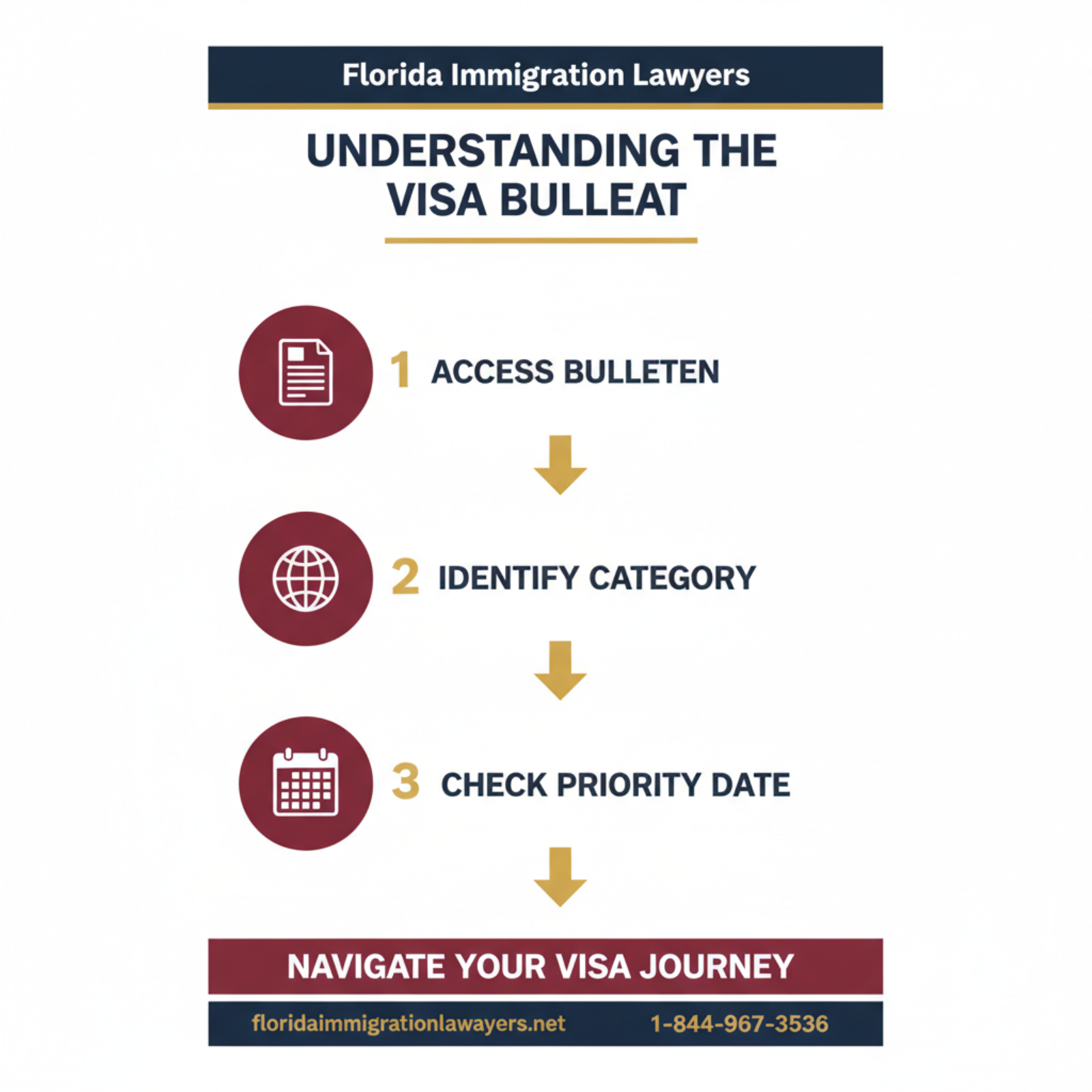
Understanding the Visa Bulletin October 2025 is only the first step. The real challenge lies in knowing how to act on the information it provides. Here is a step-by-step guide to help you navigate the process:
-
Step 1: Locate the Latest Visa Bulletin. Always refer to the official U.S. Department of State website (travel.state.gov) for the most current Visa Bulletin. Be sure to check the correct month, in this case, the Visa Bulletin October 2025.
-
Step 2: Identify Your Visa Preference Category. Your immigration petition (Form I-130 for family, Form I-140 for employment) will place you into a specific preference category. For family, these include F1 (unmarried adult sons/daughters of U.S. citizens), F2A (spouses and minor children of LPRs), F2B (unmarried adult sons/daughters of LPRs), F3 (married sons/daughters of U.S. citizens), and F4 (brothers/sisters of U.S. citizens). Employment categories include EB-1, EB-2, EB-3, EB-4, and EB-5.
Identifying Your Visa Preference Category
It is crucial to know your specific category. This information is typically found on your I-797 approval notice for your underlying petition. If you are unsure, reviewing your petition documents or consulting with an attorney can clarify this for you.
-
Step 3: Determine Your Priority Date. Your priority date is established when your petition (e.g., Form I-130 or Form I-140) was properly filed with USCIS. For employment-based petitions requiring a PERM labor certification, the priority date is the date the labor certification application was accepted for processing by the Department of Labor.
Understanding Your Priority Date
This date is your place in the queue. You can find your priority date on the I-797 approval notice issued by USCIS after your petition was approved. Keep this document safe, as it is key to tracking your eligibility.
-
Step 4: Compare Your Priority Date with the Visa Bulletin Dates. Look at the Visa Bulletin October 2025 for your specific preference category and country of chargeability. Compare your priority date with the "Final Action Dates" and "Dates for Filing Applications" charts. If your priority date is earlier than the date listed in the bulletin, your date is considered "current."
-
Step 5: Determine Which Chart USCIS Is Using. USCIS publishes a monthly update on its website indicating whether applicants should use the "Final Action Dates" or "Dates for Filing Applications" chart for filing an Adjustment of Status application (Form I-485) in the U.S. This is a critical distinction for those pursuing a green card from within Florida.
-
Step 6: Take Action if Your Date is Current. If your priority date is current under the appropriate chart (either Final Action or Dates for Filing), you may be eligible to proceed. This means either filing your Form I-485, Application to Register Permanent Residence or Adjust Status, if you are in the U.S., or preparing for your immigrant visa interview at a U.S. embassy or consulate abroad if you are outside the U.S. This is a crucial step for many Floridians.
This process can be intricate, and a single misstep can cause significant delays or even denials. Seeking guidance from an experienced immigration lawyer is highly recommended to ensure you correctly interpret the Visa Bulletin October 2025 and act accordingly.
Essential Document Checklist for Florida Immigration Applicants
Once your priority date becomes current according to the Visa Bulletin October 2025, preparing the necessary documentation is paramount. A comprehensive and accurate submission is key to a smooth process, whether you're filing an Adjustment of Status application in Florida or preparing for consular processing abroad. While specific documents vary by case, here's a general checklist of commonly required items:
- Birth Certificates: For all applicants and petitioners.
- Marriage Certificates: If applicable, for spouses.
- Divorce Decrees or Death Certificates: For any previous marriages.
- Passports: Valid passports for all applicants.
- Visa Pages and I-94 Records: Documentation of legal entry and status in the U.S.
- Affidavit of Support (Form I-864): From the petitioner and any joint sponsors, with supporting financial documents (tax returns, W-2s, employment letters).
- Medical Examination Report (Form I-693): Completed by a USCIS-approved civil surgeon. There are several approved civil surgeons conveniently located throughout Florida, including in the Orlando area.
- Police Certificates: From your country of nationality and any country you have lived in for certain periods.
- Court and Prison Records: If you have any criminal history, even minor infractions.
- Photographs: Passport-style photos for all applicants.
- Proof of Relationship: Such as photos, joint bank accounts, property deeds, birth certificates of children.
- Employment-Based Documents: For EB categories, this may include offer letters, educational degrees, professional licenses, and experience letters.
- USCIS Forms: Properly completed and signed forms, such as I-485, I-765 (work authorization), I-131 (travel document).
Ensuring every document is accurate, translated (if not in English), and properly submitted can prevent Requests for Evidence (RFEs) and delays. Florida Immigration Lawyers can help you compile a thorough and compliant application package.
Timeline and Processing Expectations for Immigrants in Florida
Understanding the Visa Bulletin October 2025 is one part of the equation; managing expectations regarding processing times is another. Even after your priority date becomes current, the actual time it takes for USCIS to process your application can vary significantly. These timelines are influenced by several factors, including the specific visa category, your country of chargeability, and the workload of the USCIS service center or field office handling your case.
USCIS provides estimated processing times on its website (uscis.gov/processing-times). You can check the average processing times for specific forms at various service centers and field offices, including those serving Florida residents in Orlando, Miami, and Tampa. These estimates are always subject to change and should be viewed as general guidelines rather than guarantees.
Factors Affecting Processing Times:
- Backlogs: High demand in certain visa categories or countries can lead to significant backlogs, even when a priority date is current.
- RFEs (Requests for Evidence): Incomplete applications or missing documents often result in RFEs, which can add months to your processing time.
- Interview Scheduling: After your application is filed, you may be called for an interview at a local USCIS field office. Scheduling availability can impact the overall timeline.
- Security Checks: All applicants undergo background and security checks, which can sometimes take an unpredictable amount of time.
For those in Florida, the processing experience can vary depending on which USCIS field office has jurisdiction over your residence. For example, applicants residing near Orlando might be interviewed at the Orlando Field Office, while those in South Florida would likely go to the Miami Field Office. Each office has its own workload and processing pace. Staying proactive and ensuring all documentation is perfect from the outset can help minimize delays.
While the Visa Bulletin October 2025 provides a snapshot of visa availability, the overall journey to a green card often involves patience. Our Florida immigration law firm is committed to keeping you informed and prepared every step of the way.
Cost Factors and Fee Breakdown for the Visa Application Process
Pursuing an immigrant visa or adjustment of status in Florida involves various costs beyond just the time and effort. It's essential to understand the potential financial commitments associated with the immigration process. These fees are subject to change by USCIS and the Department of State, so always refer to official sources for the most current amounts. We advise against listing specific amounts here, as they can quickly become outdated.
Key Cost Components:
- USCIS Filing Fees: These are fees for the various forms you will submit. Common forms include: I-130 (Petition for Alien Relative), I-140 (Immigrant Petition for Alien Worker), I-485 (Application to Register Permanent Residence or Adjust Status), I-765 (Application for Employment Authorization), and I-131 (Application for Travel Document). Each form has its own fee.
- Biometrics Fee: Required for most adjustment of status applicants for fingerprinting and background checks. This is typically included with the I-485 fee, but verify current policies.
- Medical Examination Fee: You must undergo a medical examination by a USCIS-approved civil surgeon. The fee for this examination is paid directly to the civil surgeon and varies by provider.
- Affidavit of Support Processing Fee: If your case involves consular processing, there may be a fee for processing the Affidavit of Support.
- Immigrant Visa Fee: For those undergoing consular processing abroad, there is a fee for the immigrant visa itself.
- Attorney Fees: Legal representation is a significant but worthwhile investment. An experienced immigration attorney can help ensure your application is accurate, complete, and filed correctly, potentially saving you time and money in the long run by avoiding errors and delays.
- Miscellaneous Costs: These can include translation services for foreign documents, postage, and travel expenses for interviews or biometrics appointments, especially if you live far from the USCIS field offices in Florida.
It is crucial to budget for these expenses carefully. While some fees may be waived under certain circumstances (such as low income), eligibility for fee waivers is strict. For precise and up-to-date fee information, always consult the USCIS website. Florida Immigration Lawyers can help you understand the full scope of costs involved in your specific case.
Do not navigate this complex process alone, especially with the intricate details of the Visa Bulletin October 2025. The stakes are too high to risk common pitfalls or misinterpretations. Contact Florida Immigration Lawyers today for a free consultation. Our experienced attorneys are ready to provide the personalized support you need to pursue your immigration goals in Florida.
Common Mistakes to Avoid in Your Immigration Application
Navigating the immigration process, especially in light of the Visa Bulletin October 2025, requires meticulous attention to detail. Even small errors can lead to significant delays, Requests for Evidence (RFEs), or even denial of your application. Here are some common mistakes Florida immigrants should strive to avoid:
-
Misinterpreting the Visa Bulletin: Incorrectly reading the "Final Action Dates" versus "Dates for Filing Applications" can lead to filing too early or too late. Filing when your priority date is not current will result in rejection. Always confirm which chart USCIS is using for adjustment of status.
-
Filing Incomplete Applications: Submitting forms with missing information, unsigned sections, or lacking required supporting documentation is a primary cause of RFEs and delays. Ensure every question is answered and all necessary evidence is attached.
-
Missing Deadlines: Strict deadlines apply to various stages of the immigration process, from responding to RFEs to attending interviews. Missing a deadline can jeopardize your application and may require refiling.
-
Failing to Update Your Address: If you move within Florida or to another state, you must notify USCIS of your new address within 10 days of moving. Failure to do so can result in missed notices, interviews, or even denial of your case. This is especially important for Floridians who might move for work or family.
-
Providing Inconsistent Information: Any discrepancies in your application forms or supporting documents compared to previous submissions or records can raise red flags. Always be truthful and consistent in all your immigration filings.
-
Not Disclosing All Relevant Information: Hiding or failing to disclose criminal history (even minor offenses), prior immigration violations, or other relevant personal information can lead to severe consequences, including accusations of misrepresentation and potential deportation. It's always best to be transparent.
-
Using Outdated Forms or Incorrect Fees: USCIS frequently updates its forms and fee schedules. Using an old version of a form or submitting an incorrect fee amount will lead to your application being rejected. Always download forms directly from the USCIS website.
-
Ignoring Legal Advice: Attempting to navigate complex legal issues without professional guidance, especially concerning the Visa Bulletin October 2025 or complex eligibility criteria, often leads to avoidable mistakes. An attorney provides crucial insights.
-
Improperly Translating Documents: Any foreign language documents must be accompanied by a full English translation, certified by a competent translator. An uncertified or inaccurate translation can cause delays.
-
Assuming Eligibility: Do not assume you are eligible for a specific visa or benefit simply because your priority date is current. Eligibility requirements are strict and must be met independently of visa availability. For example, some individuals may have inadmissibility issues.
Avoiding these common pitfalls can significantly improve your chances of a successful outcome. An experienced immigration attorney can help you meticulously prepare your application, minimizing the risk of errors and delays.
When to Call a Florida Immigration Lawyer
While some aspects of the immigration process might seem straightforward, the complexities, especially concerning the Visa Bulletin October 2025 and its application, often necessitate professional legal guidance. Knowing when to seek legal help can make all the difference in your case's success.
You should consider contacting Florida Immigration Lawyers if:
- Your Priority Date Becomes Current: When your date appears in the Visa Bulletin October 2025, it's time to act swiftly and correctly. An attorney ensures you file all necessary forms and documents accurately and on time, whether for Adjustment of Status in Orlando or consular processing abroad.
- You Have a Complex Case: If you have a criminal record, previous immigration violations, or issues related to unlawful presence, you face significant challenges. An attorney can assess your eligibility and help prepare waivers if needed.
- You Received a Request for Evidence (RFE) or Notice of Intent to Deny (NOID): These notices indicate that USCIS requires more information or intends to deny your application. Responding correctly and comprehensively is critical, and a lawyer can formulate a strong response.
- You Are Unsure Which Visa Category Applies to You: Understanding your correct preference category and how it impacts your priority date and eligibility can be confusing. Our attorneys can clarify this for you.
- You Need Help Interpreting the Visa Bulletin: The bulletin's charts and notes can be difficult to understand. A Florida immigration lawyer can explain what the Visa Bulletin October 2025 means for your specific situation and advise on the best course of action.
- You Are Concerned About Delays or Backlogs: If your case seems to be taking an unusually long time, or you are worried about the impact of backlogs, an attorney can help inquire about your case status and explore potential solutions.
- You Are Facing Deportation or Removal Proceedings: This is a serious situation where legal representation is absolutely vital. Our attorneys offer robust deportation defense services.
Florida Immigration Lawyers serves clients across the entire state, offering expert guidance on all immigration matters, from green cards and citizenship applications to asylum claims. We are committed to protecting your rights and helping you achieve your immigration goals.
About Florida Immigration Lawyers
Florida Immigration Lawyers is a leading law firm dedicated to providing exceptional legal representation and compassionate support to immigrants across Florida. With years of specialized experience, our team of dedicated attorneys understands the complexities of U.S. immigration law and its profound impact on individuals and families. We are committed to guiding our clients through every step of their immigration journey with integrity and expertise.
We offer a comprehensive range of immigration services, including family-based petitions, employment visas, adjustment of status, naturalization, deportation defense, and asylum. Our approach is client-centered, ensuring that you receive personalized attention and strategic advice tailored to your unique circumstances. We pride ourselves on clear communication and proactive advocacy, striving for the best possible outcomes for those we serve.
Choosing Florida Immigration Lawyers means partnering with a firm that genuinely cares about your future. We are available 24/7 to address your concerns and offer free consultations to discuss your case. Serving all of Florida, including Orlando, Miami, Tampa, and beyond, we are your trusted advocates in the intricate world of immigration law. Call us today at 1-844-967-3536 or visit our website at https://www.floridaimmigrationlawyers.net to learn how we can assist you.
Sources and References
- U.S. Department of State (DOS) - Visa Bulletin
- U.S. Citizenship and Immigration Services (USCIS)
- USCIS Processing Times
- 8 U.S.C. Chapter 12 - Immigration and Nationality Act (INA)
- 8 CFR (Code of Federal Regulations)
This article provides general legal information and is not intended as legal advice. Every case is unique, and outcomes depend on specific facts and circumstances. Contact an attorney for advice about your particular situation.
The Visa Bulletin October 2025 is a critical guidepost in your immigration journey. Do not leave its interpretation and your application process to chance. Ensure your future is in expert hands.
Contact Florida Immigration Lawyers today for a free, confidential consultation. Call us at 1-844-967-3536. Se Habla Español - Estamos aquí para ayudarle.
Florida Immigration Lawyers
Legal Team
Our experienced attorneys at Florida Immigration Lawyers have been serving clients across Florida for over 20 years. We specialize in immigration, personal injury, criminal defense, workers compensation, and family law.