Refugee Resettlement Florida: Your 2026 Guide to Status & Support
For those seeking a new beginning as a refugee in Florida, understanding the path to resettlement and available support is crucial. This comprehensive guide details the refugee resettlement process in Florida, outlining eligibility, required steps, and the vital support systems in place for 2026. We cover everything from initial arrival to long-term integration, offering insights into what you can expect. Learn about essential documents, financial aid like Refugee Cash Assistance (RCA), and how to avoid common mistakes. Florida Immigration Lawyers provides expert guidance for your journey. Call us for a free consultation to navigate your refugee status and resettlement successfully.
Refugee resettlement in Florida involves a coordinated effort to help individuals granted refugee status rebuild their lives. This process includes initial reception, housing, employment assistance, and access to crucial social services. Refugees typically receive support through government programs and local resettlement agencies, aiming for self-sufficiency within a few years of arrival.
- Refugee status is distinct from asylum, though both offer protection.
- Resettlement support is available through federal and state programs.
- Florida has several agencies assisting refugees, particularly in Tampa.
- The goal is long-term integration and economic independence.
- Legal guidance is essential throughout the entire process.
Arriving in a new country, especially under difficult circumstances, presents immense challenges. For those seeking a new beginning as a refugee in Florida, understanding the path to resettlement and available support is crucial. You are not alone in this journey, and many resources exist to help you establish a stable life.
This comprehensive guide details the refugee resettlement process in Florida, outlining eligibility, required steps, and the vital support systems in place. We will cover everything from initial arrival to long-term integration, offering insights into what you can expect in 2026. Our aim is to provide clarity and empower you with the knowledge needed for a successful transition.
For personalized guidance and expert legal assistance, do not hesitate to reach out. Call Florida Immigration Lawyers at 1-844-967-3536 for a free consultation today. Our team is dedicated to supporting your journey.
Understanding Refugee Status and Resettlement in Florida
Refugee status is a specific legal protection granted to individuals who have fled their home country due to a well-founded fear of persecution. This persecution can be based on race, religion, nationality, political opinion, or membership in a particular social group. The United Nations High Commissioner for Refugees (UNHCR) often plays a role in identifying refugees globally, but the United States determines who is granted refugee status under its own laws.
The U.S. Refugee Admissions Program (USRAP) is the formal process through which the United States accepts refugees for resettlement. This program is managed by the U.S. Department of State in conjunction with various federal agencies, including the U.S. Citizenship and Immigration Services (USCIS). Most refugees are identified and vetted overseas before they ever set foot in the U.S. You can learn more about the USRAP process on the U.S. Department of State website.
Once granted refugee status, individuals are eligible for resettlement in the United States. Florida is one of the states that receives a significant number of refugees each year, offering a diverse community and various support networks. Cities like Tampa, Orlando, and Miami are common destinations for new arrivals due to existing community resources and job opportunities.
It is important to understand that refugee status is distinct from asylum. While both provide protection, asylum is sought by individuals who are already present in the U.S. or at a port of entry. Refugees, conversely, are typically processed and approved for admission from outside the United States. Our firm offers comprehensive asylum services if you are already in the U.S. and seeking protection.
The legal framework for refugee status is primarily found within the Immigration and Nationality Act (INA). Specifically, INA Section 101(a)(42)(A) (8 U.S.C. § 1101(a)(42)(A)) defines a refugee as a person who is outside any country of such person's nationality or, in the case of a person having no nationality, is outside any country in which such person last habitually resided, and who is unable or unwilling to return to, and is unable or unwilling to avail himself or herself of the protection of, that country because of persecution or a well-founded fear of persecution.
The Refugee Resettlement Process in Florida: A Step-by-Step Guide
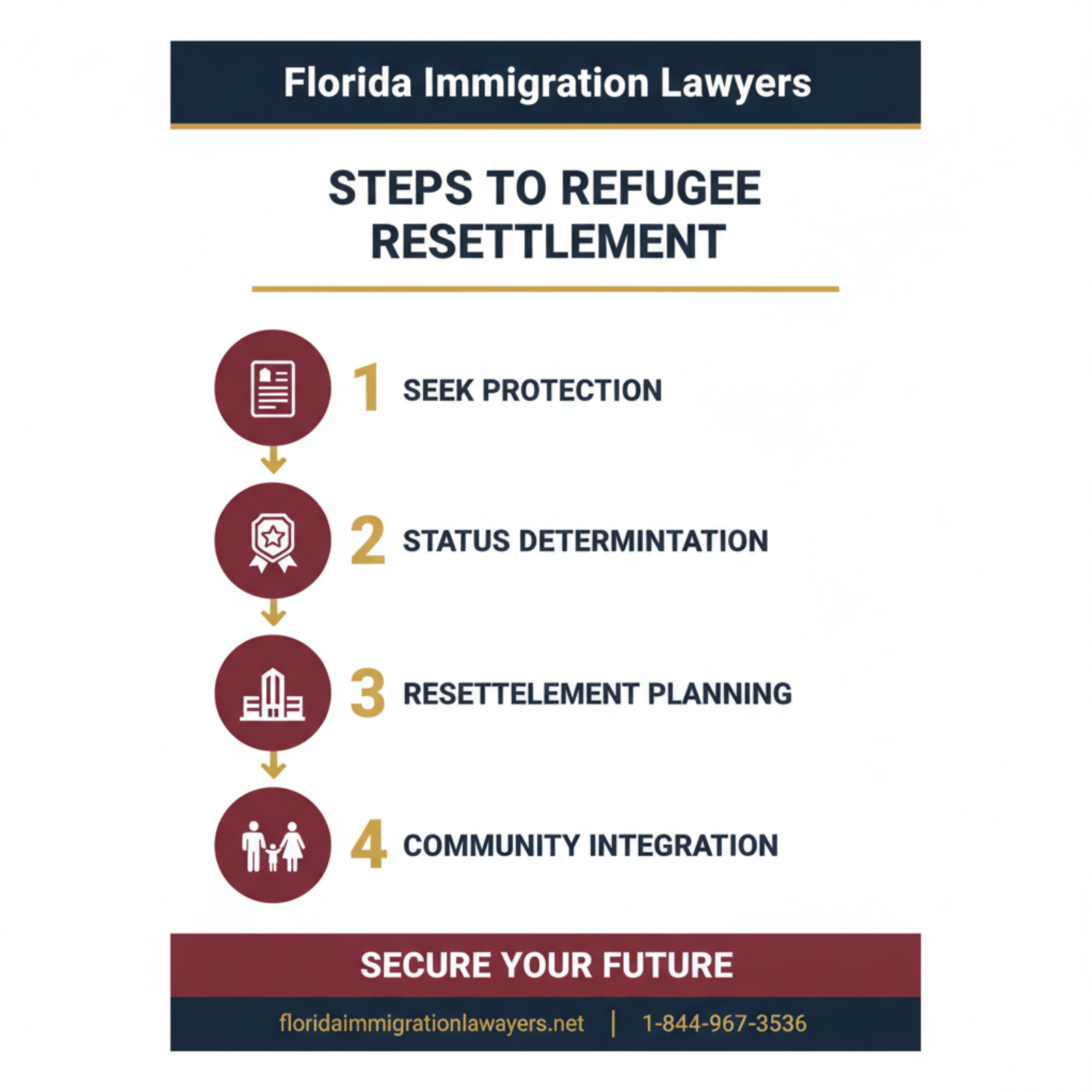
The journey of refugee resettlement in Florida is a multi-stage process, designed to provide comprehensive support from arrival to self-sufficiency. This process involves collaboration between federal agencies, state programs, and local non-profit organizations. Understanding each step can help you prepare for your new life.
-
Pre-Arrival and Initial Vetting: Before you even arrive in Florida, you will have undergone extensive interviews and security screenings overseas. This rigorous process is conducted by various U.S. government agencies, including USCIS, to determine eligibility for refugee status. Your case is reviewed to ensure you meet the legal definition of a refugee.
-
Assignment to a Resettlement Agency: Once approved for admission to the U.S., you will be assigned to one of nine national voluntary agencies (VOLAGs) that partner with the U.S. government. These agencies have local affiliates in states like Florida, particularly in areas with significant refugee populations such as Tampa. This assignment dictates which local agency will provide your initial support.
-
Arrival in Florida: Upon your arrival at a Florida airport, representatives from your assigned local resettlement agency will typically meet you. They will assist with transportation to your initial housing, which is often pre-arranged. This first few days are critical for orientation and immediate needs.
-
Initial Resettlement Services (First 30-90 Days): During this crucial period, your resettlement agency provides a wide range of services. This includes securing permanent housing, furnishing your home, enrolling children in school, and assisting with applications for social security cards and employment authorization documents (EADs). You will also receive cultural orientation to help you adapt to life in the U.S.
-
Accessing Public Benefits and Medical Care: Your agency will help you apply for essential public benefits, such as Refugee Cash Assistance (RCA) and Medicaid, if eligible. They will also facilitate initial medical screenings and help you understand the U.S. healthcare system. Timely access to these resources is vital for your well-being.
-
Employment and Self-Sufficiency (First 6-12 Months): A primary goal of resettlement is economic self-sufficiency. Agencies provide employment services, including job counseling, resume building, interview preparation, and job placement assistance. Learning English is often a key component, with referrals to English as a Second Language (ESL) classes. Many refugees in Florida quickly find work in various sectors.
-
Long-Term Integration and Follow-Up (Up to 5 Years): While intensive services typically last for a few months, support from the Office of Refugee Resettlement (ORR) and its partners can extend up to five years. This longer-term support focuses on deeper integration, including civic engagement, further education, and community building. After five years, refugees are generally expected to be fully self-sufficient and integrated into American society. They may then pursue options like a Green Card and eventually U.S. citizenship. Our firm assists clients with both family immigration and citizenship applications.
Essential Documents for Refugee Resettlement in Florida
Upon arrival and throughout your resettlement process in Florida, you will need to manage several important documents. Keeping these organized and accessible is critical for accessing services and establishing your new life. Your resettlement agency will assist you with these applications, but knowing what to expect is beneficial.
- Form I-94, Arrival/Departure Record: This document serves as proof of your lawful admission to the U.S. as a refugee. It is crucial for verifying your immigration status and eligibility for benefits. You should print this from the CBP website.
- Social Security Card: Essential for employment and accessing most government benefits. Your agency will help you apply for one shortly after arrival.
- Employment Authorization Document (EAD), Form I-765: While refugees are generally work-authorized upon arrival, an EAD is often needed by employers for verification. This document confirms your legal ability to work in the U.S.
- Green Card (Form I-485, Application to Register Permanent Residence or Adjust Status): Refugees are eligible to apply for lawful permanent residence (a Green Card) one year after their admission to the U.S. This is a critical step towards long-term stability and eventual citizenship.
- Medical Records: Any existing medical history, vaccination records, or health screening results from your home country or transit countries can be helpful for continuity of care.
- Birth Certificates and Marriage Certificates: These vital records are necessary for establishing identity, family relationships, and for various applications, including the Green Card.
- School Records/Diplomas: If you or your children have educational documents, these can be useful for school enrollment or for assessing professional qualifications for employment.
- Driver's License or State ID: Once you are settled, obtaining a Florida driver's license or state identification card is important for personal identification and mobility.
It is vital to keep all original documents in a safe place and carry copies when needed. Losing these documents can cause significant delays in accessing services and future immigration processes. Always consult with your resettlement agency or an immigration attorney regarding document requirements and application procedures.
Refugee Resettlement Timeline and Processing Expectations
The timeline for refugee resettlement can vary significantly, starting from the moment you are identified as a refugee to achieving full self-sufficiency. Understanding these phases can help manage expectations.
The initial process, from overseas interviews to arrival in the U.S., can often take several months, or even years, depending on various factors including security checks and the volume of cases. Once you arrive in Florida, the intensive resettlement services typically last between 30 to 90 days. During this period, your local resettlement agency focuses on immediate needs like housing, food, and initial orientation.
After the initial period, support transitions to longer-term integration. The Office of Refugee Resettlement (ORR) funds programs that can provide services for up to five years post-arrival. These services often include advanced English language training, vocational training, and ongoing employment assistance. The goal is to ensure you become economically self-sufficient and fully integrated into the community.
A significant milestone in the refugee journey is applying for a Green Card (lawful permanent residence). Refugees are eligible to apply for this one year after their admission to the U.S. The processing time for a Green Card application (Form I-485) can vary, typically taking several months to over a year. After holding a Green Card for five years, you may then be eligible to apply for U.S. citizenship.
Factors influencing the overall timeline include the efficiency of your assigned resettlement agency, your proactive engagement with services, and the current processing times at USCIS. While the path to full integration can take several years, the structured support system in Florida is designed to guide you every step of the way.
Cost Factors and Financial Support for Refugees in Florida
The financial aspects of starting a new life can be daunting, but refugees in Florida have access to various forms of financial support and assistance programs. These programs are designed to help you become self-sufficient without undue burden.
Upon arrival, your resettlement agency receives a per capita grant from the U.S. government to cover initial costs. This funding is used for immediate needs such as rent for temporary housing, basic furnishings, food, and transportation. This initial support is critical for stabilizing your first few weeks.
Beyond initial aid, the Office of Refugee Resettlement (ORR) oversees several programs aimed at longer-term financial stability. These include:
- Refugee Cash Assistance (RCA): Administered by the Florida Department of Children and Families (DCF), RCA provides temporary financial assistance to eligible refugees who are not eligible for other federal cash assistance programs like TANF (Temporary Assistance for Needy Families). The amount and duration of RCA can vary, but it is typically available for up to 8 months after arrival. Your resettlement agency will help you apply for these benefits.
- Refugee Medical Assistance (RMA): Also managed by DCF, RMA provides medical coverage for eligible refugees who do not qualify for Medicaid. This assistance is also typically available for up to 8 months.
- Employment Services: ORR-funded programs offer job counseling, vocational training, and job placement assistance. The goal is to help you secure employment quickly, allowing you to become financially independent. Many refugees find their first jobs in sectors like hospitality, manufacturing, or agriculture in Florida.
- English Language Training: Free or low-cost ESL classes are often available through resettlement agencies or community colleges, which are crucial for enhancing employment prospects.
- Micro-enterprise Development: Some programs offer support for refugees interested in starting their own businesses, providing training and small loans.
It is important to note that specific filing fees for immigration applications, such as for a Green Card, are generally not covered by these initial resettlement grants. However, fee waivers may be available for eligible individuals based on income. Consulting with an immigration attorney can help you understand your options for fee waivers and other financial considerations. For more information on employment authorization, you can visit the U.S. Department of Labor website.
Do not navigate this process alone. Contact Florida Immigration Lawyers today. We offer expert guidance to ensure you understand all available support and successfully manage your legal and financial journey.
Common Mistakes to Avoid During Refugee Resettlement
Navigating the refugee resettlement process in Florida can be complex. Avoiding common pitfalls is essential for a smooth transition and successful integration. Here are some mistakes to be aware of:
-
Failing to Communicate with Your Resettlement Agency: Your assigned agency is your primary resource. Not keeping them informed of changes in contact information, family status, or challenges you face can lead to missed opportunities for support. This can delay access to critical services like housing or employment assistance.
-
Missing Appointments or Deadlines: Immigration processes and benefit applications have strict timelines. Missing appointments for interviews, medical screenings, or failing to submit documents by deadlines can result in delays, denial of benefits, or even jeopardizing your immigration status. Always prioritize scheduled commitments.
-
Providing Inaccurate or Inconsistent Information: All information provided to government agencies or resettlement organizations must be truthful and consistent. Any discrepancies, whether intentional or accidental, can raise red flags, lead to investigations, and potentially result in serious legal consequences, including denial of status or even deportation.
-
Not Seeking Legal Advice When Needed: While resettlement agencies provide support, they are not legal counsel. Complex legal issues, such as family reunification, potential criminal charges, or issues with Green Card applications, require expert legal advice. Relying solely on non-legal advice for legal matters can lead to irreversible mistakes.
-
Neglecting English Language Learning: While not mandatory, proficiency in English significantly enhances employment prospects, social integration, and overall independence. Neglecting ESL classes can limit your opportunities and make daily life more challenging in Florida.
-
Ignoring Cultural Orientation: Understanding American customs, laws, and social norms is vital for successful integration. Disregarding cultural orientation provided by agencies can lead to misunderstandings, social isolation, and difficulties adapting to your new environment.
-
Delaying Green Card Application: Refugees are eligible to apply for a Green Card one year after admission. Delaying this application without good reason can prolong your temporary status and push back your eligibility for citizenship. Proactively applying ensures your path to permanent residency.
-
Falling Victim to Scams: Unfortunately, immigrants can be targets for scams related to legal services or immigration benefits. Be wary of individuals or organizations promising guaranteed results or charging exorbitant fees for services that are free or low-cost. Always verify credentials and seek legitimate help.
-
Traveling Internationally Before Obtaining a Green Card: While you have refugee status, international travel can be complicated and risky. Leaving the U.S. without proper documentation (a Refugee Travel Document) can be considered abandonment of your refugee status. Always consult with an attorney before planning any international travel.
-
Not Keeping Copies of All Documents: Always make and keep copies of every document you submit or receive. This includes applications, receipts, notices, and personal identification. Having copies can save immense time and stress if originals are lost or requested again.
When to Call a Lawyer for Refugee Resettlement in Florida
While resettlement agencies offer invaluable support, there are specific situations where the expertise of an immigration lawyer is indispensable. Florida Immigration Lawyers are here to provide the specialized legal guidance you need.
You should consider contacting an attorney if you encounter any of the following scenarios:
- Issues with Your Refugee Status: If you receive a notice questioning your refugee status, face a Notice to Appear in immigration court, or believe your status is at risk, immediate legal intervention is critical. Our firm specializes in deportation defense and can protect your rights.
- Green Card Application Challenges: If your Form I-485 application for lawful permanent residence is denied, receives a Request for Evidence (RFE) that you do not understand, or if you have a criminal record that could affect your eligibility, an attorney can help navigate these complex issues.
- Family Reunification: If you wish to petition for family members to join you in the U.S. through a Form I-730 Refugee/Asylee Relative Petition, an attorney can ensure the application is correctly prepared and filed, maximizing the chances of success.
- Changes in Circumstances: Significant life events, such as marriage, divorce, or the birth of a child, can impact your immigration status and applications. An attorney can advise on how to properly update your records and avoid future complications.
- Criminal History Concerns: Any past arrests or convictions, even minor ones, can have severe immigration consequences. Before interacting with immigration authorities, consult with a lawyer to understand the potential impact on your status.
- Difficulty Accessing Benefits: If you are struggling to access essential benefits like RCA or RMA, or if your applications are being unfairly denied, a lawyer can advocate on your behalf and ensure your rights are protected.
- Long Delays in Processing: Unexplained or excessively long delays in your immigration applications can be frustrating. An attorney can inquire with USCIS or other agencies on your behalf and explore legal avenues to expedite your case.
Florida Immigration Lawyers are committed to serving the refugee community across Florida, including Tampa. We understand the unique challenges you face and are ready to provide compassionate, effective legal representation. Do not wait until a problem escalates; early legal advice can prevent major issues down the line. We are here to help you secure your future.
About Florida Immigration Lawyers
Florida Immigration Lawyers is a leading law firm dedicated to providing exceptional legal services to immigrants throughout Florida. Our team of experienced attorneys understands the complexities and sensitivities of immigration law, offering compassionate and effective representation.
We specialize in a wide range of immigration matters, including refugee and asylum cases, family-based petitions, deportation defense, business immigration, and naturalization. Our firm is committed to protecting your rights and helping you achieve your American dream, whether you are in Tampa, Orlando, Miami, or any other part of the Sunshine State.
Choosing Florida Immigration Lawyers means partnering with a team that offers:
- Expertise: Our attorneys possess in-depth knowledge of U.S. immigration laws and policies.
- Compassion: We approach every case with empathy, understanding the personal stakes involved.
- Accessibility: We are available 24/7 to address your urgent needs and provide peace of mind.
- Bilingual Services: Our team is fluent in English and Spanish, ensuring clear communication.
- Free Consultations: We offer a complimentary initial consultation to discuss your case and outline your options.
Your journey is our priority. Let Florida Immigration Lawyers be your trusted guide through the U.S. immigration system. Visit our website at https://www.floridaimmigrationlawyers.net or call us directly at 1-844-967-3536 to schedule your free consultation today.
Sources and References
- U.S. Citizenship and Immigration Services (USCIS) - Refugees
- U.S. Department of State - U.S. Refugee Admissions Program (USRAP)
- Executive Office for Immigration Review (EOIR) - Immigration Law and Regulations
- U.S. Department of Labor (DOL) - Foreign Labor Certification
- Administration for Children and Families (ACF) - Office of Refugee Resettlement (ORR)
- U.S. Customs and Border Protection (CBP) - Official I-94 Website
- 8 U.S.C. Chapter 12 - Immigration and Nationality Act (INA)
- 8 U.S.C. § 1101(a)(42)(A) - Definition of Refugee
- 8 CFR Part 207 - Refugee Status
- USCIS Policy Manual, Volume 12, Part E - Refugees
This article provides general legal information and is not intended as legal advice. Every case is unique, and outcomes depend on specific facts and circumstances. Contact an attorney for advice about your particular situation.
Your journey to a new life in Florida is important, and we are here to support you every step of the way. Do not face the complexities of refugee resettlement alone. Contact Florida Immigration Lawyers today for a free consultation at 1-844-967-3536. Se Habla Español - Estamos aquí para ayudarle.
Florida Immigration Lawyers
Legal Team
Our experienced attorneys at Florida Immigration Lawyers have been serving clients across Florida for over 20 years. We specialize in immigration, personal injury, criminal defense, workers compensation, and family law.