Visa Bulletin October 2025 Florida: Your Essential Guide
The Visa Bulletin October 2025 is a critical guide for immigrants in Florida, detailing the availability of green card numbers. This article provides a comprehensive breakdown of the bulletin's key sections, including Final Action Dates and Dates for Filing. Learn how to interpret your priority date, understand processing expectations, and identify essential documents for your application. We cover common mistakes to avoid and highlight when to seek expert legal guidance. Florida Immigration Lawyers offers free consultations to help you navigate this complex process, ensuring your application is accurate and timely. Stay informed and prepare effectively for your immigrant visa journey in Florida.
The Visa Bulletin October 2025 provides critical dates for immigrant visa availability, directly impacting green card applications across Florida. It distinguishes between "Final Action Dates" and "Dates for Filing Applications" for various preference categories and countries. Understanding these dates is paramount for knowing when you can advance your immigration journey.
- The Visa Bulletin updates monthly, offering new insights.
- It dictates eligibility for filing green card applications.
- Dates vary significantly by country and visa preference category.
- Always consult a qualified immigration lawyer for personalized guidance.
Are you an aspiring immigrant in Florida, eagerly anticipating your opportunity for a green card? The U.S. immigration system can often feel like a labyrinth, with constantly shifting dates and complex regulations. One of the most critical tools for understanding your path forward is the monthly Visa Bulletin.
This comprehensive guide will break down the Visa Bulletin October 2025, explaining its significance, how it impacts your application, and what steps you need to take. We understand the stakes are high, and we are here to help you navigate this vital information. Call Florida Immigration Lawyers at 1-844-967-3536 for a free consultation and let us clarify your options.
Understanding the Visa Bulletin October 2025 and Its Importance for Florida Residents
The U.S. Department of State (DOS) publishes the Visa Bulletin each month. It serves as an essential roadmap for individuals seeking immigrant visas or adjustment of status to permanent residency. For Florida residents, especially those in bustling immigration hubs like Fort Lauderdale, Miami, and Orlando, keeping a close eye on these updates is crucial.
The primary purpose of the Visa Bulletin is to indicate when immigrant visas become available to prospective immigrants based on their "priority date." This system ensures compliance with annual numerical limitations set by Congress for various visa categories and countries. Without the Visa Bulletin, the process would be far more unpredictable.
There are two key charts within the Visa Bulletin: "Final Action Dates" (FAD) and "Dates for Filing Applications" (DFA). The Final Action Dates chart indicates when an immigrant visa is officially available, meaning USCIS can make a final decision on your green card application or the National Visa Center (NVC) can schedule your interview. The Dates for Filing Applications chart, on the other hand, allows certain applicants to file their adjustment of status application earlier, even if a visa is not yet immediately available. USCIS determines monthly which chart applicants residing in the U.S. must use for filing Form I-485.
Immigrant visas are categorized into family-sponsored and employment-based preferences. Family-sponsored categories include F1 (unmarried adult sons/daughters of U.S. citizens), F2A (spouses and minor children of LPRs), F2B (unmarried adult sons/daughters of LPRs), F3 (married sons/daughters of U.S. citizens), and F4 (brothers/sisters of U.S. citizens). Employment-based categories range from EB-1 (priority workers) to EB-5 (immigrant investors). Each category, along with an applicant's country of birth, has specific numerical limitations, leading to varying wait times.
For individuals in Florida, these dates directly impact their ability to move forward with their immigration journey. Whether you are in Fort Lauderdale, Tampa, or Jacksonville, understanding where your priority date falls in the **Visa Bulletin October 2025** can significantly influence your planning and strategy. It is particularly important for applicants from high-demand countries such as India, China, Mexico, and the Philippines, who often face longer backlogs.
Navigating the Visa Bulletin: A Step-by-Step Guide for Immigrant Visa Applicants
Understanding the Visa Bulletin October 2025 can seem daunting at first glance. However, by following a clear, step-by-step approach, you can effectively interpret the information and determine your eligibility for filing your green card application. This guide will walk you through the process, helping you understand your specific "green card dates."
-
Identify Your Visa Category: Your first step is to know which immigrant visa category applies to you. This is determined by the type of petition filed on your behalf. For example, if your U.S. citizen parent filed for you, you might be in an F1, F3, or F4 category. If your employer sponsored you, you would fall into one of the EB categories. This information is typically found on your I-797 approval notice.
-
Locate Your Priority Date: Your priority date is the date your immigrant petition (Form I-130 for family-sponsored or Form I-140 for employment-based) was properly filed with USCIS. This date is crucial because it marks your place in the queue for an immigrant visa. If you do not know your priority date, it will be listed on your petition approval notice.
-
Check the Visa Bulletin October 2025: Access the latest Visa Bulletin on the U.S. Department of State’s Bureau of Consular Affairs website (travel.state.gov). Look for the section that corresponds to your visa category (family-sponsored or employment-based) and your country of birth.
-
Understand Final Action Dates (FAD): Review the "Final Action Dates for Family-Sponsored Preference Cases" or "Final Action Dates for Employment-Based Preference Cases" chart. If your priority date is earlier than the date listed for your category and country, a visa is available to you. This means USCIS can finalize your adjustment of status application, or the NVC can schedule your immigrant visa interview.
-
Understand Dates for Filing Applications (DFA): Next, examine the "Dates for Filing Family-Sponsored Visa Applications" or "Dates for Filing Employment-Based Visa Applications" chart. If your priority date is earlier than the date listed for your category and country, you may be eligible to file your Form I-485, Application to Register Permanent Residence or Adjust Status, with USCIS. This allows you to submit your application earlier in the process.
-
Determine USCIS Filing Chart: Each month, USCIS announces on its website (uscis.gov) which chart from the Visa Bulletin (Final Action Dates or Dates for Filing) should be used by applicants in the U.S. for filing adjustment of status applications. It is vital to check the USCIS website for this announcement before filing.
-
Consult with an Attorney: The nuances of the Visa Bulletin can be complex, especially with specific country limitations and preference categories. Seeking legal advice from an experienced immigration attorney at Florida Immigration Lawyers is highly recommended to confirm your eligibility, understand potential next steps, and ensure a smooth application process.
How Priority Dates Affect Your Application in Fort Lauderdale
Your priority date is the bedrock of your immigrant visa application. It establishes your place in line, and its movement relative to the dates published in the **Visa Bulletin October 2025** dictates your progress. For many individuals in Fort Lauderdale and throughout Florida, understanding the movement of these dates is essential for long-term planning.
Backlogs can significantly delay processing, particularly for certain high-demand categories or countries. If a category is "oversubscribed," meaning more applicants exist than available visas, the priority dates will move slowly, or even retrogress. This means the date moves backward, requiring applicants to wait longer before they can proceed. This situation underscores the importance of a meticulously prepared application from the outset.
Key Sections of the October 2025 Visa Bulletin
The Visa Bulletin is divided into distinct sections for clarity. You will find separate charts for family-sponsored and employment-based preferences. Within these charts, dates are listed by country, often grouping all countries except those with historically high demand (e.g., China, India, Mexico, Philippines).
You will also encounter specific notations: "C" means "Current," indicating that visas are immediately available for all qualified applicants in that category and country. A specific date means that only applicants with a priority date earlier than the listed date can proceed. "U" means "Unauthorized," signifying that no visas are available. The Diversity Visa (DV) program also has its own section, typically listing cut-off numbers for the current fiscal year.
Essential Documents for Your Immigrant Visa Application in Florida
A successful immigrant visa application, whether through adjustment of status or consular processing, hinges on submitting a complete and accurate package of documents. Missing or incorrect documentation is a common cause of delays and Requests for Evidence (RFEs), impacting your "USCIS processing times." For applicants in Florida, meticulous preparation is key.
While the exact list can vary based on your specific visa category and individual circumstances, here is a general checklist of documents typically required when your priority date becomes current according to the Visa Bulletin October 2025:
- Form I-485, Application to Register Permanent Residence or Adjust Status: The primary application form for those seeking a green card while residing in the U.S.
- Form I-130, Petition for Alien Relative (if family-sponsored): A copy of the approved petition filed on your behalf.
- Form I-140, Immigrant Petition for Alien Worker (if employment-based): A copy of the approved petition filed by your employer.
- Birth Certificates: Certified copies for yourself and any derivative family members included in your application.
- Marriage Certificates (if applicable): Certified copies for yourself and your spouse, if applying as a family unit.
- Passport Photos: Recent, passport-style photographs meeting USCIS specifications.
- Medical Examination Report (Form I-693): Completed by a USCIS-approved civil surgeon, sealed in an envelope.
- Affidavit of Support (Form I-864): Filed by the petitioning relative or employer to demonstrate financial sponsorship.
- Police Clearances/Criminal Records: From any country where you have resided for a significant period since age 16.
- Evidence of Qualifying Relationship/Employment: Documents supporting the relationship (e.g., joint bank accounts, photos) or employment (e.g., job offer letter, educational degrees).
- Proof of Financial Support: Bank statements, tax returns, employment verification letters from your sponsor.
- Biographic Information: Forms such as G-325A, and if applicable, applications for employment authorization (I-765) and advance parole (I-131).
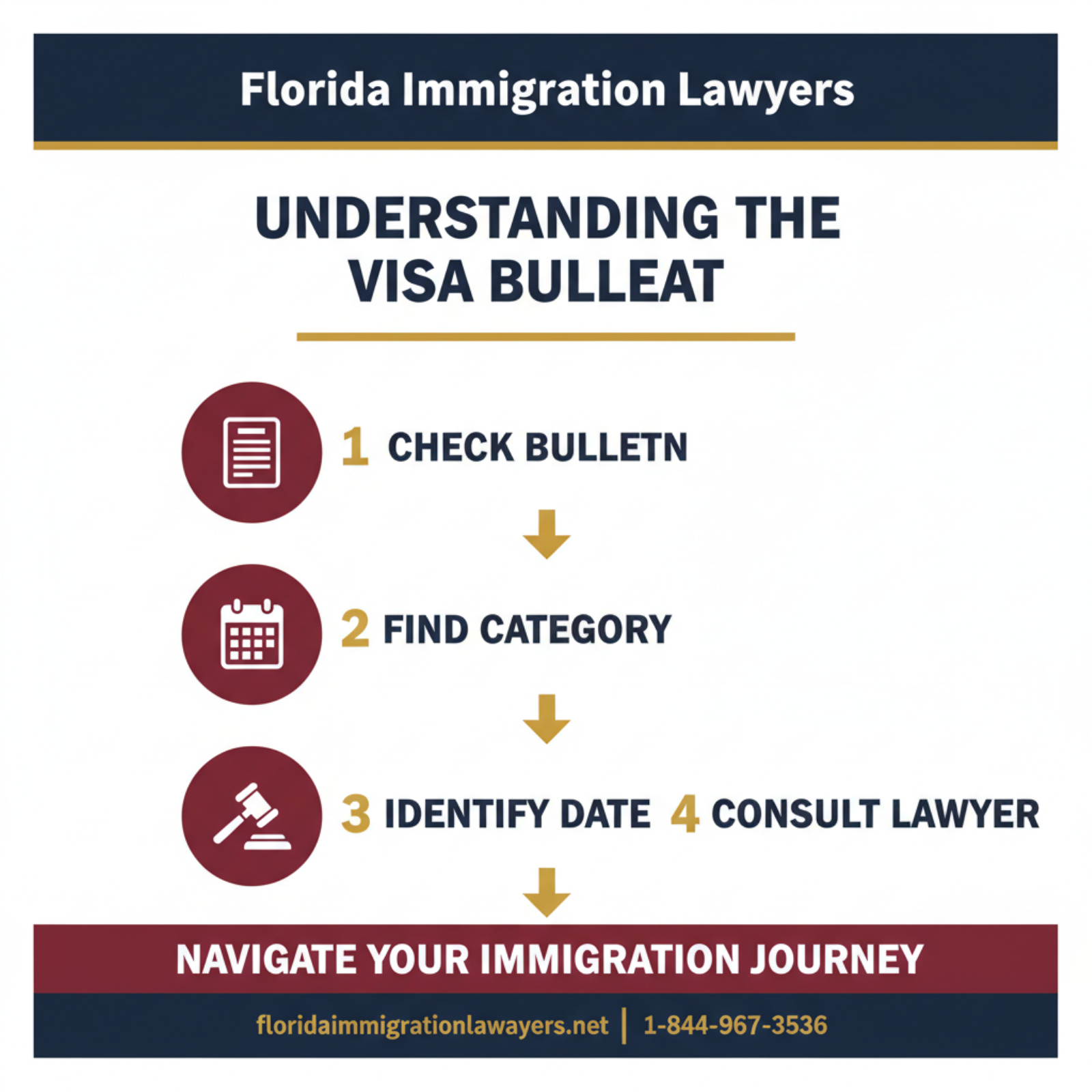
Gathering Supporting Evidence for Florida Immigrants
The importance of accuracy and completeness cannot be overstated. USCIS officers scrutinize every detail. Any discrepancies or missing documents can lead to significant delays, extending your wait time and potentially jeopardizing your application.
We strongly advise creating a detailed checklist and organizing all your documents meticulously. Ensure all foreign language documents are accompanied by certified English translations. Consulting with Florida Immigration Lawyers can help you compile a robust and complete application package, minimizing potential pitfalls.
Visa Bulletin October 2025: Processing Expectations and Timelines in Florida
Understanding the Visa Bulletin October 2025 is only one part of the equation; equally important are the processing expectations and timelines you can anticipate. Immigrant visa availability, once your priority date becomes current, initiates a new phase of your journey. However, the overall timeline is influenced by several factors, particularly for those residing in Florida.
General processing times for immigrant visas can vary widely. After your priority date is current and your application is filed, USCIS processing times depend on the specific service center or field office handling your case. For instance, residents of Fort Lauderdale, Miami, and Orlando will typically have their adjustment of status interviews at their local USCIS field offices. These offices, while following national guidelines, can have slightly different backlogs and processing speeds.
The impact of backlogs, as determined by the Visa Bulletin, is significant. High-demand countries, as mentioned previously, often experience "retrogression," where priority dates move backward, or "stagnation," where they remain unchanged for extended periods. This means that even if your priority date was current last month, it might not be this month, or you may face a longer wait than initially anticipated. This variability underscores the need for continuous monitoring of the Visa Bulletin and USCIS updates.
Both USCIS and the U.S. Department of State play distinct but interconnected roles. The DOS, through the Visa Bulletin, manages the availability of visa numbers. USCIS then processes adjustment of status applications for those already in the U.S., while the DOS handles consular processing for those applying from abroad. Their coordination is vital for a smooth process.
Applicants generally follow one of two pathways: Adjustment of Status (AOS) or Consular Processing. AOS is for individuals already present in the U.S. who meet eligibility requirements to adjust their status to permanent resident. Consular Processing is for those outside the U.S. who will attend an interview at a U.S. embassy or consulate in their home country. The Visa Bulletin applies to both pathways, dictating when an immigrant visa number is available. You can monitor specific USCIS processing times for various forms on the official USCIS website: uscis.gov/processing-times.
Cost Factors and Fee Breakdown for Immigrant Visa Applications
Pursuing an immigrant visa or green card involves various costs that applicants in Florida should be prepared for. These expenses can include government filing fees, medical examination fees, and legal fees. While specific amounts are subject to change and should always be verified on the official USCIS website, understanding the general breakdown is important for financial planning.
Government filing fees are mandatory for various forms submitted to USCIS. For instance, filing Form I-485, Application to Register Permanent Residence or Adjust Status, carries a significant fee. Additionally, if you are also applying for employment authorization (Form I-765) and advance parole (Form I-131) concurrently, these may have separate fees or be included with the I-485 filing fee, depending on current regulations. These fees are non-refundable, regardless of the outcome of your application.
A separate and often substantial cost is the medical examination fee. All applicants for adjustment of status or immigrant visas must undergo a medical examination by a USCIS-approved civil surgeon. The cost of this exam is paid directly to the doctor and can vary significantly by provider and location across Florida. This fee is distinct from any government filing fees.
Legal fees for an experienced immigration lawyer represent another significant investment. While it is possible to file applications independently, the complexity of immigration law, particularly when dealing with the **Visa Bulletin October 2025** and specific case nuances, often makes legal representation invaluable. A qualified attorney can help ensure accuracy, completeness, and strategic handling of your case, potentially saving you time and money in the long run by avoiding costly errors.
Other potential costs include fees for obtaining birth certificates, marriage certificates, police clearances, and other supporting documents. If any of your documents are not in English, you will also incur costs for certified translations. Travel expenses for interviews, biometrics appointments, or medical exams, especially if you live in a less populated part of Florida, should also be factored into your budget.
Investing in Legal Expertise for Your Florida Immigration Case
Hiring an immigration lawyer at Florida Immigration Lawyers is an investment in your future. Our attorneys can help you navigate the intricate requirements, interpret the **Visa Bulletin October 2025**, and prepare a robust application package. This expertise can be crucial in managing costs by preventing common mistakes that lead to delays, RFEs, or even denials, which often incur additional fees and stress. We aim to make the process as efficient and cost-effective as possible while upholding the highest standards of legal representation.
Do not navigate this complex process alone. The stakes are too high to leave anything to chance. Contact Florida Immigration Lawyers today for expert guidance tailored to your specific situation. We are here to provide the support and clarity you need.
Common Mistakes to Avoid with the Visa Bulletin and Your Application
Navigating the U.S. immigration system, especially when relying on the Visa Bulletin October 2025, is fraught with potential pitfalls. Even minor errors can lead to significant delays, costly RFEs, or even the denial of your application. Being aware of common mistakes can help you avoid them and ensure a smoother process.
-
Ignoring the Visa Bulletin: Many applicants fail to regularly check the Visa Bulletin, missing crucial updates on their priority date. This can cause you to miss the window when your visa number becomes available, leading to unnecessary delays.
-
Filing Too Early or Too Late: Filing your adjustment of status application when your priority date is not current, or conversely, delaying filing when it is, are both critical errors. Filing too early will result in rejection, while filing too late means losing valuable time in the queue.
-
Incorrectly Interpreting Dates: Confusing "Final Action Dates" with "Dates for Filing Applications" is a common mistake. You must always check which chart USCIS has announced for adjustment of status filings for that month. Misinterpreting these can lead to an improperly filed application.
-
Incomplete Documentation: Submitting an application without all required supporting documents is a sure way to receive a Request for Evidence (RFE). RFEs prolong the process and can sometimes indicate underlying issues with your case. Always double-check every item on the checklist.
-
Failing to Update Information: If your address, marital status, or employment changes while your application is pending, you must inform USCIS promptly. Failure to do so can result in missed communications, incorrect processing, or even abandonment of your application.
-
Misrepresenting Information: Providing false or misleading information on any immigration form or during an interview has severe consequences. This can lead to a finding of misrepresentation, making you inadmissible to the U.S. permanently.
-
Not Consulting an Attorney: Attempting to navigate complex immigration processes, such as the **Visa Bulletin October 2025** and adjustment of status, without legal counsel can be a costly mistake. An attorney can identify potential issues, strategize, and ensure compliance with all legal requirements.
-
Ignoring USCIS Communications: Failing to respond to RFEs, interview notices, or other correspondence from USCIS within the specified timeframe can lead to the denial of your application. Always open and act upon all mail from USCIS promptly.
-
Assuming "Current" Status for All Categories: While some categories may show as "C" (Current), this is not universal. Always verify the status for your specific country and visa preference category. Assuming your category is current without checking can lead to premature filing.
-
Not Understanding Country Limitations: Applicants from high-volume countries often face specific, longer backlogs. Not understanding how these limitations affect your particular case can lead to unrealistic expectations and frustration. Always check your country-specific dates.
When to Call a Lawyer for Your Visa Bulletin October 2025 Questions
While this guide provides general information, the complexities of immigration law mean that individual cases often require specialized attention. Knowing when to seek professional legal help can make a critical difference in the success of your application. Florida Immigration Lawyers are here to assist you with any aspect of the Visa Bulletin October 2025 and your broader immigration journey.
You should strongly consider contacting an attorney if you encounter any of the following scenarios:
- Complex Priority Date Issues: If you have multiple petitions, a lost priority date, or are unsure how to calculate or track yours, an attorney can provide clarity.
- Previous Immigration Violations: Any prior overstays, unlawful entries, or other immigration infractions can complicate your case. A lawyer can assess the impact and advise on potential waivers or remedies.
- Complex Family Structures: Cases involving stepchildren, adopted children, or complex family relationships require careful documentation and legal strategy, particularly for family immigration.
- Receiving an RFE or Notice of Intent to Deny: These notices from USCIS indicate a problem with your application. Responding correctly requires legal expertise to address the issues effectively.
- Unsure Which Filing Chart to Use: If the monthly USCIS announcement regarding the use of Final Action Dates or Dates for Filing is confusing, legal counsel can ensure you file correctly.
- Criminal History: Even minor arrests or convictions can have severe immigration consequences. An attorney can evaluate your record and advise on admissibility.
- Concerns About Eligibility or Documentation: If you have doubts about whether you meet all eligibility criteria or if you can gather all necessary documents, an attorney can provide a thorough assessment.
- Facing Removal Proceedings: If you are in deportation defense, seeking legal counsel is paramount.
Our attorneys at Florida Immigration Lawyers specialize in helping individuals and families throughout Florida navigate the intricate U.S. immigration system. We serve clients from Fort Lauderdale, Miami, Orlando, Tampa, and beyond, offering dedicated support for family-based visas, employment-based visas, adjustment of status, asylum, and citizenship applications. We understand the specific challenges faced by Florida's diverse immigrant population and are committed to providing empathetic, effective legal representation.
About Florida Immigration Lawyers
Florida Immigration Lawyers is a leading immigration law firm dedicated to serving individuals and families across the entire state of Florida. With offices strategically located to assist clients from Fort Lauderdale to Pensacola, we pride ourselves on providing exceptional legal counsel and compassionate support throughout your immigration journey.
Our firm specializes in a wide array of immigration services, including family-based immigration, employment-based visas, deportation defense, asylum applications, and naturalization. We understand that each case is unique, and we are committed to crafting personalized strategies that address your specific needs and goals. Our experienced attorneys possess a deep understanding of U.S. immigration law, including the nuances of the Visa Bulletin and USCIS policies.
Why choose Florida Immigration Lawyers? We are client-focused, tenacious, and dedicated to achieving the best possible outcomes for our clients. We offer free consultations, allowing you to discuss your case without financial commitment. Our team is available 24/7 to answer your urgent questions and provide peace of mind. We are proud to offer bilingual services, ensuring that language is never a barrier to obtaining quality legal representation. Our mission is to be your trusted advocate, guiding you through every step of the complex immigration process.
Contact us today to learn how we can assist you. Phone: 1-844-967-3536 | Website: https://www.floridaimmigrationlawyers.net
Sources and References
- U.S. Citizenship and Immigration Services (USCIS)
- U.S. Department of State - Bureau of Consular Affairs (Visa Bulletin)
- Executive Office for Immigration Review (EOIR)
- Immigration and Nationality Act (INA) – 8 U.S.C. Chapter 12: Sections 201-203 (8 U.S.C. §§ 1151-1153) pertaining to numerical limitations and preference categories for immigrants.
- Code of Federal Regulations (CFR) – 8 CFR Part 245: Adjustment of Status to Lawful Permanent Resident.
This article provides general legal information and is not intended as legal advice. Every case is unique, and outcomes depend on specific facts and circumstances. Contact an attorney for advice about your particular situation. Immigration laws are subject to frequent change.
Don't let the complexities of the Visa Bulletin October 2025 or the U.S. immigration system overwhelm you. Florida Immigration Lawyers is here to provide the dedicated legal support you need. Call us today at 1-844-967-3536 for your free, confidential consultation. Se Habla Español - Estamos aquí para ayudarle.
Frequently Asked Questions About the Visa Bulletin October 2025
Is USCIS moving faster in 2025?
USCIS processing times are subject to many factors, including caseload volume, staffing levels, and policy changes. While USCIS continually works to improve efficiency, there is no blanket guarantee that all cases will move faster in 2025. Processing speeds vary significantly by form type, service center, and field office. It is always best to check the official USCIS processing times tool on their website for the most current estimates specific to your application.
Is the Visa Bulletin changed in November 2025?
Yes, the Visa Bulletin is released monthly by the U.S. Department of State. This means that a new Visa Bulletin for November 2025 will be published, potentially showing different Final Action Dates and Dates for Filing Applications compared to the October 2025 bulletin. It is crucial for applicants to check the Visa Bulletin every month to stay informed about changes relevant to their priority date and visa category.
Is the U.S. suspending immigrant visas?
The U.S. government has, at various times, implemented temporary suspensions or restrictions on certain immigrant and nonimmigrant visas, often due to public health concerns or economic conditions. However, such suspensions are typically temporary and specific in scope, not a blanket halt on all immigrant visas. As of the publication date of this article, there is no general suspension of all immigrant visas. It is important to stay updated through official government sources like USCIS and the Department of State for any policy changes.
What is the October Visa Bulletin?
The October Visa Bulletin is the monthly publication by the U.S. Department of State that summarizes the availability of immigrant visa numbers for a given month. For October, it typically marks the beginning of the new fiscal year (which starts on October 1st). It provides "Final Action Dates" and "Dates for Filing Applications" for family-sponsored and employment-based preference categories, broken down by country. These dates determine when applicants can either have their green card applications finalized or, in some cases, file their applications.
Florida Immigration Lawyers
Legal Team
Our experienced attorneys at Florida Immigration Lawyers have been serving clients across Florida for over 20 years. We specialize in immigration, personal injury, criminal defense, workers compensation, and family law.