TN Visa for USMCA Professionals in Florida: Your 2026 Guide
Discover the essential guide to obtaining a TN visa for Canadian and Mexican professionals seeking opportunities in Florida in 2026. This comprehensive article from Florida Immigration Lawyers details eligibility, required documents, step-by-step application processes, and crucial tips to avoid common mistakes. Learn about the specific requirements under the USMCA, understand processing timelines, and get insights into cost factors. Whether you're a professional in Tallahassee, Miami, or anywhere in Florida, this guide will equip you with the knowledge to navigate your TN visa journey successfully. We emphasize the importance of legal counsel for a smooth and efficient application.

The TN visa allows eligible Canadian and Mexican professionals to work temporarily in the U.S. under the USMCA trade agreement. It requires a qualifying profession, an offer of employment from a U.S. employer, and specific educational credentials. This visa is a vital pathway for skilled individuals seeking professional opportunities across Florida.
- Designed specifically for Canadian and Mexican professionals.
- Requires a specific job offer in a qualifying professional field.
- Typically valid for up to three years, with options for renewal.
- Application methods vary for Canadian (port of entry) and Mexican (USCIS petition) citizens.
- Seeking legal guidance is highly recommended for a smooth process.
Are you a Canadian or Mexican professional with a job offer in Florida? Navigating U.S. immigration can often feel like a complex maze, but the TN visa offers a streamlined path for many skilled individuals. Florida, with its vibrant economy, growing industries, and diverse communities from Tallahassee to Miami, welcomes international talent.
This comprehensive guide covers everything you need to know about the TN visa in 2026, including eligibility criteria, detailed application steps, essential required documents, and common pitfalls to avoid. We will focus on the unique considerations for professionals seeking to work and live in Florida, providing actionable insights to help you achieve your career goals.
For personalized guidance on your TN visa application and to ensure every detail is meticulously handled, do not hesitate. Call Florida Immigration Lawyers at 1-844-967-3536 for a free consultation today. Our experienced attorneys are ready to assist you in navigating this crucial process.
Understanding the TN Visa for USMCA Professionals in 2026
The TN visa classification permits qualified Canadian and Mexican citizens to seek temporary entry into the United States to engage in business activities at a professional level. This nonimmigrant visa category was established under the North American Free Trade Agreement (NAFTA) and has been continued under its successor, the United States-Mexico-Canada Agreement (USMCA).
The USMCA, effective July 1, 2020, replaced NAFTA, but the provisions for the TN nonimmigrant visa largely remained unchanged. This continuity provides a stable pathway for professionals. The TN visa is distinct from other work visas, emphasizing a temporary, non-immigrant intent, meaning the applicant must intend to return to their home country upon the visa's expiration.
For individuals eyeing Florida, the TN visa opens doors to a dynamic job market. Florida's economy is booming in sectors like technology, healthcare, tourism, finance, and international trade, all of which frequently seek specialized professionals. Cities like Orlando, Tampa, and Miami are hubs for these industries, while Tallahassee, as the state capital, offers opportunities in government and related fields.
The legal framework for the TN visa is primarily found in 8 Code of Federal Regulations (CFR) Section 214.6 and Section 214(e) of the Immigration and Nationality Act (INA). These regulations outline the specific requirements, eligible professions, and application procedures that applicants must meet to qualify for this valuable visa. Understanding these foundational rules is the first step toward a successful application.
Qualifying Professions and Eligibility for Your Florida Opportunity
To qualify for a TN visa, you must meet several key criteria. First, you must be a citizen of Canada or Mexico. Second, your profession must be on the specific list of eligible occupations outlined in the USMCA. Third, you must have a prearranged full-time or part-time job with a U.S. employer in a professional capacity, and your qualifications must match the requirements of that profession.
The list of eligible professions is extensive and covers a wide range of fields. Some common examples include accountants, engineers, lawyers, teachers, scientific technicians, computer systems analysts, and healthcare professionals such as registered nurses and physical therapists. Each profession has specific educational and/or licensure requirements that must be met.
For instance, an accountant typically needs a Baccalaureate Degree or a Licenciatura Degree, or a CPA license. An engineer generally requires a Baccalaureate Degree or a Licenciatura Degree, or a state/provincial license. It is crucial that your degree or professional license directly relates to the TN profession you are applying under and the job offer you have received.
Your job offer letter from a U.S. employer in Florida must clearly state the professional nature of the position, your duties, and the expected duration of employment. It must also confirm that you will be engaged in activities consistent with one of the USMCA professions. Demonstrating that your qualifications align perfectly with the job and the TN category is paramount for approval.
Step-by-Step Guide to Obtaining Your TN Visa
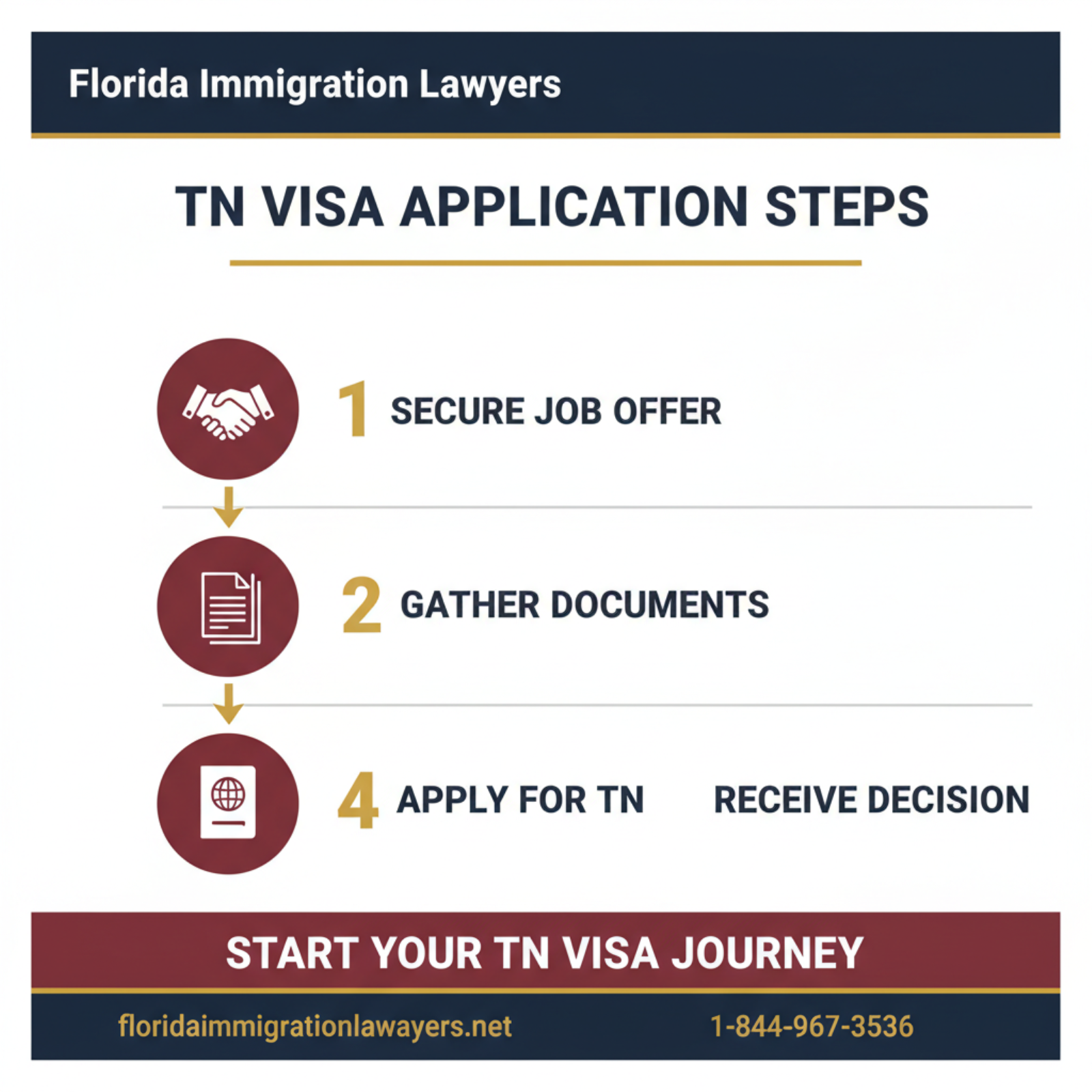
The process for obtaining a TN visa differs slightly depending on whether you are a Canadian or Mexican citizen. However, the foundational steps of securing a job offer and gathering documentation remain the same for both.
-
Secure a Qualifying Job Offer in Florida
Before initiating any visa application, you must first obtain a legitimate offer of employment from a U.S. employer. This offer must be for a position that falls within one of the designated USMCA professional categories. The offer letter should clearly detail your job title, duties, salary, employment duration, and confirm that the position requires a professional in your field.
-
Gather All Required Documentation
Once you have a job offer, compile all necessary supporting documents. This includes proof of your Canadian or Mexican citizenship, educational degrees, academic transcripts, professional licenses, and letters of experience. A comprehensive list of documents is provided in the next section.
-
Choose Your Application Method
-
For Canadian Citizens: Port of Entry (POE) Application
Canadian citizens generally apply for a TN visa directly at a U.S. port of entry (POE) or a pre-flight inspection station. You will present your documentation to a U.S. Customs and Border Protection (CBP) officer. If approved, you will typically receive your TN status immediately, stamped in your passport or on an I-94 arrival/departure record.
-
For Mexican Citizens: USCIS Petition and Consular Processing
Mexican citizens must first have their prospective U.S. employer file a Form I-129, Petition for a Nonimmigrant Worker, with U.S. Citizenship and Immigration Services (USCIS). Once the I-129 petition is approved, USCIS will send an approval notice (Form I-797). You then use this approval notice to apply for a TN visa stamp at a U.S. embassy or consulate in Mexico.
Step-by-Step Process Guide -
-
Attend Interview (if applicable)
Canadian citizens applying at a POE will have an immediate interview with a CBP officer. Mexican citizens will attend an interview at a U.S. consulate or embassy after their I-129 petition is approved. During the interview, you must clearly articulate your professional qualifications, the nature of your job, and your non-immigrant intent to return to Mexico.
-
Receive Decision and Enter the U.S.
If your application is approved, Canadian citizens receive their TN status on the spot, allowing them to enter the U.S. and begin work. Mexican citizens will receive a TN visa stamp in their passport, which allows them to travel to the U.S. and be admitted in TN status at a port of entry.
-
Begin Employment in Florida
Upon successful entry in TN status, you can begin your professional employment with your sponsoring employer in Florida. Remember that your status is tied to this employer and profession. Any significant changes may require a new application or amendment.
Essential Document Checklist for Your TN Visa Application
A thorough and accurate submission of documents is critical for a successful TN visa application. Missing or incorrect paperwork can lead to delays or even denial. Ensure you have all these items prepared:
- Proof of Canadian or Mexican Citizenship: Valid passport is typically required. For Canadians, a birth certificate or certificate of citizenship may also be accepted with a driver's license.
- Offer of Employment Letter: A detailed letter from your prospective U.S. employer in Florida. This letter must specify your job title, detailed professional duties, salary, duration of employment, and confirm that the position requires a professional in a USMCA-eligible category.
- Educational Credentials: Original or certified copies of your university degrees (Baccalaureate Degree, Licenciatura Degree, etc.), diplomas, and academic transcripts.
- Professional Licenses and Certifications: Any state, provincial, or federal licenses or certifications required for your profession in your home country and, if applicable, in the U.S. state of Florida.
- Resume/Curriculum Vitae (CV): An up-to-date resume detailing your professional experience and qualifications.
- Letters of Experience: If your qualification relies on experience in lieu of a specific degree (for certain professions), provide letters from previous employers verifying your professional experience.
- Evidence of Non-Immigrant Intent: Documents demonstrating your ties to your home country, such as property deeds, bank statements, family ties, or a letter from your current employer confirming a leave of absence or future employment.
- Previous TN Visa Documentation: If you have held TN status before, include copies of previous approval notices (Form I-797) or I-94 records.
- Passport: A valid passport with at least six months validity beyond your intended period of stay.
- Visa Application Fees: Be prepared to pay the applicable filing fees (note that specific amounts are subject to change by USCIS and CBP).
TN Visa Timeline and Processing Expectations in Florida
Understanding the processing times for a TN visa is essential for planning your move to Florida. The timeline varies significantly based on your citizenship and the application method chosen.
For Canadian citizens applying at a U.S. port of entry (POE), the process is often immediate. If all documentation is in order and the CBP officer is satisfied, you can receive your TN status on the same day. However, in some cases, if there are questions or missing documents, you may be asked to return with additional information or directed to file a petition with USCIS, which can extend the timeline.
For Mexican citizens, the process typically involves two main stages. First, your U.S. employer must file Form I-129 with USCIS. USCIS processing times for I-129 petitions can vary widely, ranging from a few weeks to several months. You can check the current processing times on the USCIS website for the specific service center handling your petition. Premium Processing is available for an additional fee, which guarantees a decision within 15 calendar days.
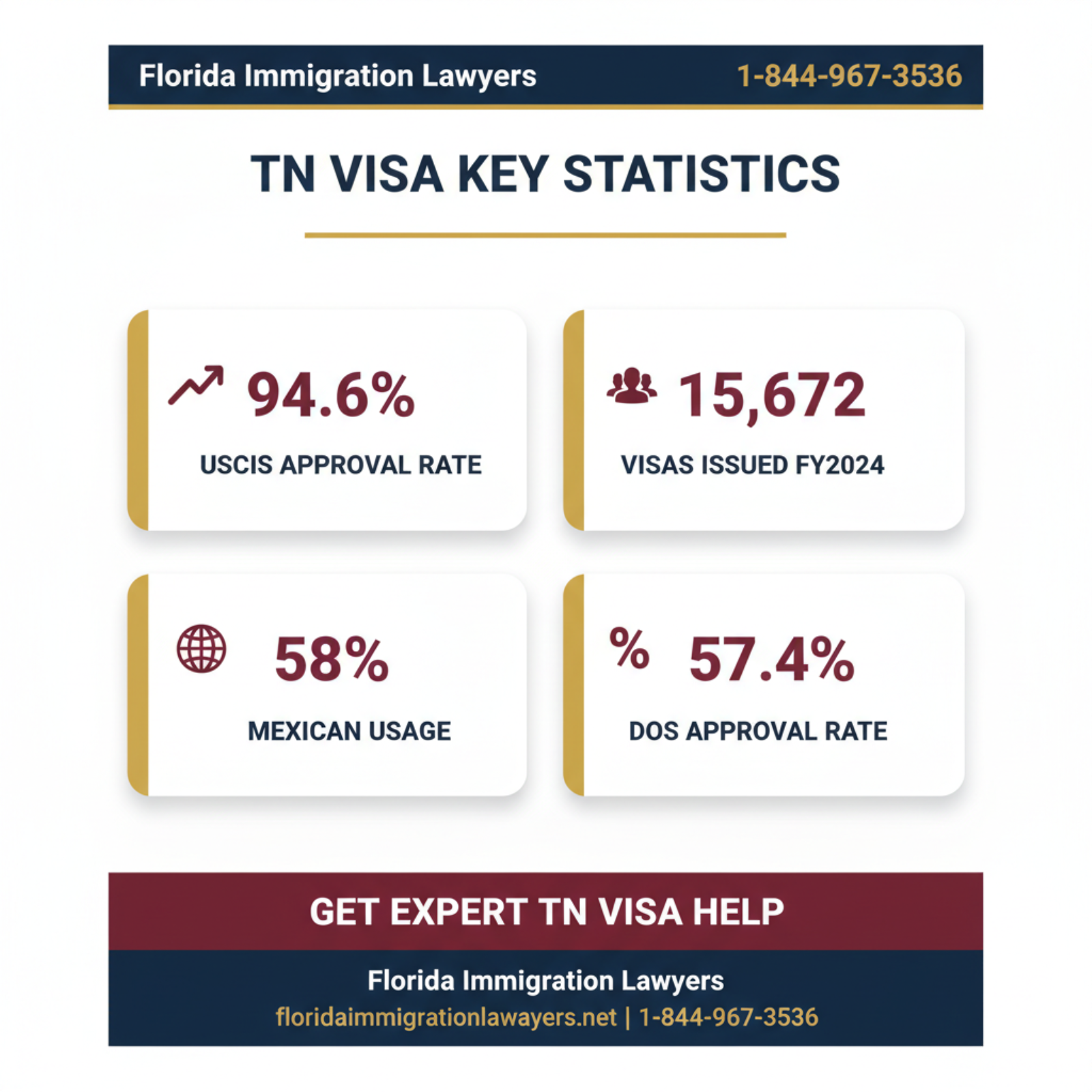
Once the I-129 petition is approved, the second stage involves consular processing at a U.S. embassy or consulate in Mexico. This includes scheduling an interview, which can take several weeks or months depending on the consulate's workload. After a successful interview, the visa stamp is usually issued within a few business days.
A TN visa is generally granted for a period of up to three years. There is no maximum limit on the number of times you can renew your TN status, as long as you continue to meet the eligibility requirements and maintain non-immigrant intent. Each renewal is essentially a new application, requiring updated documentation and adherence to current regulations.
Cost Factors and Fee Breakdown for Your TN Visa
Applying for a TN visa involves several fees that applicants should be aware of. While specific amounts can change, understanding the categories of costs will help you budget effectively for your move to Florida.
- USCIS Filing Fees: For Mexican citizens, the U.S. employer must pay the filing fee for Form I-129, Petition for a Nonimmigrant Worker. There are also potential fees for the American Competitiveness and Workforce Improvement Act (ACWIA) and fraud prevention and detection, though these typically apply to H-1B visas but can sometimes be associated with I-129 filings.
- Port of Entry (POE) Application Fee: Canadian citizens applying at a POE will pay a processing fee directly to U.S. Customs and Border Protection. This fee is generally lower than the USCIS I-129 filing fee.
- Consular Processing Fees: Mexican citizens applying for the visa stamp at a U.S. consulate or embassy will incur a Nonimmigrant Visa Application processing fee (MRV fee).
- Premium Processing Fee: If your employer opts for Premium Processing for the Form I-129 petition, an additional substantial fee is paid to USCIS to expedite the adjudication within 15 calendar days.
- Legal Fees: Engaging an experienced immigration attorney, such as Florida Immigration Lawyers, is a critical investment. Legal fees cover the attorney's expertise in preparing your petition, reviewing documents, advising on strategy, and representing you through the process. This can significantly increase your chances of approval.
- Travel Costs: Factor in expenses for travel to the port of entry or the U.S. consulate for your application and interview.
- Document Translation/Evaluation Fees: If your educational documents are not in English or require evaluation for U.S. equivalency, you may incur additional costs for certified translations or credential evaluations.
It is important to remember that all government fees are subject to change, and it is advisable to check the official USCIS and Department of State websites for the most current fee schedules.
Do not navigate this complex immigration process alone. The nuances of TN visa applications, especially with Florida-specific considerations, can be challenging. Contact Florida Immigration Lawyers today for expert legal assistance and peace of mind.
Common Mistakes to Avoid in Your TN Visa Journey
Navigating the TN visa application process can be fraught with potential missteps that could lead to delays or even denial. Being aware of these common mistakes can significantly improve your chances of success, especially when planning your professional move to Florida.
- Incorrect Profession Classification: One of the most frequent mistakes is attempting to fit a job into a TN category when it doesn't truly align with the USMCA list of professions. The job duties must clearly match the description of a qualifying TN profession. Misclassifying can lead to immediate denial by CBP or USCIS.
- Insufficient or Inaccurate Documentation: Failing to provide all required documents, or submitting incomplete, expired, or incorrect paperwork, is a common pitfall. This includes missing degrees, licenses, or a poorly drafted job offer letter. Always double-check every item against the official requirements.
- Demonstrating Immigrant Intent: The TN visa is strictly for non-immigrant, temporary entry. Any indication that you intend to permanently reside in the U.S. or pursue a green card during your TN application can result in denial. Avoid discussing long-term plans for permanent residency with immigration officials.
- Misunderstanding USMCA Requirements: The specific educational and experience requirements for each TN profession are strict. Applicants sometimes assume their general degree or experience is sufficient when it may not meet the precise criteria outlined in the USMCA regulations. Research your profession's exact requirements thoroughly.
- Failure to Prove Non-Immigrant Intent: Beyond just not demonstrating immigrant intent, you must affirmatively show ties to your home country. This includes evidence like property ownership, family in Canada or Mexico, bank accounts, or letters from employers confirming a leave of absence. Without this, officers may question your temporary intent.
- Applying at the Wrong Port of Entry (Canadians): While most major ports of entry handle TN applications, some officers at smaller or less frequented crossings may have less experience with the process. Choosing a larger, more experienced port of entry can sometimes lead to a smoother application experience.
- Overstaying or Violating Status: Once granted, it is crucial to adhere to the terms of your TN status. Overstaying your authorized period or working for an unauthorized employer can lead to severe consequences, including future inadmissibility to the U.S. and difficulties with any future immigration applications.
- Ignoring USCIS Updates and Policy Changes: Immigration laws and policies are subject to change. For example, while the TN visa was generally unaffected by the Trump administration's policies, future administrations or legislative actions could introduce changes. Always stay updated via official sources like USCIS.gov or consult with an immigration attorney.
- Submitting an Incomplete Form I-129 Petition (Mexicans): For Mexican citizens, if your employer submits an incomplete or improperly prepared Form I-129 petition, it will likely result in a Request for Evidence (RFE) or outright denial, significantly delaying the process. Precision is key for this initial filing.
- Lack of Specificity in Job Offer Letter: A vague or generic job offer letter that does not clearly outline professional duties, the TN profession, and the need for your specific qualifications can raise red flags. The letter should be tailored to the TN requirements.
- Assuming Automatic Renewal: Each TN visa renewal is treated as a new application. You must submit all required documentation and meet eligibility criteria again. Do not assume that because you were approved once, your renewal is guaranteed.
- Not Consulting an Experienced Immigration Attorney: Perhaps the most critical mistake is attempting to navigate the complexities of the TN visa process without legal counsel. An attorney can identify potential issues, ensure all documentation is correct, and provide strategic advice, significantly reducing the risk of denial.
When to Call a Lawyer for Your TN Visa in Florida
While the TN visa process may seem straightforward for some, numerous factors can complicate an application, making legal counsel invaluable. Knowing when to engage an experienced immigration attorney can save you time, stress, and potential denial.
You should consider contacting Florida Immigration Lawyers if your job duties are complex or do not perfectly align with a specific TN profession. Our attorneys can help you articulate how your role fits within the USMCA framework. Furthermore, if you have any prior immigration history, such as a previous visa denial, an overstay, or other legal issues, a lawyer's expertise is crucial to address these concerns proactively.
If your TN visa application has been denied, or if you have received a Request for Evidence (RFE) from USCIS or CBP, it is imperative to seek legal assistance immediately. Our team can analyze the reasons for the denial or RFE and help you formulate a strong response or appeal. We also assist with questions regarding renewals, changes of employer, or bringing dependents (TD status) to Florida.
Employers in Florida who are new to sponsoring TN professionals can also greatly benefit from our services. We can guide your company through the process, ensuring compliance with all immigration regulations. Our firm possesses in-depth knowledge of USCIS field office procedures and immigration court nuances relevant to Florida, offering unparalleled local insight.
Do not wait for a problem to arise. Proactive legal consultation with Florida Immigration Lawyers can help you prepare a robust application from the outset, increasing your chances of a successful outcome and allowing you to focus on your exciting new professional opportunity in Florida.
About Florida Immigration Lawyers
Florida Immigration Lawyers is a leading law firm dedicated to providing comprehensive immigration solutions across the entire state of Florida. Our team of highly skilled and compassionate attorneys is committed to helping individuals, families, and businesses navigate the complexities of U.S. immigration law with confidence and clarity.
We offer a broad range of immigration services, including family-based immigration, business and employment visas like the TN visa, asylum applications, deportation defense, citizenship and naturalization, and more. Our firm prides itself on delivering personalized attention and strategic legal advice tailored to each client's unique situation. We understand the profound impact immigration matters have on your life and future.
Choosing Florida Immigration Lawyers means partnering with a firm that prioritizes your success. We are available 24/7 to address your urgent concerns and offer free, no-obligation consultations to discuss your case. Our commitment to excellence, deep legal expertise, and unwavering advocacy make us the trusted choice for your immigration needs throughout Florida, from Jacksonville to Key West.
Contact us today to learn how we can assist you. Call 1-844-967-3536 or visit our website at https://www.floridaimmigrationlawyers.net.
Sources and References
- U.S. Citizenship and Immigration Services (USCIS) - TN NAFTA Professionals
- U.S. Department of State - TN NAFTA Professionals
- 8 U.S.C. Chapter 12 - Immigration and Nationality Act (INA) Section 214(e)
- 8 CFR Part 214.6 - Nonimmigrant classes; professionals from Mexico or Canada under the North American Free Trade Agreement
- United States-Mexico-Canada Agreement (USMCA)
This article provides general legal information and is not intended as legal advice. Every case is unique, and outcomes depend on specific facts and circumstances. Laws are subject to change, and interpretations may vary. Contact an attorney for advice about your particular situation.
Ready to pursue your professional dreams in Florida? Let our experienced team guide you through the TN visa process. Contact Florida Immigration Lawyers today at 1-844-967-3536 for a free, no-obligation consultation. We are dedicated to helping you achieve your immigration goals. Se Habla Español - Estamos aquí para ayudarle.
Florida Immigration Lawyers
Legal Team
Our experienced attorneys at Florida Immigration Lawyers have been serving clients across Florida for over 20 years. We specialize in immigration, personal injury, criminal defense, workers compensation, and family law.