Visa Bulletin January 2026: Florida Immigration Dates
The Visa Bulletin January 2026 provides crucial updates for immigrants in Florida, detailing final action dates and dates for filing applications that determine green card eligibility. Understanding these monthly updates is vital for family-sponsored and employment-based categories to avoid processing delays. This comprehensive guide explains how to interpret the bulletin, outlines necessary documents, discusses processing timelines, and highlights common mistakes. Florida Immigration Lawyers offers assistance to navigate these complex immigration waters, ensuring accurate interpretation and timely filing. Contact us for a free consultation to understand how the latest Visa Bulletin impacts your case.
The Visa Bulletin January 2026 provides crucial updates on immigrant visa availability, affecting individuals pursuing green cards in Florida. It details Final Action Dates and Dates for Filing, which determine when applicants can move forward with their immigration process. Understanding these dates is vital for family-sponsored and employment-based categories to avoid delays.
- The Visa Bulletin updates monthly, indicating visa availability.
- Priority dates dictate your place in line for a green card.
- "Dates for Filing" allow earlier application submission for some.
- Consulting an attorney is critical for accurate interpretation and timely filing.
- Florida residents must monitor the bulletin closely for local impact.
Navigating the U.S. immigration system can feel like a complex maze for immigrants in Florida. A critical monthly update is the Visa Bulletin, especially the upcoming Visa Bulletin January 2026. This bulletin serves as your roadmap towards permanent residency.
For thousands across Florida, from Miami to Orlando, understanding the Visa Bulletin January 2026 is paramount. It directly impacts when you can file your Adjustment of Status or schedule your visa interview. Misinterpreting these updates can cause significant delays and frustration.
This guide from Florida Immigration Lawyers demystifies the Visa Bulletin January 2026, explaining its meaning for family-sponsored and employment-based immigrants in Florida. We cover key concepts, provide a step-by-step interpretation, and highlight pitfalls to avoid. Guidance is crucial. Call Florida Immigration Lawyers at 1-844-YO-PELEO for a free consultation to understand how the latest Visa Bulletin affects your case.
Understanding the Visa Bulletin January 2026: A Florida Perspective
The Visa Bulletin January 2026 is the official U.S. Department of State publication summarizing immigrant visa availability. It's vital for anyone in Florida seeking a green card via family sponsorship or employment. The bulletin presents two key charts: Final Action Dates (Chart A) and Dates for Filing Applications (Chart B).
Final Action Dates (Chart A) indicate when an immigrant visa is truly available. This allows USCIS to approve Adjustment of Status or a U.S. embassy/consulate to issue a visa. If your priority date is earlier than the listed date, your visa is current, and your case can advance. This is the ultimate goal.
Dates for Filing Applications (Chart B) permit certain applicants to file their Adjustment of Status application with USCIS earlier. USCIS dictates monthly if Chart B can be used. For Florida residents, this may shorten overall processing time by enabling earlier application submission.
Visa availability faces annual quotas set by Congress, per INA sections 201-203 (8 U.S.C. §§ 1151-1153). When demand exceeds supply, a 'cutoff date' is established. Only individuals with an earlier priority date can proceed. Grasping these nuances is critical for your immigration journey in Florida.
Florida boasts a large, diverse immigrant population, especially in Miami-Dade, Broward, and Orange counties. Movements in the Visa Bulletin January 2026 can profoundly affect thousands of families and businesses here. Whether applying for a family-based or employment-based visa, staying informed is key.
What is a Priority Date and Why Does it Matter?
Your priority date is essentially your place in line for an immigrant visa. For family-sponsored petitions, it's generally the date USCIS receives your Form I-130, Petition for Alien Relative. For employment-based petitions, it's typically the date the Department of Labor receives your labor certification application (Form ETA-9089), or the date USCIS receives your Form I-140, Immigrant Petition for Alien Worker, if no labor certification is required.
This date is critical because it determines when your visa becomes 'current' according to the Visa Bulletin. A visa is current when your priority date is earlier than the cutoff date listed for your specific visa category and country of chargeability. Without a current priority date, you cannot proceed to the final stages of your green card application, whether in Florida or abroad.
Step-by-Step Guide to Interpreting the Visa Bulletin January 2026 for Florida Residents
Interpreting the Visa Bulletin January 2026 can be complex. This guide offers a structured approach for Florida residents to navigate these vital updates.
-
Identify Your Visa Category: First, determine your specific immigrant visa category. This is typically found on your Form I-797 approval notice for your I-130 or I-140 petition. Common categories include:
- Family-Sponsored (F): F1 (Unmarried Sons and Daughters of U.S. Citizens), F2A (Spouses and Children of Permanent Residents), F2B (Unmarried Sons and Daughters of Permanent Residents), F3 (Married Sons and Daughters of U.S. Citizens), F4 (Brothers and Sisters of U.S. Citizens). For more on these, visit our family immigration page.
- Employment-Based (EB): EB-1 (Priority Workers), EB-2 (Professionals with Advanced Degrees or Exceptional Ability), EB-3 (Skilled Workers, Professionals, and Other Workers), EB-4 (Certain Special Immigrants), EB-5 (Immigrant Investors). Explore our business immigration services for details.
- Locate Your Country of Chargeability: This is generally your country of birth, not necessarily your current country of residence or citizenship. The Visa Bulletin has separate columns for different countries or regions, including a "Worldwide" category, and specific columns for high-demand countries like China, India, Mexico, and the Philippines.
- Find Your Priority Date: Refer to your I-797 approval notice for your I-130 or I-140 petition. This date is crucial for determining your place in the visa queue. For example, if your I-130 was filed on June 15, 2018, that is your priority date.
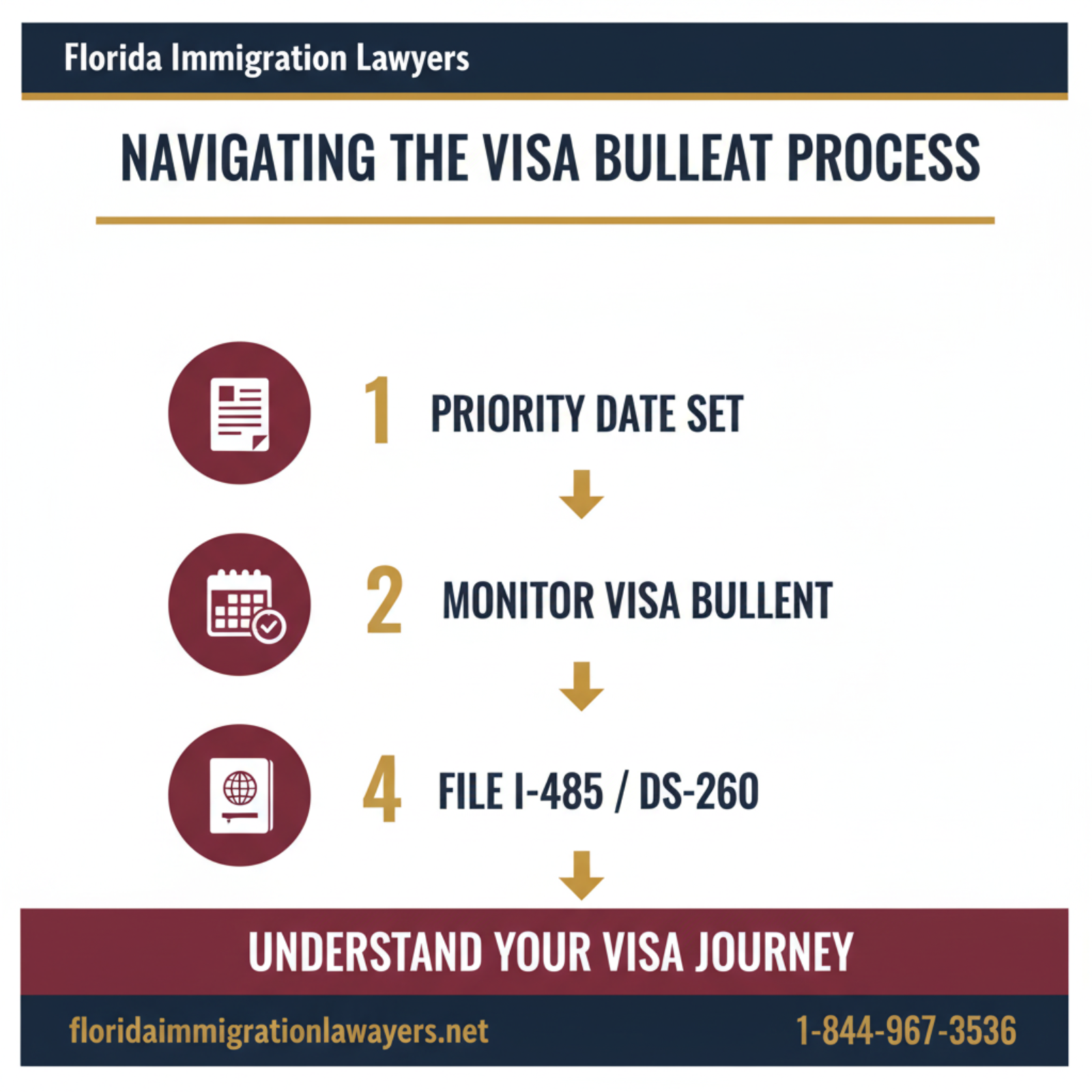
- Check "Final Action Dates" (Chart A): Look at Chart A in the Visa Bulletin January 2026 for your specific visa category and country. If your priority date is earlier than the date listed in Chart A, your immigrant visa is current. This means USCIS can finalize your Adjustment of Status application (Form I-485) if you are in the U.S., or the National Visa Center (NVC) can schedule your interview if you are applying from abroad.
- Check "Dates for Filing Applications" (Chart B): Next, review Chart B. USCIS posts on its website (typically within a week of the Visa Bulletin's release) whether applicants can use Chart B for filing Adjustment of Status applications. If USCIS indicates Chart B can be used, and your priority date is earlier than the date listed in Chart B for your category and country, you may be eligible to file your Form I-485. This is a significant advantage for many Florida residents.
- Consult USCIS Website for Chart B Use: Always confirm on the official USCIS website whether you should use the Final Action Dates chart or the Dates for Filing chart for Adjustment of Status applications. This is updated monthly and is vital for timely filing.
- Seek Professional Guidance: The intricacies of the Visa Bulletin January 2026 are complex, with varying rules by category and country. Consulting an experienced immigration lawyer in Florida is highly recommended for accurate interpretation and effective planning. Florida Immigration Lawyers are here to help.
Essential Document Checklist for Visa Applicants in Florida
Once your priority date is current, or you can file based on the Visa Bulletin January 2026, compiling correct documents is paramount. A meticulous application prevents delays. This checklist outlines common documents for Adjustment of Status in Florida or consular processing.
- Form I-485, Application to Register Permanent Residence or Adjust Status (if in U.S.)
- Form I-130, Petition for Alien Relative (copy of approval notice) or Form I-140, Immigrant Petition for Alien Worker (copy of approval notice)
- Form I-864, Affidavit of Support (for family-based visas), with supporting financial documents from sponsor
- Form I-693, Report of Medical Examination and Vaccination Record, completed by a USCIS-approved civil surgeon in Florida
- Birth Certificate (original and certified translation if not in English)
- Marriage Certificate (if applicable, original and certified translation)
- Divorce Decrees or Death Certificates for any prior marriages (if applicable)
- Passport-style photographs (typically 2)
- Copy of valid passport biographic page
- Copy of Form I-94, Arrival/Departure Record
- Copy of visa stamp (if applicable)
- Copy of any previous EAD or Advance Parole documents (if applicable)
- Police certificates from your country of origin and any country where you lived for 6+ months after age 16
- Court and prison records (if applicable)
- Military records (if applicable)
- Evidence of legal entry and maintenance of status (e.g., I-20s, DS-2019s, I-797s)
This is a general list. Your case may need more documents. For instance, Miami applicants for asylum-based adjustment may need different proofs. Always review the latest USCIS instructions for your specific form and category, as detailed in USCIS Policy Manual and 8 CFR Part 245.
Timeline and Processing Expectations for Florida Immigration Cases
The Visa Bulletin January 2026 shows visa availability, but overall green card processing involves several stages. Understanding these timelines helps manage expectations for Florida residents.
After your priority date becomes current (or you use Chart B), processing time varies. For Adjustment of Status in Florida, times differ significantly by USCIS field office and service center. The USCIS Miami Field Office times, for instance, can differ from Orlando or Tampa.
USCIS posts average processing times online, updated regularly. These range from months to years, depending on form, service center, and caseload. Case complexity, application completeness, RFEs, or interviews also impact your timeline. While the Visa Bulletin January 2026 indicates your turn, administrative processing takes time; USCIS processing times fluctuate and are not guaranteed to speed up in 2026.
For consular processing, once NVC deems your case 'documentarily qualified,' an interview is scheduled. Wait times depend on the consulate's caseload. Post-interview, administrative processing might be required. Priority dates move (advance or retrogress) based on demand and annual limits, so constant monitoring is essential. No general 'visa pausing' is indicated for January 2026, though categories can become unavailable if demand exceeds supply.
Cost Factors and Fee Breakdown for Immigration Applications
Pursuing an immigrant visa or adjustment of status involves various fees. While exact figures fluctuate, Florida applicants must budget for these expenses. The Visa Bulletin January 2026 itself has no direct cost, but the application steps it enables do.
- USCIS Filing Fees: Each form (I-130, I-140, I-485, I-765, I-131, etc.) has an associated filing fee. The I-485 fee often includes fees for employment authorization (EAD) and advance parole (AP) applications when filed concurrently.
- Biometrics Fee: Required for most Adjustment of Status applicants.
- Medical Examination Fee: Paid directly to the civil surgeon. This varies by provider in Florida.
- Affidavit of Support Fee: For consular processing, paid to the National Visa Center.
- Immigrant Visa Processing Fee: For consular processing, paid to the Department of State.
- USCIS Immigrant Fee: Paid to USCIS after visa issuance for consular processing applicants, before receiving the physical green card.
- Attorney Fees: Legal representation costs vary based on the complexity of your case and the services provided.
These fees are subject to change by USCIS and the Department of State. Always refer to the official USCIS website for the most current fee schedule (Form G-1055, Fee Schedule). Planning for these costs is an essential part of your immigration strategy in Florida.
The path to a green card is filled with intricate details and critical deadlines, especially when interpreting the Visa Bulletin January 2026. Do not navigate this process alone. The experienced attorneys at Florida Immigration Lawyers are dedicated to guiding you through every step, ensuring your application is accurate and timely. Contact Florida Immigration Lawyers today for legal assistance.
Navigating immigration, particularly with the Visa Bulletin January 2026, is complex. Even minor errors cause significant delays or denials. Here are common mistakes Florida applicants should avoid:
- Misinterpreting Priority Dates: Many applicants confuse the "Final Action Dates" with "Dates for Filing." Using the wrong chart or miscalculating your priority date can lead to premature or delayed filing, resulting in rejection or missed opportunities.
- Failing to Check USCIS's Chart B Directive: USCIS decides each month whether applicants can use Chart B for filing Adjustment of Status. Assuming you can use Chart B without checking the USCIS website will lead to your I-485 being rejected.
- Submitting Incomplete Applications: Missing required forms, documents, or signatures is a frequent cause of RFEs or outright rejections. This prolongs the process and can be costly.
- Providing Inaccurate Information: Any false or misleading information on your application can have severe consequences, including accusations of fraud and potential permanent bars from immigration benefits.
- Ignoring Deadlines: The Visa Bulletin changes monthly. If your date becomes current, you have a window to act. Missing this window can mean waiting for months or even years for your date to become current again.
- Not Updating Your Address: If you move within Florida or to another state, failing to update your address with USCIS (Form AR-11) can result in missed notices, interview appointments, or RFEs, leading to processing delays or denials.
- Failing the Medical Exam: Not completing your medical exam with a USCIS-approved civil surgeon, or not addressing issues found in the exam, can halt your application. Ensure all vaccinations are current.
- Lack of Sufficient Financial Support: For family-based visas, the Affidavit of Support (Form I-864) must demonstrate the sponsor's ability to support the immigrant. Insufficient income or assets can lead to denial.
- Not Disclosing Criminal History: Attempting to hide any criminal record, no matter how minor, will almost certainly lead to a denial and potential fraud charges. Always be truthful and provide certified disposition records.
- Traveling Internationally Without Advance Parole: If you have a pending I-485 application and travel outside the U.S. without an approved Advance Parole document, your Adjustment of Status application may be considered abandoned.
- Assuming a "Visa Pausing": While cut-off dates can regress or a category can become "unavailable," this is not a general "pause" but a re-calibration based on visa demand and supply. Always check the official bulletin for specific updates for January 2026.
When to Call a Lawyer
While this guide provides general information about the Visa Bulletin January 2026 and immigration, your circumstances are unique. Navigating immigration law without professional guidance can lead to costly mistakes and delays. Here’s when to contact Florida Immigration Lawyers:
- Your priority date is close to or has become current, and you need assistance preparing and filing your Adjustment of Status application.
- You received a Request for Evidence (RFE) or a Notice of Intent to Deny (NOID) from USCIS related to your green card application.
- You have a complex immigration history, such as previous denials, deportations, or criminal records.
- You are unsure how to interpret the Visa Bulletin January 2026 for your specific visa category and country.
- You need to understand the implications of international travel while your green card application is pending.
- You are facing an interview at a USCIS field office in Florida (e.g., Miami, Orlando, Tampa) or a U.S. consulate abroad.
- You believe there has been an error in your priority date or visa category assignment.
- You are considering changing your visa category or seeking other immigration relief.
Our experienced immigration attorneys at Florida Immigration Lawyers understand the nuances of the Visa Bulletin January 2026 and its Florida impact. We provide personalized advice, review documents, prepare applications, and represent you at interviews or in court. Our goal is to protect your rights and help you achieve your immigration goals efficiently. We handle cases from family immigration to business immigration and deportation defense.
About Florida Immigration Lawyers
Florida Immigration Lawyers is a leading firm providing comprehensive, compassionate immigration legal services across Florida. Our skilled attorneys understand the profound impact immigration has on individuals and families. We offer personalized strategies and unwavering support to help you achieve your American dream.
We focus on diverse services: family-sponsored visas, employment-based visas, adjustment of status, naturalization, asylum claims, and deportation defense. Whether in Orlando, or elsewhere, our firm represents your interests with experience and diligence.
Why choose us? Our firm excels in U.S. immigration law understanding, client-centered approach, and proven success. We offer free consultations and are available 24/7 for urgent needs. We speak your language, providing clarity and confidence. Your future in Florida is our priority.
Contact Florida Immigration Lawyers today at 1-844-YO-PELEO or visit our website at https://www.floridaimmigrationlawyers.net.
Sources and References
- U.S. Citizenship and Immigration Services (USCIS) - Visa Bulletin Information
- U.S. Department of State - Visa Bulletin
- USCIS Policy Manual
- 8 U.S.C. Chapter 12 - Immigration and Nationality Act (INA)
- INA Sections 201-203 (8 U.S.C. §§ 1151-1153) - Numerical Limitations on Immigrant Visas
- 8 CFR Part 245 - Adjustment of Status to that of Person Admitted for Permanent Residence
This article provides general legal information and is not intended as legal advice. Every case is unique, and outcomes depend on specific facts and circumstances. Contact an attorney for advice about your particular situation.
Navigating the complexities of the Visa Bulletin January 2026 and the broader U.S. immigration system requires legal guidance. Do not leave your future to chance. The dedicated team at Florida Immigration Lawyers is ready to provide the professional support you need for your green card application or any other immigration matter. We offer free, confidential consultations to discuss your case and outline your best path forward. Call us today at 1-844-YO-PELEO. Se Habla Español - Estamos aquí para ayudarle.
Do Not Navigate This Process Alone
Our experienced immigration attorneys are ready to fight for you. Get a free, confidential case review today.
Se Habla Español
Or leave your details and we’ll call you:
Free Evaluation in 24 Hours
Or talk to us right now

AI voice assistant — available 24/7
FreeFrequently Asked Questions

William J. Vásquez
Founding Attorney · Vasquez Law Firm
U.S. Air Force veteran and immigration attorney with years of hands-on U.S. immigration experience. J.D., NCCU School of Law. AILA member. Admitted to the 4th, 5th, and 11th Circuit Courts.
Available 24/7 - Free Evaluations
Reviewed for legal accuracy by William J. Vásquez
Licensed in North Carolina; U.S. immigration is federal practice.
Related Legal Services
Our Florida immigration attorneys can help you with immigration practice areas, free immigration consultation and business immigration. Call today at 1-844-YO-PELEO for a free case review.
Related Links
Related Topics
Free Legal Case Review
Discuss your case with our experienced attorneys. We're available 24/7.
Se Habla Español - Estamos aquí para ayudarle.
Related Articles
Immigration Lawyer Orlando Free Consultation in Florida
For individuals and families in Orlando, Florida, navigating the complexities of U.S. immigration law requires expert guidance. An immigration lawyer in Orlando offers crucial support for everything from visa applications and green card processes to naturalization and deportation defense. This comprehensive guide details what a free consultation covers, providing a step-by-step overview of immigration pathways, essential document checklists, and expected timelines in 2026. We also highlight common mistakes to avoid, discuss the critical role of legal counsel in deportation and asylum cases, and explain why choosing a local Orlando immigration attorney is beneficial. Florida Immigration Lawyers is dedicated to serving the diverse community of Orlando with compassionate, effective legal solutions, ensuring you receive personalized advice and robust representation for a successful immigration journey.
EAD Advance Parole Combo Card in Florida 2026
For individuals with a pending Form I-485, Application to Register Permanent Residence or Adjust Status, the EAD Advance Parole Combo Card is an essential document. This single card combines the authorization to work legally in the U.S. (Employment Authorization Document - EAD) with permission to travel internationally and re-enter without abandoning your green card application (Advance Parole). This guide from Florida Immigration Lawyers provides a comprehensive overview for applicants in Florida in 2026, covering eligibility, the step-by-step application process, required documents, expected processing times, and associated costs. We also highlight common mistakes to avoid and when to seek legal counsel to ensure a smooth and successful immigration journey. Understanding this vital card is key to maintaining stability while awaiting your permanent residency approval.
Immigration Lawyer Southwest Florida: What You Need to Know
Discover how an immigration lawyer in Southwest Florida can help you navigate complex immigration processes. Learn about costs, timelines, and common mistakes to avoid. Call Florida Immigration Lawyers for a free case review.
Change of Status from B-2 to F-1 in Florida: What You Need
Learn how to change your immigration status from a B-2 tourist visa to an F-1 student visa in Florida. This comprehensive guide covers the 2026 processing timelines, required documentation, and common mistakes to avoid. Call Florida Immigration Lawyers for personalized assistance.