Visa Bulletin 2026: Florida Priority Dates & Predictions
The 2026 Visa Bulletin is a vital guide for immigrants in Florida, influencing green card eligibility and processing times. This comprehensive article delves into priority dates, final action dates, and filing dates, explaining their impact on your immigration journey. We provide predictions for various visa categories, discuss potential wait times for Florida residents, and outline essential steps to prepare your application. Understanding these complexities is crucial for successful immigration, especially given Florida's unique dynamics. Florida Immigration Lawyers offers guidance to help you navigate these critical updates and secure your future. Contact us for a free consultation.
The 2026 Visa Bulletin outlines the availability of immigrant visas, dictating when individuals in Florida and across the U.S. can move forward with their green card applications. Priority dates, categorized by country and visa preference, determine your place in line. Predictions for 2026 suggest continued movement in some categories, while others may experience retrogression or extended wait times, making timely legal guidance essential.
- The Visa Bulletin dictates green card application eligibility.
- Priority dates are crucial for all family- and employment-based visas.
- 2026 predictions indicate varied movement across visa categories.
- Longer wait times are possible for certain countries and preferences.
- Consulting an attorney is vital for navigating these complex predictions.
Are you an aspiring immigrant in Florida, perhaps in St. Petersburg, anxiously awaiting your chance to secure a green card? The U.S. Visa Bulletin is likely a document you follow closely, as it holds the key to your immigration future. Understanding its complex predictions for 2026, especially regarding priority dates and potential florida wait times, is crucial for anyone navigating the U.S. immigration system from the Sunshine State.
This comprehensive guide will demystify the 2026 Visa Bulletin, breaking down what it means for family-sponsored and employment-based categories. We will explore how priority dates function, discuss potential movements in the coming year, and provide Florida-specific insights to help you prepare. Don't leave your immigration future to chance. Call Florida Immigration Lawyers at 1-844-YO-PELEO for a free consultation to discuss your specific situation and how the Visa Bulletin may impact you.
Understanding the Visa Bulletin for 2026
The Visa Bulletin is a monthly publication by the U.S. Department of State that provides crucial information about the availability of immigrant visas. It is essential for individuals seeking to become lawful permanent residents, commonly known as green card holders. For 2026, it will continue to be the primary indicator of when you can file your adjustment of status application or attend an immigrant visa interview abroad.
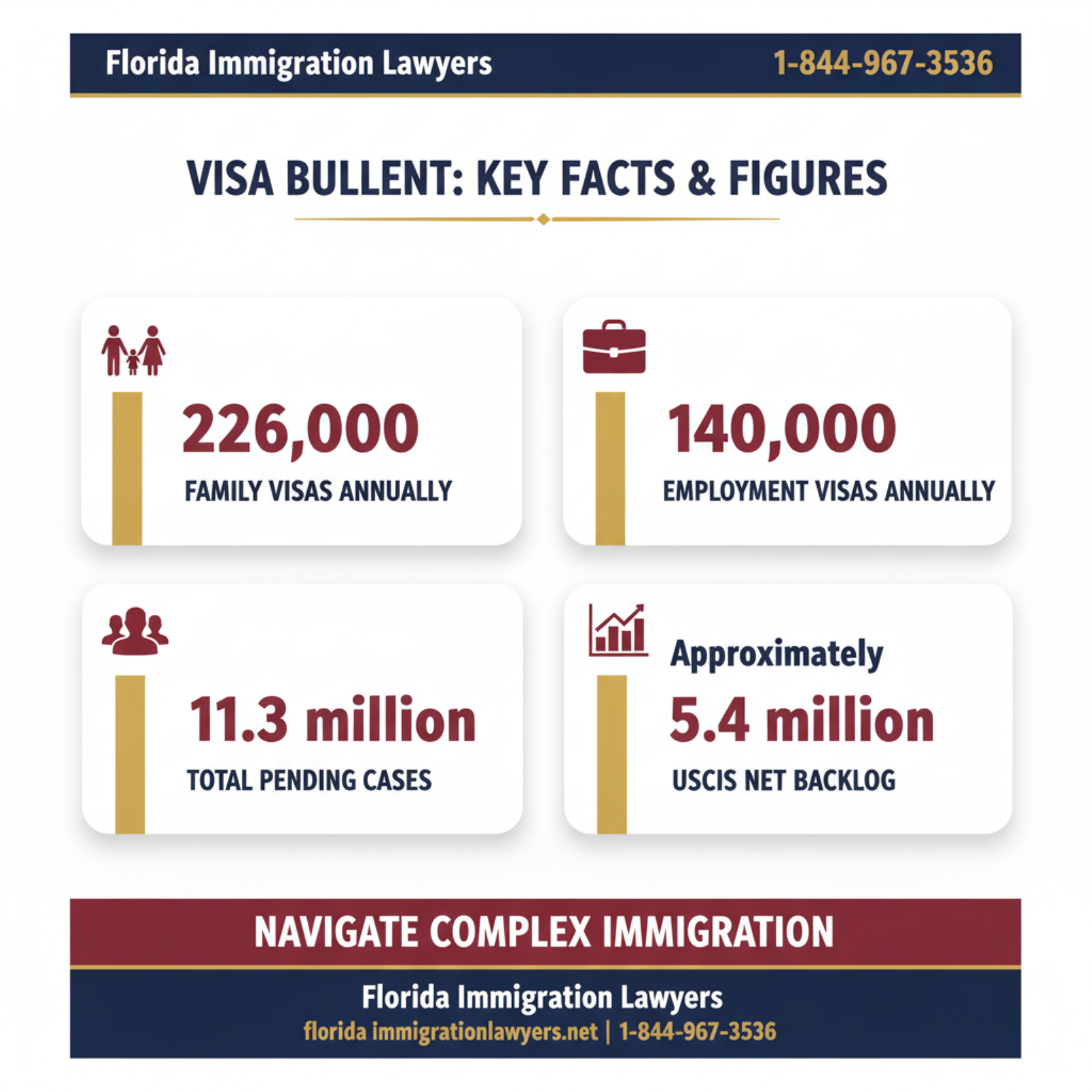
This bulletin categorizes visas into family-sponsored and employment-based preferences, each with specific annual limits. The demand for visas often exceeds these limits, leading to backlogs and wait times. The bulletin's "Final Action Dates" and "Dates for Filing Applications" charts determine eligibility. These dates are published monthly and can fluctuate, sometimes moving forward, sometimes retrogressing, or remaining stagnant. Staying informed about these changes is vital for your immigration planning, especially if you are based in Florida.
How Priority Dates and Visa Categories Work
Your priority date is the date your immigrant visa petition (Form I-130 or Form I-140) was properly filed with USCIS. For employment-based cases requiring a labor certification, it is the date the Department of Labor received your labor certification application. This date essentially marks your place in line. Once your priority date becomes "current" according to the Visa Bulletin, you may be eligible to proceed with your green card processing.
The U.S. immigration system allocates immigrant visas based on several preference categories, established under the Immigration and Nationality Act (INA). These categories are divided between family-sponsored and employment-based immigrants. Each category has a limited number of visas available each fiscal year, which runs from October 1 to September 30.
Family-Sponsored Preferences
Family-sponsored visas are for relatives of U.S. citizens and lawful permanent residents. The categories include:
- F1: Unmarried Sons and Daughters of U.S. Citizens.
- F2A: Spouses and Children of Permanent Residents.
- F2B: Unmarried Sons and Daughters (21 years of age or older) of Permanent Residents.
- F3: Married Sons and Daughters of U.S. Citizens.
- F4: Brothers and Sisters of U.S. Citizens.
Immediate relatives of U.S. citizens (spouses, unmarried children under 21, and parents) do not fall under these preference categories. They are not subject to numerical limitations or the Visa Bulletin.
Employment-Based Preferences
Employment-based visas are for foreign nationals coming to the U.S. to work permanently. These categories include:
- EB-1: Priority Workers (persons of extraordinary ability, outstanding professors/researchers, multinational executives/managers).
- EB-2: Professionals Holding Advanced Degrees and Persons of Exceptional Ability.
- EB-3: Skilled Workers, Professionals, and Other Workers.
- EB-4: Certain Special Immigrants (e.g., religious workers).
- EB-5: Immigrant Investors.
The demand for visas in certain countries, particularly China, India, Mexico, and the Philippines, often exceeds the annual per-country limits. This leads to significantly longer florida wait times for many Florida residents from these countries.
Navigating the Visa Bulletin: A Step-by-Step Guide for Florida Residents
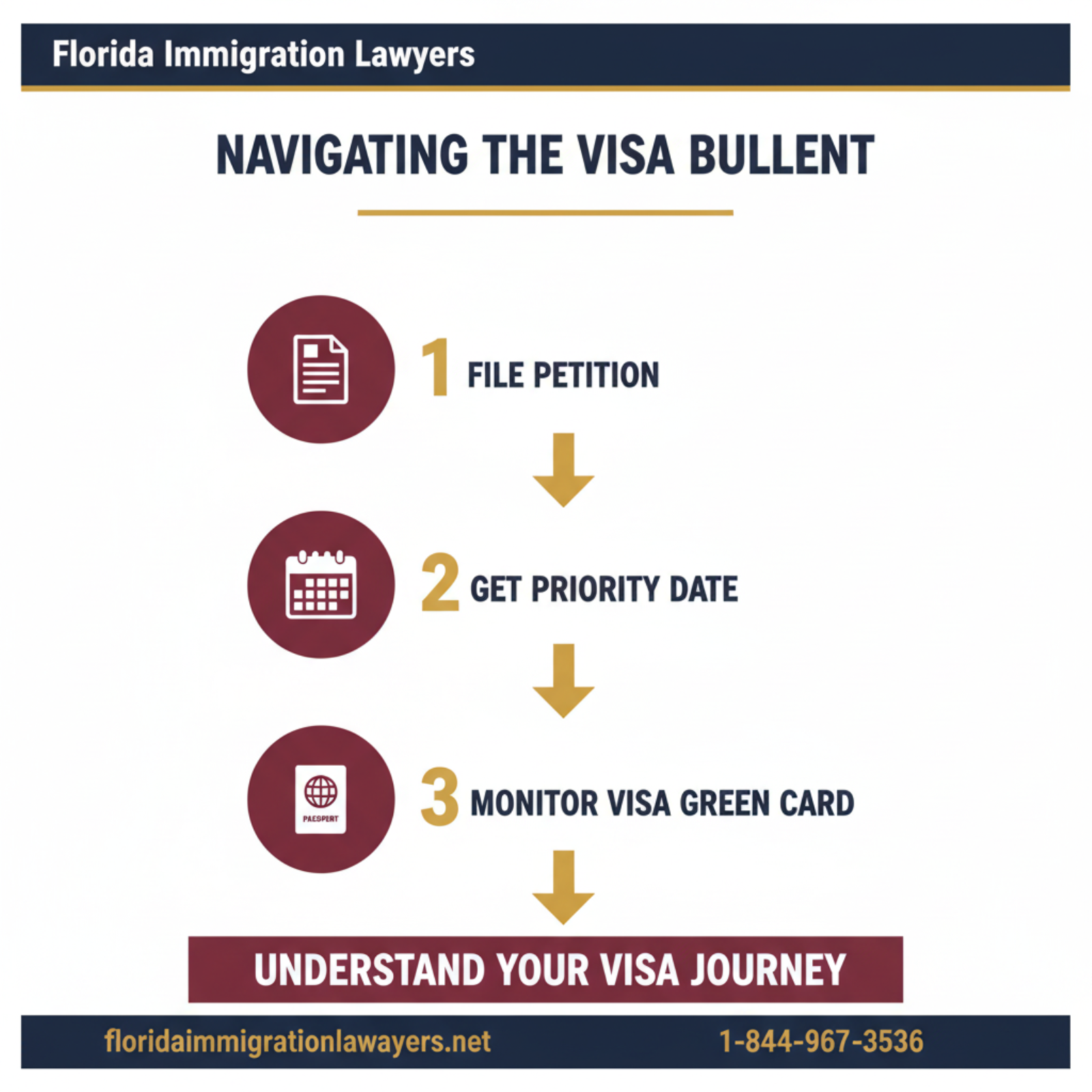
Understanding the Visa Bulletin can feel overwhelming, but breaking it down into manageable steps can help. For those in St. Petersburg and across Florida, here are the general steps to follow once your petition is approved and you are awaiting a current priority date.
- Identify Your Visa Category and Priority Date: Locate your specific family-sponsored or employment-based visa category. Your priority date is found on the I-797, Approval Notice, from USCIS for your I-130 or I-140 petition.
- Check the Monthly Visa Bulletin: Visit the official U.S. Department of State website monthly to review the latest Visa Bulletin. Pay close attention to the "Final Action Dates" and "Dates for Filing Applications" charts for your specific country of chargeability and visa category.
- Understand "Current" Status: Your priority date is "current" if it is earlier than the date listed in the relevant chart for your category and country. If your date is current under "Dates for Filing Applications," you may be able to submit your adjustment of status application (Form I-485) or begin the immigrant visa process abroad. If it's current under "Final Action Dates," your green card can be approved.
- Prepare Your Application: Once your priority date is current for filing, begin gathering all necessary documents for your Form I-485 (Adjustment of Status) if you are in the U.S., or prepare for consular processing if you are abroad. This includes medical examinations, affidavits of support, and civil documents.
- File or Attend Interview: Submit your completed application package to USCIS or attend your immigrant visa interview at a U.S. embassy or consulate abroad. For Florida residents, USCIS field offices in Tampa, Orlando, and Miami handle adjustment of status interviews.
- Respond to Requests for Evidence (RFEs): USCIS may send an RFE if they need more information or documentation. Respond promptly and thoroughly to avoid delays or denials.
- Await Decision: After your interview or submission, USCIS will review your case. If approved, you will receive your green card.
This process requires careful attention to detail and adherence to deadlines. Many Florida immigrants find that legal guidance greatly simplifies these complex steps.
Required Documents for Your Green Card Application
A successful green card application, whether through adjustment of status or consular processing, hinges on submitting a complete and accurate set of documents. Missing or incorrect documentation is a common cause for delays or even denials. Proper preparation is key for your green card processing.
Here is a general checklist of documents you will typically need for your green card application in Florida:
- Form I-485, Application to Register Permanent Residence or Adjust Status.
- Form I-130, Petition for Alien Relative (if family-based) or Form I-140, Immigrant Petition for Alien Worker (if employment-based), and approval notice.
- Two passport-style photographs.
- Copy of government-issued photo identification (e.g., driver's license).
- Copy of birth certificate.
- Copy of passport page with nonimmigrant visa (if applicable).
- Copy of passport page with admission (entry) stamp (if applicable).
- Form I-94, Arrival-Departure Record.
- Form I-864, Affidavit of Support (for family-based and some employment-based cases).
- Form I-693, Report of Medical Examination and Vaccination Record.
- Certified copies of court and police records (if you have a criminal history).
- Marriage certificate (if applying as a spouse).
- Evidence of your legal entry and maintenance of status in the U.S. (if adjusting status).
- Employment offer letter and evidence of employer's ability to pay (for employment-based cases).
This list is not exhaustive, and specific requirements vary based on your visa category and individual circumstances. Consulting with Florida Immigration Lawyers can help ensure you have all necessary documents.
Expected Timelines and Processing Expectations in 2026
Predicting exact processing times for green card processing in 2026 is challenging due to various factors. These include fluctuating demand, USCIS workload, policy changes, and annual visa limits. However, we can make some general observations based on historical trends and current projections.
The Visa Bulletin for 2026 will likely continue to show significant backlogs for certain countries, particularly India and China in employment-based categories. Mexico and the Philippines often face longer florida wait times in family-sponsored categories. For example, some EB-2 and EB-3 applicants from India could face waits of a decade or more. Family-based categories, particularly F4 for siblings of U.S. citizens, also typically involve very long waits, often exceeding 10-15 years for many countries.
Impact of Retrogression and Advancement
The priority dates in the Visa Bulletin can move forward (advance), retrogress (move backward), or remain unchanged. Retrogression happens when the demand for visas in a particular category or country exceeds the available supply. This can be incredibly frustrating for applicants who thought their date was becoming current. USCIS and the Department of State monitor visa usage closely and make adjustments to prevent over-subscription of annual limits.
For Florida residents, the movement of dates in 2026 will directly impact when you can complete your immigration process. While some categories may see steady advancement, unexpected retrogression is always a possibility. This uncertainty underscores the importance of being prepared to act quickly when your date becomes current. Monitoring the monthly Visa Bulletin updates is crucial, as is having all your documentation ready.
Do not navigate this complex process alone. The nuances of the Visa Bulletin and priority dates can be overwhelming, especially with the potential for 2026 changes. Contact Florida Immigration Lawyers today to ensure your application is handled correctly and efficiently. We are here to guide you every step of the way.
Cost Factors and Immigration Fee Breakdown
Pursuing a green card involves several fees that applicants must consider. These costs are subject to change, so it is always important to check the most current fee schedules on the USCIS website. We do not provide specific amounts here, but we outline the typical categories of expenses for your green card processing.
The primary costs associated with green card applications generally include:
- USCIS Filing Fees: These are fees for the various forms you submit, such as the I-130, I-140, I-485, I-765 (Employment Authorization Document), and I-131 (Advance Parole). The I-485 fee often includes biometric services.
- Medical Examination Fees: You must undergo a medical examination by a USCIS-approved civil surgeon. The cost for this examination varies by provider and location in Florida.
- Attorney Fees: Legal representation is an investment in your peace of mind and the success of your application. Florida Immigration Lawyers offers comprehensive services, and our fees are discussed transparently.
- Translation Fees: If any of your supporting documents are not in English, they must be translated by a certified translator.
- Travel Expenses: If you are required to travel for an interview (e.g., to a USCIS field office in Orlando or Miami, or a consulate abroad), these costs will add up.
- Miscellaneous Fees: This can include costs for obtaining birth certificates, marriage licenses, police clearances, and passport photos.
It is crucial to budget for these expenses. While some fees are non-refundable, proper preparation with legal assistance can help you avoid costly mistakes.
Common Mistakes to Avoid in Your Immigration Journey
Navigating the U.S. immigration system can be fraught with pitfalls. Avoiding these common mistakes can save you significant time, money, and stress, especially when dealing with the Visa Bulletin and priority dates for 2026.
- Ignoring the Visa Bulletin Updates: Failing to regularly check the monthly Visa Bulletin means you could miss when your priority date becomes current. This oversight can delay your application by months or even years.
- Filing Incomplete or Incorrect Forms: USCIS is strict about application completeness. Missing signatures, unanswered questions, or incorrect information will lead to Requests for Evidence (RFEs) or outright denials, impacting your green card processing.
- Not Maintaining Legal Status While in the U.S.: If you are adjusting status from within Florida, failing to maintain your underlying nonimmigrant status until your I-485 is filed can jeopardize your eligibility.
- Submitting Insufficient Supporting Documentation: Each application requires specific evidence. Not providing all necessary documents, such as birth certificates, marriage licenses, or financial records, can cause significant delays.
- Misrepresenting Facts or Providing False Information: Any attempt to deceive USCIS or provide fraudulent documents can result in a permanent bar from the U.S. Always be truthful and accurate.
- Missing Deadlines: Whether it's responding to an RFE or attending a biometric appointment, missing deadlines can lead to your application being abandoned or denied.
- Failing to Update USCIS on Address Changes: If you move within Florida or to another state, you must inform USCIS of your new address within 10 days. Failure to do so can result in missed notices and critical delays.
- Traveling Internationally Without Advance Parole: If you have a pending I-485 and travel outside the U.S. without an approved Advance Parole document (Form I-131), your adjustment of status application may be considered abandoned.
- Assuming All Categories Move Similarly: The Visa Bulletin moves differently for various categories and countries. What applies to an F2A applicant from Mexico will not apply to an EB-3 applicant from India.
- Not Consulting with an Experienced Attorney: Attempting to navigate complex immigration laws, especially with the fluctuating priority dates and florida wait times, without legal counsel often leads to avoidable errors and prolonged processes.
When to Call a Florida Immigration Lawyer
The U.S. immigration system is notoriously complex, and the Visa Bulletin for 2026 is no exception. While this guide provides general information, your specific situation will always benefit from personalized legal advice. Florida Immigration Lawyers are here to help you understand and navigate these challenges.
You should consider contacting an attorney from Florida Immigration Lawyers if:
- Your priority date is nearing current, and you need assistance preparing your adjustment of status application (Form I-485).
- You have received a Request for Evidence (RFE) or a Notice of Intent to Deny (NOID) from USCIS.
- Your case involves complex issues, such as past immigration violations, criminal history, or previous denials.
- You are unsure about your eligibility for a specific visa category or how the priority dates apply to your unique circumstances.
- You are concerned about potential florida wait times or retrogression impacting your application.
- You are considering consular processing and need guidance through the National Visa Center (NVC) stage.
- You need assistance with family-based petitions (Family Immigration) or employment-based petitions (Business Immigration).
- You are facing Deportation Defense or need help with Asylum claims, which are often time-sensitive.
- You are seeking Citizenship and need to understand the naturalization process.
Our experienced attorneys are dedicated to protecting your rights and helping you achieve your immigration goals. Visit our attorneys page to learn more about our team. We provide Immigration Law services throughout Florida.
Frequently Asked Questions About the 2026 Visa Bulletin
Here are answers to some common questions regarding the Visa Bulletin and its predictions for 2026, especially relevant to immigrants in Florida.
Will priority dates move in 2026?
Yes, priority dates are expected to move in 2026, but the extent of movement will vary significantly by visa category and country of chargeability. Some categories may see steady advancement, while others, particularly those with high demand, could experience slow movement or even retrogression. USCIS and the Department of State continuously adjust dates based on visa availability and demand, influencing florida wait times.
Is USCIS moving faster in 2026?
USCIS green card processing times are influenced by many factors, including staffing levels, budget, and the volume of applications received. While USCIS continually strives to improve efficiency, it's difficult to predict if overall processing will be "faster" across the board in 2026. Specific case types may see improvements, while others might still face delays. Checking the official USCIS processing times tool is always recommended for the most current information regarding your green card processing.
Does the Visa Bulletin predict future availability?
The Visa Bulletin itself does not directly predict future availability in a definitive sense. It reflects the current availability of visas based on demand and statutory limits. However, the Department of State often includes "Notes" or "Visa Office Updates" that provide insights into potential future movements, offering a form of prediction or expectation for the coming months. These notes are crucial for understanding trends in priority dates.
What is the Visa Bulletin for March 2026?
The Visa Bulletin for March 2026 will be released by the U.S. Department of State, typically in the middle of the preceding month (e.g., mid-February 2026). It will contain the "Final Action Dates" and "Dates for Filing Applications" charts for all family-sponsored and employment-based categories. You can find the official publication on the travel.state.gov website, which is essential for tracking your priority dates.
About Florida Immigration Lawyers
Florida Immigration Lawyers is a leading law firm dedicated to providing exceptional legal representation to immigrants across the entire state of Florida, including St. Petersburg, Tampa, Orlando, and Miami. Our team of compassionate and knowledgeable attorneys understands the complexities and emotional challenges of the immigration process. We are committed to helping individuals and families achieve their American dream through effective green card processing and other services.
We offer a comprehensive range of immigration legal services, including family-based immigration, employment-based immigration, green cards, naturalization and citizenship, deportation defense, asylum, and visa applications. Our firm prides itself on personalized attention, strategic advocacy, and a deep understanding of U.S. immigration law. We know that every case is unique, and we tailor our approach to meet your specific needs and goals.
Why choose Florida Immigration Lawyers? We are available 24/7 to answer your questions and provide support. We offer free consultations to assess your case and outline your options without any upfront cost. Our attorneys are not only legal experts but also empathetic advocates who stand by your side throughout your journey. We serve all of Florida, ensuring that no matter where you are in the state, legal help is within reach. Call us today at 1-844-YO-PELEO or visit our website at https://www.floridaimmigrationlawyers.net.
Sources and References
- U.S. Citizenship and Immigration Services (USCIS)
- U.S. Department of State - Visa Bulletin
- Executive Office for Immigration Review (EOIR)
- 8 U.S.C. Chapter 12 - Immigration and Nationality Act (INA), particularly INA Sections 201, 203 (8 U.S.C. §§ 1151, 1153)
- 8 CFR Part 204 - Immigrant Petitions
- 8 CFR Part 245 - Adjustment of Status
This article provides general legal information and is not intended as legal advice. Every case is unique, and outcomes depend on specific facts and circumstances. Contact an attorney for advice about your particular situation. The information regarding the 2026 Visa Bulletin and priority dates is based on current trends and predictions, which are subject to change by government agencies.
Don't navigate the complexities of the 2026 Visa Bulletin and your immigration journey alone. Florida Immigration Lawyers is here to provide the guidance you need. Call us now for a free, confidential consultation at 1-844-YO-PELEO. Se Habla Español - Estamos aquí para ayudarle.
Do Not Navigate This Process Alone
Our experienced immigration attorneys are ready to fight for you. Get a free, confidential case review today.
Se Habla Español
Or leave your details and we’ll call you:
Free Evaluation in 24 Hours
Or talk to us right now
AI voice assistant — available 24/7
FreeFrequently Asked Questions

William J. Vásquez
Founding Attorney · Vasquez Law Firm
U.S. Air Force veteran and immigration attorney with years of hands-on U.S. immigration experience. J.D., NCCU School of Law. AILA member. Admitted to the 4th, 5th, and 11th Circuit Courts.
Available 24/7 - Free Evaluations
Reviewed for legal accuracy by William J. Vásquez
Licensed in North Carolina; U.S. immigration is federal practice.
Related Legal Services
Our Florida immigration attorneys can help you with immigration lawyer cost in Florida, experienced immigration attorneys and asylum protection. Call today at 1-844-YO-PELEO for a free case review.
Related Links
Related Topics
Free Legal Case Review
Discuss your case with our experienced attorneys. We're available 24/7.
Se Habla Español - Estamos aquí para ayudarle.
Related Articles
Immigration Lawyer Orlando Free Consultation in Florida
For individuals and families in Orlando, Florida, navigating the complexities of U.S. immigration law requires expert guidance. An immigration lawyer in Orlando offers crucial support for everything from visa applications and green card processes to naturalization and deportation defense. This comprehensive guide details what a free consultation covers, providing a step-by-step overview of immigration pathways, essential document checklists, and expected timelines in 2026. We also highlight common mistakes to avoid, discuss the critical role of legal counsel in deportation and asylum cases, and explain why choosing a local Orlando immigration attorney is beneficial. Florida Immigration Lawyers is dedicated to serving the diverse community of Orlando with compassionate, effective legal solutions, ensuring you receive personalized advice and robust representation for a successful immigration journey.
EAD Advance Parole Combo Card in Florida 2026
For individuals with a pending Form I-485, Application to Register Permanent Residence or Adjust Status, the EAD Advance Parole Combo Card is an essential document. This single card combines the authorization to work legally in the U.S. (Employment Authorization Document - EAD) with permission to travel internationally and re-enter without abandoning your green card application (Advance Parole). This guide from Florida Immigration Lawyers provides a comprehensive overview for applicants in Florida in 2026, covering eligibility, the step-by-step application process, required documents, expected processing times, and associated costs. We also highlight common mistakes to avoid and when to seek legal counsel to ensure a smooth and successful immigration journey. Understanding this vital card is key to maintaining stability while awaiting your permanent residency approval.
Immigration Lawyer Southwest Florida: What You Need to Know
Discover how an immigration lawyer in Southwest Florida can help you navigate complex immigration processes. Learn about costs, timelines, and common mistakes to avoid. Call Florida Immigration Lawyers for a free case review.
Change of Status from B-2 to F-1 in Florida: What You Need
Learn how to change your immigration status from a B-2 tourist visa to an F-1 student visa in Florida. This comprehensive guide covers the 2026 processing timelines, required documentation, and common mistakes to avoid. Call Florida Immigration Lawyers for personalized assistance.