USCIS Processing Times Florida 2026: What to Expect in
Navigating USCIS processing times in Florida for 2026 can be daunting. This guide offers insights into what to expect for various petitions, including I-130, I-485, and N-400, specifically for applicants in West Palm Beach and throughout Florida. We cover how to track your case, essential documents, cost factors, and common mistakes to avoid. Understand the factors influencing wait times, such as service center backlogs and policy changes, and learn when to seek legal counsel. Florida Immigration Lawyers is here to provide expert guidance and support, ensuring your application is handled with precision. Schedule a free consultation to discuss your specific immigration needs and strategize for a smoother process.

USCIS processing times in Florida for 2026 vary significantly by form type, case complexity, and the specific service center or field office. While some improvements are anticipated, applicants should still expect potential delays. Factors like agency backlog, staffing levels, and policy changes can influence wait times. It is crucial to monitor official USCIS tools for the most current information and consider legal guidance for complex cases, especially in areas like West Palm Beach.
Key Takeaways:
- Processing times differ widely based on the immigration form and the specific USCIS office handling your case.
- Regularly check the official USCIS Case Status Online and Processing Times tools for up-to-date information.
- Be prepared for potential delays; planning ahead is essential for your immigration journey.
- Legal assistance from experienced attorneys can significantly help navigate the complexities and challenges of your application.
- Florida field offices, including the one serving West Palm Beach, have specific caseloads that can affect local processing.
Are you an immigrant in Florida anxiously awaiting news on your immigration application? Understanding USCIS processing times Florida 2026 can be a source of significant stress and uncertainty. The wait for a decision on your visa, green card, or citizenship application can feel endless, and knowing what to expect is crucial for planning your future in the Sunshine State.
This comprehensive guide details USCIS processing times in Florida for 2026, focusing on key petitions and offering insights for applicants in areas like West Palm Beach. We will explore what impacts these timelines, how to track your case, and how you can best prepare for the journey ahead. Our goal is to provide clarity and empower you with the knowledge to navigate this often-complex system.
For personalized guidance on your specific case and to understand how current trends might affect your application, do not hesitate to seek professional help. Call Florida Immigration Lawyers at 1-844-967-3536 for a free consultation today. We are here to help you understand your unique situation.
Understanding USCIS Processing Times Florida 2026: An Overview
What exactly are USCIS processing times? These are the estimated periods it takes U.S. Citizenship and Immigration Services (USCIS) to process a particular type of immigration application or petition. These times are not guarantees but rather averages based on historical data and current caseloads at various service centers and field offices.
Several critical factors influence these processing times. The sheer volume of applications USCIS receives is a major contributor. Budget allocations, staffing levels, and changes in immigration policies or procedures also play a significant role. Furthermore, the complexity of an individual case, including the need for additional evidence (RFEs) or interviews, can extend processing durations.
In the Florida context, applicants will interact with specific USCIS field offices. Major offices include Miami, Orlando, and Tampa, with smaller satellite offices or service centers also playing a role, such as those serving West Palm Beach. Each office has its own unique caseload and processing efficiencies, meaning times can vary even for the same form type across different locations within Florida.
Looking at historical trends, USCIS has faced challenges with backlogs in recent years. For 2026, there are ongoing efforts to reduce these backlogs and improve efficiency. However, applicants should still prepare for potential delays. The Immigration and Nationality Act (INA), 8 U.S.C. § 1101 et seq., governs many of these processes, and understanding its framework is key.
Key Factors Affecting Your Wait Time
Your individual processing time can be affected by numerous variables. The specific form you file, the service center or field office handling your case, and whether you respond promptly to all USCIS requests are all important. Unexpected events, such as natural disasters or public health emergencies, can also temporarily disrupt operations.
Moreover, the completeness and accuracy of your application are paramount. Errors or omissions can lead to Requests for Evidence (RFEs) or Notices of Intent to Deny (NOIDs), which significantly extend your wait. Ensuring all required documentation is submitted correctly from the outset is a critical step in streamlining your application process.
How to Track Your USCIS Case: A Step-by-Step Guide for Florida Residents
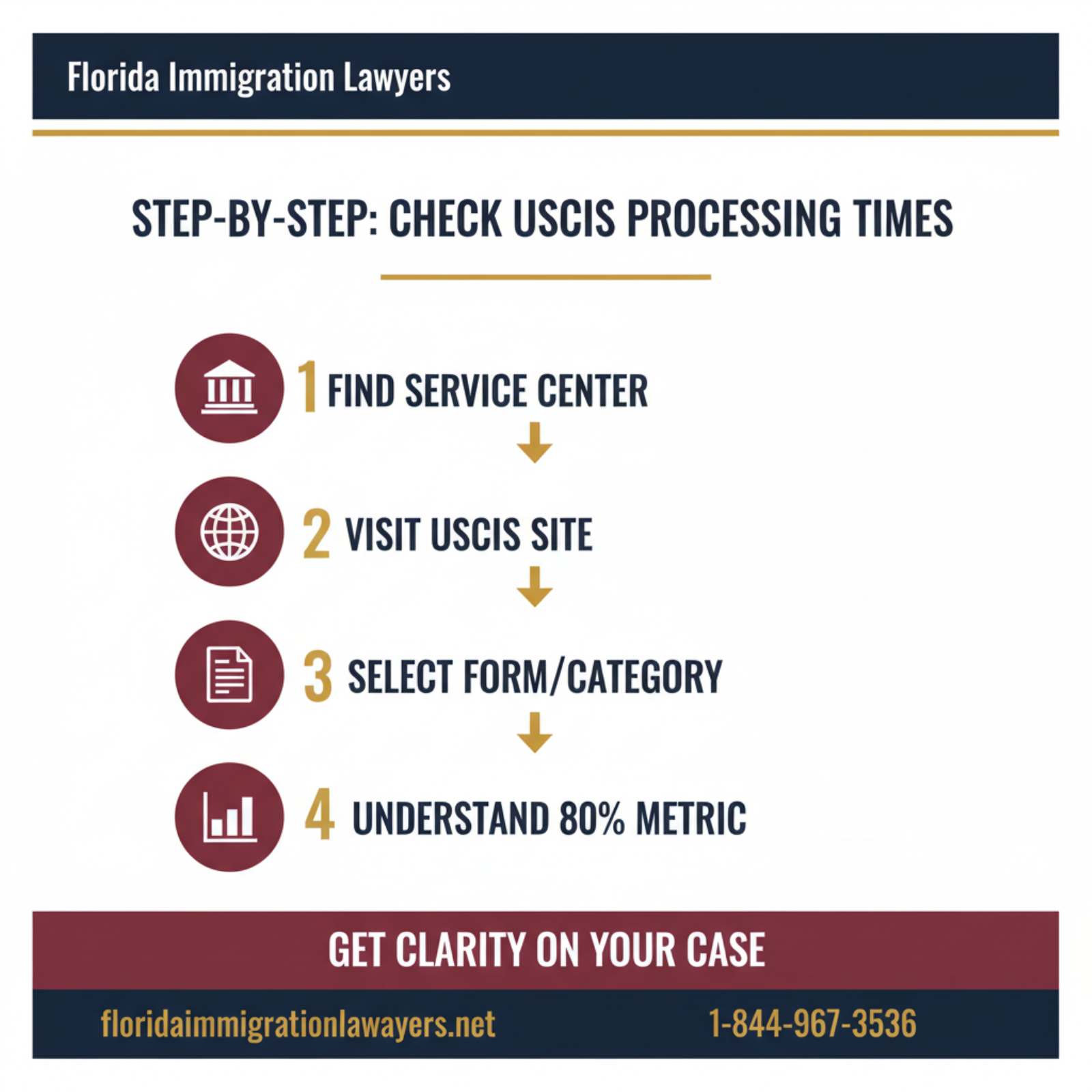
Staying informed about your application's status is essential. USCIS provides robust online tools to help you track your case. Knowing how to use these effectively can alleviate much of the anxiety associated with waiting. Here is a step-by-step guide:
-
Locate Your Receipt Number: After filing your application, USCIS will send you a receipt notice (Form I-797C). This notice contains a 13-character receipt number, typically starting with three letters (e.g., EAC, WAC, LIN, SRC, NBC, MSC, IOE). This number is your key to tracking your case.
-
Use the USCIS Case Status Online Tool: Visit the official USCIS Case Status Online Tool. Enter your 13-character receipt number exactly as it appears on your notice. This tool provides real-time updates on your application's status, from initial receipt to approval or denial. It will show you the most recent action taken on your case.
-
Check the USCIS Processing Times Tool: For estimated wait times, use the USCIS Processing Times Tool. Here, you will select your form type (e.g., I-130, I-485, N-400) and the specific service center or field office that is processing your application. This tool displays a range of time, typically indicating how long it takes to process 80% of cases for that form and office.
-
Understand "Normal Processing Time": The processing times tool shows a range, for instance, "8 to 14 months." This range represents the typical duration for most cases. Your case is generally considered "outside normal processing time" if it has been pending longer than the upper end of this displayed range.
-
When to Submit an Inquiry: If your case has exceeded the stated "normal processing time," you may be eligible to submit an "Outside Normal Processing Time" inquiry. USCIS provides specific guidelines on when and how to do this. It is important to wait until your case is truly outside the normal range before initiating such an inquiry.
-
Utilize E-Request: USCIS offers an online E-Request tool for certain types of inquiries, including those for cases outside normal processing times. This can be a convenient way to formally ask about your application's status without needing to call. Ensure you have all your case details ready when using this service.
-
Contact USCIS Directly: If online tools do not provide the answers you need, or if you have a complex issue, you can contact the USCIS National Customer Service Center (NCSC). Be prepared for potentially long wait times on the phone. Having your receipt number and any relevant documentation at hand will help facilitate the call.
Navigating Delays and Expedite Requests
Despite best efforts, delays can occur. A delay is when your application remains pending beyond the published processing times. In certain urgent circumstances, you may be able to request an expedite for your application. USCIS considers expedite requests on a case-by-case basis and requires compelling evidence.
Criteria for expedite requests typically include severe financial loss to a company or individual, urgent humanitarian reasons, or compelling U.S. government interests. You must provide documentation to support your request. While an expedite request can sometimes speed up a case, it is not guaranteed and should only be pursued with valid grounds.
Essential Documents for Common USCIS Petitions in 2026
A complete and accurate application package is vital for smooth processing. Missing documents or incorrect information are leading causes of delays and RFEs. While specific requirements vary by form, here is a general overview of documents typically needed for common petitions:
- General Document Requirements:
- Valid passport or other government-issued identification.
- Original birth certificates (and certified translations if not in English).
- Original marriage certificates (if applicable, with certified translations).
- Evidence of financial support, often Form I-864, Affidavit of Support, from a qualifying sponsor.
- Medical examination results (Form I-693) completed by a USCIS-authorized civil surgeon.
- Recent passport-style photographs meeting USCIS specifications.
- Police clearances or criminal background checks from all relevant jurisdictions.
- Specific for I-130 (Family Petition):
- Proof of the qualifying relationship (e.g., birth certificates for parent-child, marriage certificate for spousal petitions).
- Proof of the petitioner's U.S. citizenship or lawful permanent resident (LPR) status (e.g., U.S. birth certificate, naturalization certificate, green card copy).
- For spousal petitions, extensive evidence of a bona fide marriage, such as joint bank accounts, property deeds, utility bills, photos, and affidavits from friends/family.
- Specific for I-485 (Adjustment of Status):
- The underlying visa petition approval (e.g., Form I-130 or Form I-140) or a concurrently filed petition.
- Proof of lawful entry into the U.S. (e.g., I-94 arrival/departure record).
- Form I-864, Affidavit of Support, from the petitioner/sponsor.
- Form I-693, Report of Medical Examination and Vaccination Record.
- Biometrics (fingerprints and photos) taken at a USCIS Application Support Center (ASC) appointment.
- For more specific guidance on family-based petitions, visit our family immigration page.
Step-by-Step Process Guide - Specific for N-400 (Naturalization):
- Proof of continuous residence and physical presence in the U.S.
- Evidence of good moral character.
- Documentation supporting any name changes or marital status changes.
- Preparation for the English and Civics tests.
- Learn more about becoming a U.S. citizen on our citizenship page.
It is always recommended to consult the official USCIS website for the most current form instructions and required documents, as these can change. Preparing thoroughly can significantly impact your processing time.
USCIS Timeline and Processing Expectations for Florida Applicants in 2026
Understanding the estimated timelines for specific forms is crucial for planning. While these are estimates, they provide a general idea of what to expect for USCIS processing times Florida 2026.
Form I-130 (Petition for Alien Relative) Processing Times Florida 2026
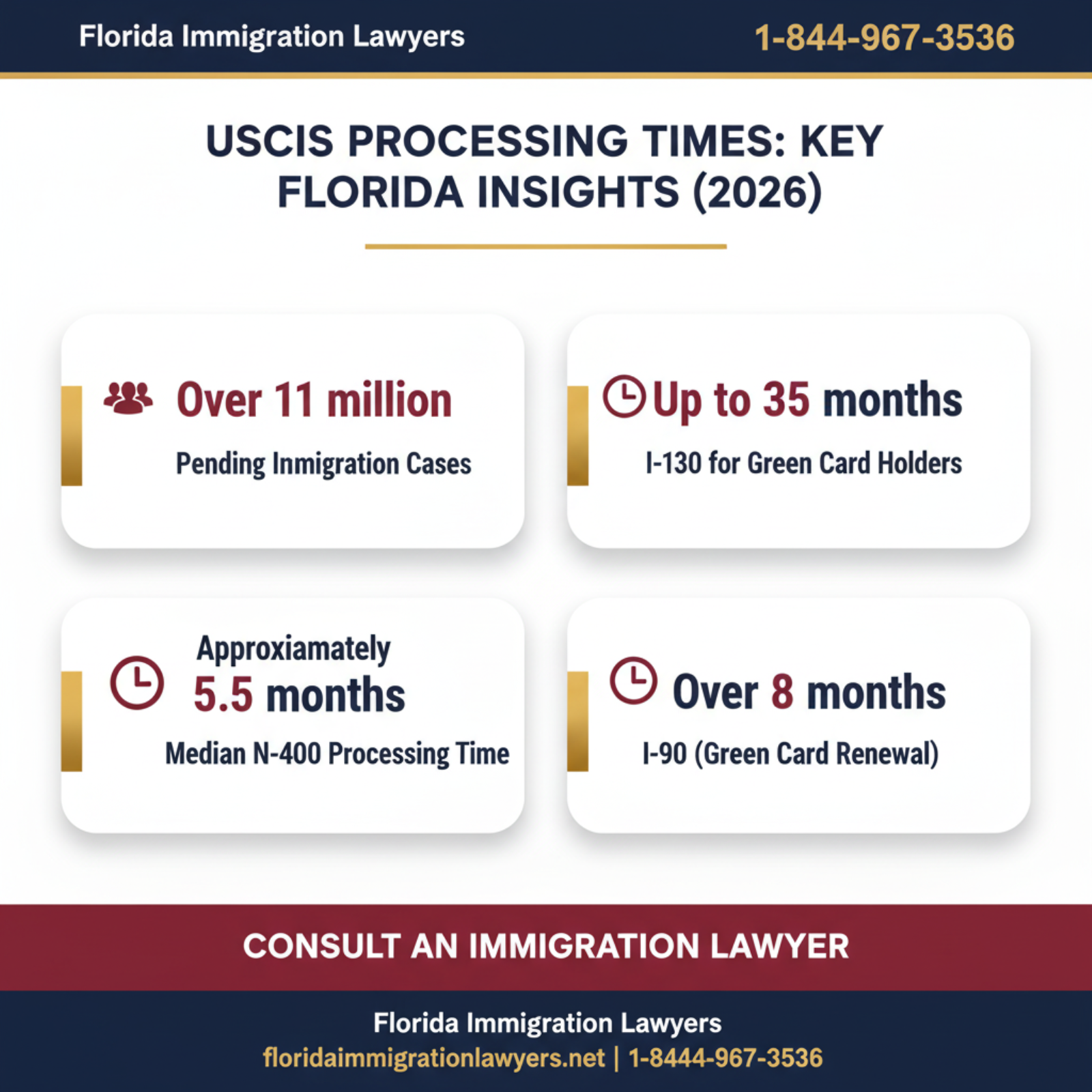
The processing time for Form I-130 varies significantly based on the relationship and whether the beneficiary is an immediate relative or falls into a preference category. For spouses of U.S. Citizens (IR1/CR1), processing can typically range from 10 to 18 months at a service center. However, if the case is transferred to a local field office in Florida (like Miami or Orlando) for concurrent I-485 filing, the overall process can be quicker.
For spouses of Lawful Permanent Residents (F2A category), the wait can be considerably longer due to visa bulletin backlogs, often extending beyond two years once an immigrant visa number becomes available. Other family categories (F1, F3, F4) face even longer waits, sometimes exceeding a decade, due to numerical limitations. So, how long does I-130 take to get approved in 2026? It depends heavily on the specific family preference category and the service center's workload, but expect several months to multiple years for most cases.
Form I-485 (Adjustment of Status) Processing Times Florida 2026
For those adjusting status within the U.S., Form I-485 processing times are often tied to the local USCIS field office jurisdiction. For applicants in West Palm Beach, your case would typically be handled by the Miami Field Office. Processing times in Florida for marriage-based I-485 applications (often filed concurrently with an I-130) can range from 8 to 18 months, including interview scheduling. Employment-based I-485s can also fall within a similar range, though premium processing for the underlying I-140 can expedite the initial petition.
How long is adjustment of status taking in 2026? While USCIS aims for efficiency, applicants should prepare for an average of 12-18 months for most I-485 applications in Florida, particularly those requiring an interview. Some cases might be faster, others slower, depending on individual circumstances and office backlogs. For comprehensive assistance with your adjustment of status or other immigration needs, explore our immigration services.
Form N-400 (Application for Naturalization) Processing Times Florida 2026
Becoming a U.S. citizen through naturalization is a significant step. Form N-400 processing times in Florida typically range from 10 to 18 months. This includes the biometric appointment, interview, and oath ceremony. Factors like the efficiency of your local field office (e.g., Miami for West Palm Beach residents) and the complexity of your background (e.g., travel history, good moral character review) can influence the timeline.
Other Key Forms and Processing Considerations
Other forms have their own specific processing times. For example, Form I-765 (Employment Authorization Document - EAD) and Form I-131 (Advance Parole) are often filed concurrently with an I-485 and can take 6-12 months. USCIS has made efforts to speed up EAD processing for certain categories. If you are concerned about specific forms like I-601 waiver processing times 2026 or green card processing, consulting an attorney is highly recommended. Our attorneys can provide tailored advice.
Is USCIS going to speed up in 2026?
USCIS has publicly committed to reducing backlogs and improving processing efficiency. Initiatives include hiring more staff, expanding online filing options, and streamlining internal processes. While these efforts are ongoing, applicants should remain realistic. Significant improvements are gradual, and localized backlogs can still impact individual cases. Therefore, while some improvements are hoped for, applicants should still plan for current average wait times.
Cost Factors and Fee Breakdown for USCIS Applications in Florida
Navigating the immigration process also involves understanding the associated costs. USCIS application fees are mandatory for most forms and are an important part of your overall planning. It is crucial to note that these fees are subject to change, so always refer to the official USCIS website for the most current information.
Application fees vary significantly by the type of form you are filing. For example, a Form I-130 petition will have a different fee than a Form I-485 application or a Form N-400 naturalization application. These fees are non-refundable, even if your application is denied. In addition to the application fee, most applicants will also pay a separate biometrics fee for fingerprinting and background checks.
Beyond USCIS fees, other costs may arise. These can include attorney fees for legal representation, which vary based on the complexity of your case and the services required. Other potential expenses include fees for required medical examinations (Form I-693), translation services for foreign-language documents, and travel costs for interviews or appointments. While we do not provide specific fee amounts here as they change, you can find detailed information on USCIS Fees directly on their website.
For individuals who meet specific income guidelines, USCIS offers fee waivers (Form I-912). Eligibility for a fee waiver is based on your household income being at or below 150% of the Federal Poverty Guidelines, receiving a means-tested benefit, or experiencing financial hardship. This option can be a significant help for eligible applicants. Our team at Florida Immigration Lawyers can help assess your eligibility for such waivers.
Do not navigate this complex process alone. Contact Florida Immigration Lawyers today to discuss your USCIS processing times Florida 2026 concerns and understand all associated costs. We offer free consultations to help you plan effectively.
Common Mistakes to Avoid When Dealing with USCIS Processing Times
To minimize delays and ensure a smoother process, be aware of these common pitfalls:
-
Submitting Incomplete Applications: Failing to include all required forms, documents, or signatures is a primary cause of delays. USCIS will issue a Request for Evidence (RFE) or even deny your application, forcing you to refile. Always double-check the instructions.
-
Providing Incorrect or Inconsistent Information: Any discrepancies in your application, such as different dates of birth or spellings, can raise red flags. This may lead to RFEs, interviews, or even accusations of misrepresentation, which can have severe legal consequences.
-
Missing Deadlines for RFEs or NOIDs: If USCIS requests additional evidence (RFE) or issues a Notice of Intent to Deny (NOID), failing to respond by the specified deadline can result in the denial or abandonment of your application. Always respond promptly and thoroughly.
-
Not Keeping Copies of All Submitted Documents: It is crucial to retain a complete copy of every form and supporting document you submit to USCIS. This serves as proof of submission and is invaluable if USCIS misplaces documents or requests them again.
-
Failing to Update Your Address with USCIS: If you move, you must inform USCIS of your new address within 10 days using Form AR-11. Failure to do so can result in missed notices, appointments, or even a denial due to undeliverable mail. This is particularly important for mobile populations in Florida.
-
Assuming Processing Times Are Fixed Guarantees: USCIS processing times are estimates, not promises. They can fluctuate based on various factors. Do not make critical life decisions based solely on the lowest end of the published range.
-
Traveling Internationally Without Advance Parole (for I-485 applicants): If you have a pending Form I-485 and travel outside the U.S. without an approved Advance Parole document (Form I-131), your adjustment of status application may be considered abandoned upon your return. This is a critical mistake.
-
Not Preparing Adequately for Interviews: For applications requiring an interview (e.g., I-485, N-400), showing up unprepared or without all requested documents can lead to delays or even denial. Review your application thoroughly and gather all original documents.
-
Ignoring USCIS Communications: Always open and review all mail from USCIS immediately. Crucial notices, appointment letters, and RFEs are time-sensitive. Ignoring them can jeopardize your case.
-
Not Seeking Legal Counsel for Complex Cases: Attempting to navigate complicated immigration matters, especially those involving prior denials, criminal history, or waivers, without an attorney can lead to critical errors. An experienced lawyer can identify potential issues and strategize solutions.
When to Call a Lawyer for Your USCIS Case in Florida
While some straightforward immigration applications can be managed independently, many situations warrant the expertise of an experienced immigration attorney. If you find yourself in any of the following scenarios, it is highly advisable to seek legal assistance from Florida Immigration Lawyers:
- Complex Case History: If you have any prior immigration denials, a criminal record, or previous deportation proceedings, your case is inherently complex. An attorney can help address these issues and present your case effectively. You can learn more about our deportation defense services.
- Receiving an RFE or NOID: A Request for Evidence (RFE) or Notice of Intent to Deny (NOID) indicates a potential problem with your application. Responding correctly and comprehensively is critical, and an attorney can help craft a strong response.
- Processing Times Significantly Exceeding Averages: If your case has been pending far longer than the published processing times, and you have not received any updates, an attorney can help investigate the delay and advocate on your behalf.
- Facing an Interview: Preparing for a USCIS interview, especially for adjustment of status or naturalization, can be daunting. An attorney can help you understand potential questions, review your application, and in some cases, attend the interview with you.
- Considering an Expedite Request: If you believe your situation warrants an expedite request, an attorney can help determine if you meet the strict criteria and assist in compiling the necessary evidence to support your claim.
- Questions About Eligibility: If you are unsure about your eligibility for a specific immigration benefit or which pathway is best for you, an attorney can provide clear guidance based on your unique circumstances.
- Threat of Deportation or Removal Proceedings: If you or a loved one are facing removal proceedings, immediate legal intervention is paramount. This is a serious legal matter requiring specialized knowledge.
Our team at Florida Immigration Lawyers understands the nuances of USCIS processing times Florida 2026 and the specific challenges faced by applicants in West Palm Beach and throughout the state. We can help you navigate the system, avoid common mistakes, and work towards a successful outcome. Do not leave your future to chance. Contact us today.
About Florida Immigration Lawyers
Florida Immigration Lawyers is a leading immigration law firm dedicated to serving individuals and families across the entire state of Florida. With years of experience and a deep understanding of U.S. immigration law, our firm is committed to providing compassionate, effective, and results-driven legal representation.
We offer a comprehensive range of immigration services, including family-based petitions, employment visas, adjustment of status, naturalization, asylum claims, and deportation defense. Our attorneys stay current with the latest immigration policies and procedures, ensuring that our clients receive the most accurate and up-to-date advice.
Why Choose Florida Immigration Lawyers? We pride ourselves on our client-centric approach, transparent communication, and unwavering dedication to achieving the best possible outcomes for our clients. We understand the profound impact immigration matters have on your life and are here to provide the support and advocacy you need.
We are available 24/7 to address your urgent legal needs and offer free, confidential consultations to discuss your case. Serving all of Florida, including West Palm Beach, Miami, Orlando, and Tampa, we are your trusted partners in immigration. Call us today at 1-844-967-3536 or visit our website at https://www.floridaimmigrationlawyers.net to learn more.
Sources and References
- U.S. Citizenship and Immigration Services (USCIS)
- USCIS Case Status Online
- USCIS Processing Times
- USCIS Fees
- U.S. Department of State (Travel.State.Gov)
- Executive Office for Immigration Review (EOIR)
- 8 U.S.C. Chapter 12 - Immigration and Nationality Act (INA)
- 8 CFR (Code of Federal Regulations pertaining to Immigration)
- USCIS Policy Manual
This article provides general legal information and is not intended as legal advice. Every case is unique, and outcomes depend on specific facts and circumstances. Contact an attorney for advice about your particular situation. Immigration laws are subject to change, and this content reflects information as of the date of publication.
Do not let uncertainty about USCIS processing times Florida 2026 hinder your immigration journey. Get the clear answers and dedicated support you deserve. The path to achieving your immigration goals in Florida can be complex, but you do not have to walk it alone. Call Florida Immigration Lawyers today at 1-844-967-3536 for your free consultation. Se Habla Español - Estamos aquí para ayudarle.
Do Not Navigate This Process Alone
Our experienced immigration attorneys are ready to fight for you. Get a free, confidential consultation today.
Se Habla Español
Frequently Asked Questions
Florida Immigration Lawyers
Immigration Attorney | Founder, Vasquez Law Firm
U.S. Air Force veteran and immigration attorney with thousands of cases resolved. J.D., NCCU School of Law. AILA member. Admitted to the 4th, 5th, and 11th Circuit Courts.
Available 24/7 - Free Evaluations
Related Legal Services
Our Florida immigration attorneys can help you with deportation defense, citizenship and naturalization and family immigration services. Call today at 1-844-967-3536 for a free consultation.
Related Links
Related Topics
Free Legal Consultation
Discuss your case with our experienced attorneys. We're available 24/7.
Se Habla Español - Estamos aquí para ayudarle.
Related Articles
Expungement Effect on Immigration in Florida | VLF Florida
Discover how expungement impacts immigration in Florida. Learn about eligibility, the process, and potential consequences. Contact Florida Immigration Lawyers at 1-844-967-3536 for a free consultation.
Immigration Services in Kissimmee Florida | VLF Florida
Discover essential immigration services in Kissimmee, Florida. Learn about the resources available for immigrants, including Puerto Rican residents in Osceola County. Contact Florida Immigration Lawyers at 1-844-967-3536 for expert guidance and a free consultation.
Child Status Protection Act (CSPA) Florida: Preventing 'Aging
Understand the Child Status Protection Act (CSPA) in Florida and how it prevents 'aging out' for derivative beneficiaries. Navigate complex immigration laws
I-360 Widow Self-Petition in Florida: A Complete Guide
Learn how to navigate the I-360 widow self-petition process in Florida. This comprehensive guide covers eligibility, documentation, and common mistakes. Call Florida Immigration Lawyers for expert assistance.