USCIS Green Card Removal Proceedings: Florida Guide 2026
Facing USCIS green card removal proceedings in Florida can be incredibly stressful for conditional permanent residents. This comprehensive guide explains the Form I-751 process, potential triggers for removal, and essential steps to protect your status. Learn about required documents, processing timelines, and common mistakes to avoid. We cover what happens if your I-751 is denied, leading to immigration court, and address frequently asked questions. Discover when to seek legal counsel from an experienced immigration lawyer to navigate these complex challenges in Pembroke Pines and throughout Florida.
If you are a conditional permanent resident facing USCIS green card removal proceedings in Florida, it means the government is trying to revoke your residency. This typically occurs if your Form I-751, Petition to Remove Conditions on Residence, is denied or if you have violated immigration laws. Protecting your status requires immediate, strategic legal action to avoid deportation.
- Removal proceedings can be initiated if your I-751 petition is denied.
- Understanding the process and your rights is crucial for conditional permanent residents.
- Seeking legal counsel from an experienced immigration lawyer is highly recommended.
- Florida residents in Pembroke Pines and across the state face specific court procedures.
USCIS Green Card Removal Proceedings: Florida Guide 2026
Imagine building a life in Florida, settling in Pembroke Pines, and then receiving a notice that threatens your permanent residency. For many conditional permanent residents, this fear becomes a reality when they face USCIS green card removal proceedings. This complex legal situation can arise from various circumstances, often stemming from issues with the Form I-751, Petition to Remove Conditions on Residence.
We understand the anxiety and uncertainty you may feel. Your green card is more than just a document; it represents your future, your family, and your home. Our goal with this comprehensive guide is to demystify the process, explain your rights, and empower you with the knowledge you need to navigate these challenging waters in Florida.
This article will cover the intricacies of conditional permanent residence, the reasons for removal proceedings, and the steps you can take to defend your status. We will also highlight the importance of legal representation. Do not face this alone. Call Florida Immigration Lawyers at 1-844-967-3536 for a free consultation. We are here to help you protect your future.
Understanding Conditional Permanent Residence and Removal Proceedings
Conditional permanent residence is granted to individuals who obtain their green card through marriage to a U.S. citizen or lawful permanent resident, or through certain investor programs. This status is typically valid for two years. Before the two-year period expires, you must file Form I-751, Petition to Remove Conditions on Residence, to convert your conditional status into permanent residency.
Failure to file the I-751, or a denial of your petition, can lead to serious consequences, including the initiation of USCIS green card removal proceedings. In these proceedings, the U.S. government seeks to remove you from the country. This is a formal legal process heard before an Immigration Judge at an Executive Office for Immigration Review (EOIR) court, such as those in Miami or Orlando, Florida.
The purpose of the I-751 is to prove that your marriage was bona fide, meaning it was entered into for love and not solely to obtain an immigration benefit. If USCIS doubts the legitimacy of your marriage, or if other issues arise, your I-751 may be denied. This denial often triggers a Notice to Appear (NTA), which formally places you in removal proceedings.
Even if you have a conditional permanent residence green card, you are not immune from removal. Certain criminal offenses, immigration violations, or misrepresentations can also lead to removal proceedings. It is crucial to understand that these proceedings are serious and require a robust defense.
What Triggers USCIS Green Card Removal Proceedings?
Several factors can lead to USCIS green card removal proceedings for conditional permanent residents. The most common trigger is the denial of an I-751 petition. This denial can occur for various reasons, including:
- Insufficient evidence: You failed to provide enough documentation to prove your marriage was legitimate.
- Divorce or annulment: If your marriage ended before your I-751 was approved, especially if you filed jointly.
- Fraud or misrepresentation: USCIS suspects you entered into a fraudulent marriage.
- Failure to appear: Missing an interview appointment with USCIS without valid reason.
- Criminal offenses: Certain criminal convictions can make you deportable, regardless of your I-751 status.
Understanding these triggers is the first step in preventing or effectively responding to a Notice to Appear. Our firm specializes in helping clients in Pembroke Pines and throughout Florida address these complex issues.
Step-by-Step Guide: Navigating the I-751 Process and Beyond
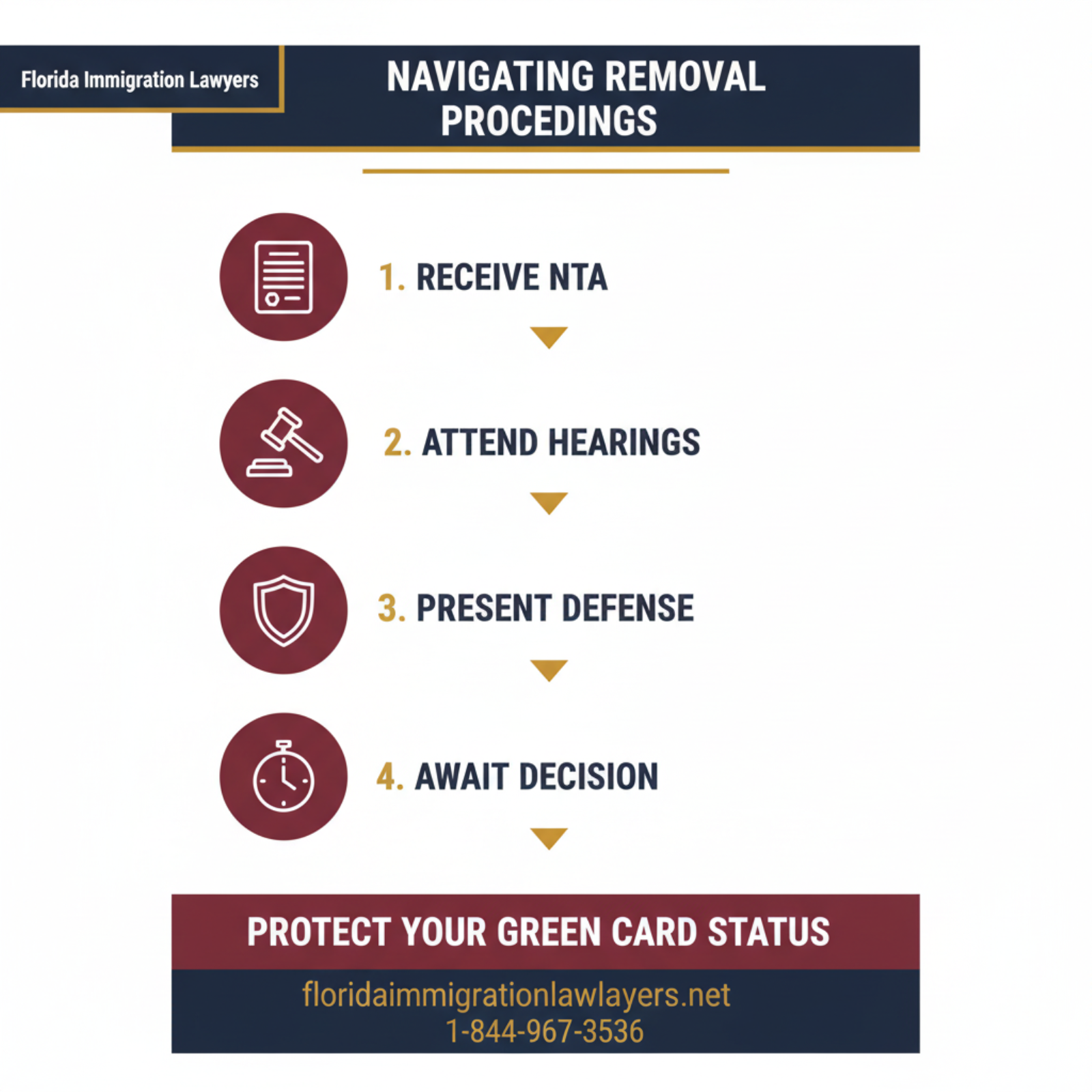
Successfully removing conditions on your green card is paramount to avoiding USCIS green card removal proceedings. Here is a simplified guide to the process, including what happens if you receive an NTA.
-
File Form I-751, Petition to Remove Conditions on Residence:
You must file this form within the 90-day period immediately preceding the expiration date on your conditional green card. If you file jointly with your spouse, you both sign. If you are filing with a waiver due to divorce, abuse, or death of your spouse, you can file at any time after becoming a conditional resident and before being removed.
-
Receive Receipt Notice (I-797C):
After filing, USCIS will send you a Form I-797C, Notice of Action. This notice extends your conditional permanent resident status, typically for 18-48 months, allowing you to continue working and traveling while your petition is pending. Keep this document with your expired green card.
-
Attend Biometrics Appointment:
USCIS will schedule you for a biometrics appointment at an Application Support Center (ASC). Here, your fingerprints, photograph, and signature will be collected for background checks.
-
Potential Interview with USCIS:
While not every I-751 petition requires an interview, USCIS may call you and your spouse for one, especially if there are concerns about the bona fides of your marriage or if you filed with a waiver. Preparing thoroughly for this interview is essential.
-
Decision on I-751:
If your I-751 is approved, USCIS will send you a new 10-year permanent resident card. If it is denied, USCIS will typically issue a Notice to Appear (NTA), initiating USCIS green card removal proceedings before an Immigration Judge.
-
If You Receive a Notice to Appear (NTA):
An NTA means you are officially in removal proceedings. You will be given a date and time for your first hearing, known as a Master Calendar Hearing, at an immigration court in Florida, such as the Miami Immigration Court or the Orlando Immigration Court. It is critical to have legal representation at this stage.
-
Removal Proceedings in Immigration Court:
In immigration court, an Immigration Judge will hear your case. You will have the opportunity to present evidence, call witnesses, and argue why you should be allowed to remain in the U.S. This could involve renewing your I-751 application with the judge or seeking other forms of relief from removal, such as asylum or deportation defense.
Essential Document Checklist for I-751 Petition
A well-prepared I-751 petition is your strongest defense against potential USCIS green card removal proceedings. Gathering comprehensive documentation is key. Here is a list of documents typically required:
- Copy of your conditional permanent resident card (front and back).
- Copy of your spouse's green card or U.S. passport (if applicable).
- Copy of your marriage certificate.
- Birth certificates of any children born to your marriage.
- Joint financial documents:
- Joint bank account statements.
- Joint tax returns (filed jointly).
- Joint utility bills (electricity, water, internet).
- Joint credit card statements.
- Joint leases or mortgages.
- Evidence of cohabitation:
- Leases, mortgages, or property deeds showing joint ownership or tenancy.
- Correspondence addressed to both spouses at the same address.
- Other evidence of bona fide marriage:
- Affidavits from friends, family, or employers attesting to the legitimacy of your marriage.
- Photographs of you and your spouse together (wedding, holidays, family events).
- Travel itineraries and tickets from joint vacations.
- Life insurance policies, wills, or retirement accounts listing each other as beneficiaries.
- Medical records showing joint appointments or shared insurance.
Step-by-Step Process Guide - If filing with a waiver (e.g., divorce, abuse, death of spouse):
- Copy of divorce decree or annulment.
- Police reports, court documents, or medical records related to abuse.
- Death certificate of your spouse.
- Any additional documentation requested by USCIS.
Organizing these documents thoroughly will strengthen your case and demonstrate the legitimacy of your marriage to USCIS.
Timeline and Processing Expectations for I-751
The I-751 processing time can vary significantly, which often adds to the stress for conditional permanent residents in Florida. USCIS processing times are subject to change based on caseloads and policy updates. As of early 2026, many I-751 petitions are taking anywhere from 18 to 48 months to process.
After filing your I-751, you will typically receive a receipt notice within a few weeks. This notice extends your conditional status, allowing you to maintain your lawful presence and work authorization. The biometrics appointment usually follows within a few months.
Interviews are not always required for I-751 petitions, especially for joint filings with strong evidence. However, if an interview is scheduled, it can add several months to the overall timeline. Delays can also occur if USCIS issues a Request for Evidence (RFE), requiring you to submit additional documentation.
If your I-751 is ultimately denied, the transition to USCIS green card removal proceedings can be relatively swift. An NTA might be issued soon after the denial. The immigration court process itself can also be lengthy, often taking years depending on the court's docket and the complexity of your case. Throughout this period, having a knowledgeable immigration attorney is invaluable.
Do not navigate this process alone. Contact Florida Immigration Lawyers today.
Cost Factors and Fee Breakdown for I-751
Understanding the costs associated with the removal of conditions green card process is important. The primary cost is the USCIS filing fee for Form I-751. This fee is subject to change, so it is crucial to check the official USCIS website for the most current amount before filing. There is also a separate biometrics fee.
These fees are non-refundable, regardless of the outcome of your petition. Therefore, ensuring your application is complete and accurate is vital to avoid unnecessary costs and delays. If your petition leads to USCIS green card removal proceedings, additional legal fees will be incurred.
Legal fees for an immigration lawyer in Florida can vary based on the complexity of your case and the services required. Initial consultations are often free, allowing you to discuss your situation and understand potential costs. Our firm offers transparent fee structures to help you plan accordingly.
Investing in experienced legal counsel can save you significant time, stress, and potentially higher costs in the long run, especially if you face removal proceedings. We serve clients throughout Florida, including Pembroke Pines, providing dedicated representation for complex immigration matters.
Addressing Common Questions About Conditional Green Cards
Many conditional permanent residents in Florida have questions about their status and potential challenges. Here, we address some common inquiries that often arise, especially when considering USCIS green card removal proceedings.
What happens if you marry a U.S. citizen and then divorce?
If your marriage to a U.S. citizen or lawful permanent resident ends in divorce before your conditional green card status is removed, you can still file Form I-751. You will need to file with a waiver based on divorce, demonstrating that the marriage was entered into in good faith, even though it subsequently ended. You must provide compelling evidence of a bona fide marriage at its inception. Without a strong waiver application, this situation can lead to USCIS green card removal proceedings.
Is immigration deporting green card holders?
Yes, lawful permanent residents, including green card holders, can be placed in removal proceedings and deported under certain circumstances. This typically occurs due to serious criminal convictions, immigration fraud, or certain violations of immigration law. While a green card provides significant protection, it does not grant absolute immunity from deportation. Those with conditional permanent residence are particularly vulnerable if their I-751 is denied.
Can you get a green card if you have diabetes?
Generally, having a medical condition like diabetes does not prevent you from obtaining a green card, provided it is well-managed and does not pose a public health risk. Immigration medical examinations focus on communicable diseases of public health significance and certain physical or mental disorders. Diabetes itself is typically not a disqualifying condition for a green card. This question is not directly related to USCIS green card removal proceedings, but it highlights common concerns about eligibility.
Why are green cards being revoked?
Green cards can be revoked for various reasons, including:
- Fraudulent marriage: If USCIS determines the marriage was entered into solely for immigration benefits.
- Criminal convictions: Certain felonies or crimes involving moral turpitude can lead to revocation.
- Abandonment of residency: Extended periods outside the U.S. without proper re-entry permits can signal abandonment.
- Failure to remove conditions: For conditional green card holders, failure to file or denial of the I-751 petition.
- Misrepresentation: Providing false information on immigration forms.
These actions can all lead to USCIS green card removal proceedings. Each situation is unique and requires a careful legal analysis.
Common Mistakes to Avoid in Conditional Green Card Cases
Navigating the conditional green card process and avoiding USCIS green card removal proceedings is challenging. Many individuals make critical errors that can jeopardize their status. Be aware of these common pitfalls:
-
Failing to File Form I-751 on Time:
Consequence: Missing the 90-day window before your conditional green card expires can lead to automatic termination of your status and initiation of removal proceedings. You lose your legal status if you don't file within the specified period.
-
Submitting Insufficient Evidence of Bona Fide Marriage:
Consequence: USCIS may doubt the legitimacy of your marriage, leading to an interview, a Request for Evidence (RFE), or even a denial of your I-751 petition, which can trigger removal proceedings.
-
Not Updating USCIS with New Address:
Consequence: Missing crucial notices, interview appointments, or RFEs because USCIS sends mail to an old address. This can result in delays, denials, or even an "in absentia" removal order if you miss a court date.
-
Attending USCIS Interviews Unprepared or Without Counsel:
Consequence: Inconsistent answers, appearing nervous, or failing to present your case effectively can raise red flags for USCIS officers, potentially leading to increased scrutiny or denial.
-
Ignoring a Request for Evidence (RFE):
Consequence: Failing to respond fully and on time to an RFE will almost certainly result in the denial of your I-751 petition, directly leading to USCIS green card removal proceedings.
-
Filing Jointly After a Divorce Without a Waiver:
Consequence: If your marriage has ended, filing jointly is inappropriate and will lead to denial. You must file with a waiver, providing specific evidence for that waiver. Failure to do so jeopardizes your case.
-
Having Criminal Issues While Your I-751 is Pending:
Consequence: Any arrest or conviction, even for minor offenses, can complicate your case significantly and make you inadmissible or deportable, potentially leading to immediate removal proceedings.
-
Lying or Misrepresenting Facts to USCIS:
Consequence: Immigration fraud carries severe penalties, including permanent bars from immigration benefits and immediate placement in USCIS green card removal proceedings.
-
Assuming Your Status is Safe Because You Filed I-751:
Consequence: While filing extends your status, it does not guarantee approval. You must remain vigilant, respond to all USCIS requests, and continue to abide by all immigration laws.
-
Traveling Internationally Without Proper Documentation:
Consequence: Attempting to re-enter the U.S. with an expired conditional green card but without a valid I-797C receipt notice can lead to issues at the port of entry, including potential denial of re-entry.
-
Not Seeking Legal Advice Early Enough:
Consequence: Waiting until a denial or NTA is issued often leaves less time and fewer options for a robust defense. Early intervention from an experienced attorney can prevent many problems.
When to Call a Florida Immigration Lawyer
Facing USCIS green card removal proceedings is one of the most stressful experiences an immigrant can endure. The stakes are incredibly high, affecting your ability to live, work, and remain with your family in the United States. While some I-751 cases may seem straightforward, certain scenarios absolutely demand the expertise of a seasoned Florida immigration lawyer.
You should immediately consult with Florida Immigration Lawyers if any of the following apply to your situation:
- You have received a Notice to Appear (NTA) in immigration court.
- Your Form I-751 petition has been denied by USCIS.
- You are filing an I-751 waiver due to divorce, abuse, or death of your spouse.
- USCIS has issued a Request for Evidence (RFE) regarding your I-751 petition.
- You have a criminal record, even if it seems minor.
- You have been accused of marriage fraud or misrepresentation.
- You have been out of the U.S. for extended periods.
- You anticipate difficulties proving the bona fides of your marriage.
- You are unsure about the required documentation or the filing process.
- You have missed an interview or appointment with USCIS.
Our team at Florida Immigration Lawyers has extensive experience in deportation defense and complex I-751 cases. We understand the specific nuances of Florida immigration courts and USCIS field offices, including those serving Pembroke Pines. We are dedicated to providing aggressive and compassionate representation to protect your rights and your future. Let us help you navigate these critical challenges and fight for your ability to stay in Florida.
About Florida Immigration Lawyers
Florida Immigration Lawyers is a leading immigration law firm dedicated to serving individuals and families across the entire state of Florida. With a deep understanding of U.S. immigration law and its impact on our clients' lives, we provide comprehensive and compassionate legal services.
Our firm specializes in a wide range of immigration matters, including family-based petitions, business visas, citizenship applications, asylum claims, and robust deportation defense. We pride ourselves on offering personalized attention and strategic advice tailored to each client's unique circumstances.
Why choose Florida Immigration Lawyers? We are committed to achieving the best possible outcomes for our clients. Our attorneys are highly experienced, dedicated advocates who work tirelessly to navigate the complexities of immigration law. We offer free consultations and are available 24/7 to address your urgent legal needs. Our bilingual team ensures that language is never a barrier to quality legal representation.
Contact us today for a free consultation: 1-844-967-3536. Visit our website: https://www.floridaimmigrationlawyers.net. We are here to serve all of Florida, including our neighbors in Pembroke Pines and surrounding communities.
Sources and References
- U.S. Citizenship and Immigration Services (USCIS) - Form I-751
- Executive Office for Immigration Review (EOIR) - Immigration Courts
- 8 U.S.C. § 1186a - Conditional permanent resident status for certain alien spouses and sons and daughters.
- 8 C.F.R. § 216.4 - Petition to remove conditions by alien spouse.
- Immigration and Nationality Act (INA) Section 216 - Conditional Permanent Resident Status.
This article provides general legal information and is not intended as legal advice. Every case is unique, and outcomes depend on specific facts and circumstances. Contact an attorney for advice about your particular situation.
If you are facing the daunting prospect of USCIS green card removal proceedings in Florida, or simply need guidance on your I-751 petition, do not delay. Your future in the U.S. depends on timely and effective legal action. Our compassionate and experienced team at Florida Immigration Lawyers is ready to stand by your side.
Call Florida Immigration Lawyers today at 1-844-967-3536 for a free, confidential consultation. Se Habla Español - Estamos aquí para ayudarle.
Need help with Immigration?
Our Florida immigration attorneys offer free consultations. Call today or schedule online.
Frequently Asked Questions
Florida Immigration Lawyers
Legal Team
Our experienced attorneys at Florida Immigration Lawyers have been serving clients across Florida for over 20 years. We specialize in immigration, personal injury, criminal defense, workers compensation, and family law.