Adjustment of Status Florida Guide 2026: Your Path to a Green Card
Discover a comprehensive guide to adjustment of status in Florida for 2026. This detailed resource from Florida Immigration Lawyers covers eligibility, the I-485 application process, required documents, and expected timelines for securing your green card. Learn about common pitfalls to avoid and when expert legal assistance is crucial. We provide vital information for individuals in Tampa and across Florida seeking permanent residency. Contact our firm for a free consultation to start your journey.
Adjustment of status allows eligible individuals already present in the U.S. to obtain lawful permanent resident (green card) status without leaving the country. This process typically involves filing Form I-485, Application to Register Permanent Residence or Adjust Status, with USCIS. Eligibility often hinges on a qualifying immigrant petition and a lawful entry or other specific legal pathways. The process can be complex, requiring careful documentation and adherence to strict guidelines.
- Apply for a green card from within the U.S.
- Requires a qualifying immigrant petition.
- Form I-485 is central to the application.
- Legal assistance can simplify the complex process.
- Eligibility depends on specific immigration categories.
Are you living in Florida and dreaming of making the Sunshine State your permanent home? Navigating the U.S. immigration system can feel overwhelming, especially when seeking to adjust your status and secure a green card. Many individuals, like you, wish to transition from a temporary visa or other lawful status to permanent residency without the need to travel abroad. This process, known as adjustment of status, offers a pathway to a secure future right here in the United States.
This comprehensive guide from Florida Immigration Lawyers will walk you through the intricacies of the adjustment of status process in Florida for 2026. We will cover eligibility requirements, the step-by-step application, necessary documents, expected timelines, and common pitfalls to avoid. Our goal is to empower you with the knowledge needed to pursue your green card journey with confidence. For personalized guidance and to discuss your specific situation, call Florida Immigration Lawyers at 1-844-967-3536 for a free consultation.
Understanding Adjustment of Status in Florida
Adjustment of status is a vital immigration procedure that permits eligible foreign nationals to apply for lawful permanent resident status, or a green card, while remaining in the United States. This is a crucial distinction from consular processing, which requires applicants to apply for an immigrant visa at a U.S. embassy or consulate abroad. For many living in Florida, including those in Tampa, Orlando, Miami, and Jacksonville, adjusting status is the preferred method to obtain a green card.
This process is governed by federal immigration law, primarily the Immigration and Nationality Act (INA), but its practical application often involves local USCIS field offices. The Tampa Field Office, for instance, handles interviews for many adjustment of status applicants residing in Central Florida. Understanding the local context, alongside federal regulations, is key to a successful application.
Eligibility Requirements for Adjustment of Status
Not everyone can adjust their status. Generally, you must meet several key criteria to be eligible. The most fundamental requirement is that you must be physically present in the United States when you file your Form I-485, Application to Register Permanent Residence or Adjust Status. Furthermore, you must have an immigrant visa immediately available to you at the time of filing your application and at the time USCIS makes a final decision.
This usually means you are the beneficiary of an approved immigrant petition, such as an I-130 Petition for Alien Relative or an I-140 Immigrant Petition for Alien Worker. Your visa category must be current according to the latest Visa Bulletin issued by the Department of State, unless you are an immediate relative of a U.S. citizen (spouse, unmarried child under 21, or parent of a U.S. citizen 21 or older). Immediate relatives are always considered to have an immigrant visa immediately available.
Common Paths to Adjustment of Status
There are several common pathways through which individuals typically seek adjustment of status. The most frequent include family-based immigration, employment-based immigration, and special immigrant categories. Each path has its own specific set of eligibility requirements and documentation.
- Family-Based Adjustment of Status: This category is for relatives of U.S. citizens or lawful permanent residents. It includes spouses, children, parents, and siblings. For immediate relatives of U.S. citizens, the process can often be filed concurrently with the immigrant petition. We frequently assist clients with family-based immigration matters.
- Employment-Based Adjustment of Status: This path is for individuals sponsored by a U.S. employer. It covers a wide range of professions and skill levels, often requiring a labor certification from the Department of Labor. Our firm has extensive experience with business immigration cases.
- Asylum Seekers and Refugees: Individuals granted asylum or refugee status in the U.S. may be eligible to adjust their status to lawful permanent resident after one year. For more information, please visit our page on asylum.
- Special Immigrant Juvenile Status (SIJS): This is for certain undocumented immigrant children in the U.S. who have been abused, abandoned, or neglected by one or both parents.
The I-485 Application Process: A Step-by-Step Guide
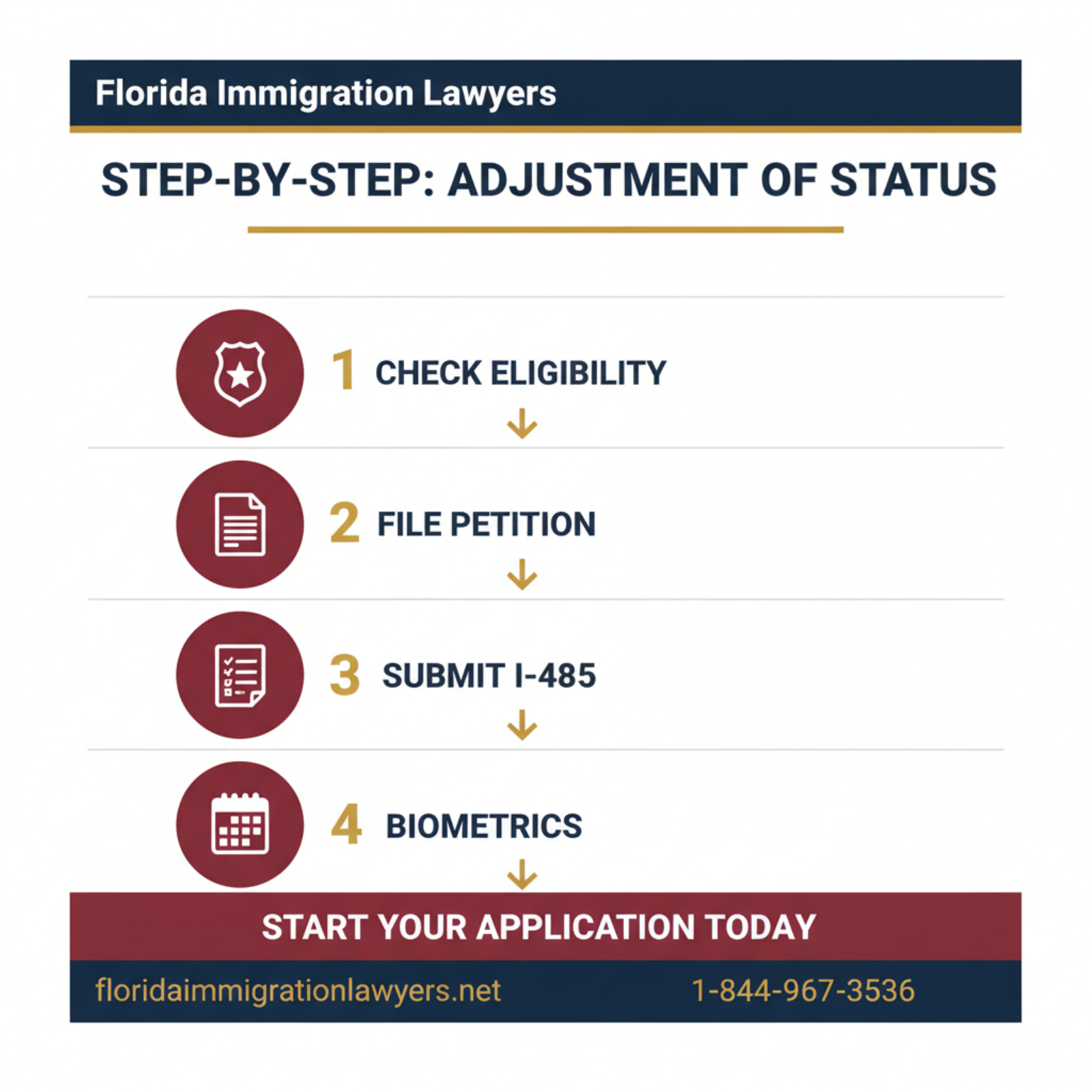
The journey to obtaining your green card through adjustment of status involves several critical steps, each requiring careful attention to detail. This process is centered around Form I-485, but it encompasses much more than just filling out a single form. Missing a step or failing to provide accurate information can lead to significant delays or even denial.
-
Determine Eligibility and Immigrant Visa Availability: Before anything else, you must confirm that you meet the general eligibility criteria for adjustment of status. This includes having a qualifying basis (e.g., an approved I-130 or I-140 petition) and an immigrant visa number available. Check the latest Visa Bulletin on travel.state.gov if you are not an immediate relative.
-
Gather Required Documents: This is perhaps the most time-consuming phase. You will need to collect a wide array of personal, financial, and immigration-related documents. This includes birth certificates, marriage certificates, passport copies, photographs, medical examination results, and proof of your lawful entry into the U.S. A detailed document checklist is provided below.
-
Complete and File Form I-485 and Supporting Forms: The core of your application is Form I-485, Application to Register Permanent Residence or Adjust Status. You will also typically need to file Form I-765 (Application for Employment Authorization) and Form I-131 (Application for Travel Document) concurrently. Filing these forms together ensures you can work and travel while your green card application is pending. Ensure all forms are filled out accurately and completely. Attach all required supporting documentation and pay the correct fees. For current fee information, always consult the official USCIS website.
-
Attend Biometrics Appointment: After USCIS accepts your application, you will receive an appointment notice for biometrics. This appointment, typically held at a local Application Support Center (ASC) in Florida, involves fingerprinting, photographs, and a signature capture. These biometrics are used for background checks and identity verification. It is crucial to attend this appointment as scheduled.
-
Prepare for and Attend Your Interview: Most adjustment of status applicants are required to attend an interview at a USCIS field office, such as the one in Tampa or Orlando. During the interview, an immigration officer will review your application, ask questions about your eligibility, and verify the information you provided. For family-based petitions, especially those based on marriage, the interview will assess the bona fides of your relationship. It is wise to prepare thoroughly with an attorney.
-
Receive a Decision: Following your interview, USCIS will make a decision on your adjustment of status application. If approved, you will typically receive your physical green card in the mail within a few weeks. If denied, USCIS will provide a written explanation for the denial. In some cases, a denial can lead to deportation proceedings, making legal representation even more critical. Our deportation defense attorneys are ready to assist if you face such a situation.
Document Checklist: Preparing Your Adjustment of Status Application
A meticulously prepared set of documents is fundamental to a successful adjustment of status application. Any missing or incorrect documents can cause significant delays or even a Request for Evidence (RFE) from USCIS. Always submit copies unless originals are specifically requested, but be ready to present originals at an interview.
- Form I-485, Application to Register Permanent Residence or Adjust Status: Completed and signed.
- Copy of Immigrant Petition Approval: E.g., Form I-130 or I-140 approval notice.
- Two Passport-Style Photos: Meeting USCIS specifications.
- Copy of Government-Issued Photo Identification: Such as a driver's license.
- Copy of Birth Certificate: With certified English translation if not in English.
- Copy of Passport Biographic Page: Showing name, photo, date of birth.
- Copy of Visa Page and Admission Stamp: Showing your last lawful entry into the U.S. (Form I-94 arrival/departure record).
- Form I-693, Report of Medical Examination and Vaccination Record: Completed by a USCIS-authorized civil surgeon, submitted in a sealed envelope.
- Form I-864, Affidavit of Support: If applicable, from your petitioner/sponsor, with supporting financial documents (tax returns, W-2s, pay stubs).
- Form I-765, Application for Employment Authorization: If you wish to work while your I-485 is pending.
- Form I-131, Application for Travel Document: If you wish to travel outside the U.S. while your I-485 is pending (Advance Parole).
- Marriage Certificate: If applying based on marriage to a U.S. citizen or LPR.
- Divorce Decrees or Death Certificates: For any prior marriages of you or your spouse.
- Evidence of Bona Fide Marriage: For marriage-based cases, such as joint bank accounts, leases, utility bills, photos, affidavits from friends/family.
- Police Clearances: If required based on your history or country of origin.
- Certified Court and Prison Records: For any arrests or convictions.
- Evidence of any prior immigration applications or petitions.
Timeline and Expectations: What to Anticipate for Your Green Card
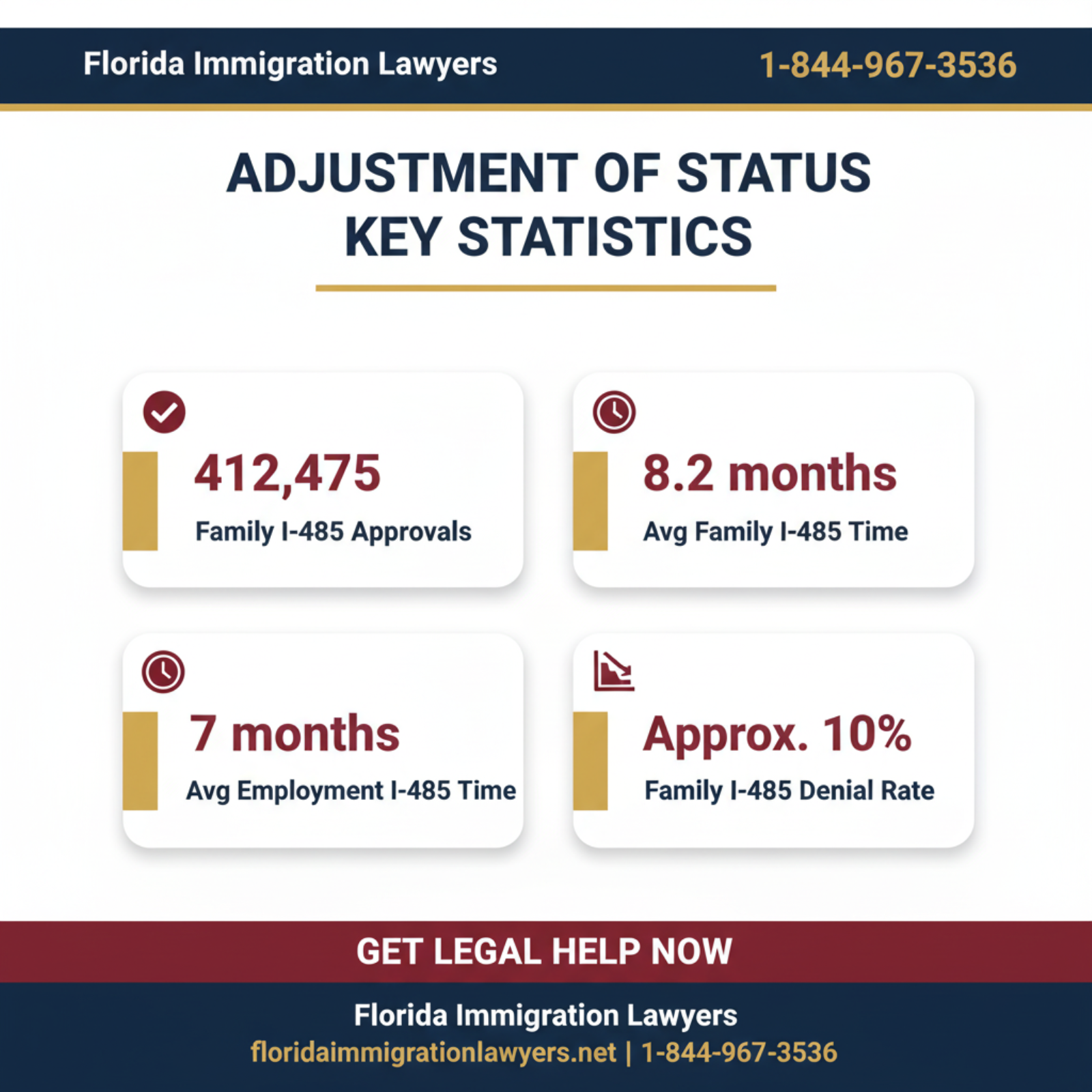
The processing time for adjustment of status applications can vary significantly, influenced by factors such as the USCIS field office workload, the specific immigrant visa category, and the completeness of your application. While we aim to provide general expectations for 2026, it is crucial to remember that these are estimates and actual times may differ. You can always check the USCIS processing times tool for the most current information.
Historically, processing times for Form I-485 can range from 8 months to over 2 years, sometimes even longer for complex cases or specific visa categories. Immediate relatives of U.S. citizens often experience faster processing compared to preference categories that are subject to visa bulletin backlogs. For applicants in Florida, the Tampa, Orlando, and Miami field offices handle a high volume of cases, which can impact local processing speeds.
- Initial Filing and Receipt Notice: Within a few weeks of filing, you should receive receipt notices (Form I-797C) for your I-485, I-765, and I-131.
- Biometrics Appointment: Typically scheduled 3-8 weeks after filing.
- Employment Authorization Document (EAD) and Advance Parole (AP): If filed concurrently, the EAD/AP card (often combined) usually arrives within 5-12 months. This allows you to work and travel internationally while your adjustment of status application is pending.
- Interview Scheduling: This can vary widely, from several months to over a year after filing, depending on your case type and the field office.
- Decision: A decision is often made at the interview or within a few weeks to months afterward.
What is the 90-day rule for adjustment of status? The 90-day rule is an informal guideline used by immigration officers to assess an applicant's intent. It suggests that if you engage in activities inconsistent with your non-immigrant visa status (like getting married to a U.S. citizen or applying for a green card) within 90 days of entry, USCIS may presume you misrepresented your intent when entering the U.S. This presumption can be overcome, but it adds complexity. It is not a strict legal rule but a guideline for evaluating intent.
Which gets approved first, I-130 or I-485? Generally, the I-130 petition (Immigrant Petition for Alien Relative) must be approved or concurrently filed before the I-485 (Adjustment of Status) can be processed for most categories. For immediate relatives of U.S. citizens, the I-130 and I-485 can often be filed at the same time (concurrent filing). In other categories, the I-130 must be approved and a visa number must be available for you to file the I-485. The I-130 establishes the qualifying relationship, while the I-485 is the actual application for the green card.
Cost Factors and Fee Breakdown for Adjustment of Status
The financial aspect of applying for adjustment of status is an important consideration. The total cost typically includes USCIS filing fees, medical examination fees, and attorney fees if you choose to hire legal representation. It is crucial to budget for these expenses. USCIS fees are subject to change, so always verify the latest amounts directly on the official USCIS website before filing.
- USCIS Filing Fees:
- Form I-485: This is the primary fee for the adjustment of status application.
- Biometrics Fee: This fee is usually included with the I-485 filing fee for most applicants.
- Form I-130: If you are filing a family-based petition concurrently, there will be a separate fee for this petition.
- Form I-765 (EAD) and Form I-131 (Advance Parole): For many adjustment of status applicants, these forms can be filed concurrently with Form I-485 without an additional filing fee. However, always check current USCIS fee schedules.
- Medical Examination Fee: You must undergo a medical examination by a USCIS-approved civil surgeon. The cost of this exam varies by physician and location in Florida (e.g., Tampa Bay area), ranging from a few hundred dollars to over a thousand. This fee is paid directly to the civil surgeon.
- Attorney Fees: Hiring an experienced immigration attorney, such as those at Florida Immigration Lawyers, is an investment in the success of your application. Legal fees vary based on the complexity of your case and the services provided. A free consultation can help you understand the scope and cost of legal representation.
Do not navigate this complex process alone. The nuances of immigration law, especially concerning adjustment of status, can be challenging without expert guidance. For comprehensive support and to ensure your application is meticulously prepared, contact Florida Immigration Lawyers today. Our dedicated team is ready to assist you.
Common Mistakes to Avoid During Adjustment of Status
Mistakes in the adjustment of status process can be costly, leading to delays, Requests for Evidence (RFEs), interviews, or even denial and potential deportation. Being aware of these common pitfalls can help you navigate the process more smoothly.
-
Filing Without an Immediately Available Visa: Many applicants mistakenly file Form I-485 when their priority date is not current, or they lack an approved underlying petition. This leads to rejection or denial. Always consult the Visa Bulletin if you are not an immediate relative.
-
Misrepresenting Intent (The 90-Day Rule): Entering the U.S. on a non-immigrant visa (like a B2 tourist visa) with the pre-conceived intent to adjust status immediately is considered misrepresentation. While the "90-day rule" is a guideline, acting quickly after entry to apply for a green card can raise red flags with USCIS about your original intent. Seek legal advice if this applies to you.
-
Incomplete or Inaccurate Forms: Failing to fill out every section of the forms, providing inconsistent information, or making simple typographical errors can lead to RFEs or rejections. Double-check everything, and ensure all questions are answered truthfully and completely.
-
Missing or Uncertified Documents: Submitting an application without all required supporting documents, or failing to provide certified English translations for foreign language documents, is a common error. Ensure all copies are clear and legible.
-
Failing to Maintain Lawful Status: For most categories (excluding immediate relatives of U.S. citizens), you must have continuously maintained a lawful non-immigrant status since your last lawful admission to the U.S. Overstaying your visa or working without authorization can make you ineligible.
-
Not Disclosing Criminal History: Attempting to conceal arrests, charges, or convictions, even minor ones, can lead to serious consequences, including a finding of misrepresentation and a permanent bar from the U.S. Always disclose all legal history to your attorney and USCIS.
-
Traveling Without Advance Parole: If you leave the U.S. after filing Form I-485 without an approved Advance Parole document (Form I-131), your adjustment of status application will generally be considered abandoned. This can have severe implications for your ability to return and continue your application.
-
Skipping the Medical Examination: The Form I-693 Report of Medical Examination and Vaccination Record must be completed by a USCIS-authorized civil surgeon and submitted in a sealed envelope. Failure to include this or submitting an unsealed envelope will lead to an RFE or denial.
-
Not Preparing for the Interview: Underestimating the importance of the USCIS interview can be detrimental. Especially for marriage-based cases, inadequate preparation to demonstrate a bona fide relationship can lead to further scrutiny or denial. Practice answering questions and organize your evidence.
-
Ignoring Requests for Evidence (RFEs): If USCIS sends an RFE, it means they need more information or documents. Failing to respond fully and on time will result in a denial of your application. Always address RFEs promptly and thoroughly.
When to Call a Lawyer for Your Adjustment of Status Application
While this guide provides a comprehensive overview, the adjustment of status process is rarely straightforward for everyone. Legal complexities can arise at any stage, making the guidance of an experienced immigration attorney invaluable. Florida Immigration Lawyers are here to help you navigate these challenges effectively.
You should consider contacting an attorney, such as those at Florida Immigration Lawyers, if any of the following scenarios apply to your situation:
- Complex Eligibility Issues: If you have overstayed a visa, entered without inspection, have a criminal record, or previous immigration violations, your case will be significantly more complex.
- Previous Denials or Deportation Orders: If you have a history of immigration application denials or have faced deportation defense proceedings, legal counsel is essential.
- Concerns about the 90-Day Rule: If you married a U.S. citizen or applied for adjustment of status soon after entering the U.S., an attorney can help you prepare to address potential intent issues.
- Unclear Document Requirements: If you are unsure which documents are needed, how to obtain them, or how to translate them properly.
- Requests for Evidence (RFEs) or Notices of Intent to Deny (NOIDs): Receiving these from USCIS indicates a problem with your application that requires an expert response.
- Interview Preparation: An attorney can help you prepare for your USCIS interview, ensuring you understand the questions and can present your case effectively.
- Seeking Family-Based or Employment-Based Green Cards: Our firm specializes in both family immigration and business immigration, providing tailored advice for these common pathways.
- Need for Travel or Work Authorization: If you need to travel internationally or work while your I-485 is pending, an attorney can guide you on the necessary concurrent filings like Form I-765 and I-131.
Florida Immigration Lawyers offers dedicated support for individuals and families throughout Florida, including Tampa, Orlando, and Miami. We understand the specific challenges and opportunities within the Florida immigration landscape. Our team is committed to protecting your rights and helping you achieve your green card goals. Visit our attorneys page to learn more about our dedicated team.
About Florida Immigration Lawyers
Florida Immigration Lawyers is a premier immigration law firm dedicated to serving individuals, families, and businesses across the entire state of Florida. With a deep understanding of U.S. immigration law and its impact on our diverse communities, we are committed to providing compassionate, effective, and results-driven legal representation. Our attorneys possess extensive experience in a wide range of immigration matters, from complex litigation to routine applications.
We believe that everyone deserves fair and just legal representation when pursuing their American dream. Our firm offers a comprehensive suite of immigration services, including:
- Family-based visas and green cards
- Employment-based visas and green cards
- Deportation defense and removal proceedings
- Asylum and refugee claims
- Citizenship and naturalization
- Appeals and waivers
- Adjustment of status applications (I-485)
When you choose Florida Immigration Lawyers, you are choosing a team that prioritizes your needs, communicates clearly, and fights tirelessly on your behalf. We are available 24/7 to address your urgent questions and concerns. We offer free consultations to help you understand your options and develop a strategic plan. Let us put our knowledge and dedication to work for you. Call us today at 1-844-967-3536 or visit our website at https://www.floridaimmigrationlawyers.net.
Sources and References
- U.S. Citizenship and Immigration Services (USCIS)
- U.S. Department of State - Visa Bulletin
- Executive Office for Immigration Review (EOIR)
- 8 U.S.C. Chapter 12 - Immigration and Nationality Act (INA)
- 8 CFR (Code of Federal Regulations)
- USCIS Policy Manual - Volume 7, Adjustment of Status
This article provides general legal information and is not intended as legal advice. Every case is unique, and outcomes depend on specific facts and circumstances. Contact an attorney for advice about your particular situation.
Embarking on the adjustment of status journey can be life-changing, but it requires precision and expertise. Don't leave your future to chance. Let the experienced attorneys at Florida Immigration Lawyers guide you every step of the way. We are committed to helping you achieve your dream of permanent residency in Florida. Call us for a free, confidential consultation at 1-844-967-3536. Se Habla Español - Estamos aquí para ayudarle.
Need help with Immigration?
Our Florida immigration attorneys offer free consultations. Call today or schedule online.
Frequently Asked Questions
Florida Immigration Lawyers
Legal Team
Our experienced attorneys at Florida Immigration Lawyers have been serving clients across Florida for over 20 years. We specialize in immigration, personal injury, criminal defense, workers compensation, and family law.