Derived Citizenship in Florida: How Children Get US Status
For families in Homestead and across Florida, understanding derived citizenship is crucial. This process allows children to automatically become U.S. citizens through their parents. Our guide covers eligibility requirements, the step-by-step N-600 application, essential documents, timelines, and cost factors. Learn how Florida Immigration Lawyers can help you navigate this complex legal journey, ensuring your child's path to U.S. citizenship is smooth and successful. Avoid common mistakes and secure your family's future with expert legal assistance.
Derived citizenship allows children to automatically become U.S. citizens through their U.S. citizen parent(s) without needing to file a separate naturalization application. This generally applies to children under 18 who are lawful permanent residents and reside with a U.S. citizen parent. The process often culminates in obtaining a Certificate of Citizenship.
- Children typically derive citizenship automatically.
- Eligibility depends on age, residency, and parent's U.S. citizenship.
- An N-600 application confirms derived citizenship.
- Consulting an attorney is crucial for complex cases.
- Homestead residents can seek local legal assistance.
Are you a parent in Homestead, Florida, wondering if your child is already a U.S. citizen, or how they can become one through your citizenship? The concept of derived citizenship is a cornerstone of U.S. immigration law, offering a path for children to automatically acquire U.S. citizenship through their parents. This process, while seemingly straightforward, involves specific legal requirements and can be complex to navigate.
This comprehensive guide from Florida Immigration Lawyers will explore the intricacies of derived citizenship, covering eligibility criteria, the application process, required documentation, and common pitfalls to avoid. We will provide valuable insights for families across Florida, including those in Homestead and the greater Miami-Dade area, seeking to secure their child's U.S. citizenship. For personalized guidance on your unique situation, call Florida Immigration Lawyers at 1-844-967-3536 for a free consultation.
Understanding Derived Citizenship in Florida
Derived citizenship, sometimes called automatic citizenship, refers to the process where a child obtains U.S. citizenship through the naturalization or U.S. citizenship of one or both parents. This differs significantly from "birthright citizenship," which applies to children born on U.S. soil. For children born outside the United States, or those who were not U.S. citizens at birth, derived citizenship offers a critical pathway.
The primary legal framework governing this process is the Child Citizenship Act of 2000 (CCA), codified under Section 320 of the Immigration and Nationality Act (INA). This act simplifies the process for many children, ensuring they become citizens automatically once certain conditions are met, without needing to file a separate naturalization application for themselves.
Who is Eligible for Derived Citizenship?
To qualify for derived citizenship under INA 320, a child must meet several key criteria simultaneously. These conditions are strict and must all be satisfied before the child turns 18 years old. Understanding these requirements is essential for families in Florida.
- At least one parent is a U.S. citizen by birth or naturalization.
- The child is under 18 years of age.
- The child is a lawful permanent resident (holds a "green card").
- The child resides in the U.S. in the legal and physical custody of the U.S. citizen parent.
It is important to note that the child's marital status is also a factor; the child must be unmarried. If any of these conditions are not met before the child's 18th birthday, they generally cannot derive citizenship under INA 320. Unlike naturalization, there is no "3-3-3 rule" or similar residency requirement for the child to automatically derive citizenship once the other conditions are met.
Differences: Derived vs. Acquired vs. Birthright Citizenship
While often confused, derived citizenship and acquired citizenship are distinct concepts, both falling under "citizenship through parents" but applying to different scenarios. Acquired citizenship typically refers to children who become U.S. citizens at the moment of their birth outside the U.S. because one or both of their parents were U.S. citizens who met specific residency requirements.
Derived citizenship, by contrast, applies to children who were not U.S. citizens at birth but later become citizens automatically through their parent's U.S. citizenship or naturalization. Birthright citizenship, or jus soli, is for individuals born within the territorial limits of the U.S. regardless of their parents' citizenship. This distinction is vital for determining the correct application process and required documentation for families in Homestead and throughout Florida. For further details on these paths, consider exploring our Citizenship practice area page.
The Path to Derived Citizenship: A Step-by-Step Guide
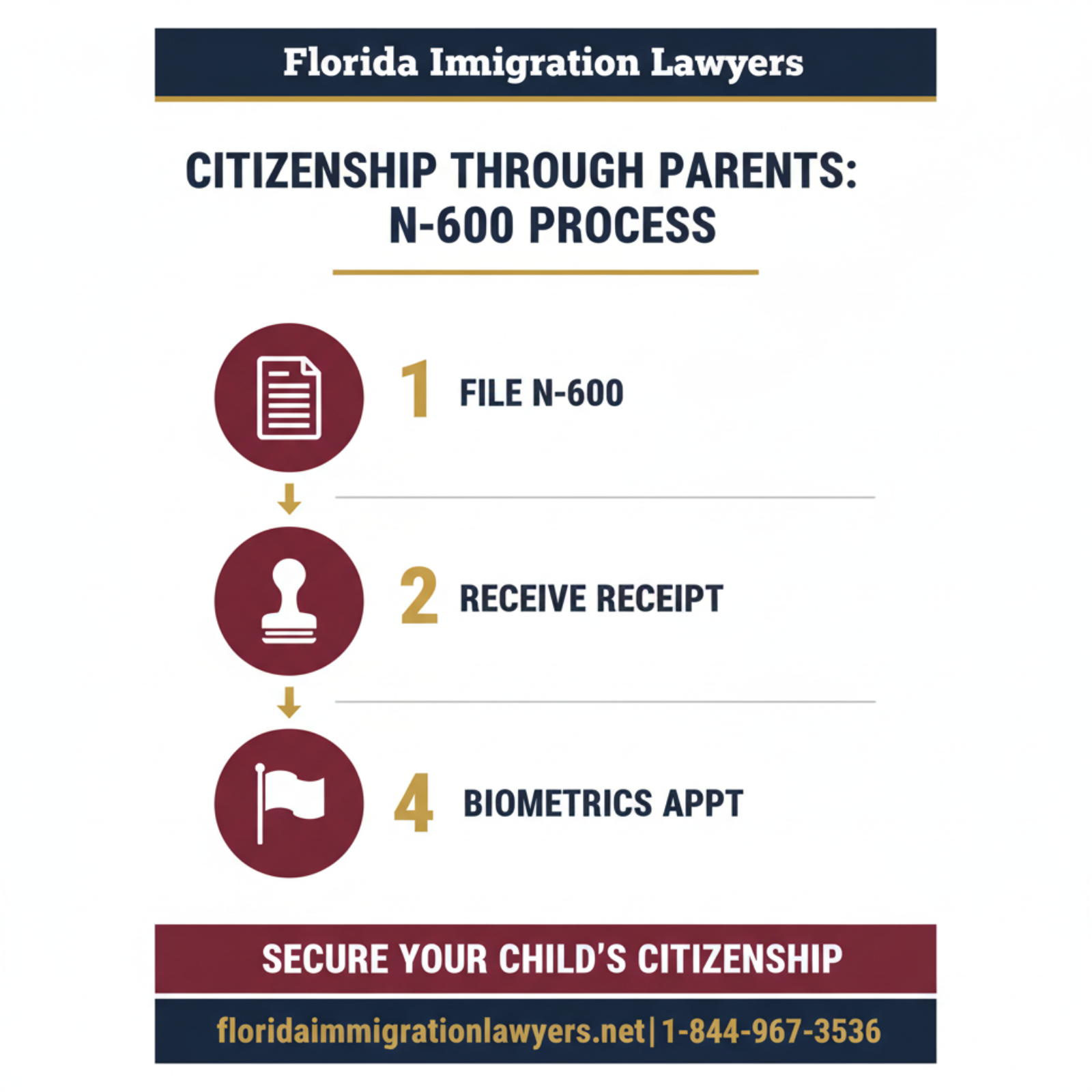
If your child meets the eligibility criteria for derived citizenship, the next step is often to obtain official proof of their U.S. citizenship. While citizenship is automatic, having a Certificate of Citizenship is crucial for demonstrating this status for employment, passports, and other benefits. The primary method for this is filing Form N-600, Application for Certificate of Citizenship.
Here is a general step-by-step guide to applying for a Certificate of Citizenship in Florida:
- Confirm Eligibility: Before anything else, ensure your child meets all the criteria for derived citizenship under INA 320. This includes age, lawful permanent resident status, U.S. citizen parentage, and residing with the U.S. citizen parent.
- Gather Required Documents: Collect all necessary supporting documentation. This typically includes birth certificates, marriage certificates, green cards, proof of parent's U.S. citizenship (e.g., birth certificate, naturalization certificate, U.S. passport), and proof of physical custody. We will detail these later.
- Complete Form N-600: Accurately fill out Form N-600, Application for Certificate of Citizenship. This form is available on the USCIS website. Ensure all sections are completed truthfully and thoroughly.
- Pay the Filing Fee: Submit the required filing fee to USCIS. Fee amounts are subject to change, so always check the most current fee schedule on the USCIS website before filing.
- Submit Your Application: Mail the completed Form N-600, along with all supporting documents and the fee, to the appropriate USCIS Lockbox facility. The mailing address depends on your location and the courier service used.
- Attend Biometrics Appointment: After submitting the application, USCIS will send a notice for a biometrics appointment. This appointment is usually held at a local Application Support Center (ASC), such as the one serving Homestead in Miami, where fingerprints and photos are taken.
- Attend an Interview (If Required): While many N-600 applications do not require an interview, USCIS may schedule one if they need additional information or clarification. Both the U.S. citizen parent and the child may need to attend.
- Receive Decision: USCIS will review the application and evidence. If approved, they will issue a Certificate of Citizenship, which is official proof of your child's U.S. citizenship.
Navigating these steps requires careful attention to detail. Florida Immigration Lawyers can assist families in Homestead and throughout Florida with each stage of the derived citizenship process, ensuring accuracy and completeness.
Essential Documents for Your Derived Citizenship Application
A successful N-600 application for a Certificate of Citizenship hinges on providing comprehensive and accurate documentation. Missing or incorrect documents can lead to delays or even denial. Here is a general checklist of documents typically required:
- Child's Birth Certificate (original or certified copy, with certified English translation if applicable)
- Child's Green Card (Form I-551, Permanent Resident Card)
- U.S. Citizen Parent's Proof of Citizenship (e.g., U.S. birth certificate, Certificate of Naturalization, U.S. passport)
- Parents' Marriage Certificate (if applicable, with certified English translation)
- Parents' Divorce Decrees (if applicable, with certified English translation)
- Adoption Decree (if applicable, for adopted children, with certified English translation)
- Evidence of Legal and Physical Custody (e.g., court orders, school records, medical records showing the child resides with the U.S. citizen parent)
- Evidence of Child's Residence in the U.S. (e.g., school records, medical records, utility bills)
- Two passport-style photos of the child
- Any other relevant immigration documents for the child (e.g., I-94 arrival/departure record)
It is crucial to submit copies of documents unless USCIS specifically requests originals. Always keep certified copies for your records. Preparing this documentation properly is a critical step in the derived citizenship process.
Derived Citizenship Timeline and Processing Expectations
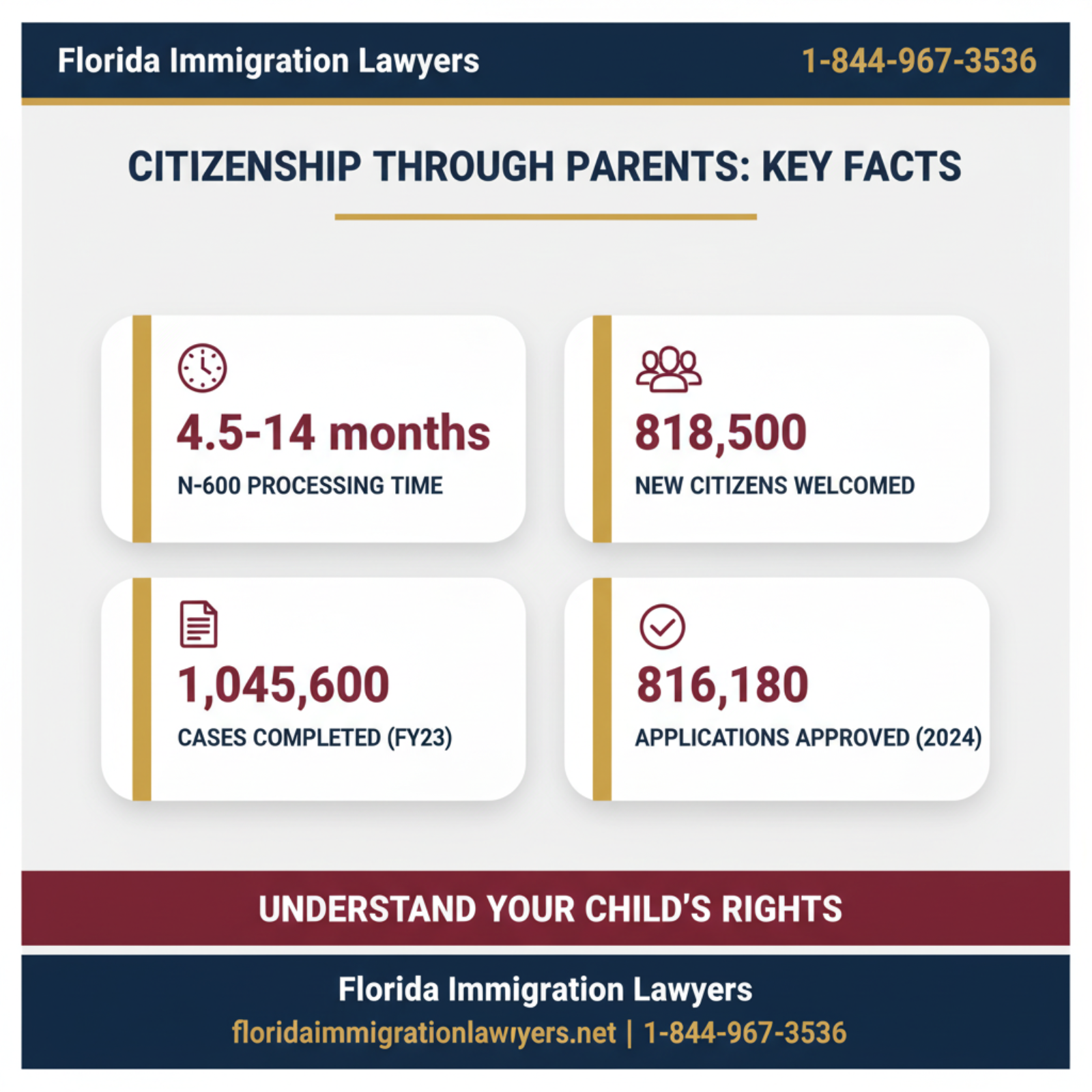
The processing time for Form N-600, Application for Certificate of Citizenship, can vary significantly depending on the USCIS field office jurisdiction and current caseloads. While it's difficult to provide an exact timeline, applicants in Florida should generally expect several months, and sometimes over a year, for a decision.
For applicants residing in Homestead, your case will typically be processed by the USCIS Miami Field Office. You can check the current estimated processing times for Form N-600 on the official USCIS website. These times are estimates and can change without notice. Factors that can influence processing speed include the completeness of your application, the complexity of your case, and USCIS resource allocation.
After filing, you will receive a receipt notice, followed by a biometrics appointment notice. If an interview is required, that will add additional time. Patience is key, but staying informed about your case status through the USCIS online tools is recommended. Our firm understands the anxiety associated with these wait times and can help you track your application.
Cost Factors and USCIS Fees for Derived Citizenship
Applying for a Certificate of Citizenship involves certain government filing fees. The primary fee is for Form N-600 itself. It is critical to note that these fees are set by USCIS and are subject to change, often without extensive prior notice. Therefore, always verify the most current fee schedule directly on the USCIS website for Form N-600 before submitting your application.
Beyond the USCIS filing fee, families should also consider potential additional costs. These may include fees for obtaining certified copies of birth certificates, marriage certificates, or other vital records. If any documents are not in English, you will incur costs for certified translations. Furthermore, if you choose to work with an experienced immigration attorney, legal fees will be part of your overall expense.
While legal fees represent an investment, the expertise of a Florida Immigration Lawyers attorney can prevent costly mistakes and delays, ultimately saving you time and money in the long run. We offer transparent fee structures and can discuss the financial aspects during your free consultation.
Do not navigate this complex process alone. The requirements for derived citizenship are specific, and errors can lead to significant delays or denials. Contact Florida Immigration Lawyers today at 1-844-967-3536 to protect your child's future.
Common Mistakes to Avoid in Derived Citizenship Cases
Even with clear guidelines, families often make critical errors when pursuing derived citizenship. Avoiding these common pitfalls can significantly improve your chances of a smooth and successful application process.
- Failing to Meet Age Requirements: A child must be under 18 years old when all other eligibility criteria are met. If the U.S. citizen parent naturalizes, or the child becomes a lawful permanent resident, even one day after their 18th birthday, they generally cannot derive citizenship under INA 320.
- Not Having Lawful Permanent Resident Status: The child must be a green card holder. Some parents incorrectly assume their child becomes a citizen simply because the parent naturalizes, without the child first obtaining LPR status. This is a common misunderstanding.
- Lack of Proper Physical and Legal Custody: The child must reside in the U.S. in the legal and physical custody of the U.S. citizen parent. If the child lives with another guardian or only one parent has legal custody, it can complicate or disqualify the case.
- Incomplete or Incorrect Documentation: Submitting an N-600 without all required supporting documents, or with documents that contain errors, is a frequent cause of Requests for Evidence (RFEs) and delays. Ensure all translations are certified.
- Ignoring USCIS Requests for Evidence (RFEs): If USCIS sends an RFE, it is crucial to respond completely and on time. Failing to do so will almost certainly lead to a denial.
- Assuming Citizenship is Automatically Documented: While derived citizenship is automatic *by law*, it is not automatically documented. Without an N-600 and a Certificate of Citizenship, proving U.S. citizenship for passports, employment, or other benefits can be challenging.
- Not Consulting an Immigration Attorney: Many families try to navigate the complex legal landscape alone. An experienced attorney can identify potential issues, ensure proper documentation, and represent your interests, especially if your case has unique circumstances like prior immigration violations or complex family structures.
When to Call a Florida Immigration Lawyer for Derived Citizenship
While the concept of derived citizenship implies an automatic process, the practical steps to confirm and document it can be challenging. Knowing when to seek professional legal assistance can make a significant difference in the outcome and efficiency of your child's case. Florida Immigration Lawyers are here to help families in Homestead, Miami, and across the state.
You should strongly consider contacting an attorney from Florida Immigration Lawyers if any of the following scenarios apply to your family:
- Your child's eligibility for derived citizenship is unclear, especially if there are questions about the U.S. citizen parent's residency, the child's LPR status, or custody arrangements.
- You are unsure about which documents are required or how to obtain certified copies and translations.
- Your family situation is complex, involving divorce, adoption, step-parents, or children born through assisted reproductive technology.
- Your child has a criminal record or any past immigration violations that could affect their eligibility.
- USCIS has issued a Request for Evidence (RFE) or an Intent to Deny your N-600 application.
- You need assistance preparing for a potential N-600 interview at the USCIS Miami Field Office.
- You want to ensure the application is filed correctly and efficiently the first time, minimizing delays and potential denials.
Our experienced attorneys understand the nuances of immigration law, including derived citizenship under INA 320 and 322. We can help you gather the correct documentation, prepare a robust application, and advocate on your behalf. Don't leave your child's future to chance; let us guide you through the process. We also assist with other family-based immigration matters, including family immigration visas and general immigration services.
About Florida Immigration Lawyers
Florida Immigration Lawyers is a leading law firm dedicated to providing exceptional legal representation to individuals and families throughout Florida. With a deep understanding of U.S. immigration law, our experienced attorneys are committed to helping our clients achieve their immigration goals, including securing derived citizenship for their children.
We offer a wide range of immigration services, from family-based petitions and asylum claims to deportation defense and business immigration. Our firm prides itself on its compassionate approach, personalized attention, and unwavering dedication to every case. We serve clients in Homestead, Miami, Orlando, Jacksonville, Tampa, and all other cities across Florida.
Choosing Florida Immigration Lawyers means partnering with a team that values your family's future. We are available 24/7 to answer your urgent questions and offer free consultations to discuss your specific needs. Visit our website at https://www.floridaimmigrationlawyers.net or call us today at 1-844-967-3536 to schedule your consultation. Let us put our expertise to work for you.
Sources and References
- U.S. Citizenship and Immigration Services (USCIS)
- USCIS Policy Manual, Volume 12, Part H, Chapter 4 - Children of U.S. Citizens
- U.S. Department of State - Acquisition of U.S. Citizenship by a Child Born Abroad
- Form N-600, Application for Certificate of Citizenship
- USCIS Processing Times
- 8 U.S.C. § 1431 (Immigration and Nationality Act Section 320 - Children Born Outside the United States and Residing Permanently in the United States)
- 8 U.S.C. § 1433 (Immigration and Nationality Act Section 322 - Children Born Outside the United States)
- 8 CFR Part 320 - Children Born Outside the United States and Residing Permanently in the United States; Requirements for Automatic Acquisition of Citizenship
This article provides general legal information and is not intended as legal advice. Every case is unique, and outcomes depend on specific facts and circumstances. Contact an attorney for advice about your particular situation. Immigration laws are subject to frequent change.
Securing your child's U.S. citizenship through derived citizenship is a significant step towards their future in Florida and the United States. Don't leave this critical process to chance. Our dedicated team at Florida Immigration Lawyers is ready to provide the expert legal guidance you need. Call us today at 1-844-967-3536 for a free, confidential consultation. Se Habla Español - Estamos aquí para ayudarle.
Need help with Immigration?
Our Florida immigration attorneys offer free consultations. Call today or schedule online.
Frequently Asked Questions
Florida Immigration Lawyers
Legal Team
Our experienced attorneys at Florida Immigration Lawyers have been serving clients across Florida for over 20 years. We specialize in immigration, personal injury, criminal defense, workers compensation, and family law.