Visa Bulletin October 2025: Florida Immigration Updates & Analysis
The Visa Bulletin October 2025 is a critical update for anyone pursuing permanent residency in Florida, detailing when immigrant visas become available for family-sponsored and employment-based categories. This guide from Florida Immigration Lawyers explains the difference between Final Action Dates and Dates for Filing, offering a step-by-step breakdown of the immigrant visa process. We cover essential documentation, processing timelines, and cost factors, with a special focus on how these updates impact residents in West Palm Beach and across Florida. Learn to avoid common application mistakes and understand when it’s crucial to seek legal counsel to navigate these complexities successfully. Contact us for expert guidance on your immigration case.
The Visa Bulletin October 2025 announces the availability of immigrant visas for the new fiscal year, crucial for individuals seeking green cards in Florida. It details "Final Action Dates" and "Dates for Filing Applications," guiding when applicants can submit their adjustment of status or consular processing documents. Understanding these dates is vital for timely and successful immigration applications.
- The October Visa Bulletin marks the start of a new fiscal year for immigrant visas.
- It provides "Final Action Dates" for visa issuance and "Dates for Filing" for application submission.
- Movement in visa categories can significantly impact eligibility and processing times.
- Florida applicants must carefully monitor the bulletin, especially for employment-based and family-sponsored preferences.
- Consulting an experienced Florida immigration lawyer is highly recommended to interpret the bulletin correctly.
Navigating the complex landscape of U.S. immigration law can feel overwhelming, especially when your future in Florida depends on understanding intricate updates like the monthly Visa Bulletin. For many aspiring immigrants and their families in West Palm Beach and across the Sunshine State, the release of the Visa Bulletin October 2025 is a moment of anticipation and critical importance. This bulletin dictates when you can move forward with your green card application.
At Florida Immigration Lawyers, we understand the anxieties and hopes tied to these announcements. This comprehensive guide will break down the Visa Bulletin October 2025, explain its significance for Florida residents, and provide clear steps on how to proceed. We are dedicated to helping you understand these vital immigration updates and how they might affect your journey. Call Florida Immigration Lawyers at 1-844-967-3536 for a free consultation to discuss your specific immigration situation.
Understanding the Visa Bulletin October 2025 for Florida Immigrants
The Visa Bulletin is a monthly publication by the U.S. Department of State that provides crucial information regarding the availability of immigrant visas. It is essential for individuals seeking permanent residency (green cards) through family-sponsored or employment-based categories. The October bulletin is particularly significant because it marks the beginning of the new fiscal year for immigration, which often brings changes in visa availability.
For immigrants in Florida, understanding this bulletin is not just about general knowledge; it is about knowing when you can take the next critical step in your immigration process. Whether you are living in Miami, Orlando, Tampa, or West Palm Beach, the dates published in the Visa Bulletin directly impact your eligibility to file certain applications, such as the Adjustment of Status (Form I-485) with USCIS. This document answers "What is the October Visa Bulletin?" by detailing the dates for various visa preference categories.
Final Action Dates vs. Dates for Filing Applications
The Visa Bulletin presents two key charts for most preference categories: "Final Action Dates" and "Dates for Filing Applications." It is crucial to distinguish between these two. The Final Action Dates indicate when an immigrant visa can actually be issued, or when a green card can be approved for those adjusting status. Your priority date must be earlier than the listed Final Action Date for your category and country of chargeability.
The Dates for Filing Applications, on the other hand, allow certain applicants to file their adjustment of status application (Form I-485) earlier than the Final Action Date. USCIS determines each month whether applicants can use the Dates for Filing chart or if they must use the Final Action Dates chart for filing I-485 applications. This decision is announced on the USCIS website shortly after the Visa Bulletin's release. Always check the USCIS website for the official guidance on which chart to use for filing your Form I-485.
For those undergoing consular processing abroad, the National Visa Center (NVC) will notify you when your priority date is current according to the Final Action Dates chart. This signals that you can proceed with submitting required documents and scheduling an interview. Both charts are integral to the immigrant visa process, providing a roadmap for applicants.
Navigating the Immigrant Visa Process: A Step-by-Step Guide
The journey to obtaining a green card involves several stages, with the Visa Bulletin playing a critical role in the timing of your application. Here is a general step-by-step guide to the immigrant visa process, applicable to many individuals in Florida:
-
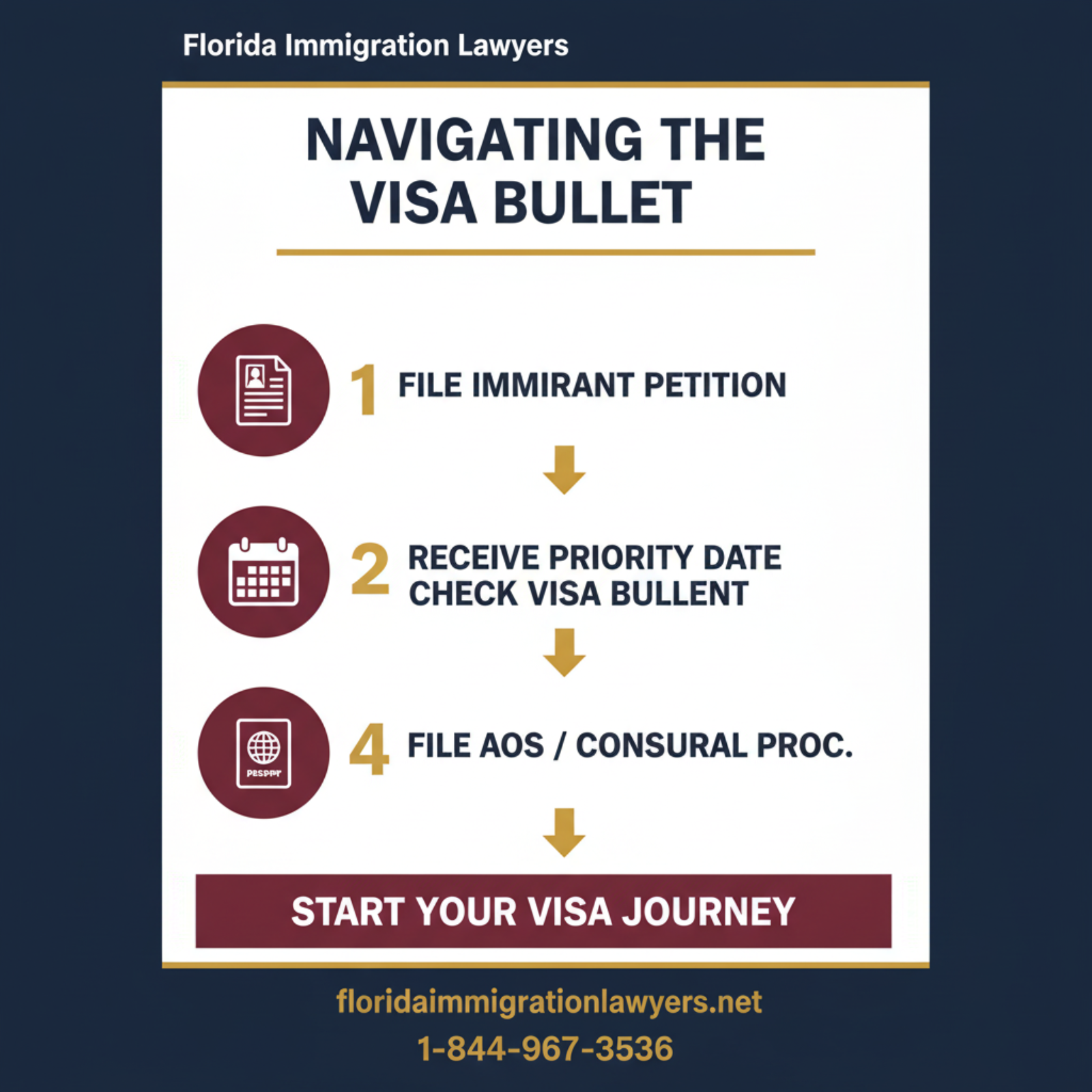
Step 1: Petition Filing and Approval (Form I-130 or I-140)
The process typically begins with a U.S. citizen or lawful permanent resident filing a petition on your behalf. This is usually Form I-130, Petition for Alien Relative, for family-based immigration, or Form I-140, Immigrant Petition for Alien Worker, for employment-based immigration. Once filed, you receive a "priority date," which is the date USCIS received the petition. This date is crucial for tracking your place in the visa queue. Our firm assists with all types of family-based immigration and business immigration petitions. -
Step 2: USCIS Petition Approval
After filing, USCIS reviews the petition. If approved, USCIS sends an approval notice. For some categories, particularly immediate relatives of U.S. citizens (spouses, unmarried children under 21, and parents), a visa is immediately available once the petition is approved. For preference categories, you must wait for your priority date to become current according to the Visa Bulletin. -
Step 3: National Visa Center (NVC) Processing (for Consular Processing)
If you are applying from outside the U.S. (consular processing), your approved petition is sent to the NVC. The NVC will collect required documents and fees. They will hold your case until your priority date is current according to the Final Action Dates chart in the Visa Bulletin. -
Step 4: Checking the Visa Bulletin for Current Dates
This is where the Visa Bulletin October 2025 comes into play. You must regularly check the Visa Bulletin to see if your priority date has become "current" under either the "Final Action Dates" or "Dates for Filing Applications" chart for your specific visa category and country of chargeability. This step dictates when you can proceed to the next stage. -
Step 5: Filing Form I-485 (Adjustment of Status) or Consular Interview
If you are in the U.S. and your priority date is current based on the USCIS guidance for the month, you may file Form I-485, Application to Register Permanent Residence or Adjust Status. If you are outside the U.S. and your priority date is current under Final Action Dates, the NVC will schedule your immigrant visa interview at a U.S. embassy or consulate in your home country. Our team can assist with all aspects of immigration applications. -
Step 6: Green Card Issuance
Upon approval of your I-485 application or successful completion of your consular interview, you will be granted lawful permanent resident status. For those adjusting status, your green card will be mailed to you. For those undergoing consular processing, you will receive an immigrant visa stamp in your passport, allowing you to enter the U.S. as a permanent resident, and your green card will follow.
Essential Documents for Your Visa Application or Adjustment of Status
Preparing a complete and accurate application package is crucial for a smooth immigration process. Missing documents or errors can lead to delays, Requests for Evidence (RFEs), or even denials. Here is a general checklist of documents you may need for your adjustment of status or consular processing application in Florida:
- Valid passport(s) for all applicants
- Birth certificates for all applicants
- Marriage certificate (if applicable)
- Divorce decrees or death certificates for any prior marriages (if applicable)
- Police certificates from all countries where you have lived for six months or more since age 16
- Medical examination results (Form I-693) completed by a USCIS-approved civil surgeon
- Affidavit of Support (Form I-864) from the petitioner and any joint sponsors, along with supporting financial documents (tax returns, W-2s, employment letters)
- Two passport-style photographs for each applicant
- Copies of all previously filed immigration petitions (e.g., I-130, I-140 approval notices)
- Evidence of your lawful entry into the U.S. (Form I-94, visa stamps)
- Copies of all nonimmigrant visa stamps and I-797 approval notices
- Proof of relationship to the petitioner (e.g., birth certificates, marriage certificates, photos, joint bank accounts, leases)
- Employment authorization documents (EAD) and advance parole documents (if applicable)
- Any other documents requested by USCIS or the NVC
Visa Bulletin October 2025: Timeline and Processing Expectations in Florida
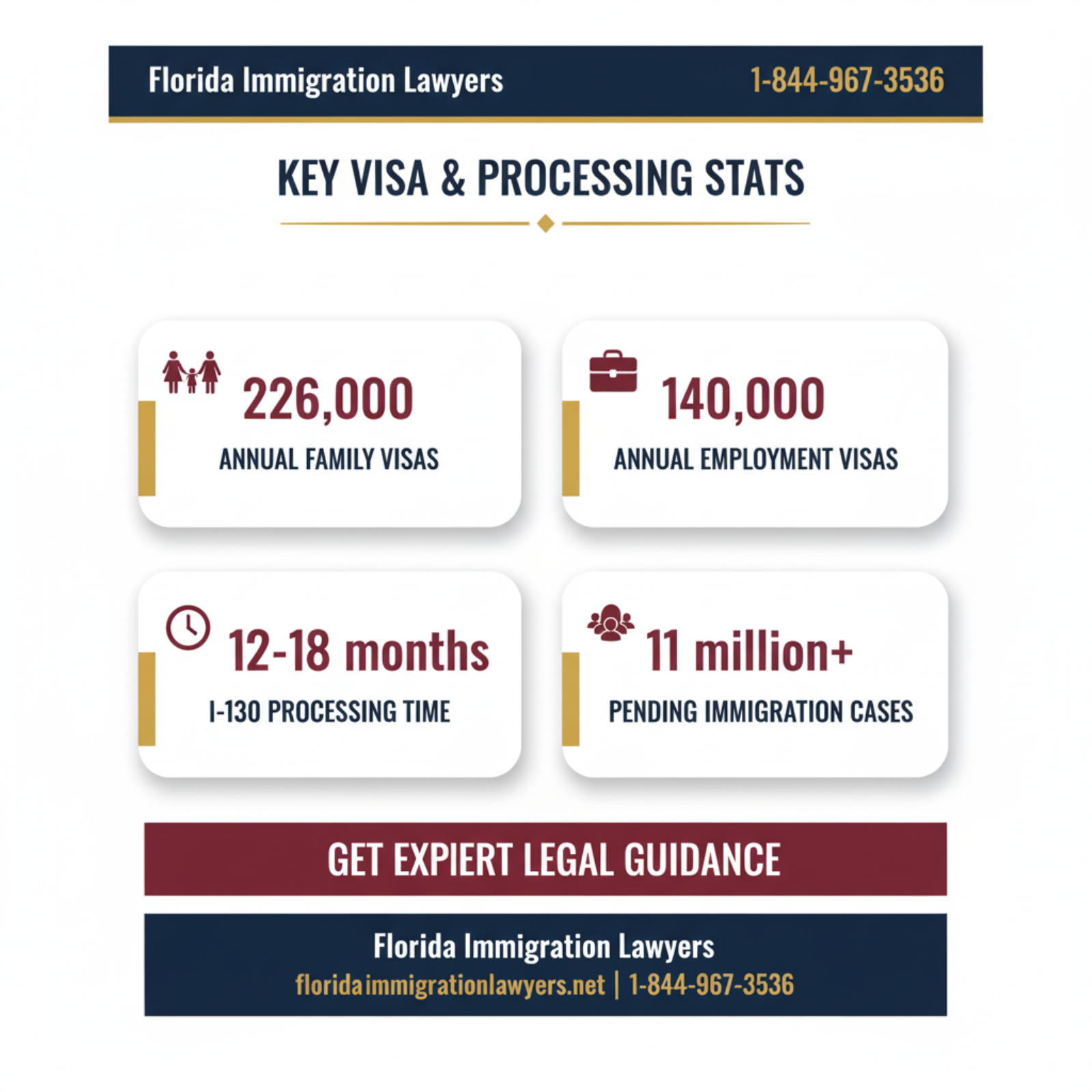
Predicting exact processing times for immigrant visas is challenging, as they are subject to various factors, including the volume of applications, staffing levels at USCIS and NVC, and annual visa quotas set by Congress. However, the Visa Bulletin October 2025 provides a snapshot of where the processing stands at the start of the new fiscal year.
October is often a month of hope for many categories, as new visa numbers become available. This can sometimes lead to significant advancements in cut-off dates, especially for employment-based categories, answering the question "Is USCIS moving faster in 2025?" While there's no guarantee of faster processing, the start of a new fiscal year often presents opportunities. You can monitor general USCIS processing times for various forms on the official USCIS website.
Factors Affecting Processing Speed
Several factors can influence how quickly your case moves forward. The most significant is your visa category and country of chargeability, as outlined in the Immigration and Nationality Act (INA) sections like 8 U.S.C. § 1153 (INA 203), which defines preference categories. Demand from other applicants in your category, geopolitical events, and policy changes can also play a role. For instance, the "Which employment-based green card is fastest?" question often depends on current demand and the specific sub-category (e.g., EB-1 typically has better availability than EB-3 for most countries).
For Florida residents, USCIS field offices in cities like Miami, Orlando, and Tampa handle adjustment of status interviews. The workload at these specific offices can also impact local processing times. While the Visa Bulletin provides the eligibility window, the actual processing time after filing depends on USCIS efficiency. It is crucial to be patient and ensure all submitted documents are accurate and complete to avoid unnecessary delays.
Understanding Cost Factors and Government Fees
Pursuing an immigrant visa or adjustment of status involves various fees. These are primarily government filing fees paid to USCIS and the Department of State, but can also include costs for medical exams, translations, and legal assistance. It's important to budget for these expenses to avoid financial hurdles during your immigration journey.
USCIS filing fees are subject to change, so it is always best to check the official USCIS website for the most current fee schedule. These fees cover the cost of processing your applications, such as the I-130, I-140, I-485, I-765 (Employment Authorization), and I-131 (Advance Parole). There are also fees associated with the medical examination, which must be performed by a USCIS-approved civil surgeon. These medical exam fees vary by provider and are paid directly to the doctor's office.
Attorney Fees and Value
While not mandatory, hiring an experienced immigration attorney, like those at Florida Immigration Lawyers, is a valuable investment. Legal fees cover professional guidance, preparation of complex forms, assistance with gathering documents, communication with government agencies, and representation during interviews. Our firm offers transparent fee structures, and we believe our expertise provides significant value by minimizing errors, reducing delays, and increasing the likelihood of a successful outcome. We help clients in West Palm Beach and throughout Florida navigate these crucial processes efficiently.
Do not navigate this process alone. Contact Florida Immigration Lawyers today to ensure your application is handled with precision and expertise.
Common Mistakes to Avoid in Your Immigration Application
-
Missing or Incomplete Documentation: Submitting an application without all required forms or supporting evidence is a leading cause of delays and RFEs. USCIS regulations, such as those found in 8 CFR § 103.2, require complete submissions. Consequences: Significant delays, RFEs, or even denial.
-
Failing to Check the Visa Bulletin Regularly: Many applicants miss their window to file because they are unaware their priority date has become current. Consequences: Missed filing opportunities, prolonged waiting times.
-
Using the Wrong Visa Bulletin Chart: Not checking the USCIS website to confirm which chart (Final Action Dates vs. Dates for Filing) is valid for filing Form I-485 in a given month. Consequences: Rejection of application, loss of filing fees.
-
Providing Inaccurate or Inconsistent Information: Any discrepancies across forms or with previous immigration applications can raise red flags. Consequences: RFEs, interviews, accusations of misrepresentation, potential denial, or even a finding of fraud.
-
Not Disclosing Criminal History: Even minor offenses from years ago must be disclosed. USCIS has access to extensive databases. Consequences: Denial, potential deportation, bars to future immigration benefits.
-
Poorly Prepared Affidavit of Support (I-864): The sponsor's financial documents must clearly demonstrate they meet the income requirements. Consequences: RFEs, denial based on public charge grounds.
-
Failing to Update Your Address with USCIS: Moving without notifying USCIS can result in missed notices, interview appointments, or RFEs. Consequences: Case abandonment, missed deadlines, denial.
-
Missing Deadlines for RFEs or NOIDs: Not responding to Requests for Evidence (RFEs) or Notices of Intent to Deny (NOIDs) within the specified timeframe. Consequences: Automatic denial of your application.
-
Attempting to "Self-Represent" in Complex Cases: While possible for simple cases, complex situations (e.g., prior denials, criminal history, specific waivers) require expert legal knowledge. Consequences: Errors leading to denial, irreversible negative outcomes.
-
Ignoring Legal Advice: Not following the guidance of your immigration attorney. Consequences: Jeopardizing your case, making avoidable mistakes.
When to Call a Florida Immigration Lawyer
While this article provides general information, every immigration case is unique. The complexities of interpreting the Visa Bulletin October 2025, understanding specific legal requirements, and navigating the application process often necessitate professional legal assistance. Our dedicated team at Florida Immigration Lawyers is here to provide the support you need.
You should consider contacting an attorney if you encounter any of the following scenarios: your priority date is current, and you need to file an adjustment of status; you receive a Request for Evidence (RFE) or a Notice of Intent to Deny (NOID); you have a criminal record or previous immigration violations; you need assistance with an asylum application; or you are facing deportation defense. We also specialize in citizenship applications and complex family-based petitions. Even if your case seems straightforward, a lawyer can ensure accuracy and efficiency.
An experienced immigration lawyer can accurately interpret the Visa Bulletin, advise you on the best course of action, prepare and submit your application with precision, and represent you during interviews or in court. We can help you understand your eligibility for various visa categories and guide you through the process, minimizing risks and maximizing your chances of success. Our attorneys are ready to assist you. Don't wait until a problem arises; proactive legal guidance is always best. Contact us today.
About Florida Immigration Lawyers
Florida Immigration Lawyers is a leading immigration law firm dedicated to serving individuals and families across the entire state of Florida. With years of experience and a deep understanding of U.S. immigration laws, our compassionate and skilled legal team provides comprehensive legal services for a wide range of immigration matters. We pride ourselves on offering personalized attention, strategic advice, and aggressive representation to achieve the best possible outcomes for our clients.
Our services include family-based immigration, employment visas, deportation defense, asylum, citizenship, and adjustment of status applications. We understand the profound impact immigration issues have on your life and are committed to guiding you through every step of the process with integrity and professionalism. We are available 24/7 to answer your questions and offer free, confidential consultations to assess your case.
Choose Florida Immigration Lawyers for unwavering support and expert legal counsel. We are your trusted partners in navigating the complexities of immigration law in Florida. Call us today at 1-844-967-3536 or visit our website at https://www.floridaimmigrationlawyers.net to learn more.
Sources and References
- U.S. Citizenship and Immigration Services (USCIS)
- U.S. Department of State Visa Bulletin
- Executive Office for Immigration Review (EOIR)
- 8 U.S.C. Chapter 12 - Immigration and Nationality Act
- 8 U.S.C. § 1153 - Allotment of immigrant visas
- 8 CFR § 103.2 - Applications, petitions, and other documents
- USCIS Policy Manual
This article provides general legal information and is not intended as legal advice. Every case is unique, and outcomes depend on specific facts and circumstances. Contact an attorney for advice about your particular situation.
The Visa Bulletin October 2025 is more than just a list of dates; it's a gateway to new opportunities for many. Don't let its complexities deter you from pursuing your American dream in Florida. Our experienced team is ready to assist you with every aspect of your immigration journey. Call Florida Immigration Lawyers at 1-844-967-3536 for a free consultation today. Se Habla Español - Estamos aquí para ayudarle.
Need help with Immigration?
Our Florida immigration attorneys offer free consultations. Call today or schedule online.
Frequently Asked Questions
Florida Immigration Lawyers
Legal Team
Our experienced attorneys at Florida Immigration Lawyers have been serving clients across Florida for over 20 years. We specialize in immigration, personal injury, criminal defense, workers compensation, and family law.