TPS Honduras Updates 2026: What Hondurans in Florida Need
For thousands of Honduran nationals in Florida, the status of Temporary Protected Status (TPS) is crucial. As of 2026, TPS Honduras continues under specific legal frameworks and ongoing litigation, requiring beneficiaries to stay informed about re-registration periods and policy changes. This comprehensive guide from Florida Immigration Lawyers provides the latest updates, details eligibility, outlines the application process, lists necessary documents, discusses timelines, and explains associated costs. We also cover common mistakes to avoid and when to seek legal counsel, ensuring Honduran communities across Florida, including Tampa, are well-equipped to navigate these complexities. Our firm offers expert legal support to protect your status and explore your options.

As of 2026, Temporary Protected Status (TPS) for Honduras remains a critical topic for thousands of beneficiaries in Florida. The program's future is largely shaped by ongoing legal decisions and potential legislative actions, creating a landscape of both uncertainty and opportunity. Eligible Hondurans must stay informed about re-registration periods and any new directives from U.S. Citizenship and Immigration Services (USCIS) to maintain their protected status and work authorization.
- Current Status: TPS Honduras continues under specific legal injunctions and settlement agreements.
- Re-registration: Beneficiaries must diligently follow announced re-registration periods to maintain status.
- Legal Counsel: Consulting an experienced immigration attorney is crucial for navigating complex requirements.
- Future Outlook: The program's long-term future may depend on court rulings or congressional action.
For thousands of Honduran nationals residing in Florida, the status of Temporary Protected Status (TPS) is a matter of profound importance, impacting their ability to live, work, and contribute to their communities without fear of deportation. As we navigate 2026, the landscape surrounding TPS Honduras continues to evolve, influenced by legal challenges, administrative decisions, and the ongoing needs of a vibrant immigrant population across the state. Understanding these developments is not just about compliance; it's about securing your future and protecting your family.
This comprehensive guide from Florida Immigration Lawyers aims to provide clarity on the latest updates regarding TPS Honduras, focusing on what beneficiaries in Florida need to know. We will delve into eligibility requirements, the application and re-registration process, essential documentation, and what to expect in the coming months and years. Our goal is to empower you with accurate, timely information so you can make informed decisions about your immigration journey.
Do not navigate the complexities of TPS Honduras alone. For personalized guidance and a free consultation, call Florida Immigration Lawyers at 1-844-967-3536 today. Our experienced team is here to help you understand your options and protect your rights.
What Are the Latest Updates on TPS Honduras in 2026?
As of 2026, Temporary Protected Status (TPS) for Honduras continues under specific legal frameworks, with ongoing litigation and potential policy changes impacting re-registration and work authorization for eligible individuals. Beneficiaries should actively monitor official announcements from the Department of Homeland Security (DHS) and USCIS.
The status of TPS for Honduras, originally designated in 1999 following Hurricane Mitch, has been subject to a series of extensions and, more recently, legal challenges to its termination. The current protection for Honduran TPS holders stems largely from the Ramos v. Mayorkas settlement agreement (formerly Ramos v. Nielsen) and subsequent court orders. This litigation has temporarily halted the termination of TPS for several countries, including Honduras, ensuring that beneficiaries can continue to live and work in the U.S. without fear of immediate deportation.
In 2026, beneficiaries in Florida must remain vigilant for specific re-registration periods announced by USCIS. These announcements typically provide a 60-day window for eligible individuals to file their applications for continued TPS benefits and work authorization. It is crucial to remember that while legal challenges provide temporary relief, the long-term future of TPS for Honduras could still be influenced by final court decisions, new legislative actions by Congress, or a change in administration policy. Florida Immigration Lawyers closely monitors these developments to provide up-to-date advice to our clients.
The immigration landscape is dynamic, and policy shifts can occur rapidly. For instance, recent federal rule changes, as noted in general news contexts, have sometimes aimed to clear asylum backlogs or redirect cases, which could indirectly impact the broader humanitarian relief framework. While TPS is distinct from asylum, shifts in overall immigration policy can signal potential changes in how humanitarian programs are administered. Staying informed through reliable legal counsel is paramount for TPS Honduras beneficiaries in Florida.
Who is Eligible for TPS Honduras in Florida?
Eligibility for TPS Honduras in Florida, as in other states, primarily extends to individuals who have continuously resided in the U.S. since the original designation date and meet specific statutory requirements, including continuous physical presence and good moral character. These criteria are strictly enforced by USCIS.
To qualify for TPS Honduras, an individual must generally meet two primary criteria: Continuous Physical Presence (CPP) and Continuous Residence (CR). For Honduras, this means having been continuously physically present in the United States since January 5, 1999, and continuously residing in the U.S. since December 30, 1998. Minor, brief, and innocent departures from the U.S. may not break CPP or CR, but any significant travel outside the country without specific authorization could lead to disqualification.
Beyond presence and residence, applicants must also demonstrate good moral character. This means they must not have been convicted of any felony or two or more misdemeanors committed in the U.S. Certain other criminal offenses, even minor ones, or violations of immigration laws, can also render an applicant ineligible. It is vital to disclose any criminal history or immigration violations to your attorney, as failure to do so can result in severe consequences, including denial and potential deportation proceedings.
Even if you meet the basic criteria, certain statutory bars can make you ineligible for TPS. These include participation in persecution, conviction of a particularly serious crime, or engaging in terrorist activity. For Honduran communities throughout Florida, from Miami to Tampa, understanding these intricate eligibility rules is essential. Many individuals who have lived here for decades under TPS may face challenges in proving continuous residence or ensuring their good moral character record is impeccable. Consulting with an immigration attorney can help assess your specific eligibility and address any potential issues.
How Do I Apply or Re-Register for TPS Honduras?
The process for applying or re-registering for TPS Honduras involves several critical steps, each requiring meticulous attention to detail and adherence to strict deadlines. Missing a step or providing incomplete information can significantly delay your application or lead to denial, jeopardizing your protected status.
Here is a step-by-step guide to applying or re-registering for TPS Honduras:
- Gather Required Documents: Before starting, collect all necessary supporting documents. This includes proof of identity, nationality, continuous residence, and continuous physical presence. For re-registration, you will also need copies of your previous TPS approval notices and Employment Authorization Documents (EADs).
- Complete Form I-821, Application for Temporary Protected Status: This is the primary form for TPS. Fill it out accurately and completely. Ensure all questions are answered, and pay close attention to sections regarding your travel history, criminal record, and immigration history.
- Complete Form I-765, Application for Employment Authorization: If you wish to obtain or renew your work permit (EAD), you must file Form I-765 concurrently with Form I-821. This allows you to legally work in the U.S. while your TPS application is pending.
- Complete Form I-131, Application for Travel Document (Optional): If you anticipate needing to travel outside the U.S. while your TPS application is pending or approved, you must apply for a travel document (advance parole) by filing Form I-131. Traveling without this document can lead to denial of your TPS and potential issues upon re-entry.
- Pay Required Fees or File for a Fee Waiver: There are fees associated with Forms I-765, I-131, and a biometrics services fee. The Form I-821 itself generally does not have a filing fee for initial or re-registration. If you cannot afford the fees, you may be eligible for a fee waiver by filing Form I-912, Request for Fee Waiver. Provide strong evidence of financial hardship.
- Submit Your Application Package: Mail your completed forms, supporting documents, and fees (or fee waiver request) to the correct USCIS Lockbox facility. The address depends on your state of residence and the specific form you are filing. Always check the USCIS website for the most current filing addresses.
- Attend Biometrics Appointment: After submitting your application, USCIS will send you an appointment notice for biometrics (fingerprints, photograph, and signature). This is a mandatory step for identity verification and background checks. Missing this appointment without rescheduling can lead to denial.
- Respond to Requests for Evidence (RFEs): USCIS may send an RFE if they need more information or clarification. Respond promptly and thoroughly by the deadline provided. Failure to respond can result in denial.
- Receive Decision: USCIS will mail you a decision notice once your application is processed. This could be an approval, a request for more information, or a denial.
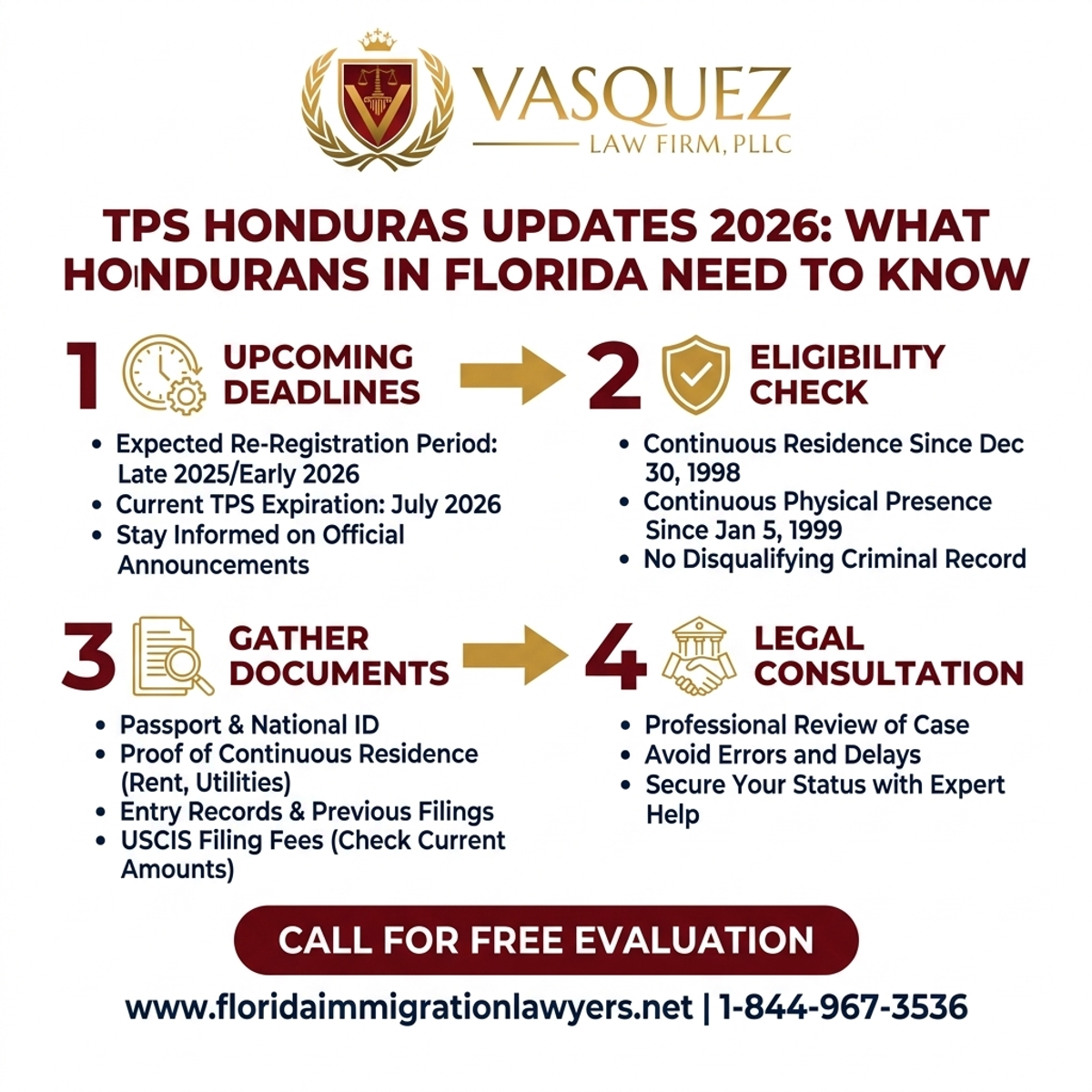
Step-by-Step Process — TPS Honduras Updates 2026: What Hondurans in Florida Need to Know
The legal framework for TPS is outlined in Section 244 of the Immigration and Nationality Act (INA) and further detailed in 8 CFR Part 244. These regulations govern all aspects of the program, from designation to eligibility and application procedures. Navigating these regulations can be challenging without legal expertise. For residents in Tampa and across Florida, seeking assistance from an immigration attorney can streamline this complex process and minimize the risk of errors.
Do not navigate this process alone. Contact Florida Immigration Lawyers today at 1-844-967-3536 for expert guidance on your TPS Honduras application or re-registration.
What Documents Are Needed for TPS Honduras Applications?
A successful TPS Honduras application or re-registration hinges on providing comprehensive and accurate documentation. Preparing a thorough package of evidence is crucial to demonstrate your eligibility for the program and avoid delays or requests for additional information from USCIS.
Here is a detailed checklist of documents typically required:
- Proof of Identity and Nationality:
- Copy of your Honduran passport (biographical page).
- Copy of your Honduran birth certificate, accompanied by a certified English translation.
- Any national identity document from Honduras with your photograph and/or fingerprint.
- Proof of Continuous Residence (CR) in the U.S. since December 30, 1998:
- Employment records (pay stubs, W-2 forms, tax returns, letters from employers).
- School records (transcripts, report cards, enrollment letters for yourself or your children).
- Medical records (hospital bills, vaccination records, doctor's notes).
- Rent receipts, utility bills (electricity, water, gas, phone) in your name.
- Bank statements, credit card statements.
- Affidavits from friends, family, or community members who can attest to your continuous presence.
- Any other dated documents showing you were in the U.S.
- Proof of Continuous Physical Presence (CPP) in the U.S. since January 5, 1999:
- The same documents used for CR can also serve as proof of CPP.
- Records of any departures from and re-entries into the U.S. (if applicable), including copies of I-94 arrival/departure records.
- Photographs: Two identical passport-style photographs taken within 30 days of filing.
- Previous TPS Documents (for re-registration):
- Copy of your most recent Form I-797, Approval Notice for TPS.
- Copy of your most recent Employment Authorization Document (EAD).
- Forms:
- Form I-821, Application for Temporary Protected Status.
- Form I-765, Application for Employment Authorization (if seeking work permit).
- Form I-131, Application for Travel Document (if seeking advance parole).
- Form I-912, Request for Fee Waiver (if applicable, with supporting financial evidence).
Every piece of evidence should be clearly organized and submitted with a cover letter. If any document is not in English, it must be accompanied by a complete and certified English translation. For Honduran families in Florida, compiling decades of documentation can be daunting. An immigration lawyer at Florida Immigration Lawyers can help you identify, organize, and present the strongest possible evidence for your TPS application, ensuring all requirements are met.
How Long Does TPS Honduras Last and What to Expect in 2026?
The duration of TPS Honduras is subject to extensions or terminations by the Secretary of Homeland Security. As of 2026, its status is intertwined with ongoing legal challenges, meaning beneficiaries should expect periodic re-registration periods and prepare for potential future policy shifts. The program's history shows a pattern of extensions, but the current environment demands careful attention to official announcements.
Historically, TPS for Honduras has been extended multiple times since its initial designation in 1999. However, the Trump administration's decision to terminate TPS for Honduras in 2018, along with several other countries, led to significant litigation. The Ramos v. Mayorkas lawsuit, among others, has effectively paused these terminations, allowing beneficiaries to retain their status and work authorization under a series of temporary extensions. This means that as of 2026, many Honduran TPS holders are operating under protection granted by court orders rather than new DHS designations.
What to expect in 2026 and beyond largely depends on the outcome of these legal battles and any new legislative initiatives. There could be a final court ruling that either upholds the termination or provides a more permanent pathway for TPS holders. Alternatively, Congress could pass legislation to provide a more definitive solution for long-term TPS beneficiaries. In the absence of such definitive action, beneficiaries should anticipate continued temporary extensions and the need to re-register regularly. Each re-registration period is critical, as failure to file within the designated window can result in the loss of TPS benefits.
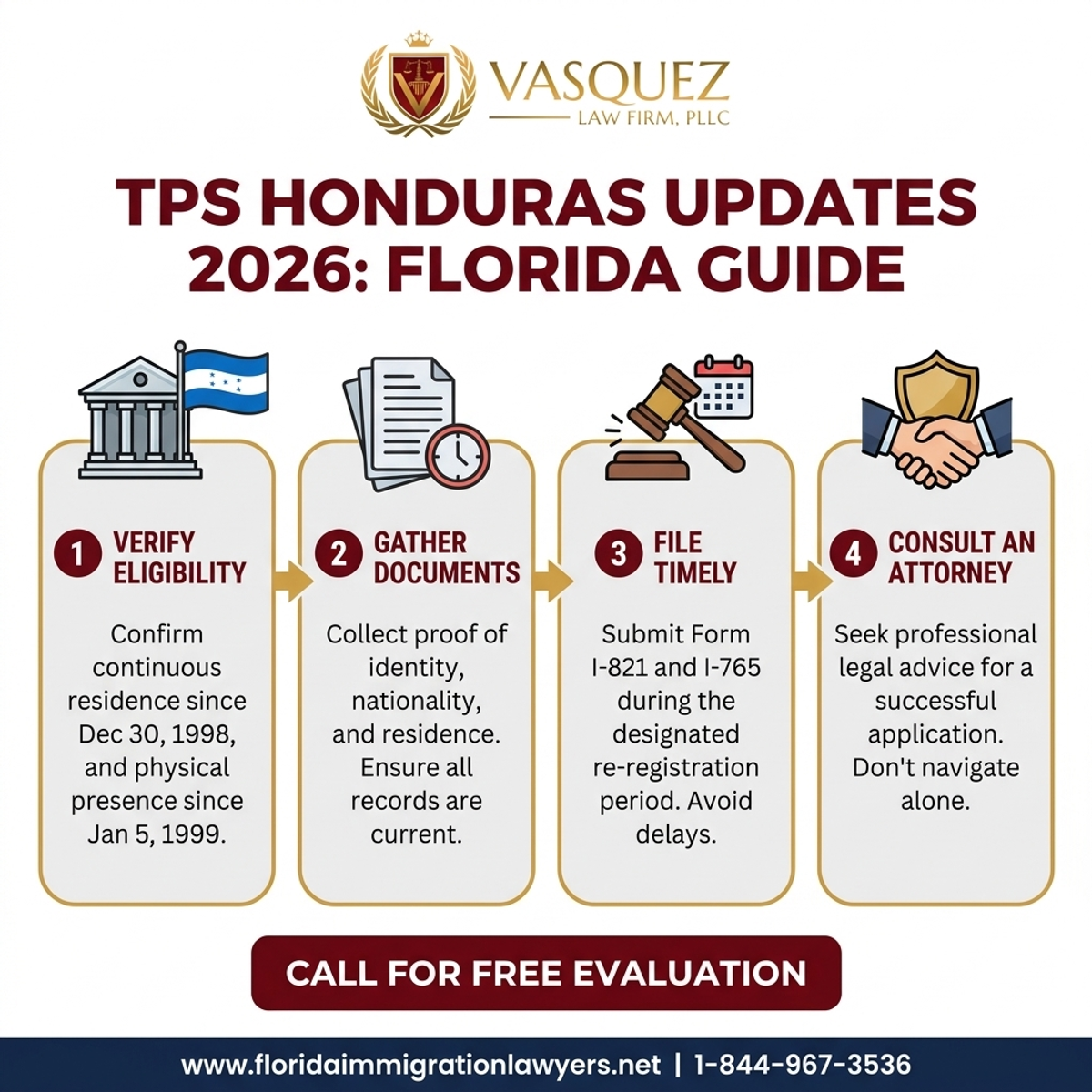
Key Statistics — TPS Honduras Updates 2026: What Hondurans in Florida Need to Know
For TPS holders in Florida, this ongoing uncertainty underscores the importance of proactive planning. Many have built lives, families, and businesses here, and the potential for a program termination carries significant weight. Understanding the typical timelines for application processing can help manage expectations and plan for the future, whether it involves continued TPS or exploring other immigration pathways.
| Stage | Typical Timeframe (2026) | Notes |
|---|---|---|
| Re-registration Period Announcement | Periodically by DHS/USCIS | Usually a 60-day window; critical to file promptly. |
| Form I-821 Processing | 6-18 months | Varies significantly by USCIS workload and specific case complexity. Check USCIS processing times online. |
| Form I-765 (EAD) Processing | 6-12 months | Often processed concurrently; interim EAD extensions may be announced. |
| Biometrics Appointment | 1-3 months after filing | Mandatory for identity verification and background checks. |
| Decision Notification | After all checks and reviews complete | Approval, Request for Evidence (RFE), or Denial. |
What Are the Costs Associated with TPS Honduras Applications?
Understanding the financial aspects of TPS Honduras applications is essential for proper planning. While the Form I-821 itself often does not carry a filing fee for initial or re-registration, other associated costs, such as biometrics fees and fees for work authorization or travel documents, can add up. These fees are subject to change, so it's always best to verify the most current amounts on the USCIS website.
In addition to government filing fees, many applicants choose to retain legal counsel to assist with their TPS application or re-registration. Attorney fees can vary widely depending on the complexity of the case, the services required, and the law firm's fee structure. While it represents an additional cost, the expertise of an immigration lawyer can be invaluable in ensuring accuracy, avoiding common mistakes, and addressing any potential challenges that may arise during the process. Many firms, including Florida Immigration Lawyers, offer free initial consultations to discuss your case and provide a clear understanding of potential costs.
For those facing financial hardship, USCIS offers a fee waiver option (Form I-912, Request for Fee Waiver) for certain forms and services, including the biometrics fee, the EAD application (Form I-765), and the travel document application (Form I-131). Eligibility for a fee waiver is based on income below 150% of the Federal Poverty Guidelines, receipt of a means-tested benefit, or demonstrating financial hardship. It is crucial to provide strong supporting documentation for any fee waiver request, as a denied waiver can delay your application.
| Item | Typical Fee (As of 2026) | Notes |
|---|---|---|
| Form I-821 (TPS Application) | $0 | No filing fee for the application itself for initial or re-registration. |
| Biometrics Services Fee | $85 | Required for applicants aged 14-79. Can be waived with Form I-912. |
| Form I-765 (EAD) | $410 | Required if you need work authorization. Can be waived with Form I-912. |
| Form I-131 (Travel Permit) | $575 | Optional, for those needing to travel outside the U.S. Can be waived with Form I-912. |
| Attorney Fees | Varies widely ($1,000 - $3,000+) | Cost for legal assistance; often includes preparation, review, and representation. |
It is important to note that these fees are subject to change by USCIS. Always consult the official USCIS website or an immigration attorney for the most current fee schedule. Planning for these costs is an integral part of successfully navigating the TPS process for Hondurans in Florida.
What Happens if My TPS Honduras Application is Denied?
A denial of your TPS Honduras application or re-registration can be a distressing outcome, but it does not always mean the end of your immigration journey. Understanding the reasons for denial and your available options is critical for determining your next steps and protecting your status.
Common reasons for TPS application denials include missing deadlines, failing to provide sufficient evidence of continuous residence or physical presence, not meeting the good moral character requirements (e.g., due to criminal convictions), or submitting incomplete or incorrect forms. USCIS strictly enforces these rules, and any discrepancies can lead to an unfavorable decision. For instance, a failure to demonstrate that you have been continuously residing in Florida since the required date could lead to a denial, even if you meet other criteria.
If your TPS application is denied, you may have several avenues to explore. One option is to file a Motion to Reopen or Reconsider with USCIS. A Motion to Reopen asks USCIS to review your case based on new facts or evidence that were not available at the time of the original decision. A Motion to Reconsider argues that the original decision was based on an incorrect application of law or policy. These motions have strict deadlines and requirements, making legal assistance highly advisable. In some cases, an appeal to the Administrative Appeals Office (AAO) may also be possible, though the scope of AAO review for TPS denials can be limited.
A denial of TPS can have serious consequences, potentially placing you in removal proceedings before an immigration judge under the Executive Office for Immigration Review (EOIR). If you are already in removal proceedings, a TPS denial could remove a critical layer of protection. It is imperative to seek immediate legal counsel from an experienced immigration attorney if your TPS application is denied. A lawyer can review your denial notice, assess the reasons for the decision, and advise you on the best course of action, which might include appealing the decision, filing a new application, or exploring other forms of immigration relief for which you may be eligible.
Common Mistakes to Avoid in Your TPS Honduras Application
Navigating the TPS Honduras application process can be complex, and even minor errors can lead to significant delays or denials. Being aware of common pitfalls can help you avoid costly mistakes and improve your chances of a successful outcome.
- Missing Deadlines: The most critical mistake is failing to file your initial application or re-registration within the designated window. Missing deadlines almost invariably leads to denial and loss of status. Always mark your calendar and aim to submit well in advance.
- Incomplete or Incorrect Forms: Submitting forms with unanswered questions, incorrect information, or missing signatures is a frequent cause of RFEs or denials. Double-check every field and ensure all required signatures are present.
- Failing to Provide Sufficient Evidence: Applicants often underestimate the amount or quality of evidence needed to prove continuous residence and physical presence. Provide a robust portfolio of dated documents covering the entire required period.
- Not Disclosing Criminal History: Attempting to conceal or omit information about past arrests or convictions, even minor ones, can be detrimental. USCIS conducts thorough background checks, and non-disclosure can lead to a finding of misrepresentation and severe immigration consequences.
- Traveling Without Advance Parole: Leaving the U.S. without an approved Form I-131 (advance parole) can result in a denial of your TPS application and may even prevent your re-entry into the country. Always secure advance parole before any international travel.
- Not Responding to Requests for Evidence (RFEs): If USCIS sends an RFE, it is crucial to respond promptly and completely by the specified deadline. Failure to do so will almost certainly lead to a denial of your application.
- Assuming Automatic Work Authorization: While TPS often comes with work authorization, it is not automatic. You must file Form I-765 to receive an Employment Authorization Document (EAD). Do not assume your old EAD is automatically extended without an official notice.
- Submitting Uncertified Translations: Any document not in English must be accompanied by a complete and certified English translation. Uncertified translations can cause delays or rejection of your evidence.
- Ignoring Legal Advice: Trying to navigate a complex immigration process like TPS without the guidance of an experienced attorney can lead to critical errors, especially if you have a complicated immigration history or criminal record.
When to Call a Lawyer for Your TPS Honduras Case
While some aspects of the TPS Honduras process might seem straightforward, many situations warrant the expertise of an experienced immigration attorney. Given the high stakes involved, consulting a lawyer can provide invaluable peace of mind and significantly improve your chances of a positive outcome.
You should strongly consider calling Florida Immigration Lawyers if any of the following scenarios apply to your TPS Honduras case:
- Complex Eligibility Issues: If you are unsure whether you meet the continuous residence or physical presence requirements, or if you have had significant absences from the U.S. since the designation date.
- Criminal Record: Any past arrests, convictions, or even charges, regardless of how minor they seem, can affect your eligibility for TPS. An attorney can assess the impact and advise on potential waivers or defense strategies.
- Previous Denials or Immigration Violations: If you have previously been denied TPS, had other immigration applications rejected, or have a history of immigration violations, legal counsel is essential.
- Involvement in Removal Proceedings: If you are currently in deportation or removal proceedings, a TPS application can be a critical defense, but it must be handled strategically by an attorney.
- Travel History Concerns: If you have traveled outside the U.S. without advance parole, or have questions about how past travel might impact your current application.
- Difficulty Gathering Evidence: If you are struggling to collect sufficient documentation to prove your continuous residence and physical presence, an attorney can help identify alternative forms of evidence.
- Desire for a Path to Permanent Residency: While TPS itself does not directly lead to a green card, an attorney can explore if you are eligible for other immigration pathways, such as family-based petitions, while you hold TPS.
- Receiving a Request for Evidence (RFE) or Notice of Intent to Deny (NOID): These notices indicate that USCIS has concerns about your application. An attorney can help you formulate a comprehensive and timely response.
Florida Immigration Lawyers has a dedicated team specializing in TPS and other humanitarian immigration relief. We understand the specific challenges faced by the Honduran community in Florida and are committed to providing compassionate and effective legal representation. Don't risk your future; get professional help.
About Florida Immigration Lawyers
Florida Immigration Lawyers is a leading law firm dedicated to providing comprehensive and compassionate immigration legal services to individuals and families throughout Florida. With a deep understanding of U.S. immigration law and its complexities, our experienced attorneys are committed to helping clients navigate their unique immigration journeys, from obtaining visas and green cards to defending against deportation.
We pride ourselves on offering personalized attention, strategic advice, and unwavering support to our diverse clientele. Our services cover a wide range of immigration matters, including family-based immigration, business immigration, asylum claims, deportation defense, citizenship applications, and humanitarian relief such as TPS. We serve all of Florida, including major hubs like Tampa, Miami, Orlando, and Jacksonville, understanding the specific needs of each community.
Choosing Florida Immigration Lawyers means partnering with a team that is available 24/7, offers free consultations, and is fluent in both English and Spanish (Se Habla Español). We are here to simplify complex legal processes, protect your rights, and work tirelessly towards the best possible outcome for your case. Your peace of mind is our priority.
Contact us today for a free consultation: 1-844-967-3536 or visit our website: www.floridaimmigrationlawyers.net.
Sources and References
- U.S. Citizenship and Immigration Services (USCIS) - Temporary Protected Status
- U.S. Citizenship and Immigration Services (USCIS) - Check Processing Times
- Executive Office for Immigration Review (EOIR)
- 8 U.S.C. Chapter 12 - Immigration and Nationality Act (INA) Section 244
- 8 Code of Federal Regulations (CFR) Part 244 - Temporary Protected Status
- Ramos v. Mayorkas, 2020 WL 6140510 (9th Cir. 2020)
Related services: immigration practice areas, family immigration services.
This article provides general legal information and is not intended as legal advice. Every case is unique, and outcomes depend on specific facts and circumstances. Contact an attorney for advice about your particular situation.
The journey through the U.S. immigration system can be daunting, but you don't have to face it alone. Whether you are seeking to understand the latest TPS Honduras updates 2026, need assistance with re-registration, or are exploring other immigration avenues, Florida Immigration Lawyers is here to help. Our dedicated team is ready to provide the expert legal guidance and support you deserve. Call us today for a free consultation and let us help you secure your future.
Contact Florida Immigration Lawyers for a Free Consultation: 1-844-967-3536. Se Habla Español - Estamos aqui para ayudarle.
If you need legal assistance, learn more about our immigration law practice, or call us at 1-844-967-3536 for a free consultation.
Do Not Navigate This Process Alone
Our experienced immigration attorneys are ready to fight for you. Get a free, confidential consultation today.
Se Habla Español
Or leave your details and we’ll call you:
Free Evaluation in 24 Hours
Or talk to us right now
AI voice assistant — available 24/7
FreeFrequently Asked Questions

William J. Vásquez
Founding Attorney · Vasquez Law Firm
U.S. Air Force veteran and immigration attorney with years of hands-on U.S. immigration experience. J.D., NCCU School of Law. AILA member. Admitted to the 4th, 5th, and 11th Circuit Courts.
Available 24/7 - Free Evaluations
Reviewed for legal accuracy by William J. Vásquez
Licensed in North Carolina; U.S. immigration is federal practice.
Related Legal Services
Our Florida immigration attorneys can help you with immigration practice areas, free immigration consultation and experienced immigration attorneys. Call today at 1-844-967-3536 for a free consultation.
Related Links
Related Topics
Free Legal Consultation
Discuss your case with our experienced attorneys. We're available 24/7.
Se Habla Español - Estamos aquí para ayudarle.
Related Articles
Military Naturalization Expedited in Florida Bases
Explore military naturalization options for families at Florida bases, including parole in place benefits in Miami. Learn how to expedite your application with expert guidance from Florida Immigration Lawyers.
Immigration Lawyer Orlando Free Consultation 2026
Discover how to find an immigration lawyer in Orlando offering a free consultation. Understand the services available and why choosing Florida Immigration Lawyers can make a difference in your case.
Biometrics Appointment in Florida 2026: What to Expect
A USCIS biometrics appointment is a crucial step for most immigration applications in Florida, involving fingerprinting, photography, and signature collection for identity verification and background checks. This guide covers how to prepare, what to expect at your ASC appointment, typical timelines, and associated costs. We also highlight common mistakes to avoid and when it's essential to consult an experienced immigration lawyer. For residents in Tallahassee, Orlando, Miami, and throughout Florida, understanding this process is vital for a smooth application. Florida Immigration Lawyers offers expert guidance to ensure your biometrics appointment and overall immigration case proceed without complications. Don't risk delays; learn how to navigate this mandatory step effectively.
Stokes Interview: Understanding Marriage Fraud in Florida
A Stokes interview is a critical step in verifying the legitimacy of a marriage in I-130 applications, especially when fraud is suspected. Learn about the process, how to prepare, and what to expect from the interview. For residents in Hollywood, Florida, understanding these aspects is crucial. Call Florida Immigration Lawyers at 1-844-967-3536 for a free consultation.