TPS Green Card Florida Pathway: Your 2026 Adjustment Guide
For Temporary Protected Status (TPS) holders in Florida, the path to a green card is not direct but achievable through adjustment of status. This comprehensive guide details the process, including establishing eligibility for an underlying immigrant visa, navigating the lawful entry requirement clarified by <i>Ramos v. Nielsen</i>, and filing Form I-485. We cover essential documents, processing timelines, and cost factors specific to Florida applicants in 2026. Avoid common mistakes and understand when legal counsel is critical. Florida Immigration Lawyers offers free consultations to help you secure permanent residency, serving West Palm Beach and all of Florida.

Yes, many Temporary Protected Status (TPS) holders in Florida can transition to a green card, but TPS itself is not a direct path. You must qualify for an underlying immigrant visa category, such as through family sponsorship or employment. Establishing lawful entry, often influenced by court decisions like Ramos v. Nielsen, is a crucial step for adjusting status in the U.S.
- TPS holders need an underlying immigrant visa to get a green card.
- Lawful entry is generally required for adjustment of status.
- Family or employment sponsorship are common pathways.
- The process involves filing Form I-485, Application to Adjust Status.
- Consult an immigration attorney for personalized guidance.
Are you a Temporary Protected Status (TPS) holder in Florida, dreaming of a more permanent future in the United States? The journey from TPS to a green card can seem complex, but it's often achievable with the right legal guidance. Many TPS individuals in West Palm Beach and across Florida seek lawful permanent residency. This guide explores the requirements, steps, and critical considerations for TPS holders seeking a green card in Florida in 2026. We will demystify the adjustment of status process and highlight key legal nuances. Call Florida Immigration Lawyers at 1-844-967-3536 for a free consultation today to discuss your unique situation.
Understanding the TPS to Green Card Florida Pathway
Temporary Protected Status (TPS) offers temporary relief from deportation and work authorization for eligible foreign nationals. While TPS provides a vital safe haven, it does not inherently lead to a green card or permanent residency. For many TPS holders in Florida, transitioning to a green card requires navigating the complex process of adjustment of status. Florida is home to a significant population of TPS beneficiaries, including those from Venezuela, Haiti, Honduras, and El Salvador. The path to a green card is not automatic; it depends on qualifying for an immigrant visa through another category, like family or employment sponsorship.
Who is Eligible for TPS in Florida?
Eligibility for TPS is determined by the Secretary of Homeland Security based on country conditions. You must meet criteria like continuous physical presence and residence, pass security checks, and avoid certain criminal convictions. Maintaining your TPS status throughout your green card application is crucial. For instance, many Venezuelan nationals in Florida have benefited from TPS, seeking options for permanent residency. Long-standing TPS communities in West Palm Beach and South Florida also seek stable immigration statuses. Each country's designation has specific requirements; staying informed is vital.
Key Differences: TPS vs. Green Card
It is important to differentiate between TPS and a green card. TPS is temporary and can be extended or terminated; it does not directly lead to U.S. citizenship. A green card, or lawful permanent residency, grants permanent living and working rights in the U.S. and is a direct pathway to naturalization. This distinction means holding TPS doesn't automatically qualify you for a green card. TPS acts as a protective status, allowing you to pursue other immigration avenues while lawfully present. This is where "adjustment of status" becomes critical for many Florida TPS holders.
Step-by-Step Guide to Adjustment of Status for TPS Holders
The primary pathway for TPS holders to obtain a green card while remaining in the U.S. is through adjustment of status. This allows eligible individuals to apply for lawful permanent resident status without leaving the country. Several critical requirements must be met. This guide outlines the general steps, but each case is unique, and legal advice is essential.
-
Establish Eligibility for an Underlying Immigrant Visa
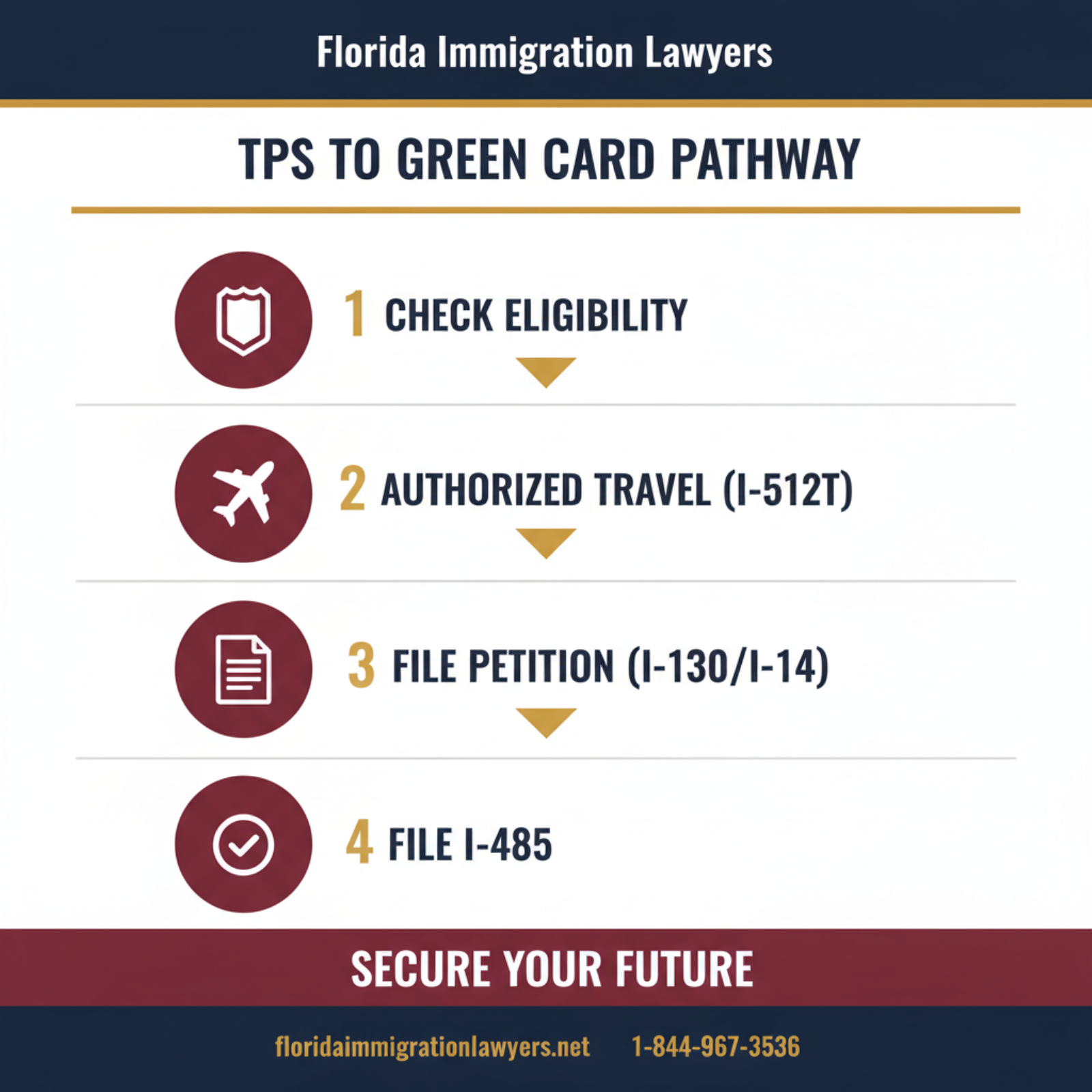
First, qualify for an immigrant visa category, typically through family-based (e.g., immediate relative of a U.S. citizen) or employment-based petition. Without an approved immigrant visa petition, you cannot adjust status. For example, a U.S. citizen spouse filing Form I-130 establishes eligibility. Some TPS holders may also be eligible for asylum, which can lead to a green card. Exploring all avenues with an experienced Florida immigration lawyer is highly recommended. Your eligibility for a green card through an underlying petition is the foundation.
-
File the Immigrant Visa Petition (If Applicable)
For family-based green cards, your U.S. citizen or lawful permanent resident relative files Form I-130 with USCIS. For employment-based, your employer typically files Form I-140. Ensure these petitions are approved before proceeding. Processing times vary; track your case status on the USCIS website. Once approved and a visa number is available, you can move forward with your adjustment of status application.
-
Secure Lawful Entry to the United States
Historically, "lawful admission" (INA Section 245(a)) was a challenge for many TPS holders who entered without inspection. However, Ramos v. Nielsen (later Ramos v. Mayorkas) clarified that a grant of TPS constitutes "lawful admission" for adjustment of status under INA 245(a), if other criteria are met. This ruling has opened a pathway for many TPS holders, especially those granted TPS after initial entry without inspection. This can be complex; consult a Florida immigration lawyer to confirm how this applies to your specific case.
-
File Form I-485, Application to Adjust Status
With an approved immigrant visa petition and meeting lawful entry, file Form I-485, Application to Adjust Status, with USCIS. This is the core of your green card application. File concurrently with Form I-765 (Employment Authorization Document) and Form I-131 (Advance Parole). A complete and accurate Form I-485 with all required supporting documentation is essential. Errors lead to delays or denial. Many Florida applicants concurrently file I-485 with their I-130 petition if they are an immediate relative of a U.S. citizen.
-
Attend Biometrics Appointment and Interview
After filing your I-485, you'll receive a notice for a biometrics appointment at a local Application Support Center (ASC) in Florida for fingerprinting and photographs. USCIS then schedules an interview at a local field office, like Miami, Orlando, or Tampa. During the interview, an immigration officer reviews your application and asks eligibility questions. For family-based petitions, they assess the relationship's authenticity. Thorough preparation with your attorney is highly recommended.
Essential Document Checklist for TPS to Green Card Applications
Gathering all necessary documents is crucial for the adjustment of status process for TPS holders. A meticulous approach helps prevent delays. Here is a general list of documents you'll typically need for your TPS to green card application:
- Form I-485, Application to Adjust Status: Completed and signed.
- Form I-130, Petition for Alien Relative (if applicable): If filed separately, provide approval notice (I-797).
- Form I-765, Application for Employment Authorization: To continue working while your I-485 is pending.
- Form I-131, Application for Travel Document (Advance Parole): To travel outside the U.S. while your I-485 is pending.
- Form I-864, Affidavit of Support: From your petitioner to show you will not become a public charge.
- Form I-693, Report of Medical Examination and Vaccination Record: Completed by a USCIS-approved civil surgeon.
- Birth Certificate: Your original birth certificate and a certified English translation.
- Marriage Certificate (if applicable): If applying through a spouse, and a certified English translation.
- Passport and Visa (if applicable): Copies of your passport, visa pages, and entry stamps.
- Form I-94, Arrival/Departure Record: If you entered lawfully.
- Proof of TPS Status: Copies of your Form I-797 approval notices for TPS and EADs.
- Photographs: Passport-style photographs meeting USCIS specifications.
- Proof of Relationship (for family-based): Birth certificates of children, joint bank accounts, utility bills, photos, affidavits.
- Police Clearances/Criminal Records: If you have any arrests or convictions, even minor ones.
- Financial Documents: Tax returns, pay stubs, employment verification letters for the sponsor.
Always ensure all foreign language documents have a certified English translation. Your Florida immigration attorney can help compile a precise list tailored to your situation and the West Palm Beach USCIS office jurisdiction requirements.
Timeline and Processing Expectations for Florida Applicants
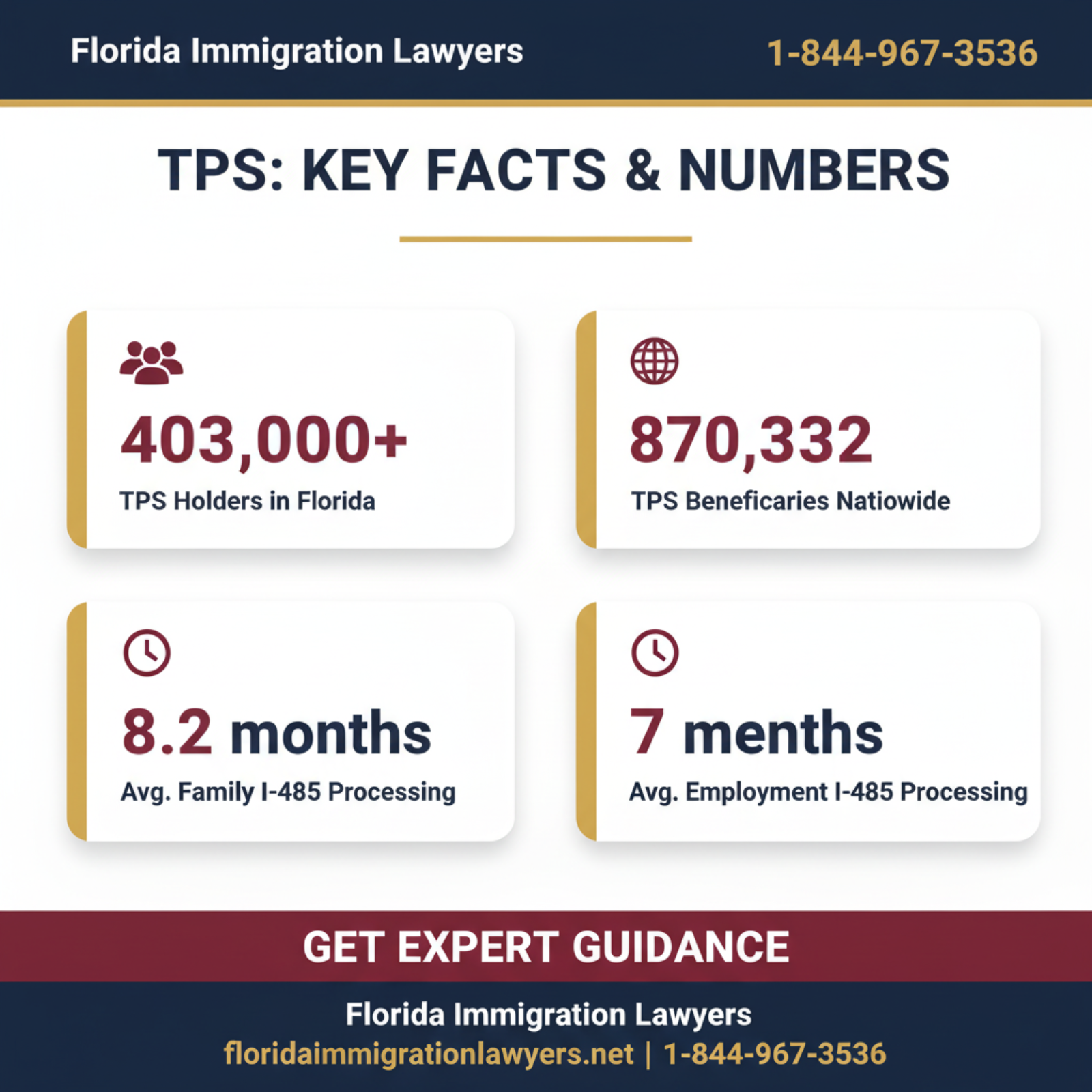
The journey from TPS to a green card through adjustment of status involves multiple stages, and processing times vary significantly. While exact timelines are impossible, understanding influencing factors helps manage expectations. These timelines are subject to change based on USCIS backlogs, policy shifts, and case complexity. Generally, the underlying petition (Form I-130 or I-140) can take months to over a year. Once a visa number is available, Form I-485 can take 12 to 24 months or longer from filing to approval.
Factors Affecting Processing Times in Florida
- USCIS Field Office Workload: Florida USCIS offices (e.g., Miami, Orlando, Tampa, Jacksonville) may have varying processing times due to caseloads.
- Case Complexity: Cases with criminal history, prior immigration violations, or complex family situations typically take longer.
- Requests for Evidence (RFEs): RFEs add significant time, as you must gather and submit additional documentation.
- Policy Changes: Immigration policies can shift, impacting processing priorities.
- Interview Backlogs: Scheduling interviews at local field offices can cause delays.
Check estimated processing times on the USCIS website. Remember these are estimates; your experience may differ. Working with Florida Immigration Lawyers helps prepare for delays and respond promptly, streamlining your TPS to green card pathway.
Cost Factors and Fee Breakdown for Green Card Applications
Pursuing a green card from TPS status involves several financial commitments. Budgeting for these costs is crucial to avoid application delays. USCIS filing fees are subject to change; always check the official USCIS website for the most current fee schedule.
- USCIS Filing Fees: For forms like I-130, I-485, I-765, and I-131. The I-485 fee often includes biometrics and fees for I-765 and I-131 when filed concurrently.
- Medical Examination Fees: A mandatory exam by a USCIS-approved civil surgeon. Costs vary by provider in Florida.
- Attorney Fees: Legal representation from an experienced immigration lawyer is an investment that can significantly improve your chances and navigate complexities. Florida Immigration Lawyers offers transparent fee structures.
- Translation Fees: For certified English translations of foreign language documents.
- Miscellaneous Costs: Including birth certificates, passport photos, and postage.
While fees can seem substantial, they are a necessary part of the green card application. Some applicants may be eligible for fee waivers for certain forms, though eligibility is strict. Discuss these cost factors and potential fee waiver options with your attorney.
Do not navigate the intricate journey from TPS to a green card alone. The complexities of immigration law, particularly regarding lawful entry and adjustment of status, demand experienced legal counsel. Contact Florida Immigration Lawyers today to schedule a consultation and let our dedicated team guide you towards a secure future in Florida.
Common Mistakes to Avoid When Applying for a Green Card from TPS
-
Not Establishing Lawful Entry Correctly
Many TPS holders entered without inspection. While Ramos v. Nielsen clarified TPS can constitute "lawful admission" for AOS, its application is nuanced. Incorrectly asserting lawful entry or failing to address prior entries can lead to denial. Consult an attorney.
-
Failing to Maintain TPS Status
Re-register for TPS during every open period until your green card is approved. Lapsing TPS status can result in unlawful presence and jeopardize your ability to adjust status.
-
Traveling Outside the U.S. Without Advance Parole
Leaving the U.S. without approved Advance Parole (Form I-131) while your AOS is pending can be considered abandonment. This can lead to re-entry bars or green card denial.
-
Incomplete or Inaccurate Forms
Submitting forms with missing information, incorrect dates, or contradictory statements leads to RFEs, delays, or denials. Answer every question truthfully and completely.
-
Failure to Disclose All Criminal History
Even minor arrests or dismissed charges must be disclosed. Withholding information can be considered misrepresentation, leading to serious immigration consequences.
-
Missing Deadlines for RFEs or Appointments
USCIS provides strict deadlines. Missing these without valid cause can result in application denial. Prompt responses are essential.
-
Not Proving Bona Fide Relationship (Family-Based)
For family-based petitions, USCIS rigorously scrutinizes relationship authenticity. Failing to provide sufficient evidence (joint documents, photos, affidavits) can lead to denial.
-
Lack of Financial Support (Affidavit of Support)
The petitioner must demonstrate sufficient financial means through Form I-864. If income is insufficient, a joint sponsor may be needed. Failure to meet this can lead to public charge inadmissibility.
-
Ignoring Changes in Immigration Law or Policy
Immigration law is dynamic. Failing to stay informed about changes can lead to costly errors. Rely on legal experts for current information.
-
Attempting to Navigate the Process Without Legal Counsel
The complexities of the TPS to green card pathway are vast. Many applicants in Florida attempt to self-file, often encountering insurmountable obstacles. An experienced immigration lawyer identifies issues, ensures compliance, and advocates for you, significantly increasing success chances.
When to Call Florida Immigration Lawyers for Your TPS to Green Card Pathway
While this guide provides an overview, the journey from TPS to a green card is rarely straightforward. Each case presents unique facts and potential challenges. Knowing when to seek professional legal assistance is crucial for a successful outcome. Florida Immigration Lawyers is here to provide dedicated support throughout Florida, including West Palm Beach, Miami, Orlando, and Tampa.
You should contact our firm immediately if any of the following scenarios apply:
- Complex Entry History: Multiple entries, prior unlawful presence, or questions about the Ramos decision's application.
- Criminal History: Any past arrests, charges, or convictions require expert legal analysis.
- Previous Immigration Violations: Prior deportations, removals, or other infractions make your case highly complex.
- Difficult Family Petitions: If your family relationship is complex or you anticipate challenges proving its authenticity.
- Need for Asylum or Other Relief: If you may be eligible for other immigration relief, such as asylum.
- Concerns About Public Charge: If financial concerns might affect meeting Affidavit of Support requirements.
- Receiving an RFE or Notice of Intent to Deny: These indicate a problem needing immediate expert attention.
- Any Uncertainty: If you feel overwhelmed or unsure about any aspect of the TPS to green card process, our attorneys offer clarity and peace of mind.
Our experienced immigration attorneys specialize in adjustment of status cases for TPS holders. We understand the specific challenges faced by Florida's diverse immigrant communities. We offer free consultations to assess your situation and outline a clear legal strategy.
About Florida Immigration Lawyers
Florida Immigration Lawyers is a leading immigration law firm dedicated to serving individuals and families across Florida. With deep understanding of U.S. immigration law and a compassionate approach, we provide comprehensive legal services. Our experienced attorneys deliver personalized, effective legal solutions, from family-based immigration to deportation defense. We prioritize client-focused service, ensuring every individual receives expert guidance. Whether in West Palm Beach, Miami, Orlando, or anywhere in Florida, our firm handles your immigration needs. We offer free consultations and are available 24/7. Our services include assistance with general immigration matters, asylum applications, deportation defense, family-based immigration, and citizenship applications. Choose Florida Immigration Lawyers for dedicated advocacy. Call us today at 1-844-967-3536 or visit our website at https://www.floridaimmigrationlawyers.net.
Sources and References
- U.S. Citizenship and Immigration Services (USCIS) - Temporary Protected Status
- U.S. Citizenship and Immigration Services (USCIS) - Adjustment of Status
- Executive Office for Immigration Review (EOIR)
- 8 U.S.C. § 1254a - Temporary Protected Status (Immigration and Nationality Act Section 244)
- 8 U.S.C. § 1255 - Adjustment of Status of Nonimmigrant to That of Person Admitted for Permanent Residence (Immigration and Nationality Act Section 245)
- 8 CFR Part 244 - Temporary Protected Status
- Ramos v. Nielsen, 967 F.3d 923 (9th Cir. 2020) (later Ramos v. Mayorkas)
- U.S. Department of State - Visa Bulletin
This article provides general legal information and is not intended as legal advice. Every case is unique, and outcomes depend on specific facts and circumstances. Contact an attorney for advice about your particular situation. Immigration laws are subject to change, and this information is current as of the publication date.
Do not wait to secure your future in Florida. The path from TPS to a green card can be complex, but with the right legal team, it is achievable. Our compassionate and experienced attorneys at Florida Immigration Lawyers are ready to assist you. Call us today at 1-844-967-3536 for your free consultation and take the first step towards permanent residency. Se Habla Español - Estamos aquí para ayudarle.
Do Not Navigate This Process Alone
Our experienced immigration attorneys are ready to fight for you. Get a free, confidential consultation today.
Se Habla Español
Or leave your details and we’ll call you:
Free Evaluation in 24 Hours
Or talk to us right now

AI voice assistant — available 24/7
FreeFrequently Asked Questions

William J. Vásquez
Founding Attorney · Vasquez Law Firm
U.S. Air Force veteran and immigration attorney with years of hands-on U.S. immigration experience. J.D., NCCU School of Law. AILA member. Admitted to the 4th, 5th, and 11th Circuit Courts.
Available 24/7 - Free Evaluations
Reviewed for legal accuracy by William J. Vásquez
Licensed in North Carolina; U.S. immigration is federal practice.
Related Legal Services
Our Florida immigration attorneys can help you with experienced immigration attorneys, business immigration and asylum protection. Call today at 1-844-967-3536 for a free consultation.
Related Links
Related Topics
Free Legal Consultation
Discuss your case with our experienced attorneys. We're available 24/7.
Se Habla Español - Estamos aquí para ayudarle.
Related Articles
Immigration Lawyer Orlando Free Consultation in 2026
Navigating the complexities of U.S. immigration law requires expert guidance. For those in Orlando and across Florida, a free consultation with an immigration lawyer can provide crucial insights into your legal options without financial commitment. This comprehensive guide from Florida Immigration Lawyers details why an initial consultation is essential, what services immigration attorneys offer, the step-by-step process, typical timelines, and associated costs. We also highlight common mistakes to avoid and when it's critical to seek professional legal assistance. Our firm serves all of Florida, including Naples and Collier County, ensuring accessible, high-quality representation for families, businesses, asylum seekers, and individuals facing deportation. Understand your rights and build a strong case with trusted legal partners.
Stem OPT Immigration Lawyer: 2026 Florida Guide
For F-1 students in Florida, the STEM OPT extension offers a vital 24-month work authorization after their initial OPT. This guide, updated for 2026, covers eligibility, the step-by-step application process, required documents, and critical timelines. Graduates from Florida universities in STEM fields must navigate strict USCIS regulations, including the E-Verify employer requirement. Learn how to avoid common mistakes and when to seek professional legal assistance from a dedicated stem OPT immigration lawyer to ensure a successful application and continued career growth in the U.S. Florida Immigration Lawyers offers expert guidance for students across the state.
Dual Citizenship Lawyer: Navigating Delays in Florida
Facing citizenship delays in Florida can be challenging, but understanding the process and knowing your options is key. Learn how a dual citizenship lawyer can assist you in navigating N-400 processing and USCIS backlogs in Hialeah.
"ina § 208(a)(2)" One-Year Filing Deadline: Florida Asylum
Discover the importance of the "ina § 208(a)(2)" one-year filing deadline for asylum seekers in Florida. Learn about the steps, documents needed, and common mistakes to avoid in your asylum application process.