TPS to Green Card Florida: Your Path to Permanent Residency
For Temporary Protected Status (TPS) holders in Hollywood, Florida, transitioning to a green card involves navigating specific immigration pathways, not a direct conversion. This comprehensive guide from Florida Immigration Lawyers details the steps, essential documents, timelines, and costs associated with adjusting status from TPS to lawful permanent residency. We cover critical aspects like establishing lawful entry, avoiding common mistakes, and understanding when professional legal assistance is indispensable. Our firm is dedicated to helping TPS beneficiaries in Florida achieve their long-term immigration goals, offering expert guidance through family-based or employment-based petitions. Contact us today for a free consultation to discuss your unique path to a green card.

For Temporary Protected Status (TPS) holders in Florida, a direct pathway to a green card does not exist. However, many individuals may adjust their status to lawful permanent resident through other existing immigration avenues, such as family-based or employment-based petitions. This process typically requires meeting specific eligibility criteria for an underlying immigrant visa category and demonstrating a lawful entry into the U.S.
- TPS does not directly lead to a green card.
- An underlying immigrant visa petition (family or employment) is usually required.
- Lawful entry into the U.S. is a critical requirement for adjustment of status.
- Seeking legal guidance is essential to navigate the complex requirements.
Are you a Temporary Protected Status (TPS) holder in Hollywood, Florida, dreaming of a more permanent future? The journey from temporary protection to lawful permanent residency, often referred to as a green card, can seem daunting. Many TPS beneficiaries across Florida, including those in vibrant communities like Hollywood, seek clarity on how to secure their long-term presence in the United States.
This comprehensive guide from Florida Immigration Lawyers will explain the potential pathways from TPS to green card Florida for those seeking lawful permanent residency. We understand the hopes and challenges involved in this process. Our goal is to provide clear, actionable information to help you understand your options.
Navigating complex immigration laws requires expert knowledge. We are here to help you every step of the way. If you have questions about your specific situation or need assistance with your application, do not hesitate. Call Florida Immigration Lawyers at 1-844-967-3536 for a free consultation.
Understanding TPS and Green Card Eligibility in Florida
Temporary Protected Status (TPS) offers protection from deportation and provides work authorization to eligible foreign nationals from designated countries. These countries are typically experiencing armed conflict, environmental disasters, or other extraordinary and temporary conditions. While TPS offers vital temporary relief, it is crucial to understand that it does not, by itself, provide a direct route to a green card or U.S. citizenship.
For TPS holders in Florida to obtain a green card, they must qualify for an immigrant visa through a separate, underlying category. This typically means being sponsored by a qualifying U.S. citizen or lawful permanent resident relative, or through an eligible employment-based petition. The most common pathway for eligible individuals already in the U.S. is through adjustment of status.
A key hurdle for many TPS holders seeking adjustment of status is demonstrating lawful entry into the United States. Historically, some TPS recipients may have entered without inspection. However, certain legal precedents and policies, like the *Matter of Arrabally and Yerrabelly* (25 I&N Dec. 771 BIA 2012) and subsequent USCIS guidance, have offered potential avenues for those who received TPS to satisfy the lawful entry requirement through a grant of advance parole.
Florida is home to a significant population of TPS beneficiaries, particularly in South Florida cities like Hollywood, Miami, and Orlando. Understanding local USCIS field office procedures and potential processing variations is important. Our firm, Florida Immigration Lawyers, is well-versed in the specific nuances affecting immigrants throughout the state.
The Step-by-Step Process: Navigating TPS to Green Card Florida
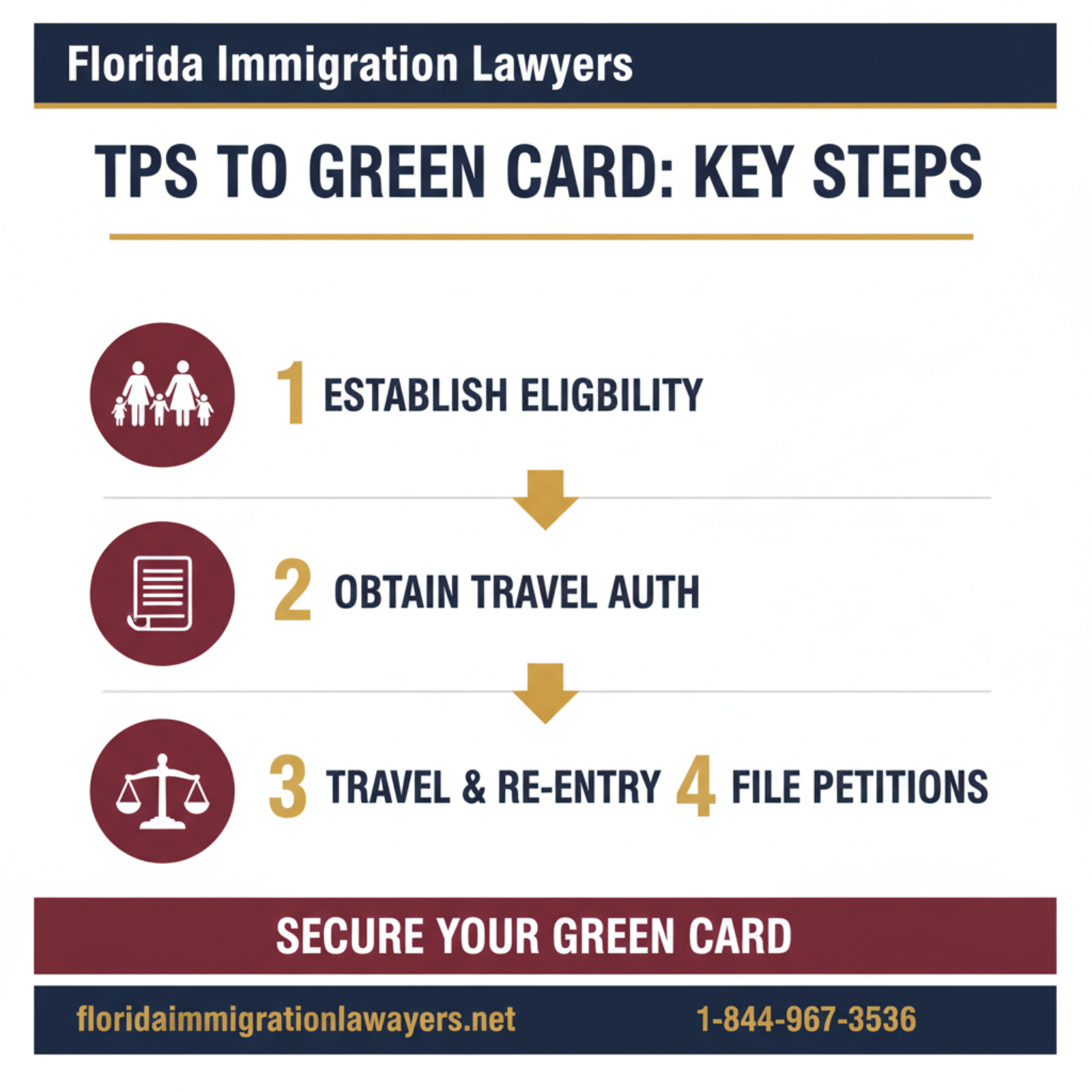
The journey from TPS to green card Florida involves several critical steps. This process is not a direct conversion but rather an application for a green card based on an independent eligibility category, with TPS providing a layer of protection during the process. Here is a general outline:
-
Determine Eligibility for an Underlying Immigrant Visa: You must first qualify for a green card through a family-based or employment-based petition. This could be through a U.S. citizen spouse, parent, or adult child (for family-based immigration). For employment-based, you would need a sponsoring employer. It is vital to assess if you meet the specific criteria for these categories before proceeding. Learn more about family-based immigration or business immigration.
-
File the Immigrant Petition: Your qualifying relative or employer must file an immigrant petition on your behalf. For family-based categories, this is typically Form I-130, Petition for Alien Relative. For employment-based categories, it is usually Form I-140, Immigrant Petition for Alien Worker. This petition establishes your eligibility for an immigrant visa category.
-
Establish Lawful Entry and Eligibility for Adjustment of Status: This is a crucial step for many TPS holders. If you entered the U.S. without inspection, you might need to obtain advance parole (Form I-131) and travel internationally to re-enter with inspection. This 'inspected entry' is often a prerequisite for adjustment of status under INA Section 245(a) (8 U.S.C. § 1255(a)). Alternatively, some TPS beneficiaries may qualify under specific interpretations or court decisions related to TPS granting lawful status or parole. It is essential to consult with an attorney regarding your entry history.
-
File Form I-485, Application to Register Permanent Residence or Adjust Status: Once your underlying immigrant petition is approved and a visa number is available (if applicable), you can file Form I-485. This form is your application for a green card while you are physically present in the United States. You will also file supporting forms like Form I-765 (Employment Authorization) and Form I-131 (Advance Parole) concurrently.
-
Attend Biometrics Appointment: After filing Form I-485, USCIS will send you an appointment notice to provide your fingerprints, photograph, and signature. This biometric data is used for background and security checks.
-
Undergo Interview (if required): Most applicants for adjustment of status will be scheduled for an interview at a local USCIS field office, such as the Miami Field Office or the Tampa Field Office. During the interview, an immigration officer will review your application, ask questions about your eligibility, and verify the information provided. Having an attorney present can be highly beneficial.
-
Receive Decision: After the interview, or sometimes without one, USCIS will make a decision on your application. If approved, you will receive your green card. If there are issues, you might receive a Request for Evidence (RFE) or a Notice of Intent to Deny (NOID). Prompt and thorough responses are critical.
Essential Document Checklist for TPS to Green Card Applicants
Preparing a complete and accurate application package is vital for a smooth process from TPS to green card Florida. Missing documents can lead to delays or even denials. Here is a general checklist of documents you will likely need:
- Proof of TPS Status: Your I-797 approval notices for TPS, Employment Authorization Documents (EADs) issued under TPS, and any other documentation proving your TPS designation.
- Birth Certificate: Your original birth certificate and a certified English translation if not in English.
- Marriage Certificate (if applicable): If your petition is family-based through a spouse, you will need your marriage certificate.
- Passport and Visa History: Copies of your passport, any previous visas, and Form I-94 (Arrival/Departure Record).
- Affidavit of Support (Form I-864): Filed by your petitioner (U.S. citizen or LPR relative) to demonstrate they can financially support you.
- Medical Examination Results (Form I-693): Completed by a USCIS-approved civil surgeon. This must be submitted in a sealed envelope.
- Police Clearances and Court Records: If you have any arrests or criminal convictions, you will need certified court dispositions.
- Evidence of Lawful Entry: Documentation proving your lawful entry into the U.S., such as an I-94 stamped with 'Paroled' if you used advance parole, or other proof of inspection and admission.
- Photographs: Passport-style photographs meeting USCIS specifications.
- Proof of Relationship: For family-based petitions, extensive evidence of a bona fide relationship (e.g., joint bank accounts, photos, utility bills).
Timeline and Processing Expectations for Your Green Card in Florida
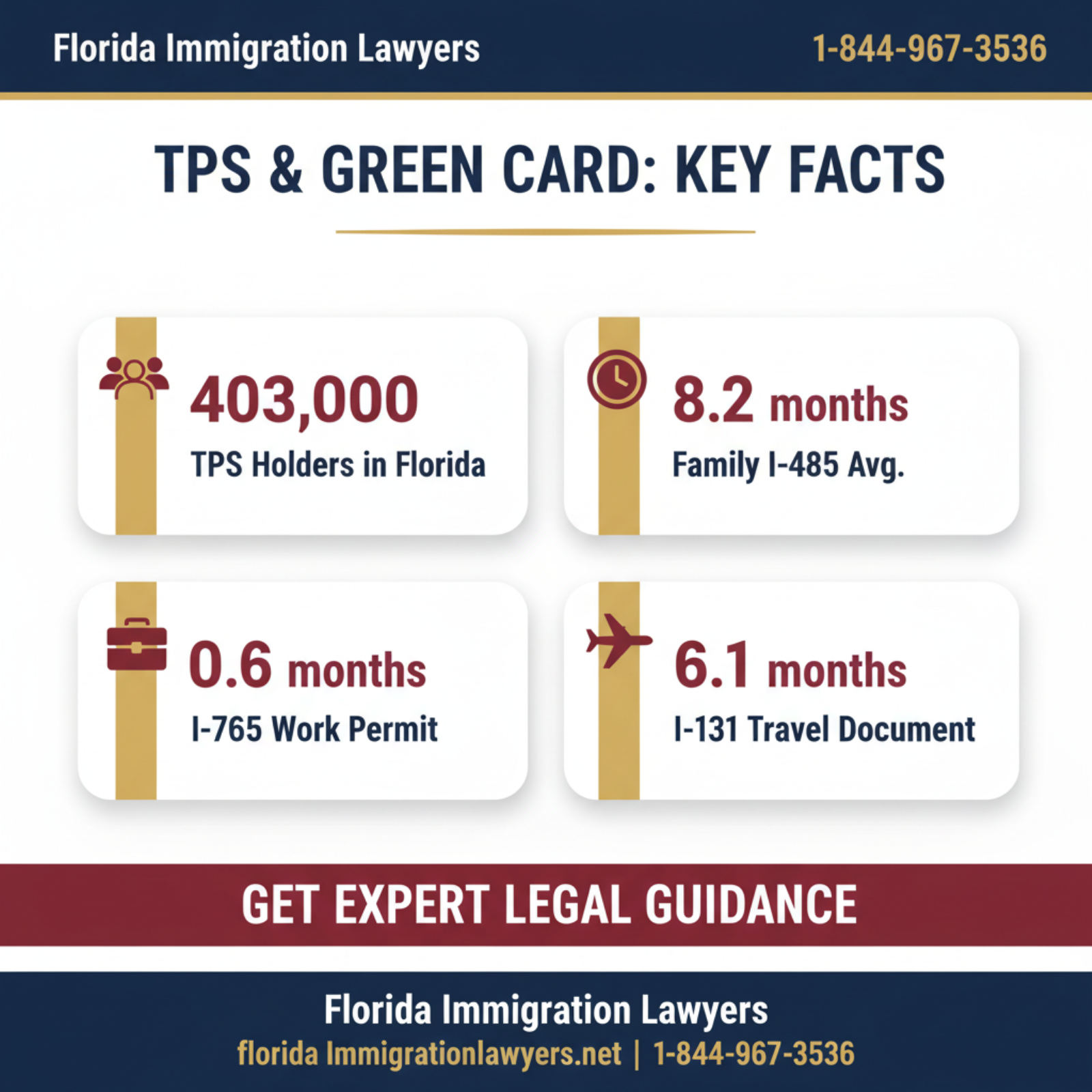
The processing time for an adjustment of status application from TPS to green card Florida can vary significantly. It depends on several factors, including the specific USCIS field office handling your case (e.g., Miami, Orlando), the type of underlying immigrant petition, and the current caseloads.
Typically, the entire process, from filing the initial petition to receiving a green card, can take anywhere from one to several years. Family-based petitions, especially those involving immediate relatives of U.S. citizens, often have shorter wait times for visa availability compared to other categories. However, the processing of Form I-485 itself at a local field office can still take many months.
Factors that can influence your timeline include the completeness and accuracy of your application, whether you receive a Request for Evidence (RFE), and the efficiency of the specific USCIS office. The current immigration climate and any policy changes, such as those related to TPS extension 2026, can also impact processing times. USCIS provides online tools to check average processing times for specific forms at different service centers and field offices. However, these are estimates and not guarantees.
Cost Factors and Fee Breakdown
Pursuing a green card from TPS to green card Florida involves various costs, including government filing fees and potentially legal fees. It is important to budget for these expenses throughout the process. Please note that government fees are subject to change, and specific amounts should always be verified on the official USCIS website.
The primary government fees typically include:
- Immigrant Petition Fee: For Form I-130 or I-140, filed by your petitioner.
- Adjustment of Status Application Fee: For Form I-485, your green card application. This often includes the biometrics fee.
- Employment Authorization Document (EAD) Fee: For Form I-765, if filed separately from I-485.
- Advance Parole Document Fee: For Form I-131, if filed separately from I-485.
- Medical Examination Fee: Paid directly to the civil surgeon. This fee varies by provider.
Beyond government fees, you should also consider:
- Attorney Fees: Legal representation is highly recommended for such a complex process. Attorney fees vary based on the complexity of your case and the services provided.
- Translation Costs: If any of your supporting documents are not in English, you will need certified translations.
- Travel Expenses: For biometrics appointments, interviews, or potential advance parole travel.
Do not navigate this process alone. The financial and legal complexities can be overwhelming. Contact Florida Immigration Lawyers today at 1-844-967-3536 to discuss your specific situation and get a clear understanding of the potential costs involved.
Common Mistakes to Avoid When Seeking a Green Card from TPS
The path from TPS to green card Florida is fraught with potential pitfalls. Avoiding common mistakes can significantly improve your chances of success and prevent costly delays or denials. Here are crucial errors to steer clear of:
-
Assuming TPS Directly Leads to a Green Card: This is a fundamental misunderstanding. TPS is temporary humanitarian relief and does not, by itself, create a pathway to permanent residency. You must qualify for a green card through an independent category, such as a family or employment petition. Failing to understand this often leads to misdirected efforts and disappointment.
-
Failing to Establish Lawful Entry: For most adjustment of status applicants, proving lawful entry into the U.S. is essential. If you entered without inspection, you might need to obtain advance parole and travel outside the U.S. and re-enter lawfully. Not addressing this requirement correctly can lead to an I-485 denial.
-
Incorrectly Completing Forms: Immigration forms are highly detailed and require precise information. Errors, omissions, or inconsistencies can trigger RFEs, delays, or even denials. Always double-check every entry and ensure consistency across all applications.
-
Missing Crucial Deadlines: Immigration processes are time-sensitive. Missing deadlines for filing petitions, responding to RFEs, or attending appointments can jeopardize your case. It is vital to track all dates carefully and respond promptly.
-
Not Disclosing All Immigration History: Attempting to conceal any part of your immigration history, including previous visa overstays, denials, or removal proceedings, can be detrimental. USCIS has access to extensive records, and any misrepresentation can lead to accusations of fraud and severe consequences.
-
Ignoring Criminal History: Any past arrests, charges, or convictions, even minor ones, must be disclosed and properly addressed. Certain criminal offenses can render you inadmissible to the U.S. and ineligible for a green card. Consulting an attorney about criminal history is paramount.
-
Not Having a Valid Underlying Petition: You cannot apply for adjustment of status without an approved (or concurrently filed) immigrant petition (I-130 or I-140) establishing your eligibility for a green card category. Filing Form I-485 without this foundational element will result in denial.
-
Attempting to File Without Legal Counsel: While technically possible, navigating the intricacies of immigration law without an experienced attorney is risky. An attorney can help identify potential issues, ensure proper documentation, and represent your best interests, especially for complex cases involving USCIS TPS and lawful entry.
-
Failing to Respond to RFEs Promptly and Completely: If USCIS sends a Request for Evidence, it means they need more information to process your case. Failing to respond by the deadline or providing incomplete information will almost certainly lead to a denial. Take RFEs seriously and seek legal help to formulate a comprehensive response.
-
Traveling Internationally Without Proper Advance Parole: If you are applying for adjustment of status, leaving the U.S. without a valid advance parole document (Form I-131) can be considered abandonment of your application. Always secure advance parole before any international travel.
When to Call a Florida Immigration Lawyer
While this guide provides general information, every immigration case is unique. The complexities of moving from TPS to green card Florida often necessitate the expertise of a seasoned immigration attorney. You should strongly consider contacting Florida Immigration Lawyers if you encounter any of the following scenarios:
- Complex Lawful Entry Issues: If your entry into the U.S. was not clearly documented or involved entry without inspection, you need an attorney to explore options like advance parole or other legal avenues to satisfy the lawful entry requirement for adjustment of status.
- Prior Deportations or Removals: A history of deportation or removal orders can significantly complicate your case and may require waivers or other advanced strategies that only an attorney can properly advise on.
- Criminal Record Concerns: Even minor criminal offenses can have severe immigration consequences. An attorney can assess the impact of your criminal history on your admissibility and eligibility for a green card.
- Previous Visa Overstays or Violations: If you have overstayed previous visas or violated immigration laws in the past, an attorney can help determine if these issues create bars to admissibility and explore potential waivers.
- Unsure About Eligibility: If you are uncertain whether you qualify for an underlying family-based or employment-based petition, an attorney can evaluate your circumstances and identify all potential pathways.
- Need Help with Form Preparation: The sheer volume and complexity of immigration forms can be overwhelming. An attorney ensures all forms are accurately completed and all necessary supporting documents are included.
- Receiving a Request for Evidence (RFE) or Notice of Intent to Deny (NOID): These notices indicate a problem with your application. An attorney can help you formulate a comprehensive and timely response to prevent denial.
- Facing an Interview: Having legal representation at your USCIS interview can provide peace of mind and ensure your rights are protected.
Florida Immigration Lawyers has extensive experience helping individuals across Florida, including Hollywood, navigate the intricate process of securing their immigration future. We are dedicated to providing compassionate and effective legal representation. Visit our immigration practice area page to learn more about how we can assist you.
About Florida Immigration Lawyers
Florida Immigration Lawyers is a leading immigration law firm dedicated to serving individuals and families across the entire state of Florida. With offices strategically located to assist clients from Hollywood to Jacksonville, we pride ourselves on providing exceptional legal counsel and compassionate support through every step of the immigration journey.
Our team of experienced attorneys specializes in a wide range of immigration matters, including family-based immigration, business immigration, asylum, deportation defense, and pathways to citizenship. We understand the profound impact immigration decisions have on your life and are committed to achieving the best possible outcomes for our clients.
Why choose Florida Immigration Lawyers? We offer personalized attention, clear communication, and a deep understanding of U.S. immigration law. Our firm is available 24/7, offering free consultations to help you understand your legal options without financial obligation. We are here to be your trusted advocates, ensuring your voice is heard and your rights are protected.
For dedicated and experienced legal assistance, contact Florida Immigration Lawyers today. Your future in Florida is our priority. Call us at 1-844-967-3536 or visit our website at https://www.floridaimmigrationlawyers.net to schedule your free consultation.
Sources and References
- U.S. Citizenship and Immigration Services (USCIS) - Temporary Protected Status
- U.S. Citizenship and Immigration Services (USCIS) - Adjustment of Status
- 8 U.S.C. § 1255 - Adjustment of status of nonimmigrant to that of person admitted for permanent residence.
- 8 C.F.R. § 245.1 - Eligibility.
- Executive Office for Immigration Review (EOIR) - Immigration Court Locations (Miami, Orlando)
- Immigration and Nationality Act (INA) Section 244(f)(4) - Lawful Status for TPS purposes.
- Matter of Arrabally and Yerrabelly, 25 I&N Dec. 771 (BIA 2012).
This article provides general legal information and is not intended as legal advice. Every case is unique, and outcomes depend on specific facts and circumstances. Contact an attorney for advice about your particular situation. Laws are subject to change.
The journey from TPS to green card Florida is a significant step towards securing your future in the United States. While the process is complex, understanding your options and having dedicated legal support can make all the difference. Florida Immigration Lawyers is committed to guiding you through every challenge and opportunity.
Do not let uncertainty stand in the way of your dreams. Take the first step towards permanent residency today. We offer free, confidential consultations to review your case and outline a clear path forward. Call Florida Immigration Lawyers at 1-844-967-3536 to schedule your free consultation. Se Habla Español - Estamos aquí para ayudarle.
Do Not Navigate This Process Alone
Our experienced immigration attorneys are ready to fight for you. Get a free, confidential consultation today.
Se Habla Español
Frequently Asked Questions
Florida Immigration Lawyers
Immigration Attorney | Founder, Vasquez Law Firm
U.S. Air Force veteran and immigration attorney with thousands of cases resolved. J.D., NCCU School of Law. AILA member. Admitted to the 4th, 5th, and 11th Circuit Courts.
Available 24/7 - Free Evaluations
Related Legal Services
Our Florida immigration attorneys can help you with asylum protection, deportation defense and citizenship and naturalization. Call today at 1-844-967-3536 for a free consultation.
Related Links
Related Topics
Free Legal Consultation
Discuss your case with our experienced attorneys. We're available 24/7.
Se Habla Español - Estamos aquí para ayudarle.
Related Articles
Immigration Rights in Florida: Know Your Legal Protections
Navigating immigration law in Florida can be complex, especially when facing potential encounters with Immigration and Customs Enforcement (ICE). This comprehensive guide empowers you with essential immigration rights, detailing your legal protections and what to do if you or a loved one are stopped or detained. Learn how to protect yourself, avoid critical mistakes, and understand the crucial role of legal counsel in safeguarding your future in Florida. From Homestead to Miami, knowing your rights is your first line of defense against deportation and legal challenges. Contact Florida Immigration Lawyers for a free consultation.
Unlawful Presence Waiver in Florida: A Guide | VLF Florida
Discover how the unlawful presence waiver can help immigrants in Florida. Learn about eligibility, application steps, and common mistakes to avoid. Contact Florida Immigration Lawyers for a free consultation.
Citizenship Test Preparation Florida: Your Guide to
Preparing for the U.S. citizenship test in Florida is a critical step towards naturalization. This comprehensive guide from Florida Immigration Lawyers covers understanding the English and civics tests, a step-by-step application process, essential documents, and effective preparation strategies. Learn about common mistakes to avoid and when to seek legal counsel for complex cases. Our experienced attorneys serve clients across Florida, including Gainesville, providing personalized support to help you achieve your dream of becoming a U.S. citizen. Contact us for a free consultation and navigate your naturalization journey with confidence and expert guidance.
Immigration Lawyer Sarasota Bradenton Florida | VLF Florida
Discover how an immigration lawyer in Sarasota and Bradenton, Florida, can help you navigate complex immigration processes. Contact Florida Immigration Lawyers for expert guidance.