TPS Florida Eligible Countries 2026: Guide to Protected
For individuals in Florida, navigating Temporary Protected Status (TPS) eligible countries in 2026 is vital. This comprehensive guide from Florida Immigration Lawyers explains TPS benefits, eligibility, the application process, and what to expect for designated nations. We cover essential documents, common mistakes to avoid, and when to seek legal counsel, focusing on communities like Pembroke Pines. Understand how TPS offers protection from deportation and work authorization, and stay informed on crucial updates. Contact us today for a free consultation to secure your immigration future.

Temporary Protected Status (TPS) provides temporary legal residency and work authorization to eligible nationals of designated countries experiencing armed conflict, environmental disaster, or other extraordinary conditions. For residents in Florida, understanding current eligible countries and application processes in 2026 is crucial. This status offers a critical lifeline, preventing deportation and allowing beneficiaries to live and work lawfully.
- TPS offers temporary protection from deportation and work authorization.
- Eligibility depends on your nationality and continuous presence in the U.S.
- Designated countries and extension periods are subject to change by DHS.
- Applying correctly and on time is vital for maintaining status.
- Consulting an immigration lawyer is highly recommended for complex cases.
Are you living in Florida, uncertain about your immigration future due to conditions in your home country? The thought of deportation can be overwhelming, especially when your country faces instability. Fortunately, Temporary Protected Status (TPS) offers a beacon of hope for many. This program allows eligible individuals from designated nations to live and work lawfully in the United States, including right here in Florida, for a temporary period.
Understanding the nuances of TPS Florida eligible countries 2026 is critical for those seeking or maintaining this vital protection. This comprehensive guide will walk you through what TPS is, who qualifies, the application process, and what to expect in the coming years. We will focus on key updates and considerations for residents of Pembroke Pines and across the Sunshine State. If you have questions or need personalized guidance, do not hesitate. Call Florida Immigration Lawyers at 1-844-967-3536 for a free consultation. We are here to help you navigate these complex immigration waters.
Understanding Temporary Protected Status (TPS) in Florida
Temporary Protected Status (TPS) is a humanitarian immigration benefit granted by the United States to eligible foreign nationals. It allows them to remain in the U.S. and obtain work authorization when their home countries are deemed unsafe for return. This designation is made by the Secretary of Homeland Security due to ongoing armed conflict, environmental disasters, or other extraordinary and temporary conditions.
For many individuals and families in Florida, including communities in Pembroke Pines, TPS has provided much-needed stability. It prevents removal and offers a pathway to contribute to the U.S. economy and society without fear. The Immigration and Nationality Act (INA) Section 244, codified at 8 U.S.C. § 1254a, outlines the legal framework for TPS. This program underscores America's commitment to humanitarian aid.
Eligibility Requirements for TPS Applicants in Florida
To be eligible for TPS Florida, applicants must meet several specific criteria. These requirements are consistently applied by U.S. Citizenship and Immigration Services (USCIS) across the nation. Understanding these points is the first step toward a successful application.
First, you must be a national of a country designated for TPS, or a person without nationality who last habitually resided in that designated country. Second, you must have been continuously physically present in the United States since the effective date of your country's most recent TPS designation. Third, you must have continuously resided in the United States since a date specified by the Secretary of Homeland Security for your country's designation.
Additionally, you must register for TPS during the initial registration period or during any re-registration period. Certain criminal offenses or national security grounds can render an applicant ineligible. It is important to remember that TPS is a temporary benefit and does not lead directly to permanent residency or U.S. citizenship. However, it can provide crucial protection while other immigration avenues are pursued.
Continuous Physical Presence and Residence
Maintaining continuous physical presence (CPP) and continuous residence (CR) in the U.S. are critical TPS requirements. CPP means you have been physically present in the U.S. without significant breaks since a specified date. CR means your primary dwelling has been in the U.S. since a specified date.
Brief, casual, and innocent departures from the U.S. may not break your continuous physical presence. However, any extended absence or departure without advance parole could jeopardize your eligibility. Consulting with Florida Immigration Lawyers can help you assess if your travel history impacts your TPS application.
Navigating the TPS Application Process in Florida
Applying for or re-registering for TPS Florida involves a structured process with specific forms and deadlines. Following these steps carefully is essential to avoid delays or denials. USCIS oversees all TPS applications, and errors can be costly.
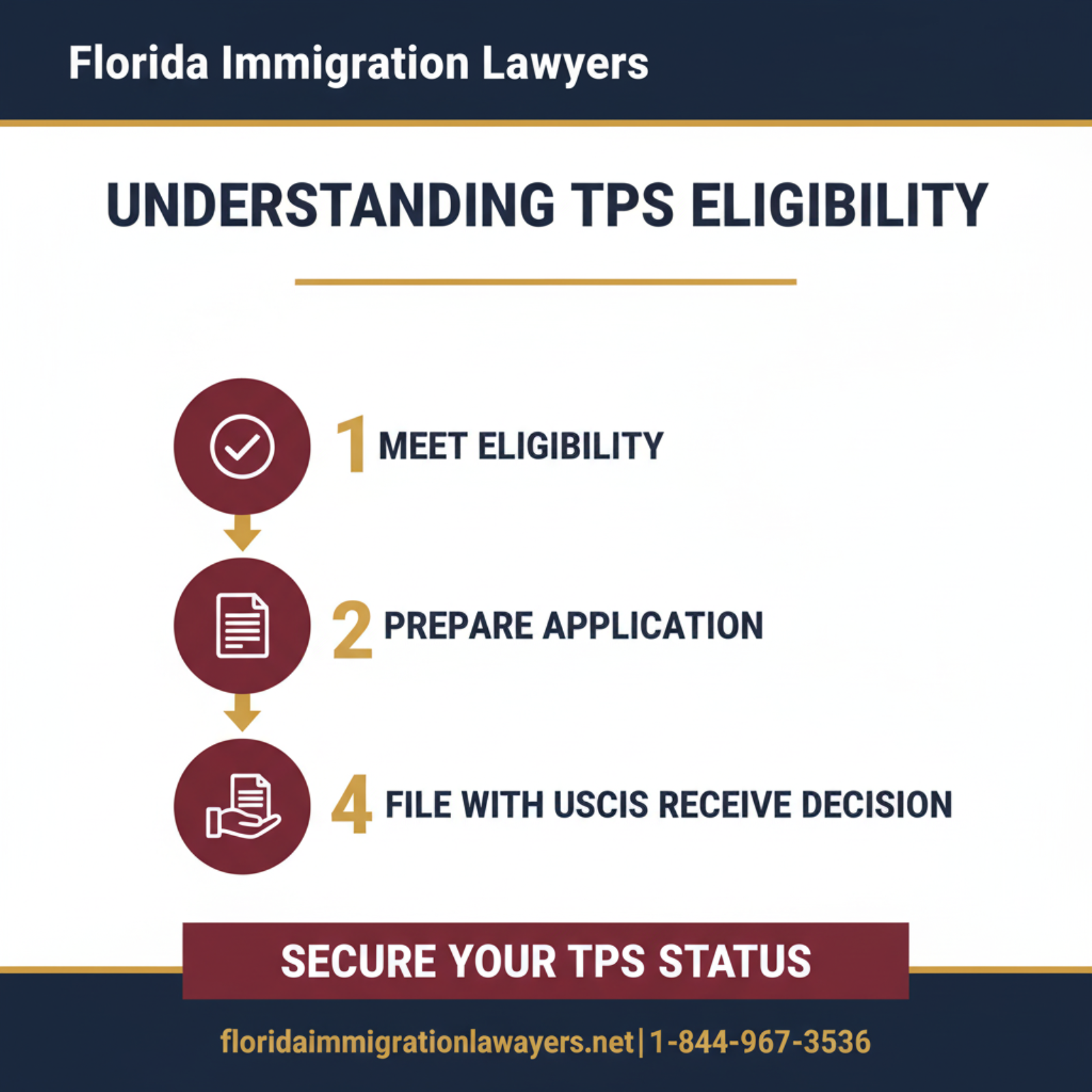
Here is a general step-by-step guide for applying for Temporary Protected Status:
- Determine Your Eligibility: Confirm your nationality and ensure your country is designated for TPS. Verify that you meet the continuous physical presence and continuous residence requirements.
- Gather Required Documents: Collect proof of identity, nationality, date of entry into the U.S., and continuous physical presence. This includes passports, birth certificates, entry stamps, and utility bills.
- Complete USCIS Forms: Fill out Form I-821, Application for Temporary Protected Status. You may also need to file Form I-765, Application for Employment Authorization, to obtain a work permit. Additionally, Form I-601, Application for Waiver of Grounds of Inadmissibility, might be necessary if you have certain inadmissibility issues.
- Pay Filing Fees: Submit the required filing fees for Form I-821 and Form I-765. Fee waivers may be available for eligible applicants, which typically require Form I-912, Request for Fee Waiver.
- Submit Your Application: Mail your completed forms, supporting documents, and fees to the designated USCIS Lockbox facility. Always keep copies of everything you submit for your records.
- Attend Biometrics Appointment: After submitting your application, you will receive a notice for a biometrics appointment at a local Application Support Center (ASC). This appointment is for fingerprinting and photographs.
- Respond to Requests for Evidence (RFE): USCIS may send an RFE if they need additional information or clarification. Respond promptly and thoroughly to avoid delays.
- Receive a Decision: USCIS will review your application and evidence, then issue a decision. If approved, you will receive an Employment Authorization Document (EAD) and a notice of TPS approval.
The process can be intricate, and even minor mistakes can lead to significant setbacks. Our team at Florida Immigration Lawyers regularly assists clients in Pembroke Pines and across Florida with their TPS applications, ensuring accuracy and completeness.
Essential Document Checklist for TPS
Having all your documents prepared is crucial for a smooth TPS application. Here is a checklist of typically required documents:
- Proof of identity and nationality (e.g., passport, birth certificate with photo ID).
- Proof of date of entry into the U.S. (e.g., I-94 arrival/departure record, airline tickets).
- Proof of continuous physical presence in the U.S. (e.g., utility bills, leases, school records, employment records, medical records).
- Two passport-style photographs.
- Any previous immigration documents (e.g., prior EADs, notices of approval).
- If applicable, marriage certificate or birth certificates for dependents.
- If applying for a fee waiver, proof of inability to pay.
Organizing these documents carefully will significantly streamline your application.
TPS Florida Eligible Countries 2026: What to Expect
The list of countries designated for Temporary Protected Status is dynamic and subject to change. As of early 2026, the following countries are generally expected to remain designated or have had recent extensions, impacting thousands of residents in Florida:
- Afghanistan: Designated due to ongoing armed conflict and humanitarian crisis.
- Burma (Myanmar): Designated following a military coup and widespread human rights abuses.
- Cameroon: Designated due to extreme violence and internal conflict.
- El Salvador: Has had TPS for many years, with termination currently enjoined by court orders.
- Haiti: Designated due to political instability, violence, and natural disasters.
- Honduras: Similar to El Salvador, termination is currently enjoined.
- Nepal: Designated after a devastating earthquake.
- Nicaragua: Termination enjoined by court orders.
- Somalia: Designated due to ongoing armed conflict and dire humanitarian conditions.
- South Sudan: Designated due to conflict and humanitarian crisis.
- Sudan: Designated due to armed conflict and humanitarian crisis.
- Syria: Designated due to civil war and humanitarian crisis.
- Ukraine: Designated due to the ongoing armed conflict with Russia.
- Venezuela: Designated due to the severe humanitarian crisis and political instability.
- Yemen: Designated due to ongoing armed conflict and humanitarian crisis.
It is crucial to note that court injunctions can affect termination dates for some countries, leading to extensions for beneficiaries. The Secretary of Homeland Security regularly reviews country conditions to determine new designations, extensions, or terminations. We recommend checking the USCIS TPS website regularly for the most up-to-date information.
Monitoring TPS Extensions and Designations
Keeping track of TPS extension 2026 announcements is vital for beneficiaries. The Department of Homeland Security (DHS) typically announces decisions regarding extensions or re-designations several months before a country's current TPS period expires. These announcements will specify new registration periods and validity dates for EADs.
Individuals from countries like Venezuela, Haiti, and Ukraine, who represent significant populations in Florida, must pay close attention to these updates. Failure to re-register within the specified window can result in loss of TPS benefits. Florida Immigration Lawyers stays abreast of these changes to provide timely advice.
Benefits and Limitations of Temporary Protected Status
Temporary Protected Status offers significant advantages to eligible individuals. The primary benefit is protection from deportation (removal) from the United States. This provides immense peace of mind for families in Florida who might otherwise face uncertainty.
Additionally, TPS beneficiaries are eligible to apply for an Employment Authorization Document (EAD). This EAD allows you to work legally in the U.S., enabling you to support yourself and your family. Many beneficiaries also become eligible for a travel document, known as an advance parole document. An advance parole document allows you to travel outside the U.S. and lawfully return, which can be invaluable for family emergencies or other important reasons. For more information on travel with TPS, you can visit travel.state.gov.
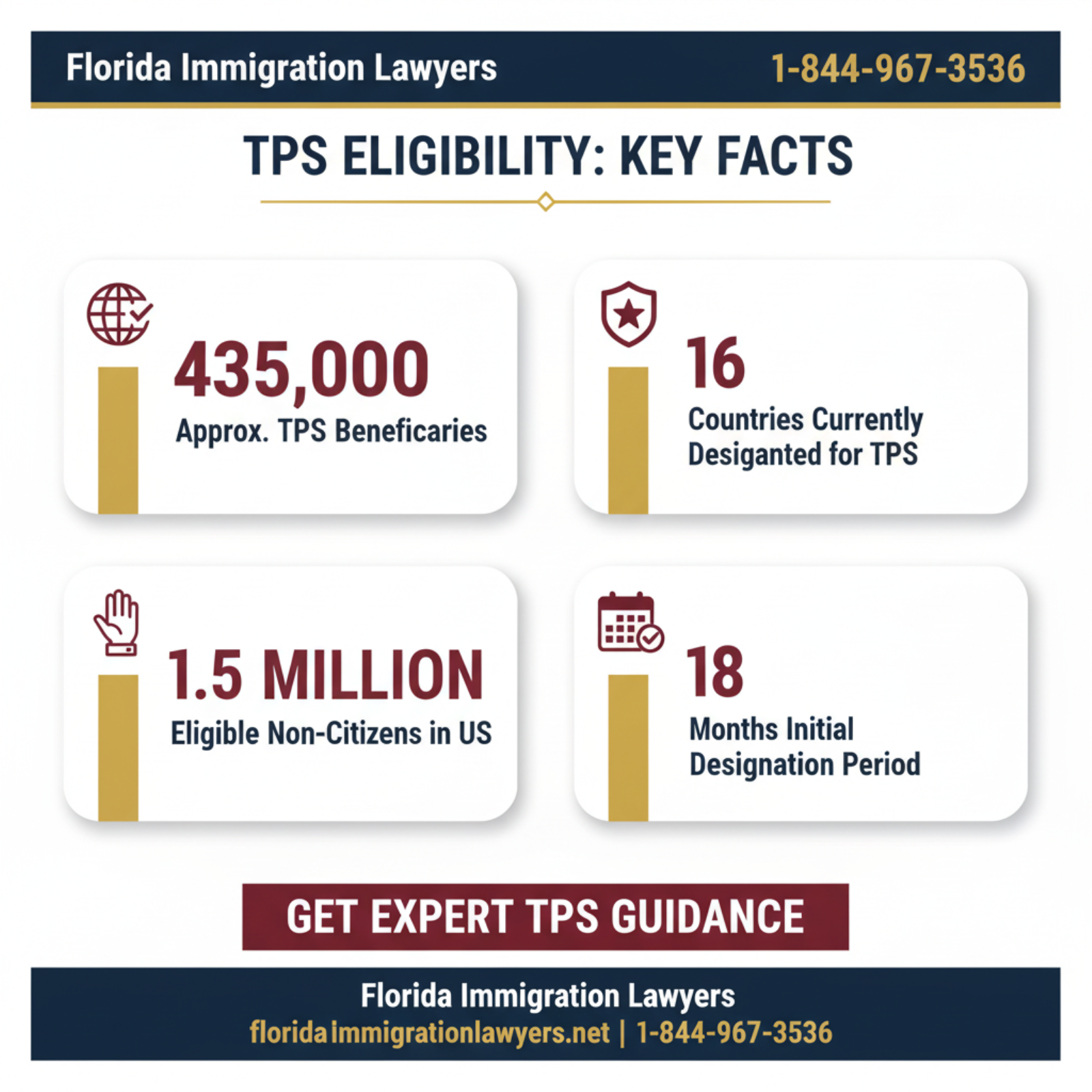
However, TPS is not a path to permanent residency or U.S. citizenship on its own. It is a temporary status, and its designation can be terminated by the Secretary of Homeland Security. While some TPS beneficiaries may eventually adjust their status through other immigration avenues, TPS itself does not directly lead to a green card. It is important to explore all potential immigration options with a knowledgeable attorney. Our firm can help you explore avenues like family-based immigration or employment-based immigration if applicable.
Life with TPS in Pembroke Pines, Florida
Living with Temporary Protected Status in Florida offers a unique set of opportunities and responsibilities. For many in Pembroke Pines, Broward County, and across South Florida, TPS provides the stability needed to build a life, work, and integrate into the community. Florida's vibrant economy and diverse population welcome individuals seeking refuge.
With an EAD, TPS beneficiaries can secure employment, obtain a driver's license, and access other essential services. This allows for greater financial independence and the ability to contribute to local communities. Many TPS holders establish roots, send their children to school, and become valued members of their neighborhoods.
However, it is vital to remain informed about the temporary nature of TPS. Continuously monitoring USCIS TPS updates and re-registration periods is crucial. While you are protected, planning for your long-term immigration future is always advisable. Florida Immigration Lawyers can assist with long-term planning, including exploring options for asylum or other forms of relief.
The complexities of TPS Florida eligible countries 2026 and the application process can be daunting. Do not navigate this process alone. Contact Florida Immigration Lawyers today for expert guidance and support. Our dedicated team is ready to assist you.
Common Mistakes to Avoid in Your TPS Application
Applying for Temporary Protected Status requires precision and attention to detail. Even minor errors can lead to significant delays or even denial of your application. Here are some common mistakes to avoid:
- Missing Deadlines: Failing to file your initial application or re-register within the designated period is a common and critical error. Always be aware of the specific deadlines for your country's designation.
- Incomplete Forms: Submitting forms with missing information or unanswered questions will likely result in a Request for Evidence (RFE) or denial. Double-check all fields.
- Insufficient Supporting Documentation: Not providing enough evidence of your nationality, continuous physical presence, or continuous residence can weaken your case. Over-document rather than under-document.
- Incorrect Fees or Missing Fee Waiver Request: Submitting the wrong fee amount or forgetting to include a fee waiver request (Form I-912) can cause your application to be rejected. Verify current fees on the USCIS website.
- Failure to Disclose Criminal History: Omitting any criminal history, even minor infractions, can be considered misrepresentation and lead to serious immigration consequences. Always be truthful and seek legal advice.
- Leaving the U.S. Without Advance Parole: Departing the U.S. without an approved advance parole document can terminate your TPS status and make you inadmissible upon return.
- Ignoring Requests for Evidence (RFEs): Not responding to an RFE by the deadline or providing insufficient information can lead to denial.
- Using Outdated Forms: Immigration forms are updated periodically. Always download the latest version from the USCIS website.
- Providing Inconsistent Information: Discrepancies between your current application and previous immigration filings can raise red flags. Ensure consistency.
- Not Seeking Legal Counsel: Attempting to navigate complex immigration law without professional help increases the risk of errors and missed opportunities.
Avoiding these pitfalls is crucial for a successful TPS application.
When to Call a Florida Immigration Lawyer for TPS Assistance
While the information provided offers a general overview, specific situations often require the expertise of a qualified immigration attorney. You should consider contacting Florida Immigration Lawyers if any of the following scenarios apply to you:
- You are unsure if your country is designated for TPS Florida or if you meet the eligibility criteria.
- You have a criminal record, even a minor one, that might impact your admissibility.
- You have previously been ordered deported or removed from the U.S.
- You have traveled outside the U.S. since your last entry or since your country's TPS designation.
- You received a Request for Evidence (RFE) from USCIS and need help responding.
- You believe you may be eligible for a fee waiver but are unsure how to apply.
- You are exploring other immigration pathways, such as asylum, family-based immigration, or business immigration, alongside TPS.
- You need assistance with deportation defense or citizenship applications.
- You simply want the peace of mind that your application is prepared correctly and professionally.
Our attorneys at Florida Immigration Lawyers are well-versed in the intricacies of immigration TPS news today and legal requirements. We serve clients throughout Florida, including Pembroke Pines, Miami, Orlando, and Tampa, and are dedicated to protecting your rights and helping you achieve your immigration goals. Do not let uncertainty or fear prevent you from seeking the legal protection you deserve.
Frequently Asked Questions about TPS
Here are answers to common questions about Temporary Protected Status that many individuals in Florida have:
- What countries are losing TPS status? As of early 2026, several countries that previously held TPS, such as El Salvador, Honduras, Nicaragua, and Nepal, have had their termination dates enjoined by court orders. This means their TPS status is currently extended. However, the legal landscape is dynamic, and beneficiaries should monitor USCIS announcements closely. There are no countries actively "losing" TPS status without ongoing legal challenges preventing immediate termination.
- What will happen to TPS in 2026? In 2026, the status of TPS for many countries will continue to be influenced by both executive decisions from the Department of Homeland Security and ongoing litigation. We anticipate further extensions for countries under court injunctions and new designations or re-designations for countries experiencing new or continued crises. The political climate and global events will play a significant role.
- What 17 countries are designated for TPS? While the exact number can fluctuate with new designations and terminations, as of early 2026, the list typically includes Afghanistan, Burma (Myanmar), Cameroon, El Salvador, Haiti, Honduras, Nepal, Nicaragua, Somalia, South Sudan, Sudan, Syria, Ukraine, Venezuela, and Yemen. The count can vary depending on whether certain countries under court injunctions are included in current active designations. Always refer to official USCIS sources for the most current list.
- What countries can I travel with TPS? Traveling outside the U.S. with TPS requires an approved advance parole document (Form I-131, Application for Travel Document). If you obtain advance parole, you can generally travel to most countries, provided you have the necessary visas for those countries. However, you cannot travel to your home country if the conditions that led to its TPS designation are still present and would make your return unsafe. Traveling without advance parole can lead to the termination of your TPS status and make you inadmissible upon your return.
About Florida Immigration Lawyers
Florida Immigration Lawyers is a leading law firm dedicated to providing comprehensive and compassionate immigration legal services across the entire state of Florida. From our base in South Florida, we proudly serve individuals and families in Pembroke Pines, Miami, Orlando, Tampa, Jacksonville, and all other communities. Our experienced attorneys understand the profound impact immigration matters have on your life.
We offer a wide range of services, including assistance with Temporary Protected Status (TPS), general immigration processes, asylum claims, deportation defense, family-based visas, business immigration, and citizenship applications. We are committed to upholding your rights and guiding you through every step of the legal journey.
Choose Florida Immigration Lawyers because we offer personalized attention, strategic legal solutions, and unwavering support. We are available 24/7 to address your urgent concerns and offer free consultations to help you understand your options. Your future in the U.S. is our priority. Call us today at 1-844-967-3536 or visit our website at https://www.floridaimmigrationlawyers.net.
Sources and References
- U.S. Citizenship and Immigration Services (USCIS) - Temporary Protected Status
- Executive Office for Immigration Review (EOIR) - Immigration Courts
- U.S. Department of State - Travel Information
- 8 U.S.C. § 1254a - Temporary Protected Status (Immigration and Nationality Act Section 244)
- 8 CFR Part 244 - Temporary Protected Status
- USCIS Policy Manual - Volume 7, Part B, Chapter 5 - Temporary Protected Status
This article provides general legal information and is not intended as legal advice. Every case is unique, and outcomes depend on specific facts and circumstances. Contact an attorney for advice about your particular situation.
Do not face the complexities of TPS Florida alone. Our experienced team at Florida Immigration Lawyers is ready to provide the compassionate and effective legal representation you deserve. Secure your future by understanding your options and acting decisively. Call us now at 1-844-967-3536 for a free, confidential consultation. Se Habla Español - Estamos aquí para ayudarle.
Do Not Navigate This Process Alone
Our experienced immigration attorneys are ready to fight for you. Get a free, confidential consultation today.
Se Habla Español
Or leave your details and we’ll call you:
Free Evaluation in 24 Hours
Or talk to us right now
AI voice assistant — available 24/7
FreeFrequently Asked Questions

William J. Vásquez
Founding Attorney · Vasquez Law Firm
U.S. Air Force veteran and immigration attorney with years of hands-on U.S. immigration experience. J.D., NCCU School of Law. AILA member. Admitted to the 4th, 5th, and 11th Circuit Courts.
Available 24/7 - Free Evaluations
Reviewed for legal accuracy by William J. Vásquez
Licensed in North Carolina; U.S. immigration is federal practice.
Related Legal Services
Our Florida immigration attorneys can help you with citizenship and naturalization, family immigration services and immigration practice areas. Call today at 1-844-967-3536 for a free consultation.
Related Links
Related Topics
Free Legal Consultation
Discuss your case with our experienced attorneys. We're available 24/7.
Se Habla Español - Estamos aquí para ayudarle.
Related Articles
BIA Remand Order: Your 2026 Guide in Florida
A BIA remand order means the Board of Immigration Appeals has sent your immigration case back to an Immigration Judge for further review. This crucial development requires immediate and strategic action, as it indicates a need to address legal errors, consider new evidence, or develop the factual record. For individuals in Florida, navigating a BIA remand can be complex, involving new hearings, strict deadlines, and the potential need for updated documentation. Understanding the reasons for the remand, preparing comprehensive evidence, and securing experienced legal representation are vital steps to achieving a favorable outcome. This guide explains the process, potential outcomes, and common mistakes to avoid in 2026, emphasizing the importance of professional legal assistance from Florida Immigration Lawyers.
I-360 Widow Petition: Guide for Surviving Spouses
For non-citizen surviving spouses of U.S. citizens in Florida, the I-360 Widow Petition offers a vital pathway to permanent residency. This self-petition allows eligible individuals to apply for a green card independently, without requiring another sponsor. You must generally file within two years of your spouse's death, prove a bona fide marriage, and ensure you have not remarried. As of 2026, understanding the strict eligibility criteria, detailed filing process, and potential costs is crucial. Florida Immigration Lawyers provides expert guidance, helping you gather necessary documentation, navigate USCIS requirements, and address any complexities, ensuring your application is strong and complete for a secure future in Florida.
Immigration Lawyer Orlando Free Consultation in 2026
Navigating U.S. immigration law in Orlando, Lakeland, and Polk County requires expert legal guidance. Florida Immigration Lawyers offers a free consultation to help you understand your options for visas, Green Cards, citizenship, or deportation defense. This comprehensive guide covers the typical process, essential documents, processing timelines for 2026, and cost factors associated with an immigration lawyer in Orlando. Learn about common mistakes to avoid and when it's crucial to seek legal assistance. Our firm provides personalized, empathetic, and strategic representation across Central Florida, ensuring you have dedicated support for your immigration journey.
I-140 Premium Processing Timeline in Florida 2026
Expediting an I-140 immigrant petition through premium processing can significantly shorten your wait time for an employment-based green card in Florida. As of 2026, USCIS guarantees a decision within 15 calendar days for eligible EB-1, EB-2, and EB-3 cases, provided Form I-907 and the associated fee are correctly filed. This guide explores the detailed timeline, eligibility requirements, necessary documents, and cost factors involved in I-140 premium processing. We also highlight crucial mistakes to avoid and underscore the importance of professional legal counsel. For employers and skilled workers in West Palm Beach and across Florida, understanding these nuances is key to a successful and timely immigration process. Florida Immigration Lawyers offers expert guidance to navigate these complex procedures effectively.