Venezuela TPS Ruling: Florida Immigrants' Guide & 2026
The Supreme Court's decisions on Temporary Protected Status (TPS) for Venezuelans have significant implications for thousands of individuals and families across Florida, especially in areas like Hialeah. This comprehensive guide details the latest developments, eligibility criteria

The Supreme Court's stance on Temporary Protected Status (TPS) for Venezuelans continues to shape the legal landscape for thousands in Florida. While specific rulings have varied, the designation offers a temporary reprieve from deportation and work authorization. Eligibility hinges on continuous residence and presence in the U.S. since the last designation date, among other criteria. Future extensions, like a potential TPS Venezuela extension 2026, remain subject to ongoing federal review and executive decisions.
- TPS provides temporary protection from deportation and work authorization.
- Eligibility for TPS Venezuela requires continuous residence and presence.
- The Supreme Court's decisions significantly influence TPS program longevity.
- Regular extensions are crucial for maintaining protected status.
- Consult a Florida immigration lawyer for personalized guidance.
Are you a Venezuelan national living in Florida, anxious about your immigration status? Perhaps you've been following the news about the Supreme Court TPS Venezuela decisions and wondering how they affect your future. The legal landscape surrounding Temporary Protected Status can be incredibly complex, especially with recent judicial developments.
This comprehensive guide will break down the latest information regarding TPS for Venezuelans, focusing on the implications for those residing in Florida, including Hialeah and surrounding communities. We will cover eligibility, the application process, and what you need to know for 2026 and beyond. Understanding these updates is vital for securing your temporary protection.
Navigating these intricate immigration laws requires expert guidance. Do not face this journey alone. Call Florida Immigration Lawyers at 1-844-967-3536 for a free consultation today. Our team is dedicated to helping you understand your rights and options.
Understanding Temporary Protected Status for Venezuelans in Florida
Temporary Protected Status (TPS) provides humanitarian relief to eligible foreign nationals from countries experiencing armed conflict, environmental disaster, or other extraordinary and temporary conditions. For many Venezuelans in Florida, TPS has offered a crucial lifeline, allowing them to live and work legally in the United States without fear of deportation.
The initial designation for Venezuela was made in March 2021, providing protection to those who had been continuously residing in the U.S. since March 8, 2021. This status has been extended, most recently through March 10, 2024, and then through September 10, 2025, with potential for a TPS Venezuela extension 2026. Such extensions are vital for beneficiaries.
The Supreme Court TPS Venezuela cases have often focused on the Executive Branch's authority to designate and terminate TPS, as well as the rights of beneficiaries. These rulings can have profound effects on the stability of TPS programs nationwide, impacting thousands of families in Florida. Our firm closely monitors these developments to provide the most current advice.
In Florida, a significant Venezuelan population resides in areas like Hialeah, Miami, Orlando, and Tampa. These communities are deeply affected by every TPS decision. The stability offered by TPS allows individuals to contribute to Florida's economy and culture, without the constant threat of removal.
Navigating Your TPS Application or Re-registration in Florida
Applying for or re-registering for TPS involves several critical steps. Missing deadlines or submitting incomplete documentation can lead to delays or even denial. It is essential to approach this process with meticulous care.
The process generally begins with filing Form I-821, Application for Temporary Protected Status. You must also file Form I-765, Application for Employment Authorization, if you wish to work legally in the U.S. Additionally, Form I-601, Application for Waiver of Grounds of Inadmissibility, may be required in some cases.
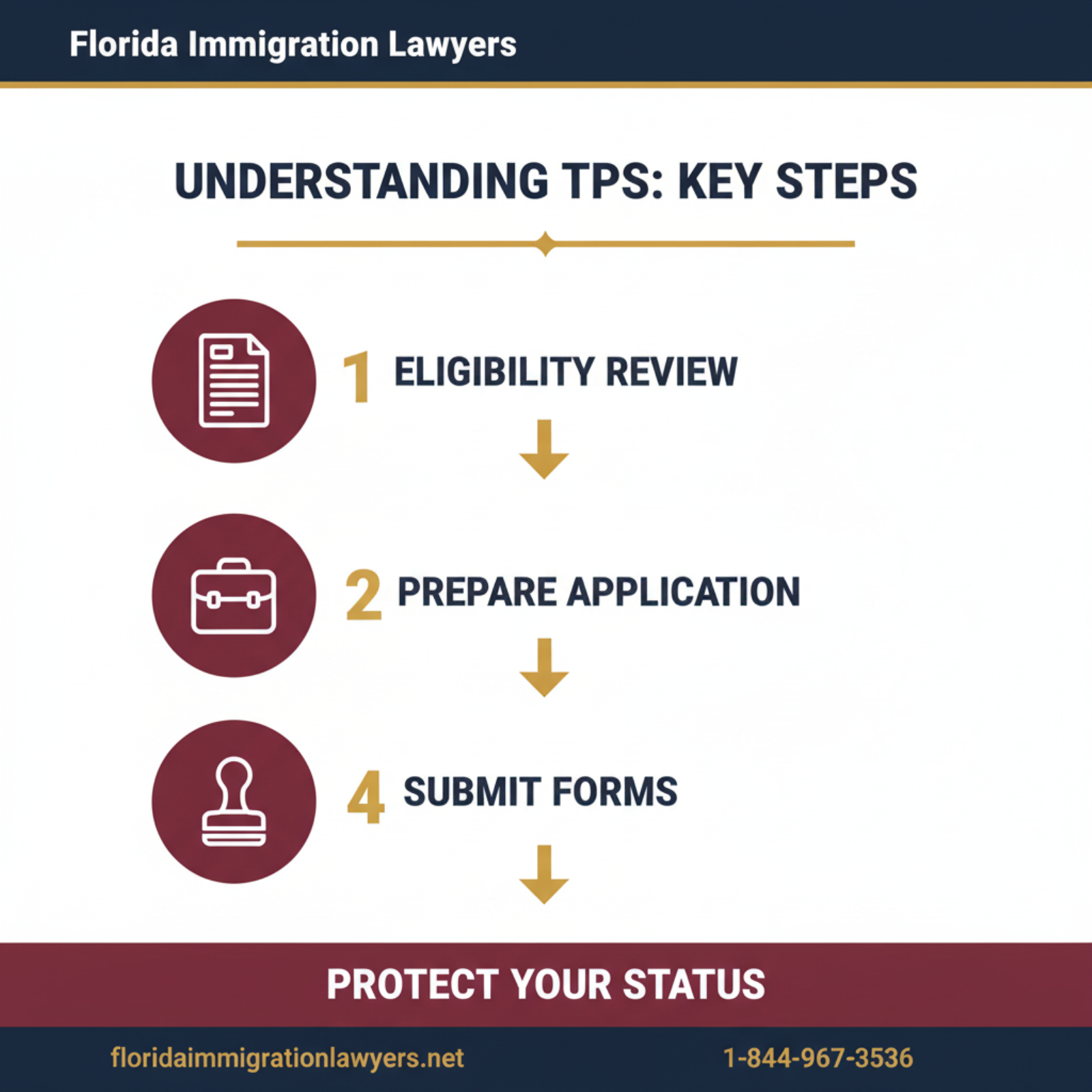
- Determine Your Eligibility: Confirm you meet all requirements for TPS Venezuela eligibility, including continuous physical presence and continuous residence since the designated dates. This typically means you must have been in the U.S. since March 8, 2021, and continuously since July 31, 2023, for the most recent re-designation.
- Gather Required Documents: Collect all necessary identity, nationality, and residence proofs. This includes passports, birth certificates, and evidence of your continuous presence in Florida.
- Complete Forms I-821 and I-765: Fill out these forms accurately and completely. Any errors can result in rejection or requests for additional evidence, prolonging your application.
- Pay Filing Fees: Submit the required fees to USCIS TPS Venezuela. If you cannot afford the fees, you may be eligible for a fee waiver by filing Form I-912, Request for Fee Waiver.
- Attend Biometrics Appointment: After filing, USCIS will send you an appointment notice for biometrics (fingerprints and photos). This is a mandatory step.
- Respond to Requests for Evidence (RFE): If USCIS needs more information, they will send an RFE. Responding promptly and thoroughly is critical to your case.
- Receive Decision: USCIS will mail you a decision notice. If approved, you will receive your Employment Authorization Document (EAD).
For those seeking protection, understanding the requirements is paramount. We can help you prepare a strong application and avoid common pitfalls. Our Florida immigration lawyer team has extensive experience with TPS cases. Learn more about general immigration services at our Immigration practice area page.
Essential Documents for TPS Venezuela Application
A complete application package is crucial for a smooth process. Having all your documents organized and readily available will save you time and stress. This list generally applies to both initial applications and re-registrations.
- Proof of identity and nationality (e.g., Venezuelan passport, birth certificate with photo ID).
- Proof of your date of entry into the U.S.
- Evidence of continuous residence in the U.S. since the designated period (e.g., utility bills, leases, school records, employment records, bank statements, medical records).
- Evidence of continuous physical presence in the U.S. since the designated period (similar documents as above, demonstrating physical presence).
- Two passport-style photographs.
- Any previous immigration documents (e.g., I-94 arrival/departure record).
- Marriage certificate (if applicable, for name change or spousal applications).
- Birth certificates for children (if applying as a family).
Ensuring the accuracy and completeness of these documents is a cornerstone of a successful application. Incorrect or missing documentation is a common reason for delays or denials.
TPS Venezuela Processing Times and What to Expect
The processing times for TPS applications can vary significantly. Factors such as the volume of applications, the specific USCIS service center handling your case, and the complexity of your individual circumstances all play a role. While the USCIS TPS Venezuela website provides estimated processing times, these are just averages.
Typically, you can expect processing to take several months, sometimes up to a year or more, especially for initial applications. Re-registrations are often processed more quickly if there are no significant changes to your case. It is important to remember that you remain protected under TPS as long as your application for re-registration is pending and filed on time.
During this waiting period, it is crucial to keep your contact information updated with USCIS. Any change of address should be reported promptly using Form AR-11, Alien's Change of Address Card. Failing to do so could result in missed notices or decisions.
While waiting for your TPS to be processed, you may also be concerned about other immigration matters. If you are facing potential deportation, our team offers robust deportation defense services.
Understanding TPS Application Costs
Applying for TPS involves various fees that you should budget for. These fees are set by USCIS and are subject to change. It is always best to check the official USCIS website for the most current fee schedule.
The primary fees typically include:
- Form I-821, Application for Temporary Protected Status (fee may be waived for initial applications or re-registrations if you are applying for your first EAD).
- Form I-765, Application for Employment Authorization.
- Biometrics services fee (for fingerprinting and photos).
It is important to note that if you are applying for an initial TPS designation, the I-821 fee is generally not required, but the biometrics and I-765 fees typically apply. For re-registration, all applicable fees usually apply, unless you qualify for a fee waiver.
Fee waivers are available for applicants who can demonstrate an inability to pay. This typically involves submitting Form I-912, Request for Fee Waiver, along with supporting documentation. Our firm can help you assess your eligibility for a fee waiver and prepare the necessary forms.
Do not navigate this process alone. Contact Florida Immigration Lawyers today. Our experienced team can provide the guidance and support you need to confidently pursue your immigration goals.
Common Mistakes to Avoid in Your TPS Venezuela Application
Navigating the TPS application process requires precision. Even minor errors can lead to significant delays or even denial of your application. Be sure to avoid these common pitfalls:
- Missing Deadlines: Failing to file your initial application or re-registration within the designated window is one of the most critical mistakes. Late filings are generally rejected, unless extraordinary circumstances apply. This could result in loss of protection and potential deportation proceedings.
- Incomplete Forms: Submitting forms with unanswered questions or missing signatures. USCIS will typically reject these applications or issue a Request for Evidence, slowing down your process considerably.
- Insufficient Supporting Documentation: Not providing enough evidence to prove continuous residence or physical presence in the U.S. This is a common reason for RFEs or denials, leaving your status uncertain.
- Failure to Update Address: Not informing USCIS of a change of address using Form AR-11. This can cause you to miss important notices, biometrics appointments, or even your approval notice, jeopardizing your case.
- Ignoring Criminal History: Failing to disclose any criminal history, even minor offenses. This can lead to serious inadmissibility issues and potential fraud charges if discovered later. Always be truthful and consult an attorney.
- Not Seeking Legal Advice: Attempting to navigate complex legal requirements without the help of a qualified Florida immigration lawyer. Misinterpretations of laws, eligibility criteria, or court rulings can have severe, lasting consequences.
- Assuming Automatic Extension: Believing that your TPS and EAD are automatically extended without checking official USCIS announcements. While extensions are common, you must verify the latest Federal Register notices for specific dates and actions required.
When to Call a Florida Immigration Lawyer
While the information provided here is comprehensive, every immigration case is unique. The complexities of immigration law, especially concerning recent Supreme Court TPS Venezuela decisions and potential future extensions like the TPS Venezuela extension 2026, often require personalized legal advice.
You should consider contacting Florida Immigration Lawyers if:
- You are unsure about your TPS Venezuela eligibility or have questions about specific requirements.
- You have a criminal record, even a minor one, which could affect your eligibility.
- You have previously been denied an immigration benefit or have prior deportation orders.
- You have left the U.S. after receiving TPS and are concerned about its impact.
- You received a Request for Evidence (RFE) or a Notice of Intent to Deny (NOID) from USCIS.
- You need assistance with re-registration or understanding the latest updates from USCIS TPS Venezuela.
- You are considering other immigration pathways, such as asylum or family immigration.
Our firm is adept at handling complex immigration challenges. We represent clients in Hialeah, Miami, and throughout Florida, providing strategic legal solutions. We understand the specific concerns of the Venezuelan community and are here to advocate for your rights. Our attorneys can also assist with citizenship applications.
Frequently Asked Questions About TPS Venezuela
What is the Supreme Court decision on TPS in Venezuela?
The Supreme Court has not issued a single, definitive ruling directly on the TPS designation for Venezuela itself. Instead, its involvement has primarily been in cases related to the Executive Branch's authority to terminate TPS for other countries, and challenges to those terminations. These rulings have indirect implications for the stability and future of all TPS designations, including Venezuela's. Lower court decisions and executive actions generally govern the specific TPS Venezuela program.
Did the Supreme Court order Trump not to deport Venezuelans?
No, the Supreme Court did not issue a direct order specifically prohibiting the Trump administration from deporting Venezuelans. The Trump administration did not designate Venezuela for TPS. The initial TPS designation for Venezuela was made by the Biden administration in March 2021. Any Supreme Court cases related to TPS during the Trump era generally involved other TPS-designated countries and challenges to their termination.
Can Venezuelans with TPS get deported?
While TPS generally protects beneficiaries from deportation, there are specific circumstances under which a TPS holder can be deported. These include committing certain crimes, failing to maintain continuous residence, or if the TPS designation for Venezuela is terminated and no other form of relief is available. It is crucial to adhere strictly to all TPS requirements and immigration laws.
Does TPS lead to a green card in Venezuela?
No, TPS itself does not directly lead to a green card or permanent residency. It is a temporary humanitarian status. However, some TPS beneficiaries may become eligible for a green card through other immigration avenues, such as family-based petitions, employment-based petitions, or asylum, while they hold TPS. Having TPS can sometimes make it easier to pursue these other avenues, but it does not automatically confer eligibility for a green card.
About Florida Immigration Lawyers
Florida Immigration Lawyers is a leading immigration law firm dedicated to serving individuals and families across the entire state of Florida. With offices strategically located to assist clients in Hialeah, Miami, Orlando, Tampa, and beyond, we are committed to providing exceptional legal representation and compassionate support.
Our firm specializes in a wide range of immigration services, including Temporary Protected Status (TPS), asylum, deportation defense, family-based petitions, business immigration, and citizenship applications. We understand the profound impact immigration matters have on our clients' lives and work tirelessly to achieve favorable outcomes.
Why choose Florida Immigration Lawyers? Our team of experienced attorneys offers personalized attention, in-depth legal knowledge, and a commitment to clear communication. We pride ourselves on being accessible and responsive, ensuring you are informed and confident throughout your legal journey. We are available 24/7 to answer your urgent questions and offer free consultations to discuss your case. Call us today at 1-844-967-3536 or visit our website at https://www.floridaimmigrationlawyers.net.
Sources and References
- U.S. Citizenship and Immigration Services (USCIS) - TPS Venezuela
- Executive Office for Immigration Review (EOIR) - U.S. Department of Justice
- 8 U.S.C. Chapter 12 - Immigration and Nationality Act (INA)
- 8 CFR Part 244 - Temporary Protected Status
- USCIS Policy Manual, Volume 7 - Asylum and Withholding of Removal, Part B - Temporary Protected Status
- Federal Register Notices concerning TPS for Venezuela
This article provides general legal information and is not intended as legal advice. Every case is unique, and outcomes depend on specific facts and circumstances. Contact an attorney for advice about your particular situation.
Do not let uncertainty dictate your future. For expert legal assistance with your TPS Venezuela application, re-registration, or any other immigration matter in Florida, contact Florida Immigration Lawyers today. Call us for a free consultation at 1-844-967-3536. Se Habla Español - Estamos aquí para ayudarle.
Do Not Navigate This Process Alone
Our experienced immigration attorneys are ready to fight for you. Get a free, confidential consultation today.
Se Habla Español
Frequently Asked Questions
Florida Immigration Lawyers
Immigration Attorney | Founder, Vasquez Law Firm
U.S. Air Force veteran and immigration attorney with thousands of cases resolved. J.D., NCCU School of Law. AILA member. Admitted to the 4th, 5th, and 11th Circuit Courts.
Available 24/7 - Free Evaluations
Related Legal Services
Our Florida immigration attorneys can help you with citizenship and naturalization, family immigration services and immigration practice areas. Call today at 1-844-967-3536 for a free consultation.
Related Links
Related Topics
Free Legal Consultation
Discuss your case with our experienced attorneys. We're available 24/7.
Se Habla Español - Estamos aquí para ayudarle.
Related Articles
Expungement Effect on Immigration in Florida | VLF Florida
Discover how expungement impacts immigration in Florida. Learn about eligibility, the process, and potential consequences. Contact Florida Immigration Lawyers at 1-844-967-3536 for a free consultation.
Immigration Services in Kissimmee Florida | VLF Florida
Discover essential immigration services in Kissimmee, Florida. Learn about the resources available for immigrants, including Puerto Rican residents in Osceola County. Contact Florida Immigration Lawyers at 1-844-967-3536 for expert guidance and a free consultation.
Child Status Protection Act (CSPA) Florida: Preventing 'Aging
Understand the Child Status Protection Act (CSPA) in Florida and how it prevents 'aging out' for derivative beneficiaries. Navigate complex immigration laws
I-360 Widow Self-Petition in Florida: A Complete Guide
Learn how to navigate the I-360 widow self-petition process in Florida. This comprehensive guide covers eligibility, documentation, and common mistakes. Call Florida Immigration Lawyers for expert assistance.