Supreme Court TPS Venezuela 2026: Florida Impact & Updates
Stay updated on the Supreme Court's Temporary Protected Status (TPS) Venezuela rulings for 2026 and their significant impact on Florida residents. This comprehensive guide covers eligibility requirements, the application process, crucial deadlines, and how to avoid common mistakes. Learn about the resources available to help you navigate these complex legal waters, especially if you reside in Kissimmee or other parts of Florida. Discover the importance of timely and accurate application submission and when to seek professional legal assistance. Florida Immigration Lawyers is ready to provide expert guidance and support.
The Supreme Court's decisions regarding Temporary Protected Status (TPS) for Venezuela in 2026 are critical for thousands of Florida residents. While the Court has addressed various challenges to TPS programs, the specific implications for Venezuelan beneficiaries require careful attention. This article provides a comprehensive overview of the current status, eligibility, and the application process to help you navigate these complex legal waters.
- Stay informed on the latest Supreme Court rulings affecting TPS Venezuela.
- Understand the eligibility requirements for TPS in 2026, including for those in Kissimmee and across Florida.
- Prepare your documentation meticulously to avoid common application errors.
- Seek timely legal counsel from experienced Florida immigration lawyers.
Are you a Venezuelan national living in Florida, concerned about the future of your Temporary Protected Status (TPS)? The immigration landscape is constantly evolving, and recent developments from the Supreme Court regarding TPS for Venezuela have created both clarity and new questions for many families. Navigating these complex legal updates can be overwhelming, especially when your status in the U.S. hangs in the balance.
This comprehensive guide from Florida Immigration Lawyers aims to demystify the Supreme Court's involvement in TPS for Venezuela, explain the impact on beneficiaries in Florida, and provide clear steps forward for 2026. We understand the anxiety and uncertainty you may be experiencing. Our goal is to equip you with accurate information and empower you to make informed decisions about your immigration future.
Do not face these challenges alone. For personalized guidance and to understand how the latest rulings affect your specific situation, call Florida Immigration Lawyers at 1-844-967-3536 for a free consultation. We are here to help you every step of the way.
Understanding Supreme Court TPS Venezuela Rulings and Florida's Role
Temporary Protected Status (TPS) provides temporary immigration status to eligible nationals of designated countries facing ongoing armed conflict, environmental disaster, or other extraordinary and temporary conditions. Venezuela was designated for TPS due to severe humanitarian conditions, and subsequent extensions and legal challenges have kept its status in flux.
The Supreme Court has recently engaged with various cases impacting the broader TPS framework, including challenges to the termination of TPS for certain countries. While the Court's specific pronouncements regarding TPS Venezuela in 2026 may focus on procedural aspects or the authority of the executive branch to designate or terminate status, these decisions have direct consequences for thousands of Venezuelan beneficiaries residing in Florida.
Florida, particularly areas like Kissimmee, Orlando, and Miami, is home to a significant Venezuelan diaspora. Consequently, any Supreme Court TPS Venezuela ruling or update reverberates deeply within our communities. Understanding the legal nuances is crucial for continued eligibility and planning your long-term immigration strategy.
The Legal Framework of TPS Designations
The authority for TPS designation stems from Section 244 of the Immigration and Nationality Act (INA), codified at 8 U.S.C. § 1254a. This statute outlines the criteria for designation, extension, and termination of TPS. The Supreme Court's role often involves interpreting these statutory provisions and reviewing lower court decisions on their application.
Recent litigation has centered on questions of judicial review over TPS terminations and the scope of relief available to beneficiaries. For Venezuelans, these legal battles dictate whether their status is maintained, extended, or potentially terminated, with direct implications for work authorization and protection from deportation.
Step-by-Step Guide: Navigating TPS Venezuela in 2026
If you are a Venezuelan national seeking to apply for or re-register for TPS in 2026, understanding the precise steps is paramount. The process, while seemingly straightforward, involves strict deadlines and detailed requirements set forth by USCIS.
Even with Supreme Court rulings, the administrative process for TPS remains largely consistent. It is essential to follow each step carefully to ensure your application is complete and submitted correctly. Missing a deadline or omitting crucial information can lead to delays or even denial.
- Stay Informed on Official Announcements: Regularly check the U.S. Citizenship and Immigration Services (USCIS) website for official announcements regarding TPS Venezuela extension 2026. The Federal Register is the primary source for designation or extension notices.
- Determine Your Eligibility: Ensure you meet all statutory requirements, including continuous physical presence and continuous residence in the U.S. from the designated date. You must also be a national of Venezuela and not be inadmissible under certain grounds.
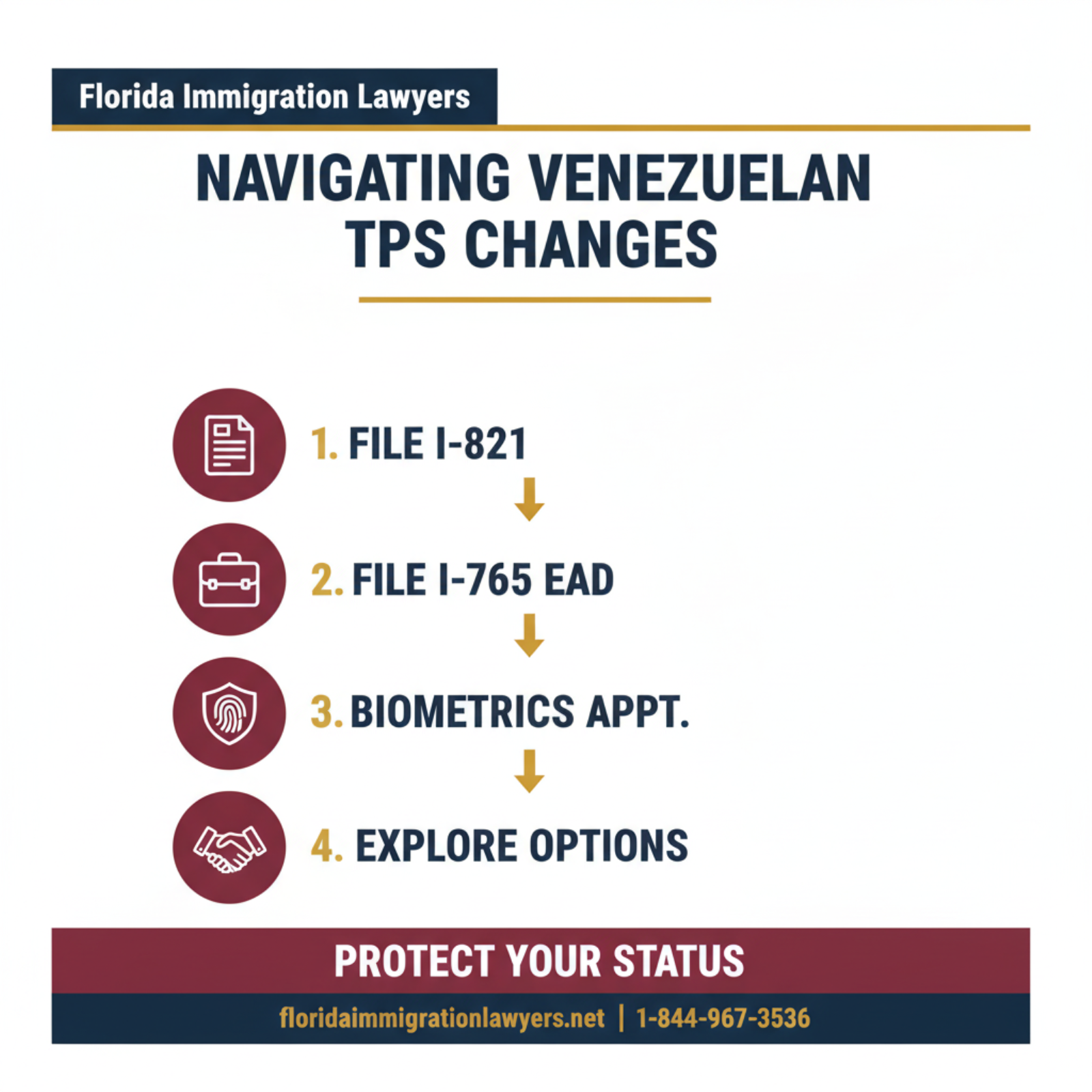
- Complete Form I-821, Application for Temporary Protected Status: Fill out this form accurately and completely. Any errors or omissions can cause significant delays.
- Complete Form I-765, Application for Employment Authorization (Optional but Recommended): If you wish to obtain an Employment Authorization Document (EAD) to work legally in the U.S., you must file Form I-765 concurrently or separately.
- Complete Form I-601, Application for Waiver of Grounds of Inadmissibility (If Applicable): If you have certain inadmissibility grounds, you may need to file this waiver. Consult with a Florida immigration lawyer to assess if this applies to your situation.
- Gather Supporting Documentation: Collect all necessary documents proving your identity, nationality, date of entry, and continuous residence. We will detail these in the checklist below.
- Pay Required Fees: Submit the correct filing fees for Form I-821 and Form I-765, unless you are eligible for a fee waiver. Do not send cash.
- Submit Your Application Package: Mail your complete application package to the designated USCIS Lockbox facility. Keep a copy of everything you submit for your records.
- Attend Biometrics Appointment: After submitting your application, USCIS will send you a notice to attend a biometrics appointment at an Application Support Center (ASC). This is mandatory.
- Respond to Requests for Evidence (RFEs): If USCIS needs more information, they will send an RFE. Respond promptly and thoroughly to avoid delays or denial.
Essential Document Checklist for TPS Venezuela Applications
A complete and accurate application package is vital for a successful TPS filing. Failing to include necessary documents or providing insufficient proof can lead to significant delays or a Request for Evidence (RFE) from USCIS. Gather these documents carefully before submitting your application.
It is always advisable to make copies of all documents for your personal records before mailing your application. This precaution ensures you have a backup of everything submitted to USCIS. Your Florida immigration lawyer can help you organize and review these materials.
- Proof of Identity and Nationality:
- Copy of Venezuelan passport or birth certificate with photo identification.
- National identity document from Venezuela with photo and/or fingerprint.
- Proof of Date of Entry:
- Form I-94, Arrival/Departure Record.
- Passport entry stamp.
- Other official documents showing date of entry.
- Proof of Continuous Residence in the U.S. from the designated date:
- Rent receipts, utility bills, or mortgage statements.
- Employment records (pay stubs, W-2 forms, letters from employers).
- School records (transcripts, report cards).
- Medical records (hospital or doctor visits).
- Bank statements showing transactions in the U.S.
- Letters from churches, unions, or other organizations.
- Affidavits from individuals attesting to your residence.
- Two passport-style photographs.
- Any previous immigration documents (e.g., prior EADs, notices of previous applications).
TPS Venezuela Timeline and Processing Expectations for 2026
The processing times for TPS applications can vary significantly based on USCIS workload, the complexity of your case, and whether you receive a Request for Evidence (RFE). While there is no guaranteed timeline, understanding the typical stages can help manage expectations.
For Venezuelan beneficiaries in Kissimmee and throughout Florida, patience is key. However, proactively checking your case status online and responding promptly to any USCIS communications can help expedite the process. Your legal team at Florida Immigration Lawyers will also monitor your case closely.
Typical Processing Stages:
- Application Submission and Receipt: Within a few weeks of mailing, you should receive a Form I-797C, Notice of Action, confirming receipt of your application.
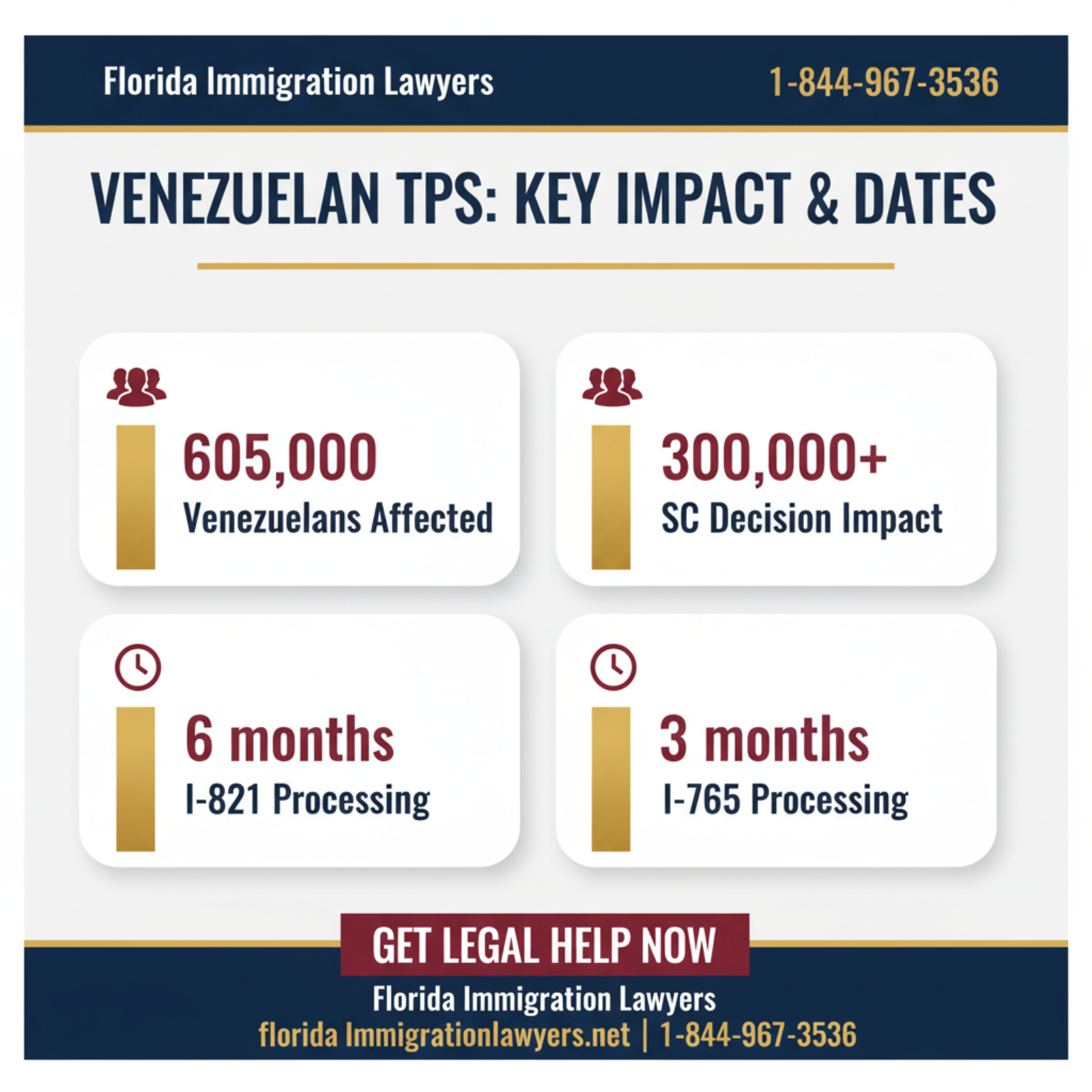
- Biometrics Appointment Notice: USCIS typically schedules biometrics appointments within 4-8 weeks after receiving your application. This appointment is crucial for fingerprinting and photographs.
- Employment Authorization Document (EAD) Processing: If you filed Form I-765, the processing time for your work permit can range from several months to over a year, depending on current backlogs. USCIS often issues automatic extensions of EADs for re-registrants, so be sure to check official announcements.
- Case Adjudication: The final decision on your Form I-821 can take many months. You will receive a written notice of approval or denial.
It is crucial to note that these timelines are estimates and can change. The Supreme Court's involvement or new legislative developments could also influence processing priorities or introduce new procedures. Always refer to the official USCIS website for the most current processing times for the service center handling your case.
Do not navigate this complex process alone. The stakes are too high. Contact Florida Immigration Lawyers today at 1-844-967-3536 to ensure your application is handled with the utmost care and expertise.
Cost Factors and Fee Breakdown for TPS Venezuela
Applying for TPS involves several fees that must be paid to USCIS, unless you qualify for a fee waiver. These fees are subject to change, so it is crucial to verify the current amounts on the official USCIS website before submitting your application. Improper fee payment is a common reason for application rejection.
Beyond the government filing fees, consider the potential costs associated with legal assistance. While retaining an attorney involves fees, the value of expert guidance in avoiding costly mistakes and ensuring a smooth process can be invaluable. Florida Immigration Lawyers offers transparent fee structures and free initial consultations.
Typical Fees Include:
- Form I-821, Application for Temporary Protected Status: This form generally requires a filing fee.
- Biometrics Services Fee: An additional fee for fingerprinting and background checks is typically required for applicants aged 14 and older.
- Form I-765, Application for Employment Authorization: If you apply for a work permit, this form also has a separate filing fee.
USCIS offers fee waivers for applicants who can demonstrate an inability to pay based on certain income guidelines or receipt of means-tested benefits. If you believe you qualify for a fee waiver, you must submit Form I-912, Request for Fee Waiver, along with supporting documentation. Improperly filed fee waiver requests can delay your application.
Common Mistakes to Avoid in Your TPS Venezuela Application
Even small errors in your TPS application can lead to significant delays, Requests for Evidence (RFEs), or even denial. Being aware of these common pitfalls can help you prepare a stronger application and increase your chances of approval. Our Florida immigration lawyer team regularly helps clients correct these issues.
- Missing Filing Deadlines: TPS designations and re-registration periods have strict deadlines. Submitting your application even one day late can result in denial. Always confirm the current deadlines on the USCIS website.
- Incomplete or Inaccurate Forms: Failing to answer all questions or providing incorrect information on Forms I-821 and I-765 is a frequent error. Double-check every field for accuracy and completeness.
- Insufficient Proof of Continuous Residence/Physical Presence: Many applicants fail to provide enough varied documentation to prove their continuous residence and physical presence in the U.S. from the designated date. Gather comprehensive evidence.
- Incorrect Fee Payment or Missing Fee Waiver Request: Submitting the wrong fee amount, using an expired check, or failing to include a properly documented fee waiver request will cause your application to be rejected.
- Not Attending Biometrics Appointment: Missing your scheduled biometrics appointment without rescheduling can lead to your application being considered abandoned and denied.
- Failure to Disclose Criminal History: Attempting to hide any arrests or convictions, even minor ones, can lead to serious immigration consequences, including inadmissibility. Always disclose truthfully and seek legal advice.
- Not Seeking Legal Counsel for Complex Cases: If you have prior deportations, criminal history, or other immigration complications, attempting to navigate TPS without a lawyer is a significant risk.
- Ignoring Requests for Evidence (RFEs): Not responding to an RFE by the deadline, or providing insufficient information in your response, often leads to application denial.
When to Call a Florida Immigration Lawyer for TPS Venezuela
While some individuals may feel confident handling their TPS application independently, certain situations strongly warrant the expertise of an experienced immigration attorney. The complexities introduced by Supreme Court rulings, coupled with evolving USCIS policies, make legal guidance invaluable.
At Florida Immigration Lawyers, we specialize in helping individuals and families in Kissimmee, Orlando, and across Florida navigate the nuances of TPS, asylum, and other immigration matters. We understand the specific challenges faced by the Venezuelan community.
You should consider contacting us if:
- You have questions about the specific impact of the Supreme Court TPS Venezuela rulings.
- You have a criminal record, even a minor one, that could affect your eligibility.
- You have previously been ordered deported or removed from the U.S.
- You have had previous immigration applications denied.
- You are unsure whether you meet the continuous physical presence or continuous residence requirements.
- You received a Request for Evidence (RFE) from USCIS and need assistance responding effectively.
- You need help gathering and organizing complex documentation.
- You simply want peace of mind knowing your application is prepared correctly and professionally.
Our firm is dedicated to providing compassionate and effective legal representation. We will assess your eligibility, prepare your application, and represent you throughout the process, fighting to protect your status in the U.S. We also assist with deportation defense, asylum claims, and citizenship applications.
About Florida Immigration Lawyers
Florida Immigration Lawyers is a leading law firm dedicated to providing comprehensive and compassionate immigration legal services to individuals and families across Florida. With years of experience and a deep understanding of U.S. immigration law, our attorneys are committed to helping our clients achieve their immigration goals.
We pride ourselves on our client-centered approach, offering personalized strategies tailored to each unique case. From family-based petitions to business immigration and deportation defense, we handle a wide range of immigration matters. Our commitment to excellence and our unwavering support for the immigrant community make us a trusted partner in your legal journey.
If you are seeking assistance with TPS, visas, green cards, citizenship, or facing deportation proceedings, we are here to help. We understand the challenges and opportunities within the immigration system and work tirelessly to protect your rights and future.
Contact Florida Immigration Lawyers today for a free consultation. Call 1-844-967-3536 or visit our website at https://www.floridaimmigrationlawyers.net. We are available 24/7 and proudly serve all of Florida.
Sources and References
- U.S. Citizenship and Immigration Services (USCIS) - Temporary Protected Status
- USCIS - TPS Designated Country: Venezuela
- Executive Office for Immigration Review (EOIR) - Board of Immigration Appeals (BIA)
- 8 U.S.C. Chapter 12 - Immigration and Nationality Act (INA) Section 244
- 8 CFR Part 244 - Temporary Protected Status
This article provides general legal information and is not intended as legal advice. Every case is unique, and outcomes depend on specific facts and circumstances. Contact an attorney for advice about your particular situation.
The landscape of immigration law, particularly concerning Supreme Court TPS Venezuela rulings, is intricate and subject to frequent changes. Protecting your status and planning your future requires diligence and expert legal guidance. Do not leave your immigration future to chance.
Contact Florida Immigration Lawyers today at 1-844-967-3536 for a free, confidential consultation. Se Habla Español - Estamos aquí para ayudarle.
Need help with Immigration?
Our Florida immigration attorneys offer free consultations. Call today or schedule online.
Frequently Asked Questions
Florida Immigration Lawyers
Legal Team
Our experienced attorneys at Florida Immigration Lawyers have been serving clients across Florida for over 20 years. We specialize in immigration, personal injury, criminal defense, workers compensation, and family law.