SIJS Florida: Special Immigrant Juvenile Status for
Understand SIJS Florida and how Special Immigrant Juvenile Status helps vulnerable minors secure legal status. Learn eligibility, process, and contact Florida Immigration Lawyers for a free consultation.

Special Immigrant Juvenile Status (SIJS) in Florida offers a path to legal residency for children in the U.S. who have been abused, neglected, or abandoned by a parent. It requires a state court order from a Florida court finding these specific circumstances. This status provides protection and the opportunity for eligible minors to apply for a Green Card, offering them a chance at a safer future.
- SIJS helps abused, neglected, or abandoned minors.
- Requires a specific order from a Florida state court.
- Leads to eligibility for a U.S. Green Card.
- Protects vulnerable children from further harm.
- Legal assistance is crucial for this complex process.
Imagine a child, far from home, facing the unthinkable: abuse, neglect, or abandonment by the very people meant to protect them. In Florida, many vulnerable minors find themselves in such heartbreaking situations. Fortunately, there is a pathway designed to offer them safety and a future: Special Immigrant Juvenile Status (SIJS).
This comprehensive guide from Florida Immigration Lawyers will walk you through the complexities of SIJS in Florida. We will explain who qualifies, the step-by-step process, required documents, and what to expect regarding timelines and costs. Understanding this crucial legal protection can make all the difference for a child in need. Call Florida Immigration Lawyers at 1-844-967-3536 for a free consultation to discuss your specific situation.
Understanding Special Immigrant Juvenile Status (SIJS) in Florida
Special Immigrant Juvenile Status (SIJS) is a vital immigration benefit designed to protect certain undocumented immigrant children in the United States. It offers a pathway to lawful permanent residency (a Green Card) for minors who have suffered severe forms of abuse, neglect, or abandonment by one or both parents. This status is codified under federal law, specifically in Section 101(a)(27)(J) of the Immigration and Nationality Act (INA).
For children in Florida, the process uniquely involves both state and federal legal systems. A Florida state court must first issue an order determining that a child has been abused, neglected, or abandoned and that it is not in their best interest to return to their parents' home country. This critical state court involvement ensures that vulnerable children receive local protection before federal immigration benefits can be pursued. Our firm understands the intricacies of navigating both legal spheres to secure a child's future. Learn more about general immigration pathways on our immigration practice area page.
Eligibility Requirements for SIJS in Florida
To qualify for Special Immigrant Juvenile Status (SIJS) in Florida, a minor must meet several stringent criteria. These requirements are set by federal immigration law and are interpreted through the lens of Florida's state statutes, particularly Chapter 39 which governs dependency proceedings. Understanding these conditions is the first step toward determining eligibility.
First, the applicant must be under 21 years old at the time the Form I-360, Petition for Amerasian, Widow(er), or Special Immigrant, is filed with USCIS. They must also be unmarried. These age and marital status requirements are strict and must be met throughout the application process.
Crucially, a Florida state court must have jurisdiction over the child and issue a specific order. This order must find that the child is dependent on the court or has been committed to the custody of a state agency or an individual appointed by the court. The court must also determine that reunification with one or both parents is not possible due to abuse, neglect, abandonment, or a similar basis under Florida law. Furthermore, the court must declare that it is not in the child's best interest to return to their or their parent's last habitual residence or country of nationality. This ensures that the child's safety and well-being are prioritized above all else. These federal requirements are outlined in 8 U.S.C. § 1101(a)(27)(J).
Step-by-Step Guide to Obtaining SIJS in Florida
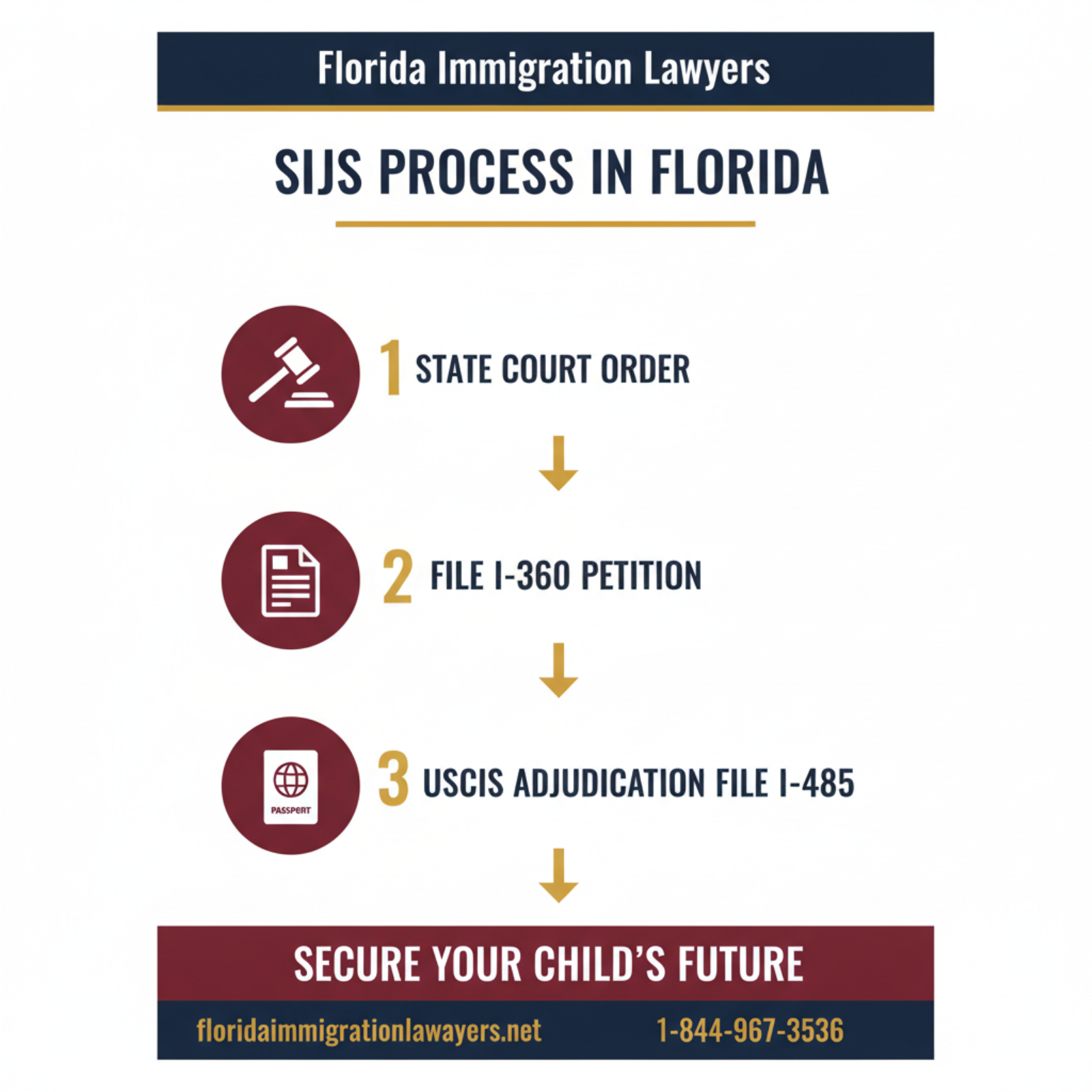
Navigating the Special Immigrant Juvenile Status (SIJS) process in Florida involves a series of critical steps, beginning at the state level and culminating with federal immigration agencies. Each stage requires careful attention to detail and adherence to specific legal procedures. Florida Immigration Lawyers is here to guide you through this journey.
- Secure a State Court Order: The initial and most foundational step is to obtain a specific order from a Florida state court. This typically occurs in dependency court, where a judge determines if a child has been abused, neglected, or abandoned by a parent. For minors residing in areas like Tampa, this process would involve the Hillsborough County dependency court, for example. The court must also find that it is not in the child's best interest to return to their home country. This state court order is non-negotiable for SIJS eligibility.
- File Form I-360, Petition for Amerasian, Widow(er), or Special Immigrant: Once the favorable state court order is secured, the next step is to file Form I-360 with U.S. Citizenship and Immigration Services (USCIS). This petition is where you formally request SIJS classification. It must include the state court order and other supporting documentation proving eligibility. USCIS reviews this petition to determine if federal SIJS requirements are met. You can find more information about USCIS forms and processes on their official website, uscis.gov.
- Apply for Adjustment of Status (Green Card) with Form I-485: After your Form I-360 is approved, or sometimes concurrently, you can apply for lawful permanent residency by filing Form I-485, Application to Register Permanent Residence or Adjust Status. This is the application for your Green Card. Concurrent filing is often possible if an immigrant visa number is immediately available, which is typically the case for SIJS applicants, though some backlogs can occur. Our firm assists families with these critical family immigration applications.
- Attend Biometrics and Interviews: As part of the adjustment of status process, USCIS will schedule an appointment for biometrics (fingerprints, photos, and signature). Many applicants will also be called for an interview with an immigration officer. During this interview, the officer will review your application and supporting documents to confirm eligibility.
- Receive Your Green Card: Upon approval of your Form I-485, USCIS will mail you your Green Card, officially granting you lawful permanent resident status in the United States. This card is usually valid for ten years and can be renewed. This milestone marks the culmination of a challenging but ultimately rewarding journey towards safety and stability.
Essential Document Checklist for SIJS Applicants
A successful Special Immigrant Juvenile Status (SIJS) application hinges on presenting a complete and accurate set of documents to both the Florida state court and USCIS. Gathering these materials carefully is paramount to avoiding delays or denials. Here is a general checklist of documents you will typically need to prepare:
- Birth Certificate: A certified copy of the applicant's birth certificate is essential to establish age and identity.
- Proof of Identity: Passport, national ID, or other government-issued identification.
- Florida State Court Order: The certified order from a Florida dependency or family court making the necessary SIJS findings (abuse, neglect, abandonment, and best interest determination).
- Proof of Relationship: Documents establishing the relationship between the child and their parents, if available.
- Medical Examination Report (Form I-693): Completed by a USCIS-approved civil surgeon.
- Form I-360, Petition for Amerasian, Widow(er), or Special Immigrant: The completed and signed petition.
- Form I-485, Application to Register Permanent Residence or Adjust Status: If filing for a Green Card.
- Form I-765, Application for Employment Authorization: If requesting a work permit while your Green Card application is pending.
- Form I-131, Application for Travel Document: If requesting advance parole for travel outside the U.S.
- Affidavits and Supporting Evidence: Statements from witnesses, teachers, social workers, or other individuals familiar with the child's situation. Police reports, school records, and medical records can also be crucial.
- Photographs: Passport-style photos as per USCIS specifications.
Ensuring all forms are correctly filled out and all supporting documents are translated into English (if necessary) and properly submitted is a critical part of securing an SIJ Green Card. Our team can help you compile these vital documents.
SIJS Processing Times and Expectations in 2026
The timeline for obtaining Special Immigrant Juvenile Status (SIJS) in Florida can vary significantly, influenced by both state court proceedings and federal immigration processing. Understanding these timeframes helps manage expectations and plan accordingly.
The initial phase, securing the necessary state court order in Florida, depends on the specific county and court's caseload. This process can range from a few months to over a year, depending on the complexity of the child's case and the court's schedule in areas like Tampa or Miami.
Once the state court order is obtained, the federal immigration process begins with the filing of Form I-360. USCIS processing times for I-360 petitions can fluctuate. While they aim for efficiency, backlogs can occur, impacting the "USCIS processing times I 360." You can check current processing times on the USCIS website. After I-360 approval, the adjustment of status (Form I-485) phase begins, which also involves biometrics appointments and interviews. The overall process, from initial state court filing to receiving a Green Card, can typically take several years.
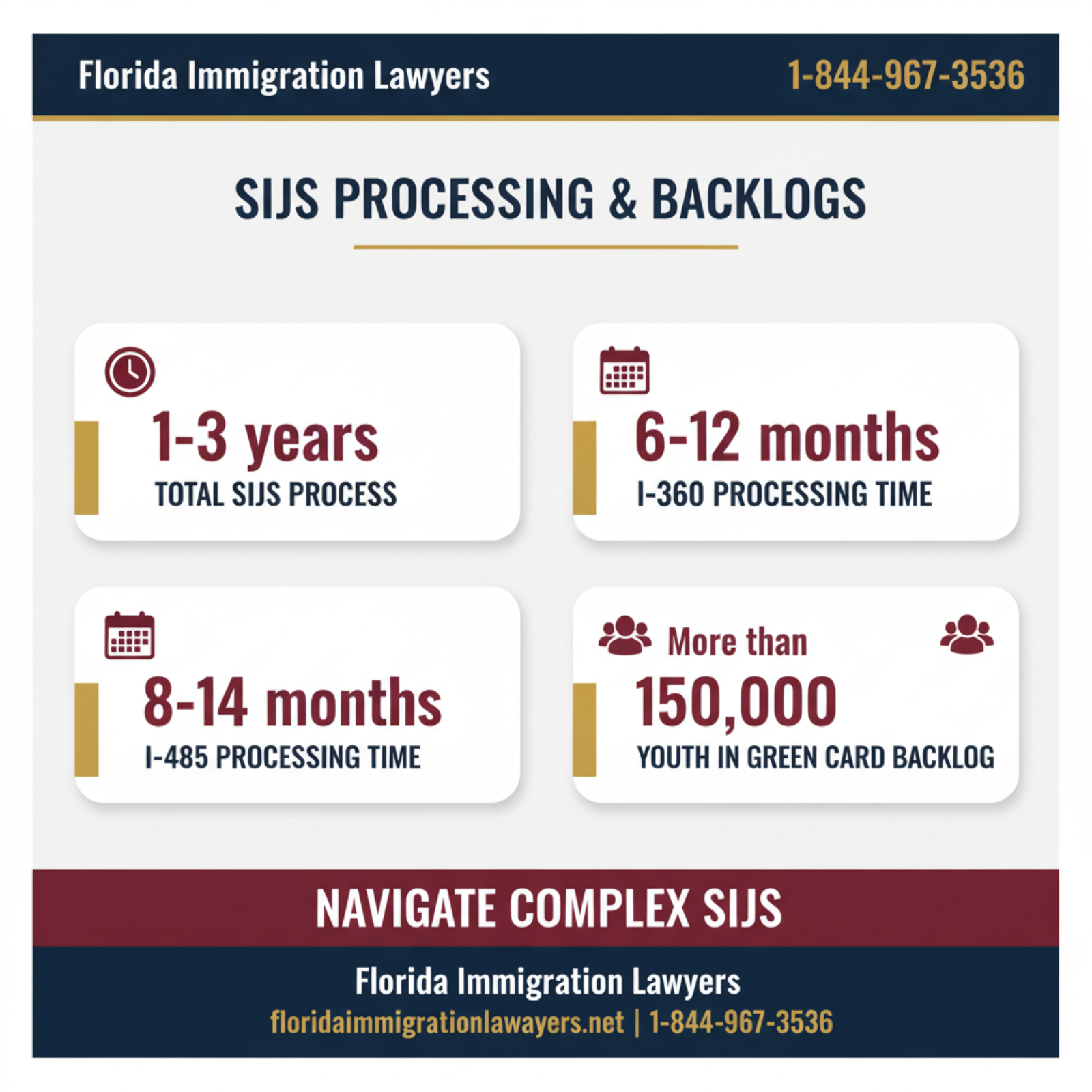
It is important to note that while SIJS applicants are generally exempt from annual visa caps, a "SIJ visa backlog" can sometimes occur due to high demand and processing limitations. This backlog primarily affects the final Green Card approval, not the SIJS classification itself. While waiting, eligible SIJ applicants can often obtain work authorization (I-765, I-360 work authorization) to legally work in the U.S. Staying informed about the Visa Bulletin is helpful, though SIJS categories often move quickly.
Cost Factors and Fee Breakdown for SIJS Applications
Pursuing Special Immigrant Juvenile Status (SIJS) involves various costs, including government filing fees and potential legal expenses. While the process aims to protect vulnerable children, financial planning is an important aspect to consider.
USCIS charges filing fees for several forms involved in the SIJS process. These typically include fees for Form I-360 (Petition for Amerasian, Widow(er), or Special Immigrant) and Form I-485 (Application to Register Permanent Residence or Adjust Status), as well as biometrics fees. It is crucial to check the most current fee schedule on the USCIS website, as these amounts are subject to change annually.
However, many SIJS applicants are eligible for fee waivers. If you cannot afford the filing fees, you may submit Form I-912, Request for Fee Waiver. This waiver can significantly reduce the financial burden. Additionally, there will be costs associated with the mandatory medical examination required for adjustment of status. These fees are paid directly to the USCIS-approved civil surgeon.
Perhaps the most significant investment, though invaluable, is legal representation. While not mandatory, having an experienced immigration attorney from Florida Immigration Lawyers can greatly increase the chances of a successful outcome. Our fees cover expert guidance, document preparation, court appearances, and communication with government agencies. We understand the financial challenges many families face and offer free consultations to discuss your case and potential costs transparently. You can reach out to us directly through our contact page.
Do not navigate this complex process alone. The stakes are incredibly high for vulnerable children seeking SIJS in Florida. Contact Florida Immigration Lawyers today to ensure their future is protected.
Common Mistakes to Avoid in SIJS Applications
Applying for Special Immigrant Juvenile Status (SIJS) is a detailed and sensitive legal process. Even minor errors can lead to significant delays or even denial, jeopardizing a child's future. Here are some common mistakes to avoid:
- Failing to Obtain a Proper State Court Order: Without a specific, legally sound order from a Florida state court making the required SIJS findings, the federal petition will be denied. Ensure the order explicitly states abuse, neglect, or abandonment and the best interest finding.
- Missing Age-Out Deadlines: The applicant must be under 21 when Form I-360 is filed. Delaying the process can lead to a child "aging out," making them ineligible for SIJS, especially if they are close to their 21st birthday.
- Incomplete or Inaccurate Forms: Submitting forms with missing information, incorrect answers, or without proper signatures is a common reason for Requests
Do Not Navigate This Process Alone
Our experienced immigration attorneys are ready to fight for you. Get a free, confidential consultation today.
Se Habla Español
Frequently Asked Questions
Florida Immigration Lawyers
Immigration Attorney | Founder, Vasquez Law Firm
U.S. Air Force veteran and immigration attorney with thousands of cases resolved. J.D., NCCU School of Law. AILA member. Admitted to the 4th, 5th, and 11th Circuit Courts.
Available 24/7 - Free Evaluations
Related Legal Services
Our Florida immigration attorneys can help you with free immigration consultation, experienced immigration attorneys and business immigration. Call today at 1-844-967-3536 for a free consultation.
Related Links
Related Topics
Free Legal Consultation
Discuss your case with our experienced attorneys. We're available 24/7.
Se Habla Español - Estamos aquí para ayudarle.
Related Articles
Expungement Effect on Immigration in Florida | VLF Florida
Discover how expungement impacts immigration in Florida. Learn about eligibility, the process, and potential consequences. Contact Florida Immigration Lawyers at 1-844-967-3536 for a free consultation.
Immigration Services in Kissimmee Florida | VLF Florida
Discover essential immigration services in Kissimmee, Florida. Learn about the resources available for immigrants, including Puerto Rican residents in Osceola County. Contact Florida Immigration Lawyers at 1-844-967-3536 for expert guidance and a free consultation.
Child Status Protection Act (CSPA) Florida: Preventing 'Aging
Understand the Child Status Protection Act (CSPA) in Florida and how it prevents 'aging out' for derivative beneficiaries. Navigate complex immigration laws
I-360 Widow Self-Petition in Florida: A Complete Guide
Learn how to navigate the I-360 widow self-petition process in Florida. This comprehensive guide covers eligibility, documentation, and common mistakes. Call Florida Immigration Lawyers for expert assistance.
