SIJS Florida: Navigating Special Immigrant Juvenile Status in 2026
Special Immigrant Juvenile Status (SIJS) offers a vital pathway to legal status for children in Florida who have been abused, neglected, or abandoned by a parent. This comprehensive guide, updated for 2026, explains the eligibility criteria, the dual state and federal application process, and what to expect when pursuing SIJS. Understanding this complex area of immigration law is crucial for protecting vulnerable youth in Kissimmee and across Florida. We cover the required state court order, USCIS petitions, documentation, timelines, and common pitfalls. Learn how Florida Immigration Lawyers can help secure a Green Card for eligible minors.
Special Immigrant Juvenile Status (SIJS) provides a pathway to lawful permanent residency for children in Florida who have been abused, neglected, or abandoned by a parent. It requires a state court order finding that reunification with one or both parents is not viable and that it is in the child's best interest to remain in the U.S. The process involves both state court proceedings and federal immigration applications with USCIS.
- SIJS protects vulnerable immigrant children.
- It requires a specific order from a Florida state court.
- The process involves federal petitions (I-360) and Green Card applications (I-485).
- Age limits and other eligibility criteria are strict.
- Legal assistance is crucial for navigating this complex pathway.
For children facing difficult circumstances in Florida, the journey to a stable future can seem overwhelming. Many young immigrants arrive in our state having experienced profound trauma, including abuse, neglect, or abandonment. Fortunately, a vital protection exists under U.S. immigration law: Special Immigrant Juvenile Status (SIJS).
This status offers a crucial pathway for vulnerable minors to secure legal residency and build a new life free from harm. Understanding the nuances of SIJS, especially within Florida's legal framework, is essential for these children and their guardians. This comprehensive guide will walk you through the eligibility, application process, and what to expect in 2026.
If you or a minor you care for may be eligible for SIJS, do not hesitate to seek expert legal guidance. Call Florida Immigration Lawyers at 1-844-967-3536 for a free consultation today. Our dedicated team is here to help you navigate this complex process.
Understanding Special Immigrant Juvenile Status (SIJS) in Florida
Special Immigrant Juvenile Status is a unique provision designed to safeguard immigrant children in the United States. It allows certain unmarried individuals under 21 years of age, who have been abused, neglected, or abandoned by a parent, to obtain a Green Card. This protection is vital for young people seeking safety and stability.
The legal basis for SIJS is found in the Immigration and Nationality Act (INA) at Section 101(a)(27)(J) and its implementing regulations at 8 CFR 204.11. These provisions outline the specific criteria that must be met to qualify for this special status. It's a two-part process involving both state and federal authorities.
The Importance of a Florida State Court Order
A critical first step in obtaining SIJS is securing an order from a Florida state court. This court, typically a Circuit Court handling dependency or guardianship cases, must make specific findings. These findings include determining that the child is dependent on the court or has been placed in the custody of a state agency or individual.
The state court must also find that reunification with one or both parents is not possible due to abuse, neglect, or abandonment. Furthermore, the court must explicitly state that it is not in the child's best interest to return to their home country or their last habitual residence. This order is the foundation of the SIJS petition.
For individuals in Kissimmee, Orlando, or other parts of Florida, these state court proceedings usually occur in the Circuit Courts. Our firm can assist you in working with local family or probate courts to obtain the necessary judicial declarations. This step is often the most challenging but is absolutely essential.
Who Qualifies for SIJS in Florida?
To be eligible for SIJS, a minor must meet several key criteria. They must generally be under 21 years old and unmarried at the time of filing their Form I-360 petition. The child also needs to be physically present in the United States when the SIJS petition is filed.
The core of SIJS eligibility revolves around the state court's findings regarding parental abuse, neglect, or abandonment. This means one or both parents have failed to provide the necessary care, protection, or support, or have actively harmed the child. The court must formally acknowledge these difficult circumstances.
It is important to note that the child must be declared dependent on a juvenile court or legally committed to, or placed in the custody of, a state agency or an individual appointed by a state court. This legal framework ensures that the child's welfare is being overseen by a judicial body in Florida. We can help you understand if your situation meets these strict requirements.
The Step-by-Step SIJS Application Process in Florida
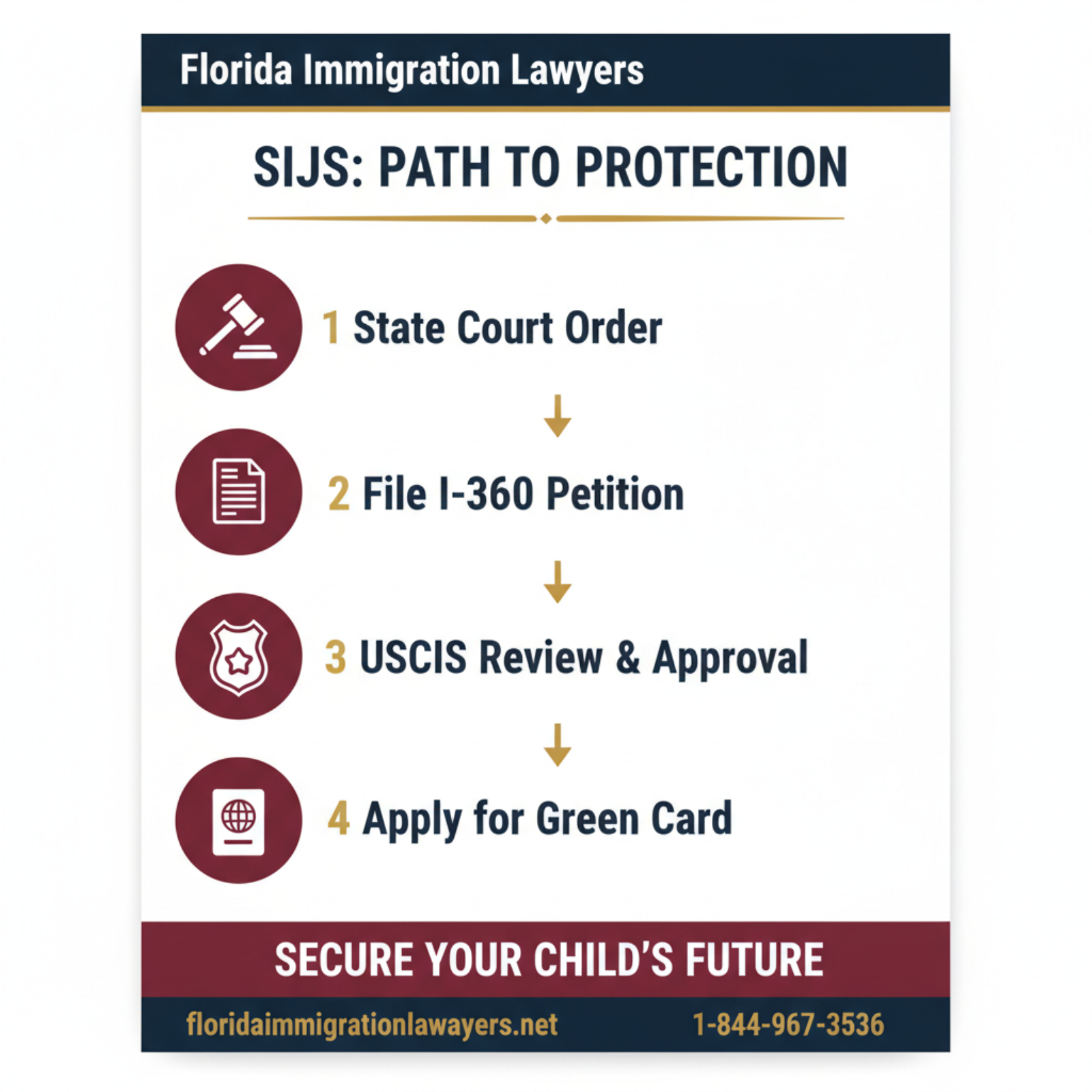
The journey to obtaining SIJS and ultimately a Green Card involves several distinct stages. Each step requires careful attention to detail and adherence to specific legal procedures. Our attorneys at Florida Immigration Lawyers guide clients through every phase.
-
Obtain a Florida State Court Order: The first and most critical step is to secure a specific order from a Florida state court. This typically involves filing a dependency petition or a guardianship petition in a Circuit Court, such as those in Kissimmee, Orlando, or Miami. The court must make findings that the child has been abused, neglected, or abandoned by one or both parents, that reunification is not viable, and that it is not in the child's best interest to return to their home country.
This state court order is the cornerstone of your SIJS application. Without it, USCIS cannot approve your petition. Our legal team has extensive experience working with Florida's judicial system to obtain these vital orders.
-
File Form I-360, Petition for Amerasian, Widow(er), or Special Immigrant: Once you have the state court order, the next step is to file Form I-360 with U.S. Citizenship and Immigration Services (USCIS). This petition is where you formally request SIJS classification. You must include the state court order and all supporting documentation to prove eligibility.
The Form I-360 packet must be meticulously prepared. Any errors or omissions can lead to delays or even denial. USCIS will review your petition to ensure all federal SIJS requirements are met, including the findings from the Florida state court.
-
File Form I-485, Application to Register Permanent Residence or Adjust Status (Green Card): After your Form I-360 is approved by USCIS, you can apply for your Green Card by filing Form I-485. In many SIJS cases, the I-360 and I-485 can be filed concurrently, depending on visa availability. This application is for adjusting your status to a lawful permanent resident.
This application requires extensive personal information, a medical examination, and various supporting documents. It is the final step in securing your permanent residency in the United States. We will help ensure your Form I-485 is complete and accurate.
-
Attend Biometrics and Interviews: As part of the I-485 process, you will typically be scheduled for a biometrics appointment to provide fingerprints and photographs. Following this, an interview with a USCIS officer may be required. This interview usually takes place at a local USCIS field office, such as those in Orlando, Miami, or Tampa.
During the interview, the officer will review your application and ask questions to verify your eligibility. Having experienced legal representation can be incredibly beneficial during this stage, as your attorney can prepare you and attend the interview with you.
-
Receive a Decision: After the interview, or once all necessary information has been reviewed, USCIS will make a decision on your Form I-485. If approved, you will receive your Green Card, officially becoming a lawful permanent resident of the United States. This marks the successful completion of the SIJS process.
If your application is denied, it is crucial to understand the reasons for the denial and explore potential options, such as filing an appeal or a motion to reopen. Our firm can advise you on the best course of action in such situations.
Essential Documents for Your SIJS Application
Gathering the correct documentation is a cornerstone of a successful SIJS application. Missing or incorrect documents can cause significant delays. Be prepared to provide the following:
- Florida State Court Order: The certified order from a Florida Circuit Court containing the specific SIJS findings. This is non-negotiable.
- Birth Certificate: Your official birth certificate, translated into English if necessary.
- Identity Documents: Passport, national identity card, or other official identification.
- Evidence of Abuse, Neglect, or Abandonment: Any reports, testimonies, or legal documents from the state court case that substantiate the findings of abuse, neglect, or abandonment.
- Form I-360, Petition for Amerasian, Widow(er), or Special Immigrant: The completed and signed form with all required supporting evidence.
- Form I-485, Application to Register Permanent Residence or Adjust Status: The completed and signed form for your Green Card application.
- Medical Examination Report: Form I-693, completed by a USCIS-approved civil surgeon.
- Photographs: Passport-style photographs meeting USCIS specifications.
- Fingerprint Fees/Biometrics: Confirmation of payment or waiver for biometrics.
- Proof of Physical Presence: Documents like school records, medical bills, or affidavits to show continuous physical presence in the U.S.
- Translations: Certified English translations of any foreign language documents.
SIJS Processing Expectations and Timelines in 2026
The processing time for Special Immigrant Juvenile Status applications can vary significantly. It depends on several factors, including the specific USCIS service center handling your case, the complexity of your situation, and current caseloads. It is important to manage expectations and understand that this is not a quick process.
Typically, the state court process to obtain the initial order can take several months, sometimes longer, depending on the court's schedule and the specifics of the dependency or guardianship case. Once that is complete, the federal immigration process begins.
USCIS processing times for Form I-360 can range from several months to over a year. After I-360 approval, the Form I-485 processing for the Green Card can also take many months. You can check current processing times on the USCIS website. Delays are common, but persistent follow-up and proper documentation can help.
Navigating SIJS Age-Out Concerns
One of the most critical aspects of SIJS is the age-out provision. Generally, you must be under 21 years old when your Form I-360 is filed and approved. However, the Child Status Protection Act (CSPA) can sometimes freeze a child's age for immigration purposes, offering protection if the I-360 is filed before they turn 21.
It is absolutely vital to file your SIJS petition as early as possible to avoid age-out issues. If a child turns 21 while their SIJS I-360 petition is pending, they may lose eligibility. Our attorneys prioritize timely filings and strategize to mitigate age-out risks for our clients in Florida.
What Happens After SIJS Approval?
Once your Form I-360 petition for SIJS is approved, you become eligible to apply for a Green Card (lawful permanent residency) through Form I-485. For many SIJS beneficiaries, a visa number is immediately available, allowing for concurrent filing or prompt adjustment of status. This is a significant advantage of SIJS.
Receiving your SIJS Green Card means you can live and work permanently in the United States. You will have access to educational opportunities and a pathway to eventual U.S. citizenship. This status provides much-needed security and a chance for a brighter future for young immigrants in Florida.
Cost Factors and Fee Breakdown for SIJS Applications
The costs associated with applying for Special Immigrant Juvenile Status involve several components. It is important to budget for these expenses, although fee waivers are often available for eligible applicants. We can discuss these options during your consultation.
USCIS Filing Fees: USCIS charges fees for filing Form I-360 and Form I-485. These fees are subject to change, so it is crucial to check the most current fee schedule on the USCIS website before filing. For many SIJS applicants, a fee waiver for Form I-360 is possible if they meet specific poverty guidelines.
Legal Fees: Hiring an experienced immigration attorney is a significant investment but often invaluable. Legal fees cover the preparation of your state court petition, the federal I-360 and I-485 applications, representation at interviews, and ongoing communication with USCIS. Our firm offers transparent fee structures.
Medical Examination Fees: All applicants for a Green Card must undergo a medical examination by a USCIS-approved civil surgeon. The cost of this exam varies by provider and is paid directly to the doctor's office. This is a mandatory component of the Form I-485 application.
Translation and Other Fees: If any of your supporting documents are not in English, you will need to pay for certified translations. There may also be costs for obtaining birth certificates or other official records. These smaller fees can add up, so plan accordingly.
Do not navigate this complex process alone. The stakes for vulnerable children are too high to risk errors. Contact Florida Immigration Lawyers today to ensure your SIJS application is handled with the utmost care and expertise. We are ready to assist you.
Common Mistakes to Avoid in SIJS Applications
The SIJS process is intricate, and even minor errors can lead to significant delays or denial. Avoiding these common pitfalls is crucial for a successful outcome:
-
Failing to Obtain a Proper State Court Order: Many applicants overlook the specific language and findings required in the state court order. The order must explicitly state abuse, neglect, or abandonment, non-viability of reunification, and that it's not in the child's best interest to return home. Without these precise findings, USCIS will deny the I-360 petition.
Consequence: Denial of the I-360, requiring a new state court process or appeal.
-
Missing the Age-Out Deadline: The requirement to be under 21 years old at the time of I-360 filing and approval is strict. Delays in filing, especially close to the 21st birthday, can lead to ineligibility, even if the state court order is obtained. Understanding CSPA protections is critical but complex.
Consequence: Permanent loss of SIJS eligibility.
-
Submitting Incomplete or Incorrect Forms: Each USCIS form (I-360, I-485, I-693) has numerous fields and specific instructions. Errors, omissions, or failure to include all required supporting evidence can result in a Request for Evidence (RFE) or outright denial.
Consequence: Significant delays, re-filing, or denial.
-
Not Providing Certified Translations: Any document not originally in English must be accompanied by a complete and certified English translation. Failure to do so renders the document unusable for USCIS purposes.
Consequence: RFEs and delays in processing.
-
Lack of Evidence for Abuse/Neglect/Abandonment: While the state court makes the initial findings, USCIS reviews the evidence. If the supporting documentation for the state court's findings is weak or insufficient, it can raise red flags for the immigration officer.
Consequence: Scrutiny, RFEs, or denial of the I-360 petition.
-
Failing to Disclose All Immigration History: It is crucial to be transparent about all past immigration interactions, even minor ones. Concealing information, regardless of intent, can lead to accusations of misrepresentation.
Consequence: Denial and potential future immigration bars.
-
Attempting the Process Without Legal Counsel: The SIJS process involves complex interplay between state family law and federal immigration law. Navigating it without an experienced attorney significantly increases the risk of errors and missed deadlines. Many nuances are easily overlooked by non-professionals.
Consequence: High probability of delays, denials, or loss of eligibility.
When to Call a Lawyer for SIJS in Florida
Given the complexities of Special Immigrant Juvenile Status, consulting an experienced immigration attorney is not just recommended; it's often essential. The dual nature of state court and federal immigration proceedings requires specialized legal knowledge. Our team at Florida Immigration Lawyers is ready to assist you.
You should contact us immediately if:
- You are a minor in Florida who has experienced abuse, neglect, or abandonment by a parent.
- You are a guardian, foster parent, or family member caring for such a child.
- A child in your care is approaching their 21st birthday, and you are concerned about the SIJS age-out deadline.
- You have initiated a state court dependency or guardianship case and need to ensure the order contains the necessary SIJS findings.
- You have received a Request for Evidence (RFE) from USCIS regarding your SIJS petition.
- Your SIJS petition (Form I-360) or Green Card application (Form I-485) has been denied.
- You are unsure about any part of the SIJS eligibility criteria or application process.
- The minor is currently in removal proceedings and needs protection.
Our firm specializes in protecting the rights and futures of immigrant children across Florida, including in Kissimmee and surrounding communities. We understand the unique challenges faced by vulnerable youth and are committed to providing compassionate and effective legal representation. Let us help you secure the future you deserve.
About Florida Immigration Lawyers
Florida Immigration Lawyers is a leading immigration law firm dedicated to serving individuals and families throughout Florida. With a deep understanding of U.S. immigration law and a commitment to our clients, we provide comprehensive legal services tailored to your unique needs. Our experienced attorneys are passionate about helping immigrants achieve their dreams of living and working legally in the United States.
We offer a wide range of immigration services, including family-based immigration, business immigration, deportation defense, asylum applications, and citizenship assistance. Our firm prides itself on its client-focused approach, ensuring that you receive personalized attention and strategic advice at every step of your immigration journey.
Why choose Florida Immigration Lawyers? We combine legal expertise with genuine empathy, understanding the profound impact immigration matters have on your life. We are available 24/7 to answer your questions and provide support. We offer free consultations, allowing you to discuss your case without financial obligation. Our firm serves clients in Kissimmee, Orlando, Miami, Tampa, and all other communities across Florida. Your success is our priority.
Contact us today at 1-844-967-3536 or visit https://www.floridaimmigrationlawyers.net to learn more about how we can help you.
Sources and References
- U.S. Citizenship and Immigration Services (USCIS) - Special Immigrant Juveniles
- Executive Office for Immigration Review (EOIR)
- U.S. Department of State - Visa Bulletin
- 8 U.S.C. § 1101(a)(27)(J) - Immigration and Nationality Act (INA) Section 101(a)(27)(J)
- 8 CFR § 204.11 - Special Immigrant Juveniles
- INA Section 245(a) - Adjustment of Status
This article provides general legal information and is not intended as legal advice. Every case is unique, and outcomes depend on specific facts and circumstances. Contact an attorney for advice about your particular situation.
Securing Special Immigrant Juvenile Status can transform a vulnerable child's life, offering safety, stability, and a future in the United States. While the process is complex, you don't have to face it alone. Florida Immigration Lawyers is here to provide the expert legal guidance and compassionate support you need.
Protecting the future of young immigrants in Florida is our mission. Call us today at 1-844-967-3536 to schedule your free consultation. Se Habla Español - Estamos aquí para ayudarle.
Florida Immigration Lawyers
Legal Team
Our experienced attorneys at Florida Immigration Lawyers have been serving clients across Florida for over 20 years. We specialize in immigration, personal injury, criminal defense, workers compensation, and family law.