PERM Labor Certification Florida: Employer-Sponsored Green Card Guide
Understanding PERM labor certification is the first step towards an employer-sponsored green card in Florida. This complex process, managed by the U.S. Department of Labor, requires employers to demonstrate that no qualified U.S. workers are available for a specific job. Our comprehensive guide covers the step-by-step requirements, essential documents, timelines, and cost factors involved. We also highlight common mistakes to avoid and explain when legal assistance is crucial. Florida Immigration Lawyers provides expert guidance to businesses and individuals throughout Florida, ensuring compliance and a smoother path to permanent residency. Contact us for a free consultation to navigate your PERM application effectively.
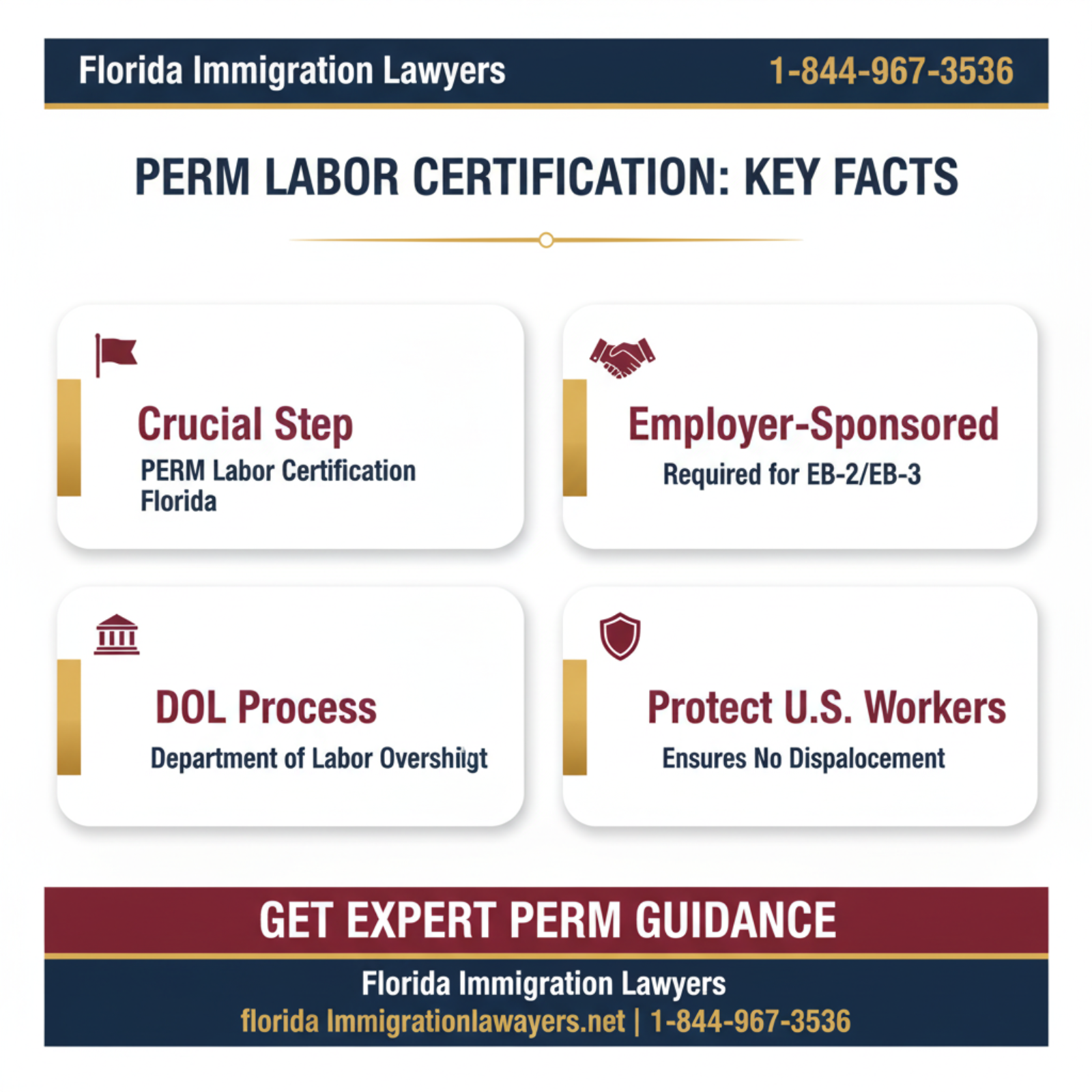
PERM (Program Electronic Review Management) labor certification is a vital first step for many foreign workers seeking an employer-sponsored green card in the U.S. It requires U.S. employers, including those in Florida, to prove to the Department of Labor (DOL) that no qualified U.S. workers are available for a specific job position. This process protects the U.S. labor market by ensuring foreign workers do not displace American workers.
- PERM verifies no qualified U.S. workers for a specific job.
- It's the initial step for most employment-based green cards (EB-2/EB-3).
- Requires extensive, documented recruitment efforts.
- Processed by the U.S. Department of Labor (DOL).
- Expert legal counsel is highly recommended for compliance.
Are you an employer in Florida looking to sponsor a skilled foreign national for a permanent position? Or perhaps you are a talented professional seeking to secure your future in the Sunshine State through employer sponsorship? The PERM labor certification process is often the critical first hurdle on the path to an employment-based green card. This complex procedure, overseen by the U.S. Department of Labor (DOL), requires meticulous attention to detail and strict adherence to regulations.
Navigating these requirements, especially in a dynamic job market like Florida's, can be challenging without expert guidance. This comprehensive guide from Florida Immigration Lawyers will demystify the PERM process. We will cover everything from understanding its purpose and step-by-step requirements to common pitfalls and cost considerations.
Our goal is to provide clarity and empower you to approach this vital immigration step with confidence, whether you are in Tallahassee, Miami, Orlando, or anywhere else in Florida. For personalized advice on your specific situation, call Florida Immigration Lawyers at 1-844-967-3536 for a free consultation. Our experienced team is ready to assist you.
Understanding PERM Labor Certification in Florida
PERM labor certification is a mandatory prerequisite for most employment-based green card categories, specifically the EB-2 (Professionals Holding Advanced Degrees or Persons of Exceptional Ability) and EB-3 (Skilled Workers, Professionals, and Other Workers) classifications. The Program Electronic Review Management (PERM) system was established to streamline the process while safeguarding the U.S. labor market. Its core principle is to ensure that hiring a foreign worker will not adversely affect the wages and working conditions of U.S. workers similarly employed.
For employers in Florida, understanding PERM is vital. Florida's economy is diverse, with strong sectors in tourism, agriculture, technology, healthcare, and aerospace. These industries often have specific needs for skilled professionals that U.S. workers may not always fill, making PERM a crucial tool for talent acquisition. The Department of Labor (DOL) reviews PERM applications to certify that the employer has tested the local job market in good faith and found no qualified U.S. workers for the position. This process is governed by the Immigration and Nationality Act (INA) Section 212(a)(5)(A) and detailed regulations found in 20 CFR Part 656.
The Role of the U.S. Department of Labor
The U.S. Department of Labor (DOL) plays a central role in the PERM process. Its primary responsibility is to ensure that the employer's job offer to a foreign worker will not negatively impact U.S. workers. The DOL achieves this by setting strict rules for recruitment, determining prevailing wages, and reviewing applications for compliance. The DOL's Employment and Training Administration (ETA) oversees the PERM program through its Foreign Labor Certification (FLC) division.
Why PERM is Crucial for Florida Businesses and Foreign Professionals
For Florida businesses, PERM allows them to fill critical skill gaps and remain competitive in a global market. It provides a legal pathway to retain highly valued foreign employees who are already contributing to the state's economy. For foreign professionals, successfully obtaining a PERM certification opens the door to permanent residency, offering stability and long-term career opportunities in thriving Florida cities like Tallahassee, Orlando, and Tampa. This process is a testament to the employer's commitment to the foreign worker and the worker's value to the company. Learn more about business immigration solutions.
The Step-by-Step PERM Labor Certification Process
The PERM process is intricate and requires careful execution. Here is a detailed, numbered guide to the typical steps involved:
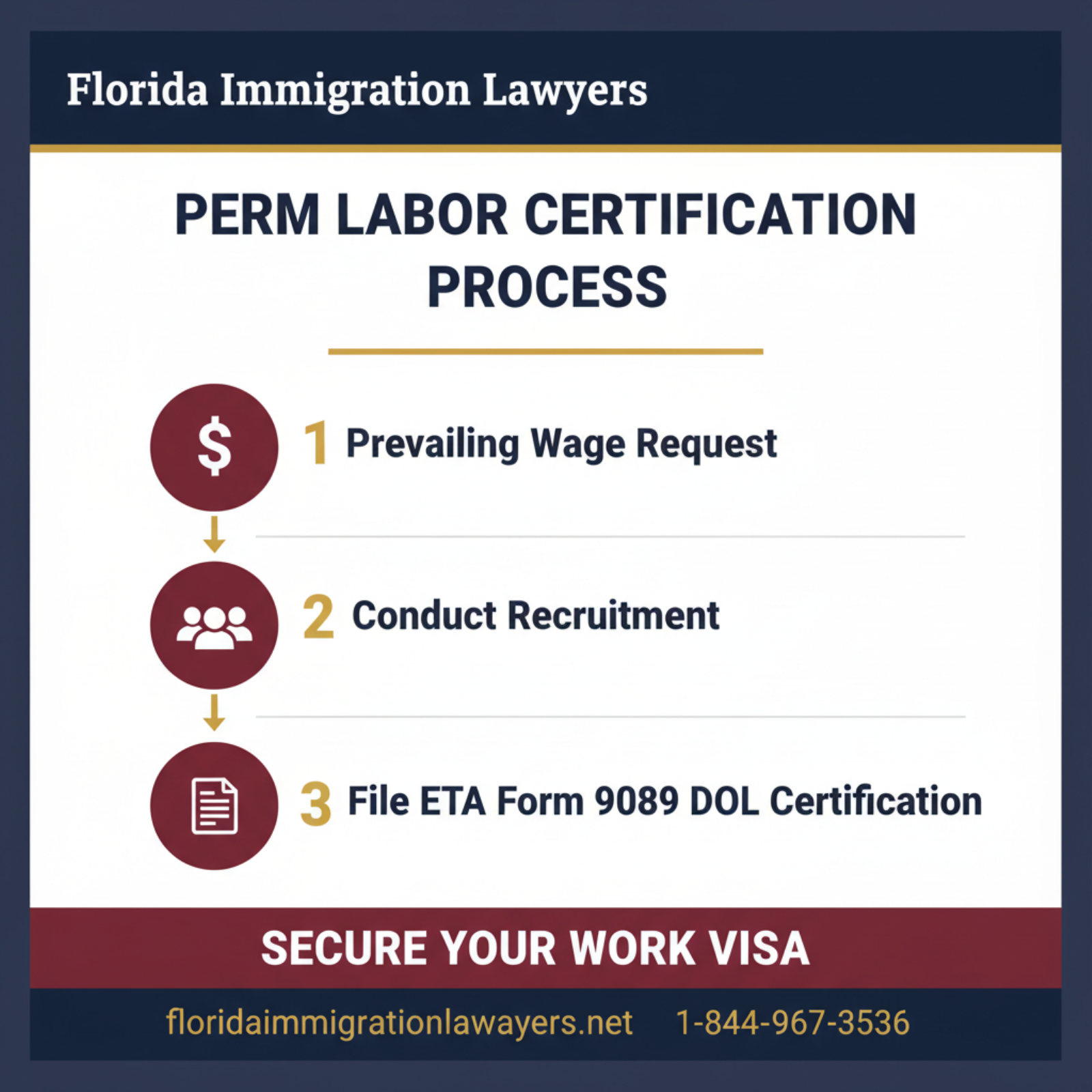
- Determine Prevailing Wage: The employer must first obtain a Prevailing Wage Determination (PWD) from the DOL. This ensures the offered wage meets or exceeds the average wage paid to similarly employed workers in the geographic area of intended employment (e.g., Tallahassee, Florida). The PWD request is filed on Form ETA-9141 and can take several months to process. This step is critical for compliance and sets the compensation standard.
- Conduct Required Recruitment: After receiving the PWD, the employer must conduct a series of recruitment efforts to test the U.S. labor market. This typically includes placing a job order with the State Workforce Agency (SWA) for 30 days and running two Sunday advertisements in a newspaper of general circulation. For professional occupations, additional recruitment steps are required, such as internal job postings, employer's website postings, job search website postings, and campus recruitment. These efforts must occur between 30 and 180 days before filing the PERM application.
- Review Applications and Interview U.S. Applicants: The employer must diligently review all resumes received as a result of the recruitment efforts. If any U.S. worker is found to be qualified, willing, and available for the position, the PERM process cannot proceed. The employer must document the legitimate, job-related reasons why any U.S. applicants were rejected. This step is a cornerstone of the PERM process, upholding its core purpose.
- File Form ETA-9089: If no qualified U.S. workers are found, the employer can then file Form ETA-9089, Application for Permanent Employment Certification, with the DOL. This form details the job offer, the foreign worker's qualifications, the recruitment efforts undertaken, and the prevailing wage. The application is filed electronically through the DOL's online PERM system. Accuracy and completeness are paramount at this stage to avoid delays.
- DOL Processing and Potential Audit: After submission, the DOL reviews the application. Some applications are selected for audit, which means the DOL requests additional documentation and evidence of the recruitment efforts and employer's attestations. An audit can significantly extend the processing time. Employers must respond thoroughly and promptly to any audit requests to maintain their application's integrity.
- PERM Certification: If the DOL approves the application, it issues a certified Form ETA-9089. This certification is valid for 180 days and must be used to file the subsequent I-140 Immigrant Petition for Alien Worker with U.S. Citizenship and Immigration Services (USCIS) within that timeframe. This is a critical milestone in the green card journey, allowing the process to move forward to USCIS. For more information on the overall immigration process, visit our practice area page.
This process requires meticulous record-keeping and a deep understanding of immigration regulations. Seeking assistance from an experienced Florida immigration lawyer can prevent costly delays and denials.
Essential Documents for Your PERM Application
Preparing a complete and accurate set of documents is vital for a smooth PERM labor certification process. Missing or incorrect documentation can lead to audits, delays, or even denials. Here is a general checklist of documents and information typically required:
- Employer's Federal Employer Identification Number (FEIN).
- Employer's business license and proof of ability to pay the offered wage.
- Detailed job description, including duties, minimum education, experience, and special requirements.
- Prevailing Wage Determination (PWD) from the Department of Labor.
- Copies of all recruitment advertisements (newspaper ads, job postings, website screenshots).
- Log of all recruitment efforts, including dates and publications.
- Resumes and applications received from U.S. worker applicants.
- Documentation of reasons for rejection for each U.S. applicant.
- Foreign national's resume or CV, educational degrees, transcripts, and professional licenses.
- Evidence of foreign national's work experience (employment letters, pay stubs).
- Copies of any relevant skill certifications or evaluations.
- Corporate financial statements or tax returns demonstrating the employer's financial viability.
- Articles of Incorporation or other business formation documents.
Maintaining organized records throughout the entire recruitment period and beyond is crucial. These documents serve as proof of compliance if an audit occurs. Working with an attorney, such as those at Florida Immigration Lawyers, can streamline this documentation process.
PERM Labor Certification Timeline and Processing Expectations in 2026
The PERM labor certification timeline can vary significantly based on several factors, including the volume of applications the DOL receives, whether an audit is issued, and the specifics of the prevailing wage determination. While exact times are subject to change, here's a general overview of what to expect in 2026 for PERM processing time:
- Prevailing Wage Determination (PWD): This initial step can take 4 to 6 months, sometimes longer, depending on DOL backlogs. The request is filed online, and the DOL issues a determination based on occupational employment statistics for your specific Florida region.
- Recruitment Period: Once the PWD is received, the employer must conduct recruitment for a minimum of 30 days (for the job order) and typically 30-60 days for other advertisements. All recruitment must occur within a 180-day window before filing.
- Waiting Period (after recruitment): There is a mandatory 30-day "quiet period" after the last recruitment activity before the ETA-9089 can be filed. This allows time for late applicants to respond.
- DOL Processing of ETA-9089: After filing, standard processing for a PERM application can range from 6 to 12 months or more. The DOL aims to process applications efficiently, but high volumes can cause delays. You can check current processing times on the DOL's Foreign Labor Certification website: flag.dol.gov/processingtimes.
- Audit/Supervised Recruitment: If an application is selected for an audit, the process can be extended by an additional 6 to 12 months or even longer, depending on the complexity of the audit response and DOL's review. Supervised recruitment is a rare but lengthy process, further impacting the overall PERM processing time.
Overall, from the start of the PWD request to PERM certification, the entire process can realistically take 12 to 24 months, or even more, before you can even file the I-140 petition with USCIS. This extensive timeline underscores the importance of early planning and consistent follow-through for your employment-based green card.
Cost Factors and Fee Breakdown for PERM Applications
Understanding the potential costs associated with PERM labor certification is essential for both employers and foreign nationals in Florida. It's important to note that the PERM application itself (Form ETA-9089) does not have a government filing fee charged by the Department of Labor. However, there are several other significant expenses involved:
-
Recruitment Costs: Employers are responsible for all costs associated with the required recruitment efforts. These can include:
- Newspaper Advertisements: Costs vary widely by publication and region. Two Sunday ads in a major Florida newspaper can range from a few hundred to over a thousand dollars, depending on the circulation in areas like Tallahassee or Miami.
- Job Search Website Postings: Fees for premium job board postings can add to the expenses.
- Professional Journal Ads: If applicable for specialized positions, these can also incur costs.
- Attorney Fees: Legal fees for an experienced immigration attorney are a primary cost. Navigating the complexities of PERM, ensuring compliance, and responding to audits typically requires expert legal guidance. Attorney fees can vary based on the complexity of the case, but generally range from several thousand dollars. Employers are legally required to pay all attorney fees associated with the PERM application itself.
- Prevailing Wage Determination (PWD) Request: There is no government fee for requesting a PWD from the DOL.
- Post-PERM Filing Fees (I-140): While not part of the PERM process itself, the PERM certification is used to file Form I-140, Immigrant Petition for Alien Worker, with USCIS. This petition has a separate USCIS filing fee, which typically changes periodically. As of 2026, these fees can be substantial and are usually paid by the employer, though some arrangements may allow the beneficiary to pay certain premium processing fees.
- Other Potential Costs: These might include fees for credential evaluations if foreign degrees need to be assessed, or translation services for foreign documents. These costs contribute to the overall labor certification cost.
Employers sponsoring a foreign worker for a PERM-based green card must be prepared for these financial commitments. It's crucial for employers to understand that they cannot require the foreign national to pay any costs associated with the PERM labor certification process itself, including attorney fees for that specific stage. This is a fundamental protection for the foreign worker under DOL regulations, specifically 20 CFR §656.12(b).
Do not navigate this complex and critical process alone. The stakes are too high for missteps. Contact Florida Immigration Lawyers today to ensure your PERM labor certification application is handled efficiently and accurately. Our dedicated team is here to guide you every step of the way.
Common Mistakes to Avoid During the PERM Process
The PERM labor certification process is fraught with potential pitfalls that can lead to significant delays or outright denial. Avoiding these common mistakes is crucial for a successful outcome:
- Failing to Obtain an Accurate Prevailing Wage Determination (PWD): Offering a wage below the DOL-determined prevailing wage will result in a denial. Employers must ensure the PWD request accurately reflects the job duties and minimum requirements. A misclassified job title or incorrect geographic area (e.g., listing Miami when the job is in Tallahassee) can lead to an incorrect PWD.
- Inadequate Recruitment Efforts: Employers often fail to conduct all required recruitment steps, use incorrect advertising language, or place ads in the wrong media. This is a leading cause of audits and denials. All recruitment must be conducted within strict timelines and according to DOL specifications for labor certification requirements.
- Rejecting Qualified U.S. Workers Improperly: The employer must have legitimate, job-related reasons for rejecting U.S. applicants. Rejecting a U.S. worker who meets the minimum requirements, or doing so for discriminatory reasons, will result in a PERM denial. Documentation of rejection reasons must be thorough and defensible.
- Defining Restrictive Job Requirements: Job duties and requirements must be those normally required for the occupation and must not be tailored specifically to the foreign worker's qualifications. Overly restrictive requirements that cannot be justified by business necessity will trigger an audit or denial. This is a frequent issue in PERM Labor Certification applications.
- Missing Deadlines and Strict Timelines: The PERM process has numerous deadlines, from the PWD validity to the recruitment period and the 30-day "quiet period." Missing any of these can invalidate the entire process. For example, failing to file the ETA-9089 within 180 days of the last recruitment activity is a common error.
- Lack of Meticulous Record-Keeping: Employers must maintain detailed records of every step of the recruitment process, including copies of all advertisements, resumes received, and interview notes. Failure to produce these records during an audit will lead to denial. Proper documentation is a core part of labor certification requirements.
- Incorrectly Stating the Employer's Ability to Pay: The employer must demonstrate a financial ability to pay the offered wage from the date the I-140 petition is filed until the foreign national obtains lawful permanent residency. Insufficient financial documentation can derail the entire green card process, even after PERM certification and I-140 approval.
These mistakes highlight the procedural complexities of PERM. Professional legal assistance can help identify and mitigate these risks, ensuring a smoother journey for your employer-sponsored green card application in Florida.
When to Call a Florida Immigration Lawyer for PERM Assistance
Navigating the intricate landscape of PERM labor certification is rarely straightforward. While this guide provides a comprehensive overview, the nuances of each case often demand specialized legal insight. It is highly advisable to consult with an experienced Florida immigration lawyer from the outset, particularly if any of the following scenarios apply to you or your business:
- You are an employer in Florida considering sponsoring a foreign worker for the first time. The initial setup and understanding of compliance requirements are critical. Our attorneys can help you establish best practices.
- The job position has unique or highly specialized requirements. If the job description deviates from standard occupational classifications, it can trigger closer scrutiny from the DOL. We can help justify business necessity.
- You anticipate difficulty in finding U.S. workers. If the local labor market, such as in Tallahassee or Jacksonville, has a surplus of U.S. workers for the position, the recruitment process will be more challenging. We can guide you through robust recruitment strategies.
- You receive an audit notification from the DOL. Responding to an audit requires a detailed and timely submission of evidence. Our team has extensive experience in successfully addressing audit requests.
- You have questions about the prevailing wage determination. Ensuring the correct prevailing wage is crucial. We can review and advise on PWD requests and challenge unfavorable determinations if necessary.
- There are concerns about the employer's ability to pay the offered wage. Demonstrating financial stability is vital for the I-140 stage. We can help compile the necessary financial documentation.
- You need help with the subsequent I-140 petition and Adjustment of Status (I-485). PERM is just the first step. Our firm provides seamless representation through the entire employer-sponsored green card process, including family-based immigration components if applicable, and even deportation defense if issues arise.
Florida Immigration Lawyers offers comprehensive legal services for businesses and individuals throughout Florida. Our attorneys are well-versed in the latest immigration laws and regulations, including those specific to **business immigration**. We understand the local context, from the bustling economy of South Florida to the state capital's unique needs. We are here to protect your interests and guide you toward a successful outcome.
Frequently Asked Questions (FAQs) About PERM Labor Certification
Here are answers to common questions about the PERM labor certification process, drawing from frequently asked queries:
1. Is a labor certificate the same as a PERM?
Yes, the terms "labor certificate" and "PERM" (Program Electronic Review Management) are generally used interchangeably. PERM is the current system and process through which the U.S. Department of Labor issues a permanent labor certification. It's the modern, electronic method for obtaining this certification, which replaced older paper-based processes.
2. Is it hard to get a labor certification?
The PERM labor certification process is widely considered complex and challenging due to its strict procedural requirements, detailed recruitment mandates, and extensive documentation. It requires meticulous attention to detail, adherence to specific timelines, and a thorough understanding of DOL regulations. While not inherently "hard" in terms of approval rates if all steps are followed correctly, the process is difficult to navigate without experienced legal counsel.
3. How do I check my PERM labor certification status?
Employers and their authorized attorneys can check the status of a PERM labor certification application online through the DOL's Foreign Labor Application Gateway (FLAG) system where the ETA Form 9089 was filed. You will need the case number to access the status. Additionally, the DOL provides general processing times on its website, which can give an estimated timeframe for review.
4. How to obtain temporary labor certification?
Temporary labor certification is a different process from permanent PERM labor certification. Temporary certifications are for nonimmigrant visas like the H-2A (agricultural workers) and H-2B (non-agricultural workers) programs. These are also managed by the Department of Labor but involve different forms (e.g., ETA-9142B for H-2B) and distinct recruitment and filing procedures. This article focuses solely on permanent PERM labor certification for green card purposes.
About Florida Immigration Lawyers
Florida Immigration Lawyers is a leading law firm dedicated to providing exceptional immigration legal services across the entire state of Florida. Our seasoned attorneys possess a profound understanding of U.S. immigration law and are committed to helping individuals, families, and businesses achieve their immigration goals. We pride ourselves on our client-focused approach, offering compassionate yet aggressive representation.
Our services span a broad range of immigration matters, including PERM labor certification, family-based petitions, business immigration solutions, naturalization and citizenship applications, asylum claims, and robust deportation defense. We understand the unique challenges faced by immigrants in Florida and work tirelessly to provide effective, ethical, and personalized legal strategies.
When you choose Florida Immigration Lawyers, you gain a partner who will stand by you through every step of your immigration journey. We offer free consultations to discuss your case and are available 24/7 to address your concerns. With offices strategically located to serve all of Florida, we are always within reach. Your success is our mission. Call us today at 1-844-967-3536 or visit our website at https://www.floridaimmigrationlawyers.net.
Sources and References
- U.S. Department of Labor (DOL) - Foreign Labor Application Gateway (FLAG)
- U.S. Citizenship and Immigration Services (USCIS) - Employment-Based Green Cards
- Immigration and Nationality Act (INA) Section 212(a)(5)(A) - Labor Certification and Qualifications for Visas
- 8 U.S.C. § 1182(a)(5)(A) - Labor certification and qualifications for visas
- 20 CFR Part 656 - Labor Certification Process for Permanent Employment of Aliens in the United States
This article provides general legal information and is not intended as legal advice. Every case is unique, and outcomes depend on specific facts and circumstances. Contact an attorney for advice about your particular situation.
Embarking on the PERM labor certification process can be daunting, but you don't have to face it alone. Let Florida Immigration Lawyers be your trusted guide. We are here to provide the expert legal representation you need for a successful employer-sponsored green card application in Florida. Call us today at 1-844-967-3536 for a free, confidential consultation. Se Habla Español - Estamos aquí para ayudarle.
Need help with Immigration?
Our Florida immigration attorneys offer free consultations. Call today or schedule online.
Frequently Asked Questions
Florida Immigration Lawyers
Legal Team
Our experienced attorneys at Florida Immigration Lawyers have been serving clients across Florida for over 20 years. We specialize in immigration, personal injury, criminal defense, workers compensation, and family law.