H-1B Visa 100k Fee in Florida: Your 2026 Guide to Eligibility
For professionals and employers in Florida, especially in Gainesville, understanding the H-1B visa in 2026 is vital. This guide clarifies the true costs and requirements, addressing the much-discussed $100,000 fee. While this fee was primarily a past proposal or temporary measure, not a universal requirement in 2026, we detail standard H-1B costs, eligibility, and the application process. Learn about prevailing wage, lottery registration, and essential documents. Florida Immigration Lawyers provides accurate, up-to-date information and expert legal counsel for your H-1B journey. Contact us for a free consultation to navigate this complex process effectively.
The discussion around a H-1B visa 100k fee primarily stems from past legislative proposals and executive orders, not a universal current requirement for most H-1B petitions in 2026. While specific circumstances or future policy changes could introduce such fees, the standard H-1B process involves different costs. Eligibility, prevailing wage requirements, and proper application are crucial for H-1B success in Florida.
- The $100,000 fee is generally not a standard H-1B requirement in 2026.
- H-1B visas require employers to pay a prevailing wage, which varies by location and occupation.
- Certain employers or specific petitions historically faced or may face additional fees.
- Consulting an immigration lawyer is vital to understand current H-1B costs and requirements.
- The H-1B lottery and application process remain highly competitive.
Navigating the complex world of U.S. immigration law can feel overwhelming, especially when news circulates about substantial fees like the H-1B visa 100k. For professionals and employers in Florida, particularly in bustling areas like Gainesville, understanding the true costs and requirements for the H-1B visa in 2026 is critical. You might be an employer seeking to hire skilled foreign talent or an individual dreaming of working in a specialty occupation in the Sunshine State.
This comprehensive guide from Florida Immigration Lawyers aims to clarify the realities surrounding the H-1B visa, addressing the much-discussed $100,000 fee, general costs, eligibility, and the application process. We will provide you with accurate, up-to-date information to help you make informed decisions. We understand your concerns and are here to offer clarity and support.
For personalized guidance on your H-1B visa journey, do not hesitate to call Florida Immigration Lawyers at 1-844-967-3536 for a free consultation. Our experienced team serves all of Florida, including Gainesville, and is ready to assist you.
Understanding the H-1B Visa and the $100,000 Fee Discussion
The H-1B visa program is a nonimmigrant visa that allows U.S. employers to temporarily employ foreign workers in specialty occupations. These occupations generally require a bachelor's degree or higher in a specific field. Fields often include IT, engineering, medicine, finance, and architecture. The program is vital for many Florida businesses seeking specialized talent.
The discussion surrounding a potential H-1B visa 100k fee has caused considerable confusion and concern. This fee was primarily proposed or implemented under specific, temporary executive actions or legislative proposals, not as a standard, universal fee for all H-1B petitions. For example, during certain periods, specific proclamations aimed at restricting entry of certain nonimmigrant workers included provisions for additional fees for certain petitioners.
As of 2026, for most standard H-1B petitions, a $100,000 fee is not a universal requirement. The standard fees associated with an H-1B petition are different and will be discussed later. It is crucial to distinguish between proposed or temporary measures and the established regulations that govern the H-1B program. Always refer to official USCIS guidelines for the most current fee schedule.
Who Has to Pay $100,000 for an H-1B Visa? Clarifying the Fee's Application
The question, "Who has to pay $100,000 for an H-1B visa?" is a common one. Historically, proposals for a $100,000 fee were often targeted at specific types of employers or circumstances. This included, for instance, certain companies heavily reliant on H-1B workers (often referred to as H-1B dependent employers) or those with a high percentage of foreign workers. These proposals were often part of broader efforts to reform the H-1B program or to encourage hiring of U.S. workers.
It is important to understand that such fees were not universally applied to every H-1B petition. They were typically tied to specific conditions, which could include the employer's size, the number of H-1B employees, or the type of petition (e.g., initial petition versus extension). The legal landscape surrounding these fees has been dynamic, with some proposals facing legal challenges or lapsing. Therefore, if you are an employer in Florida, you should not assume a $100,000 fee applies to your general H-1B petitions in 2026 without specific guidance from USCIS or an immigration attorney.
Is H-1B Actually $100k Now? The Current Reality for 2026
To directly answer, "Is H-1B actually $100k now?" – no, not for the vast majority of H-1B petitions in 2026. While the concept of a significant additional fee has been discussed and even temporarily implemented under very specific, limited circumstances in the past, it is not a standard component of the H-1B visa application process today. The regular H-1B fees are considerably lower and are outlined in the official USCIS fee schedule.
Employers and applicants in Florida should focus on the established H-1B requirements and fee structures. Any legislative changes or new executive orders that could introduce such a fee would be widely publicized and would likely face rigorous legal review. Florida Immigration Lawyers monitors these developments closely to provide the most accurate advice to our clients.
Step-by-Step Guide to the H-1B Visa Process for Florida Employers and Workers
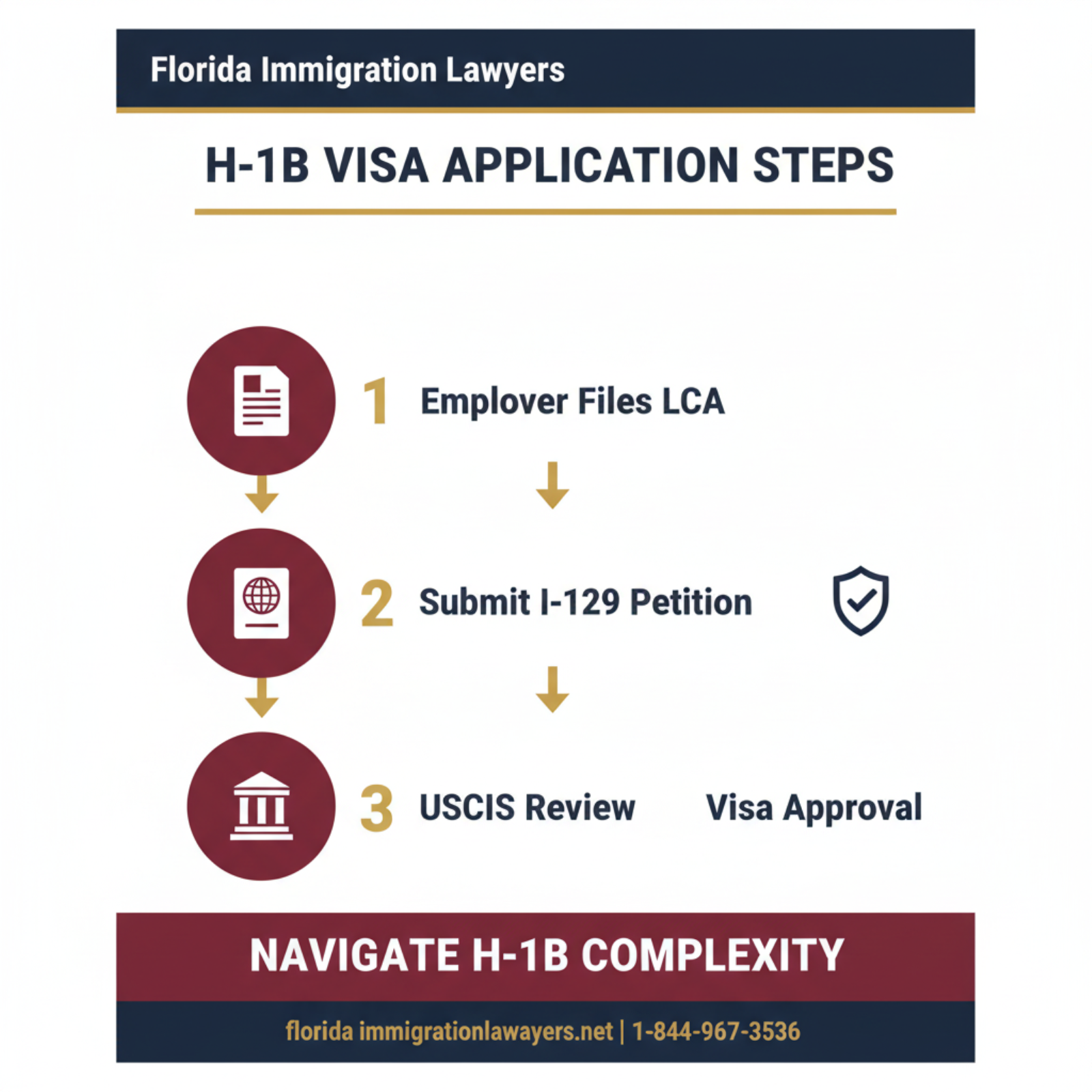
The H-1B visa process is intricate and requires careful attention to detail. For employers in Gainesville and throughout Florida, understanding each step is crucial for a successful petition. This guide outlines the typical stages involved in securing an H-1B visa.
-
Determine Eligibility and Prevailing Wage: The employer must first confirm that the position qualifies as a specialty occupation and that the foreign worker meets the educational or experience requirements. The employer must also obtain a certified Labor Condition Application (LCA) from the U.S. Department of Labor (DOL). This LCA ensures that the H-1B worker will be paid at least the prevailing wage for their occupation in the specific geographic area, such as Gainesville, Florida, and that working conditions will not adversely affect U.S. workers. This addresses the "What is the minimum salary for H-1B in Florida?" question indirectly by highlighting the prevailing wage requirement. You can find more information at dol.gov.
-
H-1B Lottery Registration (If Applicable): Due to the annual cap on H-1B visas (65,000 regular cap and an additional 20,000 for those with a U.S. master's degree or higher), USCIS typically conducts a lottery if the number of registrations exceeds the available visas. Employers must register prospective H-1B workers electronically during a specific registration period, usually in March, for the fiscal year starting October 1st. This is a critical step for many applicants.
-
File Form I-129, Petition for a Nonimmigrant Worker: If selected in the lottery (or if the cap is not met, or for cap-exempt petitions), the employer files Form I-129 with USCIS. This petition must include the certified LCA, supporting documentation about the employer, the position, and the beneficiary's qualifications. This is the core of the H-1B application.
-
Respond to Requests for Evidence (RFEs): USCIS may issue an RFE if they require additional information or clarification to make a decision on the petition. Prompt and thorough responses are essential. Our attorneys at Florida Immigration Lawyers are adept at handling RFEs effectively.
-
Petition Approval: If the petition is approved, USCIS will send an I-797 Approval Notice. If the beneficiary is already in the U.S. and eligible for a change of status, their status will automatically change. If they are outside the U.S., they will proceed to consular processing.
-
Consular Processing or Change of Status: For beneficiaries outside the U.S., they must attend an interview at a U.S. embassy or consulate in their home country to obtain the H-1B visa stamp. For those changing status within the U.S., they can begin employment on the H-1B start date. More information on visa interviews can be found at travel.state.gov.
Essential Document Checklist for Your H-1B Visa Application
A well-organized set of documents is vital for a successful H-1B petition. Both the employer and the beneficiary must provide extensive paperwork. Missing or incorrect documents can lead to delays or denials. We recommend organizing these documents meticulously.
- For the Employer:
- Certified Labor Condition Application (LCA) Form ETA 9035.
- Employer's Federal Employer Identification Number (FEIN).
- Company financial statements, tax returns, and business licenses.
- Job description, organizational charts, and evidence of the specialty occupation.
- Client letters or contracts if the H-1B worker will be placed at a third-party site.
- Evidence of ability to pay the prevailing wage.
- For the Beneficiary (Employee):
- Copies of all educational degrees, diplomas, and transcripts (evaluated by a U.S. credential evaluation service if obtained outside the U.S.).
- Letters of experience from previous employers.
- Resume or Curriculum Vitae.
- Copies of passport, birth certificate, and previous U.S. visas (if applicable).
- Most recent I-94 arrival/departure record (if in the U.S.).
- Proof of professional licenses or certifications (if required for the occupation).
- Any prior immigration documents (e.g., EAD, I-20s, I-797s).
Step-by-Step Process Guide
H-1B Visa Timeline and Processing Expectations for 2026
The H-1B visa timeline is heavily influenced by the annual cap and the lottery system. The fiscal year for H-1B visas begins on October 1st. Employers can typically file petitions on April 1st for employment starting October 1st of the same calendar year. This means there is a significant lead time involved in the application process.
If the number of registrations exceeds the annual cap, USCIS conducts a lottery, usually in March. Selected petitions can then be filed from April 1st. Regular processing times for H-1B petitions can vary widely, from a few months to over a year, depending on the USCIS service center workload. Premium processing is available for an additional fee, which guarantees a decision within 15 calendar days. This option can significantly expedite the process for urgent cases.
Given the high demand and limited number of visas, early preparation is key. Employers in Florida should begin planning their H-1B petitions well in advance of the registration and filing periods. USCIS also provides tools for checking current processing times for different form types at various service centers. Always factor in potential delays, such as Requests for Evidence (RFEs), which can extend the timeline.
Cost Factors and Fee Breakdown for the H-1B Visa
While the H-1B visa 100k fee is not a standard requirement, there are several mandatory fees associated with the H-1B petition. These fees are paid by the employer and are subject to change by USCIS. It is important to budget for these costs accurately.
- USCIS Filing Fee: This is the base fee for filing Form I-129.
- American Competitiveness and Workforce Improvement Act (ACWIA) Fee: This fee varies based on the employer's size (e.g., under 25 full-time equivalent employees or 25 or more).
- Fraud Prevention and Detection Fee: A mandatory fee for initial H-1B petitions and for employers filing a petition for a beneficiary already in H-1B status with a different employer.
- Public Law 114-113 Fee (if applicable): This fee applies to employers with 50 or more employees, where more than 50% are in H-1B or L-1 nonimmigrant status. This is the fee that has sometimes been confused with or proposed to be increased to a higher amount, such as $100,000, under specific legislative contexts. It is crucial to check current legislation for its applicability and amount in 2026.
- Premium Processing Fee (Optional): An additional fee for expedited processing within 15 calendar days.
- Attorney Fees: Legal fees for immigration counsel will vary based on the complexity of the case and the firm's rates. While not a government fee, this is a significant part of the overall cost.
- Prevailing Wage: Although not a direct filing fee, employers must commit to paying the H-1B worker at least the prevailing wage for the occupation in the specific geographic area. This is a critical financial obligation.
Understanding these various fees is essential for employers in Florida. Remember that government fees can change, so always consult the latest USCIS fee schedule or an experienced business immigration attorney.
Do not navigate this process alone. Contact Florida Immigration Lawyers today. Our team is ready to provide the expert guidance you need for your H-1B visa petition. We serve clients across Florida, including those in Gainesville and surrounding areas.
Common Mistakes to Avoid in Your H-1B Visa Application
-
Incorrectly Determining Specialty Occupation: Many employers fail to adequately demonstrate that the position requires a bachelor's degree in a specific field, leading to RFEs or denials. Consequences: Delays, re-filing costs, or outright denial of the petition.
-
Failing to Meet Prevailing Wage Requirements: Not paying the H-1B worker at least the prevailing wage for the area and occupation is a serious violation. Consequences: Penalties, back pay requirements, and potential debarment from the H-1B program.
-
Late or Incomplete Lottery Registration: Missing the electronic registration deadline or providing inaccurate information can exclude your petition from the lottery. Consequences: Inability to file the petition for the current fiscal year, requiring a wait until the next cycle.
-
Insufficient Documentation: Submitting a petition without all required supporting documents, such as certified LCAs, educational evaluations, or employer financial records. Consequences: RFEs, significant delays, or denial if not properly addressed.
-
Not Responding Adequately to RFEs: Receiving an RFE requires a thorough and timely response with compelling evidence. A weak or incomplete response will likely lead to denial. Consequences: Petition denial, loss of filing fees, and missed opportunities.
-
Misunderstanding the H-1B Cap and Exemptions: Assuming all H-1B petitions are subject to the annual cap or failing to correctly identify if an employer is cap-exempt (e.g., universities, non-profit research organizations). Consequences: Filing an ineligible petition, leading to denial, or missing opportunities for cap-exempt employment.
-
Ignoring Changes in Immigration Law: Immigration laws and policies, including fees and regulations, are subject to change. Relying on outdated information can be detrimental. Consequences: Non-compliance, delays, or petition denial due to not meeting current requirements.
When to Call a Florida Immigration Lawyer for H-1B Assistance
The H-1B visa process is complex, and the stakes are high for both employers and foreign professionals. While this guide provides general information, your specific situation will always benefit from expert legal counsel. Florida Immigration Lawyers can help you navigate these intricacies and avoid common pitfalls.
You should consider contacting us if you:
- Are an employer in Florida considering sponsoring an H-1B worker for the first time.
- Have received a Request for Evidence (RFE) from USCIS and need assistance with a robust response.
- Are a foreign professional in Florida seeking to understand your H-1B eligibility or options for changing status.
- Have questions about the prevailing wage determination for your specific occupation and location in Florida.
- Need assistance with deportation defense or other complex immigration matters related to your H-1B status.
- Are concerned about the applicability of specific fees, like the discussed H-1B visa 100k fee, to your case.
- Need help with citizenship or other pathways to permanent residency after your H-1B.
- Are an H-1B worker facing issues with your employer or employment conditions.
Our attorneys at Florida Immigration Lawyers provide comprehensive services, from initial eligibility assessments and lottery registration to petition filing and RFE responses. We are committed to protecting your interests and guiding you through every step of the process. Your success is our priority.
About Florida Immigration Lawyers
Florida Immigration Lawyers is a leading immigration law firm dedicated to serving individuals and businesses throughout Florida. With a deep understanding of U.S. immigration laws and a commitment to our clients, we provide personalized and effective legal solutions. Our team of experienced attorneys is passionate about helping you achieve your immigration goals, whether it's through an H-1B visa, family immigration, or other pathways.
We offer a wide range of services, including H-1B visa petitions, green card applications, asylum claims, deportation defense, and naturalization. We pride ourselves on our empathetic approach, clear communication, and unwavering advocacy for our clients. We understand the challenges you face and strive to make the immigration process as smooth as possible.
Choose Florida Immigration Lawyers because we are:
- Experienced: Our attorneys have years of dedicated immigration law practice.
- Client-Focused: We prioritize your needs and provide tailored strategies.
- Accessible: Available 24/7 for your urgent questions and concerns.
- Bilingual: Offering services in both English and Spanish to serve Florida's diverse community.
- Committed: Providing free consultations to discuss your case without obligation.
For expert legal assistance, contact us today. Call 1-844-967-3536 or visit our website at https://www.floridaimmigrationlawyers.net. We are here to help you navigate your immigration journey in Florida.
Sources and References
- U.S. Citizenship and Immigration Services (USCIS)
- U.S. Department of Labor (DOL)
- U.S. Department of State (travel.state.gov)
- 8 U.S.C. § 1101(a)(15)(H)(i)(b) - Immigration and Nationality Act (INA) defining H-1B visa
- 8 U.S.C. § 1184(g) - INA provisions for numerical limitations on H-1B visas
- 8 CFR Part 214.2(h) - Regulations governing H nonimmigrants
- USCIS Policy Manual
This article provides general legal information and is not intended as legal advice. Every case is unique, and outcomes depend on specific facts and circumstances. Contact an attorney for advice about your particular situation.
Don't let the complexities of the H-1B visa process deter you from pursuing your professional goals in Florida. Whether you are an employer or a skilled professional, having experienced legal representation is invaluable. Contact Florida Immigration Lawyers today at 1-844-967-3536 for a free consultation. We are available 24/7 to answer your questions and provide the support you need. Se Habla Español - Estamos aquí para ayudarle.
Need help with Immigration?
Our Florida immigration attorneys offer free consultations. Call today or schedule online.
Frequently Asked Questions
Florida Immigration Lawyers
Legal Team
Our experienced attorneys at Florida Immigration Lawyers have been serving clients across Florida for over 20 years. We specialize in immigration, personal injury, criminal defense, workers compensation, and family law.