O-1 Visa Florida: Extraordinary Ability Talent Visa Guide
Discover how to secure an O-1 visa for extraordinary ability in Florida with our comprehensive guide for 2026. Designed for individuals at the top of their field in sciences, arts, education, business, or athletics, this visa allows you to live and work in the U.S. Learn about the stringent requirements, detailed application process, essential documents, and potential pathways to a green card. We cover critical distinctions between O-1A and O-1B visas, discuss processing timelines, and outline cost factors. Avoid common mistakes and understand when expert legal assistance is vital for a successful application. Florida Immigration Lawyers offers free consultations and bilingual support across Florida, including Kissimmee, helping talented individuals navigate this complex immigration journey.

An O-1 visa is a nonimmigrant visa for individuals with extraordinary ability in the sciences, arts, education, business, or athletics, or extraordinary achievement in the motion picture or television industry. This visa allows talented individuals to live and work temporarily in the U.S., typically for an initial period of up to three years. Obtaining one requires extensive documentation demonstrating sustained national or international acclaim.
- O-1 visas are for individuals with exceptional talent.
- It requires strong evidence of national or international acclaim.
- Initial validity is typically up to three years.
- Sponsorship by a U.S. employer or agent is required.
- Consulting an attorney is highly recommended for this complex process.
O-1 Visa Florida: Extraordinary Ability Talent Visa Guide 2026
Are you an individual with exceptional talent or extraordinary ability seeking to advance your career in the United States? Florida, with its vibrant cultural scene, growing tech industry, and diverse opportunities, offers a compelling destination for professionals like you. Specifically, areas like Kissimmee, Orlando, and Miami are becoming hubs for innovation and entertainment, attracting top talent from around the globe.
The O-1 visa, often referred to as the "extraordinary ability visa" or "talent visa," is designed for nonimmigrants who have reached the pinnacle of their field. This visa category allows you to work legally in the U.S. for an employer or agent, bringing your unique skills and contributions to American soil. However, navigating the complex requirements for an O-1 visa can be challenging without expert guidance.
This comprehensive guide from Florida Immigration Lawyers will walk you through everything you need to know about the O-1 visa process in Florida for 2026. We will cover eligibility, required documentation, timelines, and common pitfalls to avoid. Our goal is to equip you with the knowledge to pursue your American dream with confidence.
Do you have questions about your specific qualifications or how to gather the compelling evidence needed? Call Florida Immigration Lawyers at 1-844-967-3536 for a free consultation. Our experienced team is ready to assist you.
Understanding the O-1 Visa for Extraordinary Ability in Florida
The O-1 nonimmigrant visa category is reserved for individuals who possess extraordinary ability in the sciences, arts, education, business, or athletics, or who have a demonstrated record of extraordinary achievement in the motion picture or television industry. This distinction is crucial, as the criteria for each category differ slightly. The underlying principle is that you must be recognized nationally or internationally for your exceptional skills.
For individuals seeking an O-1 visa in Florida, the opportunities are vast. Whether you are an acclaimed artist looking to showcase your work in Miami's art districts, a leading scientist aiming for research positions near Cape Canaveral, or an innovative entrepreneur expanding into the Orlando tech scene, Florida provides a dynamic environment. Our firm understands the unique landscape of talent and industry across the state, from Kissimmee to Jacksonville.
Who Qualifies for an O-1 Visa?
To qualify for an O-1 visa, you must demonstrate extraordinary ability by sustained national or international acclaim. This means you must be one of the small percentage who have risen to the very top of your field of endeavor. The U.S. Citizenship and Immigration Services (USCIS) evaluates petitions based on a stringent set of criteria, requiring objective evidence of your achievements.
This visa is not for everyone; it is specifically for those whose achievements are truly outstanding. The evidence you provide must clearly establish your extraordinary ability, setting you apart from others in your profession. Without strong, verifiable documentation, your petition may face significant hurdles.
O-1A vs. O-1B Visa: Key Distinctions
The O-1 visa category is further divided into two main types: O-1A and O-1B. Understanding this distinction is vital for a successful application. Each has its own specific set of criteria that must be met.
The O-1A visa is for individuals with extraordinary ability in the sciences, education, business, or athletics. This category typically requires evidence of a major, internationally recognized award (like a Nobel Prize) or meeting at least three of eight specific criteria, such as receipt of lesser nationally or internationally recognized prizes, membership in associations requiring outstanding achievements, published material about you, judging the work of others, original scientific contributions, authorship of scholarly articles, employment in a critical capacity for distinguished organizations, or high salary.
The O-1B visa is for individuals with extraordinary ability in the arts or extraordinary achievement in the motion picture or television industry. For arts, it requires evidence of a major award (like an Academy Award) or meeting at least three of six specific criteria, such as having performed in a leading capacity for productions with distinguished reputations, national or international recognition for achievements, performance for organizations with distinguished reputations, a record of major commercial or critically acclaimed successes, significant recognition from organizations, critics, or government agencies, or a high salary. For motion picture/television, similar criteria apply but emphasize a high level of accomplishment in the industry.
Step-by-Step Guide to Obtaining Your O-1 Visa in Florida
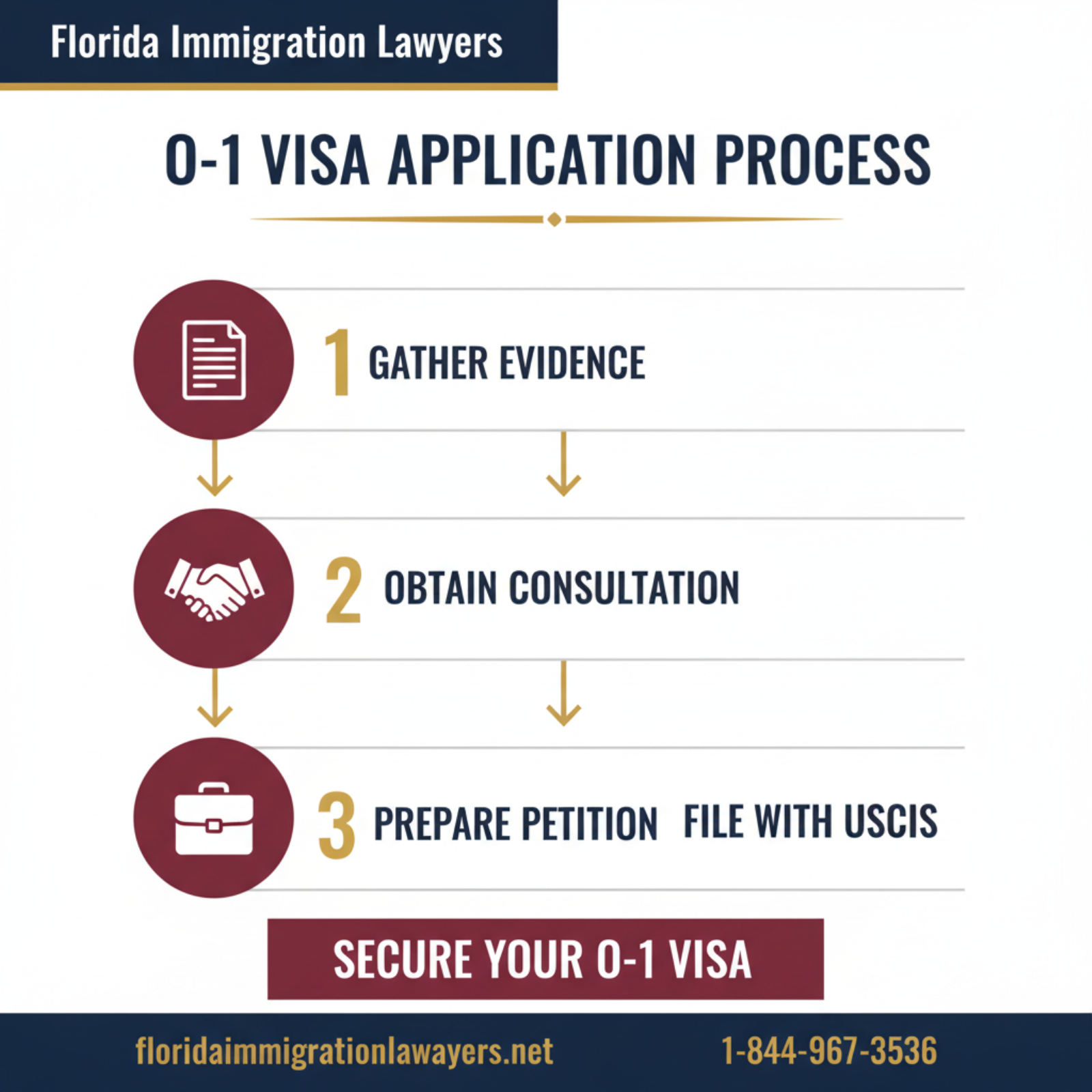
The process of securing an O-1 visa for extraordinary ability is meticulous and requires careful planning. Here is a general step-by-step guide to help you understand what to expect as a Florida applicant. Remember, each case is unique, and personalized legal advice is invaluable.
-
Secure a U.S. Employer or Agent: Unlike some other visas, an O-1 visa requires a U.S. employer or agent to petition on your behalf. This entity will be your sponsor, submitting Form I-129, Petition for a Nonimmigrant Worker, to USCIS. The agent can represent multiple employers or engagements.
-
Gather Comprehensive Evidence: This is arguably the most critical step. You must collect extensive documentation proving your extraordinary ability. This includes awards, publications, testimonials, contracts, and other materials that directly address the specific O-1A or O-1B criteria. We will elaborate on this in the document checklist section.
-
Obtain a Consultative Opinion: For O-1A petitions, a written advisory opinion from an appropriate peer group, labor organization, or management organization is generally required. For O-1B petitions, a consultation from a labor organization with expertise in your field is typically needed. Waivers may apply in limited circumstances. This opinion confirms your extraordinary ability within your field.
-
Prepare and File Form I-129 Petition: Your U.S. employer or agent will prepare and file Form I-129, along with all supporting documentation and the required filing fee, to the appropriate USCIS Service Center. This petition must clearly articulate how you meet the O-1 criteria.
-
Respond to Requests for Evidence (RFE): It is common for USCIS to issue a Request for Evidence (RFE) if they determine that the initial submission lacks sufficient proof or clarity. Responding to an RFE effectively is crucial, often requiring additional documentation or clarification. This is where experienced legal counsel, like Florida Immigration Lawyers, can make a significant difference.
-
Visa Interview at U.S. Consulate (if abroad): Once the I-129 petition is approved by USCIS, if you are outside the U.S., you will apply for the O-1 visa stamp at a U.S. embassy or consulate in your home country. This usually involves an interview to determine your eligibility and intent. If you are already in the U.S. in another nonimmigrant status, you may apply for a change of status to O-1.
-
Entry to the U.S.: Upon successful visa stamping (or change of status approval), you can enter the U.S. in O-1 status. You will typically be granted admission for the validity period of the approved petition, up to three years initially. Learn more about general immigration pathways at our immigration practice area page.
Essential Document Checklist for O-1 Visa Applicants
The success of your O-1 visa petition hinges on the quality and quantity of evidence you provide. This checklist outlines the typical documents required. Remember to provide strong, objective evidence for each criterion you claim to meet.
- Form I-129, Petition for a Nonimmigrant Worker: Filed by your U.S. employer or agent.
- Employer/Agent Letter: A detailed letter from your petitioner describing the nature of your work, your extraordinary abilities, and the terms of your employment.
- Contracts: Copies of contracts between you and your U.S. employer(s) or agent.
- Advisory Opinion: A letter from a peer group, labor organization, or management organization in your field, confirming your extraordinary ability.
- Evidence of Awards: Documentation of nationally or internationally recognized awards, prizes, or distinctions (e.g., certificates, news articles, official announcements).
- Membership in Associations: Proof of membership in associations that require outstanding achievements of their members (e.g., membership cards, letters from the association).
- Published Material: Articles, publications, or published material in professional or major trade publications or other major media about you and your work (e.g., copies of articles with publication name and date).
- Judging of Others' Work: Evidence that you have served as a judge of the work of others in your field (e.g., letters from organizations, program brochures).
- Original Contributions: Documentation of your original scientific, scholarly, or artistic contributions of major significance to your field (e.g., patents, testimonials from experts, citations).
- Authorship of Scholarly Articles: Copies of your scholarly articles published in professional journals or other major media.
- Critical Employment: Evidence of your employment in a critical or essential capacity for organizations and establishments that have a distinguished reputation (e.g., letters from employers, organizational charts).
- High Salary: Evidence that you have commanded or will command a high salary or other substantial remuneration for services (e.g., pay stubs, contracts, tax returns).
- Letters of Recommendation/Testimonials: Letters from recognized experts in your field attesting to your extraordinary ability and achievements. These should be detailed and specific.
- Itineraries: For O-1B petitions involving multiple engagements, a detailed itinerary listing the dates, locations, and descriptions of each event.
O-1 Visa Timeline and Processing Expectations for Florida Applicants
Understanding the timeline for an O-1 visa is crucial for planning your move to Florida. The overall processing time can vary significantly depending on several factors, including the USCIS service center workload, the completeness of your petition, and whether you opt for premium processing.
Generally, standard processing for Form I-129 can take anywhere from 2 to 9 months or even longer. This timeframe does not include the time it takes to gather all your evidence and prepare the petition, which can itself take several weeks to months. If you are applying from abroad, you must also factor in the visa interview scheduling and processing time at the U.S. consulate.
For those in a hurry, USCIS offers Premium Processing Service for Form I-129. By paying an additional fee, USCIS guarantees to process your petition within 15 calendar days. This significantly accelerates the initial petition review. If an RFE is issued, the 15-day clock resets once USCIS receives your response.
Can an O-1 visa be extended for 3 years?
Yes, an O-1 visa can be extended. While the initial approval is typically for up to three years, extensions can be granted in one-year increments to continue or complete the same event or activity. There is no maximum limit on the number of extensions you can seek, as long as you continue to meet the eligibility requirements and are engaged in work requiring your extraordinary ability. Each extension requires filing a new Form I-129 petition.
Cost Factors and Fee Breakdown for Your O-1 Visa Petition
The financial aspect of obtaining an O-1 visa involves several components. It is important to budget for these costs to avoid unexpected delays or difficulties. Please note that USCIS filing fees are subject to change, so always refer to the official USCIS website for the most current amounts. We do not provide specific fee amounts here to ensure accuracy over time.
The primary costs typically include:
- USCIS Filing Fee for Form I-129: This is the mandatory fee paid to USCIS for processing your petition.
- Premium Processing Fee (Optional): If you choose to expedite your petition, an additional fee is required for the Premium Processing Service.
- Attorney Fees: Legal fees for the expert guidance and assistance of an immigration attorney. Given the complexity of O-1 petitions, professional legal help is highly recommended to ensure your application is as strong as possible.
- Consultation Fees: Fees for obtaining the required advisory opinion from a peer group or labor organization.
- Translation Costs: If any of your supporting documents are not in English, certified translations will be necessary, incurring additional costs.
- Photography and Document Reproduction: Costs associated with passport-style photos and making copies of all supporting evidence.
- Travel Expenses: If you need to attend a visa interview at a U.S. consulate abroad, travel and accommodation expenses will apply.
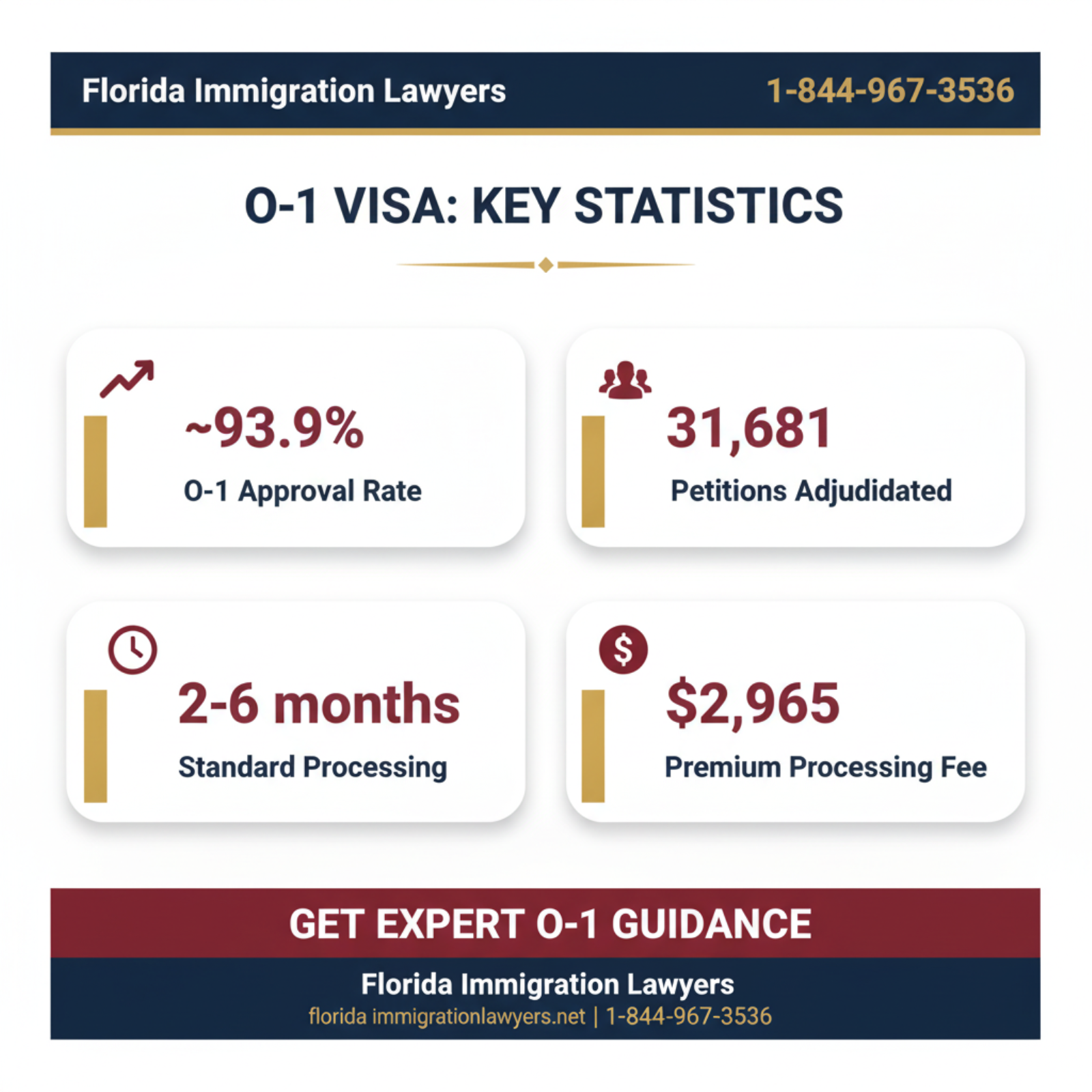
These costs can add up, but investing in a meticulously prepared petition can save you time, stress, and potential denials in the long run. For current USCIS fee schedules, you can refer to USCIS Form G-1055, Fee Schedule, and regulations at 8 CFR 103.7.
The journey to an O-1 visa in Florida can be complex, filled with specific requirements and potential challenges. Do not navigate this process alone. Contact Florida Immigration Lawyers today to ensure your extraordinary abilities are presented effectively and accurately to immigration authorities. Our team is dedicated to helping you achieve your goals.
Common Mistakes to Avoid When Applying for an O-1 Visa
Applying for an O-1 visa demands precision and a thorough understanding of immigration law. Even minor errors can lead to significant delays or even a denial. Here are some common mistakes applicants make and their potential consequences:
-
Insufficient Evidence: Many applicants underestimate the sheer volume and quality of evidence required. Simply stating you are extraordinary is not enough; you must prove it with objective, verifiable documents. Without sufficient proof for each criterion claimed, USCIS may issue an RFE or deny the petition, wasting time and money.
-
Failing to Meet Enough Criteria: For O-1A and O-1B (arts), you typically need to meet at least three of the specific regulatory criteria. Some applicants submit evidence for only one or two, leading to an automatic denial because they do not meet the minimum threshold.
-
Weak Letters of Recommendation: Generic or vague recommendation letters that do not specifically address your extraordinary abilities and contributions are ineffective. Letters should be from recognized experts, detailed, and specifically link your achievements to the O-1 criteria. Poor letters fail to convince USCIS of your unique talent.
-
Lack of National or International Acclaim: Evidence must demonstrate recognition beyond a local or regional level. Submitting only local awards or media mentions may not be enough to establish national or international acclaim, which is a core requirement for the O-1 visa.
-
Inconsistent Information: Discrepancies between your petition, supporting documents, and previous immigration records can raise red flags. Ensure all information is consistent and accurate to avoid suspicion of misrepresentation, which can have severe immigration consequences.
-
Ignoring the Advisory Opinion Requirement: Neglecting to obtain the mandatory advisory opinion from an appropriate peer group or labor organization (or a valid waiver) is a critical error. This opinion is a cornerstone of the O-1 petition and its absence will likely result in a denial.
-
Poorly Organized Petition: USCIS officers review thousands of petitions. A disorganized application with evidence scattered haphazardly makes their job difficult and can lead to frustration, potential overlooked evidence, and an RFE or denial. Present your case clearly and logically.
-
Failing to Prove a Bona Fide Job Offer/Engagement: The petition must clearly outline the specific services you will perform in the U.S. and the terms of your employment. A vague job offer or an unclear itinerary (for O-1B) can lead USCIS to question the legitimacy of your proposed work.
-
Missing Deadlines: Failing to respond to RFEs or other USCIS requests by their deadlines will result in the abandonment or denial of your petition. Timeliness is crucial in all immigration matters.
-
Not Consulting an Experienced Attorney: The O-1 visa is one of the most complex nonimmigrant visas. Attempting to navigate it without legal expertise often leads to the mistakes listed above. An experienced immigration lawyer can identify weaknesses, strengthen your case, and ensure compliance.
When to Call a Florida Immigration Lawyer for Your O-1 Visa
While this guide provides valuable information, the O-1 visa application process is highly individualized and exceptionally complex. Knowing when to seek professional legal assistance can be the difference between approval and denial, especially for those in Kissimmee or other Florida cities.
You should strongly consider contacting Florida Immigration Lawyers if any of the following scenarios apply to you:
- Unsure of Eligibility: If you are not certain whether your achievements truly meet the "extraordinary ability" standard. Our attorneys can assess your credentials and advise on the best strategy.
- Complex Case: Your career path is unusual, your evidence is unconventional, or you have previous immigration issues. These situations demand expert navigation.
- Need for Stronger Evidence: You have strong accomplishments but are struggling to compile and present them in a way that directly addresses USCIS criteria. We help you build a compelling narrative.
- Received a Request for Evidence (RFE): An RFE indicates that USCIS needs more information or clarification. Responding effectively to an RFE is critical and often requires legal expertise.
- Tight Deadlines: If you have limited time to prepare and file your petition, an attorney can streamline the process and ensure timely submission.
- Seeking Premium Processing: While premium processing speeds up review, it also means a quicker RFE response time. An attorney can help you prepare for this expedited pace.
- Employer/Agent Needs Guidance: Your U.S. employer or agent may not be familiar with O-1 visa petitions. We can guide them through their responsibilities as petitioners.
- Considering Future Green Card Options: An O-1 visa can be a stepping stone to permanent residency. Our attorneys can help you strategize for long-term immigration goals, including potential EB-1A petitions.
Florida Immigration Lawyers has a proven track record of assisting individuals with extraordinary ability across Florida. Our attorneys understand the nuances of the O-1 visa and are dedicated to providing personalized and strategic legal counsel. Visit our attorneys page to learn more about our team and how we can support your journey. You can also explore our general immigration services.
Can an O-1 Visa Lead to a Green Card? Exploring Permanent Residency Options
Many individuals who qualify for an O-1 visa naturally wonder if this temporary status can pave the way for permanent residency in the United States. The good news is, yes, it often can. While the O-1 visa itself is a nonimmigrant (temporary) visa, it is considered a "dual intent" visa. This means that holding an O-1 visa does not prevent you from simultaneously pursuing lawful permanent resident status (a green card).
The most common pathway from an O-1 visa to a green card is through the EB-1A visa for individuals of extraordinary ability. The criteria for an EB-1A green card are very similar to those for an O-1A visa, often requiring the same type of compelling evidence of national or international acclaim. If you successfully obtained an O-1A, you likely have a strong foundation for an EB-1A petition.
An EB-1A petition is an immigrant petition, allowing you to self-petition without an employer, though an employer can also petition for you. This makes it a highly desirable option for top talent. Other potential green card pathways, such as EB-2 National Interest Waiver or employment-based green cards requiring PERM labor certification, may also be available depending on your specific qualifications and field.
Strategizing your transition from a nonimmigrant visa like the O-1 to an immigrant visa is a critical step that requires careful planning. Our firm can help you explore all available options for business immigration and guide you through the process of securing your green card. Learn more about business immigration options on our business immigration practice area page.
Is an O-1 Visa Difficult to Get? Understanding Approval Rates and Challenges
The question "Is an O-1 visa difficult to get?" is frequently asked, and the honest answer is: yes, it can be. The O-1 visa is not for the faint of heart or those with merely impressive resumes. It is specifically designed for a select group of individuals who have truly reached the top of their field. The high bar for "extraordinary ability" makes it one of the more challenging nonimmigrant visas to obtain.
The difficulty stems from the stringent evidentiary requirements set by USCIS. You must not only meet at least three specific criteria but also demonstrate a pattern of sustained national or international acclaim. This often means providing multiple layers of evidence for each criterion, supported by credible testimonials from independent experts. The interpretation of what constitutes "extraordinary" can also be subjective, making a strong, well-articulated petition essential.
Despite the challenges, the approval rate for O-1 visas can be relatively high for well-prepared petitions. USCIS data generally shows a favorable approval rate for these petitions, but this often reflects the fact that only highly qualified individuals, often with legal assistance, tend to apply. The key to success lies in meticulous preparation, compelling presentation of evidence, and a deep understanding of USCIS expectations.
Working with an experienced immigration law firm, like Florida Immigration Lawyers, significantly increases your chances of success. We can help you identify the strongest evidence, structure your petition effectively, and respond strategically to any RFEs. Our goal is to make the process as smooth as possible, helping you overcome the inherent difficulties of securing an O-1 visa.
About Florida Immigration Lawyers
Florida Immigration Lawyers is a leading law firm dedicated to providing exceptional immigration services across the entire state of Florida. With a deep understanding of U.S. immigration law and a commitment to our clients, we strive to make the immigration process as clear and stress-free as possible. Our firm serves individuals, families, and businesses from Kissimmee to Fort Lauderdale, Miami to Jacksonville, and everywhere in between.
We specialize in a wide range of immigration matters, including O-1 visas for extraordinary ability, family-based petitions, employment visas, asylum claims, naturalization, and deportation defense. Our compassionate and knowledgeable attorneys work tirelessly to protect your rights and help you achieve your immigration goals. We pride ourselves on offering personalized legal strategies tailored to your unique circumstances.
Why choose Florida Immigration Lawyers? We offer free consultations, are available 24/7, and provide bilingual services (English and Spanish) to ensure effective communication. Our team is committed to delivering professional, empathetic, and results-driven representation. When your future in the U.S. is on the line, trust the experts who understand the complexities of Florida immigration law.
Contact us today for a free consultation: 1-844-967-3536 or visit our website: https://www.floridaimmigrationlawyers.net.
Sources and References
- U.S. Citizenship and Immigration Services (USCIS) - O-1 Visa
- USCIS Policy Manual, Volume 2, Part M - O Nonimmigrants
- U.S. Department of State - O Visas
- 8 U.S.C. § 1101(a)(15)(O)(i) - Immigration and Nationality Act (INA) Definition of O-1 Nonimmigrant
- 8 CFR § 214.2(o) - Regulations Pertaining to O-1 Nonimmigrant Classification
- 8 CFR § 103.7 - USCIS Fee Schedule
This article provides general legal information and is not intended as legal advice. Every case is unique, and outcomes depend on specific facts and circumstances. Contact an attorney for advice about your particular situation.
Are you ready to pursue your O-1 visa for extraordinary ability in Florida? Let Florida Immigration Lawyers guide you through every step. We are committed to helping you showcase your exceptional talent and achieve your professional goals in the U.S. Don't leave your future to chance.
Contact us today for a free, confidential consultation at 1-844-967-3536. Se Habla Español - Estamos aquí para ayudarle.
Do Not Navigate This Process Alone
Our experienced immigration attorneys are ready to fight for you. Get a free, confidential consultation today.
Se Habla Español
Frequently Asked Questions
Florida Immigration Lawyers
Immigration Attorney | Founder, Vasquez Law Firm
U.S. Air Force veteran and immigration attorney with thousands of cases resolved. J.D., NCCU School of Law. AILA member. Admitted to the 4th, 5th, and 11th Circuit Courts.
Available 24/7 - Free Evaluations
Related Legal Services
Our Florida immigration attorneys can help you with asylum protection, deportation defense and citizenship and naturalization. Call today at 1-844-967-3536 for a free consultation.
Related Links
Related Topics
Free Legal Consultation
Discuss your case with our experienced attorneys. We're available 24/7.
Se Habla Español - Estamos aquí para ayudarle.
Related Articles
Unlawful Presence Waiver in Florida: A Guide | VLF Florida
Discover how the unlawful presence waiver can help immigrants in Florida. Learn about eligibility, application steps, and common mistakes to avoid. Contact Florida Immigration Lawyers for a free consultation.
Citizenship Test Preparation Florida: Your Guide to
Preparing for the U.S. citizenship test in Florida is a critical step towards naturalization. This comprehensive guide from Florida Immigration Lawyers covers understanding the English and civics tests, a step-by-step application process, essential documents, and effective preparation strategies. Learn about common mistakes to avoid and when to seek legal counsel for complex cases. Our experienced attorneys serve clients across Florida, including Gainesville, providing personalized support to help you achieve your dream of becoming a U.S. citizen. Contact us for a free consultation and navigate your naturalization journey with confidence and expert guidance.
Immigration Lawyer Sarasota Bradenton Florida | VLF Florida
Discover how an immigration lawyer in Sarasota and Bradenton, Florida, can help you navigate complex immigration processes. Contact Florida Immigration Lawyers for expert guidance.
U Visa for Crime Victims: Florida Immigration Relief
Learn about U visas for crime victims in Florida and how they provide relief to those who assist law enforcement. Discover eligibility requirements, application steps, and the benefits of the U visa. Call Florida Immigration Lawyers for expert guidance.
