Naturalization Ceremony ICE Concerns Florida: Your
For many immigrants in Florida, including Hialeah, the naturalization ceremony is a momentous occasion. However, concerns about ICE presence can cause significant anxiety. This comprehensive guide addresses naturalization ceremony ICE concerns, clarifying who might be targeted, outlining the step-by-step naturalization process, and detailing essential documents. Learn about timelines, costs, and common mistakes to avoid. We emphasize the critical role of a Florida immigration lawyer, especially if you have a complex background or specific fears about ICE. Florida Immigration Lawyers offers free consultations to help you navigate this important journey with confidence and peace of mind. Protect your rights and secure your path to citizenship.

Naturalization ceremony ICE concerns in Florida typically arise when applicants have undisclosed criminal history, prior deportation orders, or other serious immigration violations. While most ceremonies proceed without incident, individuals with red flags may face scrutiny. Consulting a knowledgeable Florida immigration lawyer is crucial to assess your risk, prepare thoroughly, and ensure your rights are protected throughout the naturalization process.
- ICE presence at ceremonies is usually targeted, not random.
- Undisclosed issues like arrests or prior orders are major red flags.
- You cannot be deported once you become a naturalized citizen (barring fraud).
- Consult a lawyer if you have any doubts or complex history.
- Know your rights and be prepared with all necessary documentation.
Introduction: Securing Your Future as a U.S. Citizen in Florida
The journey to U.S. citizenship is a profound step, representing years of dedication and a commitment to building a new life. For many immigrants in Florida, particularly in vibrant communities like Hialeah, the naturalization ceremony is the culmination of this dream. However, a growing concern for some is the possibility of encountering U.S. Immigration and Customs Enforcement (ICE) at or around their naturalization ceremony.
This concern, while understandable, often stems from misunderstandings about ICE's role and the protections afforded to naturalization applicants. Our goal in this comprehensive guide is to demystify these naturalization ceremony ICE concerns, provide clear information on your rights, and outline the steps you can take to safeguard your path to citizenship.
We understand the anxiety this situation can cause. Our firm, Florida Immigration Lawyers, is dedicated to assisting individuals throughout Florida with their immigration needs. If you have specific questions or require personalized advice, **Call Florida Immigration Lawyers at 1-844-967-3536 for a free consultation** and let us help you navigate this critical stage with confidence.
Understanding Naturalization Ceremony ICE Concerns in Florida
The fear of ICE presence at a naturalization ceremony is a valid concern for many applicants, especially given the current immigration climate. While it is rare for ICE to conduct broad, untargeted sweeps at these ceremonies, there have been instances where individuals with specific legal issues were intercepted. It is essential to understand the nuances of these situations.
ICE's primary mission is to enforce immigration laws. When they are present at a USCIS event like a naturalization ceremony, it is typically because they have received information about an individual who has an outstanding warrant, a prior deportation order, or a criminal history that was not fully resolved or disclosed during their naturalization application process. This is particularly relevant in densely populated immigrant areas across Florida, including Miami-Dade, Broward, and Orange counties, where USCIS field offices are located.
Who Might Be Targeted by ICE at a Naturalization Ceremony?
Generally, individuals who successfully complete the naturalization process and have no undisclosed issues have little to fear. However, certain circumstances can flag an applicant for ICE scrutiny. These include:
- Applicants with a criminal record that was not fully disclosed or properly adjudicated.
- Individuals who have a prior, unexecuted order of deportation or removal.
- Those who may have committed immigration fraud in the past.
- Applicants with outstanding warrants for serious offenses.
It is crucial to remember that the naturalization process includes thorough background checks. Any discrepancies or new information that arises can lead to complications, potentially including ICE involvement. If you have concerns about your past, it is vital to discuss them with an experienced deportation defense lawyer in Florida before your ceremony.
The Naturalization Process: A Step-by-Step Guide for Florida Residents
Becoming a naturalized U.S. citizen involves several key stages, each requiring careful attention to detail. Understanding this USCIS naturalization process is your first line of defense against potential issues. As of 2026, the general steps remain consistent for applicants across Florida.
Eligibility Requirements for Naturalization
Before applying, you must meet specific criteria outlined in the Immigration and Nationality Act (INA) Section 316 (8 U.S.C. § 1427). These generally include:
- Being 18 years of age or older.
- Being a lawful permanent resident (Green Card holder) for at least 5 years (or 3 years if married to a U.S. citizen).
- Demonstrating continuous residency and physical presence in the U.S.
- Being a person of good moral character.
- Having a basic understanding of English and U.S. civics.
- Demonstrating an attachment to the principles and ideals of the U.S. Constitution.
Step-by-Step Guide to Naturalization
-
Determine Eligibility: Use the USCIS website or consult an immigration lawyer Hialeah to confirm you meet all requirements for naturalization. This initial assessment is critical to prevent future complications.
-
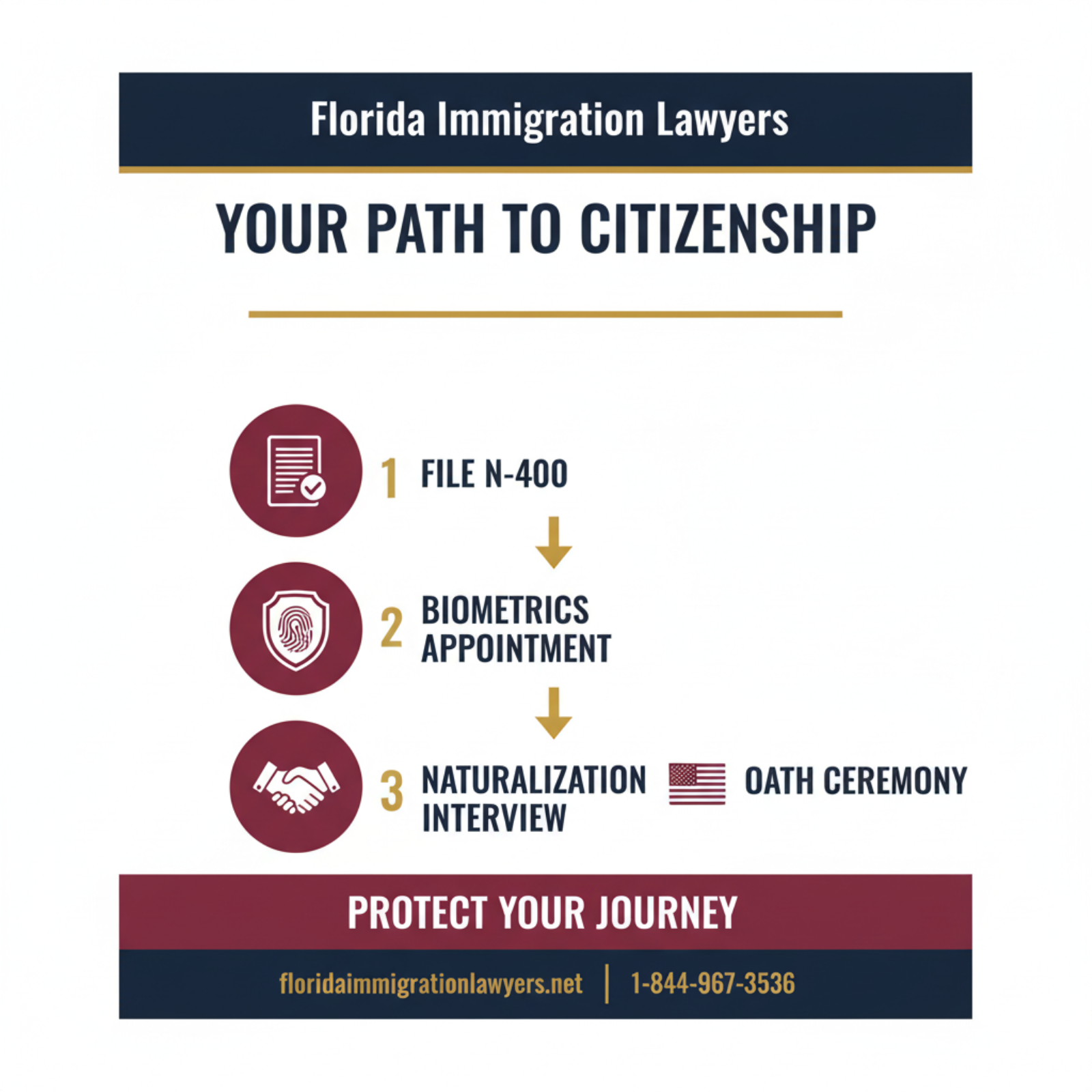
Prepare and File Form N-400: Complete the Application for Naturalization accurately and thoroughly. This form is extensive and requires detailed personal, residential, employment, and criminal history. Any omissions or inaccuracies can lead to delays or denials.
-
Attend Biometrics Appointment: After filing, you will receive a notice for a biometrics appointment at a local Application Support Center (ASC). This involves fingerprinting and a photograph for background checks. Missing this appointment without rescheduling can jeopardize your application.
Step-by-Step Process Guide -
Attend Naturalization Interview: A USCIS officer will interview you to verify the information on your N-400, test your English proficiency (reading, writing, speaking), and assess your knowledge of U.S. history and government (civics test). Be prepared to answer questions about your good moral character and any past issues.
-
Receive Decision on N-400: After your interview, the officer will typically issue a Form N-652, Naturalization Interview Results. This form will indicate if your application is recommended for approval, continued, or denied.
-
Attend the Oath of Allegiance Ceremony: If approved, you will receive Form N-445, Notice of Naturalization Oath Ceremony, inviting you to take the Oath of Allegiance. This is the final step to becoming a U.S. citizen. You will surrender your Green Card at this ceremony.
Throughout this entire process, it is wise to maintain copies of all submitted documents and correspondence with USCIS. For more detailed guidance on the path to citizenship, explore our resources on citizenship.
Essential Documents for Your Naturalization Oath Ceremony
Attending your oath ceremony citizenship is a momentous occasion. To ensure a smooth process and avoid any last-minute issues, it is imperative to bring all required documents. Failing to present these could delay your naturalization or raise unnecessary questions.
Here is a general checklist of documents you should bring to your naturalization oath ceremony:
- Your Form N-445, Notice of Naturalization Oath Ceremony.
- Your Permanent Resident Card (Green Card). This card will be collected by USCIS.
- Any Reentry Permit or Refugee Travel Document issued to you.
- All other immigration documents you may possess, such as I-94 arrival/departure records.
- State-issued identification, such as your Florida driver's license or state ID card.
- Any court orders or legal documents that show a name change, if applicable, and if not already submitted.
- Documentation of any arrests or citations, even if dismissed, that you were instructed to bring by the USCIS officer during your interview.
- If you are changing your name at the ceremony, any required documentation for that process.
Always review your Form N-445 carefully for any additional specific instructions or documents requested by the USCIS office in your area, such as the Miami or Orlando field offices.
Naturalization Timeline and Processing Expectations in Florida
The time it takes to become a U.S. citizen can vary significantly. While the dream of citizenship is clear, the path is not always linear. Understanding the typical naturalization ceremony Florida timeline can help manage expectations.
Average Processing Times
As of early 2026, USCIS processing times for Form N-400 can range from several months to over a year, depending on the specific USCIS field office and the complexity of your case. For instance, offices serving high-volume areas like Miami, Hialeah, and Orlando may have different backlogs compared to smaller offices. You can check current processing times on the USCIS website.
Factors Affecting the Timeline
Several factors can influence how long your naturalization application takes:
- USCIS Field Office Workload: Each office has its own processing pace.
- Application Complexity: Cases with criminal history, extensive travel, or previous immigration issues often take longer.
- Responses to RFEs: Delays in responding to Requests for Evidence (RFEs) can prolong the process.
- Interview Scheduling: The availability of interview slots can impact the timeline.
Patience is key, but proactive monitoring of your case status online and through legal counsel can provide peace of mind. If your case is taking an unusually long time, an attorney can help inquire with USCIS.
Cost Factors and Fees in the Naturalization Process
Pursuing U.S. citizenship involves various costs, and it's important to budget for these expenses. While we cannot provide exact fee amounts as they are subject to change, we can outline the typical cost factors.
USCIS Filing Fees and Biometrics
The primary cost is the filing fee for Form N-400. This fee covers the application processing and includes the biometrics services fee. USCIS offers fee waivers for eligible applicants who demonstrate an inability to pay. It is crucial to check the most current fee schedule on the USCIS website for Form N-400 before filing your application.
Attorney Fees and Other Costs
While not mandatory, retaining a qualified immigration lawyer can be an invaluable investment, especially if you have naturalization ceremony ICE concerns or a complex immigration history. Attorney fees vary based on the complexity of the case and the services provided. Additional costs might include:
- Fees for obtaining certified copies of records (e.g., court dispositions).
- Translation services for foreign documents.
- Travel expenses for appointments.
Do not navigate this process alone. **Contact Florida Immigration Lawyers today** for guidance and support through every step of your naturalization journey.
Common Mistakes to Avoid During Your Naturalization Journey
The path to U.S. citizenship is filled with specific requirements and potential pitfalls. Avoiding common mistakes can significantly improve your chances of a smooth and successful naturalization. Being aware of these errors is particularly important if you have any naturalization ceremony ICE concerns.
-
Failing to Disclose All Information: Omitting details about arrests, citations, or prior immigration issues, even minor ones, can be detrimental. USCIS conducts thorough background checks, and undisclosed information can lead to denials or accusations of misrepresentation, potentially triggering ICE scrutiny.
-
Lying or Misrepresenting Facts: Providing false information on your N-400 or during your interview is a serious offense. This can lead to a denial, a finding of lack of good moral character, and even charges of immigration fraud, making future immigration benefits difficult or impossible to obtain.
-
Ignoring USCIS Requests: Failing to respond to Requests for Evidence (RFEs) or missing appointments (biometrics, interview) without proper rescheduling can result in your application being considered abandoned or denied.
-
Traveling Extensively Abroad: While you are a lawful permanent resident, extensive travel outside the U.S. can disrupt your continuous residency requirement. It is crucial to understand the rules regarding absences and their impact on your eligibility.
-
Not Updating Address Changes: USCIS sends critical notices by mail. If you move and do not update your address with USCIS promptly, you could miss important communications, leading to delays or even denial of your application.
-
Neglecting Good Moral Character Requirements: Engaging in certain behaviors after filing your N-400, such as failure to pay taxes, child support, or committing new criminal offenses, can jeopardize your good moral character finding and lead to denial.
-
Attending the Oath Ceremony with Outstanding Warrants or Orders: If you have an unresolved criminal warrant or a prior, unexecuted deportation order, attending your oath ceremony without first addressing these issues with legal counsel is extremely risky and directly leads to naturalization ceremony ICE concerns.
-
Not Preparing for the English and Civics Test: While seemingly straightforward, many applicants underestimate the need for adequate preparation. Failing these tests can lead to a re-interview and delay your naturalization.
-
Failing to Seek Legal Counsel for Complex Cases: If your case involves any complexities- such as a criminal record, prior immigration violations, or long absences from the U.S.- attempting to navigate the process alone is a significant risk. An attorney can help identify and mitigate potential issues.
When to Call a Florida Immigration Lawyer
While many individuals successfully navigate the naturalization process on their own, certain situations absolutely warrant the expertise of a Florida immigration lawyer. This is especially true if you have naturalization ceremony ICE concerns or any complexities in your background.
You should strongly consider contacting Florida Immigration Lawyers if any of the following apply to your situation:
- You have any past arrests, charges, or convictions, even if they were dismissed or expunged.
- You have ever been placed in deportation or removal proceedings, regardless of the outcome.
- You have received a Request for Evidence (RFE) or a Notice of Intent to Deny (NOID) from USCIS.
- You have concerns about meeting the continuous residency or physical presence requirements due to extensive travel.
- You have doubts about your good moral character due to tax issues, child support arrears, or other legal entanglements.
- You fear potential ICE intervention at your interview or oath ceremony due to an undisclosed issue or a prior immigration violation.
- Your application has been denied, and you wish to appeal or reapply.
- You need assistance with a name change during the naturalization process.
- You simply want peace of mind that your application is thoroughly prepared and correctly filed.
Our experienced attorneys can provide comprehensive immigration legal services, from initial eligibility assessment to representation at interviews and addressing any deportation defense Florida needs. Don't leave your future to chance; let us help protect your rights and guide you to citizenship. Visit our attorneys page to learn more about our team, or contact us directly.
Frequently Asked Questions (FAQ) About ICE and Naturalization
Can ICE deport you if you're a naturalized citizen?
Generally, no. Once you are a naturalized U.S. citizen, you have the same rights and protections as a native-born citizen. You cannot be deported. The only extremely rare circumstance under which a naturalized citizen could face denaturalization and then deportation is if their citizenship was obtained through fraud or misrepresentation, which is a complex legal process initiated by the government.
Do naturalized citizens have to worry about ICE?
Once you have officially taken the Oath of Allegiance and received your Certificate of Naturalization, you are a U.S. citizen. At this point, you do not need to worry about ICE in the same way a non-citizen might. Your rights are protected by the U.S. Constitution.
Did ICE show up at a citizenship ceremony?
Yes, historically there have been isolated reports of ICE officers being present at or near naturalization ceremonies. However, these instances are typically targeted operations focusing on specific individuals who have outstanding immigration warrants or criminal issues that were not resolved before the ceremony. They are not random sweeps of all attendees.
Were immigrants pulled out of line for citizenship?
There have been reports, particularly in previous years, where individuals were reportedly pulled aside or detained at citizenship ceremonies or interviews. These cases usually involved applicants who had undisclosed criminal records, prior deportation orders, or other serious legal issues that came to light late in the process. It underscores the importance of full disclosure and legal review.
What is "good moral character" for naturalization?
Good moral character is a fundamental requirement for naturalization. USCIS defines it broadly, considering factors like your honesty, respect for the law, and adherence to societal norms during the statutory period (usually 3 or 5 years before applying). Certain criminal offenses, lying to immigration officials, or failing to support dependents can indicate a lack of good moral character.
What happens if I miss my oath ceremony?
If you miss your scheduled naturalization oath ceremony, you should contact USCIS immediately to explain the reason for your absence. Depending on the reason, USCIS may reschedule your ceremony. However, repeated absences without good cause could lead to the denial of your naturalization application.
About Florida Immigration Lawyers
Florida Immigration Lawyers is a leading law firm dedicated to providing exceptional immigration legal services across the entire state of Florida. Our experienced attorneys understand the complexities of U.S. immigration law and are committed to helping individuals and families achieve their American dream.
We offer a wide range of services, including family-based immigration, business immigration, deportation defense, asylum claims, and the full naturalization process. Our firm prides itself on its compassionate, client-focused approach, ensuring that every client receives personalized attention and strategic legal representation.
Choose Florida Immigration Lawyers because we are available 24/7 to address your urgent concerns, offer free consultations to discuss your case, and have a proven track record of success. We serve all of Florida, from Hialeah to Jacksonville, and are here to be your trusted legal partners. Contact us today at 1-844-967-3536 or visit our website at https://www.floridaimmigrationlawyers.net.
Sources and References
- U.S. Citizenship and Immigration Services (USCIS)
- USCIS Form N-400, Application for Naturalization
- USCIS Policy Manual
- Executive Office for Immigration Review (EOIR)
- 8 U.S.C. Chapter 12 - Immigration and Nationality Act (INA)
- INA Section 316 (8 U.S.C. § 1427) - Requirements for Naturalization
- 8 CFR Part 316 - General Requirements for Naturalization
This article provides general legal information and is not intended as legal advice. Every case is unique, and outcomes depend on specific facts and circumstances. Contact an attorney for advice about your particular situation.
Protect Your Path to Citizenship. Act Today!
Do not let fear or uncertainty overshadow your dream of becoming a U.S. citizen. If you have any naturalization ceremony ICE concerns, a complex immigration history, or simply want expert guidance through the process, Florida Immigration Lawyers is here to help.
Our dedicated team is ready to provide the knowledgeable and compassionate support you deserve. We serve clients throughout Florida, offering personalized strategies to protect your rights and achieve your immigration goals.
Take the first step towards securing your future. **Call Florida Immigration Lawyers today for a free, confidential consultation at 1-844-967-3536.**
Se Habla Español - Estamos aquí para ayudarle.
Do Not Navigate This Process Alone
Our experienced immigration attorneys are ready to fight for you. Get a free, confidential consultation today.
Se Habla Español
Frequently Asked Questions
Florida Immigration Lawyers
Immigration Attorney | Founder, Vasquez Law Firm
U.S. Air Force veteran and immigration attorney with thousands of cases resolved. J.D., NCCU School of Law. AILA member. Admitted to the 4th, 5th, and 11th Circuit Courts.
Available 24/7 - Free Evaluations
Related Legal Services
Our Florida immigration attorneys can help you with citizenship and naturalization, family immigration services and immigration practice areas. Call today at 1-844-967-3536 for a free consultation.
Related Links
Related Topics
Free Legal Consultation
Discuss your case with our experienced attorneys. We're available 24/7.
Se Habla Español - Estamos aquí para ayudarle.
Related Articles
Expungement Effect on Immigration in Florida | VLF Florida
Discover how expungement impacts immigration in Florida. Learn about eligibility, the process, and potential consequences. Contact Florida Immigration Lawyers at 1-844-967-3536 for a free consultation.
Immigration Services in Kissimmee Florida | VLF Florida
Discover essential immigration services in Kissimmee, Florida. Learn about the resources available for immigrants, including Puerto Rican residents in Osceola County. Contact Florida Immigration Lawyers at 1-844-967-3536 for expert guidance and a free consultation.
Child Status Protection Act (CSPA) Florida: Preventing 'Aging
Understand the Child Status Protection Act (CSPA) in Florida and how it prevents 'aging out' for derivative beneficiaries. Navigate complex immigration laws
I-360 Widow Self-Petition in Florida: A Complete Guide
Learn how to navigate the I-360 widow self-petition process in Florida. This comprehensive guide covers eligibility, documentation, and common mistakes. Call Florida Immigration Lawyers for expert assistance.