Naturalization Ceremony ICE Concerns Florida: Rights & Protection
Understanding potential ICE concerns at your naturalization ceremony in Florida is crucial for a smooth path to U.S. citizenship. While direct ICE interventions are rare and typically targeted, being fully informed about your rights, the naturalization process, and common pitfalls can alleviate anxiety. This guide provides a step-by-step overview, highlights essential documents, discusses timelines, and outlines cost factors. Learn how to avoid mistakes, recognize when to seek legal counsel, and protect your journey to becoming a U.S. citizen. Florida Immigration Lawyers offers expert guidance and free consultations to ensure peace of mind.
Facing potential U.S. Immigration and Customs Enforcement (ICE) concerns at your naturalization ceremony in Florida can be daunting. While ICE presence at these ceremonies is rare and typically targets individuals with outstanding warrants or specific legal issues, understanding your rights and preparing thoroughly is crucial. A naturalization ceremony is generally a celebratory event, but it's vital to ensure no undisclosed issues could lead to an unexpected encounter.
- ICE presence at naturalization ceremonies is uncommon but possible for specific targets.
- Always disclose all relevant information during your naturalization application process.
- Know your rights, including the right to remain silent and to speak with an attorney.
- Consulting an experienced Florida immigration lawyer can provide peace of mind and protection.
- Proper preparation, including all required documents, helps ensure a smooth ceremony.
Introduction: Safeguarding Your Path to Citizenship in Florida
The journey to becoming a U.S. citizen is a profound achievement, marking the culmination of years of effort and dedication. For many, the naturalization ceremony represents the final, joyous step in this significant process. However, for some individuals in Florida, the anticipation of this milestone can be overshadowed by concerns about potential encounters with U.S. Immigration and Customs Enforcement (ICE).
These worries, often fueled by news reports or anecdotal stories, can create unnecessary stress during what should be a celebratory event. Understanding the realities of **naturalization ceremony ICE concerns** is essential for all applicants. This comprehensive guide from Florida Immigration Lawyers aims to clarify these issues, empower you with knowledge, and help you navigate your path to citizenship with confidence and peace of mind. Learn more about the broader immigration process.
We will delve into the legal framework, procedural steps, and common pitfalls to avoid, specifically addressing the unique context of Florida. Our goal is to ensure you are well-prepared for your naturalization ceremony, understanding your rights and how to protect them. If you have specific concerns or require personalized guidance, **call Florida Immigration Lawyers at 1-844-967-3536 for a free consultation.**
Understanding Naturalization and Potential ICE Concerns in Florida
Naturalization is the process by which a lawful permanent resident (green card holder) becomes a U.S. citizen. This process involves meeting specific eligibility requirements, passing a civics and English test, and taking the Oath of Allegiance. It grants individuals full rights and responsibilities as citizens, including the right to vote and hold U.S. passports.
The U.S. Citizenship and Immigration Services (USCIS) oversees the naturalization process. USCIS is distinct from ICE, which is primarily responsible for enforcing immigration laws, including detentions and deportations. While these agencies operate under the Department of Homeland Security, their roles in the naturalization context differ significantly.
The Path to U.S. Citizenship
To qualify for naturalization, applicants must generally meet several criteria. These include being at least 18 years old, holding a Green Card for a specific period (typically 5 years, or 3 years if married to a U.S. citizen), demonstrating continuous residence and physical presence in the U.S., and exhibiting good moral character. They must also have a basic understanding of U.S. history and government and be able to read, write, and speak basic English.
The concept of **good moral character** is particularly crucial. USCIS scrutinizes an applicant's entire history, including any criminal record, false statements to immigration officials, or other acts that might indicate a lack of moral integrity. Even minor infractions, if not properly addressed, can lead to complications or denial. This is where many **naturalization ceremony ICE concerns** originate, as past undisclosed issues can resurface. Our firm specializes in citizenship applications.
Why ICE Might Be Involved at a Naturalization Ceremony
It is important to emphasize that ICE does not typically target individuals attending naturalization ceremonies without cause. The ceremony is a federal event administered by USCIS, not an ICE operation. However, in rare circumstances, ICE may be present if an individual has an outstanding warrant, a final order of removal, or has committed serious, undisclosed immigration fraud or criminal offenses that only come to light late in the process.
Reports of ICE activity at naturalization ceremonies, such as those highlighted in news stories, usually involve specific, targeted individuals. These situations are not random and are often linked to a history of serious legal issues that were either not disclosed or were intentionally misrepresented during the application process. For the vast majority of applicants, the ceremony proceeds without incident.
Understanding the distinction between USCIS and ICE roles is key. USCIS focuses on determining eligibility for benefits, while ICE focuses on enforcement. If a serious issue arises during the naturalization process that suggests an applicant is deportable or inadmissible, USCIS may refer the case to ICE. This is why complete honesty and thorough legal review are paramount.
Navigating the Naturalization Ceremony Process: A Step-by-Step Guide
Preparing for your naturalization ceremony involves more than just showing up. Being well-informed about each stage can alleviate stress, especially regarding any lingering **naturalization ceremony ICE concerns**. Here is a detailed guide to help you through this momentous occasion.
-
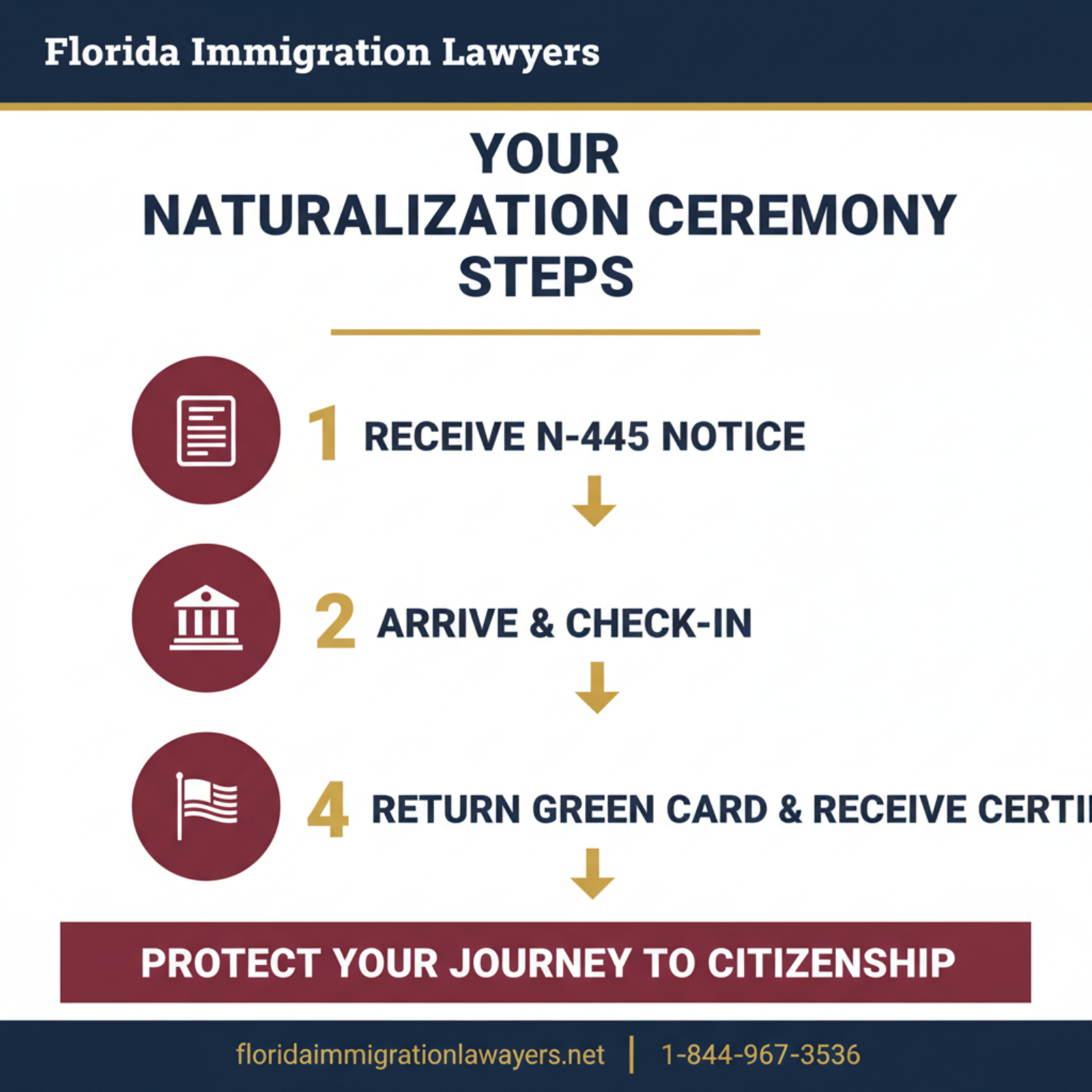
Receive Your Oath Ceremony Notice: After your N-400 interview is approved, USCIS will mail you Form N-445, Notice of Naturalization Oath Ceremony. This document specifies the date, time, and location of your ceremony. Review it carefully for accuracy and important instructions.
This notice often includes a questionnaire on the back that you must answer truthfully. It asks about changes in your eligibility or good moral character since your interview. Completing this accurately is critical to avoid any issues.
-
Review the N-445 Questionnaire Carefully: Before attending, you must answer "Yes" or "No" to several questions on the back of Form N-445. These questions relate to any changes in your marital status, arrests, travel abroad, or other events that could affect your eligibility since your interview.
If you answer "Yes" to any question, or if you have any doubts, it is imperative to consult with an experienced **Florida immigration lawyer** immediately. Failing to disclose new information or providing false answers can lead to serious consequences, including denial of citizenship and potential deportation proceedings.
-
Prepare Required Documents: On the day of your ceremony, you must bring specific documents. These typically include your N-445 notice, your Green Card (Form I-551), and any re-entry permits or travel documents issued by USCIS. Ensure all documents are easily accessible.
Additionally, bring any court documents related to name changes, if applicable, and two passport-style photos if your N-445 instructions require them. Having everything organized will facilitate a smooth check-in process at the ceremony.
-
Arrive Early at the Ceremony Location: Plan to arrive at least 30-60 minutes before the scheduled start time. This allows for security checks, seating, and any last-minute instructions. Ceremony locations in Florida might include federal courthouses or USCIS field offices in cities like West Palm Beach, Miami, Orlando, or Tampa.
Punctuality is important. Late arrivals may be denied entry, requiring you to reschedule your ceremony and potentially prolonging your wait for citizenship.
Step-by-Step Process Guide -
The Ceremony Itself: During the ceremony, you will first check in and surrender your Green Card. You will then take the Oath of Allegiance to the United States. This oath is a solemn promise to support the U.S. Constitution and laws.
After taking the oath, you will receive your Certificate of Naturalization. This document is your official proof of U.S. citizenship. Review it immediately for any errors, such as misspellings of your name or incorrect dates, and report them before leaving the venue.
-
Post-Ceremony Actions: Once you receive your Certificate of Naturalization, you are officially a U.S. citizen. You can then apply for a U.S. passport, register to vote, and update your Social Security records. Keep your Certificate of Naturalization in a safe place, as it is a vital document and difficult to replace.
This is a moment to celebrate your new **citizenship rights**. Remember, while the journey may have had its anxieties, including **naturalization ceremony ICE concerns**, reaching this point signifies a new chapter in your life in Florida and the United States.
Essential Documents for Your Naturalization Ceremony
Proper documentation is paramount for a successful naturalization ceremony. Missing or incorrect documents can lead to delays or, in rare cases, raise red flags that could cause complications. Ensure you have all the following items ready and organized.
- Form N-445, Notice of Naturalization Oath Ceremony: This is your official invitation and includes important instructions and the required questionnaire on the back.
- Your Permanent Resident Card (Green Card): You will be required to surrender this document at the ceremony as you become a U.S. citizen.
- Any Re-entry Permits or Refugee Travel Documents: If you possess these, you must also surrender them.
- Valid State-Issued Identification: A driver's license or state ID card is typically required for identification purposes.
- Two Passport-Style Photographs: Check your N-445 notice carefully; these are sometimes required if you requested a name change or if your photo from the interview is outdated.
- Documents Related to Name Change (if applicable): If you requested a legal name change as part of your naturalization, bring the court order or marriage certificate supporting this change.
- Evidence of Any Changes Since Your Interview: This includes updated arrest records, new travel documents, or divorce decrees. **Full disclosure is always the best policy.**
Bringing copies of your entire naturalization application (Form N-400) and any supporting documents you submitted to USCIS can also be helpful. While not strictly required for the ceremony, having them on hand can assist if any unexpected questions arise.
Naturalization Ceremony Timelines and Processing Expectations in 2026
The timeline for naturalization can vary significantly based on several factors, including the USCIS field office processing your application, the complexity of your case, and current agency workloads. While it's difficult to provide exact figures for every individual, understanding general expectations can help manage your anticipation for the **USCIS naturalization process**.
As of 2026, processing times for naturalization applications (Form N-400) in Florida's major USCIS field offices, such as Miami, Orlando, and Tampa, typically range from several months to over a year after filing. These times include the initial application review, biometrics appointment, interview scheduling, and finally, the oath ceremony scheduling.
After your naturalization interview is approved, the wait for the oath ceremony notice (Form N-445) can also vary. Some applicants receive their notice on the same day as their interview, while others may wait several weeks or even a few months. It's crucial to ensure your mailing address with USCIS is always current to avoid missing important notices.
Monitoring your case status online via the USCIS website is recommended. While timelines can be frustrating, patience is key. Unexpected delays can occur, but they do not necessarily indicate a problem with your application. If you experience unusually long delays or have concerns about your case, contacting a **Florida immigration lawyer** can provide clarity and assistance.
Cost Factors and Fee Breakdown for Naturalization
The financial aspect of the naturalization process is an important consideration for many applicants. While government fees are standardized, other costs can arise. Understanding these potential expenses helps you budget effectively for your journey to **citizenship rights**.
- USCIS Application Fee (Form N-400): This is the primary fee for filing your Application for Naturalization. While the exact amount can change, it typically covers the processing of your application.
- Biometrics Services Fee: This fee covers the cost of your fingerprinting and background checks. In many cases, it is combined with the N-400 filing fee.
- Attorney Fees: Retaining an experienced immigration lawyer, such as those at Florida Immigration Lawyers, is an investment in professional guidance. Legal fees vary based on the complexity of your case and the services required, but they can be invaluable in preventing errors and addressing potential **naturalization ceremony ICE concerns**.
- Translation and Document Preparation Fees: If any of your supporting documents are not in English, you will need certified translations, which incur additional costs.
- Travel Expenses: Factor in costs for travel to your biometrics appointment, interview, and naturalization ceremony, especially if you reside far from a USCIS field office in Florida like those in West Palm Beach, Jacksonville, or Fort Myers.
It is important to note that USCIS offers fee waivers for certain low-income applicants. If you believe you qualify, you can submit Form I-912, Request for Fee Waiver. This can significantly reduce the financial burden of the application process. Consult with an attorney to determine your eligibility for a fee waiver.
Do not navigate this process alone. **Contact Florida Immigration Lawyers today** for expert guidance and support through every step of your naturalization journey. We are here to protect your rights and help you achieve your dream of U.S. citizenship.
Common Mistakes to Avoid During Your Naturalization Process
The naturalization process is complex, and even minor errors can lead to delays, denials, or more serious immigration consequences. Avoiding these common mistakes is crucial for a smooth path to **citizenship rights** and to minimize any **naturalization ceremony ICE concerns**.
-
Failing to Disclose All Arrests or Criminal History: This is one of the most significant pitfalls. Even if charges were dropped, expunged, or occurred years ago, you must disclose every encounter with law enforcement. Failing to do so can be considered misrepresentation and lead to a denial of naturalization and potential deportation defense Florida issues. USCIS has access to extensive databases.
Consequence: Denial of naturalization, accusations of misrepresentation, potential referral to ICE for removal proceedings under 8 U.S.C. § 1227(a)(1)(A).
-
Providing False Information or Lying to USCIS: Any deliberate misrepresentation on your N-400 application or during your interview is a serious offense. This includes false claims to U.S. citizenship or providing incorrect details about your residence or marital status.
Consequence: Permanent bar from naturalization, criminal penalties for fraud, and initiation of removal proceedings under INA § 237(a)(1)(A) and 8 U.S.C. § 1227(a)(1)(A).
-
Not Meeting the Continuous Residence or Physical Presence Requirements: Strict rules govern how long you must live in the U.S. as a Green Card holder and how much time you can spend outside the country. Extended trips abroad can break your continuous residence.
Consequence: Denial of application, requiring you to restart the residency period.
-
Failing to Demonstrate Good Moral Character: USCIS assesses your good moral character for the statutory period (typically 3 or 5 years before filing). Certain criminal offenses, failure to pay taxes, or child support can disqualify you.
Consequence: Denial of naturalization, with a potential waiting period before you can reapply.
-
Missing Deadlines or Ignoring USCIS Notices: USCIS provides specific deadlines for responding to Requests for Evidence (RFEs) or attending appointments. Ignoring these can lead to application denial.
Consequence: Application denial, requiring a new application and fees.
-
Not Updating Your Address with USCIS: If you move, you must notify USCIS within 10 days using Form AR-11. Failure to do so can result in missed notices, including your interview or ceremony notice.
Consequence: Missed appointments, delays, or even denial of your application without your knowledge.
-
Attending the Ceremony with Undisclosed Issues: If new issues arise between your interview and ceremony (e.g., an arrest, extended travel), you must update USCIS. Answering "No" to the N-445 questions when you should answer "Yes" is a form of misrepresentation.
Consequence: Ceremony cancellation, denial of naturalization, potential referral to ICE.
When to Call a Florida Immigration Lawyer
While the naturalization process can be straightforward for many, certain situations warrant the expertise of a seasoned immigration attorney. At Florida Immigration Lawyers, we understand the complexities of immigration law and are dedicated to protecting your rights throughout the **USCIS naturalization process**.
You should strongly consider contacting us if any of the following scenarios apply to you:
- You Have a Criminal Record: Even minor arrests or convictions can impact your good moral character determination. An attorney can assess your record, advise on potential waivers, or help prepare explanations. This is crucial to avoid **naturalization ceremony ICE concerns**.
- You Have Prior Denials or Deportation Orders: If you have a history of immigration application denials or have ever been in removal proceedings, your case is complex and requires specialized legal analysis.
- You Have Spent Significant Time Outside the U.S.: Concerns about continuous residence or physical presence can be intricate. A lawyer can calculate your eligibility and advise on potential breaks in residency.
- You Have Received a Request for Evidence (RFE) or Notice of Intent to Deny (NOID): These notices indicate USCIS has questions or concerns about your application. An attorney can help you formulate a comprehensive and timely response.
- You Have Concerns About Your Interview or Ceremony: If you are anxious about the interview process, or specifically about potential ICE encounters at the ceremony, legal counsel can provide peace of mind and strategic advice.
- You Need Assistance with a Fee Waiver: Determining eligibility for fee waivers (Form I-912) can be complicated. An attorney can help you prepare and submit a strong application.
- You've Been Contacted by ICE or Received a Notice to Appear (NTA): Any direct contact from ICE, especially receiving an NTA, is a serious matter requiring immediate legal intervention. This can significantly jeopardize your naturalization.
Our experienced **Florida immigration lawyer** team is well-versed in the nuances of federal immigration law and local Florida contexts. We serve clients across Florida, including West Palm Beach, Miami, Orlando, and Tampa. We are committed to providing personalized, compassionate, and effective legal representation. You can also contact us directly here.
About Florida Immigration Lawyers
Florida Immigration Lawyers is a leading immigration law firm dedicated to serving individuals and families across the entire state of Florida. We understand that navigating the U.S. immigration system can be overwhelming and often stressful. Our mission is to provide expert legal guidance, compassionate support, and effective representation to help our clients achieve their immigration goals.
Our team of highly skilled attorneys specializes in a wide range of immigration matters, including naturalization and citizenship, deportation defense, family-based immigration, business immigration, asylum, and more. We pride ourselves on our deep knowledge of immigration law, our commitment to client success, and our ability to handle even the most complex cases.
Why choose Florida Immigration Lawyers? We offer personalized attention, clear communication, and a strategic approach to every case. We are available 24/7 to address your urgent concerns and offer **free consultations** to help you understand your options without financial obligation. With a strong track record of success and a client-first philosophy, we are your trusted partner in Florida immigration law.
Let us put our experience to work for you. Contact us today to discuss your immigration needs. Our dedicated team is ready to assist you. Phone: **1-844-967-3536**. Website: https://www.floridaimmigrationlawyers.net.
Sources and References
- U.S. Citizenship and Immigration Services (USCIS) - Naturalization Eligibility Requirements
- U.S. Citizenship and Immigration Services (USCIS) - Form N-400, Application for Naturalization
- Executive Office for Immigration Review (EOIR) - Immigration Court Procedures
- Immigration and Nationality Act (INA) **§ 316** (8 U.S.C. **§ 1427**) - General Requirements for Naturalization
- Immigration and Nationality Act (INA) **§ 237(a)(1)(A)** (8 U.S.C. **§ 1227(a)(1)(A)**) - Grounds for Deportability: Inadmissible at Time of Entry or Adjustment of Status; Violations of Status
- 8 CFR Part 316 - General Requirements for Naturalization
- USCIS Policy Manual, Volume 12 - Citizenship and Naturalization
This article provides general legal information and is not intended as legal advice. Every case is unique, and outcomes depend on specific facts and circumstances. Contact an attorney for advice about your particular situation. Immigration laws are subject to change, and this content reflects the general understanding as of 2026.
Your Journey to Citizenship in Florida: We Are Here to Help
Achieving U.S. citizenship is a monumental milestone, and at Florida Immigration Lawyers, we are honored to support you through every step. While **naturalization ceremony ICE concerns** can be unsettling, with proper preparation and expert legal counsel, you can approach your ceremony with confidence. Our firm is dedicated to safeguarding your rights and ensuring a smooth transition to citizenship.
Do not let uncertainty or fear deter you from realizing your American dream. We offer comprehensive legal services tailored to your individual needs, providing clarity and peace of mind. Our experienced team is ready to answer your questions and provide the guidance you deserve.
Take the crucial step towards securing your future. **Call Florida Immigration Lawyers today at 1-844-967-3536 for a free consultation.** Se Habla Español - Estamos aquí para ayudarle.
Need help with Immigration?
Our Florida immigration attorneys offer free consultations. Call today or schedule online.
Frequently Asked Questions
Florida Immigration Lawyers
Legal Team
Our experienced attorneys at Florida Immigration Lawyers have been serving clients across Florida for over 20 years. We specialize in immigration, personal injury, criminal defense, workers compensation, and family law.