Immigration Court Proceedings Florida: Your Guide to
Facing immigration court proceedings in Florida can be daunting. This comprehensive guide from Florida Immigration Lawyers provides essential information on removal proceedings, the role of an immigration judge, and how to navigate the EOIR system. Learn about the step-by-step process, crucial documents, timelines, and common mistakes to avoid. We cover Fort Lauderdale and other Florida courts, offering insights into what to expect and when to seek legal counsel. Understand the costs involved and discover why expert legal representation is vital for protecting your rights. Schedule a free consultation with our experienced team today.

Immigration court proceedings in Florida involve a legal process managed by the Executive Office for Immigration Review (EOIR) to determine an individual's immigration status. These proceedings, often called removal proceedings, can lead to deportation if not properly defended. Understanding your rights and the court process is crucial for a favorable outcome, especially with the complex legal landscape in Florida.
- Immigration court cases are formal legal proceedings.
- Removal proceedings can result in deportation.
- Legal representation is highly recommended.
- Florida has several immigration courts, including in Miami, Orlando, and Pompano Beach (Krome).
- Checking your immigration court case status regularly is vital.
Receiving a Notice to Appear (NTA) can be a terrifying experience. Suddenly, you find yourself facing the U.S. immigration court system, potentially facing removal from the country you call home. For many individuals and families across Florida, understanding what happens next in immigration court proceedings Florida is critical.
This comprehensive guide from Florida Immigration Lawyers will walk you through the complexities of immigration court. We will cover everything from understanding the initial notice to preparing for your hearings and exploring potential defenses. Our goal is to empower you with the knowledge needed to navigate this challenging process effectively.
Do not face the U.S. immigration court system alone. Call Florida Immigration Lawyers at 1-844-967-3536 for a free consultation today. Our experienced team is here to provide the guidance and support you need.
Understanding Immigration Court Proceedings in Florida
Immigration court proceedings, often referred to as removal proceedings, are administrative legal processes. They determine whether a non-citizen may remain in the United States or will be ordered removed, also known as deported. These proceedings are overseen by an immigration judge within the Executive Office for Immigration Review (EOIR).
Florida is a state with a significant immigrant population, and consequently, it houses several key immigration courts. These include courts in Miami, Orlando, and the Krome Service Processing Center in Pompano Beach. The Fort Lauderdale area often falls under the jurisdiction of the Miami Immigration Court or the Krome Court, depending on the detention location or place of residence.
What Are Removal Proceedings?
Removal proceedings are initiated when the Department of Homeland Security (DHS) believes an individual is deportable under U.S. immigration law. This can happen for various reasons, such as overstaying a visa, violating visa terms, committing certain crimes, or entering the U.S. without inspection. It is important to remember that being placed in removal proceedings does not automatically mean you will be deported; it means your case will be heard by an immigration judge.
Many people ask, "Does removal proceedings mean deportation?" The answer is not necessarily. Removal proceedings are the legal process that *could* lead to deportation, but they also offer opportunities to present defenses and seek forms of relief. Your ability to avoid deportation depends heavily on your specific circumstances and the legal strategies employed.
Key Players in the Immigration Court System
Understanding who is involved in your immigration court case is vital. The main parties are you (the respondent), your immigration attorney, and the Department of Homeland Security (DHS) attorney, who represents the government. The immigration judge presides over the hearings and makes decisions based on the evidence presented and applicable law.
The Executive Office for Immigration Review (EOIR) is an agency within the U.S. Department of Justice. It is responsible for adjudicating immigration cases, including those heard by immigration judges and the Board of Immigration Appeals (BIA). The EOIR sets the rules and procedures for immigration court proceedings.
What's Happening with Immigration in Florida?
Florida's immigration landscape is constantly evolving due to state and federal policy changes, as well as unique demographic shifts. The state often experiences high volumes of immigration court cases, leading to significant backlogs. This means that processing times for cases can be lengthy, requiring patience and consistent legal strategy.
Recent legislative changes and enforcement priorities in Florida have intensified the focus on immigration matters. This makes having knowledgeable legal counsel even more crucial for individuals facing immigration court proceedings Florida. We monitor these changes closely to provide the most current advice.
The Step-by-Step Journey Through Florida's Immigration Courts
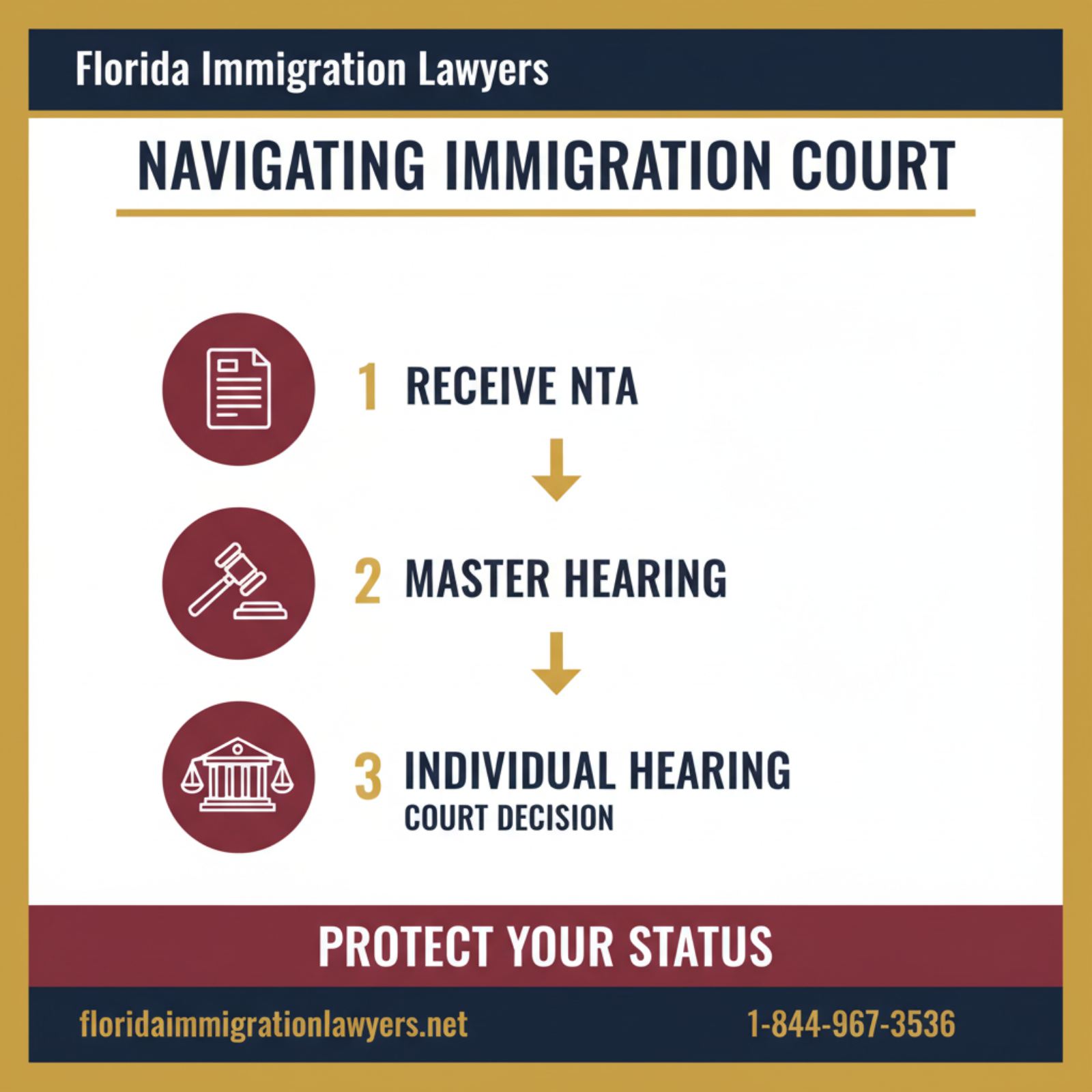
Navigating the immigration court system can feel overwhelming. Here is a general outline of the steps involved in a typical immigration court case in Florida:
-
Notice to Appear (NTA): Your journey begins when you receive a Notice to Appear from DHS. This document formally charges you with being removable from the U.S. and instructs you to appear before an immigration judge at a specified date and time. It outlines the factual allegations and the legal grounds for your removability.
-
Master Calendar Hearing (MCH): This is usually your first appearance before an immigration judge. During the MCH, the judge will confirm your identity, ensure you understand the charges, and ask you to admit or deny the factual allegations and grounds of removability. You will also be asked to state what form of relief from removal, if any, you intend to pursue. Many individuals seek legal counsel before or at this stage.
-
Filing Applications for Relief: If you are eligible for a form of relief from removal, such as asylum, adjustment of status, cancellation of removal, or a waiver, your attorney will help you prepare and file the necessary applications and supporting documents. There are often strict deadlines for these filings, so timely action is crucial.
-
Individual Hearing (Merits Hearing): This is the main hearing where you and your attorney present your case for relief from removal. You will testify, present evidence, and call witnesses. The DHS attorney will also present their case, cross-examine you and your witnesses, and may present their own evidence. This hearing is similar to a trial.
-
Immigration Judge's Decision: After considering all the evidence and testimony, the immigration judge will issue a decision. The judge may grant your application for relief, terminate your removal proceedings, or order you removed/deported from the U.S. The decision is typically given orally at the end of the individual hearing or mailed at a later date.
-
Appeals Process: If either you or the DHS attorney disagrees with the immigration judge's decision, you generally have the right to appeal to the Board of Immigration Appeals (BIA). The BIA reviews the judge's decision for legal errors. Further appeals can sometimes be made to a U.S. Circuit Court of Appeals.
Essential Documents for Your Immigration Court Case
Preparing a thorough set of documents is paramount for any immigration court case. The specific documents you need will depend on the type of relief you are seeking and the details of your case. However, some general categories of documents are almost always required or highly beneficial.
- Notice to Appear (NTA): This is the foundational document of your case. Keep all copies.
- Proof of Identity and Nationality: Passport, birth certificate, national ID card.
- Proof of Entry/Status: I-94 arrival/departure record, visa, previous immigration documents.
- Applications for Relief: Completed forms such as I-589 (Asylum), I-485 (Adjustment of Status), EOIR-42B (Cancellation of Removal for Non-LPRs), EOIR-42A (Cancellation of Removal for LPRs).
- Supporting Evidence for Applications: This can include affidavits from family/friends, medical records, police reports, country conditions reports (for asylum), financial records, tax returns, marriage certificates, birth certificates of dependents, and proof of residence.
- Criminal Records: If you have any arrests or convictions, certified court dispositions are essential.
- Proof of Family Ties: Marriage certificates, birth certificates of U.S. citizen or LPR relatives.
- Evidence of Good Moral Character: Letters of support, community involvement, employment history.
- Address History: A detailed list of all addresses where you have lived.
- Court Orders/Decisions: Any previous immigration court decisions or orders related to your case.
Organizing these documents can be a daunting task. Your attorney from Florida Immigration Lawyers can help you identify, gather, and present all necessary evidence effectively. We ensure your documentation supports your defense in the strongest possible way.
Navigating Timelines and Processing Expectations in Florida Immigration Courts
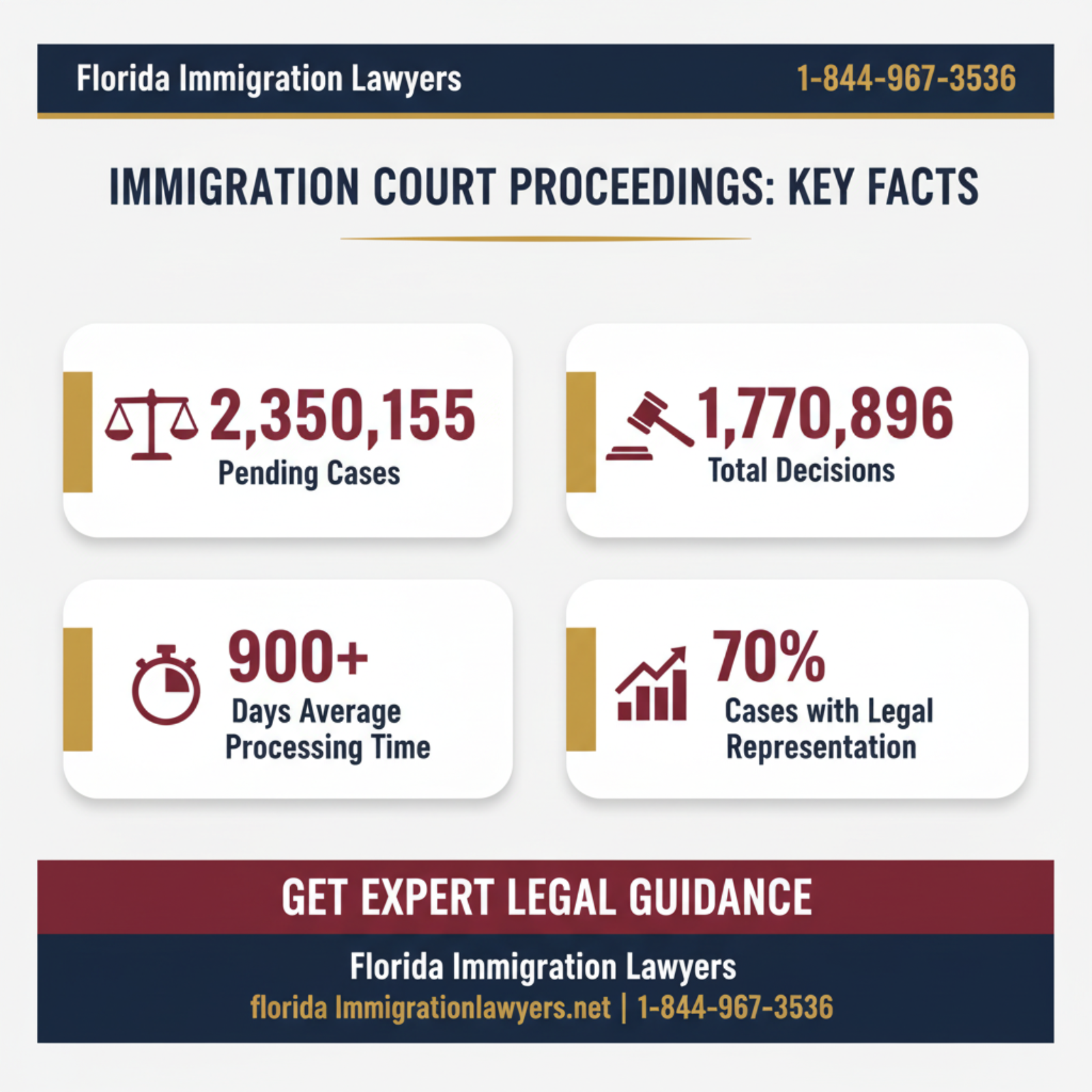
The processing times for immigration court proceedings Florida can vary significantly. Factors such as the specific court, the complexity of your case, the type of relief sought, and the current caseload of the immigration judges all play a role. Understanding these timelines helps manage expectations.
Typical Case Durations
A typical immigration court case, from the initial Master Calendar Hearing to a final decision by an immigration judge, can take anywhere from a few months to several years. Cases involving detention are often expedited. Non-detained cases, particularly those in busy courts like Miami or Orlando, frequently face longer waits. Appeals to the BIA can add another year or more to the process.
The EOIR provides an online system where you can check your immigration court case status. This tool allows you to track the progress of your case using your A-Number. It's a useful resource, but an attorney can provide more detailed insights into potential delays and next steps.
Factors Affecting Processing Speed
- Court Backlogs: Immigration courts nationwide, including those in Florida, often experience significant backlogs. This is a primary reason for lengthy processing times.
- Judge's Caseload: Each immigration judge manages a substantial number of cases, which directly impacts scheduling and decision-making speed.
- Case Complexity: Cases involving multiple forms of relief, complex factual disputes, or extensive evidence often require more court time.
- Availability of Evidence/Witnesses: Delays can occur if crucial evidence is difficult to obtain or if witnesses are unavailable.
- Motions and Continuances: Attorneys may file motions or request continuances for various reasons, which can extend the overall timeline.
We understand that waiting can be incredibly stressful. Florida Immigration Lawyers will keep you informed about your case's progress and any potential delays. We work diligently to move your case forward as efficiently as possible.
Understanding Costs and Fees in Immigration Court Cases
The financial aspect of navigating immigration court proceedings Florida is an important consideration. Costs generally fall into two main categories: legal fees for attorney services and filing fees for immigration applications.
Legal Fees
Attorney fees for immigration court cases vary widely depending on the complexity of the case, the experience of the attorney, and the extent of representation required. Some firms charge hourly rates, while others offer flat fees for specific stages of the process or for the entire case. A comprehensive defense often involves significant legal work, from preparing applications and evidence to representing you in multiple hearings.
At Florida Immigration Lawyers, we believe in transparent fee structures. During your free consultation, we can discuss the potential costs associated with your specific case. We aim to provide high-quality legal services that are accessible to our clients.
Filing Fees
U.S. Citizenship and Immigration Services (USCIS) and the Executive Office for Immigration Review (EOIR) charge fees for various immigration applications and motions. These fees are subject to change, so it is crucial to check the most current fee schedule on the USCIS website or consult with your attorney. Some common applications filed in immigration court that require fees include applications for adjustment of status or waivers.
It is important to note that certain individuals may be eligible for fee waivers based on their income or receipt of public benefits. Your attorney can help determine if you qualify for a fee waiver and assist with the application process.
Do not navigate this process alone. Contact Florida Immigration Lawyers today. We are ready to stand by your side and fight for your future.
Common Mistakes to Avoid in Immigration Court
Making mistakes in immigration court can have severe and lasting consequences, potentially leading to an order of removal. Being aware of these common pitfalls can help you avoid them:
-
Missing Court Hearings: Failing to appear for any scheduled Master Calendar or Individual Hearing is one of the most serious mistakes. An immigration judge can issue an in absentia order of removal (deportation) against you if you miss a hearing without valid reason. This order is extremely difficult to reverse.
-
Not Updating Your Address: If you move, you are legally required to inform the immigration court and USCIS of your new address within five days. Failure to do so can result in missed notices, missed hearings, and potentially an in absentia removal order. Many people ask, "How to look up immigration court hearings?" - if your address is not updated, you might not receive the notice to check.
-
Failing to File Applications for Relief on Time: There are strict deadlines for filing applications for relief from removal (e.g., asylum, cancellation of removal). Missing these deadlines without a compelling legal reason can result in the forfeiture of your right to apply, severely limiting your defense options.
-
Speaking Without an Attorney: Representing yourself in immigration court is highly risky. The legal landscape is complex, and the DHS attorney is experienced. Without counsel, you may inadvertently make statements that harm your case or fail to present crucial evidence effectively. You have the right to an attorney, but one is not provided for you.
-
Providing False Information: Lying or submitting fraudulent documents to an immigration judge or USCIS is a severe offense. It can lead to permanent bars from future immigration benefits and criminal charges. Always be truthful and provide accurate information.
-
Ignoring Legal Advice: If you have an attorney, it is essential to follow their guidance. They are familiar with immigration law and court procedures. Disregarding their advice can jeopardize your case outcomes.
-
Not Gathering Sufficient Evidence: A strong defense requires compelling evidence to support your claims for relief. Failing to collect all necessary documents, witness statements, or expert reports can weaken your case significantly. The burden of proof is often on you.
-
Assuming ICE Cannot Deport You Before Your Court Date: This is a dangerous misconception. If you are detained by ICE, they may attempt to deport you before your scheduled court date, especially if they believe you do not have a valid claim for relief or if you waive your right to a hearing. It is crucial to assert your right to see an immigration judge and to speak with an attorney immediately if detained.
-
Not Understanding the Charges: The NTA outlines the charges against you. If you do not fully understand why the government believes you are removable, you cannot effectively defend yourself. Always seek clarification from your attorney.
-
Failing to Disclose Criminal History: Even minor arrests or convictions, including those that were expunged or occurred many years ago, must be disclosed. Failure to do so can be considered misrepresentation and lead to negative consequences.
When to Call Florida Immigration Lawyers
While this guide provides general information, every immigration court case is unique and complex. Knowing when to seek professional legal assistance is crucial for protecting your rights and securing your future. Florida Immigration Lawyers are here to help in a variety of scenarios.
Specific Scenarios Requiring Legal Help:
- You have received a Notice to Appear (NTA): This is the most immediate sign you need legal counsel. An attorney can help you understand the charges and prepare your initial response.
- You are detained by ICE: If you or a loved one is in immigration detention, legal intervention is critical. An attorney can work to secure a bond hearing or explore other avenues for release.
- You are seeking asylum or other forms of relief: Applications for asylum, withholding of removal, or protection under the Convention Against Torture are highly complex. An experienced attorney can help gather evidence and present your case effectively.
- You have a criminal history: Certain criminal convictions can make you deportable or inadmissible. An attorney can assess the immigration consequences of your criminal record and explore potential waivers or defenses.
- You believe you are eligible for cancellation of removal: This is a challenging form of relief that requires proving exceptional and extremely unusual hardship to qualifying relatives. A lawyer can help build a strong case.
- You need to appeal a decision: If an immigration judge has issued an unfavorable decision, an attorney can help you file an appeal to the Board of Immigration Appeals (BIA) or beyond.
- You do not speak English fluently: Language barriers can be a significant impediment in court. Our bilingual team ensures clear communication throughout your case.
Florida Immigration Lawyers specialize in deportation defense and all aspects of immigration court proceedings Florida. We are dedicated to providing compassionate, effective, and strategic legal representation to individuals and families throughout the state. Our attorneys are intimately familiar with the procedures and expectations of the Fort Lauderdale, Miami, and Orlando immigration courts.
We understand the anxiety and uncertainty that come with facing removal proceedings. Our firm is committed to fighting for your right to remain in the U.S. and achieve your immigration goals. From your first consultation to the final decision, we are your steadfast advocates.
About Florida Immigration Lawyers
Florida Immigration Lawyers is a leading law firm dedicated to providing comprehensive and effective immigration legal services across the entire state of Florida. With a deep understanding of U.S. immigration law and a commitment to our clients, we strive to achieve the best possible outcomes for individuals and families navigating the complex immigration system.
Our firm handles a wide range of immigration matters, including general immigration, asylum cases, deportation defense, citizenship applications, family-based petitions, and business immigration solutions. We pride ourselves on offering personalized attention and strategic legal advice tailored to each client's unique situation.
Why choose Florida Immigration Lawyers? Our experienced attorneys are passionate about immigration law and are relentless in their pursuit of justice for our clients. We offer free consultations to discuss your case and are available 24/7 to address your urgent needs. Our team is bilingual, providing services in both English and Spanish to ensure effective communication and understanding.
If you are facing an immigration challenge in Fort Lauderdale, Miami, Orlando, or anywhere else in Florida, trust our firm to be your dedicated legal partner. Visit our website at https://www.floridaimmigrationlawyers.net or call us at 1-844-967-3536 to schedule your free consultation today.
Sources and References
- U.S. Citizenship and Immigration Services (USCIS)
- Executive Office for Immigration Review (EOIR)
- 8 U.S.C. Chapter 12 - Immigration and Nationality Act (INA)
- INA § 240, 8 U.S.C. § 1229a - Removal Proceedings Generally
- 8 CFR Part 1003 - Executive Office for Immigration Review
- U.S. Department of State - Bureau of Consular Affairs
This article provides general legal information and is not intended as legal advice. Every case is unique, and outcomes depend on specific facts and circumstances. Contact an attorney for advice about your particular situation.
Your future in the United States is too important to leave to chance. Take the first step towards securing your legal status and peace of mind.
Contact Florida Immigration Lawyers for a free, confidential consultation. Call us today at 1-844-967-3536. Se Habla Español - Estamos aquí para ayudarle.
Do Not Navigate This Process Alone
Our experienced immigration attorneys are ready to fight for you. Get a free, confidential consultation today.
Se Habla Español
Frequently Asked Questions
Florida Immigration Lawyers
Immigration Attorney | Founder, Vasquez Law Firm
U.S. Air Force veteran and immigration attorney with thousands of cases resolved. J.D., NCCU School of Law. AILA member. Admitted to the 4th, 5th, and 11th Circuit Courts.
Available 24/7 - Free Evaluations
Related Legal Services
Our Florida immigration attorneys can help you with free immigration consultation, experienced immigration attorneys and business immigration. Call today at 1-844-967-3536 for a free consultation.
Related Links
Related Topics
Free Legal Consultation
Discuss your case with our experienced attorneys. We're available 24/7.
Se Habla Español - Estamos aquí para ayudarle.
Related Articles
Immigration Rights in Florida: Know Your Legal Protections
Navigating immigration law in Florida can be complex, especially when facing potential encounters with Immigration and Customs Enforcement (ICE). This comprehensive guide empowers you with essential immigration rights, detailing your legal protections and what to do if you or a loved one are stopped or detained. Learn how to protect yourself, avoid critical mistakes, and understand the crucial role of legal counsel in safeguarding your future in Florida. From Homestead to Miami, knowing your rights is your first line of defense against deportation and legal challenges. Contact Florida Immigration Lawyers for a free consultation.
Unlawful Presence Waiver in Florida: A Guide | VLF Florida
Discover how the unlawful presence waiver can help immigrants in Florida. Learn about eligibility, application steps, and common mistakes to avoid. Contact Florida Immigration Lawyers for a free consultation.
Citizenship Test Preparation Florida: Your Guide to
Preparing for the U.S. citizenship test in Florida is a critical step towards naturalization. This comprehensive guide from Florida Immigration Lawyers covers understanding the English and civics tests, a step-by-step application process, essential documents, and effective preparation strategies. Learn about common mistakes to avoid and when to seek legal counsel for complex cases. Our experienced attorneys serve clients across Florida, including Gainesville, providing personalized support to help you achieve your dream of becoming a U.S. citizen. Contact us for a free consultation and navigate your naturalization journey with confidence and expert guidance.
Immigration Lawyer Sarasota Bradenton Florida | VLF Florida
Discover how an immigration lawyer in Sarasota and Bradenton, Florida, can help you navigate complex immigration processes. Contact Florida Immigration Lawyers for expert guidance.