Immigration Court Proceedings Florida: Your 2026 Guide
Understanding <strong>immigration court proceedings Florida</strong> is essential for anyone facing removal or seeking to legalize their status. This 2026 guide from Florida Immigration Lawyers details the complex process, from receiving a Notice to Appear (NTA) to navigating Master Calendar and Individual Hearings before an <strong>immigration judge Florida</strong>. We cover essential documents, timelines, and costs, emphasizing the critical importance of legal representation. Learn about <strong>removal proceedings Florida</strong>, common mistakes to avoid, and when to seek professional help. Our expert team provides dedicated <strong>deportation defense Florida</strong> services, offering free consultations to help you protect your future in the U.S.

Navigating immigration court proceedings Florida involves a structured legal process overseen by an immigration judge Florida within the Executive Office for Immigration Review (EOIR). These proceedings, often referred to as removal proceedings Florida, determine an individual's right to remain in the U.S. or face deportation. Understanding your rights and responsibilities is crucial.
- Immigration courts in Florida are part of the federal EOIR system.
- Proceedings typically begin with a Notice to Appear (NTA).
- You can seek various forms of relief from removal, such as asylum.
- An immigration judge Florida makes final decisions.
- Legal representation is highly recommended for these complex cases.
Facing immigration court can be an incredibly daunting experience. The stakes are high, impacting your future and potentially your family's life in the United States. Many individuals in St. Petersburg, Orlando, Miami, and across Florida find themselves overwhelmed when confronted with a Notice to Appear (NTA) in court.
This comprehensive guide for 2026 aims to demystify immigration court proceedings Florida. We will walk you through the process, explain key terminology like removal proceedings Florida, and highlight the critical role of an immigration judge Florida. Understanding these steps is your first line of defense.
Do not navigate this complex legal landscape alone. For personalized guidance and robust representation, call Florida Immigration Lawyers at 1-844-967-3536 for a free consultation. Our experienced team is ready to assist you.
Understanding Immigration Court Proceedings in Florida
Immigration courts operate under the Executive Office for Immigration Review (EOIR), an agency within the U.S. Department of Justice. These courts are distinct from federal or state criminal and civil courts. Their primary function is to conduct administrative hearings to determine whether noncitizens, including lawful permanent residents, asylum seekers, and undocumented individuals, should be removed from the United States.
In Florida, there are two primary EOIR immigration courts: one in Miami and another in Orlando. While St. Petersburg does not have its own immigration court, residents in St. Petersburg and the surrounding Tampa Bay area typically attend hearings at the Orlando Immigration Court or occasionally in Miami, depending on their jurisdiction and the specifics of their case. The location of your hearing is usually specified on your Notice to Appear.
The role of an immigration judge Florida is central to these proceedings. An immigration judge (IJ) is an administrative judge who presides over removal proceedings, hears testimony, reviews evidence, and issues decisions. They apply immigration law, including the Immigration and Nationality Act (INA), to the facts presented in each case. Their decisions are legally binding, subject to appeal.
Removal proceedings Florida are the formal legal process initiated by the Department of Homeland Security (DHS) to deport a noncitizen from the U.S. These proceedings begin when DHS issues a Notice to Appear (NTA), which alleges that a noncitizen is removable under immigration law. The NTA is a foundational document, outlining the specific charges against you and notifying you of your scheduled hearing before an immigration judge Florida.
Reasons for initiating removal proceedings Florida can vary widely. Common grounds include overstaying a visa, entering the U.S. without inspection, committing certain crimes, or violating terms of admission. Even lawful permanent residents can face removal for specific criminal convictions or other immigration violations. Understanding the charges in your NTA is the first critical step in preparing your defense.
Navigating the Immigration Court Process in Florida
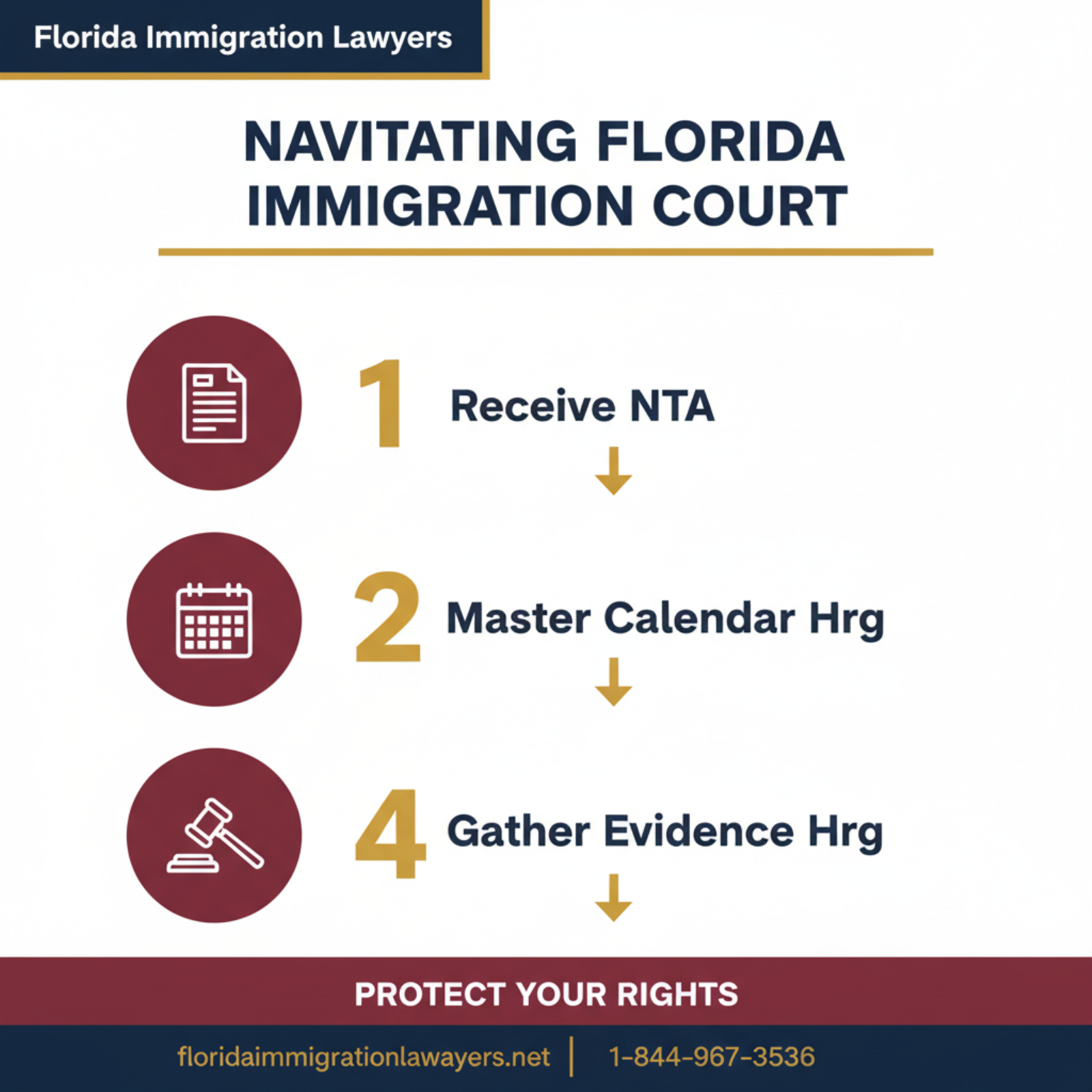
The journey through immigration court proceedings Florida can be complex and lengthy. It involves several stages, each with specific requirements and potential challenges. Here is a step-by-step guide to help you understand what to expect.
Initial Steps: Notice to Appear (NTA)
-
Receipt of Notice to Appear (NTA): Your journey in immigration court proceedings Florida begins when you receive a Notice to Appear (Form I-862) from the Department of Homeland Security (DHS). This document formally initiates removal proceedings Florida against you. It specifies the factual allegations and legal charges that make you subject to removal from the United States. Ensure you keep this document safe and review it carefully.
-
Understanding the Charges: The NTA will state why DHS believes you are deportable. This could be due to visa overstay, unlawful entry, certain criminal convictions, or other violations of immigration law. It is crucial to understand these charges, as they form the basis of the government's case against you. Consult with an attorney to clarify any ambiguities in the NTA.
Master Calendar Hearings: Your First Appearance
-
Attending Your First Master Calendar Hearing (MCH): This is your initial appearance before an immigration judge Florida. Master Calendar Hearings are typically brief and procedural. During an MCH, the judge will confirm your identity, ensure you received the NTA, and ask if you understand the charges against you. You will also be asked to admit or deny the factual allegations and concede or contest the legal charges.
-
Pleading to the Charges and Designating Country of Removal: You will formally respond to the charges listed in your NTA. If you admit the charges, the judge may then ask if you wish to apply for any forms of relief from removal. If you deny the charges, the judge may schedule an Individual Hearing to hear evidence. You will also be asked to designate a country to which you would prefer to be removed if ordered deported.
-
Requesting Relief from Removal: If you are eligible for a form of relief from deportation, such as asylum, cancellation of removal, adjustment of status, or a waiver, you must inform the judge of your intention to apply. The judge will set deadlines for filing applications and supporting documents. This is a critical juncture where legal counsel is invaluable to identify all potential avenues for relief. Learn more about asylum claims.
Individual Hearings: Presenting Your Case
-
Preparation for the Individual Hearing: The Individual Hearing, also known as a merits hearing, is where you present your case and evidence to the immigration judge Florida. This involves submitting applications for relief, gathering supporting documents, preparing witnesses, and practicing your testimony. DHS will also present its evidence and arguments. Thorough preparation is key to a successful outcome.
-
Presenting Evidence and Testimony: During the Individual Hearing, you and your attorney will present your case. This includes offering your testimony, calling witnesses, and submitting documentary evidence. DHS counsel will have the opportunity to cross-examine you and your witnesses. The judge will consider all evidence presented by both parties.
-
Judge's Decision: After hearing all testimony and reviewing all evidence, the immigration judge Florida will issue a decision. This decision may be delivered orally at the end of the hearing or in writing at a later date. The judge will either grant your application for relief, terminate the removal proceedings Florida, or order your removal from the United States. If ordered removed, the judge will also designate the country of removal.
Appeals Process
-
Appealing the Decision: If you or DHS disagree with the immigration judge's decision, you have the right to appeal to the Board of Immigration Appeals (BIA). The BIA is the highest administrative body for interpreting and applying immigration laws. An appeal must be filed within 30 days of the IJ's decision. If the BIA affirms the IJ's decision, further appeal may be possible in a federal circuit court of appeals.
Essential Documents for Your Immigration Court Case
Preparing for immigration court proceedings Florida requires meticulous organization of documents. The specific documents needed will depend on the nature of your case and the type of relief you are seeking. However, a general checklist includes the following:
- Your original Notice to Appear (NTA), Form I-862.
- Any other immigration-related notices or correspondence from USCIS, ICE, or EOIR.
- Proof of identity, such as your passport, birth certificate, or national identity document.
- Proof of your entry into the U.S., including visas, I-94 records, or entry stamps.
- Marriage certificates, birth certificates of dependents, and other family relationship documents.
- Evidence of U.S. citizen or lawful permanent resident relatives (e.g., birth certificates, naturalization certificates, green cards).
- Financial documents, such as tax returns, pay stubs, and bank statements, especially for hardship claims or fee waivers.
- Educational records, diplomas, and transcripts.
- Employment history records, including letters from employers.
- Medical records, if applicable to your claim (e.g., for asylum or humanitarian parole).
- Police clearance certificates from all places you have resided, both in the U.S. and abroad.
- Any criminal court records, including arrest reports, charging documents, and disposition records, even for minor offenses.
- Affidavits or letters of support from family, friends, or community members attesting to your good moral character, hardship, or other relevant facts.
- Photos, videos, or other visual evidence supporting your claim.
- Any specific applications for relief (e.g., Form I-589 for Asylum, Form EOIR-42B for Cancellation of Removal).
- Receipts for any fees paid to USCIS or EOIR.
Immigration Court Timelines and Expectations in Florida
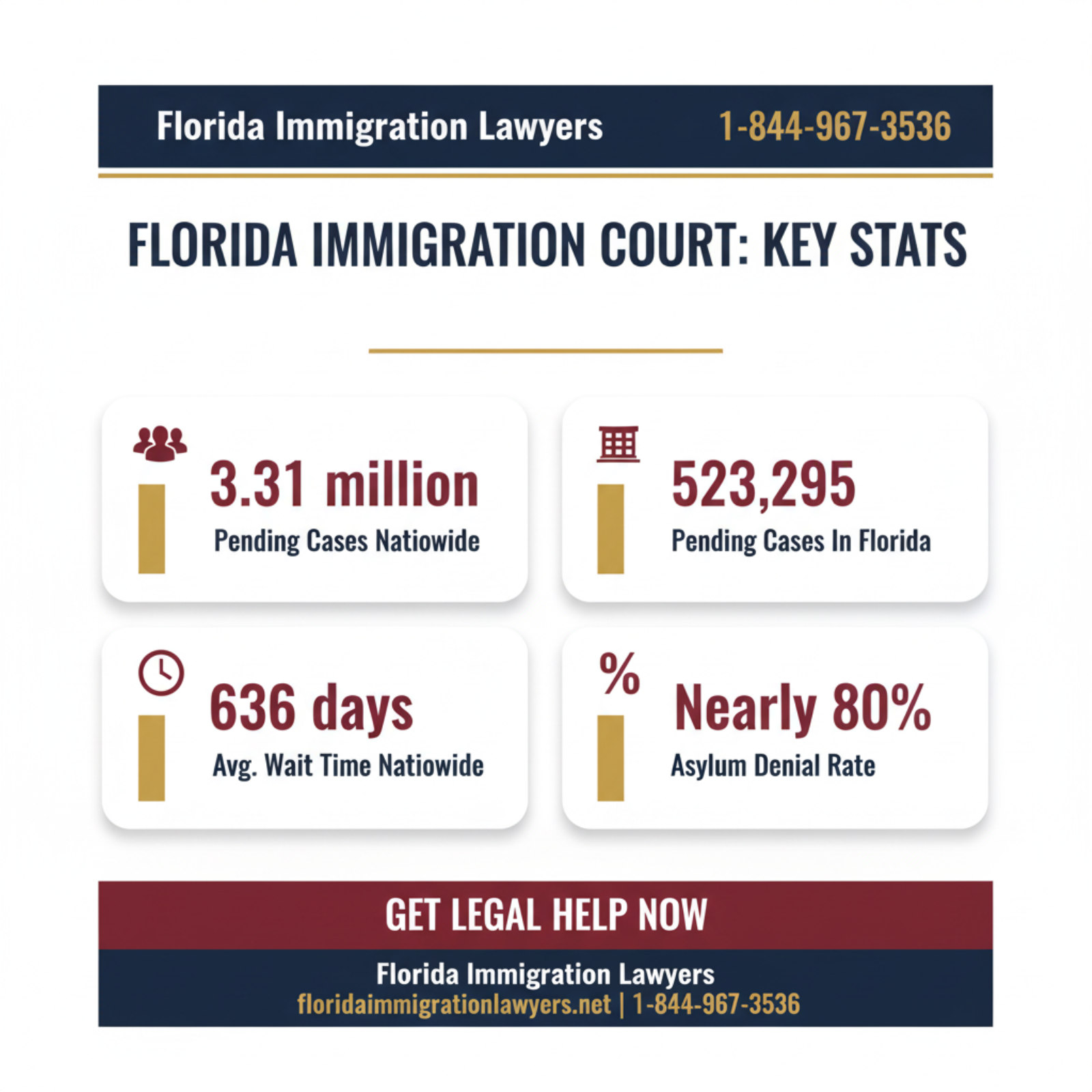
The pace of immigration court proceedings Florida can be incredibly frustrating. Due to significant backlogs, cases often take years to resolve. The Executive Office for Immigration Review (EOIR) reports a substantial number of pending cases nationwide, and Florida's courts are no exception. As of early 2026, the average wait time for a final decision in some jurisdictions can exceed several years after the initial NTA is issued. You can check the status of your immigration court case status online.
Several factors influence the timeline of your case. These include the complexity of your legal arguments, the type of relief sought, the availability of an immigration judge Florida, and the caseload of the specific court. For example, cases involving complex asylum claims with extensive documentation or criminal history often take longer than straightforward administrative closures. The availability of interpreters can also affect scheduling. For official statistics and backlog information, refer to the EOIR website.
While awaiting your court dates, it is crucial to remain vigilant. Continue to gather evidence, keep your contact information updated with the court, and promptly respond to any notices. Missing a court date can have severe consequences, including an order of removal in absentia. Your attorney will help you manage these expectations and prepare for potential delays. The process for immigration court proceedings Florida requires patience and persistence.
Understanding Costs in Florida Immigration Court Proceedings
Engaging in immigration court proceedings Florida involves various financial considerations. These costs can include government filing fees, legal representation fees, and other miscellaneous expenses. It is important to budget for these to avoid unexpected burdens during your case.
Government filing fees are required for certain applications for relief. For example, applying for adjustment of status or specific waivers typically incurs a fee. However, many applications, such as asylum (Form I-589), do not require a filing fee. It is important to note that these fees are subject to change by USCIS and EOIR. Your attorney can provide the most current information on required fees for your specific applications. Generally, you will pay fees directly to the government agency.
Legal representation fees constitute a significant portion of the overall cost. Hiring an experienced immigration attorney for your removal proceedings Florida is an investment in your future. Attorneys typically charge based on the complexity of the case, the anticipated time commitment, and their level of expertise. Some firms offer flat fees for specific services, while others bill hourly. Florida Immigration Lawyers offers free consultations to discuss your case and potential fee structures without obligation.
Other potential expenses include translation services for documents, expert witness fees, travel costs to court hearings, and fees for obtaining necessary records such as police reports or medical evaluations. While some of these costs may be unavoidable, an attorney can help you identify cost-saving measures and ensure you are only paying for what is necessary. Remember, the goal is to successfully navigate your immigration court proceedings Florida.
Do not navigate this process alone. The complexities of immigration court proceedings Florida demand professional insight. Contact Florida Immigration Lawyers today for a confidential discussion about your case and to learn how we can protect your rights. Our team is dedicated to providing comprehensive deportation defense services.
Common Mistakes to Avoid in Florida Immigration Court
Navigating immigration court proceedings Florida is fraught with potential pitfalls. Avoiding common mistakes can significantly improve your chances of a favorable outcome. Be aware of these critical errors:
-
Missing a Court Date: Failing to appear for any scheduled Master Calendar or Individual Hearing is perhaps the most serious mistake. If you miss a court date, the immigration judge Florida will likely issue an order of removal in absentia, meaning you are ordered deported without your presence. Reopening such an order is extremely difficult and requires demonstrating exceptional circumstances beyond your control. Always confirm your immigration court case status.
-
Failing to Update Your Address: If you move, you must notify the immigration court and DHS (ICE) within five days using Form EOIR-33/IC. Failure to do so means you might not receive crucial court notices, leading to missed hearings and potential removal orders. This is a common administrative error with severe consequences.
-
Lying or Misrepresenting Facts: Providing false information or misrepresenting facts to the court or to an immigration officer can lead to severe penalties. These include findings of fraud, permanent bars to immigration benefits, and even criminal charges. Honesty and integrity are paramount throughout your immigration court proceedings Florida.
-
Not Filing Applications for Relief on Time: Immigration judges set strict deadlines for filing applications for relief, such as asylum or cancellation of removal. Missing these deadlines can result in the forfeiture of your opportunity to seek that particular form of relief, severely limiting your options to avoid deportation. An attorney ensures all deadlines are met.
-
Not Gathering Sufficient Evidence: A strong case relies on compelling evidence. Many individuals fail to provide adequate documentation, witness testimony, or expert reports to support their claims for relief. Insufficient evidence can weaken your case significantly, making it harder for the immigration judge Florida to rule in your favor.
-
Ignoring Criminal History: Even minor arrests or convictions can impact your immigration case. Failing to disclose or downplay criminal history can undermine your credibility and lead to unexpected complications. Always provide your attorney with a complete and accurate criminal record, regardless of how minor you perceive the offense.
-
Representing Yourself Without Legal Counsel: While you have the right to represent yourself, immigration court proceedings Florida are incredibly complex. The law, rules of evidence, and court procedures are intricate. Individuals representing themselves often miss critical legal arguments, fail to present evidence correctly, or are unaware of available forms of relief. This can lead to an unfavorable outcome, making professional legal help essential for deportation defense Florida.
Frequently Asked Questions (FAQs) About Florida Immigration Court
Understanding the common concerns surrounding immigration court proceedings Florida is vital. Here, we address some of the most frequently asked questions:
How to look up immigration court hearings?
You can check your immigration court case status by calling the Executive Office for Immigration Review (EOIR) automated information hotline at 1-800-898-7180. You will need your A-number (alien registration number). You can also use the EOIR online portal, which provides access to hearing information for individuals with scheduled court dates. This system can help you find your next immigration court hearing date, time, and location.
Does removal proceedings mean deportation?
Not necessarily. Removal proceedings Florida are the legal process to determine if someone should be deported. While the goal of DHS is to secure an order of removal, individuals in proceedings have the opportunity to apply for various forms of relief. If a form of relief is granted by an immigration judge Florida, the removal order can be cancelled or the proceedings terminated, allowing the individual to remain in the U.S. successfully. Therefore, removal proceedings are the *initiation* of a process that *may* lead to deportation, but it is not an automatic outcome.
What is Florida's new immigration law?
Florida's Senate Bill (SB) 1718, which became effective in July 2023, significantly changed state laws affecting immigrants in Florida. This law includes provisions related to E-Verify requirements for employers, penalties for transporting undocumented individuals, and restrictions on healthcare services. It also requires hospitals to collect data on patients' immigration status. While this is a state law, it can indirectly impact individuals involved in federal immigration court proceedings Florida by altering their living and working conditions in the state. Always consult an immigration attorney to understand the specific implications of state and federal laws on your personal situation. Florida Immigration Lawyers stays updated on all relevant legislation.
Can ICE deport you before your court date?
In certain circumstances, yes, ICE (Immigration and Customs Enforcement) may be able to deport you before your scheduled court date. This typically occurs in cases of expedited removal, where individuals apprehended at or near the border or ports of entry are deemed inadmissible and can be removed without a full hearing before an immigration judge Florida. It can also happen if you waive your right to a hearing or if you have a prior, final order of removal. If you are detained by ICE, it is crucial to immediately request to speak with an attorney to understand your rights and prevent potential expedited deportation.
When to Call a Lawyer
The complexities of immigration court proceedings Florida demand professional legal assistance. While you have the right to represent yourself, the chances of a favorable outcome significantly increase with an experienced attorney by your side. We strongly recommend contacting Florida Immigration Lawyers if you are facing any of these scenarios:
- You have received a Notice to Appear (NTA) and are unsure how to respond to the charges.
- You have a prior criminal record, even a minor one, that could impact your case.
- You are seeking complex forms of relief, such as asylum, cancellation of removal, or waivers.
- You are detained by ICE and need immediate assistance to prevent expedited removal.
- You have a final order of removal and wish to explore options for appeal or reopening your case.
- You believe you may be eligible for relief but are unsure which options apply to your situation.
- You need assistance in gathering and presenting compelling evidence to the court.
- You are concerned about the impact of Florida's state immigration laws on your federal case.
Our firm specializes in immigration law, including deportation defense and navigating the intricacies of immigration court proceedings Florida. We understand the local courts in Miami and Orlando, as well as the needs of clients from St. Petersburg and across the state.
About Florida Immigration Lawyers
Florida Immigration Lawyers is a leading immigration law firm dedicated to serving individuals and families across the entire state of Florida. Our experienced attorneys provide compassionate, effective, and results-driven legal representation in all areas of immigration law. We understand the profound impact immigration matters have on our clients' lives and are committed to protecting your rights and advocating for your best interests.
We offer a comprehensive range of services, including family-based petitions, business immigration solutions, asylum claims, naturalization and citizenship applications, and robust deportation defense in immigration court proceedings Florida. Our team is proficient in handling complex cases, including those involving criminal convictions, visa overstays, and other challenging scenarios.
When you choose Florida Immigration Lawyers, you choose a partner who will stand by you every step of the way. We pride ourselves on clear communication, strategic legal planning, and unwavering dedication to our clients. Our goal is to achieve the best possible outcome for your immigration journey.
Contact us today for a free consultation to discuss your specific needs. We are available 24/7 to answer your questions and provide the expert legal guidance you deserve. Visit our website at https://www.floridaimmigrationlawyers.net or call us directly at 1-844-967-3536.
Sources and References
- U.S. Citizenship and Immigration Services (USCIS)
- Executive Office for Immigration Review (EOIR)
- U.S. Department of State (travel.state.gov)
- Immigration and Nationality Act (INA) § 240 - Removal Proceedings
- Immigration and Nationality Act (INA) § 208 - Asylum
- 8 U.S.C. Chapter 12 - Immigration and Nationality Act
- 8 CFR Part 1003 - Executive Office for Immigration Review
This article provides general legal information and is not intended as legal advice. Every case is unique, and outcomes depend on specific facts and circumstances. Immigration laws are subject to frequent change. Contact an attorney for advice about your particular situation and the most current legal developments.
Do not face the challenges of immigration court proceedings Florida alone. Secure your future and protect your rights with experienced legal representation. Call Florida Immigration Lawyers today at 1-844-967-3536 for a free, confidential consultation. Se Habla Español - Estamos aquí para ayudarle.
Do Not Navigate This Process Alone
Our experienced immigration attorneys are ready to fight for you. Get a free, confidential consultation today.
Se Habla Español
Frequently Asked Questions
Florida Immigration Lawyers
Immigration Attorney | Founder, Vasquez Law Firm
U.S. Air Force veteran and immigration attorney with thousands of cases resolved. J.D., NCCU School of Law. AILA member. Admitted to the 4th, 5th, and 11th Circuit Courts.
Available 24/7 - Free Evaluations
Related Legal Services
Our Florida immigration attorneys can help you with family immigration services, immigration practice areas and free immigration consultation. Call today at 1-844-967-3536 for a free consultation.
Related Links
Related Topics
Free Legal Consultation
Discuss your case with our experienced attorneys. We're available 24/7.
Se Habla Español - Estamos aquí para ayudarle.
Related Articles
Expungement Effect on Immigration in Florida | VLF Florida
Discover how expungement impacts immigration in Florida. Learn about eligibility, the process, and potential consequences. Contact Florida Immigration Lawyers at 1-844-967-3536 for a free consultation.
Immigration Services in Kissimmee Florida | VLF Florida
Discover essential immigration services in Kissimmee, Florida. Learn about the resources available for immigrants, including Puerto Rican residents in Osceola County. Contact Florida Immigration Lawyers at 1-844-967-3536 for expert guidance and a free consultation.
Child Status Protection Act (CSPA) Florida: Preventing 'Aging
Understand the Child Status Protection Act (CSPA) in Florida and how it prevents 'aging out' for derivative beneficiaries. Navigate complex immigration laws
I-360 Widow Self-Petition in Florida: A Complete Guide
Learn how to navigate the I-360 widow self-petition process in Florida. This comprehensive guide covers eligibility, documentation, and common mistakes. Call Florida Immigration Lawyers for expert assistance.
