H-1B Visa Price Florida 2026: Your Essential Cost Guide
For Florida businesses and skilled professionals, understanding the H-1B visa price for 2026 is critical. This comprehensive guide details the various costs, including USCIS filing fees, fraud prevention fees, and ACWIA fees, which are primarily the employer's responsibility. We outline the step-by-step H-1B process, essential document requirements, and expected timelines. Learn about common mistakes to avoid and when to seek expert legal assistance from Florida Immigration Lawyers. Our firm serves all of Florida, offering free consultations and dedicated support to navigate the complexities of business immigration, ensuring your petition is precise and compliant.
The H-1B visa price in Florida for 2026 involves several fees, primarily paid by the employer, including USCIS filing fees, fraud prevention and detection fees, and potentially ACWIA fees. Total government fees typically range from a few thousand dollars, excluding legal counsel. Understanding these costs and the application process is crucial for employers and foreign nationals seeking to work in specialty occupations.
- Most H-1B visa fees are the responsibility of the petitioning employer.
- Costs include USCIS filing fees, premium processing (optional), and legal fees.
- The H-1B cap lottery system impacts application timelines and strategies.
- Seek legal guidance from Florida Immigration Lawyers to navigate complex fee structures and requirements.
- Fees are subject to change; always verify current amounts with official sources.
Navigating the complexities of U.S. immigration law can feel overwhelming, especially when considering the financial aspects of specific visa categories. For many skilled professionals and the Florida businesses that seek to employ them, the H-1B visa is a critical pathway. Understanding the H-1B visa price Florida for 2026 is essential for proper planning and budgeting.
This comprehensive guide from Florida Immigration Lawyers will demystify the various costs associated with the H-1B visa. We will cover everything from government filing fees to legal expenses, providing clarity for both employers and prospective employees in Florida. Our goal is to equip you with the knowledge needed to approach this process confidently.
Whether you are an employer in Homestead looking to sponsor a foreign national or a skilled worker hoping to contribute to Florida's economy, being prepared for the financial commitment is key. Do not navigate this intricate process alone. Call Florida Immigration Lawyers at 1-844-967-3536 for a free consultation to discuss your specific H-1B visa needs and cost considerations.
Understanding the H-1B Visa in Florida: An Overview for 2026
The H-1B visa program allows U.S. employers to temporarily employ foreign workers in specialty occupations. These occupations generally require a bachelor's degree or higher in a specific field. It is a vital nonimmigrant visa for many industries across Florida, including technology, healthcare, and engineering.
For 2026, the H-1B visa program continues to be a cornerstone for bringing global talent to Florida. Employers in diverse areas, from the vibrant tech hubs of Miami to the agricultural and service industries around Homestead, rely on this visa. It helps fill critical labor shortages and brings specialized skills to our state.
Eligibility for an H-1B visa generally requires the foreign worker to hold a bachelor's degree or its equivalent, or possess a license in a specialty occupation field. The job itself must also meet the definition of a specialty occupation. USCIS regulations, found in 8 CFR 214.2(h), outline these specific requirements.
Each year, USCIS conducts a lottery for H-1B petitions due to the annual cap, as stipulated by INA 214(g). This competitive process underscores the importance of a meticulously prepared application. Florida Immigration Lawyers are here to guide you through every aspect of the H-1B visa process, ensuring your petition is strong and compliant.
Navigating the H-1B Visa Price Florida: A Detailed Cost Breakdown
When considering the H-1B visa price Florida, it is crucial to understand that there isn't a single, fixed fee. Instead, the total cost comprises several components, primarily borne by the petitioning employer. These fees can vary based on the size of the employer and whether premium processing is elected.
Florida businesses, whether small startups or large corporations, must factor these costs into their hiring strategies. Planning for these expenses early can prevent delays and financial surprises. Our firm advises clients throughout Florida on these important financial details.
H-1B Visa Fees 2026: Employer and Applicant Responsibilities
Most government fees associated with the H-1B petition are legally required to be paid by the employer. This includes the base filing fee, the Fraud Prevention and Detection Fee, and the American Competitiveness and Workforce Improvement Act (ACWIA) fee. It is important to note that the foreign national generally cannot pay these specific fees.
The base filing fee for Form I-129, Petition for a Nonimmigrant Worker, is a fundamental cost. This fee covers the processing of the petition itself by USCIS. While fees are subject to change, this remains a consistent component of the H-1B visa cost to employer.
The Fraud Prevention and Detection Fee helps fund USCIS efforts to combat fraud in immigration benefits. This fee is a mandatory part of most H-1B petitions. It contributes to the integrity of the H-1B program, protecting both employers and employees.
The ACWIA fee, authorized under INA 214(l), supports U.S. worker training and education programs. The amount of this fee depends on the size of the petitioning employer. Smaller employers typically pay a lower ACWIA fee than larger ones, making it a variable component of the H1B visa fees 2026.
For certain employers, particularly those with 50 or more employees where more than 50% are in H-1B or L-1 status, an additional Public Law 114-113 fee of $4,000 may apply. This fee is specific to these 'H-1B dependent' employers and adds significantly to the overall H1B visa cost to employer. It is crucial to determine if your company falls under this category.
Regarding the frequently asked question, "Who pays the $100,000 fee for H-1B?" it is important to clarify this point. While there have been past discussions and proposals for significantly higher H-1B fees, including a $100,000 fee, this is not a standard, currently implemented fee for the vast majority of H-1B petitions. Most employers will not encounter a $100,000 fee. Our firm advises clients on the actual, current fee structure and helps dispel common misconceptions.
Premium processing is an optional service offered by USCIS. For an additional fee, USCIS guarantees processing of your petition within a specific timeframe, typically 15 calendar days. While this adds to the overall h-1b visa price Florida, it can be invaluable for employers needing a faster decision, especially when timing is critical for business operations in Florida.
Beyond government fees, attorney fees for expert legal representation are a significant part of the H1B visa cost to employer. A skilled immigration lawyer can ensure all forms are correctly filed, documents are properly prepared, and deadlines are met. This investment can save considerable time and potential complications in the long run.
Beyond USCIS: Additional Costs in the H-1B Process
The costs do not always end with the USCIS filing fees. If the foreign national is applying for the H-1B visa from outside the U.S., they will need to attend a visa interview at a U.S. embassy or consulate. This process involves a separate visa application fee, which is typically paid by the applicant.
Travel expenses to and from the interview location, and eventually to Florida, are also considerations. These personal costs, while not part of the petitioning employer's direct expenses, are part of the overall financial journey for the H-1B applicant. Planning for these travel logistics is an important step in the process.
If the H-1B visa holder wishes to bring their spouse and children to the U.S., they would apply for H-4 dependent visas. Each H-4 applicant incurs separate filing fees. These fees are usually paid by the family, adding to the overall H-1B visa price Florida for the entire family unit. Our firm can assist with H-4 petitions as part of our family immigration services.
The H-1B Visa Process in Florida: A Step-by-Step Guide
The H1B visa process Florida is detailed and requires careful adherence to specific steps and deadlines. Understanding each stage is crucial for a successful application. Florida Immigration Lawyers guides you through this journey.
-
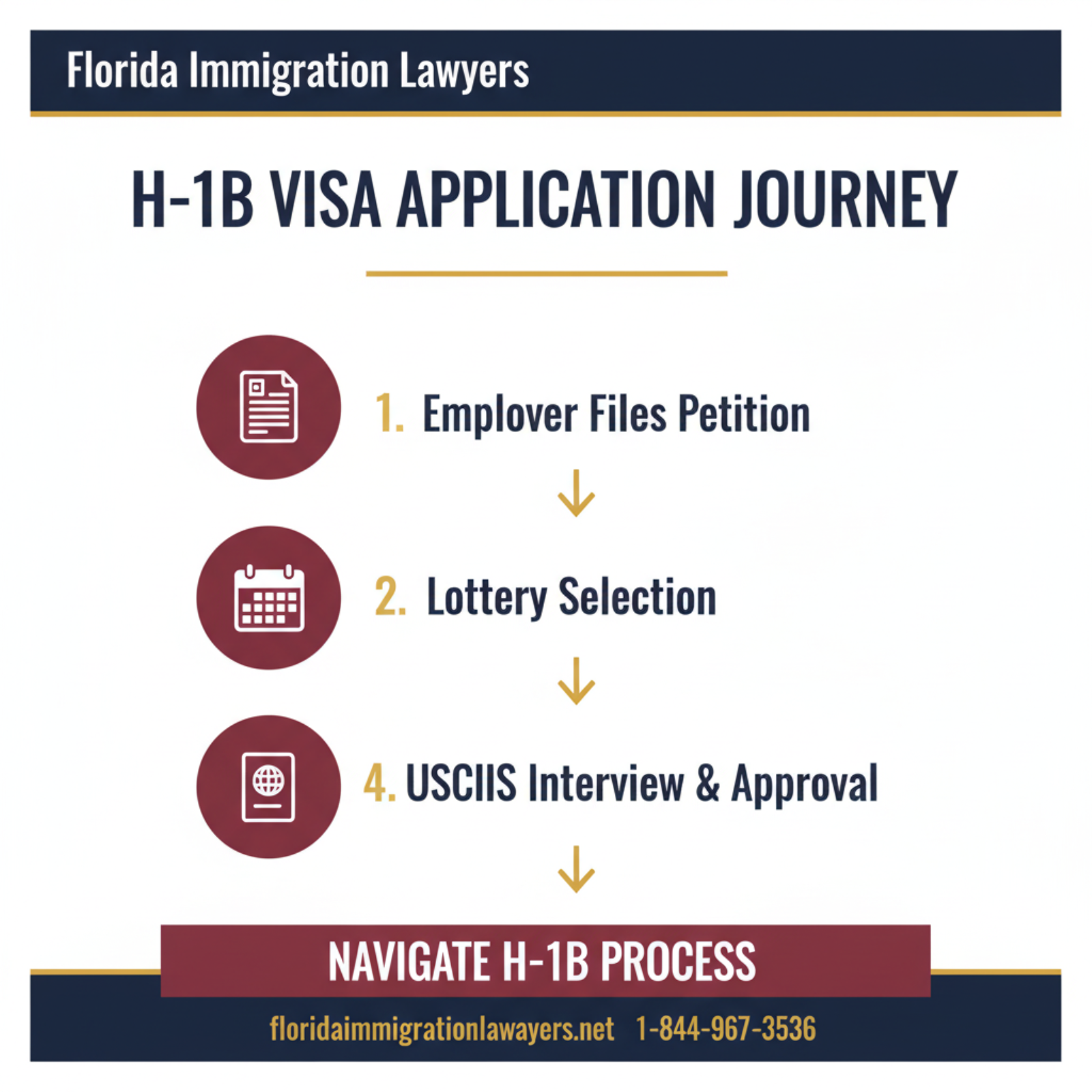
Determine Eligibility and Job Offer: First, the U.S. employer must offer a job in a specialty occupation to a foreign national who meets the educational or experiential requirements. This initial assessment is critical for both parties.
-
Labor Condition Application (LCA) Filing: The employer must file a Labor Condition Application (Form ETA-9035) with the U.S. Department of Labor (DOL). This certifies that the employer will pay the H-1B worker at least the prevailing wage or the actual wage paid to other employees with similar experience and qualifications, whichever is higher, and that working conditions will not adversely affect other workers. This is a foundational step before the H-1B petition can be filed with USCIS. You can find more information on the DOL's website at dol.gov.
-
H-1B Cap Registration (if applicable): If the H-1B cap applies, the employer must register the prospective H-1B employee during the designated registration period, typically in March. USCIS then conducts a lottery to select enough registrations to meet the annual cap. This electronic process has streamlined the initial cap-subject H-1B selection.
-
Form I-129 Petition Filing: If selected in the lottery, or if cap-exempt, the employer files Form I-129, Petition for a Nonimmigrant Worker, with USCIS. This petition includes the certified LCA, supporting documents about the employer, the beneficiary, and the specialty occupation. This is where most of the H-1B visa price Florida fees are paid.
Step-by-Step Process Guide -
USCIS Processing and Approval: USCIS reviews the petition. If approved, USCIS sends an I-797 Approval Notice. This notice confirms the H-1B status for beneficiaries already in the U.S. or paves the way for consular processing for those abroad. Processing times can vary significantly, unless premium processing is used.
-
Consular Processing or Change of Status: If the beneficiary is outside the U.S., they attend a visa interview at a U.S. consulate or embassy abroad to obtain the H-1B visa stamp. If already in the U.S. in another nonimmigrant status, the approval notice typically indicates a change of status, allowing them to begin H-1B employment on the effective date. Information on consular processing can be found at travel.state.gov.
Essential Documents for Your H-1B Petition in Florida
A successful H-1B petition relies heavily on a complete and accurate submission of documents. Missing or incorrect documentation can lead to delays or even denial. Our firm emphasizes thorough preparation for all clients in Florida.
- Employer Documents:
- Certified Labor Condition Application (LCA).
- Employer's Federal Employer Identification Number (FEIN).
- Company financial statements, tax returns, and business licenses to demonstrate ability to pay the proffered wage.
- Organizational charts and detailed job description for the specialty occupation.
- Evidence of employer's existence and operations (e.g., articles of incorporation, business registration).
- Beneficiary (Applicant) Documents:
- Copies of all educational degrees, diplomas, and transcripts (translated if not in English).
- Foreign credential evaluations if the degree is from outside the U.S.
- Professional licenses (if applicable to the specialty occupation).
- Resume/CV detailing work experience.
- Copies of passport, previous U.S. visas, I-94 records, and any prior USCIS approval notices (e.g., OPT EAD, F-1 visa).
- Birth certificate and marriage certificate (if applicable, for H-4 dependents).
- Relationship Documents (for H-4 dependents):
- Marriage certificate for spouse.
- Birth certificates for children.
- Passport copies for all dependents.
H-1B Visa Processing Timeline and Expectations for Florida Applicants
The processing timeline for an H-1B visa can vary significantly. Factors include whether the petition is cap-subject or cap-exempt, the USCIS service center workload, and whether premium processing is utilized. Planning ahead is crucial for Florida employers and prospective employees.
For cap-subject petitions, the annual H-1B lottery selection typically occurs in late March. Employers then have a window to file petitions, usually from April 1st. Regular processing times for I-129 petitions can range from several months to over a year, depending on the service center.
If you opt for premium processing, USCIS commits to adjudicating the petition within 15 calendar days. This expedited service comes with an additional fee but provides a much faster decision. Many Florida businesses choose this option to secure talent quickly.
After USCIS approval, if consular processing is required, the visa interview scheduling can add several weeks or months. This depends on the availability of appointments at the specific U.S. embassy or consulate. It is important to monitor these wait times via the Department of State's website.
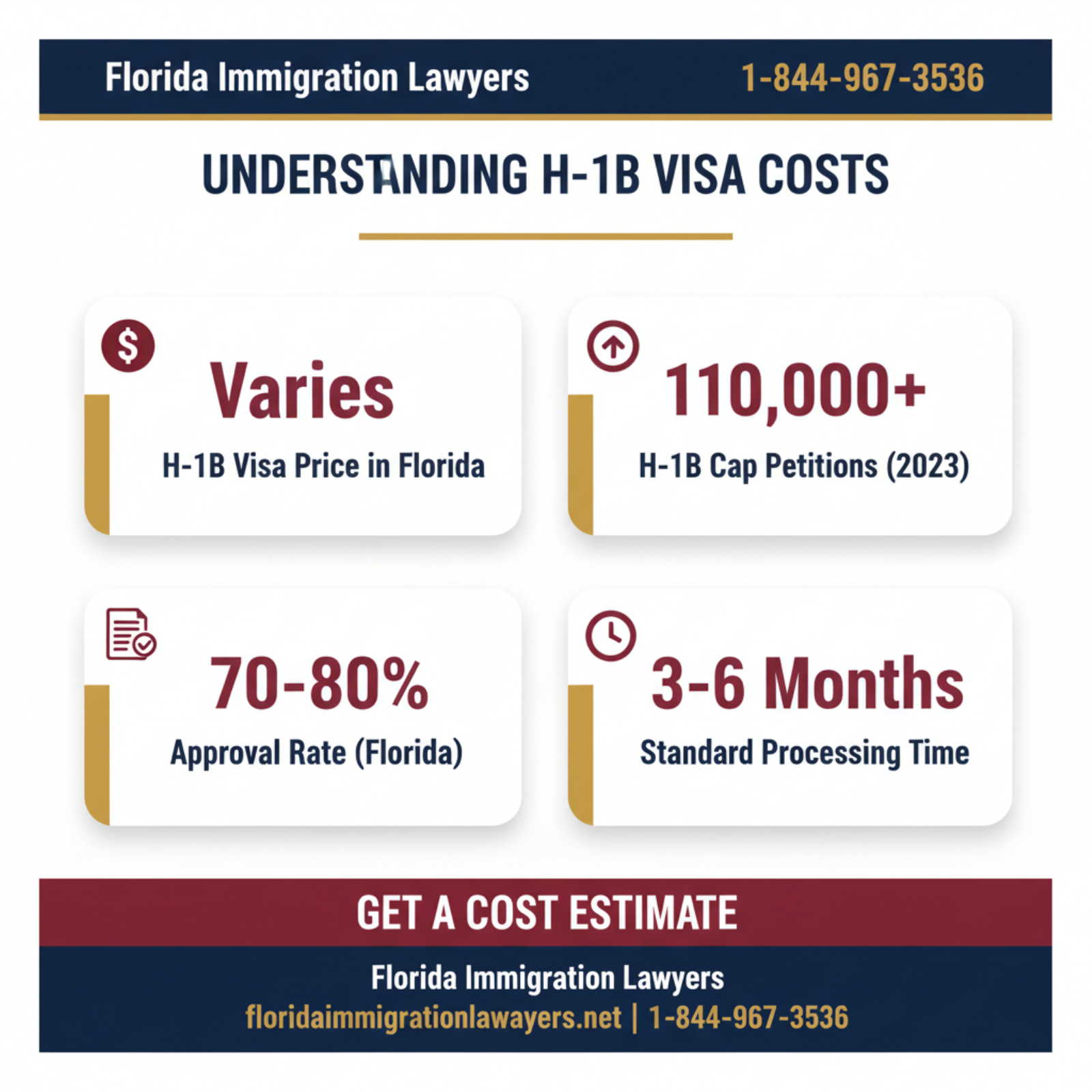
Overall, from the initial LCA filing to the final visa stamp or change of status, the entire H1B visa process Florida can take anywhere from a few months with premium processing to over a year for regular cap-subject cases. Patience and proactive legal guidance are invaluable during this period.
Do not navigate this process alone. The intricacies of H-1B visa applications demand expert attention. Contact Florida Immigration Lawyers today for dedicated support and to ensure your petition is handled with precision. We are ready to assist you.
Common Mistakes to Avoid When Applying for an H-1B Visa in Florida
Applying for an H-1B visa is a complex undertaking, and even minor errors can lead to significant delays or outright denials. Being aware of common pitfalls can help you avoid them. Florida Immigration Lawyers frequently assist clients in rectifying issues that arise from these mistakes.
-
Incorrect or Incomplete Forms: Submitting outdated forms, failing to fill out all required sections, or providing inconsistent information can trigger a Request for Evidence (RFE) or denial. Always use the most current USCIS forms and ensure every field is accurately completed.
-
Insufficient Documentation: Failing to provide all necessary supporting documents, such as academic transcripts, credential evaluations, or employer financial records, can halt the process. A robust petition includes comprehensive evidence for both the employer and the beneficiary.
-
Missed Deadlines: The H-1B process, especially for cap-subject petitions, has strict registration and filing deadlines. Missing these deadlines, even by a day, can mean waiting another year to apply. Timeliness is paramount.
-
Misrepresenting Specialty Occupation: The job duties must clearly align with a specialty occupation requiring a bachelor's degree in a specific field. Vague or generic job descriptions may lead USCIS to question the petition's validity.
-
Failure to Meet Wage Requirements: The employer must pay the H-1B worker at least the prevailing wage for the occupation in the geographic area (e.g., Homestead, Florida) or the actual wage paid to other employees, whichever is higher. Deviating from this can result in serious penalties.
-
Lack of Employer-Employee Relationship Evidence: For third-party placements, proving a clear employer-employee relationship and the employer's control over the H-1B worker is critical. USCIS scrutinizes these arrangements closely.
-
Not Addressing Prior Immigration Issues: Any past visa denials, overstays, or other immigration violations must be disclosed and properly addressed in the petition. Hiding such information can lead to severe consequences, including fraud allegations.
-
Inadequate Response to RFEs: If USCIS issues an RFE, a well-prepared and timely response is essential. A weak or incomplete response will likely lead to a denial. Seeking legal counsel to craft a strong RFE response is highly advisable.
-
Ignoring Public Access File Requirements: Employers must maintain a public access file for each H-1B employee, containing specific documents related to the LCA. Failure to do so can result in compliance violations and penalties from the Department of Labor.
-
Assuming Cap Exemption: Do not assume your organization or the beneficiary is cap-exempt without verifying the specific criteria. Many organizations believe they are cap-exempt when they are not, leading to wasted effort and missed opportunities.
When to Call a Florida Immigration Lawyer for Your H-1B Visa
While this guide provides extensive information, the H-1B visa process is rarely straightforward. The dynamic nature of immigration law and the specific nuances of each case often necessitate expert legal intervention. Florida Immigration Lawyers are here to provide the specialized assistance you need.
You should consider contacting our firm if you encounter any complex scenarios. This includes situations where the employer has a prior history of H-1B denials, if the specialty occupation is difficult to define, or if the beneficiary has a complicated immigration history. Our attorneys specialize in business immigration and can help.
Furthermore, if you receive a Request for Evidence (RFE) or a Notice of Intent to Deny (NOID) from USCIS, immediate legal counsel is paramount. These notices indicate that USCIS has concerns about your petition, and a strategic response is critical. Our team excels at crafting robust responses to such challenges.
For Florida businesses, ensuring compliance with all H-1B regulations is a significant responsibility. Our lawyers can help you navigate prevailing wage determinations, LCA requirements, and public access file obligations. We aim to protect your business from potential audits or penalties.
Ultimately, engaging Florida Immigration Lawyers provides peace of mind. We simplify the complex, manage the paperwork, and advocate on your behalf. Our experience with the H-1B visa price Florida and application process means your case is in capable hands. Explore our attorneys page to learn more about our dedicated team.
About Florida Immigration Lawyers
Florida Immigration Lawyers is a leading immigration law firm dedicated to serving individuals and businesses throughout all of Florida. Our team of experienced attorneys is committed to providing compassionate, effective, and results-driven legal representation for a wide range of immigration matters.
We understand the profound impact immigration decisions have on your life, your family, and your business. That is why we offer personalized legal strategies tailored to your unique circumstances. From H-1B visas and family petitions to asylum and deportation defense, we stand by your side.
Choosing Florida Immigration Lawyers means choosing a firm that prioritizes your success. We are available 24/7 to answer your urgent questions and offer free consultations to get you started. Our bilingual team (Se Habla Español) ensures that language is never a barrier to quality legal assistance.
For trusted legal guidance on your H-1B visa or any other immigration challenge, contact us today. Your future in Florida is our priority. Visit our website at https://www.floridaimmigrationlawyers.net or call us at 1-844-967-3536.
Sources and References
- U.S. Citizenship and Immigration Services (USCIS)
- U.S. Department of Labor (DOL) - H-1B Program
- U.S. Department of State - H-1B Specialty Occupations
- 8 U.S.C. § 1184 (Immigration and Nationality Act Section 214) - Nonimmigrant classes
- 8 U.S.C. § 1184(g) (Immigration and Nationality Act Section 214(g)) - Numerical limitations
- 8 U.S.C. § 1184(l) (Immigration and Nationality Act Section 214(l)) - ACWIA Fee
- 8 CFR § 214.2(h) - Petitions for nonimmigrant workers (H classification)
This article provides general legal information and is not intended as legal advice. Every case is unique, and outcomes depend on specific facts and circumstances. Contact an attorney for advice about your particular situation.
Understanding the H-1B visa price Florida and the intricate application process is a significant undertaking. While this guide offers a comprehensive overview, the best way to ensure a smooth and successful application is through professional legal representation. Florida Immigration Lawyers are here to provide the expert guidance you deserve.
We are committed to helping individuals and businesses across Florida achieve their immigration goals. Our compassionate and knowledgeable team is ready to assist you with every step, from initial consultation to final approval. Do not leave your future to chance.
Take the first step towards a successful H-1B visa application today. Contact Florida Immigration Lawyers for a free consultation at 1-844-967-3536. Se Habla Español - Estamos aquí para ayudarle.
Need help with Immigration?
Our Florida immigration attorneys offer free consultations. Call today or schedule online.
Frequently Asked Questions
Florida Immigration Lawyers
Legal Team
Our experienced attorneys at Florida Immigration Lawyers have been serving clients across Florida for over 20 years. We specialize in immigration, personal injury, criminal defense, workers compensation, and family law.