H-1B Visa Fee Increase Florida 2026: Navigating New Costs
Understand the significant H-1B visa fee increase in Florida for 2026, impacting employers and skilled foreign workers. This comprehensive guide from Florida Immigration Lawyers breaks down the new USCIS fee structure, including the base filing fee, ACWIA fee, Fraud Prevention and Detection Fee, and the new Asylum Program Fee. Learn about potential exemptions, a step-by-step application process, essential document checklists, and expected timelines. We also address common mistakes to avoid and when to seek legal counsel to navigate these complex new regulations successfully. Protect your H-1B petition by staying informed about the latest USCIS H-1B regulations and securing expert legal assistance for your case in Jacksonville or across Florida.

The H-1B visa fee increase in Florida for 2026 significantly alters the cost structure for employers sponsoring foreign workers. These changes, part of broader USCIS fee adjustments, include higher base filing fees, increased fraud prevention and detection fees, and potentially a new $600 "Asylum Program Fee" for certain employers. Understanding these updated costs and eligibility for exemptions is crucial for successful H-1B petitions in Florida.
- New USCIS fees for H-1B petitions took effect in 2026.
- Employers, not employees, are generally responsible for most H-1B fees.
- Certain non-profit organizations and small employers may qualify for fee exemptions.
- The process remains highly competitive, emphasizing accurate and timely submissions.
- Consulting a Florida immigration lawyer is vital to navigate these complex changes.
Are you an employer in Florida looking to sponsor skilled foreign workers, or a professional seeking an H-1B visa? You're likely aware that the landscape of U.S. immigration is constantly evolving. In 2026, significant changes to the H-1B visa fee increase have taken effect, impacting businesses and individuals across the Sunshine State, from bustling Jacksonville to the vibrant tech hubs of Miami and Orlando.
Navigating these new regulations and understanding their financial implications can be overwhelming. The United States Citizenship and Immigration Services (USCIS) has implemented updated fee schedules that directly affect the cost of filing H-1B petitions. These changes are designed to support various immigration services, but they undoubtedly add a new layer of complexity to the H-1B application process.
This comprehensive guide will break down everything you need to know about the H-1B visa fee increase in Florida for 2026. We will explore the new fee structure, discuss who is affected, detail potential exemptions, and provide a clear roadmap for employers and prospective H-1B beneficiaries. Our goal is to equip you with the knowledge to prepare effectively and avoid common pitfalls.
Do not let these new fees deter your plans. With proper guidance, you can successfully navigate the updated H-1B visa process. For personalized advice tailored to your unique situation, call Florida Immigration Lawyers at 1-844-967-3536 for a free consultation today. Our experienced team is ready to assist you.
Understanding the 2026 H-1B Visa Fee Increase in Florida
The H-1B visa program is a cornerstone for U.S. employers seeking to hire foreign professionals in specialty occupations. These roles typically require a bachelor's degree or higher in a specific field. From technology companies in Jacksonville to healthcare providers across Florida, many organizations rely on H-1B visas to fill critical skill gaps.
However, the year 2026 brings substantial changes to the financial aspects of this vital program. USCIS has implemented a series of fee adjustments that significantly impact the total cost of an H-1B petition. These adjustments are part of a broader effort to ensure the agency's operational sustainability and fund various immigration initiatives, including asylum processing.
The primary driver behind the updated costs is the need for USCIS to recover its operating expenses. Unlike many government agencies, USCIS is largely funded by filing fees. Periodic fee reviews and adjustments are necessary to keep pace with inflation, increased demand for services, and new mandates. The 2026 H-1B visa fee increase reflects these ongoing financial realities.
For businesses in Florida, particularly those in high-demand sectors, these new fees require careful budget planning. Employers must now factor in potentially higher costs when considering sponsoring H-1B workers. Understanding the specifics of each fee component is paramount to accurately estimating your overall expenses and ensuring compliance with federal regulations.
It's important to differentiate between various fees associated with the H-1B process. These include the base filing fee, the American Competitiveness and Workforce Improvement Act (ACWIA) fee, the Fraud Prevention and Detection Fee, and potentially a Public Law 114-113 fee. The most significant new addition for some employers is the "Asylum Program Fee," which has sparked considerable discussion.
These changes are not merely administrative; they have real-world implications for Florida's economy and workforce. Businesses may need to adjust their recruitment strategies, while foreign professionals considering opportunities in Florida must be aware of the increased financial burden on their prospective employers. Staying informed and proactive is key to successfully navigating this new environment.
Who is Affected by the New H-1B Visa Fees?
The H-1B visa fee increase primarily impacts U.S. employers who file Form I-129, Petition for a Nonimmigrant Worker, on behalf of foreign professionals. This includes companies of all sizes, from large corporations to small businesses and startups across Florida.
While the fees are typically paid by the employer, the overall cost can indirectly affect prospective H-1B beneficiaries. Higher costs might influence an employer's decision to sponsor, or necessitate a more stringent selection process for candidates. It is crucial for both parties to understand their roles and responsibilities concerning these fees.
Certain organizations, however, may be exempt from specific fees. These exemptions often apply to non-profit research organizations, government research entities, and institutions of higher education. We will delve into these exemptions in more detail later to help you determine if your organization qualifies for reduced H1b visa fees 2026.
Step-by-Step Guide to the H-1B Visa Application Process (2026)
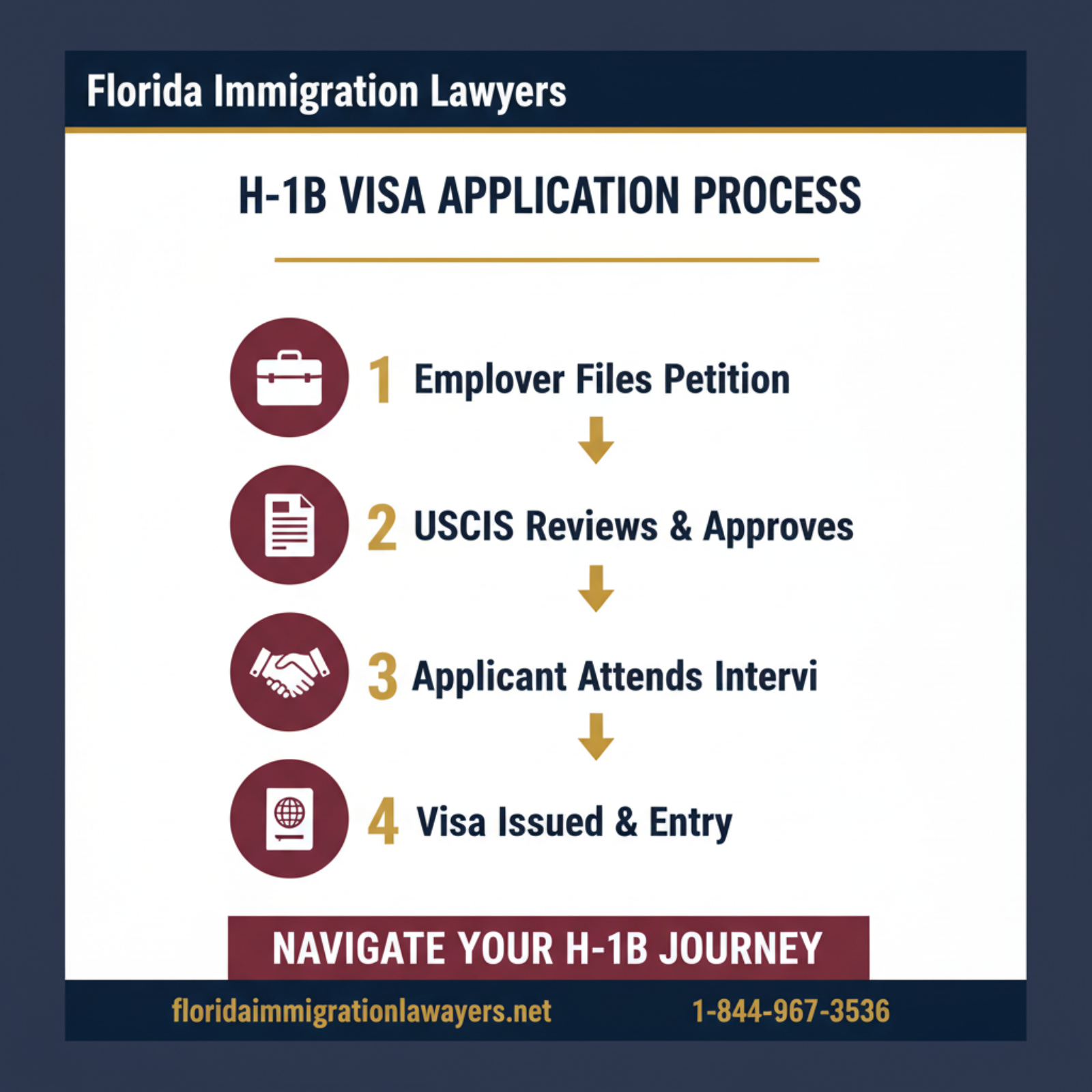
The H-1B visa application process, while complex, follows a structured path. Understanding each stage is crucial, especially with the new H-1B visa fee increase in effect. This guide provides a general overview; remember that specific situations may require additional steps or documentation. This process generally begins with the employer.
-
Determine Eligibility and Prevailing Wage: The employer must first determine if the position qualifies as a "specialty occupation" and if the foreign worker meets the educational and professional requirements. A critical step is obtaining a certified Labor Condition Application (LCA) from the Department of Labor (DOL). This requires determining the prevailing wage for the occupation in the specific geographic area (e.g., Jacksonville, Florida) to ensure the H-1B worker is paid at least the prevailing wage or the actual wage paid to other employees with similar experience, whichever is higher.
-
H-1B Cap Registration (If Applicable): Due to the annual H-1B cap, most prospective petitioners must participate in an electronic registration process. This usually occurs in March. Employers submit a registration for each beneficiary they wish to sponsor. If selected in the lottery, USCIS issues a selection notice, allowing the employer to proceed with filing the H-1B petition. This step requires a registration fee, separate from the main petition fees.
-
File Form I-129, Petition for a Nonimmigrant Worker: Once selected (or if cap-exempt), the employer files Form I-129 with USCIS. This form is the core of the H-1B petition. All required supporting documentation, including the certified LCA, educational credentials, and employment offer, must be submitted concurrently. This is also the stage where the majority of the H1b visa fees 2026 are paid.
-
Respond to Requests for Evidence (RFE): USCIS may issue an RFE if they require additional information or clarification on the petition. Prompt and thorough responses are vital to avoid delays or denials. Working with an experienced Florida immigration lawyer can significantly help in preparing a robust response.
-
Petition Approval: If the petition is approved, USCIS sends an I-797 Approval Notice. For beneficiaries already in the U.S. on another nonimmigrant status, this may include a change of status to H-1B. For those outside the U.S., it means they can proceed to the next step: consular processing.
-
Visa Interview and Issuance (Consular Processing): Beneficiaries outside the U.S. must attend a visa interview at a U.S. embassy or consulate in their home country. They will need to present their I-797 Approval Notice, passport, and other required documents. If approved, the H-1B visa stamp is placed in their passport, allowing them to enter the U.S. This stage involves a separate visa application fee paid directly to the Department of State.
-
Entry into the U.S. and Employment: Upon successful interview and visa issuance, the H-1B worker can travel to the U.S. and begin employment with the sponsoring employer on the petition's start date. They are typically admitted for the validity period of the H-1B petition, usually up to three years, with extensions possible up to a maximum of six years.
Essential Document Checklist for Your H-1B Petition
A successful H-1B petition hinges on meticulous documentation. With the H-1B visa fee increase in 2026, it's more important than ever to ensure your submission is complete and accurate from the outset. Missing or incorrect documents can lead to delays, Requests for Evidence (RFEs), or even denial.
Here is a general checklist of documents typically required for an H-1B petition. Please note that specific cases may require additional evidence. Always consult with an immigration attorney to confirm the exact requirements for your situation.
- Certified Labor Condition Application (LCA) - Form ETA-9035: Obtained from the Department of Labor, confirming prevailing wage and working conditions.
- Form I-129, Petition for a Nonimmigrant Worker: The primary USCIS form for the H-1B petition, completed and signed.
- Addendum to Form I-129 (H-1B Data Collection and Filing Fee Exemption Supplement): Used to determine applicable fees and exemptions.
- Employer's Federal Employer Identification Number (EIN): Proof of the employer's tax ID.
- Company Financials: Recent tax returns, annual reports, or financial statements demonstrating the employer's ability to pay the offered wage.
- Company Business Plan/Description: Details about the employer's operations, services, and need for the H-1B worker.
- Organizational Chart: Showing the H-1B worker's position within the company structure.
- Letter of Support/Employment Offer Letter: From the employer, detailing the job title, duties, salary, and H-1B validity period.
- Beneficiary's Educational Documents: Copies of diplomas, transcripts, and any foreign degree evaluations proving the equivalent of a U.S. bachelor's degree or higher.
- Beneficiary's Professional Licenses/Certifications: If required for the specialty occupation in Florida.
- Beneficiary's Resume/CV: Detailing work experience and qualifications.
- Beneficiary's Passport Copy: Biographical page and any previous U.S. visas.
- Beneficiary's Current U.S. Visa and I-94 Record: If already in the U.S. (e.g., F-1 OPT, L-1).
- Previous Employment Verification Letters: If applicable, to support experience claims.
- Photographs of Beneficiary: Passport-style photos meeting USCIS specifications.
- Payment for All Applicable Fees: Including the base filing fee, ACWIA fee, Fraud Prevention and Detection Fee, and the Asylum Program Fee, if applicable.
H-1B Visa Timeline and Processing Expectations for 2026
Understanding the timeline for an H-1B visa application is crucial for both employers and beneficiaries, especially with the added layer of the H-1B visa fee increase. The H-1B process is known for its annual cap and lottery system, which significantly influences processing times. For 2026, petitioners should anticipate similar patterns, with potential variations due to USCIS workload and policy shifts.
The annual H-1B cap for regular petitions is 65,000, with an additional 20,000 visas reserved for those with a U.S. master's degree or higher (the "master's cap"). The electronic registration period typically opens in early March, and results are usually announced by the end of March. If selected, employers then have a specific window, usually 90 days, to file the Form I-129 petition.
Standard processing of an H-1B petition can take anywhere from 3 to 6 months, and sometimes longer, after USCIS receives the complete application. This timeframe can be influenced by the specific USCIS service center handling the case, the volume of applications, and whether an RFE is issued. For those requiring faster adjudication, premium processing is available for an additional fee, guaranteeing a decision within 15 calendar days.
For individuals undergoing consular processing outside the U.S., additional time is required for visa interview scheduling and administrative processing at the embassy or consulate. This can add several weeks to a few months to the overall timeline. Factors like the specific consulate's workload and the applicant's nationality can influence these delays.
It is important to remember that these are general estimates. USCIS processing times can fluctuate significantly. You can monitor current processing times on the official USCIS website. Working with an attorney from Florida Immigration Lawyers can help you prepare for these timelines and strategize the best approach for your H-1B petition in Jacksonville or anywhere else in Florida.
The implementation of the H-1B visa fee increase itself does not directly alter processing times but ensures USCIS has the resources to manage its caseload. However, any new administrative burdens associated with collecting these fees or processing new exemption requests could indirectly affect efficiency.
Factors Affecting H-1B Processing Times
- USCIS Service Center Workload: Different service centers (e.g., California, Vermont, Nebraska, Texas) may have varying backlogs.
- Completeness of Petition: Incomplete applications or those requiring an RFE will experience significant delays.
- Premium Processing: Opting for premium processing (for an additional fee) guarantees a 15-day processing time once the petition is accepted.
- Consular Processing: Interview wait times and administrative processing at U.S. consulates abroad vary greatly by location.
- Policy Changes: New immigration policies or enforcement priorities can shift resources and impact processing.
H-1B Visa Cost Factors and Fee Breakdown for 2026
The H-1B visa fee increase in 2026 represents a critical financial consideration for any employer in Florida sponsoring a foreign worker. Beyond the base filing fee, several other mandatory and optional fees contribute to the overall cost. Understanding each component is vital for accurate budgeting and compliance.
Here's a breakdown of the typical H1b visa fees 2026:
- USCIS Base Filing Fee (Form I-129): This is the fundamental fee for filing the H-1B petition. The new fee schedule has adjusted this amount upward. For example, as of early 2026, the fee for many I-129 petitions rose to a new amount (e.g., $780 for employers with 25 or fewer full-time equivalent employees, and $1,300 for employers with 26 or more). Always check the latest USCIS fee schedule for exact figures, as these are subject to change.
- H-1B Registration Fee: For cap-subject petitions, a non-refundable electronic registration fee (e.g., $10) is required for each beneficiary entered into the annual lottery. This fee is paid upfront during the registration period.
- American Competitiveness and Workforce Improvement Act (ACWIA) Fee: This fee supports U.S. worker training and education programs. It typically applies to most H-1B petitions. The amount varies based on the size of the employer:
- Employers with 1-25 full-time equivalent employees: (e.g., $750)
- Employers with 26 or more full-time equivalent employees: (e.g., $1,500)
- Fraud Prevention and Detection Fee: A mandatory fee (e.g., $150) designed to combat fraud in the H-1B program. This applies to all initial H-1B petitions and petitions for a change of employer. It does not typically apply to H-1B extensions with the same employer.
- Public Law 114-113 Fee (for "H-1B Dependent" Employers and those with a high proportion of foreign workers): This additional fee (e.g., $4,000) applies to employers who employ 50 or more employees in the U.S. and more than 50% of those employees are in H-1B, L-1A, or L-1B nonimmigrant status. This is often referred to as the "50/50 rule" fee.
- Asylum Program Fee: This is one of the most significant new additions as part of the 2026 H-1B visa fee increase. USCIS has introduced a fee (e.g., $600) for most I-129 and I-140 petitions to fund asylum processing. Small employers (25 or fewer FTE employees) may pay a reduced rate (e.g., $300), and non-profit organizations are generally exempt. This fee is a key component of the updated USCIS H-1B regulations.
- Premium Processing Fee (Optional): If an employer opts for expedited processing, an additional fee (e.g., $2,805 for 2026) is paid to guarantee a 15-calendar-day processing time for the I-129 petition. This can be critical for urgent employment needs.
- Attorney Fees: The cost of retaining an experienced immigration lawyer like Florida Immigration Lawyers will vary based on the complexity of the case and the services provided. While not a USCIS fee, it's a critical part of the overall financial planning for an H-1B petition.
- Visa Application Fee (DS-160) for Consular Processing: For beneficiaries applying for the H-1B visa stamp at a U.S. consulate abroad, a separate non-refundable fee (e.g., $205) is paid directly to the Department of State.
It is important to remember that these fee amounts are illustrative and based on general information for 2026. USCIS fees are subject to change, so always verify the latest fee schedule on the official USCIS website before filing.
H1B Visa 100k Fee Exemption and Other Reductions
The concept of a "$100,000 H-1B fee" has circulated, often causing confusion. It's important to clarify that there isn't a standard, blanket $100,000 fee for all H-1B petitions. This figure sometimes arises from legislative proposals or misinterpretations of the various fees that can accumulate for certain large or "H-1B dependent" employers, particularly the P.L. 114-113 fee, which can be $4,000, combined with other fees. However, a direct $100,000 fee is not a current, widespread USCIS requirement for H-1B petitions.
Instead, the focus should be on legitimate exemptions and reductions from the actual H1b visa fees 2026 that are in effect. Several categories of employers and situations qualify for fee reductions or exemptions:
- Non-Profit Organizations: Certain non-profit organizations affiliated with institutions of higher education, or non-profit research organizations, are typically exempt from the ACWIA fee and the Asylum Program Fee.
- Government Research Organizations: Federal, state, and local government research entities also often qualify for ACWIA and Asylum Program Fee exemptions.
- Institutions of Higher Education: Universities and colleges are generally exempt from the ACWIA fee and the Asylum Program Fee.
- H-1B Extensions with the Same Employer: The Fraud Prevention and Detection Fee typically does not apply to petitions for H-1B extensions filed by the same employer for the same employee.
- Small Employers: Employers with 25 or fewer full-time equivalent employees may pay a reduced ACWIA fee and a reduced Asylum Program Fee.
Determining eligibility for these exemptions can be complex. Consulting with an immigration attorney is highly recommended to ensure your organization correctly claims any applicable fee reductions and complies with all USCIS H-1B regulations. Our firm helps businesses throughout Florida, including Jacksonville, understand their obligations and opportunities for fee savings.
Frequently Asked Questions About H-1B Visa Fees
With the new H-1B visa fee increase in 2026, many common questions arise. Here we address some of the most frequent inquiries to help clarify the process for employers and beneficiaries in Florida.
-
Who pays the $100,000 for H-1B? There is no standard, blanket $100,000 fee for all H-1B petitions. This figure often refers to the cumulative cost for certain large, H-1B-dependent employers who are subject to the Public Law 114-113 fee (e.g., $4,000) in addition to other mandatory fees. Generally, the U.S. employer is responsible for paying the USCIS filing fees, including the base fee, ACWIA fee, Fraud Prevention and Detection Fee, and the new Asylum Program Fee. The employer cannot legally require the H-1B worker to reimburse these fees. However, legal fees for attorney services or visa application fees for consular processing may sometimes be paid by the employee, depending on agreements.
-
Do I have to pay $250 to enter the US? This question likely refers to the new Asylum Program Fee, which is part of the 2026 H-1B visa fee increase. This fee (e.g., $600 for most, $300 for small employers) is paid by the employer as part of the I-129 petition filing, not by the individual upon entry to the U.S. There is no direct "entry fee" of $250 for H-1B visa holders at the border.
-
How much is a Green Card? The cost of obtaining a Green Card (lawful permanent residency) varies significantly depending on the specific path (e.g., family-based, employment-based, asylum). It involves multiple USCIS filing fees for various forms (e.g., I-130, I-485, I-765, I-131, biometrics) which can total well over $1,000 to $2,000 per applicant, not including attorney fees or medical examination costs. This is a separate process from the H-1B visa and has different fee structures.
-
Who gets the H-1B visa? The H-1B visa is granted to foreign professionals who are sponsored by a U.S. employer to work in a "specialty occupation." These occupations require theoretical and practical application of a body of highly specialized knowledge and a bachelor's degree or higher in a specific specialty (or its equivalent). Beneficiaries are typically individuals with degrees in fields like technology, engineering, medicine, science, and business, who are offered a job in the U.S. that meets these criteria.
The updated H-1B visa fees and regulations for 2026 add layers of complexity to an already intricate process. Do not navigate this process alone, risking delays or denials due to misunderstandings. Contact Florida Immigration Lawyers today for expert guidance and support. We are here to simplify your path to success.
Common Mistakes to Avoid in Your H-1B Visa Petition
Even with a clear understanding of the H-1B visa fee increase, many petitioners make avoidable errors that can jeopardize their application. These mistakes can lead to Requests for Evidence (RFEs), delays, or outright denials, costing valuable time and resources. Being aware of these pitfalls is the first step toward a successful outcome.
-
Incorrect Fee Payments: With the 2026 H1b visa fees 2026 adjustments, paying the wrong amount is a common error. This includes miscalculating fees, omitting required fees (like the Asylum Program Fee), or failing to include separate checks for different fee components when required. Consequences: USCIS will reject the petition, causing significant delays and potentially missing filing deadlines, especially for cap-subject petitions.
-
Incomplete or Inaccurate Documentation: Submitting a petition with missing forms, unsigned documents, or insufficient supporting evidence (e.g., uncertified LCA, inadequate proof of specialty occupation, missing foreign degree evaluations). Consequences: Almost guaranteed RFE, prolonged processing times, and increased attorney fees to respond. Can lead to denial if not adequately addressed.
-
Failure to Establish "Specialty Occupation": The H-1B visa requires the position to be a "specialty occupation." This means the job duties must require a bachelor's degree or higher in a specific field. Consequences: An RFE or denial if USCIS determines the role does not meet this standard, or if the employer cannot demonstrate the complexity of the duties.
-
Prevailing Wage Violations: Not paying the H-1B worker at least the prevailing wage for their occupation in the geographic area (e.g., Jacksonville) or the actual wage paid to other similar employees. Consequences: DOL investigations, back pay liabilities, and potential debarment from future H-1B sponsorships. This is a serious compliance issue.
-
Missing H-1B Cap Registration Deadlines: For cap-subject petitions, failing to register electronically within the designated window in March. Consequences: Inability to file an H-1B petition for that fiscal year, requiring a wait until the next cycle.
-
Insufficient Employer Financials: Not providing adequate proof that the employer has the financial ability to pay the H-1B worker's salary. Consequences: RFE or denial, as USCIS needs assurance that the employer can meet their obligations.
-
Beneficiary Qualification Issues: The foreign worker not possessing the required degree or equivalent work experience for the specialty occupation. Consequences: RFE or denial, as the beneficiary must clearly meet the educational requirements.
-
Failure to Maintain Status (for change of status cases): If the beneficiary is already in the U.S. and applying for a change of status, they must maintain their current nonimmigrant status throughout the H-1B petition processing. Consequences: Denial of the change of status, potentially requiring the beneficiary to leave the U.S. and apply for a visa at a consulate abroad.
-
Misrepresenting Information: Providing false or misleading information on any part of the petition. Consequences: Severe penalties, including permanent bars from future U.S. immigration benefits, criminal charges, and civil penalties. USCIS takes fraud very seriously.
-
Ignoring USCIS Updates and Policy Changes: Failing to stay informed about new USCIS H-1B regulations, fee changes, or policy memos. Consequences: Submitting an outdated petition, using incorrect forms, or misinterpreting requirements, leading to rejections or delays.
When to Call a Florida Immigration Lawyer
The complexities of the H-1B visa program, particularly with the new H-1B visa fee increase and evolving USCIS H-1B regulations in 2026, make professional legal guidance indispensable. While it might be tempting to navigate the process independently, the risks of errors, delays, or even denials are substantial. An experienced immigration attorney can provide invaluable support and strategic advice.
You should strongly consider contacting Florida Immigration Lawyers if you encounter any of the following scenarios:
- New H-1B Petition Filing: If you are an employer initiating an H-1B petition for the first time, or if you are new to the 2026 fee structure, an attorney can ensure all forms are correctly completed, all fees are accurately calculated, and all supporting documents are robust.
- Complex Case Scenarios: This includes situations where the specialty occupation definition is ambiguous, the beneficiary has complex educational credentials, or there are prior immigration issues (e.g., past denials, overstays).
- Responding to a Request for Evidence (RFE): Receiving an RFE indicates USCIS needs more information to approve your petition. A skilled lawyer can analyze the RFE, gather the necessary evidence, and craft a compelling legal argument to address USCIS's concerns effectively.
- H-1B Cap-Exempt Petitions: If you believe your organization qualifies for a cap exemption (e.g., an institution of higher education or affiliated non-profit), an attorney can help confirm eligibility and ensure proper documentation.
- Determining Fee Exemptions: Navigating the nuances of the H1B visa 100k fee exemption (or any other fee reductions) is critical. An attorney can assess your eligibility for reduced ACWIA fees, Asylum Program Fees, or other waivers, potentially saving your organization significant costs.
- Compliance Concerns: Ensuring ongoing compliance with DOL and USCIS regulations regarding prevailing wage, working conditions, and public access files is crucial. An attorney can conduct audits and provide advice to mitigate risks.
- Appeals and Motions: If your H-1B petition has been denied, an attorney can help you understand the reasons for denial and advise on options for appeal or filing a motion to reopen or reconsider.
Warning signs that you need legal help include receiving an RFE, uncertainty about which fees apply, concerns about the beneficiary's qualifications, or any doubts about the completeness and accuracy of your documentation. Our team at Florida Immigration Lawyers serves clients across Florida, including Jacksonville, Miami, and Tampa, offering comprehensive legal services for all your H-1B needs.
We understand the challenges businesses and individuals face in the U.S. immigration system. Our dedicated attorneys are committed to providing clear, strategic, and empathetic legal representation. Let us help you navigate the complexities of the H-1B visa process, especially in light of the new fee increases. Learn more about our business immigration services and how we can support your goals.
About Florida Immigration Lawyers
Florida Immigration Lawyers is a leading immigration law firm dedicated to serving individuals, families, and businesses throughout Florida. With a deep understanding of complex U.S. immigration laws, our experienced attorneys provide comprehensive legal services tailored to your unique needs.
We specialize in a wide range of immigration matters, including H-1B visas, family-based petitions, employment-based immigration, deportation defense, asylum, and citizenship applications. Our commitment is to provide compassionate, effective, and results-driven representation, always prioritizing your best interests.
Why Choose Florida Immigration Lawyers?
- Experienced Attorneys: Our team possesses extensive knowledge of current immigration laws and policies, including the latest USCIS H-1B regulations.
- Client-Centered Approach: We understand the personal impact of immigration issues and provide empathetic, personalized service.
- Proven Track Record: We strive for successful outcomes, helping countless clients achieve their immigration goals in Florida.
- Bilingual Services: Our team is fluent in English and Spanish, ensuring clear communication and understanding.
- Accessibility: We are available 24/7 to address your urgent concerns and offer free consultations to discuss your case.
Whether you are in Jacksonville, Orlando, Miami, or anywhere else in Florida, we are here to help. For a free consultation, call us at 1-844-967-3536 or visit our website at https://www.floridaimmigrationlawyers.net. Let us be your trusted partner in navigating the U.S. immigration system.
Sources and References
- U.S. Citizenship and Immigration Services (USCIS)
- USCIS - Our Fees
- Executive Office for Immigration Review (EOIR)
- 8 U.S.C. § 1101 et seq. - Immigration and Nationality Act (INA)
- 8 C.F.R. Part 214 - Nonimmigrant Classes
- 20 C.F.R. Part 655 - Temporary Employment of Nonimmigrants (H-1B, H-1B1, and E-3 Visas)
- INA § 214(g) - Numerical limitations for H-1B visas
- Public Law 114-113 - Consolidated Appropriations Act, 2016 (relevant to certain H-1B fees)
This article provides general legal information and is not intended as legal advice. Every case is unique, and outcomes depend on specific facts and circumstances. Contact an attorney for advice about your particular situation.
The H-1B visa fee increase in Florida for 2026 demands careful attention and expert guidance. Don't risk your immigration goals by going it alone. Florida Immigration Lawyers is here to provide the knowledgeable and compassionate legal support you need.
Reach out to us today for a free consultation to discuss your H-1B petition and how these new fees impact your plans. Call us now at 1-844-967-3536. Se Habla Español - Estamos aquí para ayudarle.
Do Not Navigate This Process Alone
Our experienced immigration attorneys are ready to fight for you. Get a free, confidential consultation today.
Se Habla Español
Frequently Asked Questions
Florida Immigration Lawyers
Immigration Attorney | Founder, Vasquez Law Firm
U.S. Air Force veteran and immigration attorney with thousands of cases resolved. J.D., NCCU School of Law. AILA member. Admitted to the 4th, 5th, and 11th Circuit Courts.
Available 24/7 - Free Evaluations
Related Legal Services
Our Florida immigration attorneys can help you with citizenship and naturalization, family immigration services and immigration practice areas. Call today at 1-844-967-3536 for a free consultation.
Related Links
Related Topics
Free Legal Consultation
Discuss your case with our experienced attorneys. We're available 24/7.
Se Habla Español - Estamos aquí para ayudarle.
Related Articles
Citizenship Test Preparation Florida: Your Guide to
Preparing for the U.S. citizenship test in Florida is a critical step towards naturalization. This comprehensive guide from Florida Immigration Lawyers covers understanding the English and civics tests, a step-by-step application process, essential documents, and effective preparation strategies. Learn about common mistakes to avoid and when to seek legal counsel for complex cases. Our experienced attorneys serve clients across Florida, including Gainesville, providing personalized support to help you achieve your dream of becoming a U.S. citizen. Contact us for a free consultation and navigate your naturalization journey with confidence and expert guidance.
Immigration Lawyer Sarasota Bradenton Florida | VLF Florida
Discover how an immigration lawyer in Sarasota and Bradenton, Florida, can help you navigate complex immigration processes. Contact Florida Immigration Lawyers for expert guidance.
U Visa for Crime Victims: Florida Immigration Relief
Learn about U visas for crime victims in Florida and how they provide relief to those who assist law enforcement. Discover eligibility requirements, application steps, and the benefits of the U visa. Call Florida Immigration Lawyers for expert guidance.
Motion to Reopen Immigration Case in Florida | VLF Florida
Learn how to file a motion to reopen your immigration case in Florida. Discover eligibility, steps, and common mistakes. Call us for a free consultation.
