H-1B Visa 100k Fee in Florida: Your Guide to 2026 Rules
For Florida employers and skilled professionals in 2026, understanding the potential H-1B visa 100k fee is crucial. This comprehensive guide from Florida Immigration Lawyers delves into the fee's complex history, who might be affected, and potential exemptions. Learn the step-by-step H-1B petition process, essential documentation, and expected timelines. We also cover cost factors and common mistakes to avoid, especially for F-1 OPT holders transitioning to H-1B status. Florida Immigration Lawyers offers expert guidance across Kissimmee, Orlando, and all of Florida to help you navigate H-1B challenges effectively. Contact us for a free consultation to ensure compliance and a smooth immigration journey.

The H-1B visa 100k fee refers to a past proposed fee that, while subject to legal challenges and policy changes, remains a topic of discussion for potential future implementation. Employers in Florida and nationwide must understand its implications for hiring skilled foreign workers. This fee primarily targets certain new H-1B petitions, with specific exemptions for existing H-1B holders and other categories. Staying informed about evolving immigration policies for 2026 is crucial.
- The $100k fee was a proposed measure, not a universally active one.
- It primarily targeted specific new H-1B petitions.
- Exemptions generally applied to existing H-1B holders and certain employers.
- F-1 OPT holders seeking H-1B status could be impacted if the fee is implemented.
- Consulting an immigration lawyer is vital for current guidance.
Are you an employer in Florida considering sponsoring an H-1B visa for a skilled foreign worker in 2026? Or are you a talented professional in Kissimmee, Orlando, or elsewhere in Florida hoping to secure an H-1B visa? You've likely heard discussions about a significant H-1B visa 100k fee and its potential impact. This proposed fee, while having a complex history, can cause considerable uncertainty for businesses and individuals alike.
Navigating the intricacies of U.S. immigration law, especially with shifting policies like the discussion surrounding the H-1B 100k fee, requires precise knowledge. This comprehensive guide from Florida Immigration Lawyers will clarify the background of this fee, explain who might be affected, detail potential exemptions, and outline crucial steps for H-1B petitions in Florida for 2026.
We understand your concerns about the H-1B visa 100k fee and other immigration costs. Our goal is to provide clarity and empower you with the information needed to plan effectively. For personalized advice regarding your H-1B visa situation, call Florida Immigration Lawyers at 1-844-967-3536 for a free consultation.
Understanding the H-1B Visa 100k Fee in 2026: Background and Context
The H-1B visa 100k fee refers to a significant proposed charge that has been a point of discussion and contention in U.S. immigration policy. While not a consistently applied fee, its potential for implementation underscores the dynamic nature of immigration regulations. For businesses in Florida, particularly those in tech, healthcare, and tourism around Kissimmee and Orlando, understanding this fee's history is crucial for future planning.
Historically, certain executive actions sought to impose a $100,000 fee on specific types of H-1B petitions. These actions were often aimed at encouraging the hiring of U.S. workers and addressing perceived abuses of the H-1B program. The legal landscape surrounding these proposals has been complex, with various injunctions and rescissions impacting their enforceability. As we approach 2026, it is important to monitor any renewed discussions or legislative efforts that could reintroduce such a fee.
The standard H-1B visa program allows U.S. employers to temporarily employ foreign workers in specialty occupations. These occupations generally require a bachelor's degree or higher in a specific field. The program is vital for many Florida industries that rely on skilled international talent to fill critical workforce gaps and drive innovation. Any substantial increase in H1B visa fees 2026, such as a $100k fee, would significantly impact these employers and their ability to attract top talent to Florida.
Our firm, Florida Immigration Lawyers, closely monitors all developments related to H-1B policy. We are committed to providing our clients in Kissimmee, Miami, Tampa, and throughout Florida with the most up-to-date and accurate information. This proactive approach helps ensure that your business or your personal immigration journey is prepared for any regulatory changes.
Who Might Be Affected by the H-1B Visa 100k Fee? Potential Scenarios for Florida Employers
Should the H-1B visa 100k fee be implemented in 2026, it would likely target specific categories of H-1B petitions. Based on past proposals and discussions, it's essential for Florida employers to understand who might bear this significant cost. The fee was generally designed to apply to new H-1B petitions, rather than extensions or amendments for existing H-1B workers.
New H-1B Petitions: The primary target of the proposed $100,000 fee was typically employers filing an initial H-1B petition for a foreign national who did not previously hold H-1B status. This could include individuals transitioning from F-1 OPT status or those applying from outside the U.S. Businesses in high-demand sectors across Florida, from aerospace in Brevard County to finance in Miami, could face this added expense when bringing in new talent.
H1B 100k fee for F1 students: A major concern for many F-1 OPT holders in Florida is whether they would be subject to the H-1B visa 100k fee when applying for a change of status. If the fee were to be implemented, F-1 students transitioning to H-1B status would likely be included in the 'new H-1B petition' category. This would represent a substantial financial hurdle for both the student and the sponsoring employer. It is a critical consideration for universities and employers in Kissimmee and Gainesville who often hire international graduates.
Exemptions and Waivers: While the proposed fee was substantial, discussions often included certain H1B $100k fee exemption categories. These typically involved:
- Existing H-1B Holders: Individuals already holding H-1B status and seeking an extension or transfer to a new employer were generally exempt. The fee aimed at new entries into the H-1B program.
- Cap-Exempt Employers: Certain institutions, such as universities, non-profit research organizations, and government research organizations, are typically exempt from the H-1B cap (8 U.S.C. § 1184(g)). Past proposals suggested these employers might also be exempt from the $100k fee, recognizing their public service mission. This is particularly relevant for Florida's robust higher education system.
Understanding these distinctions is paramount. Our team at Florida Immigration Lawyers can help you assess your specific situation and determine potential applicability or exemptions for the H-1B visa 100k fee if it becomes active in 2026. We serve clients across Florida, from Jacksonville to the Keys, ensuring comprehensive legal support.
Navigating the H-1B Petition Process in Florida: A Step-by-Step Guide for 2026
The H-1B petition process remains complex, regardless of potential fee changes. For Florida businesses and prospective H-1B workers in 2026, a clear understanding of the steps is essential. This guide outlines the typical journey; remember that specific details can vary.
- Determine Eligibility and Cap Requirements: The employer must first determine if the position qualifies as a specialty occupation and if the potential employee meets the educational requirements. Most H-1B visas are subject to an annual cap, currently 85,000, including 20,000 for those with a U.S. master's degree or higher. Florida employers must be aware of the H-1B cap and the lottery system, which typically occurs in March.
- Obtain a Certified Labor Condition Application (LCA): Before filing the H-1B petition, the employer must submit a Form ETA-9035/9035E, Labor Condition Application, to the U.S. Department of Labor (DOL). This certifies that the employer will pay the H-1B worker at least the prevailing wage for the occupation in the area of employment (e.g., Kissimmee, Florida) and will provide working conditions that do not adversely affect U.S. workers. This step is critical for compliance and can take several days to process. Learn more at dol.gov.
- File Form I-129, Petition for a Nonimmigrant Worker: Once the LCA is certified, the employer files Form I-129 with U.S. Citizenship and Immigration Services (USCIS). This is the core H-1B petition, governed by regulations such as 8 CFR § 214.2(h). It includes extensive documentation about the employer, the beneficiary, the job offer, and compliance with all H-1B requirements. This is where any applicable H1B visa fees 2026, including potential new surcharges, would be paid.
- Participate in the H-1B Lottery (If Applicable): If the H-1B cap is met, USCIS conducts an electronic registration lottery. Only selected registrations proceed to file the full I-129 petition. This is a highly competitive stage, and many qualified applicants, including those hoping to work in Florida, may not be selected.
- Await USCIS Adjudication: After filing, USCIS reviews the petition. This can involve Requests for Evidence (RFEs) if more information is needed. Premium processing is available for an additional fee to expedite adjudication. Once approved, USCIS issues an I-797 Approval Notice.
- Consular Processing or Change of Status: If the beneficiary is outside the U.S., they will attend an interview at a U.S. consulate or embassy abroad to obtain the H-1B visa stamp. If they are already in the U.S. (e.g., on F-1 OPT), the approved I-129 may automatically change their status to H-1B, allowing them to begin work on the H-1B start date.
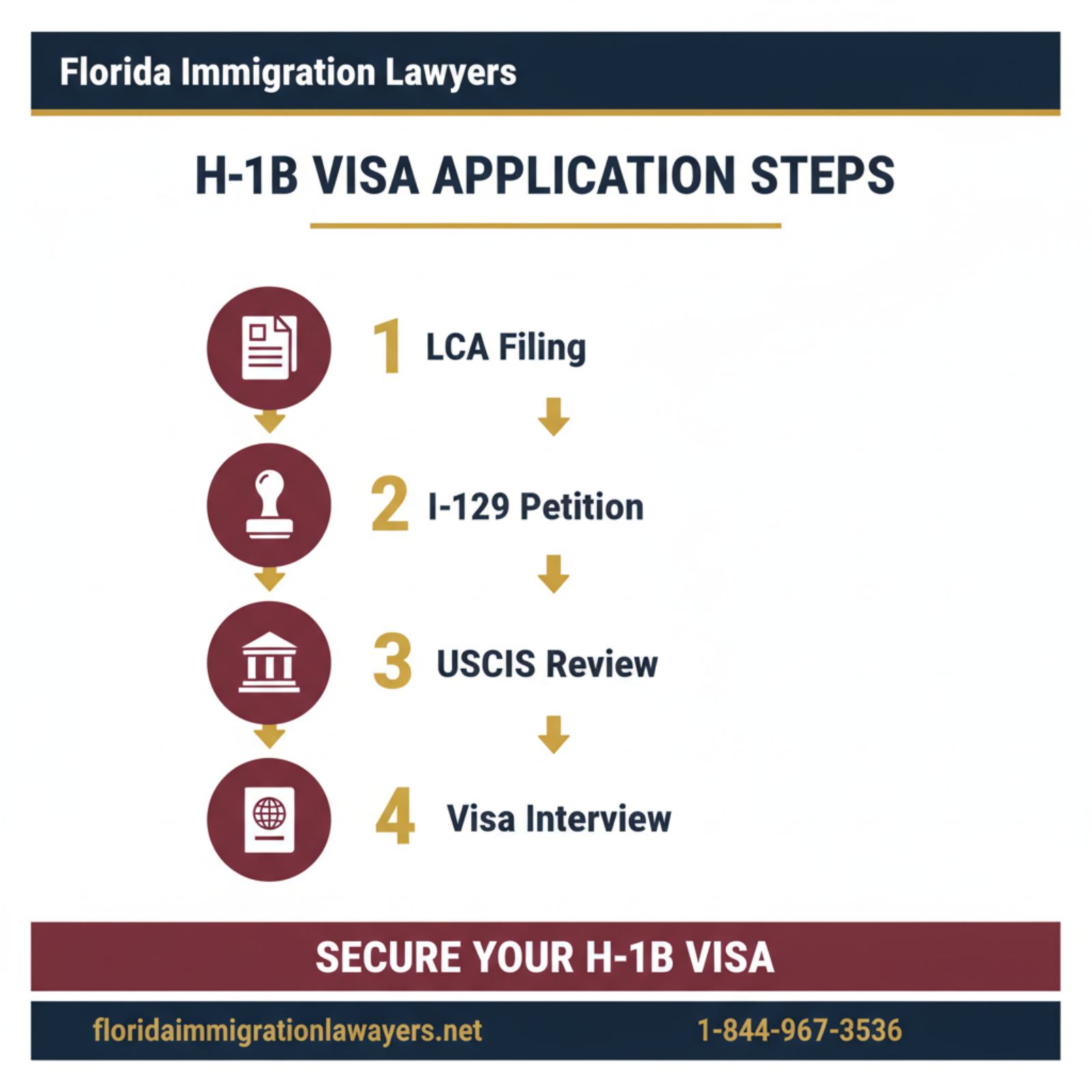
Each step requires meticulous attention to detail and adherence to strict deadlines. Errors can lead to delays or denials, impacting both the employer and the prospective employee. Florida Immigration Lawyers regularly assists businesses and individuals through every stage of this complex process, ensuring all requirements are met.
Essential Documentation for Your H-1B Visa Petition in 2026
A successful H-1B petition hinges on submitting a complete and accurate set of supporting documents. For employers and beneficiaries in Florida preparing for 2026, assembling these materials carefully is paramount. Missing or incorrect documentation is a common cause of delays and RFEs.
Employer-Specific Documents
- Company financial statements, tax returns, and business licenses.
- Employer's federal tax identification number (EIN).
- Copies of the certified Labor Condition Application (LCA).
- Detailed job description, including duties, responsibilities, and required qualifications.
- Evidence of the employer's need for a specialty occupation worker.
- Articles of Incorporation or other business formation documents.
- Proof of valid employer-employee relationship.
Beneficiary-Specific Documents
- Copies of academic degrees, diplomas, and transcripts (translated if not in English).
- Evaluations of foreign degrees to U.S. equivalency.
- Professional licenses or certifications, if applicable.
- Copies of passports, visa stamps, and I-94 arrival/departure records.
- Resume or Curriculum Vitae.
- Evidence of prior employment, if relevant.
- For F-1 OPT holders, copies of EAD card, I-20s, and academic records.
All documents must be legible and properly organized. USCIS often requests original documents for review, so always keep certified copies for your records. Our attorneys at Florida Immigration Lawyers guide clients through this extensive checklist, ensuring thorough preparation for their H-1B visa 100k related petitions.
H-1B Visa Timeline and Processing Expectations for Florida Applicants in 2026
The timeline for H-1B visa processing can vary significantly, influenced by factors such as USCIS caseload, the H-1B cap, and premium processing options. For those in Florida aiming for an H-1B visa in 2026, understanding these expectations is crucial for effective planning.
H-1B Cap Registration and Lottery (March): The H-1B cap registration period typically opens in early March. Employers must register prospective H-1B beneficiaries electronically. If the number of registrations exceeds the available visas, USCIS conducts a lottery. Selections are usually announced by the end of March. This is the first critical deadline for most cap-subject petitions.
Petition Filing (April-June): For selected registrations, employers generally have a filing window from April 1st to June 30th to submit the complete Form I-129 petition. During this period, all supporting documentation and applicable H1B visa fees 2026 must be included. Missing this window means losing the opportunity for that fiscal year.
Regular Processing Times: Without premium processing, H-1B petitions can take several months to adjudicate, often ranging from 3 to 6 months, or even longer depending on the service center. This can create uncertainty for both employers and beneficiaries. For example, a petition filed in April could see approval as late as September or October, with an H-1B start date of October 1st.
Premium Processing: For an additional fee, employers can opt for premium processing, which guarantees a response from USCIS within 15 calendar days. This significantly reduces the wait time and is often utilized by Florida businesses with urgent hiring needs. However, premium processing does not guarantee approval; it only expedites the review. You can learn more about processing times on the USCIS website.
H-1B Start Date: Approved H-1B petitions generally have an effective start date of October 1st, coinciding with the federal fiscal year. This means even if a petition is approved earlier, work under H-1B status cannot commence before October 1st. Careful planning is required to bridge any employment gaps, especially for F-1 OPT holders.
Our legal team at Florida Immigration Lawyers helps clients manage these timelines effectively, providing strategic guidance to minimize delays and ensure smooth transitions for H-1B workers in Florida, including those in Kissimmee, Tampa, and Fort Lauderdale.
Cost Factors and Fee Breakdown for H-1B Petitions in 2026
Understanding the various costs associated with an H-1B visa petition is crucial for budgeting, especially with the potential for a H-1B visa 100k fee. While we cannot provide specific, exact fee amounts as they are subject to change by USCIS and other agencies, we can outline the typical components for 2026.
Standard USCIS Filing Fees
- Base Filing Fee: Required for all I-129 petitions.
- Fraud Prevention and Detection Fee: Applies to most initial H-1B petitions and petitions for new employment.
- American Competitiveness and Workforce Improvement Act (ACWIA) Fee: Varies based on employer size. This fee supports U.S. worker training programs.
- Public Law 114-113 Fee: An additional fee that applies to employers with 50 or more employees, where more than 50% of their workforce are on H-1B or L-1 visas. This is distinct from the proposed $100,000 surcharge.
Potential H-1B Visa 100k Fee
If re-implemented, this significant surcharge would be added to the standard fees for specific new H-1B petitions, as discussed previously. Employers in Florida would need to factor this into their hiring budgets, potentially making the sponsorship of new H-1B workers considerably more expensive. This fee is distinct from other statutory fees.
Optional Fees
- Premium Processing Fee: For expedited adjudication, as mentioned earlier. This guarantees a faster response but does not impact the decision itself.
- Attorney Fees: Legal fees for professional guidance and representation are an investment in ensuring proper compliance and increasing the likelihood of a successful outcome. Florida Immigration Lawyers offers competitive rates and transparent fee structures.
Other Potential Costs
- LCA Filing (DOL): No direct fee, but administrative costs for preparation.
- Degree Evaluations: If foreign degrees require evaluation to U.S. equivalency.
- Translation Costs: For any documents not in English.
- Travel Costs: For consular processing abroad.
H1B visa fees 2026 can accumulate quickly. It's essential to plan for all potential expenses. We advise clients in Kissimmee, Lakeland, and across Florida to budget carefully and consult with us for a clear understanding of the financial implications.
Do not navigate this complex and potentially costly process alone. The nuances of the H-1B visa 100k fee and other immigration requirements demand expert attention. Contact Florida Immigration Lawyers today to ensure your petition is handled with precision and care.
Common Mistakes to Avoid
- Failing to Meet H-1B Cap Deadlines: Missing the March registration deadline or the subsequent filing window for selected petitions can mean waiting another year. This oversight can halt critical hiring plans for Florida businesses.
- Incorrectly Classifying the Occupation: Assuming a position qualifies as a "specialty occupation" without proper analysis can lead to denial. The job must genuinely require a bachelor's degree in a specific field.
- Inaccurate or Incomplete LCA: Errors in the Labor Condition Application, especially regarding prevailing wage or working conditions, can result in delays, RFEs, or even penalties from the Department of Labor.
- Insufficient Documentation: Submitting a petition with missing transcripts, degree evaluations, or employer financial records is a primary cause of RFEs and denials. Every requested document must be provided.
- Misunderstanding the H-1B Visa 100k Fee Applicability: Incorrectly assuming exemption or failing to budget for the H-1B visa 100k fee (if applicable) can lead to unexpected costs or petition rejection.
- Ignoring Prevailing Wage Requirements: Paying less than the prevailing wage for the occupation and geographic area (e.g., Kissimmee) is a serious violation and can result in severe penalties.
- Not Responding to RFEs Promptly and Thoroughly: RFEs require a comprehensive and timely response. A weak or late reply can lead to denial of the petition.
- Lack of Employer-Employee Relationship Proof: USCIS scrutinizes the bona fide employer-employee relationship, especially for third-party placements. Failure to provide sufficient evidence can lead to denial.
- Failing to Plan for Status Gaps: For F-1 OPT holders, not planning for the period between OPT expiration and H-1B start date (October 1st) can lead to unauthorized stay or employment gaps.
- Attempting to Self-File Complex Cases: While tempting to save costs, complex H-1B cases, especially with the added layer of potential H1B 100k fee for F1 students considerations, often benefit from legal expertise.
When to Call a Lawyer
The H-1B visa process, particularly with the evolving discussions around the H-1B visa 100k fee, is intricate and fraught with potential pitfalls. Knowing when to seek legal counsel can be the difference between success and significant setbacks. Florida Immigration Lawyers is here to provide the expertise you need.
You should contact an experienced immigration attorney immediately if:
- You are an employer considering sponsoring an H-1B worker for the first time or are unsure about the H-1B visa 100k fee applicability.
- You or your prospective employee have a complex immigration history, such as previous visa denials or overstays.
- Your case involves specific exemptions, such as those for cap-exempt organizations or certain foreign nationals.
- You receive a Request for Evidence (RFE) from USCIS or a Notice of Intent to Deny (NOID).
- You need to understand the implications of a change in status from F-1 OPT to H-1B, especially concerning any H1B 100k fee for F1 students.
- You require assistance with prevailing wage determinations or Labor Condition Application (LCA) compliance.
- You are concerned about potential deportation defense if your status is at risk due to H-1B issues. Our firm handles these critical matters.
Our attorneys at Florida Immigration Lawyers possess deep knowledge of H-1B regulations and can help you navigate the process efficiently and effectively. We represent clients across Florida, including Kissimmee, Miami, and Jacksonville, ensuring your best interests are protected. We also offer comprehensive support for business immigration matters and general immigration services.
About Florida Immigration Lawyers
Florida Immigration Lawyers is a leading law firm dedicated to providing exceptional immigration legal services across the entire state of Florida. Our experienced attorneys understand the complexities of U.S. immigration law and are committed to guiding individuals, families, and businesses through every step of their immigration journey. We pride ourselves on offering compassionate, client-focused representation.
Our comprehensive practice areas include H-1B visas, family immigration, business immigration, asylum, deportation defense, and citizenship. We are passionate about helping our clients achieve their American dreams, whether that involves securing a work visa in Kissimmee, reuniting with loved ones, or defending against removal. Our firm offers personalized strategies tailored to your unique situation.
Why choose Florida Immigration Lawyers? We offer a wealth of experience, a proactive approach to evolving immigration policies like the H-1B visa 100k fee, and a commitment to clear communication. Our team is available 24/7 to address your concerns and provide timely support. We believe everyone deserves access to high-quality legal representation, which is why we offer free consultations. Visit our attorneys page to learn more about our dedicated team, or contact us directly.
Contact us today for a free consultation:
- Phone: 1-844-967-3536
- Website: https://www.floridaimmigrationlawyers.net
- Availability: 24/7
- Services: Free Consultations, Serving All Florida
Sources and References
- U.S. Citizenship and Immigration Services (USCIS)
- U.S. Department of Labor (DOL) - H-1B Program
- USCIS Processing Times
- 8 U.S.C. § 1184(g) - Admission of nonimmigrants; terms and conditions; and establishment of annual numerical limitations (Immigration and Nationality Act Section 214(g))
- 8 CFR § 214.2(h) - Petitions for nonimmigrant workers (H Classification)
This article provides general legal information and is not intended as legal advice. Every case is unique, and outcomes depend on specific facts and circumstances. Contact an attorney for advice about your particular situation.
Don't let the complexities of the H-1B visa 100k fee or any other immigration challenge overwhelm you. Our dedicated legal team at Florida Immigration Lawyers is ready to provide the guidance and representation you need. Take the first step towards a clear path forward. Call us today for a free, confidential consultation at 1-844-967-3536. Se Habla Español - Estamos aquí para ayudarle.
Do Not Navigate This Process Alone
Our experienced immigration attorneys are ready to fight for you. Get a free, confidential consultation today.
Se Habla Español
Frequently Asked Questions
Florida Immigration Lawyers
Immigration Attorney | Founder, Vasquez Law Firm
U.S. Air Force veteran and immigration attorney with thousands of cases resolved. J.D., NCCU School of Law. AILA member. Admitted to the 4th, 5th, and 11th Circuit Courts.
Available 24/7 - Free Evaluations
Related Legal Services
Our Florida immigration attorneys can help you with family immigration services, immigration practice areas and free immigration consultation. Call today at 1-844-967-3536 for a free consultation.
Related Links
Related Topics
Free Legal Consultation
Discuss your case with our experienced attorneys. We're available 24/7.
Se Habla Español - Estamos aquí para ayudarle.
Related Articles
DUI Immigration Consequences in Florida | VLF Florida
A DUI conviction in Florida can have serious immigration consequences, including deportation and inadmissibility. Learn how to protect your status and what steps to take. Call Florida Immigration Lawyers for a free consultation.
USCIS Biometrics Appointment Florida: Your Guide | VLF Florida
Understanding your USCIS biometrics appointment in Florida is crucial for a smooth immigration process. This guide covers what biometrics are, the step-by-step process, essential documents, and common mistakes to avoid. Whether you're in Fort Lauderdale or elsewhere in Florida, preparing adequately for your ASC appointment is key to moving your case forward. Learn about timelines, cost factors, and when to seek legal assistance. Florida Immigration Lawyers offers expert guidance to help you navigate this important step, ensuring all requirements are met and your application remains on track. Contact us today for a free consultation.
Asylum Application Process in Florida Explained | VLF Florida
Learn the detailed steps for applying for asylum in Florida. Understand the I-589 form, timelines, and how to avoid common pitfalls. Contact Florida Immigration Lawyers for expert guidance.
Understanding Good Moral Character for Naturalization in Florida
Learn about the good moral character requirement for naturalization in Florida, and how it affects your N-400 application. Understand the role of criminal history and how to demonstrate moral character effectively. For personalized advice, call Florida Immigration Lawyers at 1-844-967-3536.
