H-1B Visa Fee Increase Florida 2026: Your Guide to New Costs
The H-1B visa fee increase in 2026 will profoundly impact employers and skilled foreign workers in Florida. New USCIS regulations are set to raise filing costs, affecting industries from technology to healthcare across cities like Orlando. This comprehensive guide from Florida Immigration Lawyers breaks down these changes, detailing new fee structures, application steps, and essential documents. We also cover potential H1B visa fee exceptions, processing timelines, and cost breakdowns. Understanding these adjustments is critical to ensure compliance and successful petitioning. Avoid common mistakes and learn when to seek expert legal counsel to navigate these complexities. Contact Florida Immigration Lawyers for a free consultation to protect your application and ensure a smooth process.

The H-1B visa fee increase in 2026 significantly alters the financial landscape for employers sponsoring foreign workers in Florida. New regulations from USCIS will introduce higher filing fees, impacting businesses and skilled professionals across sectors like technology, healthcare, and tourism in areas such as Orlando.
- New USCIS fees for H-1B petitions are effective in 2026.
- Employers bear the primary responsibility for most H-1B fees.
- Strategic planning is crucial to manage increased H-1B visa costs.
- Certain exemptions or premium processing fees may also be adjusted.
- Consulting an immigration lawyer is vital to navigate these complex changes.
Imagine your business in Orlando relies on top international talent, or you're a skilled professional eager to contribute to Florida's vibrant economy. The H-1B visa program has long been your pathway. But what happens when the rules, and the costs, suddenly change?
The U.S. Citizenship and Immigration Services (USCIS) is implementing a significant H-1B visa fee increase in 2026. This change will have profound implications for employers and foreign workers throughout Florida. Understanding these new regulations is crucial for anyone involved in the H-1B process.
This comprehensive guide from Florida Immigration Lawyers will break down the upcoming changes, what they mean for you, and how to prepare. We will cover everything from the specifics of the new fees to critical steps for a successful application. Don't face these complex changes alone. Call Florida Immigration Lawyers at 1-844-967-3536 for a free consultation today. Our experienced team is ready to assist you.
Understanding the H-1B Visa Fee Increase and Its Impact in Florida
The H-1B visa program is a nonimmigrant visa that allows U.S. employers to temporarily employ foreign workers in specialty occupations. These occupations generally require a bachelor's degree or higher in a specific field. Many Florida businesses, particularly in tech, healthcare, and tourism in cities like Orlando, depend on this program to fill critical talent gaps.
The U.S. government, through USCIS, periodically reviews and adjusts its immigration fees to cover operational costs. The upcoming H-1B visa fee increase set for 2026 represents one of the most substantial adjustments in recent years. This change aims to ensure the agency has sufficient resources to process petitions and maintain system integrity.
These new fees will affect various components of the H-1B application process. Employers will need to factor in significantly higher expenses when planning to sponsor foreign workers. This includes the base filing fee, the American Competitiveness and Workforce Improvement Act (ACWIA) fee, and potentially new or adjusted Fraud Prevention and Detection fees.
For businesses in Florida, particularly small to medium-sized enterprises, these increased costs could pose a considerable challenge. Strategic planning and legal guidance become even more critical to navigate these financial hurdles successfully. We understand your concerns and are here to help you understand the impact of these new USCIS H-1B visa fees.
Navigating the H-1B Visa Application Process with New Fee Structures
Applying for an H-1B visa involves several intricate steps, each with its own requirements and now, adjusted fee implications. The process typically begins with an employer filing a Labor Condition Application (LCA) with the U.S. Department of Labor. This ensures the foreign worker will be paid the prevailing wage for their occupation.
Once the LCA is certified, the employer can then file Form I-129, Petition for a Nonimmigrant Worker, with USCIS. This is the core petition where the majority of the H-1B visa fee increase will be felt. The petition must include extensive documentation supporting the employer's need and the beneficiary's qualifications.
For cap-subject H-1B visas, a lottery system is often employed due to demand exceeding the annual cap. If selected in the lottery, the employer proceeds with filing the full I-129 petition and associated fees. Understanding these stages is essential for a timely and compliant application.
- Step 1: Labor Condition Application (LCA) Filing. Your employer must submit Form ETA-9035/9035E to the Department of Labor. This step confirms that the employment of an H-1B worker will not adversely affect U.S. workers' wages or working conditions.
- Step 2: H-1B Lottery Registration (if applicable). For cap-subject petitions, employers must register electronically with USCIS during a specified period. A registration fee, which is also subject to change, is typically required at this stage.
- Step 3: Petition Filing (Form I-129). If selected in the lottery, or for cap-exempt petitions, the employer files Form I-129 with USCIS. This is where the bulk of the new USCIS H-1B visa fees will be assessed.
- Step 4: Supporting Documentation Submission. Alongside Form I-129, the employer must provide extensive evidence, including educational qualifications, job offer letters, and company information.
- Step 5: USCIS Processing. USCIS reviews the petition and supporting documents. This stage can involve requests for additional evidence (RFEs) or interviews.
- Step 6: Visa Interview (for beneficiaries outside the U.S.). If the petition is approved, foreign nationals outside the U.S. will attend an interview at a U.S. embassy or consulate in their home country to obtain the physical visa stamp.
- Step 7: Entry into the U.S. Upon visa approval, the beneficiary may enter the U.S. to begin their H-1B employment.
Understanding the $100,000 H-1B Fee and Other Potential New Costs
Recent discussions and proposals have included a potential h1b visa $100000 fee for certain petitions. While the specifics of this fee and its application are still evolving, it's crucial for employers to stay informed. This substantial fee, if implemented broadly, could dramatically increase the cost of sponsoring H-1B workers.
Currently, the primary fees associated with an H-1B petition include the base filing fee, the ACWIA fee, and the Fraud Prevention and Detection fee. Large employers (50 or more employees, with 50% or more H-1B or L-1 nonimmigrant workers) also pay an additional Public Law 114-113 fee. All these fees are subject to adjustment.
The proposed US H1B visa cost increase could also introduce new categories of fees or significantly raise existing ones. It is imperative to consult with an immigration attorney from Florida Immigration Lawyers to understand which fees apply to your specific situation and how to budget for them effectively. We stay abreast of all regulatory changes impacting H-1B visas.
Essential Document Checklist for Your H-1B Visa Petition in 2026
A meticulously prepared application package is critical for H-1B visa success, especially with the heightened scrutiny that often accompanies fee increases. Missing or incorrect documents can lead to delays or outright denials. Here is a general checklist of documents you will typically need:
- Certified Labor Condition Application (LCA) – Form ETA-9035/9035E.
- Form I-129, Petition for a Nonimmigrant Worker.
- Form I-129 H Supplement.
- Employer's letter of support, detailing the job offer, duties, and required qualifications.
- Proof of employer's ability to pay the proffered wage (e.g., annual reports, tax returns).
- Beneficiary's educational degrees, transcripts, and evaluations of foreign degrees.
- Beneficiary's resume and professional licenses (if applicable).
- Beneficiary's passport copies, visa copies, and I-94 arrival/departure records (if in the U.S.).
- Any previous USCIS approval notices (e.g., I-797 for previous visas).
- Company financial statements and organizational charts.
- Evidence of the specialty occupation requirement (e.g., job descriptions, industry standards).
- Photographs meeting USCIS specifications (for visa stamping).
H1B Visa Fee Exceptions and Exemptions
While the general trend is towards increased costs, certain H1B visa fee exceptions may apply. These exemptions can significantly reduce the financial burden for some petitioners. For instance, non-profit organizations affiliated with institutions of higher education, or governmental research organizations, are typically exempt from the ACWIA fee.
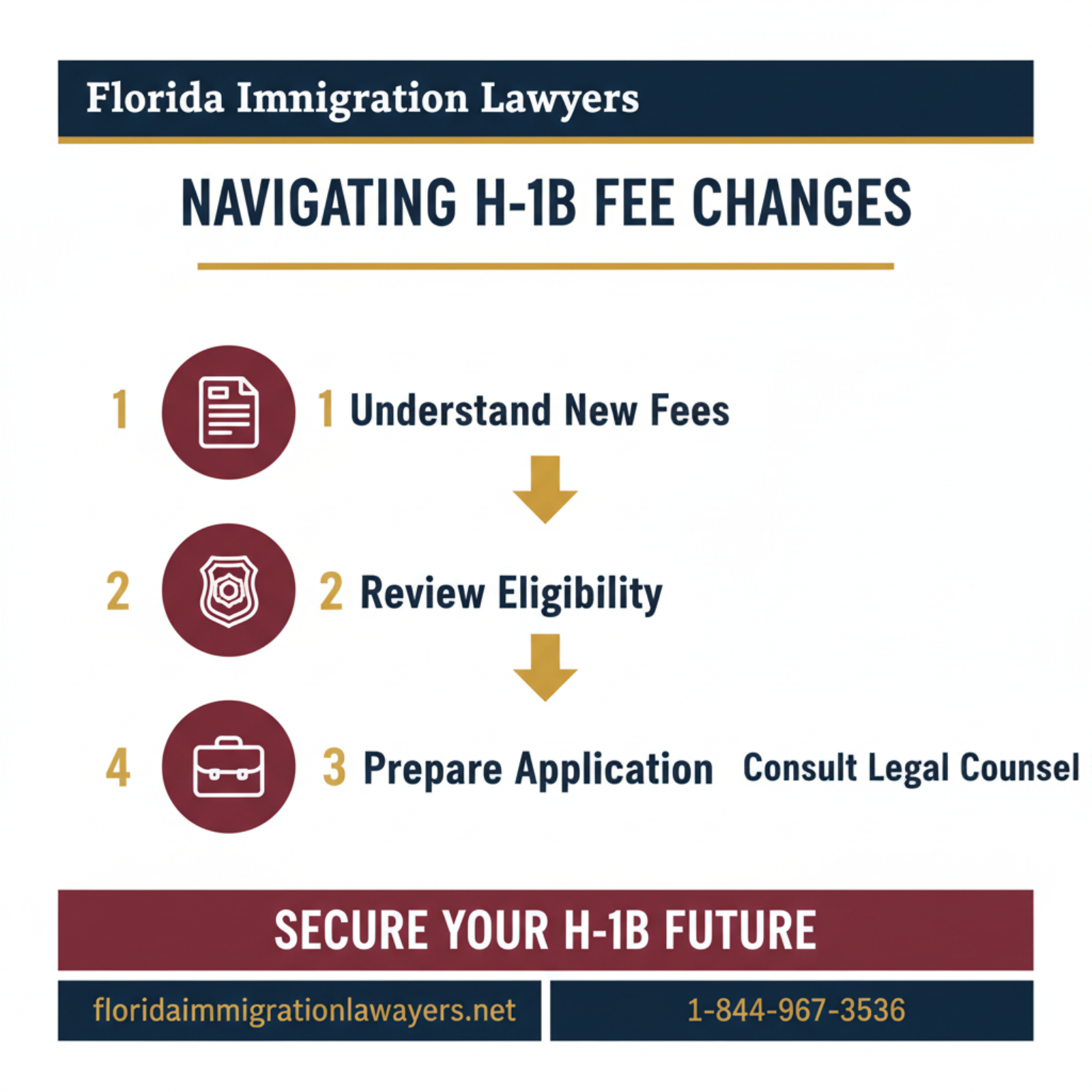
Additionally, certain petitions for extensions of stay or changes of employment for existing H-1B workers may not be subject to all new fees. It is crucial to determine if your organization or the beneficiary qualifies for any of these exemptions. Florida Immigration Lawyers can help you assess your eligibility and ensure you claim all applicable waivers.
Timeline and Processing Expectations for H-1B Visas in 2026
The H-1B visa process can be lengthy, and the H-1B visa fee increase does not necessarily shorten processing times. USCIS processing times vary widely based on the service center, case volume, and the complexity of the petition. It is essential to plan accordingly, especially if you have critical start dates for new employees.
Typically, the LCA certification process takes 7-10 business days. After that, the I-129 petition processing can range from several months to over a year. Premium processing, which guarantees a 15-calendar-day processing time for an additional fee, is often available. However, the premium processing fee itself is also subject to increase and availability.
For cap-subject petitions, the annual lottery usually occurs in March, with petitions filed in April for an October 1st start date. Any delays can push back employment authorization significantly. Proactive preparation and submission of a complete, accurate petition are your best defenses against extended waits.
Cost Factors and Fee Breakdown for H-1B Visas in Florida
Understanding the full financial commitment is vital for any employer considering an H-1B visa. The H-1B visa fee increase in 2026 will impact several components of the overall cost. These fees are generally paid by the employer, as required by law, to prevent the burden from falling on the foreign worker.
Here's a breakdown of typical fees, noting that specific amounts are subject to change by USCIS:
- USCIS Base Filing Fee for Form I-129: This is the core fee for the petition itself.
- American Competitiveness and Workforce Improvement Act (ACWIA) Fee: This fee supports U.S. worker training and education. It varies based on the employer's size (e.g., $750 for employers with 1-25 full-time equivalent employees, $1,500 for employers with 26 or more).
- Fraud Prevention and Detection Fee: A standard fee applied to all initial H-1B petitions and petitions for new employment.
- Public Law 114-113 Fee (for certain employers): An additional fee of $4,000 for employers with 50 or more employees, where 50% or more are H-1B or L-1 nonimmigrants.
- H-1B Lottery Registration Fee: A smaller fee for each registration submitted during the annual lottery.
- Premium Processing Fee (Optional): This expedited service comes with a significant additional cost, which is also subject to increase.
- Attorney Fees: Fees for legal representation from an immigration law firm like Florida Immigration Lawyers. These vary based on complexity and services provided.
- Other Costs: These may include educational evaluations, translation services, and mailing costs.
Employers must budget carefully for these fees. The potential for a h1b visa $100000 fee for certain situations underscores the need for thorough financial planning. Ensure you understand all potential costs associated with the US H1B visa cost increase.
Do not navigate this complex process alone. The stakes are too high. Contact Florida Immigration Lawyers today to ensure your H-1B petition is handled with precision and expertise. Our team is ready to provide the guidance you need.
Common Mistakes to Avoid with H-1B Visa Petitions and New Fees
Navigating the H-1B visa process, especially with new fee structures, can be fraught with potential pitfalls. Avoiding these common mistakes is crucial for a successful outcome.
- Failing to Budget for Increased Fees: Many employers underestimate the total financial impact of the H-1B visa fee increase. This can lead to delays or inability to pay required fees, jeopardizing the entire application.
- Incorrectly Calculating Prevailing Wage: Not paying the correct prevailing wage, as determined by the Department of Labor, can result in LCA denials, USCIS petition denials, or even investigations and significant fines.
- Missing H-1B Lottery Deadlines: For cap-subject petitions, missing the annual registration window means waiting another year for a chance. This can severely disrupt business operations and talent acquisition plans in Florida.
- Incomplete or Inaccurate Documentation: Any missing forms, unsigned documents, or inconsistencies can lead to Requests for Evidence (RFEs) or outright denials, significantly prolonging the process and increasing costs.
- Not Proving "Specialty Occupation": Failing to clearly demonstrate that the position requires a bachelor's degree or higher in a specific field is a common reason for denial. The job duties must align with the degree.
- Beneficiary Qualification Issues: The foreign worker must possess the required educational background and experience for the specialty occupation. Inadequate proof or discrepancies can jeopardize the petition's approval.
- Ignoring Public Access File Requirements: Employers must maintain a public access file for each H-1B worker at their principal place of business. Failure to do so can result in penalties and compliance issues.
- Misunderstanding Fee Exemption Eligibility: Incorrectly assuming eligibility for H1B visa fee exceptions can lead to underpayment, causing rejection of the petition or significant delays while correcting the fees.
- Late Filing of Petitions: Submitting petitions too close to deadlines increases the risk of errors and may not allow sufficient time for corrections or responses before a critical start date.
- Improperly Responding to RFEs: Receiving a Request for Evidence requires a timely, comprehensive, and legally sound response. A weak or incomplete response is a leading cause of petition denial.
- Not Consulting an Experienced Attorney: Attempting to navigate the complexities of H-1B visas, especially with new fee regulations and the potential for a h1b visa $100000 fee, without legal counsel often leads to costly mistakes, prolonged processes, and ultimate denial.
When to Call a Florida Immigration Lawyer for H-1B Visa Assistance
The landscape of H-1B visas is constantly changing, and the upcoming H-1B visa fee increase makes expert legal guidance more important than ever. While some employers might consider handling the process themselves, the complexities and potential for costly errors are significant. Here are specific scenarios where contacting Florida Immigration Lawyers is highly recommended:
- Understanding New Fee Structures: When you need clarification on the new USCIS H-1B visa fees, including the potential h1b visa $100000 fee and how they apply to your specific case.
- Complex Case Scenarios: If your company has unique organizational structures, the beneficiary has an unusual educational background, or the job duties are not clearly defined as a specialty occupation.
- Previous Denials or RFEs: If you have experienced a previous H-1B denial or received a Request for Evidence (RFE), our attorneys can help you identify the issues and strategize for re-filing or responding.
- Employer Compliance Concerns: Ensuring your company remains compliant with Department of Labor and USCIS regulations, especially regarding prevailing wage and public access files.
- H1B Visa Fee Exceptions: Determining if your organization or the beneficiary qualifies for any H1B visa fee exceptions that could save significant costs.
- Strategic Planning for Talent Acquisition: When you need assistance integrating H-1B sponsorship into your long-term talent acquisition strategy, especially in competitive markets like Orlando.
- Deportation Defense Concerns: If an H-1B worker faces issues that could lead to deportation defense, immediate legal intervention is critical.
- Transitioning to Green Card: For H-1B holders looking to transition to permanent residency, our firm also specializes in family immigration and business immigration pathways to green cards.
- General Immigration Guidance: For any questions related to immigration law or other visa categories.
Our dedicated attorneys at Florida Immigration Lawyers are well-versed in the latest immigration policies and regulations. We serve clients across Florida, including Orlando, Miami, Tampa, and Jacksonville. We are committed to providing personalized and effective legal solutions. Contact us today to discuss your H-1B visa needs.
Frequently Asked Questions About H-1B Visa Fee Increases
We understand you have many questions about the H-1B visa program and the recent fee adjustments. Here are answers to some commonly asked questions:
- Who pays the $100,000 for H-1B? The proposed h1b visa $100000 fee, if finalized, is generally intended to be paid by the sponsoring employer. U.S. immigration law prohibits employers from passing most H-1B filing fees directly onto the foreign worker. The specific circumstances under which this fee would apply are still being clarified by USCIS, but it is typically aimed at certain large employers or specific types of petitions.
- How much is a Green Card? The cost of a Green Card varies significantly depending on the specific immigration pathway (e.g., family-based, employment-based, asylum). It involves various USCIS filing fees, medical examination fees, and potentially attorney fees. These costs are separate from H-1B visa fees. For a detailed breakdown, it's best to consult with an immigration attorney. Our firm can assist with citizenship and green card applications.
- Who gets the H-1B visa? The H-1B visa is designed for foreign nationals who will be employed in a "specialty occupation" in the U.S. This means the job typically requires a bachelor's degree or higher in a specific field, and the applicant must possess that degree or its equivalent. The visa is primarily for skilled professionals in fields like IT, engineering, medicine, and education.
- What is the H-1B visa fee increase? The H-1B visa fee increase refers to the upcoming adjustments by USCIS to various fees associated with filing H-1B petitions, effective in 2026. These increases impact the base filing fee, ACWIA fee, Fraud Prevention and Detection fee, and potentially new or higher fees like the discussed h1b visa $100000 fee. The goal is to cover USCIS operational costs and fund specific programs.
Florida Immigration Lawyers is a premier law firm dedicated to providing exceptional immigration legal services across the entire state of Florida. With offices strategically located to serve communities from Orlando to Miami, Tampa to Jacksonville, we are committed to helping individuals, families, and businesses navigate the complexities of U.S. immigration law. Our experienced attorneys bring a wealth of knowledge and a compassionate approach to every case.
We specialize in a broad range of immigration matters, including H-1B visas, family-based petitions, employment visas, asylum claims, deportation defense, and pathways to citizenship. Our firm understands the unique challenges faced by immigrants in Florida and strives to provide clear, effective, and ethical legal representation. We pride ourselves on our client-focused approach and our unwavering dedication to achieving the best possible outcomes.
When you choose Florida Immigration Lawyers, you gain a partner who is available 24/7 to address your concerns. We offer free consultations to evaluate your situation and discuss your options without obligation. Our bilingual team is proficient in English and Spanish, ensuring clear communication and culturally sensitive service. Let us put our expertise to work for you. Phone: 1-844-967-3536 Website: https://www.floridaimmigrationlawyers.net
Sources and References
- U.S. Citizenship and Immigration Services (USCIS)
- U.S. Department of Labor (DOL) - H-1B Program
- 8 U.S.C. § 1101(a)(15)(H)(i)(b) - Immigration and Nationality Act (INA) defining H-1B nonimmigrants
- 8 U.S.C. § 1184(g) - Immigration and Nationality Act (INA) on numerical limitations (cap)
- 8 CFR § 214.2(h) - Regulations governing H nonimmigrants
- American Competitiveness and Workforce Improvement Act of 1998 (ACWIA) - Public Law 105-277
- Public Law 114-113 - Consolidated Appropriations Act, 2016, regarding certain H-1B and L-1 fees
This article provides general legal information and is not intended as legal advice. Every case is unique, and outcomes depend on specific facts and circumstances. Contact an attorney for advice about your particular situation.
Navigating the complexities of the H-1B visa fee increase in 2026 requires expert guidance and meticulous preparation. Don't leave your future or your business's talent needs to chance. Florida Immigration Lawyers is here to provide the dedicated and knowledgeable legal support you deserve. Reach out to us today for a free, no-obligation consultation. Call 1-844-967-3536. Se Habla Español - Estamos aquí para ayudarle.
Do Not Navigate This Process Alone
Our experienced immigration attorneys are ready to fight for you. Get a free, confidential consultation today.
Se Habla Español
Frequently Asked Questions
Florida Immigration Lawyers
Immigration Attorney | Founder, Vasquez Law Firm
U.S. Air Force veteran and immigration attorney with thousands of cases resolved. J.D., NCCU School of Law. AILA member. Admitted to the 4th, 5th, and 11th Circuit Courts.
Available 24/7 - Free Evaluations
Related Legal Services
Our Florida immigration attorneys can help you with asylum protection, deportation defense and citizenship and naturalization. Call today at 1-844-967-3536 for a free consultation.
Related Links
Related Topics
Free Legal Consultation
Discuss your case with our experienced attorneys. We're available 24/7.
Se Habla Español - Estamos aquí para ayudarle.
Related Articles
Expungement Effect on Immigration in Florida | VLF Florida
Discover how expungement impacts immigration in Florida. Learn about eligibility, the process, and potential consequences. Contact Florida Immigration Lawyers at 1-844-967-3536 for a free consultation.
Immigration Services in Kissimmee Florida | VLF Florida
Discover essential immigration services in Kissimmee, Florida. Learn about the resources available for immigrants, including Puerto Rican residents in Osceola County. Contact Florida Immigration Lawyers at 1-844-967-3536 for expert guidance and a free consultation.
Child Status Protection Act (CSPA) Florida: Preventing 'Aging
Understand the Child Status Protection Act (CSPA) in Florida and how it prevents 'aging out' for derivative beneficiaries. Navigate complex immigration laws
I-360 Widow Self-Petition in Florida: A Complete Guide
Learn how to navigate the I-360 widow self-petition process in Florida. This comprehensive guide covers eligibility, documentation, and common mistakes. Call Florida Immigration Lawyers for expert assistance.
