H-1B Visa Fee Increase Florida 2026: Navigating New
The H-1B visa program is vital for many skilled foreign workers and Florida employers. With potential fee increases slated for 2026, staying informed is crucial. This comprehensive guide outlines the expected H-1B visa fee increase, processing changes, and how these affect applicants and businesses in Fort Lauderdale and across Florida. We cover the application steps, essential documents, timelines, and discuss the specific circumstances that might trigger higher fees, including the much-discussed $100,000 fee. Prepare effectively for your H-1B petition with expert insights.

The H-1B visa program faces significant changes in 2026, including a notable H-1B visa fee increase from USCIS. These adjustments will impact employers and skilled foreign workers across Florida, including Fort Lauderdale. Understanding the new cost structure, application requirements, and specific exemptions is crucial for a successful petition. Proactive planning and expert legal guidance are essential to navigate these evolving immigration policies effectively.
- New USCIS fees for H-1B petitions are expected in 2026.
- The application process will remain rigorous, requiring meticulous documentation.
- Certain employers or specific legislative proposals may involve a higher "$100,000 fee" under specific circumstances, not universally.
- Consulting an experienced Florida immigration lawyer is vital for compliance and success.
- Preparation for the H-1B lottery and petition filing must account for these new financial and procedural demands.
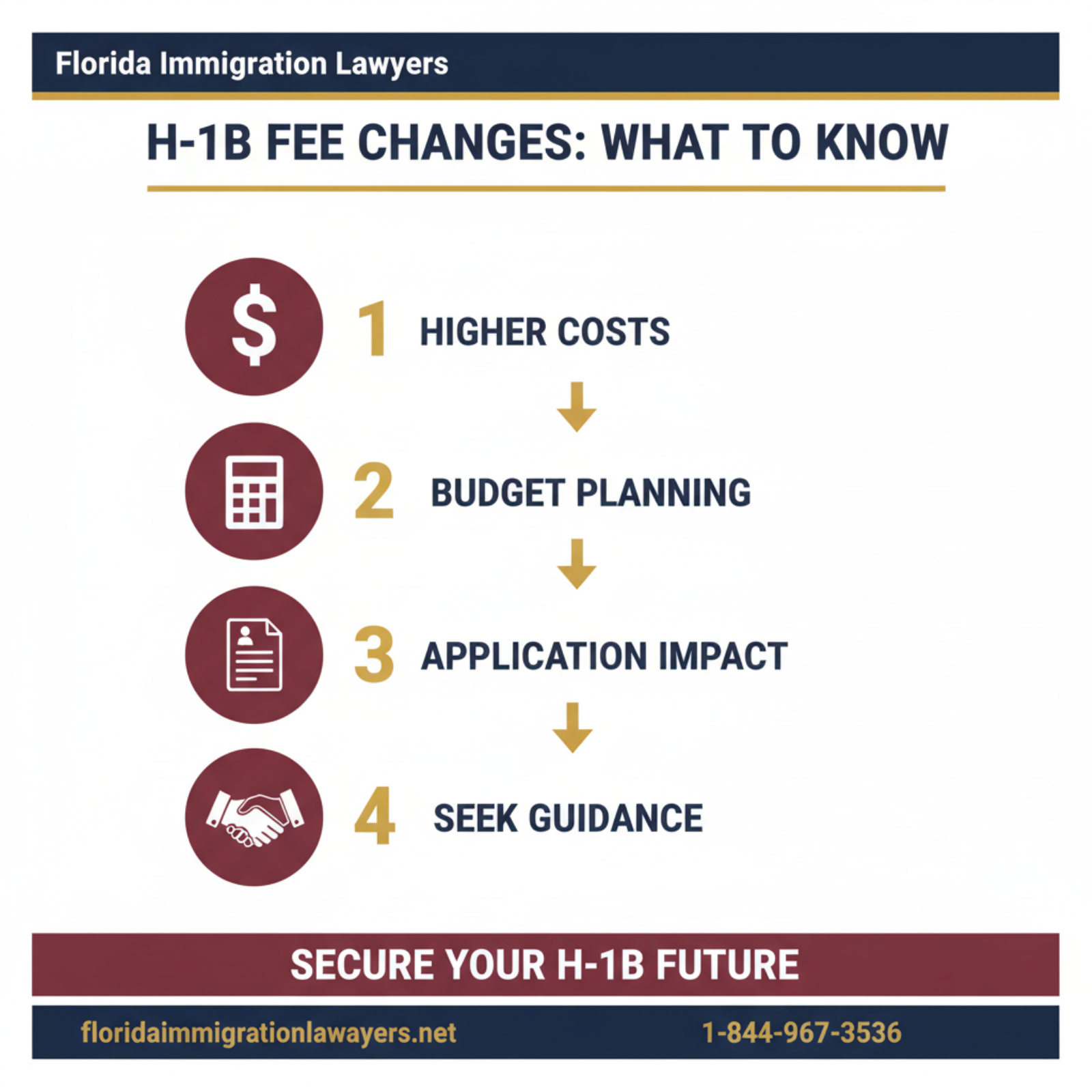
The H-1B visa is a cornerstone of the U.S. economy, enabling American employers to hire highly skilled foreign professionals in specialty occupations. For businesses and talented individuals in Florida, particularly in thriving areas like Fort Lauderdale, the H-1B program is a critical pathway for innovation and growth. However, significant changes are on the horizon, with the U.S. Citizenship and Immigration Services (USCIS) implementing a substantial H-1B visa fee increase set for 2026.
These impending fee adjustments present new challenges and complexities for both petitioners and beneficiaries. Navigating these changes requires a clear understanding of the new cost structure, updated application procedures, and potential exemptions. This comprehensive guide will walk you through everything you need to know about the H-1B visa fee increase in Florida for 2026, offering insights and practical advice to help you prepare effectively.
We understand that immigration processes can be daunting, especially with new regulations. That's why our team at Florida Immigration Lawyers is here to support you every step of the way. Do not face these changes alone. Call Florida Immigration Lawyers at 1-844-967-3536 for a free consultation to discuss your H-1B visa options and how the new fees may impact your case.
Understanding the H-1B Visa Fee Increase in Florida for 2026
The H-1B nonimmigrant visa program allows U.S. employers to temporarily employ foreign workers in specialty occupations. These occupations generally require a bachelor's degree or higher in a specific field, encompassing roles in technology, engineering, medicine, and more. Florida, with its booming tech sector, healthcare industry, and diverse economy, relies heavily on this program to attract global talent. (See: U.S. Citizenship and Immigration Services (USCIS) for official program details).
Historically, USCIS fees are adjusted periodically to cover operational costs, fund new initiatives, and manage the growing volume of applications. The announced H-1B visa fee increase for 2026 is part of a broader effort to ensure the agency's financial stability and improve processing times. These adjustments reflect the rising administrative expenses associated with adjudicating petitions and maintaining robust immigration services.
For businesses in Fort Lauderdale, Miami, Orlando, and Tampa, understanding these new financial obligations is paramount. The increased costs could influence hiring decisions and budget allocations for international talent. Similarly, skilled foreign workers planning to seek H-1B sponsorship in Florida need to be aware of the higher expenditures involved in their immigration journey.
The fee structure for H-1B petitions includes several components, such as the base filing fee, the American Competitiveness and Workforce Improvement Act (ACWIA) fee, the Fraud Prevention and Detection fee, and potentially a Public Law 114-113 fee for certain employers. Each of these components is subject to review and adjustment, contributing to the overall H-1B visa fee increase. It is important to remember that these fees are typically paid by the employer, not the employee, though specific arrangements can vary.
Navigating the H-1B Visa Application Process in 2026
The H-1B visa process is highly competitive and complex, particularly due to the annual cap of 85,000 visas (65,000 regular cap and 20,000 for those with a U.S. master's degree or higher). The process begins well before the April 1st filing date for the fiscal year starting October 1st. Preparing early is key to a successful outcome.
Eligibility Requirements for H-1B Visa Applicants
To qualify for an H-1B visa, both the employer and the employee must meet specific criteria. The employer must demonstrate that the position is a "specialty occupation," requiring theoretical and practical application of a body of highly specialized knowledge, and a bachelor's degree or its equivalent. The employer must also agree to pay at least the prevailing wage for the occupation in the area of intended employment, as determined by the Department of Labor.
For the employee, eligibility typically requires holding a bachelor's degree or its equivalent, or possessing a license in a specialty occupation field, or having work experience equivalent to a bachelor's degree. This ensures that only highly qualified individuals fill critical roles. Our Florida immigration lawyers can help you assess your eligibility thoroughly.
The H-1B Lottery and Selection Process
Due to the annual cap, USCIS conducts an electronic registration lottery if the number of registrations exceeds the available visas. Employers must register prospective H-1B workers electronically during a designated period, typically in March. Only those registrations selected in the lottery are eligible to file an H-1B petition. This random selection process underscores the importance of a well-prepared registration.
Here is a step-by-step guide to the H-1B visa application process:
-
Employer Determines Eligibility: The sponsoring employer first confirms that the position qualifies as a specialty occupation and that the prospective employee meets the educational and experiential requirements. This initial assessment is critical for avoiding later issues.
-
Labor Condition Application (LCA) Filing: The employer files a Form ETA-9035, Labor Condition Application, with the U.S. Department of Labor (DOL). The LCA attests that the employer will pay the H-1B worker at least the prevailing wage or actual wage, whichever is higher, and will provide working conditions that will not adversely affect other workers. The LCA must be certified by the DOL before filing the H-1B petition.
-
Electronic Registration with USCIS: If the H-1B cap is reached, employers must register their prospective H-1B employees online with USCIS during a specific registration period. A non-refundable registration fee is required for each submission. This step determines who is eligible to file a full petition.
-
H-1B Cap Lottery (If Applicable): If USCIS receives more registrations than available visas, a random lottery is conducted. Only selected registrations proceed to the next stage. Notifications of selection are typically issued by the end of March.
-
File Form I-129 Petition: For selected registrations, the employer files Form I-129, Petition for a Nonimmigrant Worker, with USCIS within the designated filing window. This petition includes detailed information about the employer, the employee, the job, and the terms of employment. All required fees, including the new H-1B visa fee increase, must be submitted at this stage.
-
Submit Supporting Documents: A comprehensive package of supporting documents must accompany Form I-129. This includes educational credentials, professional licenses, previous employment verification, and detailed information about the sponsoring company. Accuracy and completeness are paramount.
-
Respond to Requests for Evidence (RFEs): USCIS may issue an RFE if they require additional information or clarification. Prompt and thorough responses are crucial to prevent delays or denials. An RFE often indicates a complex issue that benefits from legal counsel.
-
Attend Biometrics and Interview (If Applicable): Depending on the situation, the applicant may need to attend a biometrics appointment or an interview at a U.S. embassy or consulate abroad (for consular processing). For those already in the U.S. seeking a change of status, an interview is less common but possible.
-
Receive Decision: USCIS reviews the petition and issues a decision. If approved, the H-1B visa is granted, allowing the individual to work in the U.S. for the sponsoring employer. Our firm assists clients throughout this entire process, from Fort Lauderdale to Pensacola.
Essential Documents for Your H-1B Visa Petition
A successful H-1B petition relies on a meticulously prepared document package. Gathering all necessary paperwork well in advance can significantly reduce stress and prevent delays. Ensure all documents are current, accurate, and properly translated if not in English. The H-1B visa fee increase makes avoiding errors even more critical to prevent re-filing.
Here is a comprehensive checklist of documents typically required:
- Certified Labor Condition Application (LCA): Form ETA-9035, approved by the Department of Labor.
- Form I-129, Petition for a Nonimmigrant Worker: The primary petition form, correctly filled out and signed.
- Supplement H-1B Data Collection and Filing Fee Exemption: Relevant supplements to Form I-129.
- Employer's Letter of Support: A detailed letter from the sponsoring employer explaining the job offer, the nature of the specialty occupation, and why the applicant is qualified.
- Beneficiary's Educational Documents: Copies of diplomas, degrees, transcripts, and any professional licenses. Foreign degrees may require an educational equivalency evaluation.
- Beneficiary's Resume/CV: A detailed overview of work experience, skills, and qualifications.
- Letters of Experience: Documentation from previous employers verifying work experience, especially if relying on experience in lieu of a degree.
- Passport and Visa Copies: Copies of the beneficiary's valid passport, current U.S. visa (if applicable), and I-94 arrival/departure record.
- Employer's Business Documents: Articles of incorporation, business licenses, federal tax ID number, financial statements, and other evidence of the company's legitimacy and ability to pay the prevailing wage.
- Client Letters/Vendor Contracts: For consulting firms, letters from end-clients or contracts detailing the project and the H-1B worker's role.
- Photographs: Passport-style photographs of the beneficiary meeting USCIS specifications.
- Proof of Employer-Employee Relationship: Documentation like organizational charts, employee agreements, and supervision details, especially for third-party placements.
H-1B Visa Processing Timelines and Expectations
Understanding the potential waiting periods is crucial for both employers and H-1B applicants. H-1B processing times can vary significantly based on several factors, including the USCIS service center handling the petition, the volume of applications, and whether premium processing is utilized. The H-1B visa fee increase does not necessarily guarantee faster processing, but it aims to support agency operations.
Regular processing for an H-1B petition can take anywhere from a few months to over a year, especially if an RFE is issued. USCIS provides estimated processing times on its website, which are updated regularly. It is always wise to check the latest estimates for the specific service center processing your case. For Florida applicants, petitions are typically processed at the Vermont Service Center or California Service Center, depending on the employer's location.
For those requiring a faster decision, USCIS offers Premium Processing Service. By paying an additional fee, petitioners can request USCIS to adjudicate their Form I-129 petition within 15 calendar days. This service is invaluable for urgent business needs or critical hiring timelines. However, even premium processing can be temporarily suspended during peak filing periods, so planning is essential.
It is important to manage expectations regarding timelines. While some cases are processed quickly, others face unforeseen delays. Working with an experienced immigration lawyer can help you anticipate potential issues and prepare accordingly, minimizing the impact of processing variations on your plans in Florida.
Understanding H-1B Visa Cost Factors and the Fee Breakdown
The total cost of an H-1B visa petition is comprised of several fees, many of which are subject to the upcoming H-1B visa fee increase in 2026. It is critical to understand each component to budget accurately and ensure all necessary payments are made. Remember, USCIS does not provide refunds for denied petitions.
-
USCIS Base Filing Fee: This is the fundamental fee for filing Form I-129. This fee is subject to the general increase. (Refer to 8 CFR 103.7(b)(1) for fee regulations).
-
American Competitiveness and Workforce Improvement Act (ACWIA) Fee: Employers with 25 or fewer full-time equivalent employees generally pay a lower ACWIA fee, while those with 26 or more employees pay a higher amount. This fee supports U.S. worker training and education programs.
-
Fraud Prevention and Detection Fee: This fee is required for all initial H-1B petitions and for petitions filed by a new employer. It helps fund USCIS efforts to combat fraud in the H-1B program.
-
Public Law 114-113 Fee (for "H-1B Dependent" Employers): Some employers, particularly those with a high percentage of H-1B workers (known as H-1B dependent employers) or those employing 50 or more employees with 50% or more H-1B or L-1 nonimmigrants, are subject to an additional fee. This fee is a significant cost factor for certain large companies.
-
H-1B Registration Fee: A smaller, non-refundable fee is required for each electronic registration submitted during the annual H-1B lottery period. This fee also saw an increase.
-
Premium Processing Fee (Optional): If you opt for expedited processing, an additional, substantial fee is paid. This fee also increased recently and may see further adjustments.
Regarding the question, "Who pays the $100,000 for H-1B?" it's important to clarify. A $100,000 fee for H-1B visas has been proposed in legislative discussions, specifically targeting certain scenarios or types of employers. For instance, some proposals have focused on "mega-employers" or those heavily reliant on H-1B workers, or to exempt certain critical sectors like healthcare. As of early 2026, this is not a universal fee for all H-1B petitions. Any such fee would typically be paid by the sponsoring employer, not the beneficiary. Our firm closely monitors legislative developments concerning `H1B 100k fee exemption` and other proposed fee structures.
Concerning the query, "Do I have to pay $250 to enter the US?" this is generally not a fee associated with the H-1B visa itself. Entry fees to the U.S. can vary widely depending on nationality and visa type (e.g., ESTA fee for Visa Waiver Program, I-94 fee for certain land border entries). For H-1B visa holders, the primary costs are the petition fees paid by the employer and any consular processing fees for the visa stamp abroad, which are distinct from a general entry fee.
Many individuals also wonder, "How much salary is required for an H-1B visa?" The H-1B program mandates that employers pay at least the prevailing wage for the occupation in the area of intended employment, or the actual wage paid to other employees with similar experience and qualifications, whichever is higher. This amount varies significantly by job title, industry, experience level, and geographic location within Florida, such as Fort Lauderdale versus a rural area. The Department of Labor provides resources to determine prevailing wages.
Finally, regarding "How much is a Green Card?" it is important to distinguish this from the H-1B visa process. An H-1B is a nonimmigrant visa for temporary work, while a Green Card grants permanent residency. The application process and associated fees for a Green Card are separate and typically much more extensive. While many H-1B holders do pursue Green Cards, it is a distinct legal pathway with different cost implications.
The total expenses for an H-1B petition can be substantial, and the H-1B visa fee increase will only add to this burden. Employers, especially those sponsoring `H1B visa for F1 students` transitioning from OPT, must budget carefully. It is crucial not to cut corners on legal advice or petition preparation to save on costs, as errors can lead to denials and even greater financial losses.
Do not navigate this complex and evolving process alone. Contact Florida Immigration Lawyers today at 1-844-967-3536 to ensure your H-1B petition is prepared accurately and strategically, especially with the impending fee changes.
Common Mistakes to Avoid in Your H-1B Visa Application
The H-1B visa application process is unforgiving of errors. Even minor mistakes can lead to significant delays, Requests for Evidence (RFEs), or outright denials, costing valuable time and resources. With the H-1B visa fee increase, avoiding these pitfalls is more crucial than ever. Here are some common mistakes we often see:
-
Incomplete or Inaccurate Forms: Failing to fill out all sections of Form I-129 and its supplements completely and accurately. USCIS rejects petitions with missing information, requiring resubmission and potential loss of lottery selection.
-
Incorrect or Uncertified LCA: Submitting an LCA (Labor Condition Application) that contains errors, is outdated, or has not been certified by the Department of Labor. An uncertified LCA will lead to an immediate rejection of the H-1B petition.
-
Lack of "Specialty Occupation" Proof: Failing to clearly demonstrate that the offered position truly requires a bachelor's degree or its equivalent in a specific field. Vague job descriptions or roles that could be performed by someone without a specialized degree are often challenged.
-
Late Filing or Missed Deadlines: Submitting the H-1B petition outside the designated filing window, especially after a lottery selection. Strict deadlines apply, and missing them means waiting for the next fiscal year.
-
Insufficient Supporting Evidence: Not providing enough documentation to support claims of eligibility for both the employer and the beneficiary. This often leads to RFEs, prolonging the process.
-
Employer Misrepresentation: Providing false or misleading information about the company, the job, or the beneficiary. This can result in severe penalties, including fraud charges and future immigration bars.
-
Not Responding to RFEs Promptly or Adequately: Failing to submit all requested evidence by the RFE deadline, or providing an incomplete response. This is a common cause of denials.
-
Ignoring the H-1B Visa Fee Increase: Submitting incorrect fee amounts, especially after the new 2026 fee schedule takes effect. This will result in rejection of the petition.
-
Poorly Defined Employer-Employee Relationship: For third-party placements or consulting roles, failing to adequately prove that the petitioning employer maintains control over the H-1B worker. USCIS scrutinizes these relationships closely.
-
Assuming Lottery Selection: Proceeding with other life plans (e.g., resigning from a job, making travel arrangements) before receiving official confirmation of H-1B lottery selection. Selection is never guaranteed.
-
Travel Issues During Processing: Traveling outside the U.S. while a change of status H-1B petition is pending without consulting an attorney. This can lead to abandonment of the application.
When to Call a Florida Immigration Lawyer for H-1B Assistance
While this guide provides general information, the complexities of immigration law, especially with the upcoming H-1B visa fee increase and evolving policies, make professional legal counsel invaluable. Florida Immigration Lawyers are dedicated to guiding individuals and businesses through these intricate processes, serving clients from Fort Lauderdale, Miami, Orlando, and across the entire state.
You should consider contacting an experienced immigration attorney in the following scenarios:
- Initial Application Guidance: If you are an employer sponsoring an H-1B worker for the first time, or if you are an individual seeking H-1B sponsorship. We ensure your petition is strong from the outset.
- Complex Eligibility Issues: If there are questions about whether the position qualifies as a specialty occupation, or if the beneficiary's qualifications are unconventional (e.g., relying on work experience in lieu of a degree).
- Responding to Requests for Evidence (RFEs): An RFE indicates USCIS has concerns about your petition. An attorney can craft a comprehensive and legally sound response, significantly increasing your chances of approval.
- H-1B Cap Exempt Petitions: If you are seeking an H-1B visa under a cap-exempt category (e.g., employment with higher education institutions, non-profit research organizations), an attorney can confirm eligibility and navigate specific requirements.
- Change of Employer or Amendments: When an H-1B worker changes employers, or if there are significant changes to the terms of employment, new petitions or amendments are often required.
- Denials and Appeals: If your H-1B petition has been denied, an attorney can review the decision, advise on potential appeals, or explore other immigration pathways.
- Compliance Concerns: Employers need to ensure ongoing compliance with H-1B regulations, including LCA requirements and public access file maintenance.
- Strategic Planning: For businesses planning long-term talent acquisition strategies involving H-1B visas, including transitioning `H1B visa for F1 students` from OPT to H-1B, legal counsel provides foresight and planning.
- Concerns about the $100,000 Fee: If your company falls into a category that might be subject to the higher fees or is seeking an `H1B 100k fee exemption`, expert advice is critical.
Our attorneys at Florida Immigration Lawyers specialize in various immigration matters, including general immigration, business immigration, and family immigration. We have a deep understanding of USCIS regulations and local Florida contexts, and we are committed to providing personalized, effective legal solutions. Visit our attorneys page to learn more about our team.
About Florida Immigration Lawyers
Florida Immigration Lawyers is a leading law firm dedicated to providing exceptional immigration legal services across the entire state of Florida. With offices strategically located to serve diverse communities, we are committed to helping individuals, families, and businesses navigate the complexities of U.S. immigration law. Our experienced team of attorneys understands the unique challenges faced by immigrants and employers in Florida, including those in Fort Lauderdale, Miami, Orlando, and Tampa.
We offer a comprehensive range of immigration services, including but not limited to H-1B visas, Green Cards, family-based petitions, asylum claims, deportation defense, and citizenship applications. Our approach is client-centered, focusing on clear communication, strategic planning, and aggressive advocacy to achieve the best possible outcomes for our clients.
Choosing Florida Immigration Lawyers means partnering with a team that genuinely cares about your future. We pride ourselves on our deep legal knowledge, our empathetic approach, and our unwavering commitment to justice. We are available 24/7 to address your urgent immigration concerns and offer free, confidential consultations to assess your situation and explain your legal options.
Do not let the complexities of immigration law overwhelm you. Let our dedicated team provide the expert guidance you need. Visit our website at https://www.floridaimmigrationlawyers.net or call us directly at 1-844-967-3536 to schedule your free consultation today.
Sources and References
- U.S. Citizenship and Immigration Services (USCIS) - H-1B Specialty Occupations
- U.S. Department of State - H-1B Specialty Occupations
- Executive Office for Immigration Review (EOIR)
- 8 U.S.C. Chapter 12 - Immigration and Nationality Act (INA)
- INA Section 101(a)(15)(H)(i)(b) - Definition of H-1B Nonimmigrant
- INA Section 214(g) - Numerical Limitations on H-1B Visas
- 8 CFR 214.2(h) - Regulations for H-1B Visas
- 8 CFR 103.7(b)(1) - USCIS Fee Regulations
This article provides general legal information and is not intended as legal advice. Every case is unique, and outcomes depend on specific facts and circumstances. Immigration laws are subject to frequent change. Contact an attorney for advice about your particular situation and the most current regulations.
The landscape of H-1B visas is constantly evolving, and the H-1B visa fee increase for 2026 adds another layer of complexity. Ensuring your application is meticulously prepared and compliant with the latest regulations is paramount for success. Our team at Florida Immigration Lawyers is here to provide the expert guidance and robust representation you need to navigate these changes confidently.
Do not leave your immigration future to chance. Secure the professional legal support that makes a difference. Call Florida Immigration Lawyers today at 1-844-967-3536 for a free consultation. Se Habla Español - Estamos aquí para ayudarle.
Do Not Navigate This Process Alone
Our experienced immigration attorneys are ready to fight for you. Get a free, confidential consultation today.
Se Habla Español
Frequently Asked Questions
Florida Immigration Lawyers
Immigration Attorney | Founder, Vasquez Law Firm
U.S. Air Force veteran and immigration attorney with thousands of cases resolved. J.D., NCCU School of Law. AILA member. Admitted to the 4th, 5th, and 11th Circuit Courts.
Available 24/7 - Free Evaluations
Related Legal Services
Our Florida immigration attorneys can help you with free immigration consultation, experienced immigration attorneys and business immigration. Call today at 1-844-967-3536 for a free consultation.
Related Links
Related Topics
Free Legal Consultation
Discuss your case with our experienced attorneys. We're available 24/7.
Se Habla Español - Estamos aquí para ayudarle.
Related Articles
Expungement Effect on Immigration in Florida | VLF Florida
Discover how expungement impacts immigration in Florida. Learn about eligibility, the process, and potential consequences. Contact Florida Immigration Lawyers at 1-844-967-3536 for a free consultation.
Immigration Services in Kissimmee Florida | VLF Florida
Discover essential immigration services in Kissimmee, Florida. Learn about the resources available for immigrants, including Puerto Rican residents in Osceola County. Contact Florida Immigration Lawyers at 1-844-967-3536 for expert guidance and a free consultation.
Child Status Protection Act (CSPA) Florida: Preventing 'Aging
Understand the Child Status Protection Act (CSPA) in Florida and how it prevents 'aging out' for derivative beneficiaries. Navigate complex immigration laws
I-360 Widow Self-Petition in Florida: A Complete Guide
Learn how to navigate the I-360 widow self-petition process in Florida. This comprehensive guide covers eligibility, documentation, and common mistakes. Call Florida Immigration Lawyers for expert assistance.