Green Card Through Marriage Florida: Your Path to Permanent
Obtaining a green card through marriage in Florida can be a life-changing journey, offering a path to permanent residency for foreign nationals married to U.S. citizens or lawful permanent residents. This comprehensive guide from Florida Immigration Lawyers breaks down the entire marriage-based green card process, from initial eligibility requirements to the final interview. We cover crucial steps like filing Form I-130, adjustment of status, and consular processing. Understanding the nuances of immigration law is vital, especially with the specific requirements and processing times relevant to Florida residents. Discover how to navigate the complexities, avoid common pitfalls, and secure your future in the Sunshine State. We are here to help you every step of the way.

To obtain a green card through marriage in Florida, you must be married to a U.S. citizen or lawful permanent resident. The process involves filing Form I-130, then either adjusting status within the U.S. or undergoing consular processing abroad. Eligibility, a genuine marriage, and proper documentation are crucial for success.
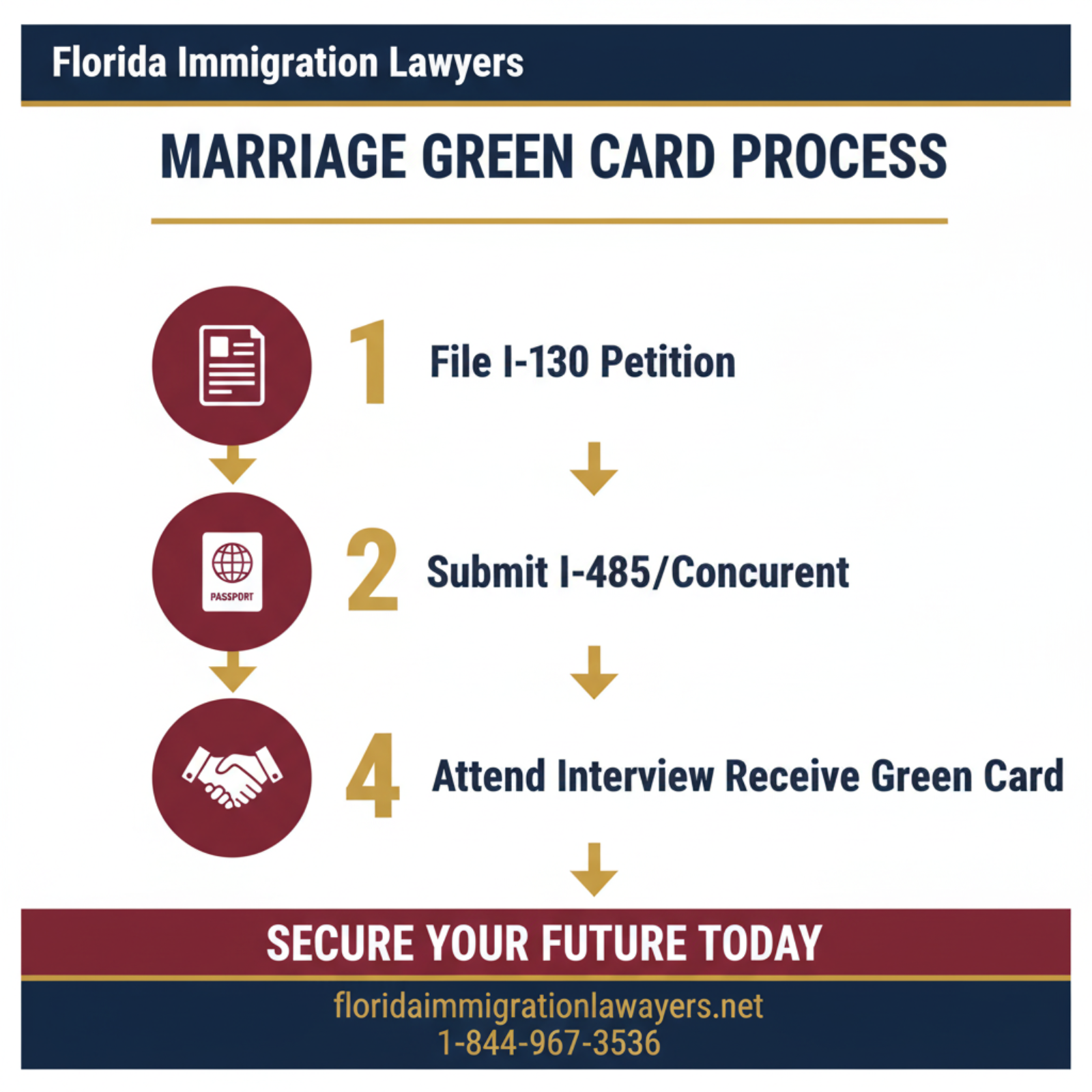
- File Form I-130 (Petition for Alien Relative) with USCIS.
- Complete Form I-485 (Adjustment of Status) or consular processing.
- Attend an interview to prove your bona fide marriage.
- Expect processing times to vary, typically 12-24 months.
- Consult an immigration lawyer for personalized guidance.
Green Card Through Marriage Florida: Your Path to Permanent Residency
Are you married to a U.S. citizen or lawful permanent resident and dreaming of building a life together in the Sunshine State? The journey to obtaining a green card through marriage in Florida can feel overwhelming, filled with complex forms, strict deadlines, and detailed legal requirements. You are not alone in this process, and understanding each step is crucial for a successful outcome.
This comprehensive guide by Florida Immigration Lawyers will walk you through everything you need to know about securing your permanent residency based on marriage. We will cover eligibility, the application process, required documents, and what to expect along the way. Our goal is to demystify this process for you, providing clear, actionable information specific to individuals living in Florida.
Do not navigate this complex legal landscape without expert help. For personalized guidance and to discuss your unique situation, call Florida Immigration Lawyers at 1-844-967-3536 for a free consultation. We are here to support your journey to a new life in Florida.
Understanding the Green Card Through Marriage Process in Florida
A marriage-based green card is a pathway for foreign nationals to become lawful permanent residents of the United States. This status grants you the right to live and work permanently anywhere in the U.S., including vibrant communities like West Palm Beach and throughout Florida.
The core principle behind this type of visa is proving that your marriage is legitimate and not entered into solely for immigration purposes. U.S. Citizenship and Immigration Services (USCIS) scrutinizes these applications closely to prevent fraud, which is why detailed evidence and careful preparation are essential.
Who is Eligible for a Marriage-Based Green Card?
Eligibility for a green card through marriage Florida depends on several factors. First, you must be legally married to either a U.S. citizen or a lawful permanent resident (LPR). The marriage must be valid in the place where it occurred, and both spouses must have the legal capacity to marry.
Second, the foreign national spouse must be admissible to the United States. This means they generally must not have certain criminal records, previous immigration violations, or specific health-related issues that could deem them inadmissible under INA Section 212(a). For instance, specific health conditions like certain communicable diseases or mental health issues with harmful behavior may be grounds for inadmissibility, but conditions like diabetes typically are not unless they pose a public health risk or involve a lack of vaccination. In some cases, waivers may be available, but these add another layer of complexity to the process.
Finally, your marriage must be "bona fide," meaning it is real and genuine. You and your spouse must intend to establish a life together, not just obtain an immigration benefit. USCIS looks for compelling evidence of your shared life.
Adjustment of Status vs. Consular Processing
The path you take to obtain your green card depends on where the foreign national spouse is currently located. If you are already in the United States after a lawful entry, you may be eligible for adjustment of status Florida. This allows you to apply for permanent residency without leaving the country.
If you are residing outside the United States, or if you entered the U.S. without inspection, you will typically go through consular processing. This involves applying for an immigrant visa at a U.S. embassy or consulate in your home country. Both processes lead to the same outcome but have different procedural steps.
Step-by-Step Guide to Your Marriage-Based Green Card Application
Navigating the application for a green card through marriage Florida involves several critical stages. Each step requires meticulous attention to detail and adherence to USCIS guidelines. Here is a general outline of the process you can expect:
-
Step 1: File Form I-130, Petition for Alien Relative
The U.S. citizen or LPR spouse, known as the petitioner, initiates the process by filing Form I-130 with USCIS. This petition formally establishes the bona fide relationship between you and your spouse. You will need to provide evidence such as your marriage certificate, birth certificates, and proof of any previous marriage terminations. This is the foundational step for any family-based immigration petition.
-
Step 2: USCIS Processing of Form I-130
Once submitted, USCIS reviews your I-130 petition. They will send you a receipt notice, followed by a notice of approval or a Request for Evidence (RFE) if more information is needed. The processing times for I-130 can vary significantly based on the service center and the volume of applications. You can track your case status online using the receipt number.
-
Step 3: Apply for Adjustment of Status (Form I-485) or Consular Processing
If the foreign national spouse is in the U.S. and eligible, they will file Form I-485, Application to Register Permanent Residence or Adjust Status. This can often be filed concurrently with Form I-130 if the petitioner is a U.S. citizen and a visa is immediately available. For LPR petitioners, the foreign national spouse must wait until a visa number becomes available based on the Visa Bulletin.
If the foreign national spouse is abroad, the approved I-130 is sent to the National Visa Center (NVC). The NVC then collects required documents and fees before forwarding the case to the appropriate U.S. embassy or consulate for consular processing. This is a crucial distinction in the marriage-based green card process.
-
Step 4: Biometrics Appointment
Regardless of whether you are adjusting status or undergoing consular processing, the foreign national spouse will typically be scheduled for a biometrics appointment. This involves taking fingerprints, photographs, and a signature. These biometrics are used for background checks and identity verification.
-
Step 5: Interview with USCIS or Consular Officer
Both spouses will attend an interview. For adjustment of status cases, this interview takes place at a local USCIS office, such as the one serving West Palm Beach residents. For consular processing, the interview is at the U.S. embassy or consulate abroad. The purpose of the interview is to verify the authenticity of your marriage and to confirm eligibility. Be prepared to answer questions about your relationship and provide additional evidence.
-
Step 6: Decision and Receipt of Green Card
If your application is approved, the foreign national spouse will receive either a temporary (conditional) green card or a permanent green card. If your marriage is less than two years old on the day your green card is approved, you will receive a conditional green card, valid for two years. If your marriage is more than two years old, you will receive a 10-year permanent green card. Understanding the difference between a conditional green card and a permanent one is vital for future planning.
Essential Documents for Your Marriage-Based Green Card Application
Gathering the correct documentation is paramount for a successful green card through marriage Florida application. Missing or incorrect documents can lead to delays or even denial. This checklist provides a general overview of what you will typically need.
Required Documents Checklist:
- Proof of U.S. Citizenship or Lawful Permanent Residency: Petitioner's birth certificate, naturalization certificate, passport, or green card (Form I-551).
- Proof of Marriage: Your marriage certificate.
- Proof of Termination of Prior Marriages (if applicable): Divorce decrees or death certificates for both spouses.
- Birth Certificates: For both the U.S. citizen/LPR spouse and the foreign national spouse.
- Passport and Visa Information: Foreign national spouse's valid passport, visa, and I-94 arrival/departure record (if in the U.S.).
- Photographs: Passport-style photos for both spouses (specific requirements apply).
- Affidavit of Support (Form I-864): Filed by the U.S. citizen/LPR spouse, demonstrating financial ability to support the immigrant. This includes tax returns, W-2s, and employment verification letters.
- Medical Examination Report (Form I-693): Completed by a USCIS-approved civil surgeon (for adjustment of status).
- Evidence of Bona Fide Marriage: This is critical to prove your marriage is genuine. Examples include:
- Joint bank accounts, credit card statements.
- Joint leases or mortgage agreements.
- Birth certificates of children born to the marriage.
- Utility bills in both names.
- Life insurance policies naming each other as beneficiaries.
- Photographs of the couple together over time, with family and friends.
- Affidavits from friends and family attesting to the bona fide nature of the marriage.
- Travel itineraries, hotel bookings, and receipts from joint trips.
- Police Clearances/Criminal Records: From any country where the foreign national spouse has lived for more than six months since age 16 (for consular processing).
Organizing these documents thoroughly is a key step. We advise making copies of everything you submit to USCIS or the NVC for your own records.
Timeline and Processing Expectations for Florida Residents (2026-03-31)
The timeline for obtaining a green card through marriage Florida can vary significantly. Factors influencing processing times include the specific USCIS service center handling your case, the volume of applications, and the completeness of your submitted documentation. As of March 2026, applicants should anticipate certain general timeframes.
Current Processing Times in Florida
For those undergoing adjustment of status Florida, the entire process, from filing Form I-130 and I-485 concurrently to receiving a green card, typically takes 12 to 24 months. This includes the time for biometrics, potential Requests for Evidence (RFEs), and the interview. USCIS processing times are updated regularly on their website, and we encourage you to check the specific times for the field office serving your Florida location, such as the offices in Miami, Orlando, or Tampa, which cover areas like West Palm Beach.
If you are pursuing consular processing from abroad, the timeline can also range from 12 to 18 months or more after the I-130 is approved. This includes NVC processing and scheduling an interview at the U.S. embassy or consulate. These estimates are general, and individual cases may take longer or shorter depending on their complexity.
Conditional Green Card and Its Removal
If your marriage is less than two years old when your green card is approved, you will receive a conditional green card valid for two years. To remove these conditions and obtain a 10-year permanent green card, you and your spouse must file Form I-751, Petition to Remove Conditions on Residence, within the 90-day period before your conditional green card expires.
Failing to file Form I-751 on time or correctly can lead to the termination of your conditional resident status and even deportation proceedings. This removal of conditions process is a critical second stage that often requires similar evidence of a bona fide marriage as the initial application.
Cost Factors and Fee Breakdown for Your Application
Applying for a green card through marriage Florida involves various government filing fees. It is important to budget for these costs, which can be substantial. Please note that USCIS fees are subject to change, and we recommend checking the official USCIS website for the most current fee schedule.
Typical Fees You May Encounter:
- Form I-130, Petition for Alien Relative: This fee is paid by the U.S. citizen or LPR petitioner.
- Form I-485, Application to Register Permanent Residence or Adjust Status: This fee is paid by the foreign national spouse. It often includes the biometrics service fee.
- Form I-765, Application for Employment Authorization: If filed concurrently with I-485, the fee may be included.
- Form I-131, Application for Travel Document (Advance Parole): If filed concurrently with I-485, the fee may be included.
- Medical Examination Fee: Paid directly to the civil surgeon. This fee varies by provider.
- Form I-751, Petition to Remove Conditions on Residence: Required for conditional green card holders.
Beyond government fees, you should also consider potential costs for document translations, obtaining certified copies of records, and, importantly, legal fees if you choose to hire an experienced immigration attorney. While not mandatory, legal representation can significantly streamline the process and help avoid costly mistakes. Florida Immigration Lawyers offers transparent fee structures and free consultations to discuss your specific needs.
The journey to obtaining a permanent residency Florida can be complex, but you do not have to face it alone. Understanding every form, deadline, and interview question requires specialized knowledge.
Do not navigate this process alone. Contact Florida Immigration Lawyers today to schedule a comprehensive review of your case and ensure your application is strong.
Common Mistakes to Avoid in Your Green Card Application
The marriage-based green card process is intricate, and even minor errors can lead to significant delays or denials. Being aware of these common pitfalls can help you avoid unnecessary complications.
-
1. Submitting Incomplete or Incorrect Forms
Consequence: USCIS will issue a Request for Evidence (RFE) or outright deny your application. This adds months to your processing time and creates additional stress. Always double-check every field and ensure all required signatures are present.
-
2. Lack of Sufficient Bona Fide Marriage Evidence
Consequence: USCIS may suspect marriage fraud, leading to intense scrutiny, multiple interviews, or denial. Gather a wide range of evidence demonstrating your shared life and genuine intent to be married. Do not rely on just a few photos.
-
3. Failure to Disclose All Immigration History
Consequence: Any omission, even if unintentional, can be considered misrepresentation, leading to a finding of inadmissibility and denial. Be completely honest and transparent about all previous entries, departures, visa applications, and any immigration violations.
-
4. Missing Deadlines for RFEs or I-751 Petition
Consequence: Missing an RFE deadline can lead to denial. Missing the 90-day window to file Form I-751 to remove conditions on your conditional green card can result in termination of your permanent resident status and initiation of deportation proceedings. Always mark your calendar and respond promptly.
-
5. Inadequate Financial Sponsorship (I-864)
Consequence: If the petitioner's income does not meet the poverty guidelines, the foreign national spouse may be deemed inadmissible. Ensure your sponsor meets the income requirements, or secure a joint sponsor if necessary. This is a critical component of the application.
-
6. Traveling Internationally Without Advance Parole
Consequence: If you have an I-485 adjustment of status application pending and leave the U.S. without an approved Advance Parole document (Form I-131), your I-485 application may be considered abandoned. Always consult with an attorney before making travel plans while your case is pending.
-
7. Not Preparing for the Interview
Consequence: A poorly prepared interview can raise red flags for the USCIS officer, leading to further investigation or denial. Practice answering questions about your relationship, know your evidence well, and bring all original documents requested in the interview notice.
-
8. Ignoring Previous Criminal History or Immigration Violations
Consequence: These issues can make you inadmissible. Attempting to hide them is worse. Always disclose any criminal history or immigration violations, and explore potential waivers with an attorney. Do not assume minor issues will be overlooked.
-
9. Not Updating USCIS on Address Changes
Consequence: You might miss important notices, RFEs, or interview appointments, leading to delays or denial. Always update your address with USCIS within 10 days of moving using Form AR-11 or online.
-
10. Not Seeking Legal Counsel
Consequence: While not legally required, navigating immigration law without an attorney increases the risk of errors, missed opportunities, and negative outcomes. An experienced lawyer can identify potential issues and ensure a smooth process.
When to Call a Florida Immigration Lawyer
While this guide provides extensive information, every immigration case is unique. There are specific situations where the expertise of an immigration attorney, especially one familiar with Florida's immigration landscape, becomes invaluable. Florida Immigration Lawyers is dedicated to assisting clients throughout the state, including those in West Palm Beach and surrounding areas.
You should consider contacting us if:
- You have a complex immigration history, such as previous visa overstays, deportations, or criminal convictions.
- You are unsure whether you qualify for adjustment of status Florida or need to pursue consular processing.
- USCIS has issued a Request for Evidence (RFE) or a Notice of Intent to Deny (NOID).
- Your marriage has ended in divorce or separation before the conditions on your green card can be removed.
- You are applying for a waiver of inadmissibility.
- You need assistance gathering comprehensive evidence for a bona fide marriage.
- You are concerned about the interview process and want thorough preparation.
- You simply want peace of mind knowing your application is prepared correctly and professionally.
Our attorneys at Florida Immigration Lawyers can help you understand your options, prepare a robust application, and represent you effectively before USCIS or at the consulate. We are experienced in handling all aspects of the spouse visa Florida process.
About Florida Immigration Lawyers
Florida Immigration Lawyers is a leading immigration law firm dedicated to serving individuals and families across the entire state of Florida. We understand the profound impact immigration matters have on your life and are committed to providing compassionate, effective, and results-driven legal representation.
Our experienced team specializes in a wide range of immigration services, including family-based visas, employment visas, asylum, deportation defense, and naturalization. We pride ourselves on clear communication, meticulous preparation, and a deep understanding of U.S. immigration law, including the intricacies of obtaining a green card through marriage Florida.
Why Choose Us?
- Expertise: Our attorneys possess extensive knowledge of immigration law and stay updated on all policy changes.
- Client-Centered Approach: We prioritize your needs, offering personalized strategies and unwavering support.
- Accessibility: We are available 24/7 to answer your urgent questions and provide guidance.
- Free Consultations: We offer free, no-obligation consultations to assess your case and explain your options.
- Bilingual Services: Our team is fluent in English and Spanish, ensuring effective communication.
Let us be your trusted partner on your immigration journey. Visit our website at https://www.floridaimmigrationlawyers.net or call us today at 1-844-967-3536 to schedule your free consultation. We are here to help you achieve your American dream.
Sources and References
- U.S. Citizenship and Immigration Services (USCIS) - Green Card Through Marriage
- U.S. Department of State - Family-Based Immigrant Visas
- 8 U.S.C. § 1186a - Conditional permanent resident status for certain alien spouses and sons and daughters.
- 8 U.S.C. § 1255 - Adjustment of status of nonimmigrant to that of person admitted for permanent residence.
- 8 CFR Part 204 - Immigrant Petitions.
- USCIS Policy Manual, Volume 7, Part B - Marriage-Based Petitions.
This article provides general legal information and is not intended as legal advice. Every case is unique, and outcomes depend on specific facts and circumstances. Laws and policies are subject to change. Contact an attorney for advice about your particular situation.
Embarking on the path to a green card through marriage Florida is a significant step towards securing your future in the United States. While the process demands careful attention, with the right legal support, it can be a smooth and successful journey.
Do not leave your future to chance. Let the experienced attorneys at Florida Immigration Lawyers guide you through every stage of your application. We are committed to protecting your rights and helping you achieve your immigration goals.
Call us today for a free consultation at 1-844-967-3536. Se Habla Español - Estamos aquí para ayudarle.
Do Not Navigate This Process Alone
Our experienced immigration attorneys are ready to fight for you. Get a free, confidential consultation today.
Se Habla Español
Frequently Asked Questions
Florida Immigration Lawyers
Immigration Attorney | Founder, Vasquez Law Firm
U.S. Air Force veteran and immigration attorney with thousands of cases resolved. J.D., NCCU School of Law. AILA member. Admitted to the 4th, 5th, and 11th Circuit Courts.
Available 24/7 - Free Evaluations
Related Legal Services
Our Florida immigration attorneys can help you with asylum protection, deportation defense and citizenship and naturalization. Call today at 1-844-967-3536 for a free consultation.
Related Links
Related Topics
Free Legal Consultation
Discuss your case with our experienced attorneys. We're available 24/7.
Se Habla Español - Estamos aquí para ayudarle.
Related Articles
Immigration Lawyer Hialeah Florida: Your Guide to Legal Help
For residents of Hialeah, Florida, navigating U.S. immigration law can be complex. Whether you seek a visa, green card, or need deportation defense, a skilled immigration lawyer in Hialeah, Florida, is crucial. This guide from Florida Immigration Lawyers covers essential steps, document requirements, timelines, and cost factors. We emphasize avoiding common mistakes and knowing when to seek legal counsel for intricate cases like asylum or family petitions. Our firm provides comprehensive, bilingual support for Miami-Dade County and all Florida residents, ensuring empathetic and effective representation. Contact us for a free consultation to protect your rights and future.
DACA Renewal Guide for Florida Dreamers 2026 | VLF Florida
Renew your DACA status in Florida for 2026 with our comprehensive guide. Learn key steps, document requirements, and common mistakes to avoid. Call Florida Immigration Lawyers at 1-844-967-3536 for a free consultation today.
Special Immigrant Juvenile Status in Florida | VLF Florida
SIJS offers a pathway to legal residency for minors in Florida who have faced abuse, abandonment, or neglect. Learn how SIJS can provide legal protection and a brighter future. Call us for a free consultation.
Asylum Interview Preparation in Florida: Key Steps
Prepare for your asylum interview in Florida with expert guidance. Learn about key steps, document requirements, common mistakes, and when to seek legal help.