Fraud Waiver Florida Immigration: Navigating I-601 Hardship
Facing inadmissibility due to immigration fraud or misrepresentation in Florida? The I-601 waiver offers a pathway to overcome these challenges by demonstrating extreme hardship to a qualifying U.S. citizen or LPR relative. This guide from Florida Immigration Lawyers details the complex application process, essential documentation, processing expectations, and associated costs for individuals in Orlando and across Florida. Learn what constitutes immigration fraud, who qualifies for an I-601, and critical mistakes to avoid. Our expert attorneys provide the guidance needed to navigate this intricate legal landscape, ensuring your application is meticulously prepared. Contact us for a free consultation.
An immigration fraud waiver, specifically the Form I-601, allows certain individuals deemed inadmissible due to immigration fraud or misrepresentation to overcome this barrier and pursue legal status in the U.S. This complex process typically requires demonstrating extreme hardship to a qualifying U.S. citizen or lawful permanent resident relative. Navigating these waivers in Florida demands precise documentation and legal expertise.
- The I-601 waiver addresses inadmissibility due to fraud or misrepresentation.
- Applicants must prove extreme hardship to a qualifying U.S. relative.
- The process involves detailed documentation and a strong legal argument.
- Eligibility criteria are strict and require careful review.
- Seeking legal counsel from Florida Immigration Lawyers is highly recommended.
Imagine building a life in sunny Florida, only to discover that a past immigration issue, perhaps an unintentional error or a youthful indiscretion, now threatens your future in the United States. For many individuals, a finding of immigration fraud or misrepresentation can lead to inadmissibility, jeopardizing their dreams of permanent residency or even causing deportation.
However, there is hope. The U.S. immigration system provides avenues for relief, one of the most significant being the fraud waiver, specifically Form I-601, Application for Waiver of Grounds of Inadmissibility. This crucial waiver can offer a second chance for those facing seemingly insurmountable obstacles.
This comprehensive guide from Florida Immigration Lawyers will walk you through the intricacies of the I-601 waiver process, focusing on how it applies to residents across Florida, including Orlando and surrounding communities. We will cover eligibility, the application steps, required documentation, and what to expect regarding timelines and costs. If you are concerned about past immigration issues, call Florida Immigration Lawyers at 1-844-967-3536 for a free consultation to discuss your specific situation.
Understanding the Immigration Fraud Waiver (I-601) in Florida
The I-601 waiver is a vital tool for individuals seeking to overcome certain grounds of inadmissibility to the United States. Inadmissibility means that a person is not allowed to enter or remain in the U.S. legally. One common ground for inadmissibility is a finding of immigration misrepresentation or fraud, which can arise from various past actions.
For individuals in Florida, understanding this waiver is particularly important due to the state's diverse immigrant population and complex immigration landscape. Our firm, Florida Immigration Lawyers, regularly assists clients throughout the state, from Miami to Jacksonville, in navigating these challenging legal waters.
What Constitutes Immigration Fraud or Misrepresentation?
Immigration fraud or misrepresentation involves knowingly providing false information or concealing material facts to obtain an immigration benefit. This can happen during visa applications, border entries, or other interactions with immigration authorities. Even seemingly minor omissions can be considered material misrepresentations.
Examples include lying about marital status, previous arrests, or using false documents to enter the country. The U.S. government takes these matters very seriously, and a finding of fraud under INA Section 212(a)(6)(C)(i) can lead to a permanent bar from the U.S. without a successful waiver. It is important to remember that intent is often a key factor in such determinations.
Who Needs an I-601 Fraud Waiver?
You may need an I-601 fraud waiver if you have been found inadmissible to the U.S. because of a material misrepresentation or fraud committed to gain an immigration benefit. This often applies to individuals who are seeking an immigrant visa from outside the U.S. or who are applying for adjustment of status from within the U.S. but have a prior finding of inadmissibility.
The fraud waiver is specifically designed for certain types of inadmissibility, notably those related to fraud, misrepresentation, or certain criminal grounds. It is distinct from other waivers, like the I-601A provisional unlawful presence waiver. Determining which waiver applies to your unique situation is a critical first step.
To be eligible for an I-601 waiver based on fraud, you generally must demonstrate that your denial of admission would result in extreme hardship to a qualifying U.S. citizen or lawful permanent resident spouse or parent. This requirement for extreme hardship is a high bar and demands extensive evidence and compelling arguments. Our attorneys specializing in general immigration law understand the nuances of this requirement.
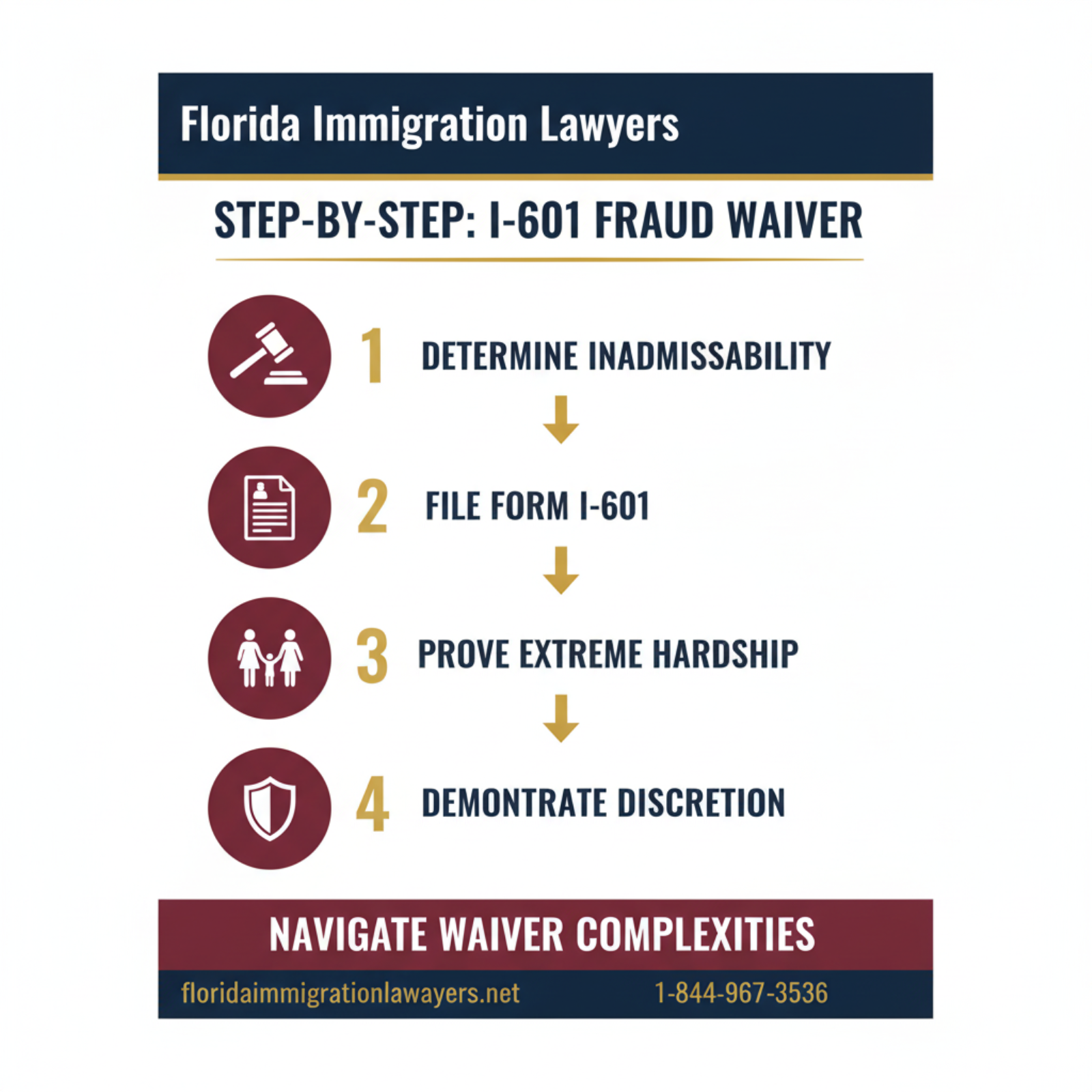
The I-601 Application Process: A Step-by-Step Guide
Applying for an I-601 fraud waiver is a detailed and often lengthy process. It requires careful preparation and adherence to specific legal guidelines. Here is a step-by-step overview of what you can expect when navigating this complex path in Florida:
-
Determine Eligibility and Ground of Inadmissibility: The first step is to confirm that you are indeed subject to a ground of inadmissibility that can be waived by an I-601. This often means a finding of fraud or misrepresentation under INA 212(a)(6)(C)(i). An experienced immigration attorney can help you understand the specific legal basis for your inadmissibility and whether an I-601 waiver is the correct path for you. This initial assessment is crucial to avoid delays and potential denials.
-
Identify a Qualifying Relative: To be eligible for a fraud waiver, you must typically have a qualifying U.S. citizen or lawful permanent resident spouse or parent. The hardship must be to this specific relative, not to yourself or your children. This is a fundamental requirement of the I-601 waiver process, and without a qualifying relative, the waiver cannot be granted. Our team often works with families in family-based immigration cases.
-
Gather Evidence of Extreme Hardship: This is arguably the most critical part of the application. You must collect extensive documentation proving that your qualifying relative would suffer extreme hardship if you were denied admission to the U.S. This evidence can include medical records, financial statements, psychological evaluations, educational records, country conditions reports, and affidavits. The hardship must be more than the normal difficulties associated with separation.
-
Complete Form I-601, Application for Waiver of Grounds of Inadmissibility: Fill out the form accurately and completely. Any errors or omissions can lead to requests for evidence (RFEs) or even denials. The form itself asks for detailed information about the grounds of inadmissibility and the basis for your waiver request. It is essential to be truthful and thorough in your responses.
-
Prepare a Detailed Legal Brief: Your attorney will prepare a compelling legal brief that argues why your case meets the legal standard for extreme hardship and why the waiver should be granted. This brief ties all your evidence together and presents a clear, persuasive narrative to USCIS. This document is your primary opportunity to present your case effectively.
-
Submit the Application and Supporting Documents: Once everything is prepared, the complete application package, including Form I-601, all supporting documents, the legal brief, and the filing fee, is submitted to the appropriate USCIS lockbox facility. The filing location depends on whether you are adjusting status or applying for an immigrant visa abroad. Following precise mailing instructions is vital.
-
Attend Biometrics Appointment (if required): USCIS may require you to attend a biometrics appointment at an Application Support Center (ASC) in Florida, such as the one in Orlando. Here, your fingerprints, photograph, and signature will be collected for background checks. This is a standard part of most immigration applications.
-
Respond to Requests for Evidence (RFEs) or Notices of Intent to Deny (NOIDs): It is common for USCIS to issue RFEs if they need more information, or NOIDs if they intend to deny your application. Prompt and thorough responses are critical. An attorney can help you understand and address these requests effectively, providing additional evidence or legal arguments as needed.
-
Receive a Decision: After review, USCIS will issue a decision on your I-601 waiver application. If approved, you can proceed with your immigration process. If denied, your attorney can advise you on potential appeals or other legal avenues available. A denial can be devastating, but it is not always the final word.
Essential Documents for Your Fraud Waiver Application
A well-prepared I-601 waiver application hinges on a robust collection of supporting documents. These documents serve as evidence to prove the extreme hardship your qualifying relative would face. Gathering these meticulously is crucial for a successful outcome.
Here is a comprehensive list of documents typically required for an immigration fraud waiver application:
- Form I-601, Application for Waiver of Grounds of Inadmissibility: The official application form, completed accurately and signed.
- Proof of Relationship: Marriage certificates, birth certificates, adoption decrees, or other official documents establishing your relationship to the qualifying U.S. citizen or LPR spouse or parent.
- Proof of Qualifying Relative's U.S. Citizenship or LPR Status: Copy of passport, birth certificate, naturalization certificate, or green card.
- Affidavits from Qualifying Relative: Detailed, sworn statements from your U.S. citizen or LPR spouse or parent describing the extreme hardship they would suffer if you were denied admission. These should be personal and specific.
- Financial Documents: Bank statements, tax returns, employment letters, pay stubs, mortgage statements, rental agreements, utility bills, and proof of debts or financial obligations. These demonstrate financial reliance and potential financial hardship.
- Medical Documents: Medical records, diagnoses, prognoses, treatment plans, and letters from doctors for any physical or mental health conditions affecting the qualifying relative that would be exacerbated by your absence or relocation.
- Psychological Evaluations: Professional evaluations from licensed psychologists or psychiatrists detailing the emotional or psychological impact your absence would have on the qualifying relative. This is a powerful form of evidence for extreme hardship.
- Educational Documents: School enrollment records, transcripts, and letters from schools if your qualifying relative's education would be significantly disrupted.
- Country Conditions Reports: Objective evidence about the social, economic, political, and security conditions in your home country, if your qualifying relative would have to relocate there with you. This can be crucial in proving extreme hardship.
- Proof of Community Ties in the U.S.: Letters from community leaders, employers, religious leaders, or neighbors attesting to your and your qualifying relative's ties to the community in Florida.
- Other Supporting Evidence: Any other documents that help demonstrate hardship, such as proof of special needs for children, caregiving responsibilities, or business ownership.
- Translations: Any documents not in English must be accompanied by a certified English translation.
Organizing these documents thoroughly and presenting them clearly is vital for a strong fraud waiver application. Florida Immigration Lawyers can help you compile and present your evidence effectively.
Do not navigate this complex process alone. Contact Florida Immigration Lawyers today to ensure your application is handled with precision and care.
I-601 Waiver Processing Times and Expectations
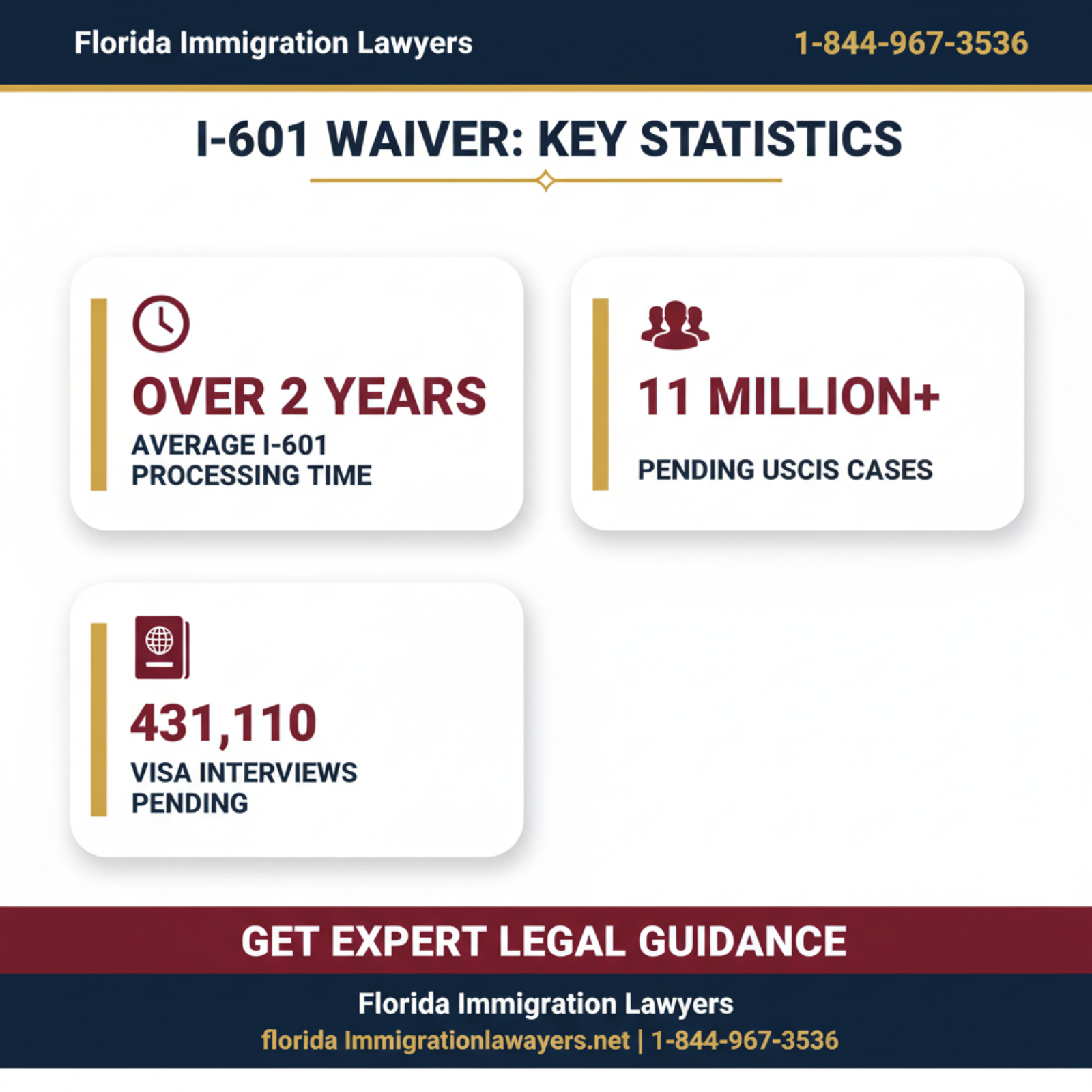
The processing time for an I-601 waiver can vary significantly based on several factors, including the specific USCIS service center handling your application, the complexity of your case, and the current workload of immigration officers. It is important to manage your expectations and understand that these waivers typically take a substantial amount of time to process.
Historically, I-601 waiver processing time frames have ranged from several months to over a year, and sometimes even longer. USCIS provides estimated processing times on its website, but these are subject to change and should only be used as general guidance. Factors like the completeness of your application and the need for RFEs can also impact the timeline.
For those in Florida, particularly those interacting with the USCIS Field Office in Orlando or other regional offices, local processing trends might also play a role. However, most I-601 applications are processed by specific service centers rather than local field offices. Staying informed about the latest processing updates from USCIS is always recommended.
While awaiting a decision on your fraud waiver, it is crucial to maintain your legal status if you are currently in the U.S. and eligible to do so. If you are applying from abroad, be prepared for potential delays in your ability to enter the U.S. Patience and continuous communication with your legal team are essential throughout this period. Our firm helps clients manage expectations and provides regular updates on their case status.
Cost Factors for an Immigration Fraud Waiver in 2026
Understanding the costs associated with an I-601 fraud waiver is an important part of preparing for the application process. These costs generally fall into two main categories: government filing fees and legal fees.
Government Filing Fees: USCIS charges a non-refundable filing fee for Form I-601. This fee is subject to change, so it is crucial to check the most current fee schedule on the USCIS website before filing. Remember, this fee must be paid in the correct amount and format, or your application may be rejected. There are generally no fee waivers available for the I-601.
Legal Fees: Hiring an experienced immigration attorney, such as those at Florida Immigration Lawyers, is highly recommended for an I-601 waiver due to its complexity. Legal fees will vary depending on the specifics of your case, the amount of evidence required, and the attorney's experience. While this represents an investment, the expertise provided can be invaluable in compiling a strong case and navigating potential pitfalls.
Additional costs might include fees for obtaining documents (e.g., birth certificates, medical records), translation services, psychological evaluations, and expert witness reports for country conditions. These supplementary costs can add up, so it is wise to budget for them when planning your fraud waiver application. We strive to be transparent about all potential costs from the outset.
Frequently Asked Questions About Immigration Fraud Waivers
Navigating the complexities of immigration law, especially when dealing with issues of fraud or misrepresentation, often raises many questions. Here, we address some of the most common inquiries our clients in Florida have regarding fraud waivers.
Is there a waiver for immigration fraud?
Yes, there is a waiver for immigration fraud. Form I-601, Application for Waiver of Grounds of Inadmissibility, is the primary mechanism to overcome inadmissibility due to fraud or willful misrepresentation of a material fact. This fraud waiver is specifically authorized under INA Section 212(i) for certain categories of applicants who can demonstrate extreme hardship to a qualifying U.S. citizen or lawful permanent resident relative. It is a critical pathway for many individuals seeking to regularize their status.
Who qualifies for a 601a waiver?
The I-601A provisional unlawful presence waiver is distinct from the I-601 fraud waiver. The I-601A is for individuals who are inadmissible solely due to unlawful presence in the U.S. and who have a qualifying U.S. citizen or lawful permanent resident spouse or parent. It allows them to apply for the waiver while still in the U.S., significantly reducing the time spent abroad during the immigrant visa process. It does not waive grounds of inadmissibility related to fraud or misrepresentation. To qualify, you must be the beneficiary of an approved immediate relative petition (Form I-130, I-140, or I-360) and meet other strict criteria. If you have a fraud issue, you typically need the standard I-601, not the I-601A.
What is considered fraud for immigration purposes?
For immigration purposes, fraud or misrepresentation is generally considered to be the deliberate act of providing false information or concealing a material fact to obtain an immigration benefit. This includes, but is not limited to, lying on visa applications, presenting false documents, misrepresenting marital status, or making false claims to U.S. citizenship. The key elements are usually materiality (the information was important to the decision) and willfulness (the intent to deceive). Even seemingly minor falsehoods can lead to a finding of inadmissibility. It is crucial to be entirely truthful in all immigration dealings.
What crimes does immigration not forgive?
While the I-601 waiver can address certain criminal grounds of inadmissibility, there are some crimes that immigration law generally does not forgive, making waivers extremely difficult or impossible to obtain. These typically include aggravated felonies (as defined by immigration law, which can differ from state law), murder, torture, drug trafficking, and certain crimes related to terrorism or national security. For these severe offenses, even if a waiver is theoretically possible, the likelihood of approval is very low. It is essential to consult with an attorney specializing in deportation defense to understand the implications of any criminal record.
Common Mistakes to Avoid in Your Fraud Waiver Application
The I-601 fraud waiver process is fraught with potential pitfalls. Even minor errors can lead to significant delays or outright denial, jeopardizing your immigration future in Florida. Avoiding these common mistakes is critical for a successful outcome:
-
Incomplete Documentation: Submitting an application without all required forms and supporting evidence is a frequent error. Consequences: Delays, RFEs, or denial, wasting valuable time and resources.
-
Failing to Prove Extreme Hardship: Many applicants underestimate the high legal standard for "extreme hardship." Consequences: Automatic denial, as this is the core requirement for the I-601 waiver.
-
Not Disclosing All Relevant Information: Attempting to conceal past immigration issues or criminal history, even if minor. Consequences: A new finding of fraud or misrepresentation, making future immigration relief even more difficult.
-
Missing Deadlines: Failing to respond to RFEs or appeal denials within the specified timeframes. Consequences: Application abandonment or permanent denial without further review.
-
Incorrectly Identifying Qualifying Relatives: Believing any U.S. citizen or LPR family member can be a qualifying relative. Consequences: Denial, as only a U.S. citizen or LPR spouse or parent typically qualifies for the fraud waiver.
-
Assuming Minor Errors Are Not Misrepresentation: Downplaying the significance of small inaccuracies on past forms. Consequences: USCIS may still deem it a material misrepresentation, requiring a waiver you didn't anticipate.
-
Attempting to File Without Legal Counsel: Navigating the complex legal requirements and evidentiary standards alone. Consequences: Increased risk of errors, weak arguments, and denial due to lack of expertise.
-
Submitting Inconsistent Information: Providing conflicting details across different immigration forms or interviews. Consequences: Triggers suspicion of fraud, leading to intense scrutiny or denial.
-
Failing to Understand Country Conditions: Not adequately researching or documenting the conditions in the country of relocation if your qualifying relative would have to move. Consequences: Weakens the extreme hardship argument significantly.
-
Poorly Organized Application: Submitting a disorganized package of documents. Consequences: Makes it difficult for immigration officers to review your case, potentially leading to misunderstandings or delays.
When to Call a Lawyer for Your Fraud Waiver
The decision to seek legal counsel for an I-601 fraud waiver is not just advisable-it is often critical for success. The complexities of immigration law, particularly concerning inadmissibility and waivers, demand the expertise of a seasoned attorney. Here are specific scenarios where contacting Florida Immigration Lawyers is highly recommended:
- Complex Fraud Allegations: If your case involves intricate or multiple allegations of fraud or misrepresentation, a lawyer can help dissect the charges and build a robust defense.
- Difficulty Proving Extreme Hardship: Demonstrating extreme hardship is the cornerstone of the fraud waiver. If you are struggling to gather compelling evidence or articulate your case, an attorney can guide you.
- Prior Denials or Appeals: If a previous waiver application was denied, or you are considering an appeal, legal representation is essential to identify past mistakes and strategize a stronger approach.
- Facing Deportation Proceedings: If you are in removal proceedings, an attorney can assess whether an I-601 waiver can be pursued as a form of relief from deportation. Our deportation defense team is ready to assist.
- Uncertainty About Eligibility: If you are unsure whether you qualify for an I-601 or another type of waiver, a lawyer can clarify your options and guide you toward the correct path.
- Criminal History: Any criminal record, even minor, can complicate your fraud waiver application. An attorney can advise on how to address these issues.
- Navigating Different Waiver Types: There are various waivers available. An attorney ensures you apply for the correct waiver for your specific grounds of inadmissibility, preventing wasted time and resources.
Florida Immigration Lawyers possesses deep experience in handling I-601 waivers for clients across Florida, including Orlando and throughout the state. We understand the nuances of proving extreme hardship and can meticulously prepare your application to maximize your chances of success. Our attorneys are committed to protecting your rights and securing your future.
About Florida Immigration Lawyers
Florida Immigration Lawyers is a leading immigration law firm dedicated to serving individuals and families across the entire state of Florida. With a profound understanding of U.S. immigration law and a commitment to our clients, we provide compassionate yet aggressive legal representation for a wide range of immigration matters.
Our firm specializes in helping clients navigate complex issues, including fraud waivers, family-based petitions, deportation defense, asylum claims, and citizenship applications. We pride ourselves on offering personalized attention, clear communication, and strategic solutions tailored to each client's unique circumstances.
Why choose Florida Immigration Lawyers? We offer extensive experience, a track record of success, and a deep dedication to our clients' well-being. We understand the anxieties and challenges that come with immigration processes, and we are here to provide unwavering support every step of the way. Our team is available 24/7 to address your urgent needs and provide a free consultation to assess your case.
Contact us today to learn how we can assist you with your immigration journey. Call Florida Immigration Lawyers at 1-844-967-3536 or visit our website at https://www.floridaimmigrationlawyers.net. We are here to help you achieve your American dream.
Sources and References
- U.S. Citizenship and Immigration Services (USCIS)
- Executive Office for Immigration Review (EOIR)
- 8 U.S.C. § 1182 (Immigration and Nationality Act Section 212) - Grounds of Inadmissibility
- 8 CFR § 212.7 - Waiver of certain grounds of inadmissibility
- USCIS Policy Manual, Volume 8, Part K, Chapter 2 - Fraud or Willful Misrepresentation of a Material Fact
This article provides general legal information and is not intended as legal advice. Every case is unique, and outcomes depend on specific facts and circumstances. Contact an attorney for advice about your particular situation.
If you are facing an immigration challenge involving fraud or misrepresentation in Florida, seeking experienced legal guidance is crucial. Florida Immigration Lawyers are dedicated to helping you navigate these complex issues with compassion and expertise. Don't delay-secure your future by calling us today at 1-844-967-3536 for a confidential, free consultation. Se Habla Español - Estamos aquí para ayudarle.
Need help with Immigration?
Our Florida immigration attorneys offer free consultations. Call today or schedule online.
Frequently Asked Questions
Florida Immigration Lawyers
Legal Team
Our experienced attorneys at Florida Immigration Lawyers have been serving clients across Florida for over 20 years. We specialize in immigration, personal injury, criminal defense, workers compensation, and family law.