Dual Citizenship Florida: Your Guide to Two Passports in 2026
Discover the path to dual citizenship in Florida for 2026. This comprehensive guide from Florida Immigration Lawyers explains U.S. naturalization, the concept of holding two passports, and key immigration laws. Learn about eligibility, the step-by-step application process, required documents, and critical financial considerations. We also cover common mistakes to avoid and when to seek legal counsel to ensure a smooth journey. Contact us for a free consultation and expert guidance on your dual nationality aspirations.
Dual citizenship, also known as dual nationality, means a person is a citizen of two countries simultaneously. The U.S. generally permits its citizens to hold dual nationality. For those in Florida, this typically involves first becoming a U.S. citizen through naturalization while retaining citizenship in their country of origin, provided that country's laws also allow it.
- U.S. law generally allows dual citizenship.
- Naturalization is the primary path to U.S. citizenship for immigrants.
- Eligibility includes residency, good moral character, and English/civics tests.
- Consulting an attorney is crucial for navigating complex requirements.
Navigating Dual Citizenship and Florida Immigration in 2026
Imagine maintaining strong ties to two nations, enjoying the rights and privileges of both. For many immigrants in Florida, the dream of dual citizenship is a powerful aspiration. It offers enhanced travel flexibility, expanded opportunities, and a deeper connection to their heritage and adopted home.
Understanding the intricacies of dual citizenship, especially within the U.S. immigration framework, can be challenging. This comprehensive guide from Florida Immigration Lawyers will walk you through the process, focusing on the steps for those living in Florida, the essential requirements, and how to avoid common pitfalls in 2026.
Whether you are considering naturalization or already hold a green card, we are here to help. Do you have questions about your eligibility or the application process? Call Florida Immigration Lawyers at 1-844-967-3536 for a free consultation today.
Understanding Dual Citizenship and Florida Immigration
Dual citizenship, or dual nationality, arises when a person is a citizen of two different countries at the same time. The United States generally permits its citizens to hold dual nationality. This means a U.S. citizen may also be a citizen of another country, and vice versa, without losing their U.S. citizenship, provided they did not intend to relinquish U.S. citizenship when obtaining foreign citizenship.
The U.S. government does not explicitly prohibit dual nationality. However, it also does not actively endorse it. The key principle under U.S. law is often one of intent. If you acquire foreign citizenship without the express intent to renounce your U.S. citizenship, you generally retain your U.S. nationality. This policy is primarily guided by court decisions and administrative practice rather than specific statutes.
For individuals residing in Florida, a state known for its vibrant immigrant communities, understanding these nuances is particularly important. Florida is home to millions of foreign-born residents, many of whom may be eligible for U.S. citizenship through naturalization. Achieving U.S. citizenship is often the first step towards realizing dual citizenship.
The benefits of holding two passports can be significant. You may experience greater ease of travel, potentially avoiding visa requirements for certain countries. Dual nationality can also offer increased economic opportunities, property ownership rights in both nations, and the ability to participate politically in both countries, subject to each nation's laws.
However, dual citizenship also comes with responsibilities, including potential tax obligations in both countries and adherence to the laws of both nations. It is crucial to understand that while the U.S. generally permits dual nationality, your country of origin may not. Some countries require you to formally renounce your previous citizenship upon becoming a U.S. citizen.
The process of becoming a U.S. citizen through naturalization is governed by the Immigration and Nationality Act (INA), specifically 8 U.S.C. Chapter 12. This comprehensive law outlines the requirements and procedures for individuals seeking to become naturalized citizens of the United States. Our firm, Florida Immigration Lawyers, is well-versed in these complex regulations and can guide you through every step.
The Path to Dual Citizenship: A Step-by-Step Guide for Floridians
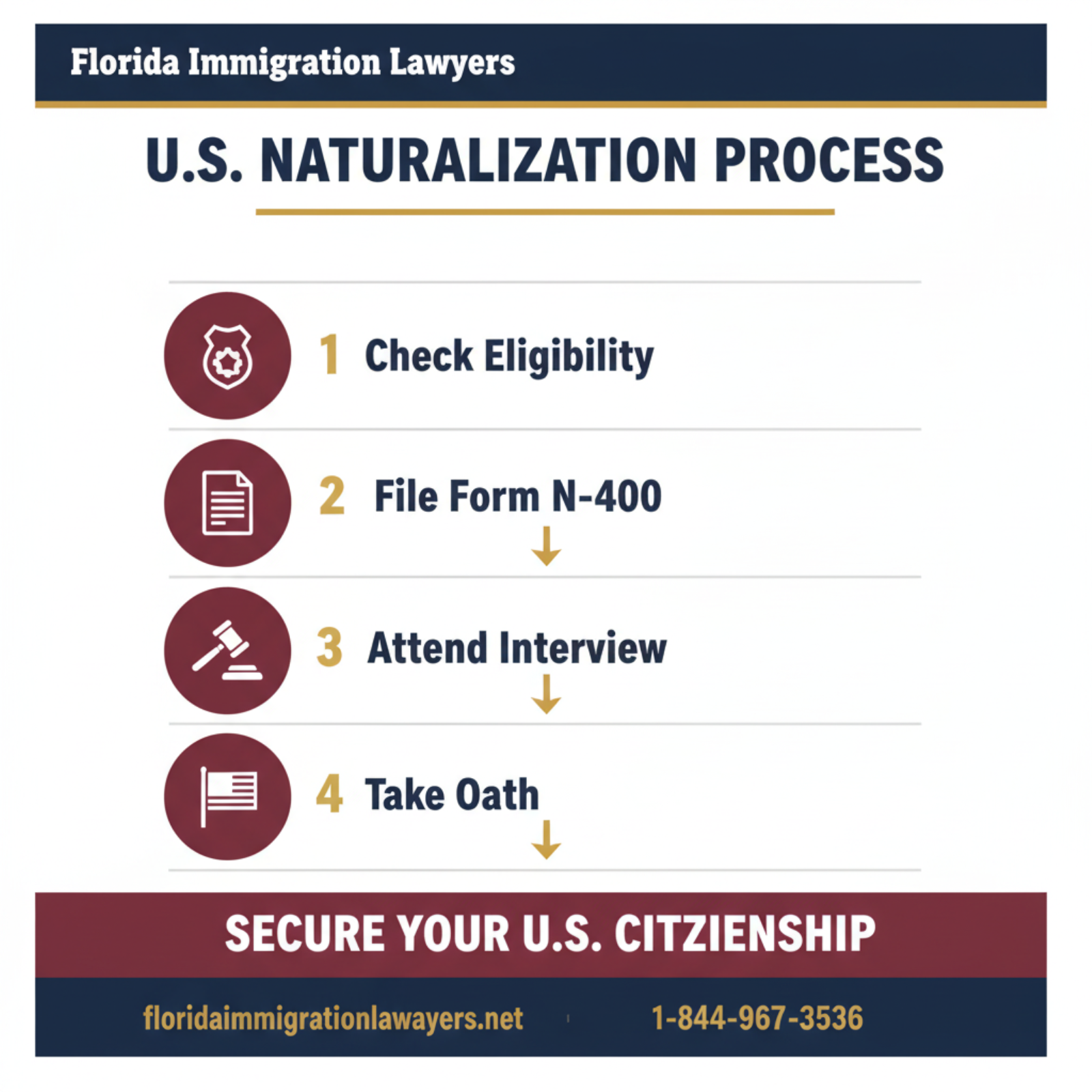
For most immigrants in Florida seeking dual citizenship, the primary path involves first becoming a naturalized U.S. citizen. This process requires careful attention to detail and adherence to specific legal requirements. Here is a general step-by-step guide to U.S. naturalization:
Eligibility Requirements for U.S. Naturalization
Before you can apply for U.S. citizenship, you must meet several key criteria. These requirements are outlined in the Immigration and Nationality Act (INA) Section 316 and 319 (8 U.S.C. § 1427 and § 1430). Generally, you must:
- Be at least 18 years old at the time of filing Form N-400.
- Be a lawful permanent resident (Green Card holder) for at least five years. This period is reduced to three years if you obtained your Green Card through marriage to a U.S. citizen and meet other specific criteria.
- Have resided continuously in the U.S. as a lawful permanent resident for at least five years (or three years if married to a U.S. citizen) immediately preceding the date of filing your N-400 application.
- Be physically present in the U.S. for at least half of that five-year (or three-year) period. This means 30 months out of 60 months, or 18 months out of 36 months, respectively.
- Demonstrate good moral character for the statutory period (five or three years). This involves having no serious criminal record or other disqualifying actions.
- Be able to read, write, and speak basic English.
- Have a basic understanding of U.S. history and government (civics).
- Be willing to take an Oath of Allegiance to the United States.
Living in Florida means you will likely interact with USCIS field offices in cities like Orlando, Miami, or Tampa. These offices handle interviews for naturalization applicants in their respective regions. Understanding these local processes is part of a successful application.
The Naturalization Application Process
Once you confirm your eligibility, you can begin the application process. This typically involves the following steps:
- Determine Your Eligibility: Carefully review all requirements to ensure you meet them. If you have any doubts, especially regarding continuous residency or good moral character, consult with Florida Immigration Lawyers.
- Prepare Form N-400, Application for Naturalization: This is the primary form for applying for U.S. citizenship. It is extensive and requires accurate and complete information about your personal history, residency, and other details.
- Gather Supporting Documents: Collect all necessary documents, such as copies of your Green Card, marriage certificates, tax returns, travel records, and any court disposition records if you have had arrests.
- Submit Your Application and Fees to USCIS: File Form N-400 along with the required filing fee and biometrics fee. USCIS fees are subject to change, so always check the most current fee schedule on USCIS.gov.
- Attend Biometrics Appointment: After filing, you will receive an appointment notice to visit an Application Support Center (ASC) in Florida for fingerprinting, photographs, and a signature. This is used for background checks.
- Attend Naturalization Interview: USCIS will schedule an interview at a local field office, such as the Orlando Field Office or Miami Field Office. During the interview, an officer will review your application, test your English proficiency, and administer the civics test.
- Receive a Decision: After the interview, you will receive a decision. This could be an approval, a denial, or a request for more information (Request for Evidence – RFE).
- Attend the Oath of Allegiance Ceremony: If approved, you will be invited to an Oath of Allegiance ceremony. This is the final step where you officially become a U.S. citizen. You will receive your Certificate of Naturalization at this ceremony.
Successfully navigating these steps requires precision. Any errors or omissions can lead to delays or even denial. Our team at Florida Immigration Lawyers has extensive experience guiding clients through the entire naturalization process, ensuring all requirements are met.
Essential Documents and Financial Considerations for Dual Nationality
Preparing a thorough application package is paramount to a successful naturalization process. Missing documents or incorrect information can significantly delay your application or even lead to a denial. Furthermore, understanding the financial aspects is crucial for planning.
Required Documents Checklist
While the exact documents may vary based on your specific situation, a general checklist for your N-400 application includes:
- Form N-400, Application for Naturalization (original, signed)
- Copy of your Permanent Resident Card (Green Card, Form I-551) – both front and back
- Copies of state-issued identification, such as your Florida driver's license or state ID
- Copies of your current and expired passports from your country of origin
- Copies of marriage certificates, divorce decrees, or death certificates for current and prior spouses (if applicable)
- Copies of birth certificates for any children, whether born in the U.S. or abroad
- Certified copies of court disposition records for any arrests or citations, even if charges were dismissed or expunged
- Tax returns for the last five years (or three years if applying based on marriage to a U.S. citizen)
- Proof of selective service registration (for male applicants between 18 and 26 years old)
- Travel records, including dates of all trips outside the U.S. and countries visited since becoming a permanent resident
- Two identical passport-style photographs (if filing by mail)
- Any other documents specifically requested by USCIS in an RFE or interview notice
Organizing these documents meticulously will streamline your application process. Florida Immigration Lawyers can help you compile and review your documents to ensure completeness and accuracy before submission.
Cost Factors and Fee Breakdown
The financial aspect of applying for dual citizenship primarily involves USCIS filing fees for naturalization and potential legal fees. It is important to budget for these costs:
- USCIS Filing Fees: The fee for Form N-400 is subject to change. Always check the official USCIS website for the most current fee information. There may also be a separate biometrics fee.
- Attorney Fees: While not mandatory, hiring an experienced immigration attorney can significantly improve your chances of success and reduce stress. Florida Immigration Lawyers offers competitive rates for comprehensive legal services.
- Translation Costs: If any of your supporting documents are not in English, you will need certified translations, which incur additional costs.
- Other Country's Fees: If your country of origin has a specific process for retaining or acquiring its citizenship, there may be additional fees associated with that process.
For those facing financial hardship, USCIS offers fee waivers for certain forms, including the N-400, if you meet specific income guidelines or receive means-tested benefits. Discussing your financial situation with your attorney can help determine if you are eligible for a fee waiver.
Timeline and Processing Expectations for Dual Citizenship in Florida
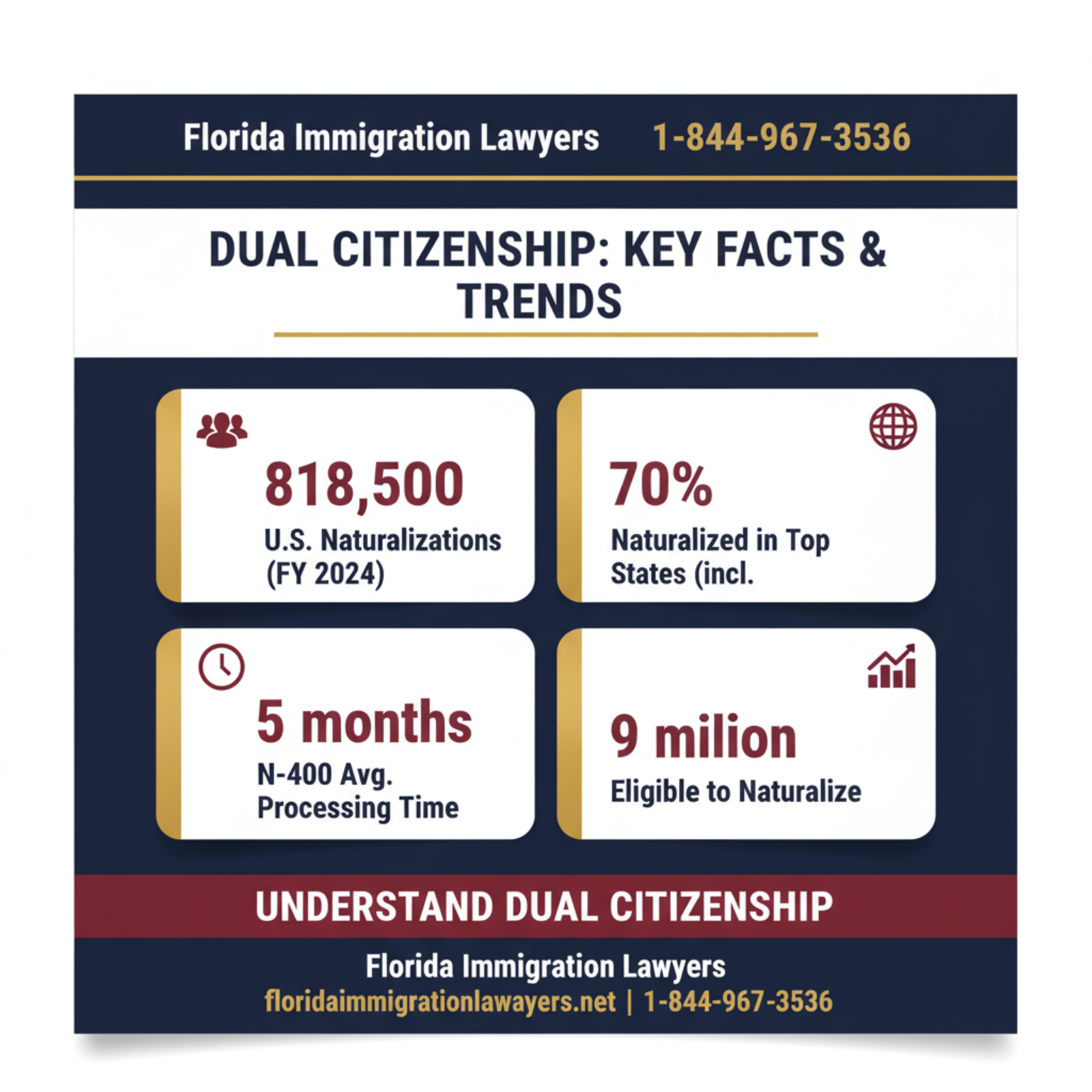
The timeline for obtaining U.S. citizenship through naturalization can vary significantly. Several factors influence how long the process takes, from initial application submission to the Oath of Allegiance ceremony. Understanding these timelines can help you manage your expectations.
Generally, the entire naturalization process can take anywhere from 6 to 18 months, or even longer, depending on the USCIS field office processing your application and the complexity of your case. For applicants in Florida, processing times can differ between the major USCIS field offices in Orlando, Miami, and Tampa. You can check estimated processing times on the USCIS website for specific forms and field offices.
Factors that can influence your processing time include:
- USCIS Workload: High volumes of applications can lead to longer wait times.
- Completeness of Application: An incomplete application or missing documents will result in delays, often through a Request for Evidence (RFE).
- Background Checks: Security checks can sometimes take longer, especially if there are any discrepancies or complex histories.
- Interview Backlogs: The scheduling of naturalization interviews can vary by field office capacity.
- Response to RFEs: Promptly responding to any requests for additional information is crucial to avoid further delays.
While some parts of the process are beyond your control, submitting a meticulously prepared application and responding promptly to all USCIS requests can help streamline your case. Staying informed about your case status through the USCIS online tool is also recommended. Florida Immigration Lawyers can assist you in monitoring your application and addressing any issues that arise.
Do not navigate this complex process alone. The journey to dual citizenship involves critical legal steps that require expert guidance. Contact Florida Immigration Lawyers today for dedicated support and peace of mind.
Common Mistakes to Avoid in Your Dual Citizenship Journey
Applying for dual citizenship through U.S. naturalization is a detailed process where even minor errors can lead to significant setbacks. Being aware of common mistakes can help you avoid them and ensure a smoother application.
- Misunderstanding Residency Requirements: Many applicants miscalculate their continuous residency or physical presence in the U.S. Extensive trips abroad can break continuous residency, making you ineligible. Always track your travel dates carefully. Consequences include application denial and needing to restart the statutory period.
- Failing to Disclose All Information: Omitting details about past arrests, immigration violations, or even minor infractions on your N-400 application can be considered misrepresentation. This can lead to a denial based on a lack of good moral character and potential allegations of fraud. Be completely honest and seek legal advice for any problematic history.
- Inadequate Document Preparation: Submitting an incomplete application or failing to provide certified translations for non-English documents is a frequent issue. This often results in a Request for Evidence (RFE) or outright denial, prolonging your wait time. Always double-check your checklist and ensure all documents are properly prepared.
- Assuming Automatic Dual Citizenship: Not all countries permit dual nationality. Some foreign countries require you to formally renounce your previous citizenship upon acquiring a new one. Failing to understand your country of origin's laws can lead to unexpected loss of your original citizenship. Research both countries' laws or consult an attorney familiar with international immigration.
- Lack of English or Civics Knowledge: The naturalization interview includes tests on English proficiency (reading, writing, speaking) and U.S. civics. Underestimating these tests and failing to prepare adequately can lead to a failed interview and a re-test, or even denial. Utilize official study materials and practice tests.
- Ignoring Travel Restrictions After Filing: While your N-400 is pending, be cautious about long trips outside the U.S. Excessive travel can raise questions about your intent to reside permanently in the U.S. and potentially impact your good moral character assessment. Consult your attorney before making significant travel plans.
- Not Updating USCIS with Address Changes: If you move after filing your N-400, you must inform USCIS of your new address promptly. Failure to do so can result in missed appointment notices, RFEs, or other critical communications, potentially leading to your application being considered abandoned.
When to Call a Lawyer for Your Dual Citizenship Journey
While the naturalization process leading to dual citizenship can seem straightforward for some, many situations warrant the expertise of an experienced immigration attorney. Florida Immigration Lawyers are here to provide the guidance you need, especially if you encounter any of the following scenarios:
- Complex Eligibility Issues: If you have a criminal record, even a minor one, or have had past immigration violations, determining your good moral character can be complicated. An attorney can assess your situation and advise on the best course of action.
- Long Absences or Travel Concerns: If you have spent significant time outside the U.S. during your permanent residency, an attorney can help calculate your physical presence and continuous residency to ensure you meet the requirements, potentially preventing a denial.
- Previous Denials or Difficulties: If you have previously been denied naturalization or have faced other immigration challenges, a lawyer can review your past applications and identify strategies for a successful reapplication.
- Uncertainty About Your Country of Origin's Laws: If you are unsure whether your home country permits dual citizenship or what steps are required to maintain it, an attorney can help you find reliable information or refer you to appropriate legal counsel abroad.
- Special Circumstances: Cases involving military service, disability waivers for English/civics tests, or other unique situations often benefit from legal expertise to navigate specific regulations (8 CFR Part 316).
- Expedited Processing Needs: While rarely granted, an attorney can help determine if your situation qualifies for expedited processing and assist in making such a request.
- Language Barriers or Difficulty Understanding Legal Forms: If English is not your first language or you find legal forms overwhelming, an attorney can ensure your application is accurate and complete, avoiding costly mistakes.
At Florida Immigration Lawyers, we understand the nuances of U.S. citizenship and naturalization law. We can assist you with preparing your application, representing you at interviews, and addressing any challenges that arise. Our goal is to make your path to dual citizenship as smooth as possible. Explore our citizenship services and general immigration practice areas for more information, or simply contact us directly.
About Florida Immigration Lawyers
Florida Immigration Lawyers is a leading immigration law firm dedicated to serving individuals and families across the entire state of Florida. With years of experience and a deep understanding of U.S. immigration law, our team of dedicated attorneys provides compassionate and effective legal representation.
We specialize in a wide range of immigration matters, including family-based immigration, business immigration, naturalization, deportation defense, asylum, and, of course, dual citizenship guidance. Our commitment is to our clients, ensuring they receive personalized attention and strategic advice tailored to their unique circumstances.
Why choose Florida Immigration Lawyers? We pride ourselves on our client-focused approach, transparent communication, and a proven track record of success. Our attorneys are available 24/7 to address your urgent concerns and offer free, no-obligation consultations to help you understand your legal options. We are here to be your trusted partner on your immigration journey.
Visit our website at https://www.floridaimmigrationlawyers.net or call us directly at 1-844-967-3536 to schedule your free consultation. Let us help you achieve your immigration goals.
Sources and References
- U.S. Citizenship and Immigration Services (USCIS)
- U.S. Department of State - Dual Nationality
- Executive Office for Immigration Review (EOIR)
- 8 U.S.C. Chapter 12 - Immigration and Nationality Act (INA)
- INA § 316 - Requirements for Naturalization (8 U.S.C. § 1427)
- INA § 319 - Spouses of Citizens (8 U.S.C. § 1430)
- 8 CFR Part 316 - General Requirements for Naturalization
This article provides general legal information and is not intended as legal advice. Every case is unique, and outcomes depend on specific facts and circumstances. Contact an attorney for advice about your particular situation. Laws are subject to change.
Embarking on the path to dual citizenship is a significant decision that can open many doors. With the right legal support, you can navigate the complexities of U.S. immigration law with confidence. Do not delay your journey towards a brighter future.
For expert legal guidance on dual citizenship, naturalization, and all Florida immigration matters, reach out to Florida Immigration Lawyers. Schedule your free consultation today by calling 1-844-967-3536. Se Habla Español - Estamos aquí para ayudarle.
Need help with Immigration?
Our Florida immigration attorneys offer free consultations. Call today or schedule online.
Frequently Asked Questions
Florida Immigration Lawyers
Legal Team
Our experienced attorneys at Florida Immigration Lawyers have been serving clients across Florida for over 20 years. We specialize in immigration, personal injury, criminal defense, workers compensation, and family law.