Citizenship Interview Tips Florida: Your Guide to Naturalization Success
Navigating the U.S. naturalization process in Florida requires careful preparation, especially for the citizenship interview. This comprehensive guide provides essential tips for Florida residents, covering eligibility, what to expect at your USCIS interview, and a step-by-step preparation plan. Learn about required documents, common mistakes to avoid, and when to seek legal assistance. Florida Immigration Lawyers offers expert guidance to help you confidently approach your naturalization interview and achieve your dream of U.S. citizenship. We are here to support you every step of the way.
Passing your citizenship interview in Florida requires thorough preparation. You must demonstrate a good moral character, knowledge of U.S. history and government, and English proficiency. Understanding your N-400 application and bringing all required documents are crucial for success. Seeking legal guidance can significantly improve your chances.
- Prepare for English proficiency (speaking, reading, writing).
- Study U.S. civics questions (100 questions).
- Review your N-400 application thoroughly.
- Gather all original supporting documents.
- Seek legal guidance for complex cases.
Are you dreaming of becoming a U.S. citizen and enjoying the full benefits of living in beautiful Florida? The naturalization interview is a pivotal step on this exciting journey. Preparing for this interview can feel daunting, but with the right guidance, you can approach it with confidence.
This comprehensive guide offers essential citizenship interview tips Florida residents need to prepare effectively for their USCIS interview in 2026. We will cover everything from understanding the process to avoiding common pitfalls. Our goal is to equip you with the knowledge to succeed.
For personalized guidance and to ensure you are fully prepared, call Florida Immigration Lawyers at 1-844-967-3536 for a free consultation today.
Understanding the Naturalization Interview Process in Florida
The naturalization interview is a formal meeting with a U.S. Citizenship and Immigration Services (USCIS) officer. Its primary purpose is to verify the information on your Form N-400, Application for Naturalization, and to assess your eligibility for U.S. citizenship. This interview is a critical step towards becoming a U.S. citizen.
In Florida, interviews typically take place at one of the USCIS field offices, such as those in Miami, Orlando, or Jacksonville. Your appointment notice will specify the exact location and time. It is vital to arrive prepared and on time for your scheduled interview.
Eligibility Requirements for U.S. Citizenship
To be eligible for naturalization, you must meet several requirements outlined in the Immigration and Nationality Act (INA). Generally, these include being at least 18 years old at the time of filing, being a lawful permanent resident (Green Card holder) for a specified period (typically five years, or three years if married to a U.S. citizen), and demonstrating continuous residence and physical presence in the U.S.
You must also show good moral character, an attachment to the principles of the U.S. Constitution, and a willingness to take the Oath of Allegiance. Furthermore, you need to demonstrate English language proficiency and knowledge of U.S. history and government (civics). These requirements are detailed in 8 U.S.C. § 1427 (INA 316).
What to Expect at Your USCIS Interview
When you arrive at the USCIS field office, you will go through security checks. Once cleared, you will check in and wait to be called for your interview. The USCIS officer will call your name and lead you to a private interview room.
The interview begins with an oath to tell the truth. The officer will then review your N-400 application, asking questions to confirm your identity and the accuracy of the information you provided. You will also undergo an English proficiency test, which includes speaking, reading, and writing components. Additionally, you will take a civics test to assess your knowledge of U.S. history and government.
The officer will ask you questions about your background, family, employment, and any travel history. They will also inquire about your good moral character, including any interactions with law enforcement. Honesty and clarity in your responses are paramount.
Step-by-Step Guide to Preparing for Your Citizenship Interview
Thorough preparation is the key to a successful naturalization interview. Following these steps will help you feel more confident and ready for your appointment.
- Review Your N-400 Application Thoroughly: Go over every single question and answer on your Form N-400. The USCIS officer will ask questions directly from this form. Ensure you are familiar with all the details, dates, and responses you provided.
- Practice English Proficiency: The English test has three parts: speaking, reading, and writing. Your ability to speak English will be assessed during the interview conversation. For reading, you will need to read one out of three sentences correctly. For writing, you will write one out of three sentences correctly. Practice reading and writing simple English sentences.
- Study U.S. History and Government (Civics): You will be asked up to 10 questions from a list of 100 civics questions. You must answer 6 out of 10 questions correctly to pass. The official USCIS website provides the list of 100 questions and study materials. Focus on understanding the answers, not just memorizing them.
- Gather All Original Documents: Bring all original documents that support your N-400 application, as well as the originals of any copies you submitted. This includes your Green Card, passport, state ID, marriage certificates, divorce decrees, birth certificates, tax returns, and any court or police records.
- Understand Good Moral Character: USCIS assesses your good moral character based on your conduct during the statutory period (usually 3 or 5 years) before filing your N-400. Be prepared to discuss any issues that might affect this, such as criminal history, tax issues, or failure to pay child support.
- Dress Professionally and Arrive Early: Presenting yourself well can make a positive impression. Dress in neat, conservative attire. Plan to arrive at least 30-45 minutes before your scheduled interview time. This allows for security checks, parking, and finding the correct office.
- Practice Answering Questions Clearly and Honestly: Role-play the interview with a friend or family member. Practice answering questions about your N-400, your background, and your understanding of U.S. civics. Always answer truthfully and directly.
- Know Your Rights: You have the right to have an attorney present with you at your naturalization interview. If you have any concerns or a complex case, having legal representation can be highly beneficial.
Essential Documents for Your USCIS Interview
Bringing a complete set of documents to your naturalization interview is crucial. Missing documents can lead to delays or even a denial of your application. Always bring originals, not just copies.
- Your interview appointment notice (Form I-797C).
- Your Permanent Resident Card (Green Card).
- Your state-issued identification, such as a Florida Driver's License or ID card.
- All passports, current and expired, and any other travel documents you possess.
- Your N-400 application, along with any supporting documents you submitted.
- Original birth certificates, marriage certificates, divorce decrees, or death certificates for yourself, your spouse, and your children, as applicable.
- Proof of residence in Florida for the statutory period, such as utility bills, lease agreements, or property deeds.
- Tax returns for the past five years (or three years if applying based on marriage to a U.S. citizen).
- Certified court dispositions, police records, or probation records for any arrests or citations, even if charges were dismissed or expunged.
- Proof of Selective Service registration, if applicable (for males born after 1959).
- Any documents related to military service, if applicable.
- Evidence of your spouse's U.S. citizenship, if applicable (e.g., birth certificate, naturalization certificate, U.S. passport).
Citizenship Interview Timeline and Processing Expectations
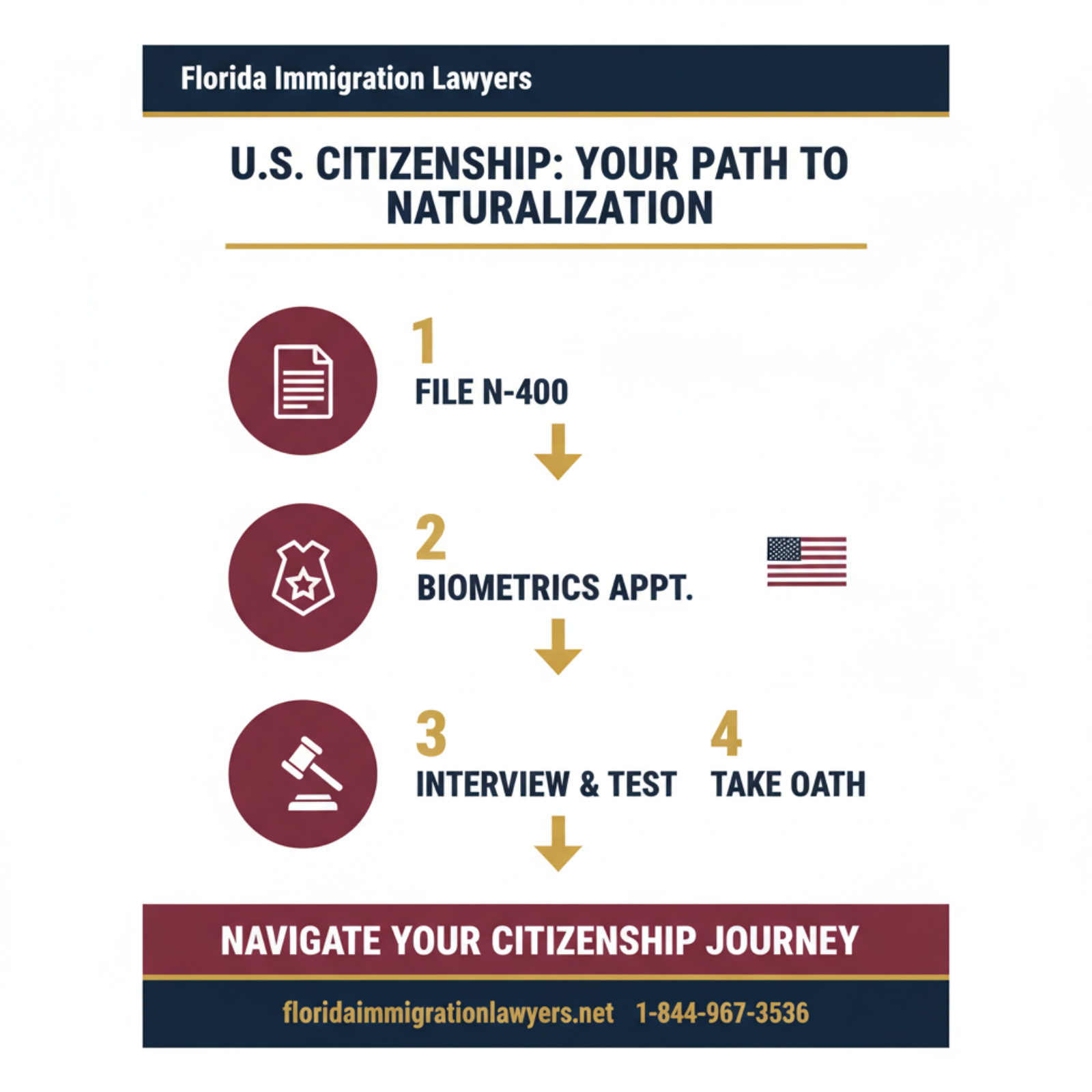
The naturalization process involves several stages, and the timeline can vary significantly. After filing your N-400, you will typically receive a receipt notice, followed by an appointment for biometrics (fingerprints) within a few weeks or months.
The waiting period between biometrics and your interview can range from several months to over a year, depending on the USCIS field office workload in Florida. For example, processing times at the Miami field office might differ from those in Orlando or Tampa. You can check current processing times on the USCIS website.
After the interview, the officer may issue a decision immediately, or you may receive a Request for Evidence (RFE) if more information is needed. If approved, you will typically receive a notice for your Oath of Allegiance ceremony within a few weeks or months. This ceremony is the final step to becoming a U.S. citizen.
Cost Factors and Fee Breakdown for Naturalization
The naturalization process involves certain fees that applicants must pay directly to USCIS. These fees are subject to change, so it is crucial to check the most current fee schedule on the USCIS website (uscis.gov) before filing your application.
Generally, the primary costs include the N-400 application filing fee and a biometrics services fee. USCIS offers fee waivers for eligible applicants who can demonstrate an inability to pay based on certain income or public benefits criteria. Information on fee waivers, including Form I-912, Application for Fee Waiver, and eligibility requirements can be found in 8 CFR § 106.3.
Beyond government fees, applicants might incur other costs. These can include fees for obtaining necessary documents, such as birth certificates or court records. If you choose to hire an immigration attorney, legal fees will also be a factor. While not mandatory, legal representation can be a wise investment, especially for complex cases.
Do not navigate this process alone. The complexities of the naturalization interview, especially for those seeking citizenship interview tips Florida, can be overwhelming. Contact Florida Immigration Lawyers today for dedicated support and peace of mind.
Common Mistakes to Avoid During Your Citizenship Interview
Avoiding these common pitfalls can significantly increase your chances of a successful naturalization interview.
- Lying or Providing False Information: Any misrepresentation or false statement on your N-400 application or during the interview can lead to an immediate denial of your application, and potentially even deportation or criminal charges. Honesty is always the best policy.
- Failing to Disclose Arrests or Criminal History: Even minor arrests, traffic tickets (if they involved an arrest), or expunged records must be disclosed. USCIS has access to your criminal history, and failing to disclose it can be seen as a lack of good moral character, resulting in denial.
- Lack of English Proficiency: Failing the English reading, writing, or speaking tests will result in a failed interview. While you get a second chance, it causes delays. Practice regularly to ensure you meet the requirements.
- Not Studying for the Civics Test: The civics test is mandatory. Failing to answer enough questions correctly will lead to a failed interview. Utilize the official USCIS study materials extensively.
- Not Reviewing Your N-400 Application: If your answers during the interview contradict the information on your N-400, it raises red flags. Review your application multiple times to ensure you are familiar with every detail.
- Arriving Late or Unprepared: Arriving late can lead to your interview being rescheduled or even canceled. Appearing disorganized or without necessary documents creates a poor impression and causes delays.
- Not Bringing All Required Documents: The USCIS officer will request specific documents. Failing to bring originals or all requested evidence will result in delays, a Request for Evidence (RFE), or a denial if not provided promptly.
- Disrespectful or Argumentative Behavior: Maintain a respectful and polite demeanor throughout the interview. Arguing with the officer or showing disrespect can negatively impact their assessment of your good moral character.
- Failing to Maintain Good Moral Character: Issues such as tax evasion, failure to pay child support, or repeated minor offenses during the statutory period can lead to a determination that you lack good moral character, thus making you ineligible for naturalization.
- Not Seeking Legal Advice for Complex Cases: If you have any criminal history, prior immigration violations, long absences from the U.S., or other complex issues, attempting to navigate the process alone without legal counsel can lead to critical errors and denial.
When to Call a Lawyer
While many individuals successfully navigate the naturalization process on their own, certain situations warrant the expertise of an immigration attorney. Florida Immigration Lawyers can provide invaluable assistance.
You should consider calling a lawyer if you have any criminal history, no matter how minor or old. This includes arrests, charges, or convictions. An attorney can assess the impact of these issues on your good moral character and prepare a strong case.
Other scenarios include having previously been denied naturalization, having spent significant time outside the U.S. that might affect your continuous residence, or if you have any doubts about your eligibility. If you receive a Request for Evidence (RFE) or a Notice of Intent to Deny (NOID), immediate legal consultation is critical.
Florida Immigration Lawyers can help you review your N-400 application, prepare you thoroughly for the interview, and even accompany you to the USCIS interview in Fort Lauderdale or any other Florida location. We can also assist with appeals if your application is denied, ensuring your rights are protected throughout the process.
About Florida Immigration Lawyers
Florida Immigration Lawyers is a leading immigration law firm dedicated to serving individuals and families across the entire state of Florida. Our experienced attorneys are deeply committed to helping our clients achieve their immigration goals, from family-based petitions to naturalization.
We understand the complexities and emotional challenges of the immigration system. Our firm offers comprehensive legal services, including assistance with naturalization, asylum claims, deportation defense, family immigration, and business immigration. We pride ourselves on providing compassionate, effective, and personalized legal representation.
Choose Florida Immigration Lawyers for our unwavering dedication, profound legal knowledge, and a client-first approach. We are available 24/7 to answer your questions and provide support. We offer free consultations to discuss your unique situation and develop a tailored strategy.
Visit our website at https://www.floridaimmigrationlawyers.net or call us directly at 1-844-967-3536 to learn how we can help you.
Sources and References
- U.S. Citizenship and Immigration Services (USCIS)
- U.S. Department of State - Bureau of Consular Affairs
- Executive Office for Immigration Review (EOIR)
- 8 U.S.C. Chapter 12 - Immigration and Nationality Act (INA), particularly 8 U.S.C. § 1427 (INA 316) regarding eligibility for naturalization.
- 8 CFR § 106.3 - Fee Waivers.
This article provides general legal information and is not intended as legal advice. Every case is unique, and outcomes depend on specific facts and circumstances. Contact an attorney for advice about your particular situation.
Your journey to U.S. citizenship is important. Let Florida Immigration Lawyers be your trusted partner. We offer experienced legal representation for all aspects of the naturalization process, providing the best citizenship interview tips Florida has to offer. Call us today at 1-844-967-3536 for a free, confidential consultation. Se Habla Español - Estamos aquí para ayudarle.
Internal Links:
Need help with Immigration?
Our Florida immigration attorneys offer free consultations. Call today or schedule online.
Frequently Asked Questions
Florida Immigration Lawyers
Legal Team
Our experienced attorneys at Florida Immigration Lawyers have been serving clients across Florida for over 20 years. We specialize in immigration, personal injury, criminal defense, workers compensation, and family law.