Fiance Visa K-1 Process in Florida: Your 2026 Guide
For U.S. citizens in Florida, bringing a foreign fiancé(e) to the country through a K-1 visa involves specific steps and requirements. This guide outlines the entire process, from filing Form I-129F with USCIS to consular processing, the visa interview, and eventually adjusting status after marriage. We cover essential documents, estimated timelines for 2026, and potential cost factors. Understanding these details is crucial for a smooth application. Florida Immigration Lawyers offers expert guidance to help you avoid common mistakes and navigate complexities, ensuring your journey to family unity is successful. Learn how to prepare for each stage and when professional legal assistance is invaluable.

The K-1 fiance visa allows a U.S. citizen's foreign fiancé(e) to enter the United States to marry within 90 days of arrival. The process involves filing Form I-129F, USCIS approval, consular processing abroad, and then applying for adjustment of status after marriage. It is a multi-step journey requiring careful documentation and adherence to strict timelines, especially for those in Florida seeking to unite with their loved ones.
- U.S. citizen sponsors foreign fiancé(e).
- Marriage must occur within 90 days of arrival in the U.S.
- Requires Form I-129F petition and consular interview.
- Adjustment of status to a Green Card holder follows marriage.
- Legal guidance is highly recommended for a smooth process.
Are you a U.S. citizen in Florida, perhaps in Orlando or the surrounding vibrant communities, dreaming of bringing your foreign fiancé(e) to the United States? The journey to reunite with your loved one through a fiance visa, specifically the K-1 visa, can seem daunting. This specialized nonimmigrant visa is designed precisely for this purpose, allowing your fiancé(e) to enter the U.S. with the intention of marriage.
Many couples find the K-1 visa process complex, filled with specific requirements, extensive paperwork, and varying timelines. Understanding each step is crucial for a successful application. This comprehensive guide will walk you through the entire K-1 fiance visa process as it pertains to Florida residents in 2026, offering clarity and actionable insights.
We understand the emotional investment and the importance of getting this right. From initial petition filing to the final adjustment of status, we will cover the essential details. If you have questions or need personalized assistance, do not hesitate to call Florida Immigration Lawyers at 1-844-967-3536 for a free consultation. We are here to help you navigate this significant journey.
Overview of the K-1 Fiance Visa Process in Florida
The K-1 visa is a nonimmigrant visa that specifically enables a foreign citizen fiancé(e) of a U.S. citizen to travel to the United States. Its primary purpose is to allow the couple to marry within 90 days of the foreign fiancé(e)'s arrival. After marriage, the foreign spouse can then apply for adjustment of status to become a lawful permanent resident.
This visa category is unique because it anticipates an immigrant intent, meaning the foreign national intends to remain in the U.S. permanently after marriage. Unlike other nonimmigrant visas, the K-1 visa acknowledges this intention from the outset. For Florida residents, sponsoring a K-1 visa means engaging with federal immigration agencies like USCIS and the Department of State.
Eligibility for the K-1 visa hinges on several key requirements. Both the U.S. citizen petitioner and the foreign fiancé(e) must be legally free to marry, meaning any previous marriages must have been legally terminated. Furthermore, the couple must have met in person at least once within two years before filing the petition, though waivers for this requirement exist under specific cultural or extreme hardship circumstances. The U.S. citizen must also intend to marry their fiancé(e) within 90 days of their entry into the U.S.
Key Requirements for the K-1 Fiance Visa
To qualify for a K-1 visa, the U.S. citizen petitioner must meet specific criteria. You must be a U.S. citizen; lawful permanent residents (Green Card holders) are not eligible to file a K-1 petition. You and your foreign fiancé(e) must have a bona fide intent to marry each other.
The relationship must be genuine, not solely for immigration benefits. Evidence of a real relationship is crucial throughout the process. This includes photos together, communication records, and affidavits from friends and family.
Finally, both parties must be eligible to marry and intend to do so within 90 days of the foreign fiancé(e)'s arrival in the United States. This 90-day window is strict, and failure to marry within this timeframe can lead to serious immigration consequences.
Step-by-Step Guide to Securing Your K-1 Fiance Visa for Florida
The K-1 fiance visa process involves several distinct stages, each with its own set of forms, fees, and requirements. Following these steps carefully is essential for a successful outcome. This guide outlines the typical journey for Florida residents.
-
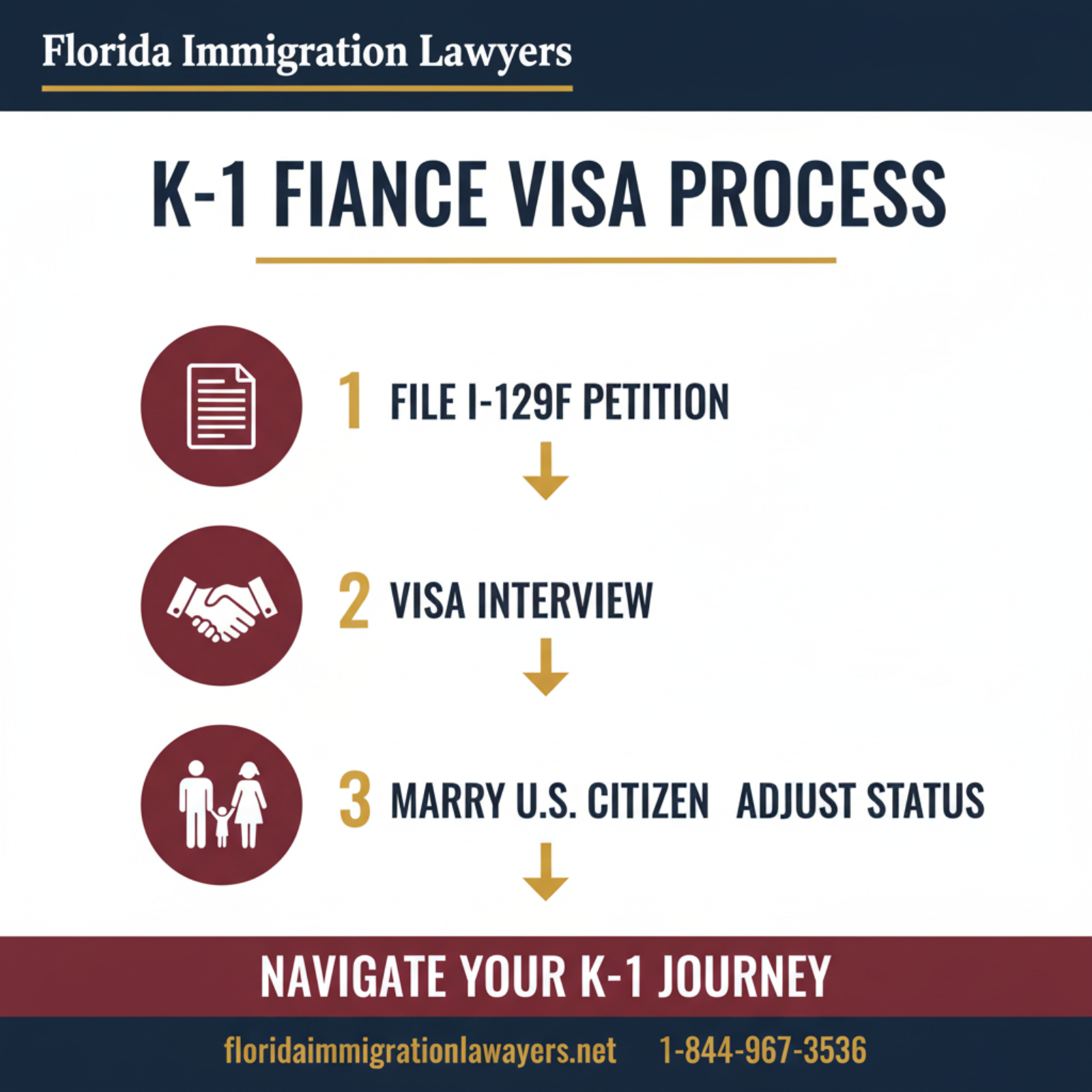
Initial Petition Filing (Form I-129F)
The process begins when the U.S. citizen petitioner files Form I-129F, Petition for Alien Fiancé(e), with U.S. Citizenship and Immigration Services (USCIS). This form establishes your relationship and intent to marry. You will need to include supporting documentation demonstrating your U.S. citizenship, proof of your relationship, and evidence that you have met in person within the last two years.
For individuals in Florida, the petition is typically mailed to a specific USCIS Lockbox facility, which then forwards it to a service center for processing. Accuracy and completeness are paramount at this stage to avoid delays or requests for additional evidence. This initial petition is critical for starting your K-1 visa journey.
-
USCIS Processing and Approval
Once USCIS receives your I-129F petition, they will send a receipt notice. This notice confirms that your application has been accepted for processing. USCIS will then review your petition to ensure all requirements are met and that your relationship appears legitimate. This stage can involve background checks for both the petitioner and the beneficiary.
If USCIS approves your petition, they will send an approval notice (Form I-797). This approval signifies that the U.S. government recognizes your eligibility to proceed with the fiance visa process. The approved petition is then sent to the National Visa Center (NVC).
-
National Visa Center (NVC) and Consular Processing
Upon receiving the approved I-129F petition from USCIS, the National Visa Center (NVC) will assign a case number. The NVC acts as an intermediary, forwarding your case to the appropriate U.S. Embassy or Consulate in your fiancé(e)'s home country. They will send instructions to your fiancé(e) regarding the next steps, including how to pay fees and submit required documents for the consular interview.
Your fiancé(e) will need to complete Form DS-160, the Online Nonimmigrant Visa Application. This form collects detailed biographical and background information. Ensuring all information is consistent with the I-129F petition is vital to prevent discrepancies that could cause delays.
-
The K-1 Visa Interview
After the NVC processes the necessary documents, the U.S. Embassy or Consulate will schedule an interview for your foreign fiancé(e). The interview is a critical step where a consular officer will assess the legitimacy of your relationship and confirm your fiancé(e)'s eligibility for the K-1 visa. They will ask questions about your relationship, your plans for marriage, and your fiancé(e)'s background.
Your fiancé(e) will also undergo a medical examination by an authorized physician before the interview. They must bring all required documents, including their passport, birth certificate, police clearances, and evidence of your relationship, to the interview. Honesty and consistency are key during this interview.
-
Entering the U.S. and Marriage
If the consular officer approves the K-1 visa, it will be stamped in your fiancé(e)'s passport. Your fiancé(e) can then travel to the United States. Upon arrival at a U.S. port of entry, a Customs and Border Protection (CBP) officer will review their documents and admit them into the country on a K-1 nonimmigrant visa.
Once your fiancé(e) arrives in Florida, you must marry within 90 days. This is a strict legal requirement of the K-1 visa. You can marry anywhere in the U.S., whether it is in Orlando, Miami, or another Florida city. After marriage, your spouse will need to apply for adjustment of status to become a lawful permanent resident.
-
Adjusting Status to Lawful Permanent Resident
After you are legally married, your foreign spouse must file Form I-485, Application to Register Permanent Residence or Adjust Status, with USCIS. This application converts their K-1 nonimmigrant status to lawful permanent resident status (Green Card holder). You, as the U.S. citizen spouse, will typically file Form I-864, Affidavit of Support, to demonstrate your ability to financially support your spouse.
This stage often involves an interview at a local USCIS field office in Florida, such as the ones in Orlando or Miami, where officers will verify the validity of your marriage. Upon approval, your spouse will receive a conditional Green Card, valid for two years. Before the two-year card expires, you will need to file Form I-751, Petition to Remove Conditions on Residence, to obtain a permanent Green Card.
Essential Documents for Your K-1 Fiance Visa Petition
Gathering the correct documentation is paramount for a successful fiance visa application. Missing or incorrect documents can lead to significant delays. Here is a general checklist of documents typically required for the I-129F petition and subsequent consular processing:
- U.S. Citizen Petitioner's Documents:
- Proof of U.S. citizenship (e.g., birth certificate, passport, naturalization certificate).
- Certified copy of divorce decrees or death certificates for any previous marriages for both parties.
- Passport-style photos of both the petitioner and beneficiary.
- Intent to marry statement signed by both parties.
- Evidence of meeting in person within the last two years (e.g., flight itineraries, passport stamps, photos together).
- Evidence of a bona fide relationship (e.g., photos, letters, emails, chat logs, joint financial documents, affidavits from friends/family).
- Foreign Fiancé(e) Beneficiary's Documents (for consular processing):
- Valid passport, valid for at least six months beyond the intended period of stay.
- Birth certificate.
- Certified copy of divorce decrees or death certificates for any previous marriages.
- Police certificates from all countries where the beneficiary has lived for certain periods.
- Medical examination results from an authorized physician.
- Evidence of financial support (e.g., I-134, Affidavit of Support, if not covered by I-864 later).
- Completed Form DS-160 confirmation page.
Step-by-Step Process Guide
K-1 Fiance Visa Timeline and Processing Expectations for Florida Residents
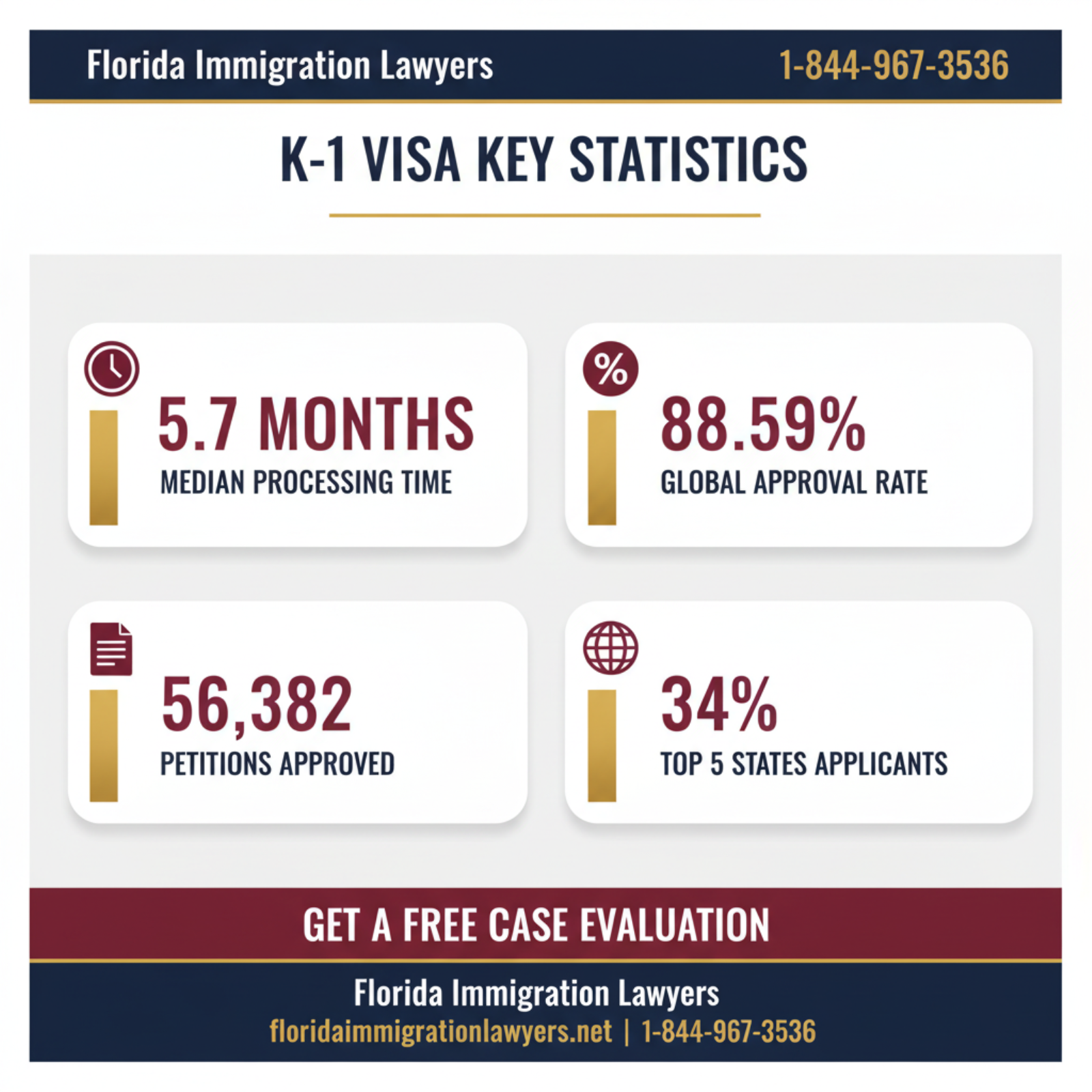
One of the most common questions we hear from couples in Florida is, "How long does it take to get a K-1 visa in Florida?" The processing time for a K-1 visa can vary significantly. It is influenced by several factors, including the current USCIS caseload, the efficiency of the NVC, and the specific U.S. Embassy or Consulate involved.
Generally, you can expect the entire K-1 visa process, from filing the I-129F petition to the visa interview, to take anywhere from 10 to 18 months, or even longer in some cases. USCIS processing times for the I-129F petition itself can range from 6 to 12 months. After USCIS approval, the NVC and consular processing stage typically adds another 3 to 6 months.
It is important to remember that these are general estimates, and individual cases may experience different timelines. Factors such as requests for additional evidence (RFEs) or administrative processing at the embassy can extend these periods. The U.S. Department of State provides visa processing times, and USCIS offers case processing times on their websites, which are updated regularly.
Can your fiancé come to the U.S. while waiting for a K-1 visa? Typically, no. The K-1 is specifically for entry with intent to marry. Applying for other nonimmigrant visas (like a tourist visa) while a K-1 is pending can be problematic, as it may be viewed as misrepresenting intent. It is generally best to wait for the K-1 visa approval.
Cost Factors and Fee Breakdown for the K-1 Fiance Visa Application
The K-1 visa process involves several fees that applicants must pay to various government agencies. These fees are subject to change, so it is crucial to check the most current fee schedules on the official USCIS and Department of State websites. While we cannot provide exact amounts, here is a breakdown of the typical cost categories:
- USCIS Filing Fee: This is for Form I-129F, Petition for Alien Fiancé(e). This fee is paid directly to USCIS when you submit your initial petition.
- Consular Processing Fee: Once the case moves to the National Visa Center and then to the U.S. Embassy or Consulate, there will be a nonimmigrant visa application fee (DS-160 fee) for the beneficiary.
- Medical Examination Fee: Your fiancé(e) will need to pay for a medical examination conducted by an authorized panel physician in their home country. This fee varies by country and clinic.
- Other Potential Costs: These can include fees for obtaining required documents (birth certificates, police records), translation services if documents are not in English, travel expenses for the interview, and ultimately, travel to the U.S.
- Adjustment of Status Fees: After marriage in Florida, there will be additional fees for filing Form I-485 (Adjustment of Status) and potentially for the biometrics appointment.
It is important to budget carefully for these expenses, as they can add up. These fees are non-refundable, regardless of the outcome of your application. Professional legal assistance, while an additional cost, can help you avoid costly mistakes and ensure a smoother process.
Do not navigate this complex process alone. The intricate requirements and potential pitfalls of the K-1 fiance visa demand careful attention to detail. Contact Florida Immigration Lawyers today to ensure your application is handled professionally and efficiently. We are committed to helping families in Florida unite.
Common Mistakes to Avoid During the K-1 Fiance Visa Process
The K-1 fiance visa process, while a pathway to family unity, is fraught with potential missteps that can lead to delays or even denial. Being aware of these common errors can save you time, money, and emotional stress. Florida Immigration Lawyers frequently assists clients in avoiding these pitfalls.
-
Incomplete or Inaccurate Documentation: Submitting a petition with missing forms, incorrect information, or insufficient supporting evidence is a leading cause of delays. USCIS will issue a Request for Evidence (RFE), which significantly prolongs processing. Ensure every question is answered truthfully and all required documents are included.
-
Insufficient Proof of Bona Fide Relationship: Immigration officials need to be convinced your relationship is genuine, not just for immigration purposes. Failing to provide ample evidence like photos, communication records, and travel itineraries can raise red flags. Be thorough in demonstrating your authentic connection.
-
Not Meeting the "Met in Person" Requirement: The law requires the couple to have met physically within two years of filing the I-129F petition. Neglecting this requirement, or not having sufficient proof of the meeting, will result in denial unless a rare waiver applies. Keep clear records of your meetings.
-
Failure to Disclose Previous Marriages or Criminal History: Transparency is critical. Omitting information about prior marriages, even if legally terminated, or any criminal records for either party, can be considered misrepresentation and lead to severe consequences, including permanent bars from the U.S. Always disclose everything fully and accurately.
-
Marrying Outside the 90-Day Window: The K-1 visa is granted with the strict condition that marriage occurs within 90 days of the foreign fiancé(e)'s entry into the U.S. Failing to marry within this timeframe means the foreign national will fall out of status and must depart the U.S., or face deportation. This is a non-negotiable deadline.
-
Inadequate Financial Support (Affidavit of Support Issues): The U.S. citizen petitioner must demonstrate they can financially support their fiancé(e) to prevent them from becoming a public charge. Failing to meet the income requirements or submitting an improperly completed Form I-864 (Affidavit of Support) can lead to denial of the adjustment of status. Seek guidance if your income is borderline.
-
Applying for Other Visas While K-1 is Pending: Attempting to obtain a different visa, such as a tourist visa, while a K-1 petition is pending can be seen as misrepresentation of intent to consular officers. The K-1 visa explicitly acknowledges immigrant intent, whereas most other nonimmigrant visas require non-immigrant intent. This can complicate or jeopardize your K-1 application.
When to Call a Lawyer for Your K-1 Fiance Visa
While some couples attempt the K-1 visa process independently, the complexities of immigration law often necessitate professional legal guidance. Florida Immigration Lawyers are here to provide comprehensive support for your journey, especially if you encounter specific challenges. Knowing when to seek legal counsel can make a significant difference in your case's outcome.
You should consider contacting an experienced immigration attorney if:
- You have a complex immigration history: This includes previous visa denials, deportations, overstays, or criminal records for either the petitioner or the beneficiary. These issues can significantly complicate the application and require expert navigation.
- You have difficulty meeting the "met in person" requirement: If you and your fiancé(e) have not met in person within the last two years, or if there are cultural or extreme hardship reasons preventing such a meeting, an attorney can assess your eligibility for a waiver.
- You have concerns about financial sponsorship: If the U.S. citizen's income is near the poverty guidelines, or if there are other complexities with the Affidavit of Support, a lawyer can help explore options like joint sponsors.
- Your petition receives a Request for Evidence (RFE) or Notice of Intent to Deny (NOID): These notices indicate that USCIS has concerns about your application. An attorney can help you formulate a robust and timely response to address these issues effectively.
- Your relationship has unusual circumstances: If there's a significant age difference, cultural differences, or a history of previous short marriages, an attorney can help you present your case in the most compelling way.
- You simply want peace of mind: Navigating immigration law can be stressful. A lawyer can ensure all forms are correctly filed, all documents are submitted, and you are prepared for every stage of the process, including the interview.
Florida Immigration Lawyers has extensive experience assisting individuals and families throughout Florida, including Orlando, Miami, and Tampa, with their K-1 visa applications and subsequent adjustment of status processes. We are dedicated to protecting your rights and helping you achieve your immigration goals. Our attorneys are well-versed in the latest immigration policies and procedures, including those affecting Florida residents. Let us put our expertise to work for you. Learn more about our family immigration services and how we can support your overall immigration journey.
About Florida Immigration Lawyers
Florida Immigration Lawyers is a leading immigration law firm dedicated to serving individuals and families across the entire state of Florida. With a deep understanding of U.S. immigration laws and a commitment to our clients, we provide compassionate yet aggressive legal representation. Our mission is to guide you through the complex immigration system with clarity and confidence.
We offer a comprehensive range of immigration services, including family-based visas, employment visas, deportation defense, asylum claims, and naturalization assistance. Our experienced attorneys are passionate about helping you achieve your American dream, whether you are seeking to reunite with family, pursue career opportunities, or find safety and refuge in the United States.
Choosing Florida Immigration Lawyers means choosing a partner who will stand by you every step of the way. We pride ourselves on our personalized approach, meticulous attention to detail, and unwavering dedication to our clients' success. We are available 24/7 to address your concerns and offer free, confidential consultations to discuss your unique situation.
Contact us today to experience the difference our expertise can make. Call Florida Immigration Lawyers at 1-844-967-3536 or visit our website at https://www.floridaimmigrationlawyers.net. We serve all of Florida and are ready to help you.
Sources and References
- U.S. Citizenship and Immigration Services (USCIS) - Fiancé(e) Visa (K-1)
- U.S. Department of State - Family-Based Immigrant Visas
- Executive Office for Immigration Review (EOIR)
- Immigration and Nationality Act (INA) Section 101(a)(15)(K) - Definition of K Nonimmigrant
- Immigration and Nationality Act (INA) Section 214(d) - Nonimmigrant Visa Issuance
- 8 U.S.C. § 1101(a)(15)(K) - Nonimmigrant visa definitions
- 8 CFR Part 214.2(k) - K Nonimmigrants regulations
- USCIS Policy Manual, Volume 6, Part B, Chapter 2 - K Nonimmigrant Visas
This article provides general legal information and is not intended as legal advice. Every case is unique, and outcomes depend on specific facts and circumstances. Immigration laws are complex and subject to change. Contact an attorney for advice about your particular situation.
Embarking on the fiance visa journey to unite your family in Florida is a significant step. With the right legal support, you can navigate the process confidently and efficiently. Don't leave your future to chance.
For a confidential and free consultation, reach out to Florida Immigration Lawyers today. Call us at 1-844-967-3536. Se Habla Español - Estamos aquí para ayudarle.
Do Not Navigate This Process Alone
Our experienced immigration attorneys are ready to fight for you. Get a free, confidential consultation today.
Se Habla Español
Frequently Asked Questions
Florida Immigration Lawyers
Immigration Attorney | Founder, Vasquez Law Firm
U.S. Air Force veteran and immigration attorney with thousands of cases resolved. J.D., NCCU School of Law. AILA member. Admitted to the 4th, 5th, and 11th Circuit Courts.
Available 24/7 - Free Evaluations
Related Legal Services
Our Florida immigration attorneys can help you with experienced immigration attorneys, business immigration and asylum protection. Call today at 1-844-967-3536 for a free consultation.
Related Links
Related Topics
Free Legal Consultation
Discuss your case with our experienced attorneys. We're available 24/7.
Se Habla Español - Estamos aquí para ayudarle.
Related Articles
Expungement Effect on Immigration in Florida | VLF Florida
Discover how expungement impacts immigration in Florida. Learn about eligibility, the process, and potential consequences. Contact Florida Immigration Lawyers at 1-844-967-3536 for a free consultation.
Immigration Services in Kissimmee Florida | VLF Florida
Discover essential immigration services in Kissimmee, Florida. Learn about the resources available for immigrants, including Puerto Rican residents in Osceola County. Contact Florida Immigration Lawyers at 1-844-967-3536 for expert guidance and a free consultation.
Child Status Protection Act (CSPA) Florida: Preventing 'Aging
Understand the Child Status Protection Act (CSPA) in Florida and how it prevents 'aging out' for derivative beneficiaries. Navigate complex immigration laws
I-360 Widow Self-Petition in Florida: A Complete Guide
Learn how to navigate the I-360 widow self-petition process in Florida. This comprehensive guide covers eligibility, documentation, and common mistakes. Call Florida Immigration Lawyers for expert assistance.