EB-5 Investor Green Card Florida: Your Path to U.S.
The EB-5 investor green card program offers a strategic pathway to U.S. permanent residency for foreign nationals through significant capital investment and job creation. This guide explores the intricacies of EB-5 investment immigration in Florida, covering eligibility, the step-by-step application process, essential documentation, and expected timelines. Learn about direct investments versus regional center projects, the crucial "at risk" capital requirement, and how to transition from conditional to permanent green card status. We also highlight common mistakes to avoid and when expert legal counsel is indispensable for success. Discover how Florida Immigration Lawyers can assist you in achieving your residency goals in dynamic areas like Naples.

The EB-5 investor green card program offers a path to U.S. permanent residency for foreign investors who make a qualifying capital investment in a U.S. commercial enterprise and create at least 10 full-time jobs for U.S. workers. This program is a vital option for those seeking investment immigration, particularly in Florida, where dynamic economic growth presents numerous opportunities, including those within regional centers.
- Invest $800,000 or $1,050,000 in a U.S. enterprise.
- Create 10 full-time jobs for U.S. workers.
- Can lead to permanent U.S. residency (green card).
- Options include direct investment or through a regional center.
- Seek legal guidance for this complex investment immigration process.
Are you an international investor considering making a significant impact on the U.S. economy while securing your family's future in Florida? The EB-5 investor green card program offers a unique pathway to U.S. permanent residency through capital investment. This program, often referred to as investment immigration, has been a beacon for many seeking new opportunities in dynamic states like Florida.
Navigating the complexities of U.S. immigration law, especially for a high-stakes process like the EB-5, requires expert guidance. This comprehensive guide will walk you through the intricacies of the EB-5 program, its requirements, benefits, and how you can achieve your dream of living and working in Florida, particularly in flourishing areas like Naples. If you are ready to explore your options, call Florida Immigration Lawyers at 1-844-967-3536 for a free consultation. Our experienced team is here to assist you every step of the way.
Understanding the EB-5 Investor Program for Florida Residency
The EB-5 Immigrant Investor Program, established by Congress in 1990, aims to stimulate the U.S. economy through job creation and capital investment by foreign investors. This program provides a pathway to a green card for eligible investors and their immediate family members. For those considering investment immigration in Florida, the EB-5 program presents significant opportunities.
To qualify for the EB-5 program, an investor must make a capital investment in a new commercial enterprise. This enterprise must create or preserve at least 10 full-time jobs for qualifying U.S. workers. The investment can be made either directly into a business or through a USCIS-designated regional center. Florida offers a diverse and growing economy, making it an attractive location for EB-5 investments.
Eligibility Requirements for the EB-5 Investor Green Card
Several key criteria determine eligibility for an EB-5 investor green card. First, the investor must commit the required capital amount. This is generally $1,050,000, or a reduced amount of $800,000 if the investment is made in a Targeted Employment Area (TEA) or an infrastructure project. TEAs are typically rural areas or areas experiencing high unemployment. Many parts of Florida, including certain census tracts in and around Naples, may qualify as TEAs, offering a lower investment threshold.
Second, the investment must result in the creation of at least 10 full-time jobs for qualifying U.S. workers within two years of the investor's admission to the U.S. as a conditional permanent resident. These jobs must be direct, indirect, or induced, depending on whether the investment is direct or through a regional center. Third, the investor's capital must be "at risk," meaning there is no guarantee of return, and the funds must be lawfully gained. (See 8 U.S.C. § 1153(b)(5)).
Choosing Between Direct Investment and a Regional Center
Investors pursuing an EB-5 investor green card in Florida have two primary avenues for their capital investment: direct investment or through a regional center. A direct investment involves investing directly into a new commercial enterprise that the investor will typically manage or play a significant role in. This option requires the investor to directly demonstrate the creation of 10 full-time jobs. This can be more challenging for investors who are not actively involved in day-to-day business operations.
Alternatively, many investors choose to invest through a USCIS-approved regional center. Regional centers are entities, agencies, or organizations that promote economic growth, improved regional productivity, job creation, and increased domestic capital investment. Investing through a regional center allows for the calculation of both direct and indirect job creation, offering more flexibility and often a simpler path to meeting the job creation requirement. Florida has several active and successful regional centers, particularly in major economic hubs.
Conditional vs. Permanent Green Card Status
The EB-5 program initially grants a conditional green card valid for two years. This conditional status is a crucial step toward obtaining permanent residency. During this two-year period, the investor must demonstrate that they have sustained their investment and that the required jobs have been created or are expected to be created. This period allows USCIS to verify the investment's compliance with program requirements.
To remove the conditions and obtain a permanent green card, the investor must file Form I-829, Petition by Investor to Remove Conditions on Permanent Resident Status, within the 90-day period before the conditional green card expires. Proving the sustained investment and job creation is paramount at this stage. Successfully navigating this petition is critical for securing long-term residency in Florida.
Step-by-Step EB-5 Application Process for Florida Investors
Embarking on the journey to obtain an EB-5 investor green card in Florida involves a carefully structured application process. Each step requires meticulous attention to detail and adherence to USCIS regulations. Understanding this process is key to a successful investment immigration outcome. Our firm, Florida Immigration Lawyers, regularly assists clients in Naples and across Florida with these complex applications.
- Identify an Investment Opportunity: The first step is to identify a qualifying investment. This could be a direct investment in a new commercial enterprise or an investment through a USCIS-approved regional center. For investors in Florida, research potential projects in high-growth areas or TEAs. Ensure the project aligns with EB-5 visa requirements, particularly regarding job creation and capital at risk.
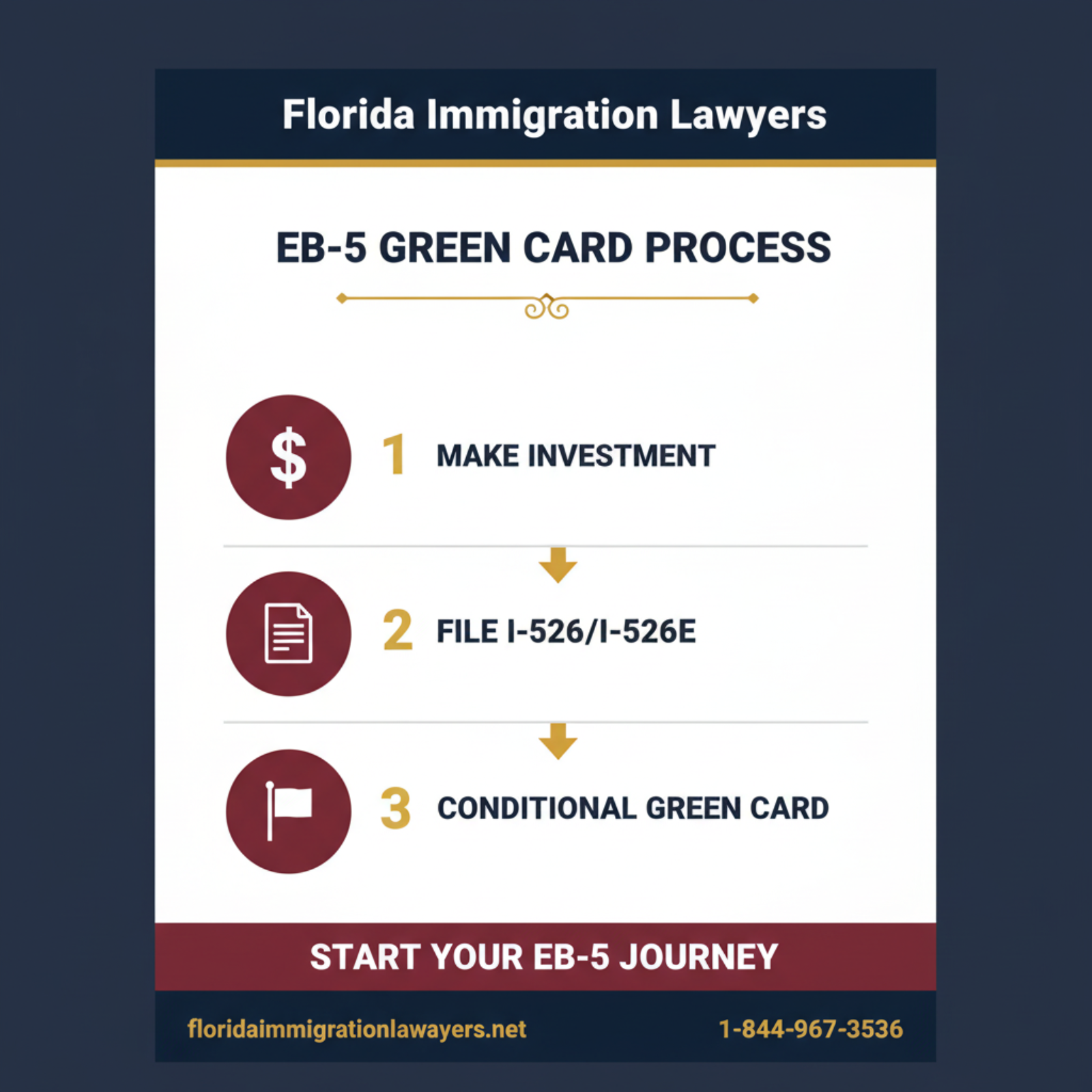
- File Form I-526, Immigrant Petition by Alien Entrepreneur: Once an investment is identified and committed, your immigration attorney will prepare and file Form I-526 with U.S. Citizenship and Immigration Services (USCIS). This petition proves that you have made a qualifying investment in a U.S. commercial enterprise and that the investment meets all EB-5 program requirements. Detailed documentation regarding the source of funds and the investment project will be required.
- Wait for I-526 Approval: USCIS will review your I-526 petition. Processing times can vary significantly based on demand, country of origin, and USCIS workload. During this waiting period, it is crucial to maintain all investment documentation.
- Apply for Conditional Permanent Residency (Green Card): Upon I-526 approval, the next step depends on your physical location.
- If you are outside the U.S., you will apply for an immigrant visa through consular processing at a U.S. Embassy or Consulate in your home country. This involves submitting Form DS-260, Immigrant Visa Application.
- If you are already in the U.S. on a valid non-immigrant visa, you may be eligible to file Form I-485, Application to Register Permanent Residence or Adjust Status, concurrently or after I-526 approval, if a visa number is immediately available.
- Fulfill Job Creation Requirements: During the two-year conditional residency period, you must ensure that your investment creates or preserves the required 10 full-time jobs. If you invested through a regional center, the regional center will typically manage this aspect, providing reports and documentation. For direct investments, you are responsible for demonstrating direct job creation.
- File Form I-829, Petition to Remove Conditions: Within the 90-day window before your conditional green card expires, you must file Form I-829 with USCIS. This petition demonstrates that the capital investment was sustained and that the job creation requirements were met. This is a critical step to transition from conditional to permanent green card status. (Refer to 8 C.F.R. § 204.6(m)).
- Obtain Permanent Green Card: Upon approval of your I-829 petition, the conditions on your residency will be removed, and you will become a lawful permanent resident of the United States. This grants you all the rights and privileges of a green card holder, including the ability to live, work, and travel freely in the U.S.
Essential Document Checklist for EB-5 Investors in Florida
A thorough and meticulously organized set of documents is paramount for a successful EB-5 investor green card application. USCIS requires extensive proof to verify your investment, the lawful source of your funds, and the job creation impact. Preparing these documents carefully, especially for a significant investment immigration process in Florida, can streamline your application.
Here is a general checklist of documents you will typically need for your EB-5 petition. Please note that specific requirements may vary based on your individual case and chosen investment path (direct vs. regional center).
- Identity and Biographical Documents:
- Passport copies for yourself and all accompanying family members.
- Birth certificates for yourself and all family members.
- Marriage certificate (if applicable).
- Police clearance certificates from countries where you have resided.
- Medical examination results (Form I-693).
- Investment-Related Documents:
- Proof of capital investment (e.g., bank statements, escrow agreements, wire transfer confirmations).
- Detailed business plan for the new commercial enterprise (for direct investments) or offering documents from the regional center project.
- Evidence that the investment is in a Targeted Employment Area (TEA) if claiming the lower investment threshold (e.g., census data, unemployment statistics).
- Documentation proving the investment is "at risk" and will create 10 full-time jobs.
- Source of Funds Documents: This is a critical component. You must demonstrate that your invested capital was obtained through lawful means.
- Tax returns (personal and business) for the past five to seven years.
- Bank statements showing funds accumulation.
- Evidence of property sales, business profits, stock sales, gifts, loans, or inheritance.
- Certificates of incorporation or business registration documents if funds are from a business.
- Pay stubs, employment letters, and salary certificates.
Step-by-Step Process Guide - Job Creation Documents (for I-829 Petition):
- Payroll records, I-9 forms, and tax documents for U.S. workers hired.
- Business financial statements and tax returns showing sustained operations.
- Evidence of capital deployment and continued operation of the commercial enterprise.
- Economic reports demonstrating indirect and induced job creation (for regional center investments).
Organizing these documents can be overwhelming. Florida Immigration Lawyers can help you compile and present a robust application.
EB-5 Visa Timeline and Processing Expectations in Florida (2026)
The processing timeline for an EB-5 investor green card can be a significant concern for applicants. While specific dates are difficult to predict due to fluctuating USCIS workloads and demand, understanding the general stages and current trends can help manage expectations. For those pursuing investment immigration in Florida, planning for these timelines is crucial.
As of 2026, USCIS publishes estimated processing times on its website for various petitions, including Forms I-526 and I-829. These times can range from several months to several years, particularly for I-526 petitions from certain high-demand countries. The EB-5 Reform and Integrity Act of 2022 introduced measures aimed at improving processing times and program integrity, but significant backlogs may still exist. The program is currently authorized through September 30, 2027, so it is not ending in 2026.
Key Stages and Estimated Durations:
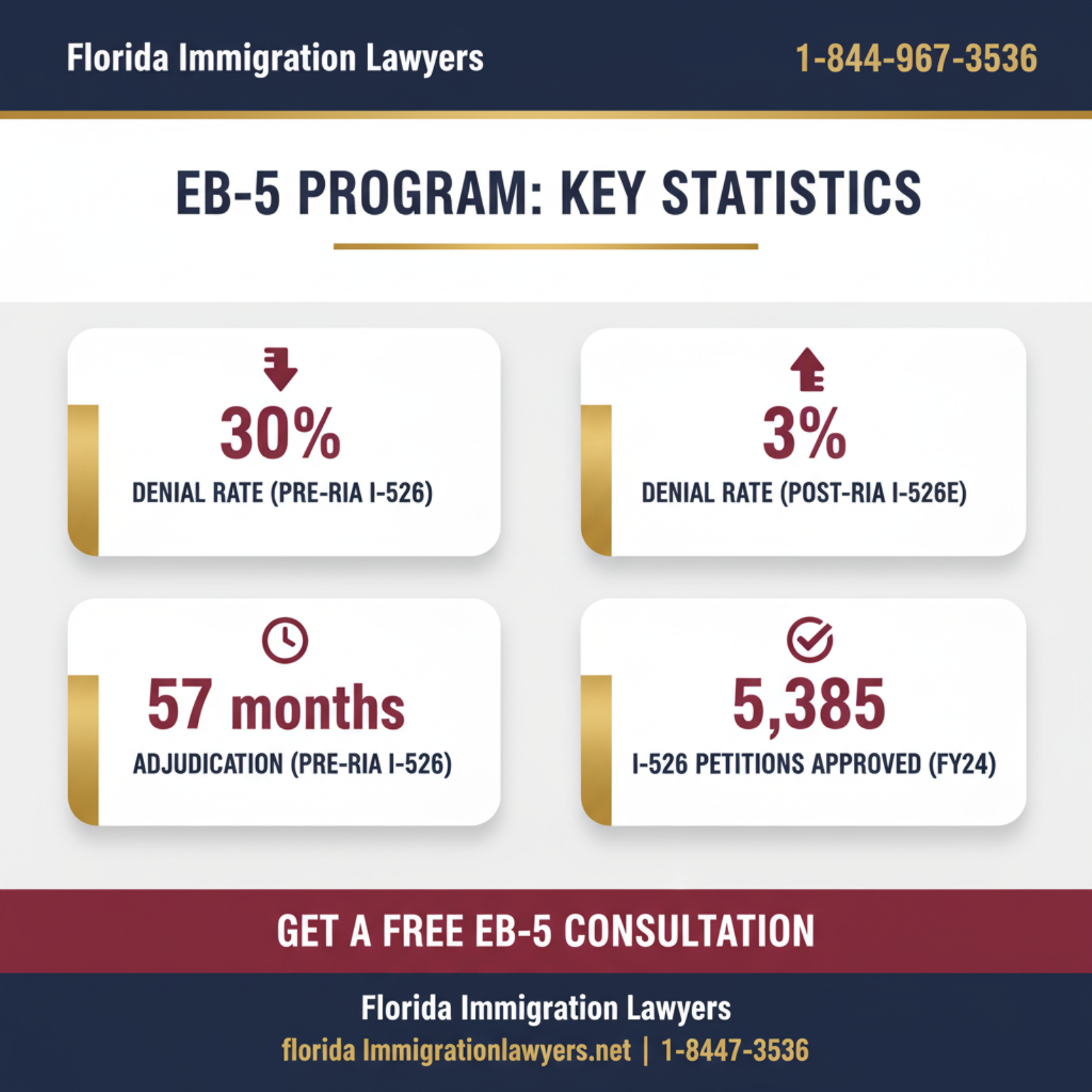
- Form I-526 Processing: This is often the longest stage. Historically, I-526 processing could take 30-60 months or more, especially for certain countries facing visa backlogs. New regulations and increased efficiencies may lead to improvements, but investors should still anticipate a multi-year wait.
- Consular Processing or Adjustment of Status: Once your I-526 is approved and a visa number is available, the next stage typically takes 6-12 months. This involves interviews and background checks either at a U.S. consulate abroad or through an adjustment of status application if you are already in the U.S.
- Conditional Residency Period: This period is fixed at two years. During this time, you must maintain your investment and ensure job creation requirements are met.
- Form I-829 Processing: The petition to remove conditions generally takes 24-48 months or more to process. This period determines whether your conditional status will be converted to a permanent green card.
It is important to note that these are estimates. Factors such as the volume of applications, staffing levels at USCIS service centers, and the complexity of your case can all influence your individual timeline. Working with an experienced immigration attorney from Florida Immigration Lawyers can help you prepare a strong application to minimize potential delays.
Cost Factors and Fee Breakdown for Your EB-5 Investment
The financial commitment for an EB-5 investor green card extends beyond the initial capital investment. Understanding the various costs involved is essential for comprehensive financial planning. For those considering investment immigration in Florida, a clear breakdown of these expenses will help you make informed decisions.
The primary investment amount for the EB-5 program is either $800,000 for Targeted Employment Areas (TEAs) and infrastructure projects, or $1,050,000 for all other areas. Naples, Florida, with its thriving economy, may offer opportunities in both TEA-designated zones and non-TEA zones. This initial capital must be fully committed and "at risk" throughout the conditional residency period.
Additional Fees and Expenses:
Beyond the capital investment, applicants for an EB-5 investor green card should anticipate several other significant fees:
- USCIS Filing Fees: These are fees paid directly to U.S. Citizenship and Immigration Services for processing your petitions.
- Form I-526, Immigrant Petition by Alien Entrepreneur: The fee is subject to change but is typically several thousand dollars.
- Form I-485, Application to Register Permanent Residence or Adjust Status (if applicable): This fee also varies and includes biometric services.
- Form DS-260, Immigrant Visa Application (for consular processing): A fee is paid to the Department of State.
- Form I-829, Petition by Investor to Remove Conditions on Permanent Resident Status: This fee is also subject to change but is typically several thousand dollars.
Key Statistics & Data - Administrative Fees (for Regional Center Investments): If you invest through a regional center, they often charge an administrative fee. This fee, separate from your capital investment, can range from $50,000 to $70,000 or more. It covers the regional center's operational costs, project development, and compliance efforts.
- Immigration Attorney Fees: Legal fees for an experienced immigration attorney are a crucial investment. Given the complexity of the EB-5 program, expert legal guidance is invaluable. Fees vary based on the attorney's experience and the complexity of your case but can range significantly.
- Due Diligence Fees: Before committing to an investment, many investors engage independent third-party due diligence firms to assess the project's viability and compliance. These fees can vary widely depending on the scope of the review.
- Escrow and Banking Fees: Fees associated with transferring funds, maintaining escrow accounts, and other banking services.
- Translation and Document Preparation Fees: If your documents are not in English, certified translations will be required.
- Medical Examination Fees: Required for all applicants for permanent residence.
It is important to budget comprehensively for all these costs. While the EB-5 program represents a substantial financial commitment, it offers a direct path to a green card and the myriad opportunities that come with U.S. residency.
Do not navigate this complex and high-stakes process alone. The journey to obtaining an EB-5 investor green card can be filled with intricate legal requirements and significant financial decisions. Contact Florida Immigration Lawyers today for personalized guidance and robust representation. Our dedicated team is ready to help you pursue your investment immigration goals in Florida. You can also visit our contact page to learn more.
Common Mistakes to Avoid in Your EB-5 Investor Green Card Application
The EB-5 investor green card program is highly regulated, and even minor errors can lead to significant delays or outright denials. Avoiding common pitfalls is crucial for a successful investment immigration outcome in Florida. Here are some key mistakes to watch out for:
- Insufficient or Unverified Source of Funds: Failing to meticulously document the lawful source of all invested capital is one of the most frequent reasons for I-526 denials. USCIS requires a clear and verifiable paper trail for all funds. This includes tax records, business records, and transaction histories.
- Investing in a Non-Qualifying Enterprise or Project: Not all businesses or projects meet EB-5 criteria. Ensure your chosen investment, whether direct or through a regional center, genuinely qualifies by creating the required number of jobs and meeting the "at risk" capital requirement. This also applies to green card through investment in real estate projects, which must meet job creation.
- Failure to Create the Required Number of Jobs: The core purpose of the EB-5 program is job creation. Investors must demonstrate that their investment has created or will create at least 10 full-time jobs for qualifying U.S. workers. For direct investments, this means direct hires; for regional centers, it includes indirect and induced jobs, which still require robust economic modeling.
- Misunderstanding the "At Risk" Requirement: Your capital must be genuinely "at risk," meaning there can be no guarantees of return or redemption. Any arrangements that guarantee the return of capital or shield the investor from loss will disqualify the investment.
- Incomplete or Inconsistent Documentation: Submitting an application with missing documents, inconsistencies, or errors can lead to Requests for Evidence (RFEs) or denials. Every piece of information must align across all submitted forms and supporting evidence.
- Missing Deadlines: Strict deadlines apply, particularly for filing Form I-829 to remove conditions. Missing this 90-day window before your conditional green card expires can jeopardize your permanent residency status.
- Lack of a Comprehensive Business Plan: For direct investments, a detailed and credible business plan is essential. It must clearly outline how the enterprise will operate, create jobs, and sustain itself.
- Failing to Prove Sustained Investment for I-829: When applying to remove conditions, you must demonstrate that your capital remained invested and at risk throughout the conditional residency period, and that the jobs were created and maintained.
- Not Understanding the Role of a Regional Center: While regional centers simplify job creation calculations, investors must still understand the project, perform due diligence, and ensure the regional center maintains its USCIS designation. Consider researching most successful EB-5 regional centers.
- Attempting to Navigate the Process Without Legal Counsel: The EB-5 program is incredibly complex. Relying solely on general information or non-specialized advice can lead to critical mistakes. Expert legal guidance is indispensable.
When to Call Florida Immigration Lawyers for Your EB-5 Journey
The EB-5 investor green card process is one of the most complex pathways to U.S. permanent residency. While this article provides general information, your specific circumstances will always require tailored legal advice. Knowing when to engage an experienced immigration attorney, especially for investment immigration in Florida, is crucial for success.
You should strongly consider contacting Florida Immigration Lawyers at the very beginning of your EB-5 journey.
- Initial Assessment and Strategy: Before you even commit to an investment, we can assess your eligibility, explain the nuances of the program, and help you strategize the best approach for your individual and family goals. This includes determining if a direct investment or a regional center project is more suitable and identifying potential Targeted Employment Areas (TEAs) in or around Naples.
- Source of Funds Documentation: Proving the lawful source of your investment funds is often the most challenging aspect of the EB-5 application. Our attorneys can guide you through the intricate requirements, helping you gather and present comprehensive and compelling evidence to USCIS.
- Investment Due Diligence: While we do not provide financial advice, we can review the immigration-specific aspects of potential investment projects to ensure they meet EB-5 requirements. We can also advise on the "at risk" requirement and job creation methodologies.
- Petition Preparation and Filing: We meticulously prepare and file Form I-526 and later Form I-829, ensuring all documentation is complete, accurate, and presented in the strongest possible manner. This minimizes the risk of Requests for Evidence (RFEs) or denials.
- Responding to RFEs or Denials: If USCIS issues an RFE or a Notice of Intent to Deny, our legal team can prepare a robust response to address their concerns effectively. In the unfortunate event of a denial, we can explore options for appeal or reconsideration.
- Consular Processing or Adjustment of Status: We will guide you through the interview process at a U.S. embassy or consulate or assist with your adjustment of status application if you are already in the U.S.
- Removing Conditions (I-829 Petition): The transition from conditional to permanent green card status is critical. We will help you compile the necessary evidence to demonstrate sustained investment and job creation, ensuring a smooth removal of conditions.
Florida Immigration Lawyers offers comprehensive legal services for all aspects of business immigration and investor visas. We understand the specific opportunities and challenges in Florida, including those for an EB-5 investor green card in flourishing communities like Naples. Don't leave your future to chance.
About Florida Immigration Lawyers
Florida Immigration Lawyers is a leading immigration law firm dedicated to serving individuals, families, and businesses across the entire state of Florida. With a deep understanding of complex U.S. immigration laws, our experienced attorneys provide compassionate and results-driven legal representation. We are committed to helping our clients navigate the often-challenging immigration landscape.
Our firm offers a wide range of immigration services, including family-based petitions, employment visas, deportation defense, asylum applications, and naturalization. For investors and entrepreneurs, we specialize in business immigration solutions, including the EB-5 investor green card program. We pride ourselves on clear communication, strategic planning, and unwavering advocacy for our clients.
Why choose Florida Immigration Lawyers? We offer personalized attention, a thorough approach to every case, and a commitment to achieving the best possible outcomes. Our team is available 24/7 to answer your questions and provide support. We offer free consultations to discuss your case and outline your legal options.
Contact Florida Immigration Lawyers today to take the first step towards your immigration goals.
Phone: 1-844-967-3536
Website: https://www.floridaimmigrationlawyers.net
Serving all of Florida, including Naples, Miami, Orlando, Tampa, and Jacksonville.
Sources and References
- U.S. Citizenship and Immigration Services (USCIS) - EB-5 Immigrant Investor Program
- USCIS Policy Manual - Volume 6, Part G - Investors
- U.S. Department of State - Visa Bulletin
- 8 U.S.C. § 1153(b)(5) - Immigration and Nationality Act (INA) Section 203(b)(5) - Employment-Based Immigrants: Fifth Preference
- 8 C.F.R. § 204.6 - Petitions for employment creation aliens
This article provides general legal information and is not intended as legal advice. Every case is unique, and outcomes depend on specific facts and circumstances. Contact an attorney for advice about your particular situation.
Ready to take the next step towards your EB-5 investor green card in Florida? Don't navigate the complexities of investment immigration alone. Call Florida Immigration Lawyers at 1-844-967-3536 for a confidential and free consultation. Our experienced team is here to provide the expert guidance and support you need. Se Habla Español - Estamos aquí para ayudarle.
Do Not Navigate This Process Alone
Our experienced immigration attorneys are ready to fight for you. Get a free, confidential consultation today.
Se Habla Español
Or leave your details and we’ll call you:
Free Evaluation in 24 Hours
Or talk to us right now

AI voice assistant — available 24/7
FreeFrequently Asked Questions

William J. Vásquez
Founding Attorney · Vasquez Law Firm
U.S. Air Force veteran and immigration attorney with years of hands-on U.S. immigration experience. J.D., NCCU School of Law. AILA member. Admitted to the 4th, 5th, and 11th Circuit Courts.
Available 24/7 - Free Evaluations
Reviewed for legal accuracy by William J. Vásquez
Licensed in North Carolina; U.S. immigration is federal practice.
Related Legal Services
Our Florida immigration attorneys can help you with immigration practice areas, free immigration consultation and experienced immigration attorneys. Call today at 1-844-967-3536 for a free consultation.
Related Links
Related Topics
Free Legal Consultation
Discuss your case with our experienced attorneys. We're available 24/7.
Se Habla Español - Estamos aquí para ayudarle.
Related Articles
SIJS Process for Minors in Florida: What You Need to Know
Special Immigrant Juvenile Status (SIJS) offers a path to legal residency for minors in Florida who have been abused, abandoned, or neglected. This comprehensive guide covers eligibility requirements, application steps, and common mistakes to avoid. Our expert team at Florida Immigration Lawyers is here to assist you through this complex process. Learn more about how SIJS can help secure your future.
BIA Remand Order: Your 2026 Guide in Florida
A BIA remand order means the Board of Immigration Appeals has sent your immigration case back to an Immigration Judge for further review. This crucial development requires immediate and strategic action, as it indicates a need to address legal errors, consider new evidence, or develop the factual record. For individuals in Florida, navigating a BIA remand can be complex, involving new hearings, strict deadlines, and the potential need for updated documentation. Understanding the reasons for the remand, preparing comprehensive evidence, and securing experienced legal representation are vital steps to achieving a favorable outcome. This guide explains the process, potential outcomes, and common mistakes to avoid in 2026, emphasizing the importance of professional legal assistance from Florida Immigration Lawyers.
I-360 Widow Petition: Guide for Surviving Spouses
For non-citizen surviving spouses of U.S. citizens in Florida, the I-360 Widow Petition offers a vital pathway to permanent residency. This self-petition allows eligible individuals to apply for a green card independently, without requiring another sponsor. You must generally file within two years of your spouse's death, prove a bona fide marriage, and ensure you have not remarried. As of 2026, understanding the strict eligibility criteria, detailed filing process, and potential costs is crucial. Florida Immigration Lawyers provides expert guidance, helping you gather necessary documentation, navigate USCIS requirements, and address any complexities, ensuring your application is strong and complete for a secure future in Florida.
Immigration Lawyer Orlando Free Consultation in 2026
Navigating U.S. immigration law in Orlando, Lakeland, and Polk County requires expert legal guidance. Florida Immigration Lawyers offers a free consultation to help you understand your options for visas, Green Cards, citizenship, or deportation defense. This comprehensive guide covers the typical process, essential documents, processing timelines for 2026, and cost factors associated with an immigration lawyer in Orlando. Learn about common mistakes to avoid and when it's crucial to seek legal assistance. Our firm provides personalized, empathetic, and strategic representation across Central Florida, ensuring you have dedicated support for your immigration journey.