Derived Citizenship in Florida: Your Guide to Parents'
Understanding derived citizenship is key for many Florida families, especially those with children born abroad or whose parents naturalized. This automatic process allows children under 18 to gain U.S. citizenship through their U.S. citizen parent(s) if specific conditions are met, including having lawful permanent resident status and residing in the U.S. in parental custody. Documenting this status often involves filing Form N-600, Application for Certificate of Citizenship, with USCIS. This comprehensive guide from Florida Immigration Lawyers details eligibility, the step-by-step application, required documents, timelines, and common pitfalls. Learn how to secure your child's future in Florida and contact our expert team for a free consultation.

Derived citizenship allows a child to automatically become a U.S. citizen through their U.S. citizen parent(s) without needing to apply for naturalization. This typically occurs when a child, including those born abroad, meets specific conditions before their 18th birthday, such as having a U.S. citizen parent, being a lawful permanent resident, and residing in the U.S. under parental custody. The process often involves filing Form N-600 to obtain official documentation.
- Children can derive citizenship through U.S. citizen parents.
- Conditions must be met before the child's 18th birthday.
- Lawful Permanent Resident status is usually required.
- The child must reside in the U.S. in the legal and physical custody of the U.S. citizen parent.
- Form N-600, Application for Certificate of Citizenship, is commonly used to document this status.
Navigating U.S. immigration law can feel complex, especially when confirming your or your child's citizenship status. Many individuals in Florida, including those born abroad or whose parents naturalized, may already be U.S. citizens through derived citizenship.
This process allows children to automatically acquire U.S. citizenship from their U.S. citizen parent(s) without separate naturalization. This guide clarifies eligibility, the application process, and vital documentation for families across Jacksonville and throughout Florida.
For personalized guidance and to determine your best path forward, call Florida Immigration Lawyers at 1-844-967-3536 for a free consultation today. Our experienced team is ready to assist you.
Understanding Derived Citizenship in Florida: An Overview
Derived citizenship is a critical aspect of U.S. immigration law. It enables certain children to automatically become U.S. citizens through their U.S. citizen parent(s). This differs from "acquired citizenship," which applies to children born abroad to U.S. citizen parents who meet specific conditions at birth.
The primary legal foundation is the Child Citizenship Act of 2000 (CCA), codified under Sections 320 and 322 of the Immigration and Nationality Act (INA). The CCA simplified this process for many families, including those residing in Florida.
The Child Citizenship Act of 2000 (INA 320 & 322)
INA Section 320 outlines criteria for children residing in the U.S. to derive citizenship. It ensures children of U.S. citizens are recognized as citizens, promoting family unity across Florida.
Who Qualifies for Derived Citizenship?
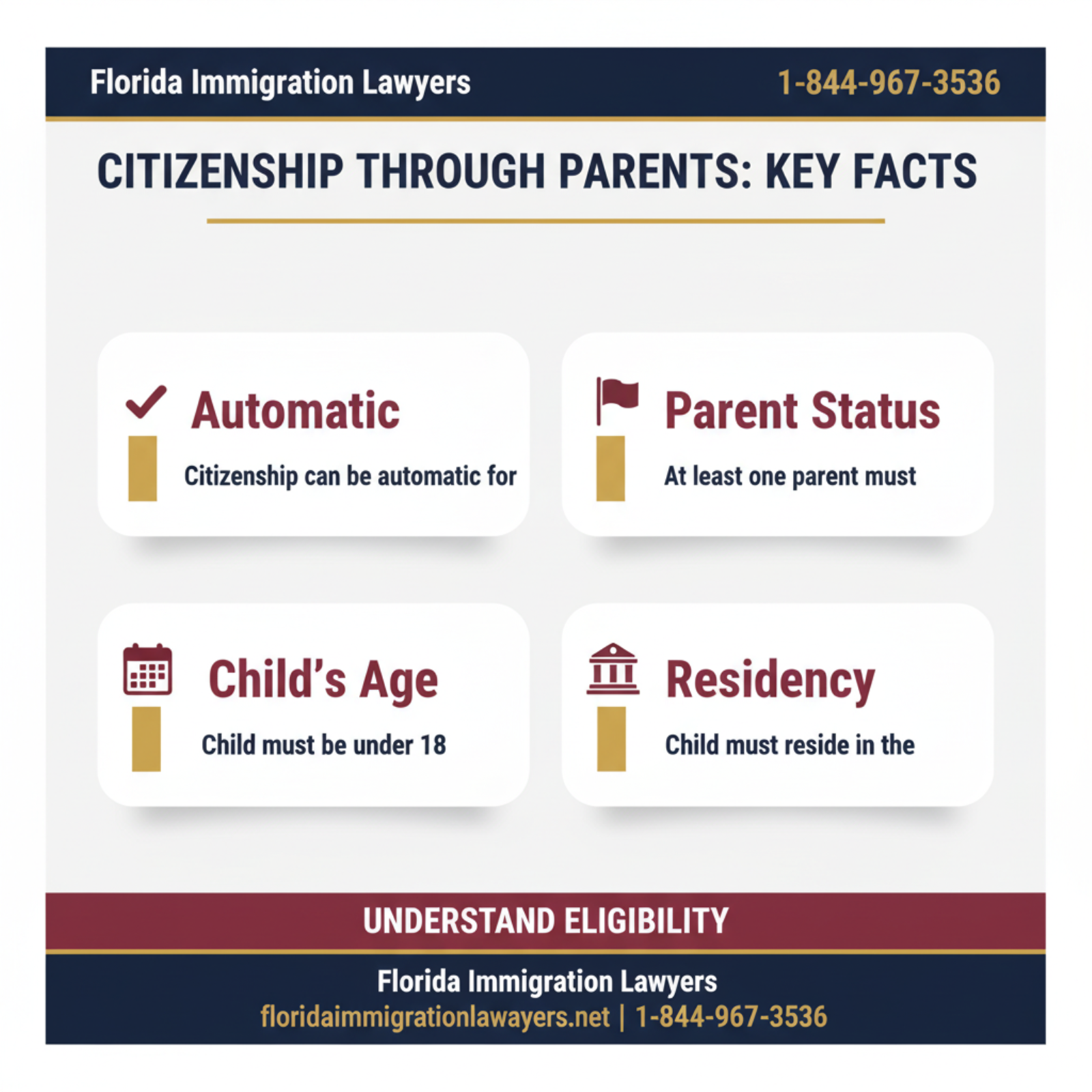
Generally, a child derives U.S. citizenship if all these conditions are met concurrently on or after February 27, 2001:
- At least one parent is a U.S. citizen (by birth or naturalization).
- The child is under 18 years of age.
- The child is a lawful permanent resident (LPR).
- The child resides in the U.S. in the legal and physical custody of the U.S. citizen parent.
The U.S. citizen parent must have been a citizen when these conditions were fulfilled. This pathway is crucial for many Florida families. For additional details, visit the official USCIS website.
Eligibility Requirements for Derived Citizenship: What You Need to Know
Accurately determining eligibility for derived citizenship requires a precise review of several factors. All requirements must be met simultaneously on or after February 27, 2001, for automatic citizenship.
U.S. Citizen Parent Status
One parent must be a U.S. citizen (by birth or naturalization). The naturalization date is vital; the child must meet all other conditions while the parent holds U.S. citizenship.
Child's Age and Marital Status
The child must be under 18 years old when all conditions are met, a strict deadline. The child must also be unmarried; marriage generally disqualifies a child from deriving citizenship.
Lawful Permanent Resident Status
For most derived citizenship cases under INA 320, the child must first obtain lawful permanent resident (LPR) status, a "green card." This allows permanent U.S. residence.
Many children gain LPR status through family-based immigration. Florida Immigration Lawyers frequently assists families with family-based immigration matters in Florida.
Residency in the United States and Parental Custody
The child must reside permanently in the U.S. They must also be in the legal and physical custody of the U.S. citizen parent. Legal custody implies court-granted custody or being the biological parent. Physical custody means the child lives with that parent.
Custody requirements are critical in divorce, separation, or adoption cases. Our citizenship practice area provides clarity for complex custody situations.
Born Abroad to U.S. Citizen Parents (Acquired Citizenship)
Acquired citizenship applies if a child is born outside the U.S. to a U.S. citizen parent, meeting specific parental residency requirements at birth. This does not require LPR status for the child.
Documentation often involves a Consular Report of Birth Abroad (CRBA) or N-600. Consult travel.state.gov for details.
Given the legal nuances, consulting an immigration attorney in Florida is highly recommended for accurate assessment.
The Step-by-Step Process for Documenting Derived Citizenship
While derived citizenship is automatic upon meeting conditions, official documentation is essential. This involves filing Form N-600, Application for Certificate of Citizenship, with U.S. Citizenship and Immigration Services (USCIS).
Florida Immigration Lawyers guides clients through this application, including those in Jacksonville.
- Determine Eligibility: Verify all conditions (U.S. citizen parent, under 18, LPR, residing in U.S. in custody) were met concurrently.
- Gather Required Documentation: Collect supporting documents like birth certificates, naturalization certificates, green cards, and custody evidence.
- Complete Form N-600: Fill out the application thoroughly. Errors cause delays.
- Prepare Supporting Evidence: Attach clear copies of all required documents. Do not send originals unless requested.
- Pay the Filing Fee: Submit the correct, current USCIS fee. Check the official USCIS website.
- Mail the Application Package: Send the complete N-600 to the correct USCIS Lockbox for your Florida residence.
- Attend Biometrics Appointment: The child attends an Application Support Center (ASC) for fingerprints, photos, and signature.
- Attend Interview (If Required): USCIS may schedule an interview to verify information.
- Receive Decision and Certificate: Upon approval, USCIS mails a Certificate of Citizenship (Form N-560/N-561), proof for a U.S. passport.
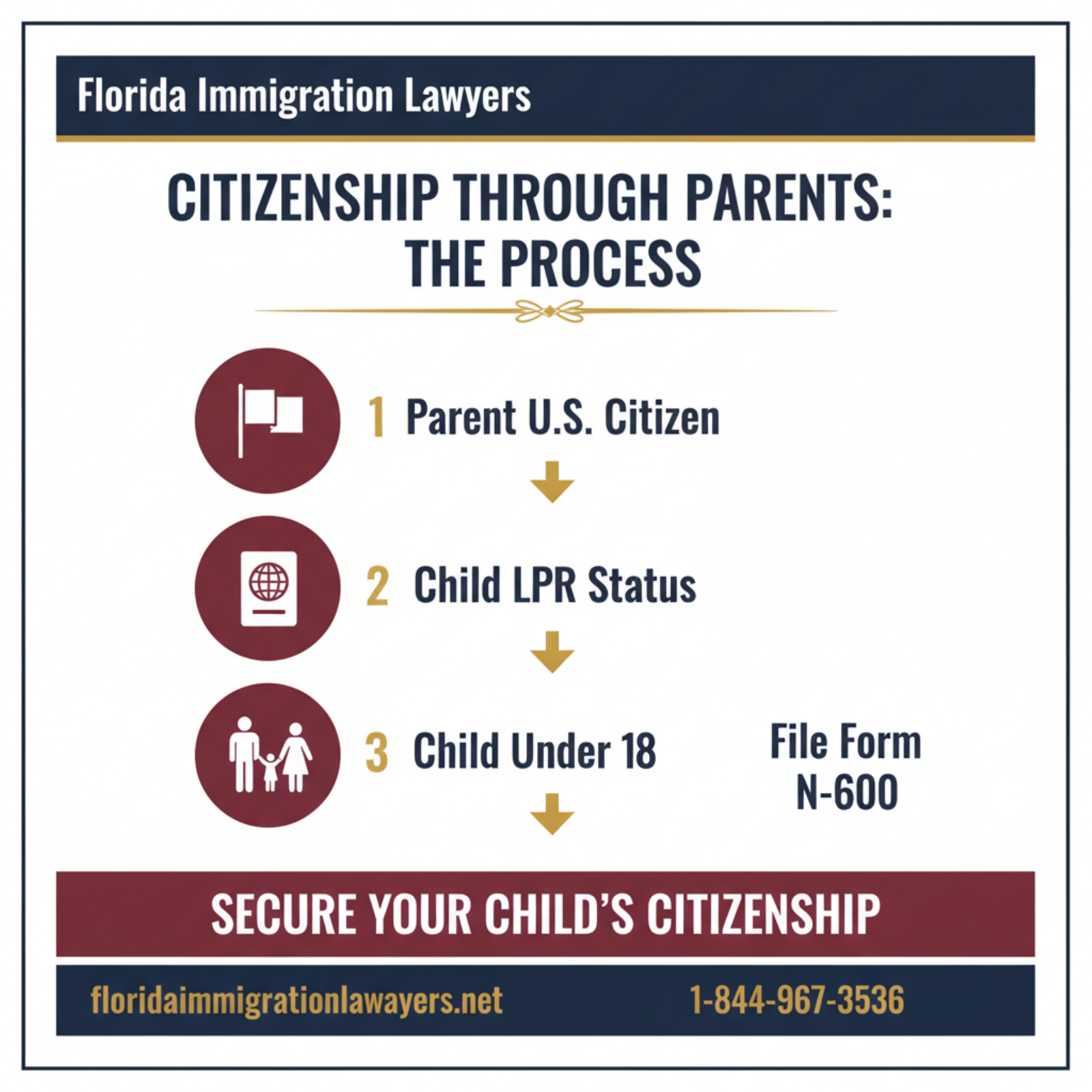
This structured approach helps ensure correct completion. Professional legal assistance can significantly impact the outcome for Florida residents.
Essential Documents for Your N-600 Application
A complete N-600 application requires comprehensive supporting documents to prove each eligibility requirement for derived citizenship. Missing documentation can lead to delays or denials.
Here is a general checklist of documents you will typically need:
- Child's Birth Certificate: Showing birth date, place, and parents' names.
- U.S. Citizen Parent's Proof of Citizenship: Birth or naturalization certificate.
- Marriage Certificate of U.S. Citizen Parent(s): If applicable.
- Evidence of Termination of Prior Marriages: Divorce decrees or death certificates, if applicable.
- Child's Permanent Resident Card (Green Card): Front and back copy.
- Evidence of Legal and Physical Custody: Court orders, school records, medical records, especially for divorce/separation.
- Proof of U.S. Residence: Utility bills, lease agreements, school enrollment, tax documents.
- Photographs: Two identical passport-style photos of the child.
- Form G-1145: Optional, for electronic notification.
USCIS may request additional documents. Provide clear copies. An experienced immigration lawyer in Florida ensures your checklist is complete and accurate.
Understanding Timelines and Cost Factors for Derived Citizenship
The processing time for Form N-600 varies, depending on the USCIS service center, application completeness, and workloads. Florida applicants can expect processing times from several months to over a year.
Regularly check the USCIS processing times page for current estimates. After filing, expect a receipt notice, then a biometrics appointment notice. Interviews are sometimes required.
Cost Factors and Fee Breakdown
The main cost is the USCIS filing fee for Form N-600. Always verify the current fee on the USCIS website, as fees change. Incorrect fees will lead to rejection.
Additional potential costs include:
- Document Translation Fees: For non-English documents.
- Postage and Mailing Costs.
- Legal Fees: For attorney assistance, highly recommended for accuracy.
Fee waivers may be available. Discussing costs with Florida Immigration Lawyers helps you plan your budget. Professional legal assistance saves time and prevents errors for families across Florida.
Do not navigate this complex process alone. The nuances of derived citizenship can be challenging, and a single mistake could lead to significant delays or even denial. Contact Florida Immigration Lawyers today to ensure your application is accurate, complete, and submitted correctly. We are here to help you secure your family's future in Florida.
Common Mistakes to Avoid When Claiming Derived Citizenship
Documenting derived citizenship with Form N-600 requires precision. Many applicants make errors that can delay or jeopardize their case. Being aware of these pitfalls is key.
- Miscalculating Eligibility Dates: Incorrectly determining if all conditions were met concurrently before the child's 18th birthday. Consequences: Application denial.
- Failing to Prove Lawful Permanent Resident (LPR) Status: The child must have officially obtained a green card before age 18. Consequences: Application denial.
- Lack of Sufficient Evidence for Parental Custody: Complex in divorce/separation, leading to RFEs or denial. Consequences: Delays or denial.
- Submitting an Incomplete Form N-600: Blank sections or insufficient answers cause rejection or delays. Consequences: USCIS returns application.
- Incorrect Filing Fees: Using outdated or incorrect fees results in rejection. Consequences: Application returned, requiring resubmission.
- Not Providing Certified Translations: Non-English documents require certified English translations. Consequences: RFE or denial.
- Sending Original Documents: Only send clear copies unless originals are specifically requested. Consequences: Potential loss of documents.
- Ignoring Requests for Evidence (RFEs): Failure to respond fully and on time to USCIS requests leads to denial. Consequences: Application denial.
- Assuming Citizenship Without Documentation: While automatic, a Certificate of Citizenship is needed to prove status. Consequences: Inability to prove citizenship.
Florida Immigration Lawyers are experts in these challenges, helping families across Florida prepare robust applications and minimize errors, from Fort Lauderdale to Pensacola.
When to Call a Lawyer for Derived Citizenship in Florida
While derived citizenship is automatic upon meeting conditions, documenting it can be complex. Specific scenarios warrant legal counsel from Florida Immigration Lawyers.
Complex Family Situations
If your family involves divorce, adoption, or custody questions, an attorney clarifies impacts and helps gather necessary documentation.
Challenges with Documentation
Missing records, unreadable documents, or foreign documents needing certified translations complicate cases. Our team guides you on obtaining replacements or ensuring proper translations.
Prior Immigration Issues
History of immigration violations or criminal records for the child or parent significantly affects the N-600. An attorney assesses complexities and advises strategies, including for deportation defense.
Uncertainty About Eligibility
If unsure whether all derived citizenship conditions were met, a lawyer conducts a thorough review, analyzing facts and providing a definitive eligibility assessment.
Received an RFE or NOID
If USCIS sends a Request for Evidence (RFE) or Notice of Intent to Deny (NOID), a correct, comprehensive response is critical. An attorney helps understand issues and prepares a strong response.
Florida Immigration Lawyers serves clients throughout Florida, from Jacksonville to Orlando. We offer compassionate, effective legal representation. Visit our attorneys page.
About Florida Immigration Lawyers
Florida Immigration Lawyers is a leading firm dedicated to serving individuals and families across Florida. Our mission is to provide expert legal guidance and compassionate representation to help clients achieve their immigration goals.
We understand the profound impact immigration matters have. Our skilled attorneys offer personalized strategies and unwavering support, ensuring you are informed and empowered.
Our Services & Why Choose Us
We offer diverse services: family-based petitions, citizenship, deportation defense, asylum claims, and visa applications. Our expertise covers various U.S. immigration law aspects, addressing diverse client needs effectively.
- Expertise: In-depth knowledge of U.S. immigration law.
- Client-Centered: Empathetic, responsive service.
- Proven Track Record: Successful outcomes for Florida families.
- Bilingual Services: English and Spanish.
- Accessibility: Available 24/7, with free consultations.
Whether in Jacksonville, Miami, or Tampa, our firm provides dedicated legal support. Contact Florida Immigration Lawyers today at 1-844-967-3536 or visit https://www.floridaimmigrationlawyers.net for a free consultation. Let us be your trusted partner.
Sources and References
- U.S. Citizenship and Immigration Services (USCIS) - Citizenship
- USCIS Policy Manual, Volume 12, Part H, Chapter 4 - Children of U.S. Citizens
- U.S. Department of State - Acquisition of U.S. Citizenship by a Child Born Abroad
- 8 U.S.C. § 1431 - Children born outside the United States and residing permanently in the United States; conditions for automatic citizenship (INA § 320)
- 8 U.S.C. § 1433 - Children born outside the United States; application for certificate of citizenship (INA § 322)
- 8 CFR Part 320 - Child residing in the United States; conditions for automatic citizenship
- 8 CFR Part 322 - Child residing outside the United States; conditions for acquiring citizenship
- Child Citizenship Act of 2000 (Public Law 106-395)
This article provides general legal information and is not intended as legal advice. Every case is unique, and outcomes depend on specific facts and circumstances. Contact an attorney for advice about your particular situation.
Understanding derived citizenship is a critical step towards securing your family's future in Florida. Don't leave your or your child's citizenship status to chance. The complexities of immigration law require expert guidance to ensure a smooth and successful process.
Contact Florida Immigration Lawyers today for a confidential, free consultation. Call us at 1-844-967-3536. Se Habla Español - Estamos aquí para ayudarle. Let us provide the clarity and support you need to navigate this important journey.
Do Not Navigate This Process Alone
Our experienced immigration attorneys are ready to fight for you. Get a free, confidential consultation today.
Se Habla Español
Or leave your details and we’ll call you:
Free Evaluation in 24 Hours
Or talk to us right now

AI voice assistant — available 24/7
FreeFrequently Asked Questions

William J. Vásquez
Founding Attorney · Vasquez Law Firm
U.S. Air Force veteran and immigration attorney with years of hands-on U.S. immigration experience. J.D., NCCU School of Law. AILA member. Admitted to the 4th, 5th, and 11th Circuit Courts.
Available 24/7 - Free Evaluations
Reviewed for legal accuracy by William J. Vásquez
Licensed in North Carolina; U.S. immigration is federal practice.
Related Legal Services
Our Florida immigration attorneys can help you with citizenship and naturalization, family immigration services and immigration practice areas. Call today at 1-844-967-3536 for a free consultation.
Related Links
Related Topics
Free Legal Consultation
Discuss your case with our experienced attorneys. We're available 24/7.
Se Habla Español - Estamos aquí para ayudarle.
Related Articles
BIA Remand Order: Your 2026 Guide in Florida
A BIA remand order means the Board of Immigration Appeals has sent your immigration case back to an Immigration Judge for further review. This crucial development requires immediate and strategic action, as it indicates a need to address legal errors, consider new evidence, or develop the factual record. For individuals in Florida, navigating a BIA remand can be complex, involving new hearings, strict deadlines, and the potential need for updated documentation. Understanding the reasons for the remand, preparing comprehensive evidence, and securing experienced legal representation are vital steps to achieving a favorable outcome. This guide explains the process, potential outcomes, and common mistakes to avoid in 2026, emphasizing the importance of professional legal assistance from Florida Immigration Lawyers.
I-360 Widow Petition: Guide for Surviving Spouses
For non-citizen surviving spouses of U.S. citizens in Florida, the I-360 Widow Petition offers a vital pathway to permanent residency. This self-petition allows eligible individuals to apply for a green card independently, without requiring another sponsor. You must generally file within two years of your spouse's death, prove a bona fide marriage, and ensure you have not remarried. As of 2026, understanding the strict eligibility criteria, detailed filing process, and potential costs is crucial. Florida Immigration Lawyers provides expert guidance, helping you gather necessary documentation, navigate USCIS requirements, and address any complexities, ensuring your application is strong and complete for a secure future in Florida.
Immigration Lawyer Orlando Free Consultation in 2026
Navigating U.S. immigration law in Orlando, Lakeland, and Polk County requires expert legal guidance. Florida Immigration Lawyers offers a free consultation to help you understand your options for visas, Green Cards, citizenship, or deportation defense. This comprehensive guide covers the typical process, essential documents, processing timelines for 2026, and cost factors associated with an immigration lawyer in Orlando. Learn about common mistakes to avoid and when it's crucial to seek legal assistance. Our firm provides personalized, empathetic, and strategic representation across Central Florida, ensuring you have dedicated support for your immigration journey.
I-140 Premium Processing Timeline in Florida 2026
Expediting an I-140 immigrant petition through premium processing can significantly shorten your wait time for an employment-based green card in Florida. As of 2026, USCIS guarantees a decision within 15 calendar days for eligible EB-1, EB-2, and EB-3 cases, provided Form I-907 and the associated fee are correctly filed. This guide explores the detailed timeline, eligibility requirements, necessary documents, and cost factors involved in I-140 premium processing. We also highlight crucial mistakes to avoid and underscore the importance of professional legal counsel. For employers and skilled workers in West Palm Beach and across Florida, understanding these nuances is key to a successful and timely immigration process. Florida Immigration Lawyers offers expert guidance to navigate these complex procedures effectively.