DACA News 2026 Florida: Navigating Updates & Renewals
Stay informed on DACA news 2026 in Florida. This comprehensive guide covers renewal processes, legal challenges, eligibility updates, and essential documents for DACA recipients across the state, including Gainesville. Learn about timelines, costs, and common mistakes to avoid. Florida Immigration Lawyers provides expert guidance, ensuring you understand your rights and options amidst the evolving DACA landscape. Protect your future by seeking professional legal assistance.
As of 2026, Deferred Action for Childhood Arrivals (DACA) remains a complex and evolving program. While new applications are generally not being processed, renewals are still accepted. Significant legal challenges, particularly from the Fifth Circuit Court of Appeals, continue to shape its future, especially for Dreamers in Florida. Understanding current guidelines and seeking legal counsel is crucial to protect your status.
- DACA renewals are currently being processed by USCIS.
- New DACA applications are generally not accepted.
- The Fifth Circuit decision continues to impact DACA's long-term future.
- Legal guidance is essential for navigating DACA in Florida.
- Advance Parole remains an option for eligible DACA recipients.
Are you a DACA recipient in Florida, or do you have loved ones whose lives are impacted by this program? The landscape surrounding Deferred Action for Childhood Arrivals (DACA) is constantly shifting, and staying informed is vital, especially with the latest DACA news 2026. Many individuals in Gainesville and across Florida face uncertainty about their status, renewal processes, and what the future holds. We understand your concerns and the profound impact these legal developments have on your daily life and future aspirations.
This comprehensive guide from Florida Immigration Lawyers will delve into the current status of DACA in 2026. We will explore recent court decisions, outline the renewal process, discuss eligibility updates, and highlight critical considerations for DACA recipients in Florida. Our goal is to provide clear, actionable information to help you navigate these complex legal waters. Do not face these challenges alone; call Florida Immigration Lawyers at 1-844-967-3536 for a free consultation and let our experienced team provide the clarity and support you need.
Understanding DACA's Evolving Landscape in 2026 for Florida Dreamers
Deferred Action for Childhood Arrivals (DACA) has provided temporary relief from deportation and work authorization for hundreds of thousands of young people since its inception in 2012. These individuals, often called Dreamers, have grown up in the United States and contribute significantly to our communities and economy, including here in Florida. However, the program has faced persistent legal challenges, leading to an uncertain future. As we navigate DACA news 2026, it is important to understand the program's current operational status and the legal decisions shaping it.
The most significant recent development impacting DACA recipients nationwide, and particularly in Florida, stems from ongoing litigation, including the Fifth Circuit decision for DACA. In January 2025, the U.S. Court of Appeals for the Fifth Circuit affirmed a lower court's ruling that the DACA program is unlawful. This decision generally prohibits USCIS from approving new DACA applications. However, it allowed for the continued processing of DACA renewal applications for existing recipients. This means that while no new DACA applications are being brought back, current DACA recipients can generally still renew their status.
For DACA recipients in Florida, understanding this nuanced legal situation is paramount. The Department of Homeland Security (DHS) has reiterated its commitment to upholding the court's order while continuing to accept and process renewal requests. This ongoing legal battle underscores the importance of staying informed and seeking expert legal guidance. Our firm, Florida Immigration Lawyers, closely monitors all DACA legal challenges to provide the most current and accurate advice to our clients. We serve individuals in Gainesville, Tampa, Miami, and throughout Florida, ensuring they understand their rights and options related to immigration.
Step-by-Step Guide to DACA Renewal in 2026 for Florida Residents
Renewing your DACA status is a critical process that requires attention to detail and timely submission. For DACA recipients in Florida, the renewal process typically follows a set procedure, though specific requirements can change. It is crucial to begin your renewal application well in advance of your current DACA expiration date, ideally 120 to 150 days before it expires. This allows ample time for processing and to address any potential requests for evidence from USCIS.
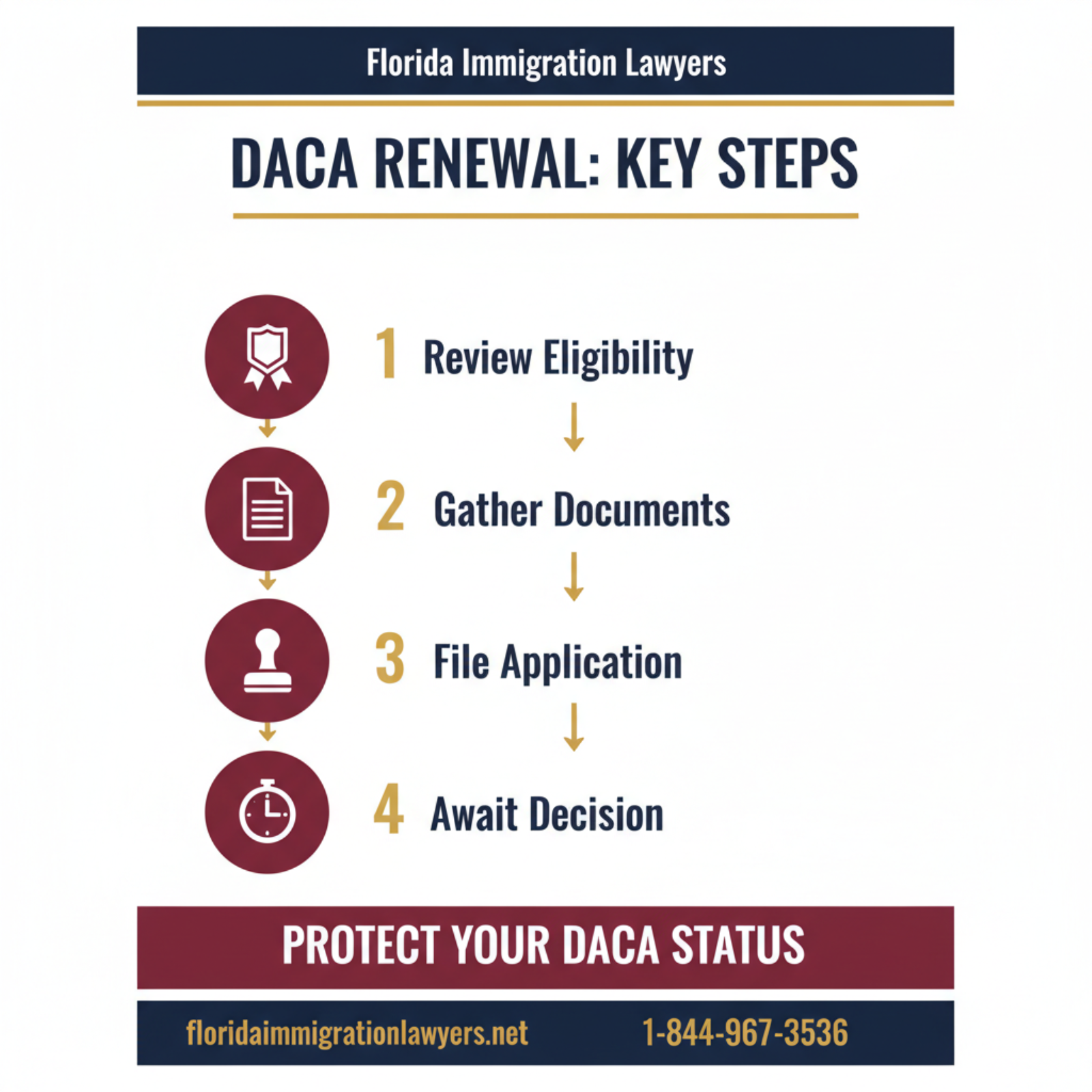
Here is a general step-by-step guide for DACA renewal Florida in 2026:
- Review Your Eligibility: Confirm you continue to meet the DACA guidelines. This includes not having departed the U.S. without Advance Parole, not having any disqualifying criminal convictions, and continuously residing in the U.S. since June 15, 2007.
- Gather Necessary Documents: Collect all required documentation, including previous DACA approval notices, employment authorization documents (EADs), and any updated personal information. We will detail a full checklist below.
- Complete USCIS Forms: You will need to accurately complete Form I-821D (Consideration of Deferred Action for Childhood Arrivals), Form I-765 (Application for Employment Authorization), and Form I-765 Worksheet. Ensure all information is consistent with your previous applications and current details.
- Prepare Supporting Evidence: While USCIS generally does not require extensive new evidence for renewals unless there are changes, be prepared to submit documents proving continuous residence or identity if requested. Keep copies of everything you submit.
- Pay Filing Fees: The application requires payment of the USCIS filing fees, which cover both the DACA request and the Employment Authorization Document. Note that these fees are subject to change, so always check the latest amounts on the USCIS website. You can typically pay by money order, personal check, cashier's check, or credit card using Form G-1450.
- Assemble and Mail Your Application: Organize your application packet clearly, following USCIS instructions for assembly. Mail your complete packet to the appropriate USCIS Lockbox facility. The correct mailing address depends on your state of residence, so verify the address on the USCIS website for Florida applicants.
- Attend Biometrics Appointment (if required): After USCIS accepts your application, you may receive a notice to attend a biometrics (fingerprinting) appointment at an Application Support Center (ASC). It is crucial to attend this appointment.
- Monitor Your Case Status: You can track the status of your application online using the receipt number provided by USCIS. Be prepared for potential processing delays, especially given the ongoing legal challenges.
Navigating this process without legal guidance can be daunting. Our Florida immigration lawyer DACA specialists are here to assist you with every step, ensuring your application is complete and accurate.
Essential Document Checklist for DACA Renewal Applicants
A complete and accurate application package is crucial for a successful DACA renewal. Missing documents or errors can lead to delays or even denial. For DACA recipients in Florida, gathering all necessary paperwork well in advance is a key step. This checklist outlines the typical documents and forms required for your DACA renewal list. Remember to keep copies of all documents you send to USCIS for your records.
Here is a comprehensive checklist of documents generally required for DACA renewal:
- Completed Forms:
- Form I-821D, Consideration of Deferred Action for Childhood Arrivals
- Form I-765, Application for Employment Authorization
- Form I-765 Worksheet (if applicable)
- Form G-1450, Authorization for Credit Card Transactions (if paying by credit card)
- Proof of Identity:
- Copy of your most recent Employment Authorization Document (EAD)
- Copy of your DACA Approval Notice (Form I-797)
- Copy of your birth certificate with a certified translation (if not in English)
- Copy of your passport biographical page or national identity document with photograph
- Photographs:
- Two identical passport-style photographs taken within 30 days of filing. Write your name and A-number lightly on the back of each photo.
- Proof of Continuous Residence (if requested or if there were changes since previous application):
- School records (transcripts, diplomas)
- Employment records (pay stubs, W-2s, employment letters)
- Medical records
- Utility bills
- Bank statements
- Rental agreements or mortgage statements
- Tax returns
Step-by-Step Process Guide - Previous DACA-Related Documents:
- Copies of all previous DACA approval notices (Form I-797)
- Copies of all previous Employment Authorization Documents (EADs)
- Proof of Advance Parole (if applicable):
- If you traveled outside the U.S. with Advance Parole, include copies of your Form I-131 approval notice and your passport entry/exit stamps.
- Filing Fees:
- Check or money order payable to "U.S. Department of Homeland Security" for the correct amount, or Form G-1450 if paying by credit card.
Our team at Florida Immigration Lawyers can help you meticulously prepare your application, ensuring all required documents are included and properly organized. This meticulous approach can significantly improve your chances of a smooth renewal process.
DACA Renewal Timeline and Processing Expectations in 2026
Understanding the potential timeline for your DACA renewal application is crucial for planning your future and avoiding gaps in your employment authorization. As of DACA news 2026, processing times can vary significantly based on USCIS workload, policy changes, and the complexity of individual cases. While USCIS aims for efficient processing, applicants should prepare for potential delays.
Typically, USCIS recommends filing your DACA renewal application 120 to 150 days before your current DACA and Employment Authorization Document (EAD) expire. This timeframe generally allows for the application to be processed before expiration. However, it is not uncommon for processing times to extend beyond this window, especially in periods of high volume or when there are ongoing legal reviews impacting the program. You can check the average processing times for Form I-821D and Form I-765 on the USCIS website by selecting the service center handling your application (often Nebraska Service Center or California Service Center for DACA).
Factors that can influence your DACA renewal timeline include:
- Application Volume: A surge in applications can naturally extend processing times.
- Requests for Evidence (RFE): If USCIS requires additional information or documentation, it will send an RFE, which will add time to the process. Responding promptly and thoroughly is critical.
- Biometrics Appointments: Delays in scheduling or attending your biometrics appointment can impact your overall processing time.
- Legal and Policy Changes: Ongoing DACA legal challenges and policy adjustments can introduce uncertainty and slow down processing.
It is important to note that if your DACA and EAD expire while your renewal application is still pending, you may experience a temporary lapse in work authorization. While USCIS generally tries to avoid this, it is a possibility. Therefore, early filing is always recommended. If your renewal is approved after your previous EAD expires, your new EAD will typically be valid from the date of approval. Our Florida immigration lawyer DACA team can help you monitor your case and advise you on strategies to mitigate potential delays.
Cost Factors and Fee Breakdown for DACA Applications
Understanding the financial commitment involved in your DACA application or renewal is an important part of the planning process. While the Deferred Action for Childhood Arrivals program provides a pathway for temporary relief, it does come with associated costs. As of DACA news 2026, these fees are primarily for the government filing and potentially for legal assistance. It is crucial to budget accordingly and be aware that government fees can change.
The primary costs associated with a DACA application or renewal are the USCIS filing fees. These fees combine the cost for Form I-821D (Consideration of Deferred Action for Childhood Arrivals) and Form I-765 (Application for Employment Authorization), which includes the biometrics services fee. It is important to note that USCIS does not accept fee waivers for DACA applications. Always check the official USCIS website for the most current fee schedule, as these amounts are subject to change without prior notice. Providing an incorrect fee amount can lead to the rejection of your entire application.
In addition to government fees, many DACA applicants choose to retain the services of an experienced immigration attorney. While not legally required, professional legal assistance can be invaluable, especially given the program's complex and evolving nature. Legal fees for DACA services can vary depending on the complexity of your case, the services provided (e.g., initial application, renewal, advance parole, or addressing specific legal issues), and the law firm's fee structure. Investing in legal counsel from a reputable firm like Florida Immigration Lawyers can help ensure your application is prepared accurately, submitted correctly, and that you are aware of all your legal options. This can save you time, stress, and potential complications in the long run.
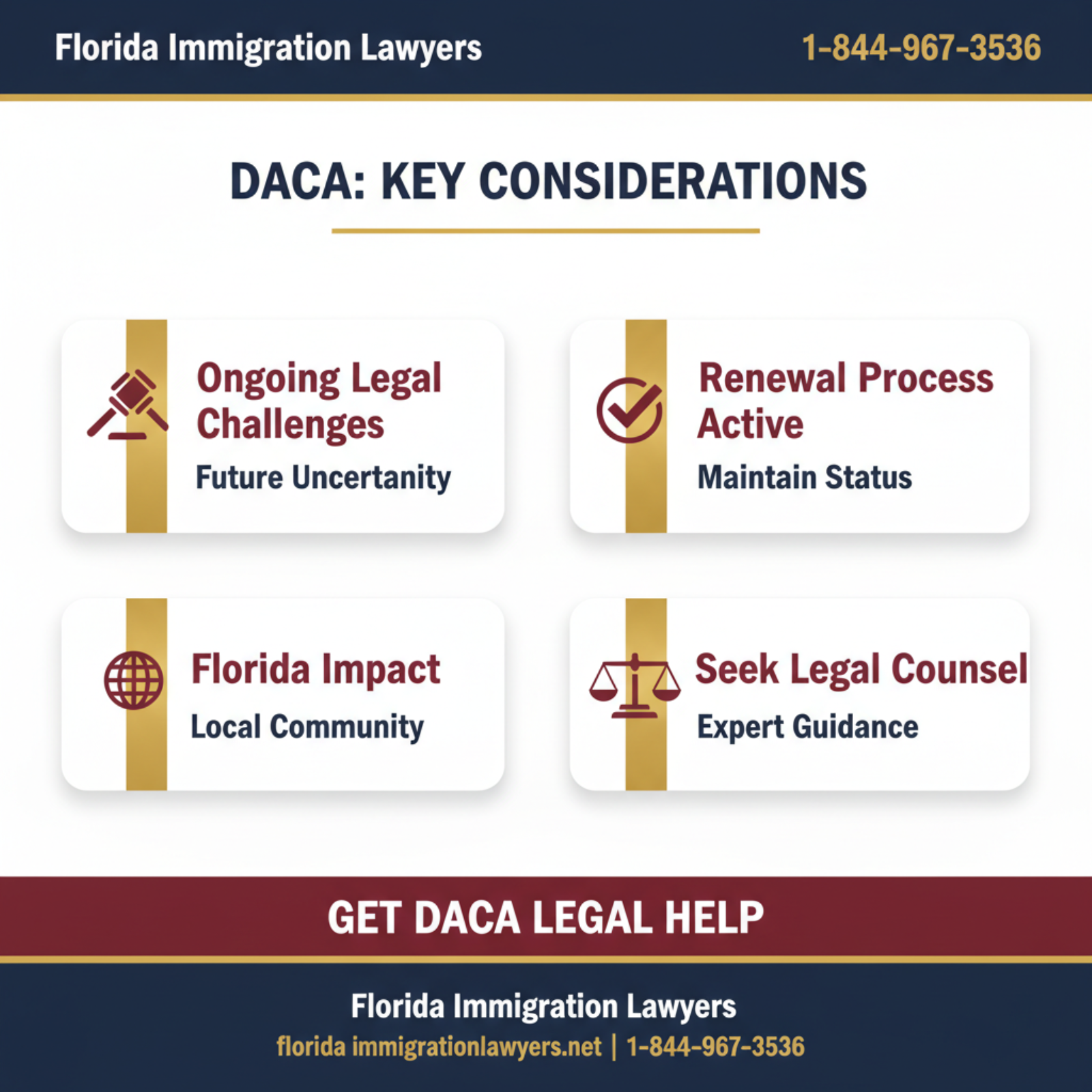
The DACA process is intricate and fraught with potential pitfalls. Navigating the legal complexities, especially with the constant changes in DACA news 2026, requires expert knowledge and dedicated support. Do not navigate this process alone. For personalized guidance and robust legal representation, contact Florida Immigration Lawyers today. We are committed to protecting your rights and securing your future in Florida.
Common Mistakes to Avoid in Your DACA Application or Renewal
Even a minor error in your DACA application or renewal can lead to significant delays, requests for evidence, or even denial. For DACA recipients in Gainesville and across Florida, understanding and avoiding these common pitfalls is essential for a successful outcome. The stakes are high, and meticulous attention to detail is paramount.
- Filing Late: Submitting your renewal application too close to your current DACA expiration date is a common mistake. This can lead to a lapse in work authorization and lawful presence. Always aim to file 120-150 days before expiration.
- Incorrect or Incomplete Forms: Failing to fill out all required fields accurately on Forms I-821D and I-765 can cause rejection. Double-check every section and ensure consistency with previous applications.
- Missing Required Documents: Forgetting to include necessary supporting evidence, such as copies of previous EADs or identity documents, will result in an RFE and processing delays. Refer to a comprehensive checklist.
- Incorrect Filing Fees: Submitting the wrong fee amount or an expired payment method will lead to the rejection of your entire application. Always verify the current fees on the USCIS website.
- Failing to Disclose Criminal History: Any criminal history, no matter how minor, must be disclosed truthfully. Failure to do so can result in serious immigration consequences, including potential deportation. Consult an attorney if you have any criminal record.
- Not Attending Biometrics Appointment: If USCIS schedules a biometrics appointment, failing to attend without proper rescheduling can lead to your application being denied. Attend promptly or reschedule correctly.
- Ignoring USCIS Requests for Evidence (RFEs): If you receive an RFE, it is crucial to respond thoroughly and by the deadline. Failure to do so will result in denial.
- Traveling Without Advance Parole: Leaving the U.S. without an approved Form I-131 (Application for Travel Document - Advance Parole) will automatically terminate your DACA status. This is a critical mistake.
- Providing Inconsistent Information: Discrepancies between your current application and previous submissions or other government records can raise red flags. Ensure all information is consistent and accurate.
- Not Seeking Legal Counsel for Complex Cases: If you have a criminal record, a history of immigration violations, or any other complex issues, attempting to navigate DACA without an attorney can be disastrous.
Avoiding these mistakes significantly increases your chances of a smooth and successful DACA renewal. An experienced Florida immigration lawyer DACA specialist can meticulously review your application and help you prepare for any potential challenges.
When to Call a Florida Immigration Lawyer for DACA Assistance
While some DACA renewals may seem straightforward, the program's volatile nature and complex legal framework mean that legal assistance is often invaluable. For DACA recipients in Florida, particularly with the ongoing DACA legal challenges and DACA eligibility updates, knowing when to seek professional help is crucial. Florida Immigration Lawyers is here to provide dedicated support and expert counsel.
You should consider contacting an immigration attorney if any of the following scenarios apply to you:
- First-Time DACA Application: Although new DACA applications are generally not being approved as of 2026 due to court orders, if there are any legislative changes or new pathways, an attorney can advise if you become eligible.
- Criminal History: Even minor arrests or convictions can impact your DACA eligibility. An attorney can assess your record, advise on potential impacts, and help prepare your application to mitigate risks.
- Previous Immigration Violations: If you have any history of immigration violations, such as prior deportation orders, unlawful entries, or overstays, legal counsel is essential to determine your eligibility and prevent complications. Our firm specializes in deportation defense.
- Gaps in Residence or Departures from the U.S.: If you have had significant gaps in your continuous residence in the U.S. since June 15, 2007, or if you traveled outside the U.S. without approved Advance Parole, an attorney can help clarify your situation.
- Received a Request for Evidence (RFE) or Notice of Intent to Deny (NOID): These notices from USCIS indicate a problem with your application. Responding correctly and comprehensively is critical, and an attorney can help you formulate the best response.
- Uncertainty About Eligibility: If you are unsure whether you meet all DACA criteria or if recent DACA eligibility updates affect your status, a consultation with an expert can provide clarity.
- Seeking Advance Parole: If you wish to travel outside the U.S. for educational, employment, or humanitarian purposes, applying for Advance Parole (Form I-131) is complex and requires careful preparation. An attorney can guide you through this process to ensure your continued eligibility under immigration law.
- Concerned about "Should DACA be worried" due to Legal Changes: With the constant flux in DACA news 2026, many recipients feel anxious. An attorney can provide up-to-date information and explain how legal developments, such as the Daca class action, might specifically affect your situation in Florida.
Our experienced team at Florida Immigration Lawyers understands the unique challenges faced by DACA recipients in Florida. We are committed to providing compassionate, effective, and up-to-date legal advice to protect your future.
Frequently Asked Questions (FAQs) About DACA in Florida
The DACA program generates many questions, especially given its dynamic legal status. Here, we address some of the most common inquiries from DACA recipients in Florida, incorporating the latest DACA news 2026.
1. Can DACA get a license in Florida?
Yes, DACA recipients in Florida are generally eligible to obtain a Florida driver's license or identification card. You will need to present your valid Employment Authorization Document (EAD) and DACA approval notice (Form I-797), along with other required identity and residency documents, to the Florida Department of Highway Safety and Motor Vehicles (FLHSMV). The EAD serves as proof of your lawful presence and work authorization.
2. What is the Fifth Circuit decision for DACA?
The U.S. Court of Appeals for the Fifth Circuit, in January 2025, affirmed a lower court's ruling that the DACA program is unlawful. This decision generally prevents USCIS from approving new DACA applications. However, the court allowed for the continuation of DACA renewals for individuals who already have DACA status. This means that while new applicants are largely barred, existing DACA recipients can still apply for renewal.
3. Are they bringing DACA back?
As of DACA news 2026, new DACA applications are generally not being accepted or approved due to the Fifth Circuit's ruling. There are ongoing legislative efforts and legal challenges that aim to create a permanent pathway to legal status for Dreamers, but no new DACA program allowing initial applications has been "brought back" or implemented. The focus remains on renewing existing DACA statuses.
4. Is DACA allowed in Florida?
Yes, DACA is allowed in Florida. While DACA is a federal program, its effects and rules apply nationwide, including in Florida. DACA recipients in Florida are eligible to renew their status, obtain driver's licenses, and work legally. However, state-specific policies or legal challenges, such as those that might arise from state legislation, can sometimes affect DACA recipients. It is always best to consult with a Florida immigration lawyer DACA expert to understand any potential local impacts.
5. What is Advance Parole for DACA recipients?
Advance Parole allows eligible DACA recipients to travel outside the United States and lawfully return. It is granted for humanitarian, educational, or employment purposes. Traveling without Advance Parole will automatically terminate your DACA status. This option is still available for DACA recipients in 2026 and can be pursued for various legitimate reasons, including "advance parole educational purpose" trips. Our firm can assist with your Form I-131 application.
At Florida Immigration Lawyers, we are a leading immigration law firm dedicated to serving individuals and families across the entire state of Florida. With offices strategically located to assist clients from Gainesville to Miami, Tampa, Orlando, and beyond, our mission is to provide compassionate, effective, and results-driven legal representation. We understand the profound impact immigration matters have on your life and your family's future. Our team of highly skilled and experienced attorneys is committed to guiding you through every step of your immigration journey.
We offer a comprehensive range of immigration services, including DACA renewals and related matters, family-based immigration, business immigration, deportation defense, asylum claims, and naturalization. Our firm prides itself on its deep understanding of U.S. immigration law, including complex areas like the DACA news 2026 updates and DACA legal challenges. We are here to simplify the complex, clarify the uncertain, and advocate tirelessly on your behalf.
Why choose Florida Immigration Lawyers?
- Expertise: Our attorneys possess extensive experience in all facets of immigration law.
- Personalized Attention: We treat every client with respect and provide tailored legal strategies.
- Bilingual Services: We offer full services in English and Spanish to ensure clear communication.
- Accessibility: We are available 24/7 to address your urgent concerns.
- Free Consultations: We offer free consultations to discuss your case and outline your options.
Do not face your immigration challenges alone. Trust the dedicated professionals at Florida Immigration Lawyers to be your advocates. Visit our website at https://www.floridaimmigrationlawyers.net or call us anytime at 1-844-967-3536 to schedule your free consultation. We are here to help you secure your American Dream.
Sources and References
- U.S. Citizenship and Immigration Services (USCIS) - Deferred Action for Childhood Arrivals (DACA)
- Executive Office for Immigration Review (EOIR)
- U.S. Department of State - Bureau of Consular Affairs
- 8 U.S.C. § 1101 et seq. - Immigration and Nationality Act (INA)
- 8 CFR § 274a.12(c)(14) - Classes of aliens authorized to accept employment
- 8 CFR § 274a.13 - Application for employment authorization
- 5th U.S. Circuit Court of Appeals Decision, Texas v. United States (related to DACA Final Rule)
This article provides general legal information and is not intended as legal advice. Every case is unique, and outcomes depend on specific facts and circumstances. Immigration laws are complex and subject to change. Contact an attorney for advice about your particular situation. Florida Immigration Lawyers does not guarantee case outcomes or specific results.
Navigating the complexities of DACA, especially with the latest DACA news 2026 and ongoing legal battles, requires expert guidance. Do not risk your future by attempting to manage your DACA application or renewal alone. Our compassionate and knowledgeable attorneys at Florida Immigration Lawyers are ready to provide the dedicated support you need. Protect your status and secure your future. Call us today at 1-844-967-3536 for a free, confidential consultation. Se Habla Español - Estamos aquí para ayudarle.
Florida Immigration Lawyers
Legal Team
Our experienced attorneys at Florida Immigration Lawyers have been serving clients across Florida for over 20 years. We specialize in immigration, personal injury, criminal defense, workers compensation, and family law.