Green Card Holder ICE Detention in Florida: Your Rights
Green card holders in Florida can face ICE detention for reasons like criminal convictions or re-entry issues. While holding an LPR status offers protection, it doesn't grant absolute immunity from detention or deportation. This guide details your rights, what steps to take if detained, essential documents, and the legal process in 2026. Learn about bond eligibility, immigration court timelines, and the importance of immediate legal counsel. Florida Immigration Lawyers specializes in deportation defense and can help protect your status. Contact us for a free consultation to understand your options and secure expert representation.
Quick Answer: Green Card Holder ICE Detention in Florida
Green card holders can be detained by ICE in Florida for various reasons, including certain criminal convictions, re-entry issues, or violations of immigration law. While holding a green card offers significant protections, it does not grant absolute immunity from detention or potential deportation. Understanding your rights and seeking immediate legal counsel from an experienced immigration lawyer are crucial steps to protect your status and navigate the complex legal process effectively in 2026.
- Green card holders are not immune to ICE detention or deportation.
- Common reasons include criminal history, misrepresentation, or re-entry issues.
- You have the right to remain silent and request an attorney if detained.
- Early legal intervention is vital for bond eligibility and defense.
- Florida Immigration Lawyers can help protect your rights and status.
Green Card Holder ICE Detention in Florida: What You Need to Know in 2026
Imagine returning to your home in Miami after a family visit abroad, only to be stopped by Customs and Border Protection (CBP) and then transferred to Immigration and Customs Enforcement (ICE). Or perhaps a routine traffic stop in Orlando leads to an ICE detainer, placing you in custody despite your lawful permanent resident (LPR) status.
These scenarios, while frightening, are a reality for many green card holders across Florida. Holding a green card provides significant rights and privileges, but it does not offer absolute protection from detention or even deportation under certain circumstances.
If you or a loved one are a green card holder facing ICE detention in Florida, understanding your rights and the legal process is paramount. This comprehensive guide from Florida Immigration Lawyers will explain why green card holders may be detained, what steps to take, and how our experienced team can help you navigate this challenging situation in 2026.
Do not wait until it is too late. Call Florida Immigration Lawyers at 1-844-967-3536 for a free consultation today. Our dedicated attorneys serve all of Florida and are ready to provide the urgent legal support you need.
Understanding Green Card Holder ICE Detention in Florida: An Overview
While U.S. green card holders, also known as lawful permanent residents (LPRs), possess many of the same rights as U.S. citizens, they are still subject to immigration laws that can lead to detention and deportation. ICE detention for green card holders typically occurs when there is a belief that the individual is deportable or inadmissible under the Immigration and Nationality Act (INA).
In Florida, a state with a large and diverse immigrant population, ICE and CBP actively enforce immigration laws. Detention centers across the state, such as the Krome Service Processing Center in Miami or the Baker County Detention Center, house individuals facing immigration proceedings.
Why Green Card Holders May Be Detained by ICE
Several factors can trigger ICE detention for a green card holder. It is crucial to understand these risks to protect your status.
- Criminal Convictions: This is the most common reason. Certain criminal offenses, particularly those classified as aggravated felonies or crimes involving moral turpitude (CIMTs) under the INA, can make a green card holder deportable. Even minor offenses can sometimes lead to issues, especially if they are repeated.
- Re-entry Issues: Green card holders returning to the U.S. from international travel may be detained at ports of entry, including Florida airports like Miami International Airport (MIA) or Orlando International Airport (MCO). This can happen if CBP officers suspect inadmissibility due to past criminal history, misrepresentation on visa applications, or if they believe the LPR status has been abandoned due to prolonged absences.
- Violations of Immigration Law: This includes marriage fraud, misrepresentation on immigration applications, or other breaches of immigration statutes. Even if discovered years later, these violations can lead to detention and removal proceedings.
- Prior Deportation Orders: If a green card holder previously had a deportation order and re-entered the U.S. illegally, they may be subject to reinstatement of removal.
It is important to remember that ICE does not detain green card holders for no reason. There must be a legal basis, such as a ground of inadmissibility or deportability, as outlined in sections INA § 212 (inadmissibility) or INA § 237 (deportability) of the Immigration and Nationality Act. These sections are complex, and their application often requires expert legal interpretation.
What to Do If a Green Card Holder is Detained by ICE: A Step-by-Step Guide
Being detained by ICE can be a terrifying experience, especially for green card holders who believe their status offers full protection. Knowing your rights and what immediate actions to take can significantly impact the outcome of your case. Here's a step-by-step guide if you or someone you know faces green card holder ICE detention in Florida:
-
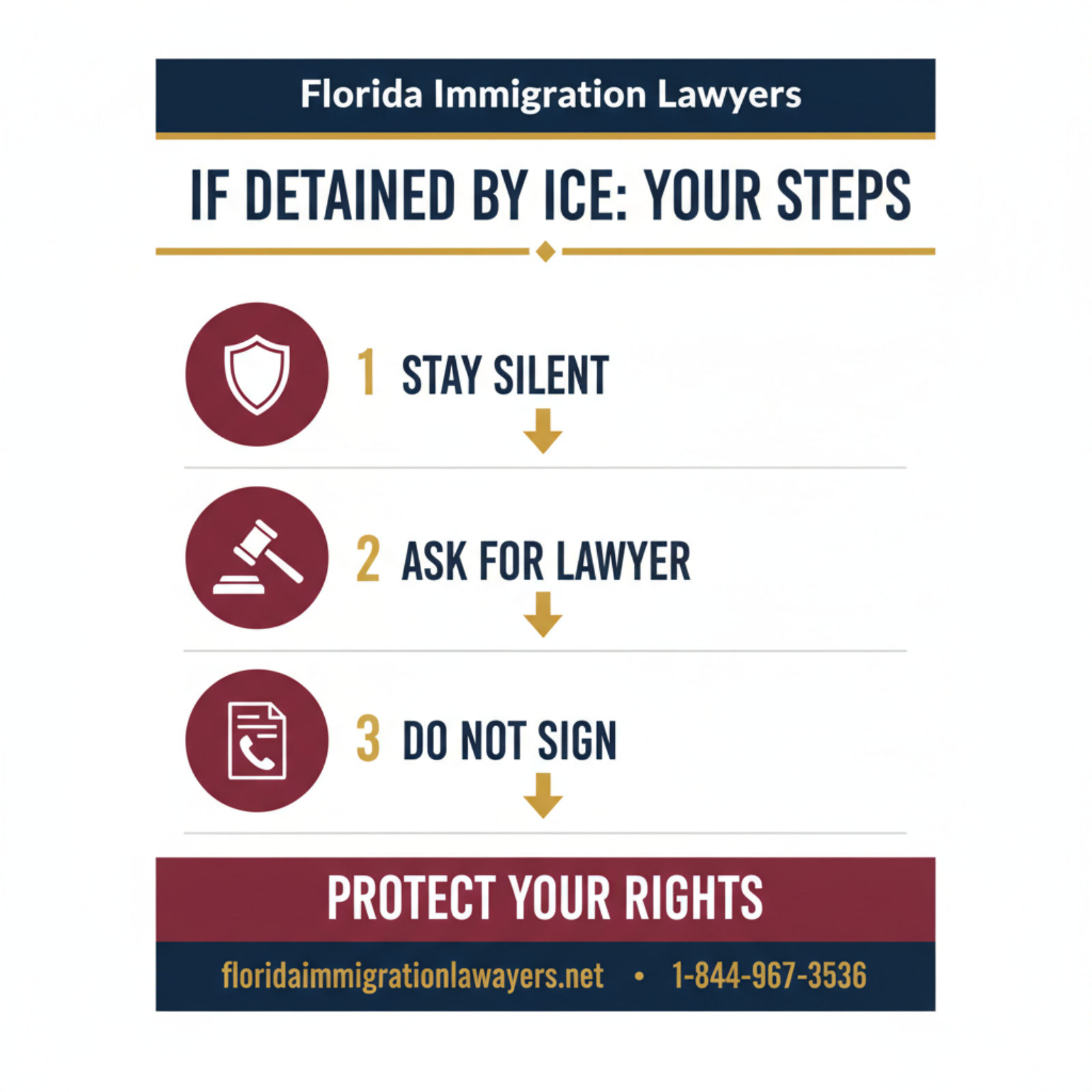
Remain Silent and Do Not Resist: You have the right to remain silent. Do not answer questions about your immigration status, country of origin, or how you entered the U.S. beyond providing your name, date of birth, and country of birth. Do not resist arrest or physical detention, as this can lead to additional criminal charges.
-
Do Not Sign Anything Without Legal Review: Immigration officers may present documents for you to sign. These documents could waive your rights, including your right to a hearing before an immigration judge or your right to apply for relief from removal. Absolutely do not sign anything you do not understand or without legal counsel.
-
State Your Request for an Attorney Clearly: As an LPR, you have a right to legal representation in immigration proceedings. Clearly state, "I want to speak with my attorney." Repeat this request if necessary. ICE officers must provide you with an opportunity to contact legal counsel.
-
Ask for the Officer's Information and Reason for Detention: Politely ask for the name, badge number, and agency of the officers involved. Also, ask for the reason for your detention. This information will be crucial for your legal team.
-
Contact Family or Friends Immediately: Once allowed, make a phone call to inform a trusted family member or friend of your detention and location. Provide them with the officer's information and the detention facility's name. They can then contact an immigration lawyer on your behalf.
-
Gather Any Documents You Have: If you have your green card (Form I-551) or other identification on you, present it. This can help confirm your identity as an LPR. However, do not provide any documents that are not specifically requested or that you are unsure about.
-
Seek Legal Counsel Immediately: This is the most critical step. An experienced Florida immigration attorney can determine the legal basis for your detention, assess your eligibility for bond, identify potential defenses against deportation, and represent you in immigration court. Quick action is essential, especially for bond hearings.
Addressing the question "What happens if a green card holder goes to jail?" - If a green card holder is arrested for a crime and goes to jail, ICE may place a detainer on them. This means that once the criminal charges are resolved, instead of being released, the individual is transferred to ICE custody to face immigration proceedings. This is a common pathway to ICE detention for LPRs in Florida.
Essential Documents for Green Card Holders in ICE Detention
When facing ICE detention, having access to key documents can significantly aid your defense and expedite the process. If you are detained, or if a family member is trying to help you, gathering these documents is a top priority for your legal team.
- Green Card (Form I-551): This is your primary proof of lawful permanent residency. Always carry it with you as required by 8 U.S.C. § 1304(e).
- Passport and Travel Documents: Your current passport, especially if you have traveled internationally, can provide crucial entry and exit records.
- Birth Certificate: Your original birth certificate helps establish your identity and nationality.
- Marriage Certificate (if applicable): If your green card was obtained through marriage, this is vital.
- Children's Birth Certificates (if applicable): Proof of U.S. citizen or LPR children can demonstrate strong ties to the U.S. and may be relevant for certain forms of relief.
- Proof of Residence in Florida: Utility bills, lease agreements, property deeds, or mortgage statements showing your continuous residency in Florida.
- Tax Returns: Several years of tax returns demonstrate your financial contributions and ties to the U.S.
- Employment Letters/Records: Proof of stable employment in Florida, including pay stubs and letters from employers, can show community ties and good moral character.
- Criminal Records (if any): If you have a criminal history, obtain certified copies of all court dispositions. Your attorney needs to review these to understand the exact charges and outcomes.
- Medical Records: Any significant medical conditions or ongoing treatments should be documented.
- Previous Immigration Applications/Receipts: Copies of all past immigration filings (e.g., I-485, I-130, I-765, I-131) and their approval notices or receipt numbers.
- Letters of Support: Affidavits from family, friends, and community members attesting to your good character and ties to the U.S.
These documents help your attorney build a comprehensive case, establish your identity, demonstrate your ties to Florida and the U.S., and potentially mitigate any allegations against you.
Understanding the Timeline and Processing Expectations for Detained Green Card Holders
The timeline for green card holder ICE detention cases in Florida can vary significantly depending on the specifics of your situation, including the grounds for detention, the complexity of your case, and the current backlog at the immigration courts.
Initial Processing and Bond Hearings
After detention, you will typically undergo an initial processing period where ICE determines if you are eligible for release on bond. Many green card holders are eligible for bond hearings before an Immigration Judge, especially if their grounds of deportability are not mandatory detention offenses under INA § 236(c).
However, if you have certain criminal convictions, particularly aggravated felonies, you may be subject to mandatory detention, meaning an Immigration Judge cannot grant you bond. In such cases, your only path to release is typically winning your underlying immigration case.
Bond hearings usually occur within a few weeks of detention. During this hearing, your attorney will argue for your release, presenting evidence of your ties to the community in Florida, your lack of flight risk, and that you are not a danger to the community. The Immigration Judge, part of the Executive Office for Immigration Review (EOIR) which oversees immigration courts in Miami, Orlando, and Pompano Beach, will make a decision.
Immigration Court Proceedings
If released on bond or if you remain detained, your case will proceed through immigration court. This involves a series of hearings, including master calendar hearings and individual hearings. The goal is to determine if you are deportable as alleged by the Department of Homeland Security (DHS) and if you are eligible for any forms of relief from removal, such as cancellation of removal for LPRs (INA § 240A(a)), waivers, or asylum.
The entire process can take months or even years, especially if appeals are filed. The current legal landscape in 2026 continues to present challenges with court backlogs, making swift legal action and persistent advocacy essential.
Cost Factors and Fee Breakdown in ICE Detention Cases
Navigating ICE detention and immigration court proceedings involves various costs. Understanding these financial aspects is important for planning and making informed decisions. While Florida Immigration Lawyers offers free initial consultations, there are fees associated with legal representation and other aspects of the case.
Attorney Fees
Legal fees for ICE detention cases can vary significantly based on the complexity of your situation, the amount of work involved, and the experience of your attorney. Our firm typically offers different fee structures:
- Flat Fees: For specific services, such as a bond hearing or a specific motion. This provides predictability.
- Hourly Rates: For cases that are more complex or require ongoing representation through multiple court appearances.
During your free consultation, our attorneys will discuss our fee structure transparently and provide an estimate for the services required for your specific green card holder ICE detention case.
Bond Amounts
If an Immigration Judge grants bond, you will need to pay a specified amount to secure your release. Bond amounts can range widely, from a few thousand dollars to tens of thousands, depending on factors like your criminal history, ties to the community, and flight risk. This money is typically returned to the bond obligor (the person who paid it) once the immigration case concludes, provided all court appearances are met.
Other Potential Costs
- Filing Fees: While many motions in immigration court do not have direct filing fees, some applications for relief (e.g., I-601 waivers) do.
- Translation and Document Fees: Costs associated with translating foreign documents into English by certified translators, or obtaining certified copies of court records.
- Expert Witness Fees: In some complex cases, particularly those involving medical or psychological evaluations, expert witness fees may apply.
Our team at Florida Immigration Lawyers will provide a clear breakdown of all anticipated costs during your consultation. We believe in transparent communication about all financial aspects of your case.
Do not navigate this process alone. The complexities of green card holder ICE detention require skilled legal guidance. Contact Florida Immigration Lawyers today at 1-844-967-3536 for immediate assistance and to protect your future.
Common Mistakes to Avoid If a Green Card Holder is Detained
When facing ICE detention, panic and uncertainty can lead to critical errors that severely jeopardize your immigration status. Avoiding these common mistakes is as important as knowing your rights.
-
Lying or Providing False Information to Immigration Officials: Any misrepresentation can lead to permanent bars to immigration benefits or further grounds of deportability. Always be truthful, but exercise your right to remain silent regarding sensitive questions.
-
Signing Documents Without Understanding Them or Without Legal Counsel: This is a grave error. You might unknowingly sign away your right to a hearing, agree to voluntary departure, or admit to allegations that are not true. Always insist on speaking with an attorney before signing anything.
-
Resisting Arrest or Obstructing Justice: Engaging in confrontational behavior or resisting ICE agents can lead to criminal charges. These new charges will only complicate your immigration case and make a favorable outcome much harder to achieve.
-
Failing to Carry Your Green Card (Form I-551): Federal law (8 U.S.C. § 1304(e)) requires all lawful permanent residents to carry proof of their registration. Not having your green card can lead to delays, questioning, or even detention while your status is verified.
-
Traveling Internationally with an Undisclosed Criminal History: If you have any past arrests or convictions, even if expunged, traveling outside the U.S. and attempting to re-enter can trigger inadmissibility grounds at the port of entry, leading to detention by CBP and transfer to ICE.
-
Ignoring Notices to Appear (NTAs) or Court Dates: Failing to appear for an immigration court hearing will almost certainly result in an in absentia removal order, making it extremely difficult to reopen your case and leading to a final order of deportation.
-
Not Disclosing Your Entire History to Your Attorney: Your immigration lawyer needs to know every detail, good or bad, to build the strongest possible defense. Hiding information can lead to unexpected pitfalls in court.
-
Overstaying a Temporary Absence Abroad: Green card holders generally should not remain outside the U.S. for more than six months without a re-entry permit. Extended absences can lead to a presumption that you have abandoned your LPR status upon re-entry.
-
Failing to Update Your Address with USCIS and EOIR: If your address changes, you are legally required to notify USCIS within 10 days using Form AR-11. For those in removal proceedings, you must also notify the immigration court (EOIR). Missing crucial notices due to an outdated address can result in adverse decisions.
-
Believing a Green Card Offers Absolute Immunity from Deportation: While LPR status provides significant protections, it is not absolute. Certain criminal acts, immigration violations, or misrepresentations can lead to deportation, even if you have held your green card for many years.
-
Delaying Legal Counsel: The immigration system moves quickly. Delaying the retention of an attorney can mean missed deadlines for bond hearings, appeals, or applications for relief, significantly harming your case.
-
Accepting Voluntary Departure Without Legal Advice: While voluntary departure allows you to leave the U.S. without a formal deportation order, it can have serious consequences for future immigration attempts. Always consult an attorney before accepting this option.
When to Call a Lawyer for Green Card Holder ICE Detention
Given the severe consequences of ICE detention and potential deportation for green card holders, prompt legal action is not just advisable-it is often critical. Knowing when to seek legal help can make all the difference in protecting your future in Florida.
Specific Scenarios Requiring Legal Help:
- Any Encounter with ICE or CBP: If you are approached, questioned, or detained by immigration agents, immediately request an attorney.
- Receiving a Notice to Appear (NTA): This document officially places you in removal proceedings before an Immigration Judge. You need legal representation to prepare your defense.
- Criminal Arrest or Charges: If you are a green card holder arrested for any crime in Florida, contact an immigration attorney immediately, even if the charges seem minor. Criminal convictions are the leading cause of deportation for LPRs.
- Returning to the U.S. and Being Questioned by CBP: If you face extensive questioning at a port of entry, particularly regarding your admissibility or past, seek legal counsel.
- Fear of Deportation: If you have concerns about your immigration status due to past issues, legal changes in 2026, or family circumstances, a proactive consultation can help you understand your risks and options.
Why Choose Florida Immigration Lawyers?
At Florida Immigration Lawyers, we specialize in deportation defense and green card holder ICE detention cases across Florida, including Miami, Orlando, and Tampa. Our experienced attorneys understand the nuances of immigration law and the specific challenges faced by LPRs.
We can:
- Immediately intervene with ICE to ascertain the reasons for detention.
- Represent you in bond hearings to seek your release.
- Develop robust defense strategies against deportation in immigration court.
- File necessary waivers and applications for relief.
- Guide you through every step of the complex legal process.
Your green card is a precious asset; do not risk losing it. Let our dedicated team fight for your rights and your future.
About Florida Immigration Lawyers
Florida Immigration Lawyers is a leading immigration law firm dedicated to serving individuals and families across the entire state of Florida. With years of specialized experience, our attorneys are committed to providing compassionate, effective, and results-driven legal representation for all immigration matters.
Our Services Include:
- Deportation Defense and Removal Proceedings
- Green Card Applications and Adjustments of Status
- Asylum and Refugee Status
- Citizenship and Naturalization
- Family-Based Immigration
- Business and Employment Immigration
- Visa Applications and Waivers
Why Choose Florida Immigration Lawyers?
- Experienced and Dedicated: Our team possesses in-depth knowledge of U.S. immigration law and a strong track record of success.
- Client-Centered Approach: We prioritize your needs, communicate clearly, and provide personalized strategies for your unique situation.
- Available 24/7: We understand that immigration issues can arise at any time, which is why we are available around the clock to assist you.
- Free Consultations: We offer complimentary initial consultations to discuss your case and outline your legal options.
- Serving All of Florida: From Miami to Jacksonville, Tampa to Orlando, we provide comprehensive legal support throughout the state.
- Bilingual Services: Se Habla Español. Our team is fluent in Spanish, ensuring clear communication and understanding for our diverse clientele.
When your future in the United States is at stake, you need a legal team you can trust. Contact us today to learn how we can help protect your rights and achieve your immigration goals.
Phone: 1-844-967-3536
Website: https://www.floridaimmigrationlawyers.net
Sources and References
- U.S. Citizenship and Immigration Services (USCIS)
- Executive Office for Immigration Review (EOIR)
- U.S. Immigration and Customs Enforcement (ICE)
- 8 U.S.C. Chapter 12 - Immigration and Nationality Act (INA)
- INA § 212 - General Classes of Aliens Ineligible for Visas and Admission; Waivers of Inadmissibility
- INA § 236 - Apprehension and Detention of Aliens
- INA § 236(c) - Detention of Criminal Aliens
- INA § 237 - General Classes of Deportable Aliens
- INA § 240A(a) - Cancellation of Removal for Certain Permanent Residents
- 8 U.S.C. § 1304(e) - Certificate of Alien Registration or Alien Registration Receipt Card; Personal Possession and Production
- 8 CFR Part 236 - Apprehension and Detention of Inadmissible and Deportable Aliens; Removal of Aliens Ordered Removed
This article provides general legal information and is not intended as legal advice. Every case is unique, and outcomes depend on specific facts and circumstances. Laws are subject to change. Contact an attorney for advice about your particular situation.
If you are a green card holder facing ICE detention in Florida, time is of the essence. Do not face this complex legal challenge alone. Our experienced immigration attorneys at Florida Immigration Lawyers are ready to provide the aggressive and compassionate representation you deserve. Call us now for a free, confidential consultation: 1-844-967-3536. Se Habla Español - Estamos aquí para ayudarle.
Florida Immigration Lawyers
Legal Team
Our experienced attorneys at Florida Immigration Lawyers have been serving clients across Florida for over 20 years. We specialize in immigration, personal injury, criminal defense, workers compensation, and family law.