EXCELLENCE SINCE 1995•60+ YEARS COLLECTIVE EXPERIENCE•SERVING ALL FLORIDA & NATIONWIDE•YO PELEO™ - WE FIGHT•ORLANDO OFFICE•24/7 AVAILABILITY•SE HABLA ESPAÑOL•
EXCELLENCE SINCE 1995•60+ YEARS COLLECTIVE EXPERIENCE•SERVING ALL FLORIDA & NATIONWIDE•YO PELEO™ - WE FIGHT•ORLANDO OFFICE•24/7 AVAILABILITY•SE HABLA ESPAÑOL•
Conditional Green Card Removal Florida: Your I-751 Guide in 2026
For those holding a conditional green card in Florida, removing those conditions is a vital step towards permanent residency. This detailed 2026 guide explains the I-751 petition process, from understanding your status to gathering crucial documents and avoiding common pitfalls. Learn about filing deadlines, evidence requirements, and what to expect regarding processing times and costs. Whether you're in Tampa or elsewhere in Florida, ensuring a strong and timely application is paramount. Discover when to seek legal help from Florida Immigration Lawyers to navigate complex situations and secure your future.
Vasquez Law FirmPublished on March 18, 2026
0 views
Removing conditions from your **conditional green card** in Florida requires filing Form I-751, Petition to Remove Conditions on Residence, with **USCIS**. This process typically applies to those who received their green card through marriage and ensures you transition to a 10-year permanent resident card. It's crucial to file within the 90-day window before your conditional card expires to maintain your lawful status.
File Form I-751 within 90 days of your conditional green card's expiration.
Provide robust evidence of a bona fide marriage.
Understand joint filing versus waiver options.
Prepare for potential interviews at a Florida USCIS office.
Seek legal counsel to navigate complex situations or waivers.
Conditional Green Card Removal Florida: Your I-751 Guide in 2026
Did you recently receive a two-year conditional green card through marriage in Florida? You're not alone. Thousands of individuals across the Sunshine State, from Tampa to Miami, navigate this crucial step towards permanent residency every year. The journey from conditional resident to full permanent resident requires a specific process: the **conditional green card removal Florida** procedure.
Understanding the requirements for filing Form I-751, Petition to Remove Conditions on Residence, is essential. Failing to remove these conditions can lead to serious immigration consequences, including the loss of your lawful status. This comprehensive guide will walk you through everything you need to know for 2026, helping you prepare for a successful outcome.
The stakes are high, and the process can be complex. Don't risk your future. For personalized guidance and to ensure your application is flawless, **call Florida Immigration Lawyers at 1-844-967-3536 for a free consultation** today. Our experienced team is ready to assist you.
Understanding Your Conditional Green Card Status in Florida
When you obtain a green card based on a marriage that was less than two years old at the time of approval, **USCIS** grants you conditional permanent resident status. This status is valid for two years. The purpose of this conditional period is to ensure that the marriage is legitimate and not entered into solely for immigration benefits.
This conditional status is not permanent. To transition to a 10-year permanent resident card, you must file Form I-751, Petition to Remove Conditions on Residence, with **USCIS**. This critical filing demonstrates that your marriage was, and continues to be, bona fide.
For residents in Florida, this means adhering to specific federal regulations and potentially interacting with local USCIS field offices, such as those in Tampa or Orlando. The rules are uniform nationwide, but local processing times and procedures can vary. Your ability to demonstrate a genuine marital union is paramount.
Who Needs to File I-751?
Generally, you must file Form I-751 if you received your green card through marriage to a U.S. citizen or lawful permanent resident, and your marriage was less than two years old on the day you received permanent resident status. This also applies to your conditional dependent children who obtained status at the same time or within 90 days thereafter.
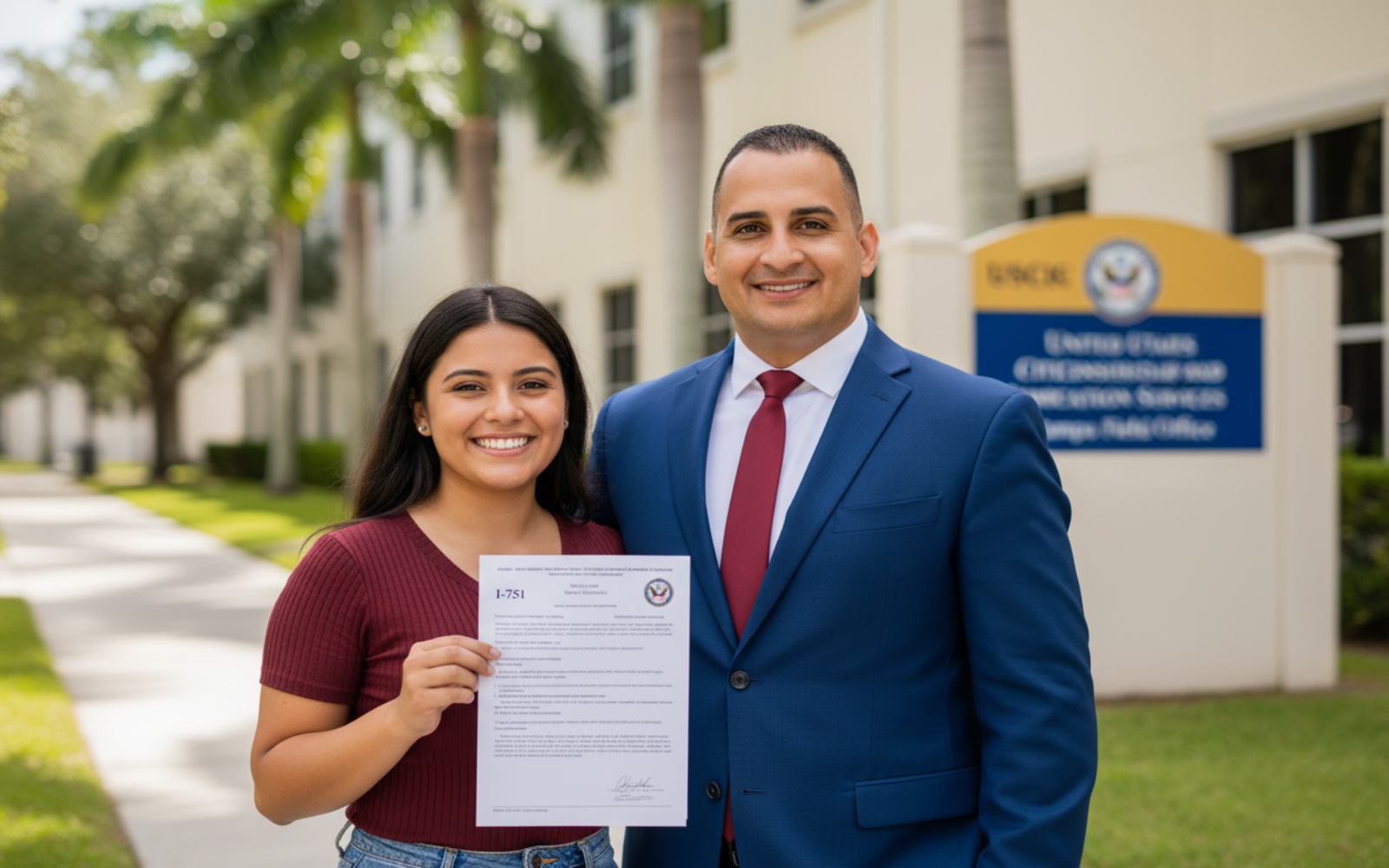
Featured: Conditional Green Card Removal Florida: Your I-751 Guide in 2026
If you were granted a green card based on marriage and your marriage was already over two years old when your green card was approved, you would have received a 10-year green card directly. In such cases, you do not need to file Form I-751. You would instead prepare for green card renewal when your 10-year card expires.
Understanding your specific situation is the first step. Our firm can help you determine if you are required to file Form I-751 for **conditional green card removal Florida**.
The Step-by-Step Process for I-751 Petition in Florida
Navigating the **I-751** petition process can seem daunting, but breaking it down into manageable steps makes it clearer. Here is a general guide to help you understand what to expect when filing for **conditional green card removal Florida** in 2026.
Determine Your Filing Window: You must file Form I-751 during the 90-day period immediately preceding the expiration date on your conditional green card. Filing outside this window can lead to serious complications, including termination of your conditional resident status and initiation of deportation proceedings.
Mark your calendar the moment you receive your conditional green card. Missing this crucial deadline is one of the most common pitfalls applicants face. If you have already missed this window, seek legal advice immediately.
Gather Comprehensive Supporting Documentation: This is arguably the most critical step. You need to provide compelling evidence to prove that your marriage is bona fide and not just for immigration purposes. The more evidence you provide, the stronger your case.
Think about documents that show commingling of finances, cohabitation, joint responsibilities, and shared life experiences. We will detail specific document types in the next section.
Complete Form I-751 Accurately: Fill out every section of Form I-751 completely and accurately. Any omissions or errors can cause delays or even rejection. Ensure all questions are answered truthfully and consistently with your supporting documents.
If you are filing jointly with your spouse, both of you will sign the form. If you are filing with a waiver, only you will sign. Always keep a copy of the completed form and all supporting documents for your records.
Pay the Filing Fees: As of 2026, there are specific filing fees for Form I-751 and biometric services. These fees are subject to change by USCIS, so always check the official USCIS website for the most current amounts. You can pay by money order, personal check, cashier's check, or credit card using Form G-1450, Authorization for Credit Card Transactions.
Do not send cash. Ensure your payment is correct to avoid rejection of your application. These fees are non-refundable, even if your petition is denied.
Mail Your Petition to the Correct USCIS Lockbox: The filing location depends on your state of residence and whether you are also filing Form I-765, Application for Employment Authorization, or Form I-131, Application for Travel Document. For most Florida residents, your I-751 package will be sent to a designated USCIS Lockbox facility.
Always verify the current filing address on the USCIS website before mailing. Sending your application to the wrong address can cause significant delays. Use certified mail with return receipt requested to track your submission.
Receive I-797C, Notice of Action: After USCIS receives your petition, they will send you a Form I-797C, Notice of Action, acknowledging receipt. This notice will also extend your conditional permanent resident status for a specified period, typically 24 months, while your petition is pending. This notice acts as temporary proof of your status and can be used with your expired green card for travel and employment.
Keep this notice safe, as it is crucial documentation during the processing period. It extends your ability to work and travel during the review of your I-751 petition.
Attend Biometrics Appointment: USCIS will send you a separate notice for a biometrics appointment at an Application Support Center (ASC) in Florida, such as the one in Tampa. At this appointment, your fingerprints, photograph, and signature will be collected. This is a mandatory step for identity verification and security checks.
It is crucial to attend this appointment. Failure to do so without rescheduling may lead to the denial of your petition. Bring the appointment notice and a valid photo ID.
Potential Interview: While not every I-751 applicant is interviewed, USCIS reserves the right to schedule an interview. If called for an interview, you and your spouse (for joint filings) will attend a USCIS field office, perhaps in Tampa or Orlando. The interview aims to verify the legitimacy of your marriage.
Be prepared to answer questions about your relationship, daily life, and shared experiences. Having an attorney present can be beneficial, especially if there are complexities in your case or if you are filing a waiver.
Receive a Decision: After reviewing all evidence and potentially conducting an interview, USCIS will make a decision. If approved, you will receive a new 10-year permanent resident card. If denied, your conditional status may be terminated, and you may be placed in removal proceedings.
An approval means you have successfully navigated the **conditional green card removal Florida** process. A denial is serious and requires immediate legal action, often involving an appeal or defense in immigration court.
Essential Document Checklist for Your I-751 Petition
A well-organized and comprehensive set of supporting documents is critical for a successful **I-751** petition. This list applies whether you are filing jointly with your spouse or seeking a waiver for **conditional green card removal Florida**.
Copy of your conditional green card (front and back).
Copy of your marriage certificate.
Birth certificates of any children born to your marriage.
Joint bank account statements (checking, savings, credit cards).
Joint lease agreements or mortgage statements (showing cohabitation).
Joint utility bills (electricity, water, internet) addressed to both spouses.
Joint tax returns (federal and state) for the period of conditional residency.
Vehicle titles or insurance policies showing joint ownership or beneficiaries.
Life insurance policies, wills, or retirement accounts listing each other as beneficiaries.
Affidavits from friends, family, and employers attesting to the bona fides of your marriage (include their contact info and ID copies).
Photographs of you and your spouse together over time, including family events, holidays, and vacations.
Travel itineraries and tickets for trips taken together.
Correspondence between you and your spouse (emails, texts, cards).
Evidence of joint membership in organizations, clubs, or religious institutions.
Any other documents demonstrating the ongoing nature of your marital union.
Special Considerations for Waiver Filings
In certain circumstances, you may be able to file Form I-751 without your spouse, requesting a waiver of the joint filing requirement. This is common in cases of divorce, death of the spouse, or abuse. The evidence required will shift to demonstrate the circumstances of the waiver, in addition to proving the marriage was initially bona fide.
For example, if you are filing due to divorce, you will need your final divorce decree. If you experienced abuse, you would need evidence such as police reports, medical records, or affidavits from counselors. Navigating waiver petitions is particularly complex, and consulting with a Florida immigration lawyer is highly recommended.
Timeline and Processing Expectations for I-751 in 2026
The processing time for Form I-751 can vary significantly. **USCIS processing time** depends on the volume of applications, the specific service center handling your case, and the completeness of your submitted documentation. While it is difficult to give an exact timeframe, applicants should generally expect to wait several months to over a year for a decision.
You can check the current processing times on the USCIS website by selecting Form I-751 and your specific service center. Remember that these times are estimates and can fluctuate. Your I-797C Notice of Action extends your status while your case is pending, providing peace of mind during this waiting period.
If your case involves an interview, this will add to the processing time. Some cases are approved without an interview, especially those with very strong evidence. However, be prepared for the possibility of an interview, particularly if your evidence is not perfectly clear or if there are any discrepancies in your application.
Do not navigate this process alone. **Contact Florida Immigration Lawyers today** for expert assistance with your **conditional green card removal Florida** petition. We can help you prepare a robust application and address any concerns.
Cost Factors and Fee Breakdown for I-751 in Florida
When preparing your I-751 petition for **conditional green card removal Florida**, you will incur certain costs. These primarily include the USCIS filing fee and the biometrics services fee. It is crucial to check the official USCIS website for the most current fee schedule, as these amounts are subject to change.
As of early 2026, the filing fee for Form I-751 is a specific amount, and there is an additional fee for biometrics services per applicant. These fees are non-refundable, regardless of the outcome of your petition. Ensure your payment is made out correctly to the U.S. Department of Homeland Security.
Beyond the government fees, you should also consider potential legal fees if you choose to hire an immigration attorney. While not mandatory, legal representation can significantly increase your chances of success, especially for complex cases or waiver filings. An attorney can help you gather evidence, prepare your forms, and represent you during an interview.
Other potential costs might include fees for obtaining certified copies of documents, translation services for foreign-language documents, or postal fees for sending your application. Planning for these expenses in advance will help you manage the financial aspect of the **conditional green card removal Florida** process effectively.
Common Mistakes to Avoid During Your I-751 Application
Applying for **conditional green card removal Florida** is a detailed process where even small errors can lead to significant delays or denials. Be vigilant and avoid these common pitfalls:
Missing the 90-Day Filing Window: Failing to file Form I-751 within the 90 days before your conditional green card expires is a critical error. This can lead to termination of your status and being placed in removal proceedings. Your lawful status depends on timely filing.
Insufficient Evidence of a Bona Fide Marriage: Submitting a weak application with minimal evidence is a common mistake. USCIS needs compelling proof that your marriage is real. Lack of joint documents, commingled finances, or shared life can raise red flags.
Incomplete or Inaccurate Forms: Leaving fields blank, providing inconsistent information, or making typos on Form I-751 can cause delays or outright rejection. Every question must be answered thoroughly and truthfully. Double-check all entries before submission.
Incorrect Filing Fees: Sending the wrong amount or an improperly prepared payment can result in your entire application being returned. Always verify the current fees on the USCIS website and ensure your check or money order is correctly addressed.
Not Attending the Biometrics Appointment: Missing your scheduled biometrics appointment without rescheduling can lead to the denial of your I-751 petition. This appointment is mandatory for identity verification.
Failing to Update USCIS on Address Changes: If you move while your I-751 is pending, you must update USCIS within 10 days using Form AR-11. Failure to do so can result in missed notices, interviews, or even denial due to inability to contact you.
Ignoring USCIS Requests for Evidence (RFE): If USCIS sends an RFE, it means they need more information or clarification. Failing to respond fully and on time will almost certainly lead to a denial. Address all points in the RFE thoroughly.
Misunderstanding Waiver Requirements: If you are filing for a waiver of the joint filing requirement (e.g., due to divorce, abuse, or death of spouse), you must meet specific criteria and provide appropriate evidence. Incorrectly filing a waiver or lacking proof can jeopardize your case.
Poor Organization of Documents: Sending a disorganized pile of documents makes it difficult for USCIS officers to review your case efficiently. Categorize your evidence, use cover letters, and tab sections for clarity. This helps streamline the review process.
Lying or Misrepresenting Information: Any false statements or fraudulent documents can lead to severe penalties, including a permanent bar from future immigration benefits. Always be truthful and provide authentic information.
Not Consulting an Attorney for Complex Cases: While not every case requires an attorney, complex situations like divorce, abuse, criminal history, or previous immigration issues warrant legal guidance. Attempting to navigate these alone can be risky.
When to Call a Florida Immigration Lawyer
While some straightforward **conditional green card removal Florida** cases may seem manageable on your own, many situations benefit immensely from professional legal assistance. An experienced immigration attorney can provide invaluable guidance, ensuring your application is strong and complete.
You should strongly consider contacting Florida Immigration Lawyers if any of the following scenarios apply to you:
You are approaching or have missed the 90-day filing window for your I-751.
Your marriage has ended in divorce or annulment, and you need to file a waiver.
You have experienced abuse or extreme cruelty from your U.S. citizen or permanent resident spouse.
Your spouse has passed away, and you need to file a waiver.
You have a limited amount of joint evidence to prove the bona fides of your marriage.
You have a criminal record, even a minor one, which could impact your eligibility.
You have received a Request for Evidence (RFE) from USCIS.
You have been scheduled for an I-751 interview and want to be thoroughly prepared.
You have a complex immigration history or previous immigration denials.
You are concerned about potential deportation defense if your I-751 is denied.
You need to travel internationally while your I-751 is pending.
Florida Immigration Lawyers specializes in all aspects of immigration law, including family-based immigration and removal of conditions. We serve clients throughout Florida, including Tampa, Orlando, and Miami, and can provide the expert legal advice you need. Our team understands the nuances of asylum, citizenship, and business immigration, ensuring comprehensive support.
About Florida Immigration Lawyers
Florida Immigration Lawyers is a premier immigration law firm dedicated to serving individuals and families across the entire state of Florida. With a deep understanding of U.S. immigration laws and policies, our experienced attorneys are committed to providing compassionate, effective, and results-driven legal representation.
We believe in personalized service, recognizing that every client's situation is unique. Our firm handles a wide range of immigration matters, from family-based petitions and employment visas to deportation defense and citizenship applications. We pride ourselves on our client-focused approach, ensuring you are informed and supported at every stage of your immigration journey.
When you choose Florida Immigration Lawyers, you gain a trusted advocate who will meticulously prepare your case, anticipate challenges, and tirelessly work towards your success. Our commitment extends to offering accessible legal services, including free consultations and bilingual support (Se Habla Español).
Let us be your guide through the complexities of immigration law. We are available 24/7 to answer your questions and provide the expert assistance you deserve. Visit our website at https://www.floridaimmigrationlawyers.net or call us directly at **1-844-967-3536** to speak with one of our dedicated attorneys.
8 U.S.C. § 1186a - Conditional permanent resident status for certain alien spouses and sons and daughters (Immigration and Nationality Act Section 216)
8 CFR § 216.4 - Petition for removal of conditions
Preparing for your asylum interview in Florida, especially in 2026, demands meticulous attention to detail and a clear u...
This article provides general legal information and is not intended as legal advice. Every case is unique, and outcomes depend on specific facts and circumstances. Contact an attorney for advice about your particular situation.
The journey to full permanent residency is a significant milestone. By understanding the **conditional green card removal Florida** process and avoiding common mistakes, you can confidently navigate this stage. Remember, timely filing and comprehensive evidence are your strongest assets.
If you have questions or need assistance with your **I-751** petition, don't hesitate to reach out. Our dedicated team at Florida Immigration Lawyers is here to provide the support and expertise you need for a smooth transition. **Call us today at 1-844-967-3536 for a free consultation.** Se Habla Español - Estamos aquí para ayudarle.
A conditional green card is a temporary green card valid for two years, granted to individuals who obtained their permanent residency through marriage to a U.S. citizen or lawful permanent resident, and the marriage was less than two years old at the time of approval. This condition is imposed to prevent marriage fraud. To become a permanent resident with a 10-year green card, you must file Form I-751 to prove your marriage is legitimate and ongoing. Failure to remove these conditions can lead to the termination of your resident status and potential deportation.
Your green card is conditional because you received it based on a marriage that was less than two years old at the time your permanent residency was granted. U.S. Citizenship and Immigration Services (USCIS) implements this condition to verify the authenticity of the marriage. It serves as a probationary period, requiring you and your spouse to demonstrate that your marriage is bona fide and not entered into solely for immigration benefits. This process helps USCIS deter marriage fraud and ensures the integrity of the immigration system.
Form I-751 is the application filed with USCIS to remove the conditions on your two-year green card. This petition is typically filed jointly by both the conditional resident and their U.S. citizen or lawful permanent resident spouse. Its purpose is to prove to USCIS that the marriage upon which the green card was based was entered into in good faith and remains valid. Successful approval of Form I-751 leads to the issuance of a 10-year permanent green card. Understanding the requirements and gathering comprehensive evidence is crucial for a smooth process.
You must file Form I-751 during the 90-day period immediately preceding the expiration date on your conditional green card. USCIS will send you a reminder notice, but it's essential to track this deadline yourself. Filing too early or too late can lead to significant issues, including rejection of your petition or even the initiation of deportation proceedings. If you have exceptional circumstances preventing timely filing, such as divorce or abuse, you may be able to file outside this window with a waiver. Seeking legal advice is highly recommended if you are approaching this critical deadline.
If your marriage ended in divorce or annulment before you filed Form I-751, you can still apply to remove conditions by requesting a waiver. You must demonstrate that you entered the marriage in good faith, and that the marriage was terminated through divorce or annulment. You'll need to provide substantial evidence of your bona fide marriage, even without your former spouse's cooperation. This can be a complex situation, and it's advisable to consult with an experienced immigration attorney to understand your options and prepare a strong waiver application.
To demonstrate a bona fide marriage, you'll need to submit a wide range of documents with your I-751 petition. This includes joint financial records (bank statements, tax returns, utility bills), joint property ownership (deeds, leases), birth certificates of children born to the marriage, insurance policies showing joint beneficiaries, affidavits from friends and family, and extensive photographic evidence of your life together. The more compelling and varied the evidence, the stronger your case. Organize your documents clearly and provide copies, not originals, unless specifically requested.
After filing your I-751 petition, USCIS will send you a receipt notice (Form I-797C, Notice of Action), which extends your conditional resident status, typically for 24 months, allowing you to continue working and traveling. You will also receive an appointment for biometrics (fingerprints and photos). USCIS may then schedule an interview, especially if they have questions about your evidence or if you filed a waiver. Finally, you will receive a decision by mail. Processing times can vary significantly, so patience is key.
Yes, you can generally travel outside the U.S. while your I-751 petition is pending. The receipt notice (Form I-797C) you receive from USCIS, which extends your conditional green card status, serves as temporary proof of your lawful permanent resident status. When traveling internationally, you should carry your expired conditional green card along with the I-797C receipt notice. This combination proves your continued authorization to re-enter the U.S. However, always check the latest travel advisories and ensure your documentation is current before planning any international trips.
If your I-751 petition is denied, USCIS will typically issue a Notice to Appear (NTA), initiating deportation proceedings against you. This is a serious situation, and it's crucial to seek immediate legal counsel. An immigration attorney can help you understand the reasons for denial and explore potential defenses or avenues for relief in immigration court. You may have the opportunity to present your case to an immigration judge, who will make an independent decision on your eligibility to remove conditions or for other forms of immigration relief.
While it's possible to file Form I-751 on your own, retaining an experienced immigration attorney can significantly increase your chances of success, especially in complex cases. An attorney can help you gather comprehensive evidence, ensure all forms are correctly filled out, prepare you for potential interviews, and represent you if issues arise, such as a request for more evidence or a denial. For individuals in Florida navigating the intricacies of conditional green card removal, a Tampa immigration lawyer can provide invaluable guidance and peace of mind throughout the process.
VLF
Florida Immigration Lawyers
Legal Team
Our experienced attorneys at Florida Immigration Lawyers have been serving clients across Florida for over 20 years. We specialize in immigration, personal injury, criminal defense, workers compensation, and family law.