Cancellation of Removal Florida Guide 2026: Stay in the U.S.
Facing deportation in Florida can be terrifying, but cancellation of removal offers a critical pathway for eligible non-citizens to remain in the U.S. This guide from Florida Immigration Lawyers details the two types of cancellation – for Lawful Permanent Residents and Non-LPRs – outlining the strict eligibility requirements, including continuous presence, good moral character, and demonstrating exceptional hardship to qualifying family members. We provide a step-by-step overview of the immigration court process, from receiving a Notice to Appear to the final decision, and highlight essential documents needed for your application. Understand the typical timelines, cost factors, and crucial mistakes to avoid to protect your case. If you're in removal proceedings, securing expert legal representation is paramount. Our firm serves all of Florida, offering free consultations to help you navigate this complex legal challenge.
Cancellation of removal is a powerful form of relief that allows certain non-citizens facing deportation in immigration court to remain lawfully in the United States. It requires meeting strict eligibility criteria, including continuous physical presence, good moral character, and demonstrating exceptional and extremely unusual hardship to qualifying family members. The process is complex and often requires skilled legal representation.
- Cancellation of removal offers a path to avoid deportation.
- Eligibility depends on your immigration status and time in the U.S.
- You must prove continuous presence and good moral character.
- Demonstrating extreme hardship to a qualifying relative is crucial.
- Legal assistance is highly recommended due to the process's complexity.
Facing deportation can be one of the most frightening experiences for individuals and families in Florida. The thought of being separated from loved ones, losing your home, and starting anew in an unfamiliar country is overwhelming. Fortunately, for some, a legal remedy known as cancellation of removal offers a beacon of hope.
This comprehensive guide from Florida Immigration Lawyers will walk you through the intricacies of cancellation of removal in 2026, focusing on the specific requirements and processes relevant to Florida residents. We understand the challenges you face and are here to provide clarity and support.
Do not face the U.S. immigration court system alone. Your future in Florida may depend on expert legal guidance. Call Florida Immigration Lawyers at 1-844-967-3536 for a free consultation to discuss your specific situation and explore your options for deportation defense.
Understanding Cancellation of Removal in Florida
Cancellation of removal is a discretionary form of relief granted by an Immigration Judge. It allows certain non-citizens who are in removal proceedings to adjust their status to that of a lawful permanent resident (LPR), effectively stopping their deportation. This relief is critical for many individuals and families across Florida, including those in Tallahassee and surrounding areas.
The Immigration and Nationality Act (INA) provides for two main types of cancellation of removal, each with distinct eligibility criteria. It is vital to understand which category may apply to your circumstances, as the requirements differ significantly.
What is Cancellation of Removal?
At its core, cancellation of removal is a defense against deportation. If granted, it means the Immigration Judge has decided that despite being deportable, you should be allowed to remain in the United States and become a lawful permanent resident. This decision considers various factors, often weighing the equities of your situation against any grounds of deportability.
The law governing cancellation of removal is found in Section 240A of the Immigration and Nationality Act (INA), specifically 8 U.S.C. § 1229b. This statute outlines the precise conditions that must be met for an individual to be considered for this form of relief. Navigating these legal requirements can be complex without experienced legal counsel.
Two Paths to Relief: LPR vs. Non-LPR
There are two primary categories for cancellation of removal, often referred to as "LPR Cancellation" and "Non-LPR Cancellation":
-
Cancellation of Removal for Lawful Permanent Residents (INA 240A(a)): This applies to individuals who are already green card holders but have become deportable due to certain criminal offenses or other violations. To be eligible, you must have:
- Been a lawful permanent resident for at least five years.
- Resided in the United States continuously for seven years after being admitted in any status.
- Not been convicted of an aggravated felony.
- Not previously been granted cancellation of removal.
Featured: Cancellation of Removal Florida Guide 2026: Stay in the U.S. The Immigration Judge will then consider various factors, including your family ties, employment history, community involvement, and the nature of your deportable offense, to determine if you warrant a favorable exercise of discretion.
-
Cancellation of Removal for Non-Lawful Permanent Residents (INA 240A(b)): This applies to individuals who do not have a green card and are facing deportation. This is often referred to as "10-year cancellation of removal" due to one of its key requirements. To be eligible, you must demonstrate:
- Continuous physical presence in the U.S. for at least 10 years immediately preceding the date of application (with specific exceptions for certain absences).
- Good moral character during this 10-year period.
- No convictions for certain criminal offenses (aggravated felonies, controlled substance offenses, etc.).
- That your removal would result in "exceptional and extremely unusual hardship" to your qualifying U.S. citizen or lawful permanent resident spouse, parent, or child.
The "exceptional and extremely unusual hardship" standard is a high bar and requires compelling evidence. It means hardship beyond what would typically be expected from deportation.
Understanding these distinctions is crucial. Our Florida immigration lawyers can help you determine your eligibility and build a strong case.
Navigating the Cancellation of Removal Process: A Step-by-Step Guide
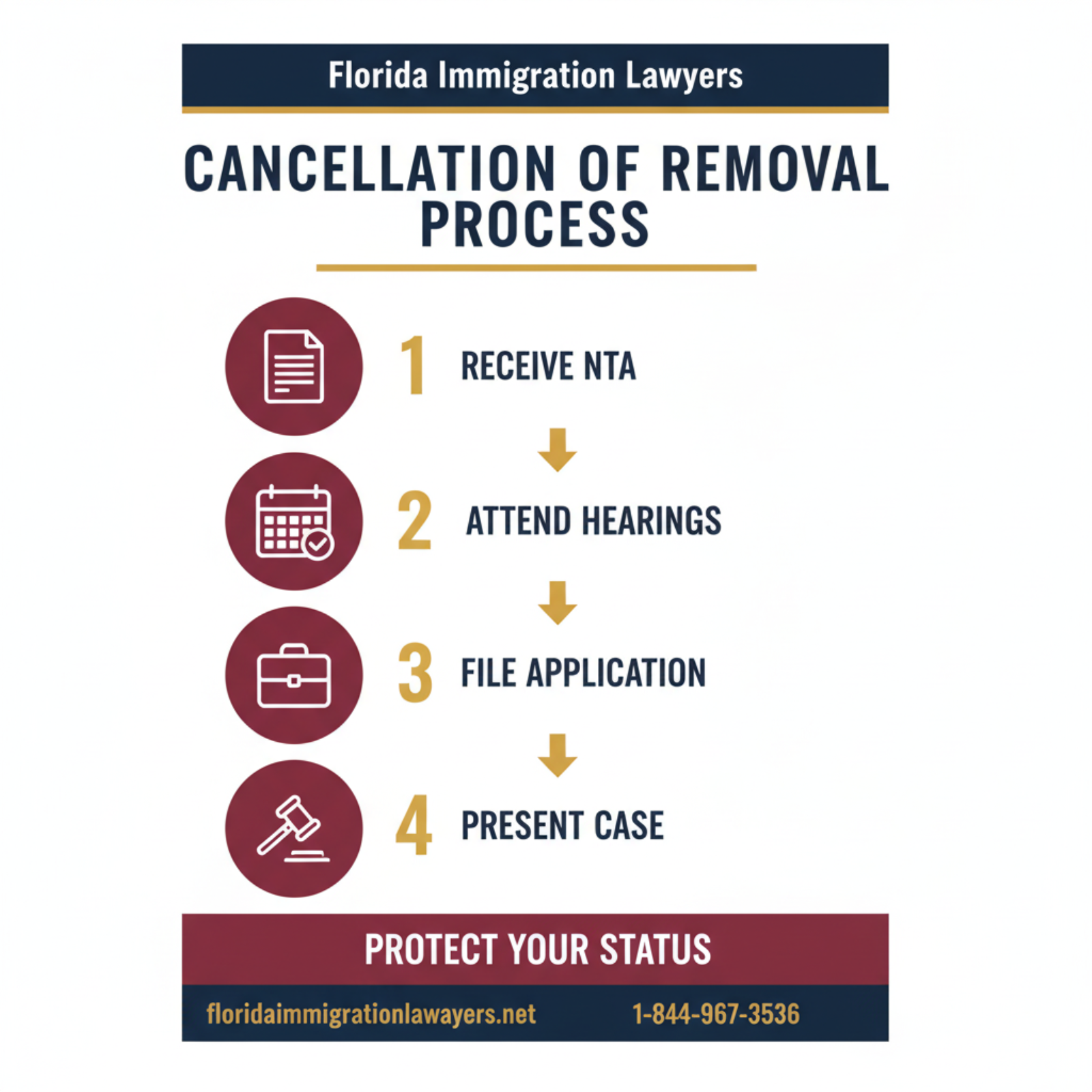
The process for seeking cancellation of removal is intricate and unfolds within the U.S. immigration court system. It is not an application filed directly with USCIS; rather, it is a defense presented before an Immigration Judge. Here is a general step-by-step overview:
-
Receipt of Notice to Appear (NTA): The process begins when you receive a Notice to Appear (Form I-862) from the Department of Homeland Security (DHS). This document formally places you in removal proceedings, stating the reasons DHS believes you are deportable and scheduling your initial hearing before an Immigration Judge in a Florida immigration court, such as those in Orlando or Miami.
-
Initial Master Calendar Hearing: Your first appearance in immigration court is a Master Calendar Hearing. Here, the Immigration Judge will confirm your identity, ensure you understand the charges, and ask you to plead to the allegations and designate countries of removal. This is the crucial stage where you or your attorney will inform the court of your intention to apply for cancellation of removal as a form of relief.
-
Filing the Application: Depending on your eligibility, you will file either Form EOIR-42A (for Non-LPR Cancellation) or Form EOIR-42B (for LPR Cancellation). These applications are submitted to the Immigration Court, along with supporting documents and the required filing fee (or a fee waiver request). The court will typically set a deadline for submission.
-
Gathering Evidence and Supporting Documents: This is an intensive phase where you must collect substantial evidence to support your eligibility claims. For Non-LPR cancellation, this includes proof of continuous physical presence, good moral character, and, most importantly, evidence of exceptional and extremely unusual hardship to your qualifying relatives. For LPR cancellation, it involves demonstrating positive equities.
-
Individual Hearing (Merits Hearing): This is your trial before the Immigration Judge. During this hearing, you and your witnesses will testify, and your attorney will present all your evidence. DHS counsel will also have the opportunity to cross-examine you and your witnesses and present their own arguments against your application. This hearing is often lengthy and detailed.
-
Decision by the Immigration Judge: After the Individual Hearing, the Immigration Judge will issue a decision. If your application for cancellation of removal is granted, your deportation case will be terminated, and you will be granted lawful permanent resident status. If denied, you may have the option to appeal the decision to the Board of Immigration Appeals (BIA).
Each step requires careful preparation and adherence to strict deadlines. Our team at Florida Immigration Lawyers is experienced in guiding clients through this entire process, from the initial NTA to the final decision.
Document Checklist for Your Cancellation of Removal Application
A successful cancellation of removal petition relies heavily on comprehensive and compelling documentation. Gathering these materials can be a significant undertaking, but it is essential for proving your eligibility and demonstrating your ties to the U.S. This list provides a general overview; your specific case may require additional items.
- Completed Form EOIR-42A (Non-LPR) or EOIR-42B (LPR) and all required supplements.
- Proof of identity and nationality (passport, birth certificate).
- Proof of continuous physical presence in the U.S. for the required period (e.g., school records, employment records, utility bills, tax returns, medical records, leases, bank statements, affidavits from friends/family).
- Evidence of good moral character (e.g., letters of recommendation, community service awards, employment history, tax records, police clearances from all residences).
- For Non-LPR cancellation: Extensive evidence of "exceptional and extremely unusual hardship" to your qualifying U.S. citizen or LPR spouse, parent, or child. This can include:
- Medical records demonstrating severe health conditions requiring U.S. care.
- Psychological evaluations detailing the impact of separation.
- Financial hardship evidence (loss of income, inability to support family abroad).
- Educational impact on children.
- Country conditions reports if returning to a dangerous or unstable environment.
- Affidavits from qualifying relatives describing anticipated hardship.
- For LPR cancellation: Evidence of positive equities, such as:
- Family ties in the U.S. (marriage certificates, birth certificates of U.S. citizen children).
- Employment history and contributions to the community.
- Property ownership.
- Rehabilitation evidence if the deportable offense was criminal.
- Marriage certificates, birth certificates of children, and other family relationship documents.
- Police clearance certificates from all jurisdictions where you have resided.
- Certified court dispositions for any criminal history.
- Tax transcripts from the IRS for the relevant years.
- Any other documents that support your claim of ties to the U.S. or hardship.
All foreign language documents must be accompanied by a certified English translation. Organizing these documents meticulously is crucial for a strong presentation in immigration court.
Timeline and Processing Expectations for Cancellation of Removal Cases
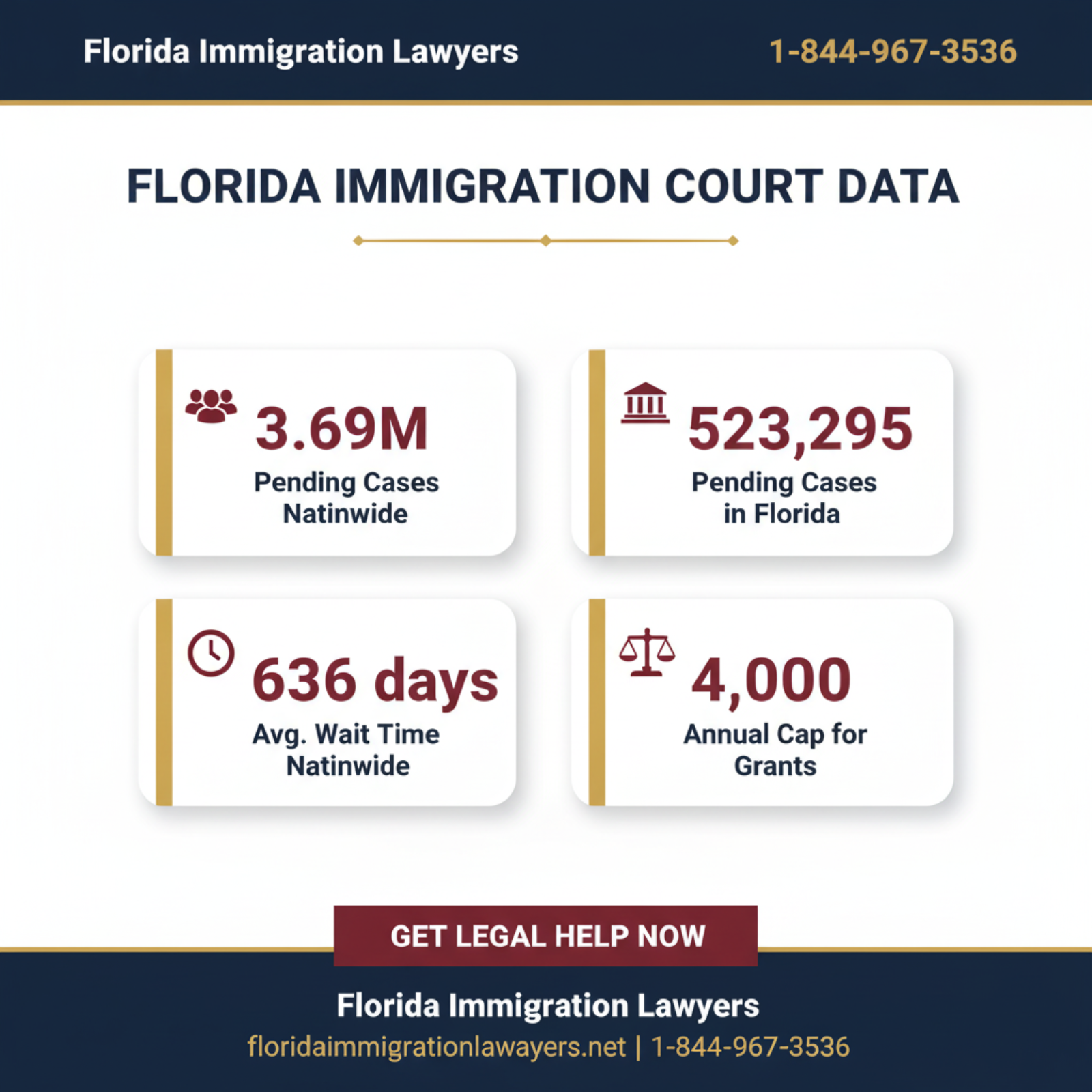
The timeline for cancellation of removal cases in Florida, like elsewhere in the U.S., can be lengthy and unpredictable. The U.S. immigration court system, overseen by the Executive Office for Immigration Review (EOIR) of the Department of Justice, experiences significant backlogs. This means patience is often required.
Typically, from the date you receive your Notice to Appear to a final decision from an Immigration Judge, the process can take anywhere from **two to five years, or even longer**. Several factors influence this timeline:
-
Court Backlogs: Immigration courts in Florida, such as those in Miami and Orlando, handle thousands of cases annually. The volume of cases can lead to significant delays in scheduling hearings.
-
Judge's Caseload: The individual caseload of the assigned Immigration Judge can affect how quickly your case progresses.
-
Complexity of Your Case: Cases involving extensive criminal histories, multiple forms of relief sought, or complex factual disputes may require more hearings and thus take longer.
-
Requests for Continuances: Either party (you/your attorney or DHS counsel) may request continuances for various reasons, such as gathering more evidence or awaiting the outcome of another legal matter. This can extend the timeline significantly.
-
Appeals: If the Immigration Judge's decision is appealed to the Board of Immigration Appeals (BIA), this adds another layer of processing, which can take several months to over a year.
While the wait can be frustrating, it is important to remain engaged with your attorney and comply with all court orders and deadlines. Our team keeps clients informed about their case status and manages expectations regarding processing times.
Cost Factors and Fee Breakdown for Cancellation of Removal
Pursuing cancellation of removal involves various costs, which can be a concern for many families. These costs generally fall into two categories: government filing fees and legal fees.
-
Government Filing Fees: The primary government fee is for filing the application itself, Form EOIR-42A or EOIR-42B. While specific amounts are subject to change, there is a fee associated with filing this form. It is crucial to check the most current fee schedule on the Executive Office for Immigration Review (EOIR) website or consult with your attorney. In some cases, if you meet specific low-income guidelines, you may be eligible to request a fee waiver.
-
Legal Fees: Hiring an experienced immigration attorney is arguably the most significant investment but one that dramatically increases your chances of success. Legal fees cover the attorney's time and expertise in:
- Assessing your eligibility and strategy.
- Preparing and filing the application with all supporting documents.
- Representing you at Master Calendar and Individual Hearings.
- Communicating with the court and DHS counsel.
- Preparing witnesses and evidence.
- Handling any appeals, if necessary.
Legal fees for cancellation of removal cases vary widely depending on the complexity of the case, the attorney's experience, and the amount of work involved. Florida Immigration Lawyers offers transparent fee structures and will discuss all costs upfront during your consultation.
-
Other Potential Costs:
Key Statistics & Data - Translation services for foreign language documents.
- Costs for obtaining official records (birth certificates, police clearances, court dispositions).
- Fees for expert witnesses (e.g., psychologists for hardship evaluations, country condition experts).
- Travel expenses for court appearances.
While the costs may seem substantial, the investment in a qualified legal team for your deportation defense is often invaluable. It protects your right to remain in the U.S. and secure a future for your family.
Do not navigate this complex process alone. The stakes are too high to risk errors or missed opportunities. Contact Florida Immigration Lawyers today to schedule a consultation and let us help you build the strongest possible case for cancellation of removal.
Common Mistakes to Avoid in Cancellation of Removal Cases
Seeking cancellation of removal is a challenging endeavor with strict rules. Many applicants make critical errors that can jeopardize their entire case. Avoid these common pitfalls:
-
Missing Deadlines: Immigration court deadlines are rigid. Failing to file your application or submit documents by the specified date can lead to a denial of your application or even an order of removal. Always track your deadlines carefully.
-
Insufficient Evidence of Hardship: For Non-LPR cancellation, merely stating hardship is not enough. You must provide extensive, objective evidence proving "exceptional and extremely unusual hardship" to your qualifying relatives. Vague or general claims will not suffice.
-
Lack of "Good Moral Character" Proof: You must demonstrate good moral character for the required period. Undisclosed criminal history, false statements, or certain behaviors can disqualify you. Be transparent and provide comprehensive evidence of your good character.
-
Inaccurate or Inconsistent Testimony: Your testimony in court is crucial. Inconsistencies with your application or prior statements can severely damage your credibility and your case. Always be truthful and consistent.
-
Not Disclosing All Criminal History: Even minor offenses or arrests that did not lead to conviction must be disclosed to your attorney and the court. Failure to disclose can be considered a material misrepresentation and can lead to immediate disqualification from any form of relief.
-
Failing to Prove Continuous Physical Presence: This is a fundamental requirement. You must meticulously document your presence in the U.S. for the required period. Gaps in documentation or significant absences can be fatal to your eligibility.
-
Attempting to Self-Represent: The complexity of immigration law and court procedures makes self-representation extremely risky. Without legal training, you may miss critical arguments, fail to present evidence correctly, or inadvertently make statements that harm your case. An experienced attorney is invaluable.
When to Call a Lawyer for Your Cancellation of Removal Case
Given the high stakes and intricate legal requirements, securing experienced legal representation is not just advisable-it's often essential for anyone considering or facing cancellation of removal. Here are specific scenarios where you should immediately contact an attorney:
-
You Received a Notice to Appear (NTA): This is your official notice that you are in removal proceedings. The moment you receive an NTA, you should consult with an immigration lawyer. Do not wait until your first court date.
-
You Believe You Are Eligible for Cancellation of Removal: If you meet the basic criteria for continuous presence, good moral character, and have qualifying relatives, an attorney can confirm your eligibility and help you gather the necessary evidence.
-
You Have a Complex Criminal History: Certain criminal convictions can make you ineligible for cancellation of removal. An attorney can analyze your criminal record, explain the implications, and determine if any waivers or alternative forms of relief are available.
-
You Are Confused by the Paperwork or Court Process: Immigration forms are lengthy and confusing, and court procedures are highly formal. A lawyer can ensure all documents are correctly filed and represent you effectively in court.
-
Your Case Involves "Exceptional and Extremely Unusual Hardship": Proving this high standard requires compelling evidence and persuasive legal arguments. An attorney knows what types of evidence are needed and how to present them effectively to an Immigration Judge.
-
You Have Been Previously Denied Immigration Benefits: If you have a history of denied applications, an attorney can review your past records and identify potential issues that need to be addressed in your current case.
Florida Immigration Lawyers specializes in deportation defense and cancellation of removal cases across Florida, including Tallahassee, Orlando, and Miami. Our attorneys are dedicated to protecting your rights and fighting for your ability to remain in the U.S. We will assess your case, explain your options, and provide a clear strategy to pursue the best possible outcome.
About Florida Immigration Lawyers
Florida Immigration Lawyers is a premier law firm dedicated to providing exceptional legal representation to immigrants across the entire state of Florida. We understand the profound impact immigration matters have on individuals and families, and we are committed to offering compassionate, effective, and results-driven legal services.
Our experienced attorneys specialize in a wide range of immigration services, including deportation defense, asylum, citizenship, family immigration, and business immigration. We pride ourselves on our deep knowledge of immigration law and our unwavering dedication to our clients.
Why choose Florida Immigration Lawyers? We offer personalized attention, strategic legal solutions, and a proven track record of success. Our firm is available 24/7 to address your urgent needs, and we offer free consultations to help you understand your legal options without financial commitment. We serve all of Florida, ensuring that expert immigration assistance is always within reach.
Your journey through the immigration system can be daunting, but you don't have to face it alone. Trust the dedicated team at Florida Immigration Lawyers to be your advocate. Visit our attorneys page to learn more about our team, or contact us directly.
Sources and References
- U.S. Citizenship and Immigration Services (USCIS)
- Executive Office for Immigration Review (EOIR)
- 8 U.S.C. Chapter 12 - Immigration and Nationality Act (INA)
- Immigration and Nationality Act (INA) Section 240A - Cancellation of Removal; Adjustment of Status
- 8 U.S.C. § 1229b - Cancellation of removal; adjustment of status
- 8 CFR Part 1240 - Proceedings to Determine Removability of Aliens in the United States
- 8 CFR Part 1240.20 - Cancellation of removal and adjustment of status for certain nonpermanent residents
- 8 CFR Part 1240.21 - Cancellation of removal for certain permanent residents
This article provides general legal information and is not intended as legal advice. Every case is unique, and outcomes depend on specific facts and circumstances. Contact an attorney for advice about your particular situation.
If you are facing removal proceedings in Florida, time is of the essence. Do not delay in seeking expert legal counsel. The experienced team at Florida Immigration Lawyers is ready to help you explore your options for cancellation of removal and fight for your right to stay in the United States.
Contact Florida Immigration Lawyers today for a free consultation at 1-844-967-3536. Se Habla Español - Estamos aquí para ayudarle.
Frequently Asked Questions
Florida Immigration Lawyers
Legal Team
Our experienced attorneys at Florida Immigration Lawyers have been serving clients across Florida for over 20 years. We specialize in immigration, personal injury, criminal defense, workers compensation, and family law.