Adjustment of Status Florida Guide: Your Path to a Green Card
For individuals in Florida seeking a green card, Adjustment of Status (AOS) offers a vital pathway to permanent residency without leaving the U.S. Our 2026 guide covers the I-485 application process, eligibility, required documents, and processing times. Learn about common mistakes to avoid and when professional legal assistance is crucial. Florida Immigration Lawyers provides expert guidance for your adjustment of status journey, ensuring compliance with all requirements and maximizing your chances of success. Schedule your free consultation today to discuss your unique immigration needs.
Adjustment of Status allows eligible individuals already present in the United States to apply for lawful permanent resident status (a green card) without having to leave the country. This process, primarily involving USCIS Form I-485, is a vital pathway for many immigrants in Florida to secure their future and establish permanent residency.
- It enables obtaining a green card without leaving the U.S.
- Requires an approved immigrant petition (e.g., I-130 or I-140).
- Involves submitting Form I-485 with supporting documents.
- Eligibility hinges on maintaining lawful status or specific waivers.
- Consulting an attorney is crucial for navigating complex requirements.
Adjustment of Status Florida Guide: Your Path to a Green Card
Are you living in Florida and dreaming of a secure future in the United States? The process of obtaining a green card can often seem daunting, filled with complex forms and strict legal requirements. For many, adjustment of status offers a pathway to permanent residency without the need to leave the country.
This comprehensive guide from Florida Immigration Lawyers is designed to demystify the adjustment of status process for individuals residing in Florida. We will walk you through the eligibility criteria, the step-by-step application process for Form I-485, essential documents, and what to expect regarding timelines and costs in 2026.
Whether you are in Jacksonville, Miami, Orlando, or anywhere else in the Sunshine State, understanding this critical immigration pathway is your first step towards a permanent green card. Don't navigate this complex journey alone. Call Florida Immigration Lawyers at 1-844-967-3536 for a free consultation to discuss your specific situation and learn how we can assist you.
Understanding Adjustment of Status in Florida
Adjustment of Status, often referred to as AOS, is a legal procedure that allows certain foreign nationals already in the United States to apply for lawful permanent resident (LPR) status, or a green card, without returning to their home country. This is a significant benefit compared to consular processing, which requires applicants to attend an interview at a U.S. embassy or consulate abroad.
The primary legal basis for adjustment of status is found in Section 245 of the Immigration and Nationality Act (INA), specifically 8 U.S.C. § 1255. This statute outlines the general requirements and specific conditions under which an individual may adjust their status.
Eligibility Criteria for Adjustment of Status
Not everyone is eligible for adjustment of status. Generally, you must meet several key criteria:
- Lawful Entry: You must have been inspected and admitted or paroled into the United States.
- Approved Immigrant Petition: There must be an immigrant visa immediately available to you at the time you file your Form I-485. This typically means an approved Form I-130 (Petition for Alien Relative) or Form I-140 (Immigrant Petition for Alien Workers).
- Maintain Lawful Status: Most applicants must have continuously maintained a lawful immigration status since their arrival, though exceptions exist for immediate relatives of U.S. citizens.
- No Inadmissibility Grounds: You must not be inadmissible to the U.S. under INA § 212(a). This includes grounds related to health, criminal history, security, or public charge, among others.
For individuals in Florida, understanding these eligibility criteria is paramount. Our firm, Florida Immigration Lawyers, regularly assists clients throughout the state, including those in Jacksonville, Tampa, and Miami, in determining their eligibility for this crucial pathway to a green card.
Family-Based Adjustment of Status
One of the most common avenues for adjustment of status is through family sponsorship. U.S. citizens and lawful permanent residents can petition for eligible relatives. Immediate relatives of U.S. citizens (spouses, unmarried children under 21, and parents) often have an immigrant visa immediately available, allowing for concurrent filing of Form I-130 and Form I-485.
Other family preference categories (e.g., married children of U.S. citizens, siblings of U.S. citizens) are subject to visa bulletin backlogs. This means you must wait for your priority date to become current before you can file your I-485 application. This waiting period can vary significantly by country and category.
Employment-Based Adjustment of Status
Individuals sponsored by U.S. employers can also apply for adjustment of status. Similar to family-based preferences, most employment-based categories require an approved Form I-140 and a current priority date from the Visa Bulletin. Certain employment categories, particularly for individuals with extraordinary ability or advanced degrees, may also allow for concurrent filing.
Navigating the complexities of employment-based immigration can be challenging. Our experienced attorneys at Florida Immigration Lawyers can help assess your eligibility and guide you through the specific requirements for your employment-based green card application.
The Step-by-Step I-485 Process for Florida Residents
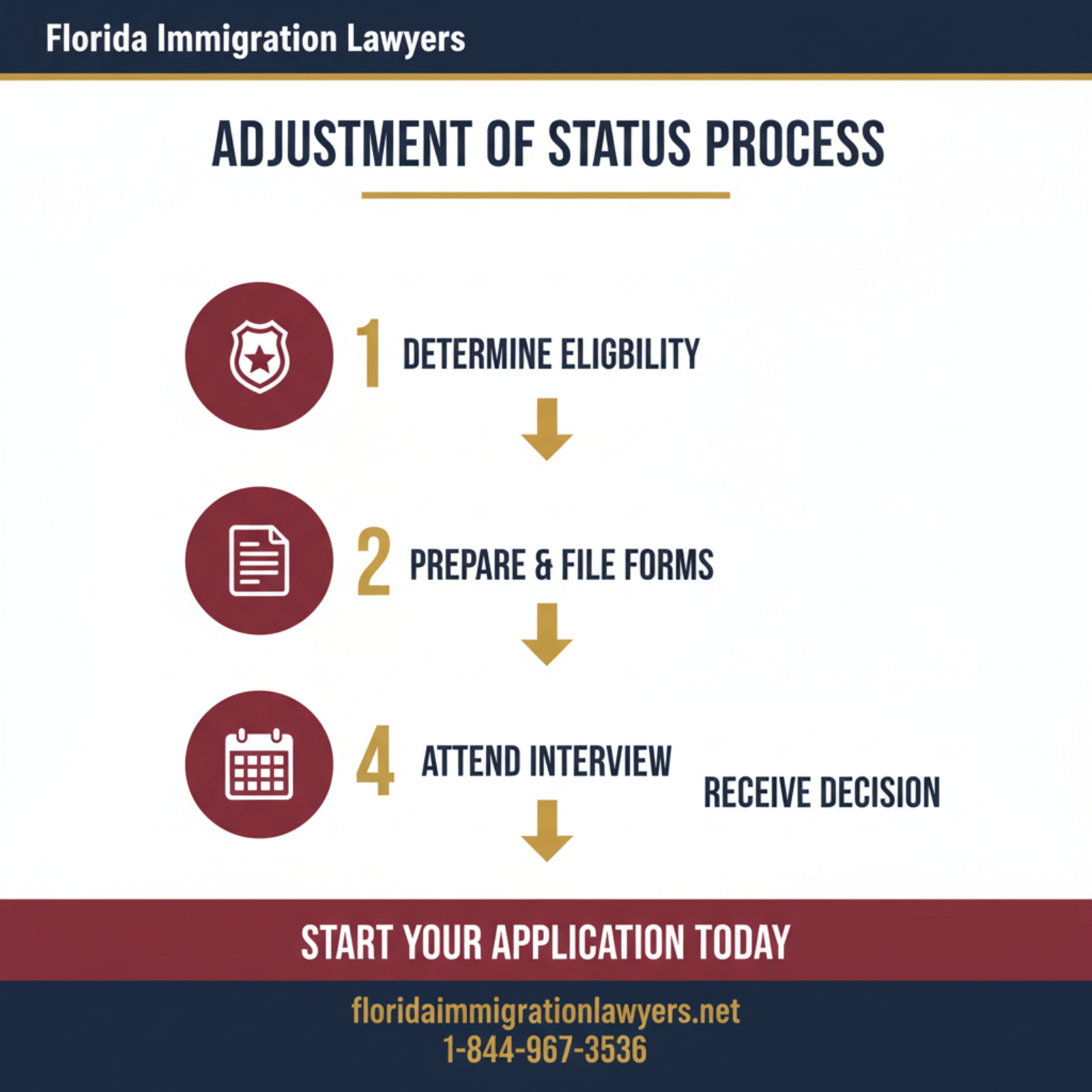
The application for adjustment of status involves several critical steps. Following these steps carefully is essential for a successful outcome. Here is a detailed guide to the process, which primarily revolves around submitting Form I-485, Application to Register Permanent Residence or Adjust Status.
-
Determine Eligibility and Visa Availability: Before filing, ensure you meet all the basic adjustment of status requirements. For most categories, this means having an approved immigrant petition (Form I-130, I-140, or I-360) and an immigrant visa immediately available based on the Visa Bulletin. Immediate relatives of U.S. citizens typically do not need to check the Visa Bulletin.
We can help you verify your eligibility and confirm visa availability, a crucial first step for any Florida resident considering this path. Visit USCIS.gov for detailed eligibility categories.
-
Prepare Form I-485 and Supporting Documentation: This is a comprehensive application that requires meticulous attention to detail. You will need to complete Form I-485 accurately and gather all required supporting documents. These include personal identification, evidence of your immigrant petition, financial documents, and more.
This step often includes preparing Form I-765 (Application for Employment Authorization) and Form I-131 (Application for Travel Document) concurrently, allowing you to work and travel while your green card application is pending.
-
Undergo a Medical Examination: All adjustment of status applicants must undergo a medical examination conducted by a USCIS-approved civil surgeon. The surgeon will complete Form I-693, Report of Medical Examination and Vaccination Record, which you will submit with your I-485 application, or bring to your interview.
Ensure you receive the sealed envelope containing your I-693, as it must remain unopened until submitted to USCIS. You can find approved civil surgeons on the USCIS website.
-
File Your Application Packet with USCIS: Once all forms are completed and documents gathered, you will mail your complete application packet, including Form I-485, supporting documents, and the correct filing fees, to the designated USCIS Lockbox facility. The specific address depends on the type of petition and your location.
Proper assembly and submission are critical to avoid delays. Errors in filing can lead to a Request for Evidence (RFE) or even a denial.
-
Attend Biometrics Appointment: After USCIS accepts your application, you will receive an appointment notice for biometrics collection at an Application Support Center (ASC). This involves submitting fingerprints, photographs, and a signature, which are used for background checks.
Missing this appointment without rescheduling can severely impact your case. Be sure to attend promptly at the designated Florida ASC location, such as those in Jacksonville, Orlando, or Miami.
-
Interview with USCIS (if required): Many adjustment of status applicants are required to attend an interview at a USCIS Field Office. During the interview, a USCIS officer will review your application, verify your eligibility, and ask questions about your petition and supporting documents. Not all cases require an interview, especially for some employment-based categories.
If an interview is required, it will typically be held at a USCIS field office serving your Florida residence, such as the Jacksonville Field Office or the Miami Field Office.
-
Receive Decision: Following the interview (or if waived), USCIS will make a decision on your I-485 application. If approved, you will receive your permanent resident card, or green card, by mail. If denied, USCIS will send a written explanation for the denial, and you may have options to appeal or refile.
The wait for a decision can be anxious, but our team at Florida Immigration Lawyers will keep you informed every step of the way.
Essential Documents for Your Adjustment of Status Application
A complete and well-organized document submission is vital for a successful adjustment of status application. Missing or incorrect documents are a primary cause of delays and denials. This list outlines the typically required documents:
- Form I-485, Application to Register Permanent Residence or Adjust Status
- Form I-130 (or I-140, etc.) petition and approval notice, if not filed concurrently
- Two U.S. passport-style photographs
- Copy of your birth certificate
- Copy of your passport biographical page and visa page
- Copy of your I-94 Arrival/Departure Record
- Copy of your government-issued photo identification
- Form I-693, Report of Medical Examination and Vaccination Record (in a sealed envelope)
- Form I-864, Affidavit of Support (for family-based cases), with financial evidence from the sponsor
- Form I-765, Application for Employment Authorization (optional, but recommended)
- Form I-131, Application for Travel Document (optional, but recommended)
- Evidence of lawful entry and continuous lawful status (e.g., previous visa stamps, I-797 approval notices)
- Certified copies of court records, police records, or other criminal history documents (if applicable)
- Marriage certificate (for spouse petitions) or birth certificates (for child petitions)
Always check the USCIS website for Form I-485 instructions for the most current and complete list of required documents, as these can change. Our attorneys ensure your application package is thorough and compliant with all current adjustment of status requirements.
Adjustment of Status Processing Times and Expectations in 2026
The time it takes to process an adjustment of status application can vary significantly based on several factors, including the USCIS Field Office jurisdiction, the specific immigrant category, the completeness of your application, and current USCIS workloads. For applicants in Florida, processing times for Form I-485 can range from several months to over two years in 2026.
USCIS provides estimated processing times on its website, which are updated regularly. It is crucial to monitor these times, but also understand they are estimates. Factors such as Requests for Evidence (RFEs) or interview scheduling delays can extend your overall adjustment of status processing time.
For individuals residing in Jacksonville, your case will likely be processed through the USCIS Jacksonville Field Office, or potentially another Florida office depending on the initial filing location. Other major USCIS field offices in Florida include Miami, Orlando, and Tampa. Each office may have slightly different processing nuances.
Which gets approved first, I-130 or I-485?
For immediate relatives of U.S. citizens, Forms I-130 and I-485 can often be filed concurrently. In such cases, USCIS typically processes both forms together, and the I-130 must be approved before the I-485 can be approved. For other family-based or employment-based categories, the I-130 or I-140 petition must be approved, and a visa number must be available, before the I-485 can be adjudicated.
Understanding Adjustment of Status Costs and Fees
Applying for adjustment of status involves various government filing fees, which are subject to change by USCIS. While we cannot provide exact figures as they fluctuate, it is important to be aware of the types of fees you will encounter:
- Form I-485 Filing Fee: This is the primary fee for the adjustment of status application itself.
- Biometrics Services Fee: A separate fee is typically required for the biometrics appointment.
- Form I-130 or I-140 Filing Fee: If an immigrant petition is being filed concurrently, or was filed separately, its respective fee applies.
- Medical Examination Fee: This fee is paid directly to the civil surgeon and varies by provider and location in Florida.
- Attorney Fees: Legal fees for assistance from an experienced immigration lawyer. While an additional cost, professional legal guidance can be invaluable in preventing costly mistakes and ensuring a smooth process.
It is crucial to check the USCIS website for current fees before filing, as incorrect fees can lead to rejection of your application. Our firm can help you understand all applicable costs for your green card application.
Do not navigate this process alone. Contact Florida Immigration Lawyers today to ensure your application is handled with precision and care. We offer comprehensive legal services for all your immigration needs.
Common Mistakes to Avoid in Your Adjustment of Status Application
The adjustment of status process is intricate, and even minor errors can lead to significant delays or even denial. Being aware of common pitfalls can save you time, money, and stress.
-
Filing Without an Immediately Available Visa: This is a frequent error, especially for family preference categories. Filing your I-485 when your priority date is not current will result in a rejection or denial. Always check the Visa Bulletin.
-
Incomplete or Incorrect Forms: Missing signatures, unanswered questions, or outdated forms can lead to immediate rejection or a Request for Evidence (RFE), prolonging your adjustment of status processing time.
-
Insufficient Supporting Documentation: Failing to provide all required documents, such as birth certificates, marriage certificates, or financial evidence, will cause delays. USCIS needs clear proof for every claim.
-
Issues with Lawful Entry or Status Maintenance: Many applicants mistakenly believe they are eligible despite an unlawful entry or a period of unauthorized stay. Unless specific exceptions apply (e.g., immediate relatives of U.S. citizens), these issues can be fatal to an adjustment of status application.
-
Criminal History Not Disclosed: Failing to disclose any criminal history, even minor offenses, can be considered misrepresentation and lead to denial. It is always best to be truthful and seek legal advice on how to address such issues.
-
Public Charge Concerns: Not adequately demonstrating that you will not become a public charge, often through a robust Affidavit of Support (Form I-864) from your sponsor, can lead to denial. This is a significant focus for USCIS.
-
Travel Without Advance Parole: If you leave the U.S. while your I-485 is pending without an approved Form I-131 (Advance Parole), your adjustment of status application may be considered abandoned. This is a critical mistake for Florida applicants who might travel internationally.
-
Working Without Employment Authorization: Engaging in unauthorized employment while your I-485 is pending can disqualify you from adjustment of status, unless you are an immediate relative of a U.S. citizen. Always wait for your Employment Authorization Document (EAD).
-
Missing Biometrics or Interview Appointments: Failing to attend scheduled appointments without proper rescheduling can lead to your application being considered abandoned or denied.
-
Inconsistent Information: Providing conflicting information across different forms or during an interview can raise red flags and lead to accusations of misrepresentation.
People Also Ask (PAA) - Quick Answers
We've gathered some common questions related to adjustment of status to provide quick, clear answers for our Florida community.
What are the steps for adjustment of status?
The main steps include determining eligibility, filing an immigrant petition (if not already approved), completing a medical exam, submitting Form I-485, attending a biometrics appointment, and potentially an interview with USCIS before receiving a decision. Each step requires careful attention to detail.
What are common I-485 mistakes?
Common mistakes include filing without a current visa, submitting incomplete forms or insufficient documentation, failing to disclose criminal history, traveling without advance parole, or working without authorization. These errors can significantly delay or jeopardize your green card application.
Can a green card holder still be deported?
Yes, a green card holder, also known as a lawful permanent resident, can still be deported (removed) from the United States under certain circumstances. This typically occurs due to serious criminal convictions, immigration fraud, or violating specific immigration laws. It is crucial to understand that a green card does not grant absolute immunity from deportation.
When to Call a Lawyer for Your Adjustment of Status Case
While the goal of this guide is to provide comprehensive information, immigration law is incredibly complex and constantly evolving. There are many scenarios where the guidance of an experienced attorney is not just helpful, but absolutely essential for a successful adjustment of status application, especially in a diverse state like Florida.
You should consider contacting Florida Immigration Lawyers if any of the following apply to your situation:
- You have a history of overstaying a visa or unlawful presence in the U.S.
- You entered the U.S. without inspection or parole.
- You have any criminal history, even minor offenses or arrests.
- You have previously been denied a visa or had an immigration application rejected.
- You have received a Request for Evidence (RFE) or Notice of Intent to Deny (NOID) from USCIS.
- You have concerns about the public charge rule or need a waiver of inadmissibility.
- Your case involves complex family relationships or prior marriages.
- You are seeking adjustment of status after marriage to a U.S. citizen and want to ensure proper documentation.
- You are confused about the Visa Bulletin or whether a visa is immediately available to you.
- You need to apply for a waiver for certain grounds of inadmissibility.
- Your case has specific complexities regarding your employment history or previous immigration applications.
Our firm specializes in helping individuals throughout Florida, including those facing unique challenges in Jacksonville, navigate the intricacies of adjustment of status. We can provide personalized advice, prepare your application meticulously, represent you during interviews, and respond effectively to any USCIS inquiries. Protecting your future and securing your green card is our priority. Explore our general immigration services or learn more about family immigration and business immigration pathways.
About Florida Immigration Lawyers
Florida Immigration Lawyers is a leading immigration law firm dedicated to serving individuals and families across the entire state of Florida. With offices and a strong presence, we understand the unique needs of our diverse community, from Jacksonville to Miami, Orlando to Tampa, and everywhere in between.
Our team of experienced and compassionate attorneys is committed to providing exceptional legal representation for a wide range of immigration matters. We pride ourselves on our client-focused approach, ensuring that you receive personalized attention and strategic advice tailored to your specific circumstances.
Why Choose Florida Immigration Lawyers?
- Expertise: Our attorneys possess in-depth knowledge of U.S. immigration law, including the latest policies and procedures for adjustment of status.
- Comprehensive Services: We handle all aspects of green card applications, visa petitions, asylum claims, deportation defense, and citizenship applications.
- Client-Centered Approach: We are dedicated to clear communication, transparency, and empowering our clients throughout their legal journey.
- Accessibility: We are available 24/7 to address your urgent concerns and offer free consultations to help you understand your options.
- Bilingual Support: Our team includes fluent Spanish speakers, ensuring effective communication and culturally sensitive service for our Hispanic community.
Your journey to a green card or U.S. citizenship is important, and we are here to guide you every step of the way. Visit our attorneys page to learn more about our team, or contact us today to begin your free consultation.
Florida Immigration Lawyers
Phone: 1-844-967-3536
Website: https://www.floridaimmigrationlawyers.net
Sources and References
- U.S. Citizenship and Immigration Services (USCIS)
- USCIS Form I-485, Application to Register Permanent Residence or Adjust Status
- U.S. Department of State Visa Bulletin
- Immigration and Nationality Act (INA) Section 245 (8 U.S.C. § 1255) - Adjustment of Status
- Immigration and Nationality Act (INA) Section 212(a) (8 U.S.C. § 1182) - General Classes of Aliens Ineligible to Receive Visas and Inadmissible to United States
- 8 Code of Federal Regulations (CFR) Part 245 - Adjustment of Status
- Executive Office for Immigration Review (EOIR) - Immigration Court Locations in Florida
This article provides general legal information and is not intended as legal advice. Every case is unique, and outcomes depend on specific facts and circumstances. Contact an attorney for advice about your particular situation.
Securing your future in Florida through adjustment of status is a significant step, and Florida Immigration Lawyers is here to ensure your journey is as smooth as possible. We offer comprehensive support for all your immigration needs.
Don't delay your path to a green card. Take the first step today by reaching out to our dedicated team. We are available 24/7 to provide the expert guidance you deserve.
Call Florida Immigration Lawyers for a free consultation at 1-844-967-3536. Se Habla Español - Estamos aquí para ayudarle.
Frequently Asked Questions
Florida Immigration Lawyers
Legal Team
Our experienced attorneys at Florida Immigration Lawyers have been serving clients across Florida for over 20 years. We specialize in immigration, personal injury, criminal defense, workers compensation, and family law.