Abrego Garcia Deportation in Florida: Your Legal Defense Options
The Abrego Garcia deportation case highlights the critical need for strong legal defense in immigration removal proceedings. If you're facing deportation in Florida, understanding your due process rights and legal options is crucial. This guide covers the deportation process, essential documents, timelines, costs, and common mistakes to avoid. Florida Immigration Lawyers offers expert guidance and representation. Learn how to protect your future and explore available relief from removal. Contact us for a free consultation.
The Abrego Garcia deportation case highlights the critical importance of robust legal defense in immigration removal proceedings. In Florida, individuals facing deportation have due process rights, including the right to legal representation, to present evidence, and to appeal decisions. Understanding these rights and the complexities of immigration law is essential to challenge a removal order effectively and seek relief from deportation.
Key Takeaways:
- Deportation proceedings are complex and require expert legal guidance.
- You have due process rights, even if detained or facing removal.
- Various forms of relief from deportation may be available.
- Timely action and proper documentation are crucial for your defense.
- A Florida immigration lawyer can significantly impact your case outcome.
Imagine receiving a Notice to Appear, initiating a process that could lead to your removal from the United States. For many, this is a terrifying reality. The complexities of immigration law, as demonstrated by high-profile cases like the Kilmar Abrego Garcia deportation, underscore the immense challenges individuals face.
If you or a loved one are confronting potential deportation in Florida, understanding your rights and legal options is paramount. This comprehensive guide will walk you through the intricacies of deportation defense, highlighting the critical steps, potential pitfalls, and how experienced legal counsel can protect your future in our state.
Do not face these proceedings alone. Call Florida Immigration Lawyers at 1-844-967-3536 for a free consultation. We are here to help you navigate this difficult time.
Understanding Abrego Garcia Deportation Challenges in Florida
The case of Kilmar Abrego Garcia, a Salvadoran man who faced a mistaken deportation, brought national attention to the vulnerabilities within the U.S. immigration system. His experience underscores that even in complex situations, individuals possess significant rights and avenues for defense against removal. For those in Florida, understanding these rights is the first step.
Deportation, also known as removal, is the formal process by which the U.S. government orders a non-citizen to leave the country. This can happen for various reasons, including visa overstays, criminal convictions, or unlawful entry. The stakes are incredibly high, affecting families, livelihoods, and futures across West Palm Beach and all of Florida.
Florida, with its diverse population and busy ports of entry, sees a significant number of immigration cases. The immigration courts in Miami and Orlando, part of the Executive Office for Immigration Review (EOIR), handle thousands of removal proceedings annually. This makes expert local legal representation indispensable for anyone facing deportation defense.
The Deportation Process: A Step-by-Step Guide for Florida Residents
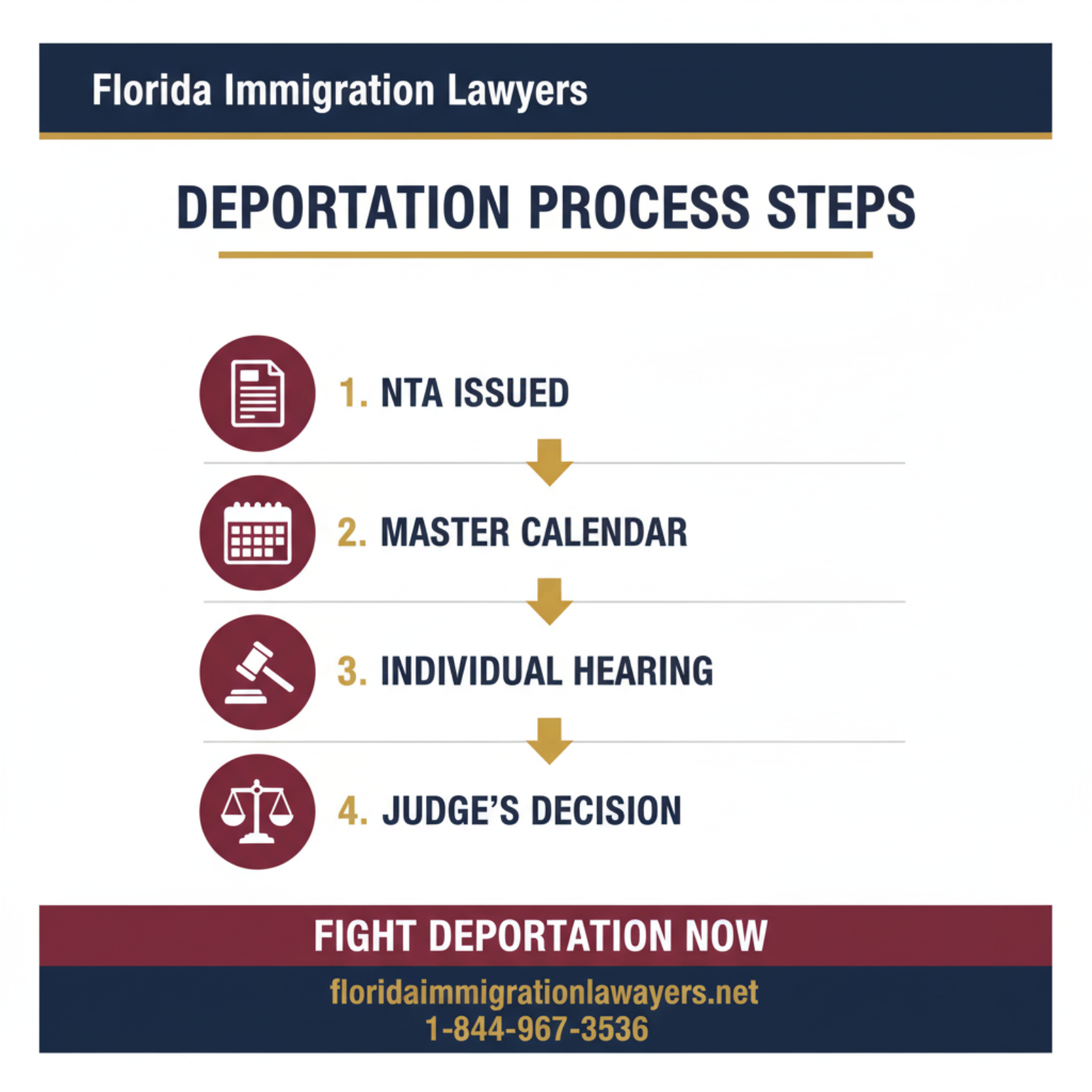
Navigating the U.S. immigration court system can be daunting. The process typically begins with an official notice and progresses through several stages. Each step presents opportunities for legal intervention and defense.
Here is a general overview of the deportation process you might encounter in Florida:
-
Issuance of a Notice to Appear (NTA)
The process formally begins when Immigration and Customs Enforcement (ICE) issues a Form I-862, Notice to Appear (NTA). This document alleges that you are removable from the U.S. and orders you to appear before an Immigration Judge. The NTA will specify the charges against you and the legal basis for your alleged removability. It is crucial to review this document immediately with an attorney.
-
Master Calendar Hearings
Your first appearance before an Immigration Judge will be a Master Calendar Hearing. This is a preliminary hearing where the judge confirms your identity, ensures you have received the NTA, and allows you to admit or deny the allegations and charges. This is also where you inform the court if you intend to seek relief from removal. An attorney can help you understand the charges and articulate your defense strategy.
-
Pleading for Relief from Removal
If you deny removability or seek relief, you will typically be given time to prepare your application(s) for relief. Common forms of relief include asylum, withholding of removal, protection under the Convention Against Torture (CAT), cancellation of removal for certain non-permanent residents, or adjustment of status. Each form of relief has specific eligibility requirements. For example, cancellation of removal requires demonstrating continuous physical presence and good moral character, among other factors (INA § 240A, 8 U.S.C. § 1229b).
-
Individual Hearings (Merits Hearing)
If you apply for relief, the court will schedule an Individual Hearing. This is your opportunity to present your case, testify, and call witnesses. The government attorney will also present their case and may cross-examine you and your witnesses. The Immigration Judge will consider all evidence and testimony. This hearing is often the most critical stage of the process for anyone facing Abrego Garcia deportation challenges.
-
Decision by the Immigration Judge
After the Individual Hearing, the Immigration Judge will issue a decision. They may grant relief, order you removed, or terminate the proceedings. If the judge orders removal, they will also designate the country to which you will be deported. A favorable decision means you can remain in the U.S. and often leads to a path towards lawful permanent residency.
-
Appeals Process
If either you or the government disagree with the Immigration Judge's decision, you generally have 30 days to file an appeal with the Board of Immigration Appeals (BIA). The BIA reviews the judge's decision for legal error. Further appeals can be made to the U.S. Circuit Courts of Appeals. The appeals process is complex and strictly time-sensitive. (See 8 CFR § 1003.38).
Essential Documents for Your Deportation Defense
A strong defense against deportation relies heavily on compelling evidence and thorough documentation. Gathering the right documents early can significantly strengthen your case. Your Florida immigration lawyer will guide you on what specific documents are needed for your unique situation.
Here is a general checklist of documents that are often crucial in deportation defense cases:
- Identification Documents: Passport, birth certificate, national identity card, driver's license, state ID.
- Immigration Documents: Any previous visas, I-94 arrival/departure records, I-797 approval notices, green card (Form I-551), employment authorization documents (EAD).
- Proof of Residence: Utility bills, lease agreements, property deeds, bank statements, school records, showing continuous presence in Florida or the U.S.
- Family Information: Marriage certificates, birth certificates of children, divorce decrees, proof of relationship to U.S. citizens or lawful permanent residents.
- Employment Records: Pay stubs, W-2 forms, employment letters, tax returns. These demonstrate your economic ties and contributions.
- Financial Records: Bank statements, property records, loan documents.
- Medical Records: Especially if seeking asylum or relief based on health conditions or vulnerabilities.
- Police Reports/Court Records: For any criminal history, even minor offenses. Your lawyer will need to review these thoroughly.
- Witness Affidavits/Letters of Support: Statements from family, friends, employers, or community leaders attesting to your good moral character, hardship, or ties to the community.
- Proof of Hardship: Documentation showing extreme and unusual hardship to qualifying relatives if you were to be deported.
Navigating Timelines and Processing Expectations in Florida Immigration Courts
The duration of deportation proceedings can vary significantly. Factors influencing timelines include the complexity of your case, the caseload of the immigration court, the specific judge assigned, and whether appeals are filed. It is important to manage your expectations and prepare for a potentially lengthy process, especially if your case involves issues similar to the Abrego Garcia deportation.
In Florida, immigration courts in Miami and Orlando often face heavy dockets. A typical removal case, without significant delays or appeals, can take anywhere from one to three years, or even longer. Cases involving detention may be expedited, but this is not always guaranteed.
Key factors affecting your timeline:
- Court Location: Caseloads vary by court. Miami and Orlando courts are particularly busy.
- Case Complexity: Straightforward cases with clear forms of relief may proceed faster than complex asylum claims or cases with criminal convictions.
- Judge's Schedule: Each Immigration Judge manages their own docket.
- Availability of Evidence: Delays can occur if you or your attorney need more time to gather documents or secure witnesses.
- Appeals: An appeal to the BIA can add another 1-2 years to the process, and further appeals to federal courts can extend it even more.
Your Florida Immigration Lawyers team will provide you with realistic expectations for your case timeline. We are committed to keeping you informed every step of the way.
Cost Factors and Fee Breakdown for Deportation Defense
Understanding the financial commitment involved in deportation defense is a critical part of preparing for the process. Legal fees for immigration cases, particularly removal proceedings, can vary widely based on the complexity of the case, the experience of your attorney, and the amount of work required. It is important to remember that investing in legal representation is an investment in your future.
While Florida Immigration Lawyers offers a free initial consultation, subsequent fees will depend on your specific needs. Here are common cost factors:
- Attorney Fees: This is typically the largest component. Some attorneys charge hourly rates, while others offer flat fees for specific stages or the entire case. Complex cases, like those involving criminal issues or multiple forms of relief, will naturally incur higher fees.
- Filing Fees: USCIS and EOIR charge fees for various applications for relief, such as an application for adjustment of status (Form I-485) or a motion to reopen. These fees are subject to change and are paid directly to the government. (For current fees, refer to USCIS website).
- Translating Documents: If your documents are not in English, certified translations will be required. This is an additional cost.
- Expert Witness Fees: In some cases, expert testimony (e.g., psychological evaluations for asylum claims, country conditions experts) may be necessary, adding to the expense.
- Travel Expenses: If your attorney needs to travel for hearings outside of West Palm Beach or other local Florida courts, these costs may be passed on.
We believe in transparent billing and will discuss all potential costs with you upfront during your consultation. Our goal is to provide exceptional legal services at a fair and clear price.
Do not navigate this process alone. The complexities of immigration law and the high stakes of deportation proceedings demand experienced legal representation. Contact Florida Immigration Lawyers today to discuss your case and explore your defense options.
Common Mistakes to Avoid in Removal Proceedings
Facing deportation is stressful, and it's easy to make errors that could jeopardize your case. Being aware of common pitfalls can help you avoid costly setbacks. Florida Immigration Lawyers are here to ensure you avoid these mistakes, particularly when dealing with complex situations such as those highlighted by the Abrego Garcia deportation.
- Missing Deadlines: Immigration courts operate on strict timelines. Missing a filing deadline for an application or an appeal can lead to an automatic denial or removal order.
- Failing to Appear in Court: Not attending a scheduled court hearing, even if you did not receive a notice, can result in an "in absentia" removal order, which is very difficult to overturn.
- Providing Inconsistent Information: Any discrepancies in your testimony or documents can severely undermine your credibility with the Immigration Judge. Always be truthful and consistent.
- Not Disclosing Criminal History: Attempting to hide past arrests or convictions, no matter how minor, can be detrimental. Your attorney needs full disclosure to build a proper defense.
- Signing Documents Without Understanding: Never sign any immigration document presented by an officer or official without fully understanding its contents and implications, ideally with your attorney present.
- Failing to Update Your Address: If you move, you must notify the immigration court and USCIS of your new address immediately. Failure to do so means you might miss critical notices.
- Believing Misinformation: Relying on advice from non-attorneys or unreliable sources can lead to incorrect actions and severe consequences for your case.
- Not Gathering Sufficient Evidence: A weak case lacking proper documentation, witness testimony, or legal arguments will likely fail. Thorough preparation is key.
- Appearing Unprepared: Going to court without having rehearsed your testimony, understanding the questions you might face, or having your documents organized can negatively impact the judge's perception.
- Delaying Legal Counsel: Waiting too long to consult an experienced immigration attorney can limit your defense options and opportunities to seek relief.
When to Call a Florida Immigration Lawyer for Deportation Defense
The moment you receive a Notice to Appear or become aware of potential deportation proceedings, it is crucial to seek legal counsel immediately. The complexities of immigration law require expert guidance. Attempting to navigate the system alone can have severe and irreversible consequences, especially in cases with unique circumstances like the Abrego Garcia deportation.
You should contact Florida Immigration Lawyers if any of the following apply to your situation:
- You have received a Notice to Appear (NTA) from ICE.
- You are detained by ICE and facing removal.
- You have a past criminal conviction, even a minor one, that could impact your immigration status.
- You believe you may be eligible for asylum or other forms of relief from deportation.
- You have a previous deportation order you wish to challenge or reopen.
- Your family members are U.S. citizens or lawful permanent residents, and your deportation would cause them extreme hardship.
- You are unsure about your immigration status or rights in the U.S.
Our experienced attorneys at Florida Immigration Lawyers understand the nuances of deportation defense. We serve clients across Florida, including West Palm Beach, Miami, and Orlando, providing compassionate and strategic representation. We will fight tirelessly to protect your rights and keep your family together in the United States.
Frequently Asked Questions (FAQs) About Deportation Defense in Florida
Understanding the deportation process can bring many questions. Here are some commonly asked questions to help clarify key aspects of removal proceedings in Florida.
What is the difference between deportation and removal?
Historically, "deportation" referred to removing a non-citizen who was legally admitted, while "exclusion" applied to those denied entry. Under current law (INA § 240, 8 U.S.C. § 1229a), both are consolidated under the term "removal proceedings." Essentially, they both mean the government is seeking to compel a non-citizen to leave the U.S. We use the terms interchangeably for general understanding.
Can I be deported if I am married to a U.S. citizen?
Marriage to a U.S. citizen does not automatically prevent deportation. While it can be a pathway to lawful permanent residency and a strong factor in seeking certain forms of relief from removal, such as adjustment of status or cancellation of removal, it does not provide absolute protection. The specifics of your case, including how you entered the U.S. and any criminal history, are crucial.
What happens if I miss my immigration court hearing in Florida?
Missing a scheduled immigration court hearing, especially a Master Calendar or Individual Hearing, can have severe consequences. The Immigration Judge may issue an "in absentia" removal order, meaning you are ordered deported without your presence. Overturning such an order is extremely difficult and requires demonstrating exceptional circumstances for your absence. Always consult with your attorney and ensure you attend all hearings.
How long does the deportation process take in Florida?
The duration varies significantly. Simple cases might be resolved in a year, but complex cases, particularly those involving appeals or extensive evidence, can take several years – often 3-5 years or more. Factors include court caseloads in Miami or Orlando, the specific judge, and the complexity of your defense strategy. Your attorney can provide a more tailored estimate.
What kind of relief from deportation is available?
Several forms of relief may be available depending on your specific circumstances. These include asylum, withholding of removal, protection under the Convention Against Torture (CAT), cancellation of removal for certain non-permanent residents, adjustment of status, waivers of inadmissibility, and voluntary departure. Each has distinct eligibility criteria, and a skilled attorney can determine which options apply to you.
Can a criminal record lead to deportation?
Yes, certain criminal convictions can make a non-citizen deportable or inadmissible. These include crimes involving moral turpitude, aggravated felonies, drug offenses, and firearms offenses. Even minor offenses can sometimes have severe immigration consequences. It is critical to discuss any criminal history, no matter how old or seemingly insignificant, with your immigration lawyer.
About Florida Immigration Lawyers
Florida Immigration Lawyers is a leading law firm dedicated to providing exceptional immigration legal services across the entire state of Florida. With years of specialized experience, our team understands the unique challenges faced by immigrants and their families. We are committed to delivering compassionate, effective, and results-driven representation.
Our comprehensive services include deportation defense, asylum applications, family-based immigration, business immigration, citizenship, and visa petitions. We pride ourselves on our client-focused approach, ensuring every individual receives personalized attention and a tailored legal strategy.
Why choose Florida Immigration Lawyers? We offer:
- Extensive expertise in all areas of immigration law.
- A deep understanding of Florida's specific immigration landscape.
- Aggressive advocacy combined with empathetic client support.
- Bilingual services to effectively communicate with our diverse clientele.
- A commitment to protecting your rights and securing your future in the U.S.
We are available 24/7 to address your urgent immigration needs and offer free consultations to help you understand your options. Contact us today at 1-844-967-3536 or visit our website at https://www.floridaimmigrationlawyers.net to schedule your confidential consultation. Let us be your trusted guide through the complex immigration process.
Sources and References
- U.S. Citizenship and Immigration Services (USCIS)
- Executive Office for Immigration Review (EOIR)
- U.S. Immigration and Customs Enforcement (ICE)
- 8 U.S.C. Chapter 12 - Immigration and Nationality Act (INA)
- INA § 240 - Removal Proceedings Generally (8 U.S.C. § 1229a)
- INA § 240A - Cancellation of Removal (8 U.S.C. § 1229b)
- 8 CFR § 1003.38 - Appeals to the Board of Immigration Appeals
- 8 CFR § 1240.10 - Hearings.
- USCIS Filing Fees
This article provides general legal information and is not intended as legal advice. Every case is unique, and outcomes depend on specific facts and circumstances. Contact an attorney for advice about your particular situation. Laws are subject to change and this information is current as of 2026-03-10.
Do not let the fear of deportation define your future. With Florida Immigration Lawyers, you have a dedicated advocate on your side. We offer free, confidential consultations to review your case and develop a robust defense strategy tailored to your needs. Call us today at 1-844-967-3536. Se Habla Español - Estamos aquí para ayudarle.
Frequently Asked Questions
Florida Immigration Lawyers
Legal Team
Our experienced attorneys at Florida Immigration Lawyers have been serving clients across Florida for over 20 years. We specialize in immigration, personal injury, criminal defense, workers compensation, and family law.