EXCELLENCE SINCE 1995•60+ YEARS COLLECTIVE EXPERIENCE•SERVING ALL FLORIDA & NATIONWIDE•YO PELEO™ - WE FIGHT•ORLANDO OFFICE•24/7 AVAILABILITY•SE HABLA ESPAÑOL•
EXCELLENCE SINCE 1995•60+ YEARS COLLECTIVE EXPERIENCE•SERVING ALL FLORIDA & NATIONWIDE•YO PELEO™ - WE FIGHT•ORLANDO OFFICE•24/7 AVAILABILITY•SE HABLA ESPAÑOL•
Withholding of Removal Florida Defense: Your Guide to Protection
Navigating the complexities of U.S. immigration law can be daunting, especially when facing deportation. For individuals in Florida who fear persecution or torture in their home country, <strong>withholding of removal Florida defense</strong> offers a critical pathway to safety. This comprehensive guide from Florida Immigration Lawyers explains the requirements, process, and distinctions of this vital relief, including Convention Against Torture (CAT) protection. We empower you with the knowledge needed to understand your options and secure your future in Florida.
Vasquez Law FirmPublished on March 10, 2026
0 views
Withholding of removal is a form of protection granted to individuals facing deportation in Florida who can prove a clear probability of persecution or torture if returned to their home country. Unlike asylum, it does not lead to permanent residency but prevents removal to that specific country. It is a vital defense against deportation, particularly for those in Florida's immigration courts.
Requires demonstrating a "clear probability" of future harm.
Prevents deportation to the country of feared persecution.
Does not provide a path to U.S. permanent residency.
Often sought in conjunction with or as an alternative to asylum.
Legal representation is crucial for success in Florida immigration courts.
Facing the threat of deportation can be one of the most terrifying experiences for an immigrant in Florida. The thought of being forced to return to a country where you fear for your life or safety is overwhelming. Fortunately, U.S. immigration law offers certain forms of protection, and among the most critical is withholding of removal Florida defense.
This comprehensive guide from Florida Immigration Lawyers will delve into the intricacies of withholding of removal, explaining what it is, who qualifies, and how it differs from other forms of relief like asylum. We will provide you with a clear roadmap, focusing on the specific challenges and opportunities within Florida's immigration system. Understanding these complex laws is your first step towards securing your future.
Do not face this challenging process alone. For immediate guidance and a thorough evaluation of your case, call Florida Immigration Lawyers at 1-844-967-3536 for a free consultation. Our experienced team is ready to assist you.
Understanding Withholding of Removal Florida Defense
Withholding of removal is a crucial form of protection for non-citizens in the United States who have been ordered removed but fear persecution or torture upon return to their home country. It is distinct from asylum, offering a different standard of proof and a more limited form of relief. Section 241(b)(3) of the Immigration and Nationality Act (INA), codified at 8 U.S.C. § 1231(b)(3), outlines its criteria.
The primary purpose of withholding of removal Florida defense is to prevent the U.S. government from sending an individual to a country where their life or freedom would be threatened. This protection is mandatory if an immigration judge finds a clear probability of persecution based on race, religion, nationality, membership in a particular social group, or political opinion. The burden of proof is significantly higher than for asylum.
In Florida, individuals facing deportation proceedings in immigration courts, such as those in Miami, Orlando, or the Executive Office for Immigration Review (EOIR) in Orlando, often explore this option. It serves as a vital defense, particularly when asylum eligibility might be barred due to certain criminal convictions or other factors. Our firm, Florida Immigration Lawyers, regularly assists clients throughout the state, including those in Naples and surrounding areas.
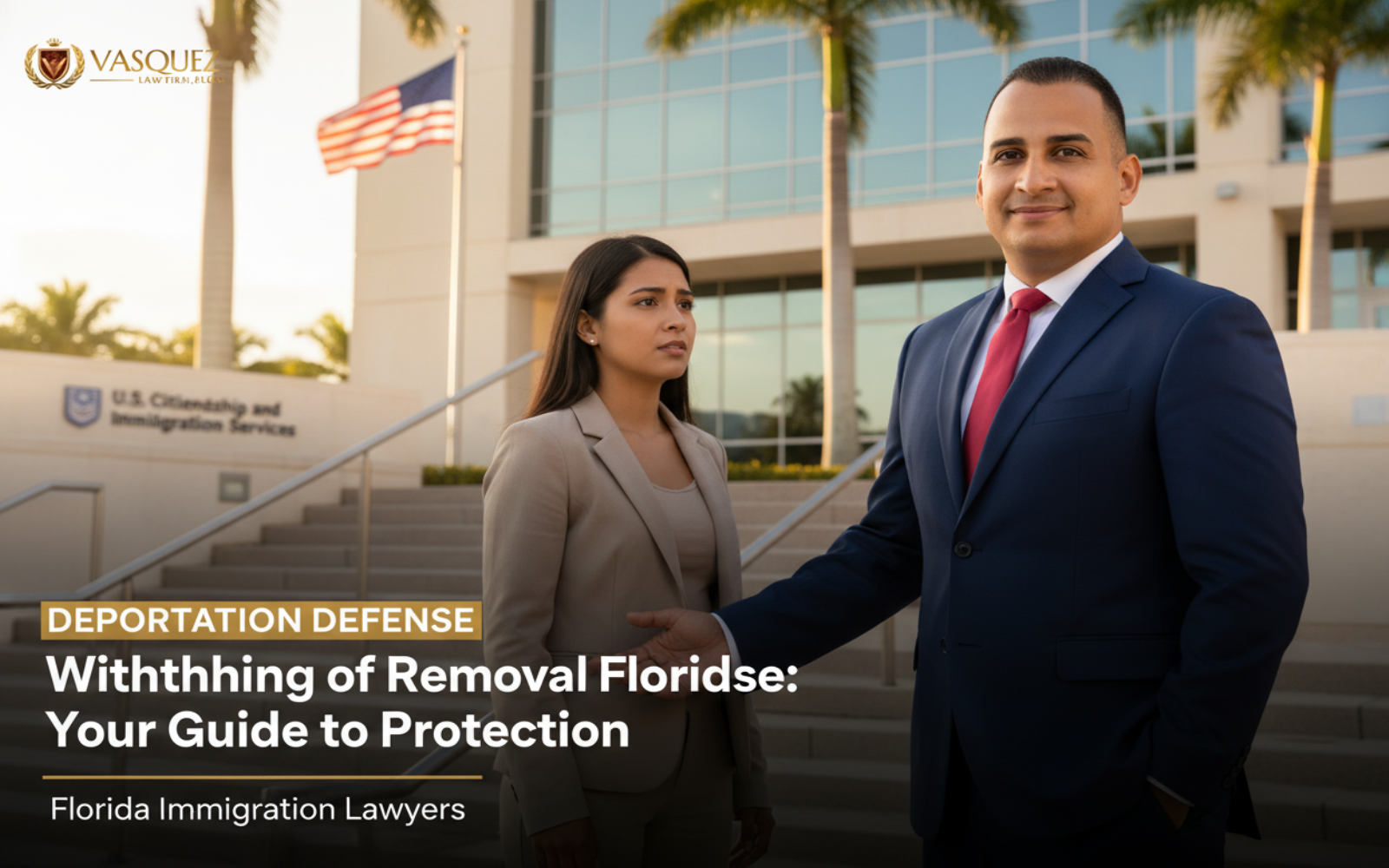
Featured: Withholding of Removal Florida Defense: Your Guide to Protection
The Convention Against Torture (CAT) provides another layer of protection, often sought alongside withholding of removal. Article 3 of the CAT, implemented by 8 CFR § 208.16(c), prohibits the U.S. from removing an individual to a country where there are substantial grounds to believe they would be subjected to torture. This form of relief requires demonstrating it is "more likely than not" that you would be tortured, a very high standard.
While both withholding of removal and CAT protection prevent deportation, neither grants permanent residency or a direct path to citizenship. They allow you to remain in the U.S. and provide work authorization, but international travel carries risks. Understanding these nuances is critical for your future.
Eligibility for Withholding of Removal and CAT Protection in Florida
To be eligible for withholding of removal Florida defense, you must demonstrate that it is "more likely than not" that your life or freedom would be threatened if you were returned to your home country. This means proving a clear probability of persecution based on one of the five protected grounds: race, religion, nationality, membership in a particular social group, or political opinion. This is a higher standard than the "well-founded fear" required for asylum.
For CAT protection Florida, you must prove it is "more likely than not" that you would be tortured if returned. Torture is specifically defined as severe pain or suffering intentionally inflicted by or at the instigation of, or with the consent or acquiescence of, a public official or other person acting in an official capacity. This definition is very specific and does not include all forms of harm.
Certain factors can bar eligibility for withholding of removal, even if you meet the probability standard. These include having committed a particularly serious crime, constituting a danger to the community, or having engaged in terrorist activities. These bars are strictly applied in Florida immigration courts and require careful legal analysis.
The process generally begins when you are placed in removal proceedings before an immigration judge. You must then file an application for asylum and for withholding of removal (Form I-589) within the specified timeframe. Your application and testimony will be critically evaluated, often with a Department of Homeland Security (DHS) attorney opposing your claim. Successfully navigating this requires robust evidence and compelling testimony.
Step-by-Step Guide to Pursuing Withholding of Removal
Receive a Notice to Appear (NTA): Your immigration journey often begins when you receive an NTA, placing you in removal proceedings before an immigration judge in a Florida immigration court, such as those serving Naples residents. This document outlines the government's reasons for your deportability.
Consult with an Immigration Attorney: This is a critical first step. An experienced attorney from Florida Immigration Lawyers can assess your eligibility for withholding of removal Florida defense, asylum, and CAT protection. They will help you understand the legal complexities and strategize your defense.
File Form I-589: You must file Form I-589, Application for Asylum and for Withholding of Removal, with the immigration court. This application details your fear of persecution or torture and provides crucial background information. Timeliness is often important, though withholding of removal does not have the strict one-year filing deadline that asylum does.
Gather Supporting Evidence: Collect all possible evidence to support your claim. This includes affidavits from witnesses, country condition reports, medical records, police reports, and any documentation of past harm or threats. Strong evidence is vital for proving a "clear probability" of future harm.
Prepare for Your Individual Hearing: You will attend an individual hearing before an immigration judge. During this hearing, you will testify about your fears and experiences, and present your evidence. A DHS attorney will cross-examine you, and the judge will ask questions. Thorough preparation with your attorney is essential.
Receive the Judge's Decision: After the hearing, the immigration judge will issue a decision. If your application for withholding of removal Florida defense is granted, you will be protected from deportation to your specific country of fear. If denied, you may have the option to appeal the decision to the Board of Immigration Appeals (BIA).
Essential Documents for Your Withholding of Removal Case
A strong withholding of removal Florida defense hinges on comprehensive and credible documentation. Gathering the right evidence is paramount to proving your eligibility to the immigration judge. Missing or insufficient documentation can significantly weaken your case.
Here is a checklist of documents typically required or highly beneficial for your withholding of removal or CAT protection application in Florida:
Form I-589, Application for Asylum and for Withholding of Removal: The primary application form, accurately completed and signed.
Personal Declaration: A detailed, written statement from you explaining your experiences, fears of persecution or torture, and the basis for these fears. This should be consistent with your testimony.
Identity Documents: Copies of your passport, birth certificate, national ID card, and any other documents proving your identity and nationality.
Proof of Entry/Presence in the U.S.: I-94 records, visa stamps, or any documents showing how and when you entered the United States.
Witness Affidavits: Sworn statements from individuals who can corroborate your story, such as family members, friends, or colleagues who witnessed events or can attest to your credible fear.
Country Condition Reports: Official reports from organizations like the U.S. Department of State, Amnesty International, Human Rights Watch, or academic experts detailing human rights abuses, political instability, or persecution in your home country. These reports are crucial for establishing the general threat.
Evidence of Past Persecution/Harm: Medical records, psychological evaluations, police reports, newspaper articles, photos, videos, or letters documenting any past harm you or your family members have suffered.
Evidence of Membership in a Protected Group: Documents proving your race, religion, nationality, political affiliation, or membership in a particular social group if applicable to your claim.
Court and Police Records: If you have been arrested or detained, provide records from your home country to show the context of the events and any persecution you faced.
Travel Documents: Any travel documents, such as airline tickets or boarding passes, that show your departure from your home country.
Any Other Corroborating Evidence: Letters, emails, social media posts, or any other items that support your narrative and demonstrate your fear.
Organizing these documents systematically is a key part of building a strong defense. Your legal team at Florida Immigration Lawyers will guide you through this process, ensuring all necessary evidence is compiled and presented effectively to the immigration court in Florida.
Timeline and Processing Expectations for Florida Cases
The timeline for a withholding of removal Florida defense case can vary significantly, depending on several factors. These include the caseload of the specific immigration court, the complexity of your case, the need for additional evidence, and the availability of judges and court dates. Immigration courts in Florida, such as those in Orlando and Miami, often have substantial backlogs, which can extend processing times.
Generally, after filing your Form I-589, you will receive a notice for a Master Calendar Hearing. This is usually a short procedural hearing where the judge confirms receipt of your application and sets future dates. Following this, an Individual Hearing (or Merits Hearing) will be scheduled, where you present your testimony and evidence. This hearing can be several months or even years after your initial filing, especially in busy Florida courts.
After your individual hearing, the immigration judge will typically issue an oral decision at the end of the hearing or a written decision shortly thereafter. If the decision is appealed to the Board of Immigration Appeals (BIA), that process can add many more months, or even years, to the overall timeline. The BIA's decisions can then be appealed to a federal circuit court, further prolonging the process.
While there is no strict processing time, it is common for a withholding of removal case, from initial filing to a final decision by an immigration judge, to take anywhere from one to three years, or even longer. Appeals can extend this considerably. Patience and consistent engagement with your legal team are essential throughout this extended process. Florida Immigration Lawyers are committed to keeping you informed at every stage of your case.
Cost Factors and Fee Breakdown for Immigration Relief
Pursuing withholding of removal Florida defense involves various costs, primarily legal fees and potential administrative fees. While there are no government filing fees specifically for Form I-589 for asylum and withholding of removal applicants, other costs can arise. It is important to understand these financial aspects upfront when planning your defense.
The most significant cost factor will typically be attorney fees. Immigration law is highly specialized, and the complexity of withholding of removal cases demands experienced legal representation. Fees can vary based on the attorney's experience, the complexity of your case, the amount of evidence to be gathered, and the anticipated time commitment for court appearances and preparation.
At Florida Immigration Lawyers, we believe in transparent fee structures. During your free consultation, we can discuss our fees and payment options tailored to your situation. While we cannot quote specific figures without evaluating your case, our goal is to provide exceptional legal services at a fair cost.
Other potential costs may include:
Translation Services: If your documents are not in English, they must be translated by a certified translator.
Expert Witness Fees: In some complex cases, an expert witness (e.g., a country conditions expert or a psychologist) may be necessary, incurring additional fees.
Medical Examinations: If medical or psychological evidence is crucial, you may need to pay for evaluations.
Document Procurement: Fees for obtaining official records from your home country or other sources.
Travel Expenses: Costs associated with traveling to court hearings, especially if you reside far from the immigration court in Florida.
Investing in skilled legal representation is an investment in your future and safety. While costs are a consideration, the potential outcome of a successful withholding of removal Florida defense far outweighs the financial outlay. Our firm is dedicated to helping individuals throughout Florida, including Naples, secure their protection.
The path to securing withholding of removal Florida defense is fraught with legal challenges and requires meticulous preparation. Do not navigate this complex process alone. Contact Florida Immigration Lawyers today to ensure your case receives the expert attention it deserves.
Common Mistakes to Avoid in Withholding of Removal Cases
Successfully obtaining withholding of removal Florida defense requires careful adherence to legal procedures and a deep understanding of immigration law. Many applicants, without proper legal guidance, make critical errors that can jeopardize their case. Avoiding these common mistakes is paramount to your success:
Missing Deadlines: Although withholding of removal does not have the strict one-year filing deadline of asylum, other court deadlines are crucial. Missing a deadline for filing documents or responding to a court order can lead to a denial or even an order of removal.
Inconsistent Testimony: Providing information that contradicts previous statements, written applications, or even minor details can severely undermine your credibility with the immigration judge. Consistency is key.
Insufficient Evidence: Failing to provide enough compelling evidence to meet the "more likely than not" standard is a common pitfall. Vague claims without corroborating documents or witness testimony are often insufficient.
Lack of Specificity: General statements about fear are rarely enough. You must articulate specific threats, incidents, and reasons why you personally fear persecution or torture, linking them to a protected ground.
Not Understanding the Legal Standard: Many applicants confuse the "well-founded fear" standard for asylum with the higher "more likely than not" standard for withholding of removal. Misunderstanding this difference can lead to an ill-prepared case.
Failing to Address Statutory Bars: Certain criminal convictions or other actions can bar you from eligibility. Not addressing these bars proactively or understanding their implications can lead to an automatic denial, even if your fear is genuine.
Poor Preparation for Hearing: Testifying in immigration court is challenging. Being unprepared for direct and cross-examination, or not knowing how to present your narrative clearly, can weaken your case significantly.
Attempting to Self-Represent: Immigration law is incredibly complex. Representing yourself, especially in a high-stakes deportation defense Naples case, is a major risk. An attorney understands legal arguments, court procedures, and how to present your case effectively.
Ignoring Country Conditions: While your personal story is vital, failing to present up-to-date and relevant country condition reports to substantiate the general threat in your home country can weaken your claim that your fear is reasonable.
Not Disclosing All Relevant Information: Hiding information, even if embarrassing or seemingly irrelevant, can be detrimental. Judges expect full disclosure, and inconsistencies or omissions can be seen as attempts to mislead the court.
Misunderstanding CAT Protection: The specific definition of "torture" under CAT is often misunderstood. Not demonstrating that the torture would be inflicted by or with the acquiescence of a public official can lead to a denial of CAT relief.
When to Call a Lawyer for Your Florida Immigration Case
Navigating the U.S. immigration system, particularly when facing removal proceedings, is exceptionally complex. The stakes are incredibly high, and a single misstep can have permanent consequences. Therefore, knowing when to seek professional legal assistance is crucial for anyone considering withholding of removal Florida defense.
You should immediately contact an experienced immigration attorney from Florida Immigration Lawyers if any of the following scenarios apply to you:
You have received a Notice to Appear (NTA): This is the official document placing you in deportation proceedings. It is the most urgent trigger to seek legal counsel.
You fear returning to your home country: If you genuinely believe you will be persecuted or tortured if you are deported, you need to explore all available protections, including asylum, withholding of removal, and CAT.
You have a criminal record: Even minor convictions can complicate your immigration case and potentially bar you from certain forms of relief. An attorney can assess the impact of your record.
You have been detained by ICE: If you or a loved one is in immigration detention, legal assistance is critical for bond hearings and removal defense. Our firm regularly handles deportation defense Naples cases for detained individuals.
Your asylum application was denied: If you've previously applied for asylum and it was denied, you may still be eligible for withholding of removal or CAT protection, but a new strategy is needed.
You are unsure of your eligibility: The legal criteria for withholding of removal and CAT are stringent. An attorney can evaluate your specific facts against the law to determine your best options.
You need help gathering evidence: Collecting and organizing the necessary documentation for your case can be overwhelming. An attorney can guide you through this process and help secure crucial country condition reports.
You need representation in immigration court: Appearing before an immigration judge without legal representation significantly reduces your chances of success. An attorney will advocate for you, present your case, and cross-examine witnesses.
Florida Immigration Lawyers has a proven track record of helping immigrants throughout Florida, including Naples, Orlando, and Miami, secure their future. Our dedicated team understands the nuances of asylum Florida requirements and withholding of removal cases. We offer compassionate yet aggressive representation to protect your rights.
Frequently Asked Questions About Withholding of Removal
Understanding withholding of removal can be complex. Here are answers to some commonly asked questions:
What are the requirements for withholding of removal?
To qualify for withholding of removal, you must demonstrate that it is "more likely than not" (meaning a clear probability) that your life or freedom would be threatened if you were returned to your home country. This threat must be based on your race, religion, nationality, membership in a particular social group, or political opinion. Certain criminal convictions or other factors can bar eligibility.
How can I win a withholding of removal case?
Winning a withholding of removal case requires compelling evidence, consistent and credible testimony, and strong legal arguments. You must provide detailed accounts of past persecution or threats, supported by country condition reports, medical records, witness affidavits, and any other corroborating documents. Expert legal representation from a firm like Florida Immigration Lawyers is crucial for building and presenting a strong case.
How can withholding of removal be revoked?
Withholding of removal can be revoked if the Attorney General determines that you are no longer eligible for the protection. This can happen if conditions in your home country significantly change, removing the basis for your fear of persecution or torture. It can also be revoked if you commit certain serious crimes or engage in activities that make you a danger to the U.S. community.
What is the difference between cancellation of removal and withholding of removal?
Cancellation of removal is a discretionary form of relief that can lead to lawful permanent residency for certain non-permanent residents or permanent residents who meet specific criteria (e.g., continuous physical presence, good moral character, and extreme hardship to qualifying relatives). Withholding of removal, on the other hand, is a mandatory form of relief that only prevents deportation to a specific country and does not lead to permanent residency. It focuses solely on the fear of persecution or torture.
About Florida Immigration Lawyers
Florida Immigration Lawyers is a leading law firm dedicated to providing exceptional legal representation to immigrants across the entire state of Florida. Our team of compassionate and highly skilled attorneys understands the profound impact immigration issues have on individuals and families. We are committed to protecting your rights and helping you achieve your immigration goals.
We offer a comprehensive range of immigration services, including deportation defense, asylum, citizenship applications, family immigration petitions, business immigration solutions, and relief such as withholding of removal. Our firm prides itself on its client-centered approach, offering personalized strategies tailored to each unique case. We serve clients in Naples, Miami, Orlando, and all other Florida communities.
Why choose Florida Immigration Lawyers? We are available 24/7 to address your urgent needs, offering free consultations to assess your situation without financial burden. Our attorneys possess in-depth knowledge of U.S. immigration law and are relentless in their pursuit of justice for our clients. Trust us to be your unwavering advocates in the complex world of immigration.
Contact us today at 1-844-967-3536 or visit our website at https://www.floridaimmigrationlawyers.net to schedule your free consultation. Let us help you navigate your path to safety and stability in the United States.
The Abrego Garcia deportation case highlights the critical need for strong legal defense in immigration removal proceedi...
This article provides general legal information and is not intended as legal advice. Every case is unique, and outcomes depend on specific facts and circumstances. Contact an attorney for advice about your particular situation. Immigration laws are subject to change, and this information may not reflect the most current legal developments.
If you or a loved one is facing deportation and fears returning to your home country, do not delay. Your future and safety depend on swift, decisive action. Contact Florida Immigration Lawyers today at 1-844-967-3536 for a free, confidential consultation. Our dedicated attorneys are here to provide the expert deportation defense you need. Se Habla Español - Estamos aquí para ayudarle.
Frequently Asked Questions
Withholding of Removal is a form of protection granted to non-citizens who fear persecution in their home country. Unlike asylum, it does not lead to permanent residency (a green card) but prevents the individual from being deported to a specific country where their life or freedom would be threatened. It is typically sought by individuals who are already in removal proceedings and have demonstrated that it is more likely than not they would be persecuted on account of race, religion, nationality, membership in a particular social group, or political opinion if returned. This protection is a crucial defense against deportation for many individuals facing severe risks abroad.
Eligibility for Withholding of Removal requires an applicant to demonstrate that it is "more likely than not" (a higher standard than asylum's "well-founded fear") that they would be persecuted upon return to their home country based on one of five protected grounds: race, religion, nationality, membership in a particular social group, or political opinion. Additionally, applicants must not have committed certain serious crimes, such as aggravated felonies, or pose a danger to the security of the United States. The applicant must also be physically present in the U.S. and generally cannot have firmly resettled in another country before arriving in the U.S.
The primary differences between Asylum and Withholding of Removal lie in the burden of proof, the benefits conferred, and the bars to eligibility. Asylum requires demonstrating a "well-founded fear" of persecution, while Withholding of Removal demands proving it is "more likely than not" that persecution would occur. Asylum, if granted, can lead to permanent residency (a green card) after one year, offering a path to citizenship. Withholding of Removal, on the other hand, only prevents deportation to the dangerous country and does not directly lead to a green card or citizenship, though it allows the individual to remain and work in the U.S.
Protection under the Convention Against Torture (CAT) is a form of relief from removal available to individuals who can demonstrate that it is "more likely than not" they would be tortured if returned to their country of origin. Torture, under CAT, is defined as severe pain or suffering, physical or mental, intentionally inflicted by or at the instigation of or with the consent or acquiescence of a public official or other person acting in an official capacity. Unlike asylum or withholding of removal, CAT protection does not require the torture to be based on one of the five protected grounds, making it a critical last resort for many.
To apply for Withholding of Removal in Florida, you must generally be in removal proceedings before an Immigration Judge. The application is typically made using Form I-589, Application for Asylum and for Withholding of Removal, which must be filed within one year of your last arrival in the U.S., unless an exception applies. You will need to present your case, including testimony and supporting evidence, to the Immigration Judge. It is highly recommended to seek assistance from an experienced immigration attorney in Florida to navigate the complex legal requirements and procedures, ensuring all necessary documentation is properly submitted.
A successful Withholding of Removal claim requires compelling evidence to meet the "more likely than not" standard. This typically includes detailed personal testimony describing the past persecution or fear of future persecution. Supporting evidence can include affidavits from witnesses, country condition reports from human rights organizations, news articles, medical records documenting injuries from persecution, police reports, and expert witness testimony. Any documentation that corroborates your story and demonstrates the risk you face upon return to your home country is crucial. An attorney can help you gather and present the strongest possible evidence.
Yes, if you are granted Withholding of Removal, you are eligible to apply for an Employment Authorization Document (EAD), also known as a work permit. This allows you to legally work in the United States. The EAD is typically granted for a specific period and can be renewed as long as your Withholding of Removal status remains valid. While Withholding of Removal does not provide a direct path to a green card or citizenship, the ability to work legally is a significant benefit that allows individuals to support themselves and their families while remaining safe in the U.S.
Generally, individuals granted Withholding of Removal should not travel outside the United States. Traveling abroad could be seen as an abandonment of your claim or could raise questions about your fear of persecution, potentially jeopardizing your protected status. Unlike asylum, which allows for travel with a refugee travel document, Withholding of Removal does not typically provide a mechanism for international travel. If you leave the U.S., you may not be permitted to re-enter, and your protection could be revoked. It is crucial to consult with an immigration attorney before considering any international travel.
If your Withholding of Removal claim is denied by an Immigration Judge, you generally have the right to appeal the decision to the Board of Immigration Appeals (BIA). This appeal must be filed within 30 days of the Immigration Judge's decision. If the BIA also denies your appeal, you may have further options, such as filing a petition for review with a U.S. Court of Appeals, depending on the specifics of your case. It is critical to have an experienced immigration attorney guide you through the appeals process, as these stages are highly complex and time-sensitive.
While not legally required, having an experienced immigration attorney is highly recommended for a Withholding of Removal case. These cases are incredibly complex, involving high stakes and stringent legal standards. An attorney can help you understand the eligibility requirements, gather compelling evidence, prepare your testimony, navigate the intricate court procedures, and represent you effectively before the Immigration Judge and, if necessary, on appeal. Their expertise significantly increases your chances of a successful outcome, providing invaluable guidance and advocacy throughout the entire process.
VLF
Florida Immigration Lawyers
Legal Team
Our experienced attorneys at Florida Immigration Lawyers have been serving clients across Florida for over 20 years. We specialize in immigration, personal injury, criminal defense, workers compensation, and family law.