USCIS Green Card Removal Proceedings: Florida Guide 2026
For conditional green card holders in Florida, the process to remove conditions, typically through Form I-751, is critical. Failure to do so, or a denial, can lead to serious USCIS green card removal proceedings and potential deportation. This comprehensive guide explains the I-751 process, essential documentation, timelines, and common mistakes to avoid. Learn about the role of USCIS and immigration courts in Florida, and when it is crucial to seek legal assistance. Florida Immigration Lawyers are here to provide expert guidance and defense against removal proceedings across the state, including Gainesville. Understand your rights and protect your future.

Conditional green card holders in Florida face USCIS green card removal proceedings if they fail to remove conditions on their residence, often through Form I-751. This process can lead to deportation if not handled correctly. USCIS initiates these actions, but the Executive Office for Immigration Review (EOIR) handles court cases. Seeking legal counsel is crucial for navigating these complex immigration challenges.
- Form I-751 is vital for conditional residents to remove conditions.
- Failure to file or denial can trigger removal proceedings.
- These proceedings are complex, often requiring experienced legal expertise.
- Florida residents have specific local considerations and immigration courts.
Imagine building a new life in sunny Florida, establishing roots in communities like Gainesville, only to face uncertainty about your green card status. For many immigrants, especially those who received their green card through marriage or as an investor, this uncertainty can become a daunting reality. You might hold a conditional green card, valid for two years, and the process to make it permanent can sometimes lead to unexpected complications, including potential USCIS green card removal proceedings.
This comprehensive guide is designed to help you understand the intricacies of conditional permanent residence and the steps required to remove conditions on your green card in Florida. We will explore the critical Form I-751, common pitfalls, and what to do if you find yourself facing removal or deportation. Our aim is to provide clear, actionable information so you can protect your future in the Sunshine State.
Do not let fear or confusion jeopardize your immigration status. The stakes are incredibly high, and understanding your rights and obligations is paramount. If you have concerns about your conditional green card or believe you might be at risk, we are here to help. Call Florida Immigration Lawyers at 1-844-967-3536 for a free consultation and let our experienced team guide you through this challenging landscape.
Understanding USCIS Green Card Removal Proceedings in Florida
USCIS green card removal proceedings are a serious matter for any non-citizen, even lawful permanent residents (LPRs). These proceedings, often referred to as deportation proceedings, are legal actions taken by the U.S. government to remove an individual from the country. For conditional green card holders in Florida, these proceedings most commonly arise when the conditions on their residence are not properly removed.
Conditional permanent residence is granted to individuals who obtain their green card based on a marriage that is less than two years old at the time of approval, or to certain investor immigrants. This status is temporary, lasting for two years. Before this period expires, you must file a petition to remove the conditions, proving your eligibility for permanent residence.
Conditional Permanent Residence in Florida
Florida, with its diverse population and vibrant communities, is home to many conditional permanent residents. Whether you reside in Miami, Orlando, Tampa, or Gainesville, the requirements for removing conditions are consistent nationwide. However, the local processing offices and immigration courts can play a significant role in the practical aspects of your case.
The core idea behind conditional residence is to prevent immigration fraud, particularly marriage fraud. You must demonstrate that the marriage through which you obtained your green card was entered into in good faith, not solely to obtain an immigration benefit. For investors, it means proving job creation and sustained investment.
The Role of USCIS and Immigration Courts
The U.S. Citizenship and Immigration Services (USCIS) is the agency responsible for processing your petition to remove conditions, typically Form I-751 for marriage-based conditional residents. If USCIS denies your petition, or if you fail to file it on time, they may issue a Notice to Appear (NTA), initiating USCIS green card removal proceedings.
Once an NTA is issued, your case moves from USCIS to the Executive Office for Immigration Review (EOIR), which oversees the immigration courts. In Florida, these courts are located in Miami, Orlando, and a new one recently opened in Gainesville to serve North Florida. An immigration judge will then hear your case, determining whether you should be deported or allowed to remain in the U.S. This shift from an administrative review to a judicial process highlights the increased complexity and seriousness of the situation.
Step-by-Step Guide to Removing Conditions on Your Green Card (I-751 Process)
Successfully removing the conditions on your green card, primarily through Form I-751, is your best defense against potential USCIS green card removal proceedings. This process requires meticulous attention to detail and timely action. Here is a general guide to navigating the I-751 process:
- Understand the Filing Window: You must file Form I-751, Petition to Remove Conditions on Residence, during the 90-day period immediately preceding the expiration date on your conditional green card. Missing this deadline can lead to severe consequences, including the termination of your conditional resident status and the initiation of removal proceedings.
- Gather Comprehensive Documentation: The most crucial aspect of the I-751 petition is providing sufficient evidence to prove your marriage is bona fide or your investment is legitimate and sustained. This includes joint financial documents, birth certificates of children, affidavits from friends and family, and photos.
- Complete Form I-751 Accurately: Fill out the form thoroughly and accurately. Any discrepancies or incomplete information can cause delays or even a denial. If you are filing jointly with your spouse, both must sign. If you are filing with a waiver, ensure you select the correct reason.
- File with USCIS: Mail your completed Form I-751, all supporting documents, and the required filing fee to the appropriate USCIS Lockbox facility. You will receive a receipt notice (Form I-797C) acknowledging receipt of your petition. This notice extends your conditional resident status, allowing you to continue working and traveling for a specified period, typically 24 months.
- Attend Biometrics Appointment: USCIS will send you an appointment notice for biometrics collection at an Application Support Center (ASC). This usually involves fingerprinting and a photograph.
- Prepare for Potential Interview: While not all I-751 petitioners are interviewed, USCIS may schedule one, especially if they have questions about your evidence or relationship. Both spouses typically attend a joint interview. If you filed with a waiver, you would attend alone.
- Receive Decision: After processing, biometrics, and a potential interview, USCIS will issue a decision. If approved, you will receive a new 10-year green card. If denied, USCIS will likely issue a Notice to Appear (NTA), placing you in USCIS green card removal proceedings.
For more detailed assistance with family-based immigration matters, including the I-751 process, please visit our Family Immigration page.
Essential Document Checklist for I-751 and Removal Defense
Having a robust collection of documents is paramount, whether you are filing Form I-751 or defending against USCIS green card removal proceedings. The stronger your evidence, the better your chances of a favorable outcome. Here is a checklist of commonly required documents:
- ✓ Copy of your conditional permanent resident card (Form I-551).
- ✓ Copy of your marriage certificate (if applicable).
- ✓ Birth certificates of any children born during the marriage.
- ✓ Joint bank account statements, showing shared finances over time.
- ✓ Joint tax returns filed for the past two years.
- ✓ Joint utility bills, leases, or mortgage statements for your shared residence in Florida.
- ✓ Joint insurance policies (health, life, auto) listing both spouses.
- ✓ Affidavits from friends, family, and employers attesting to the bona fide nature of your marriage.
- ✓ Photographs of you and your spouse together from various times, including family gatherings and vacations.
- ✓ Evidence of trips and vacations taken together.
- ✓ Any other documents proving you have commingled your lives and assets.
- ✓ If filing a waiver, documentation supporting the waiver request (e.g., divorce decree, evidence of abuse, extreme hardship).
- ✓ For investor visas, proof of investment and job creation.
Timeline and Processing Expectations for Conditional Green Cards in 2026
The processing times for Form I-751 can vary significantly and are subject to change. As of 2026, applicants in Florida and across the U.S. should anticipate a wait that can range from 18 to 36 months, or even longer in complex cases. USCIS processing times are updated regularly on their website, and it is essential to check the most current estimates. For the latest official processing times, always refer to uscis.gov/processing-times.
Upon filing, you will receive an I-797C receipt notice. This notice automatically extends your conditional resident status, typically for 24 months, allowing you to continue working and traveling while your petition is pending. Keep this notice with your expired conditional green card as proof of your status.
Factors that can influence your processing timeline include the volume of applications at the specific USCIS service center handling your case, the complexity of your petition, and whether an interview is required. Cases involving waivers or extensive requests for evidence (RFEs) often take longer. Patience is key, but so is proactive follow-up if your case exceeds the published processing times.
Cost Factors and Fee Breakdown for Green Card Petitions
When preparing for your I-751 petition or considering defense against USCIS green card removal proceedings, it is important to understand the associated costs. These generally fall into two categories: government filing fees and legal fees.
USCIS filing fees for Form I-751 are set by the government and are subject to change. These fees must be paid at the time of filing and are non-refundable. There is also a separate fee for biometrics services. It is crucial to verify the current fees directly on the USCIS website (uscis.gov) before submitting your application, as incorrect payment can lead to rejection of your petition.
Beyond government fees, you will also need to consider legal fees if you choose to hire an immigration attorney. While not mandatory, legal representation is highly recommended, especially for complex cases, waiver requests, or if you are already in removal proceedings. Attorney fees can vary based on the complexity of your case, the experience of the lawyer, and the services provided. A reputable firm like Florida Immigration Lawyers will offer a clear fee structure during your initial consultation.
Do not navigate this process alone. The complexities of immigration law, particularly when facing USCIS green card removal proceedings, demand expert guidance. Contact Florida Immigration Lawyers today to discuss your situation and understand how we can protect your future in Florida. We serve clients across the state, including Gainesville and surrounding areas.
Common Mistakes to Avoid in Conditional Green Card Cases
Navigating the conditional green card process requires careful attention to detail. Avoiding these common mistakes can significantly improve your chances of success and prevent the initiation of USCIS green card removal proceedings.
-
Failing to File Form I-751 on Time: This is perhaps the most critical mistake. If you do not file your Petition to Remove Conditions within the 90-day window before your conditional green card expires, your status will automatically terminate, and USCIS will likely issue a Notice to Appear (NTA).
-
Submitting Incomplete or Insufficient Documentation: Providing weak or too little evidence to prove a bona fide marriage or sustained investment is a common reason for denial. USCIS needs compelling proof that your relationship or investment is legitimate.
-
Not Responding to Requests for Evidence (RFEs): USCIS may send an RFE if they need more information or clarification. Failing to respond fully and on time can lead to a denial of your petition.
-
Missing Biometrics Appointments or Interviews: Skipping these crucial appointments without proper rescheduling can be detrimental to your case. Always attend or reschedule promptly with valid reasons.
-
Misrepresenting Information or Lying: Any false statements or fraudulent documents can lead to a denial, permanent bars from immigration benefits, and even criminal charges. Honesty is always the best policy.
-
Failing to Update Address with USCIS: If you move, you must inform USCIS within 10 days using Form AR-11. Missing important notices due to an outdated address can result in missed appointments or unreceived RFEs, leading to denials.
-
Assuming a Divorce Means Automatic Denial: If your marriage ends through divorce or annulment, you may still be eligible to file Form I-751 with a waiver of the joint filing requirement. Many people mistakenly believe their case is hopeless after a divorce.
-
Not Seeking Legal Counsel for Complex Cases: Attempting to handle a complicated case, such as one involving a waiver, a previous denial, or criminal history, without an attorney can be a grave mistake. An immigration lawyer can provide invaluable guidance and representation.
When to Call a Lawyer for Your Green Card Status
While some straightforward immigration processes can be managed independently, situations involving conditional green cards, especially those bordering on USCIS green card removal proceedings, almost always benefit from professional legal assistance. Here are specific scenarios where contacting an experienced immigration lawyer is highly advisable:
- You Received a Notice to Appear (NTA): If you have an NTA, it means you are officially in deportation proceedings. You need immediate legal representation to defend your right to remain in the U.S. Our Deportation Defense services are specifically designed for these critical situations.
- Your Form I-751 Was Denied: A denial often leads to removal proceedings. An attorney can help you understand the reasons for denial and explore options, such as appealing the decision or re-filing.
- Your Marriage Ended in Divorce or Annulment: If your marriage has ended, you will need to file Form I-751 with a waiver of the joint filing requirement. This is a complex process that benefits greatly from legal expertise to prove the bona fides of your original marriage and your eligibility for the waiver.
- You Experienced Abuse or Extreme Hardship: If you are a victim of abuse by your U.S. citizen or LPR spouse, or if removing you from the U.S. would cause extreme hardship, you may qualify for a waiver. Proving these circumstances requires sensitive and detailed documentation, best handled with legal guidance.
- You Have a Criminal Record: Any criminal history, even minor offenses, can complicate your I-751 petition and potentially make you deportable. An attorney can assess your record and advise on the best course of action.
- You Are Approaching Your 90-Day Filing Window: If the expiration of your conditional green card is nearing, and you have questions or complex circumstances, consult an attorney to ensure timely and accurate filing.
- You Have Been Accused of Marriage Fraud: These are serious allegations that require a strong legal defense.
At Florida Immigration Lawyers, our dedicated team of attorneys understands the nuances of immigration law and the specific challenges faced by individuals in Florida. We are committed to providing robust representation for your I-751 petition, offering comprehensive asylum services, and providing aggressive deportation defense. Learn more about our team on our Attorneys page or contact us directly for support.
Frequently Asked Questions About Green Card Removal Proceedings
Can a green card holder be in removal proceedings?
Yes, absolutely. Even lawful permanent residents (LPRs), or green card holders, can be placed in removal proceedings. While holding a green card grants significant rights, it does not guarantee immunity from deportation. Common reasons include committing certain crimes, marriage fraud, failing to remove conditions on a conditional green card (especially through Form I-751), or violating other immigration laws. If you are an LPR and receive a Notice to Appear (NTA), it is crucial to seek legal counsel immediately to protect your status and defend against potential deportation. The process involves appearances before an immigration judge to determine your eligibility to remain in the U.S.
How long does USCIS take to remove conditions on a green card?
The processing time for Form I-751, Petition to Remove Conditions on Residence, can vary significantly. As of 2026, it generally ranges from 18 to 36 months, though some cases may be resolved faster or take longer, depending on their complexity and the caseload at the specific USCIS service center. Upon filing, USCIS will issue a receipt notice (Form I-797C) which extends your conditional resident status for a specific period, usually 24 months, allowing you to continue living and working in the U.S. while your petition is pending. It is always best to check the official USCIS website for the most current processing times.
How long does it take for I751 to get approved?
The approval timeline for Form I-751 is tied directly to the USCIS processing times mentioned above. Typically, after filing, you will receive a receipt notice within a few weeks. A biometrics appointment will follow several months later. An interview may or may not be scheduled, which can add several more months to the process. The overall time from filing to final approval and receipt of your new 10-year green card can be anywhere from 1.5 to 3 years. Factors like the completeness of your application, the strength of your evidence, and whether you are filing with a waiver can all impact how quickly your I-751 is approved.
What are common I-751 denial reasons?
Common reasons for I-751 denial include insufficient evidence to prove a bona fide marriage or investment, failure to file the petition on time, misrepresentation or fraud, and a failure to respond to Requests for Evidence (RFEs) or attend scheduled interviews. If the marriage through which the conditional green card was obtained ends in divorce, and a waiver is not properly filed or supported, it can also lead to denial. Additionally, a criminal record or other inadmissibility issues discovered during the review process can result in denial. A denial typically leads to the initiation of USCIS green card removal proceedings.
What if my marriage ends before my I-751 approval?
If your marriage ends in divorce or annulment before your I-751 is approved, you are still eligible to file or proceed with your I-751 petition by requesting a waiver of the joint filing requirement. You must demonstrate that the marriage was entered into in good faith and was legitimate at its inception, even though it subsequently ended. This waiver process can also be used if your spouse passed away, or if you were subjected to battery or extreme cruelty by your U.S. citizen or LPR spouse. This is a complex area, and legal assistance is highly recommended to ensure your waiver is properly documented and presented.

Can I travel during green card removal proceedings?
Traveling internationally during USCIS green card removal proceedings is generally not advisable and can be extremely risky. Leaving the U.S. while in removal proceedings may be considered a self-deportation, potentially barring your return. If you absolutely must travel, you should consult with an experienced immigration attorney first. In some limited circumstances, it might be possible to obtain advance parole, but this is rare and requires specific authorization from immigration authorities. Always prioritize your legal case over travel plans when facing removal.
What is a Notice to Appear (NTA)?
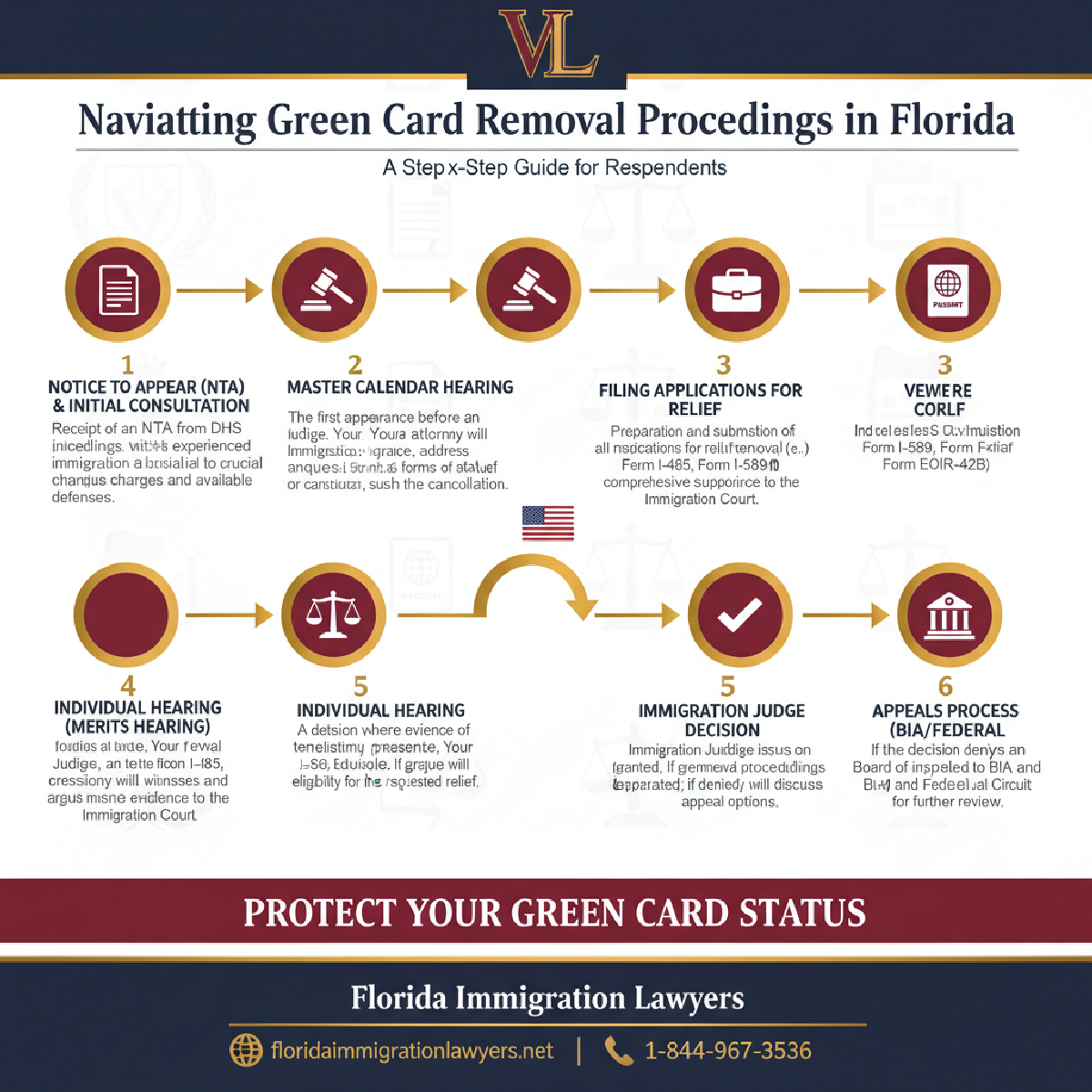
A Notice to Appear (NTA), officially Form I-862, is a document issued by the Department of Homeland Security (DHS), often by USCIS or ICE, that formally charges an individual with being removable from the United States. It initiates formal USCIS green card removal proceedings before an immigration judge. The NTA will specify the reasons DHS believes you are deportable and will provide information about your initial hearing (master calendar hearing) in immigration court. Receiving an NTA is a critical event, and it is imperative to contact an immigration attorney immediately upon receipt.
Where are immigration courts located in Florida?
Florida hosts several immigration courts, primarily located in major metropolitan areas due to the state's large immigrant population. The main immigration courts in Florida are in Miami, Orlando, and a new court facility recently opened in Gainesville to serve the northern region of the state. These courts fall under the Executive Office for Immigration Review (EOIR) of the U.S. Department of Justice. For official information about immigration courts and their operating status, you can visit justice.gov/eoir. Our attorneys are familiar with navigating cases in all Florida immigration courts.
About Florida Immigration Lawyers
Florida Immigration Lawyers is a leading law firm dedicated to serving the diverse immigration needs of individuals and families across the entire state of Florida. With years of experience and a deep understanding of complex U.S. immigration laws, our compassionate and skilled attorneys are committed to providing exceptional legal representation.
We specialize in a wide range of immigration services, including family-based immigration, employment visas, deportation defense, asylum claims, naturalization, and assistance with conditional green card matters like Form I-751. Our mission is to protect your rights, navigate legal challenges, and help you achieve your American dream.
When you choose Florida Immigration Lawyers, you gain a dedicated advocate who will stand by your side every step of the way. We offer personalized attention, clear communication, and strategic legal solutions tailored to your unique situation. We understand the anxieties involved in immigration processes and strive to make your experience as smooth and stress-free as possible.
Contact us today for a free consultation: 1-844-967-3536. Our team is available 24/7 to answer your questions and provide the support you need. Visit our website at https://www.floridaimmigrationlawyers.net to learn more about how we can help you.
This article is for general informational purposes only and does not constitute legal advice. Immigration laws change frequently. For advice specific to your situation, please consult with a qualified immigration attorney.
Facing USCIS green card removal proceedings can be one of the most stressful experiences of your life. Do not face it alone. Our team at Florida Immigration Lawyers is ready to provide the expert legal guidance and compassionate support you need. We are here to fight for your right to remain in the U.S. and continue building your life in Florida.
Take the first step towards securing your future. Call Florida Immigration Lawyers today at 1-844-967-3536 for your free, confidential consultation. Let us help you navigate these complex legal waters with confidence.
Do Not Navigate This Process Alone
Our experienced immigration attorneys are ready to fight for you. Get a free, confidential consultation today.
Se Habla Español
Frequently Asked Questions
Florida Immigration Lawyers
Immigration Attorney | Founder, Vasquez Law Firm
U.S. Air Force veteran and immigration attorney with thousands of cases resolved. J.D., NCCU School of Law. AILA member. Admitted to the 4th, 5th, and 11th Circuit Courts.
Available 24/7 - Free Evaluations
Related Legal Services
Our Florida immigration attorneys can help you with deportation defense, citizenship and naturalization and family immigration services. Call today at 1-844-967-3536 for a free consultation.
Related Links
Related Topics
Free Legal Consultation
Discuss your case with our experienced attorneys. We're available 24/7.
Se Habla Español - Estamos aquí para ayudarle.
Related Articles
Stokes Interview: Navigating Marriage Fraud in Florida
A Stokes interview is a specialized, separate interview conducted by USCIS when there are suspicions of marriage fraud in a green card application. This rigorous process involves individual questioning of spouses, focusing on inconsistencies in their testimonies to determine the authenticity of their marital bond. For couples in Florida, navigating this high-stakes interview requires meticulous preparation, extensive documentation, and often the strategic guidance of an experienced immigration lawyer. Understanding the process, preparing for detailed questions, and presenting a strong case are crucial for overcoming marriage fraud allegations and securing your immigration future. Florida Immigration Lawyers stands ready to assist you.
Immigration Attorney Gainesville: North Florida Legal Help
For those in Gainesville, Alachua County, and throughout North Florida, navigating U.S. immigration law requires expert guidance. An experienced immigration attorney can simplify complex processes, from family-based petitions and employment visas to critical asylum claims and deportation defense. This comprehensive guide outlines the essential services provided by an immigration attorney, details necessary documentation, clarifies processing timelines, and discusses associated costs. We also highlight common mistakes to avoid and crucial scenarios where legal counsel is indispensable. Florida Immigration Lawyers serves all of Florida, including Gainesville and St. Petersburg, providing dedicated legal support to help you achieve your immigration goals. Contact us for a free consultation to discuss your specific needs.
Military Naturalization Expedited at Florida Bases
Explore expedited military naturalization processes for service members at Florida bases like MacDill. Learn about eligibility, steps, and common mistakes. Contact Florida Immigration Lawyers for a free consultation.
Protect Yourself from Immigration Scams in Florida
Learn how to protect against immigration scams in Florida, focusing on St. Petersburg. This guide covers identifying scams, verifying credentials, and getting legal help. Call Florida Immigration Lawyers at 1-844-967-3536 for assistance.