USCIS Green Card Removal Proceedings in Florida: Your Guide
Facing USCIS green card removal proceedings in Florida can be one of the most stressful experiences for a lawful permanent resident. Whether triggered by an expired conditional green card (I-751 issues), criminal charges, or other immigration violations, these proceedings threaten your ability to remain in the U.S. This comprehensive guide from Florida Immigration Lawyers explains the process, common reasons for removal, essential documents for your defense, and critical mistakes to avoid. We provide insights into navigating the complex immigration court system and emphasize the importance of experienced legal representation. If you are in Pembroke Pines or anywhere in Florida and facing deportation, understanding your rights and options is paramount. Contact our dedicated attorneys for a free consultation to safeguard your future.
Facing USCIS green card removal proceedings in Florida can be daunting, but it does not mean your journey in the U.S. is over. These proceedings typically arise when USCIS questions the validity of your green card, often related to conditional residency (I-751) or allegations of inadmissibility/deportability. Understanding your rights and having expert legal representation is crucial to effectively defend your permanent resident status.
- Green card holders can face removal proceedings for various reasons.
- Conditional green card holders must file Form I-751 to remove conditions.
- Failure to file or denial of I-751 can lead to removal proceedings.
- Legal representation is vital to navigate immigration court successfully.
- You may have options to fight removal, even if an I-751 is denied.
Are you a green card holder in Florida facing the frightening prospect of USCIS green card removal proceedings? The thought of losing your permanent residency and being deported from the United States can be incredibly overwhelming. This is a challenging time, filled with uncertainty and complex legal requirements.
Whether your conditional green card is expiring, you've received a Notice to Appear (NTA), or you are simply worried about your immigration status, you are not alone. Many individuals in Pembroke Pines and across Florida find themselves in similar situations. Understanding the process and your rights is the first step towards protecting your future.
At Florida Immigration Lawyers, we understand the stakes involved. Our experienced team is dedicated to providing compassionate and effective legal defense for individuals facing USCIS green card removal proceedings. Do not face this complex legal battle on your own. Call Florida Immigration Lawyers at 1-844-967-3536 for a free consultation today.
Understanding USCIS Green Card Removal Proceedings
USCIS green card removal proceedings, also known as deportation proceedings, are legal processes initiated by the Department of Homeland Security (DHS) to determine whether a non-U.S. citizen should be ordered removed from the United States. These proceedings take place in immigration courts, not regular federal courts.
For green card holders, facing these proceedings is particularly distressing. It means your lawful permanent resident status, which you worked hard to obtain, is at risk. The government believes you are no longer eligible to remain in the U.S. under immigration law, such as INA § 237 (8 U.S.C. § 1227), which outlines deportable aliens.
These proceedings can be triggered by various factors. Often, they involve issues with a conditional green card, criminal convictions, or violations of immigration laws. Understanding the specific reason behind your Notice to Appear (NTA) is paramount.
Why Green Card Holders Face Removal Proceedings
Even with a green card, your status is not always absolute. Several situations can lead to USCIS green card removal proceedings:
Conditional Green Card Issues (I-751)
Many individuals obtain a two-year conditional green card, particularly through marriage to a U.S. citizen or permanent resident, or through certain investor programs. To become a permanent resident, you must file Form I-751, Petition to Remove Conditions on Residence, within the 90-day period before your conditional green card expires. Failure to file, or a denial of your I-751 petition, is a leading cause of removal proceedings.
If USCIS denies your I-751, they will typically issue an NTA, placing you in immigration court. Here, an immigration judge will review your case, and you will have another opportunity to prove that your marriage was bona fide or that you qualify for a waiver of the joint filing requirement.
Criminal Convictions
Certain criminal convictions can make a green card holder deportable. These include crimes involving moral turpitude (CIMT), aggravated felonies, drug offenses, and domestic violence. The severity and nature of the crime determine the potential for removal. Even minor offenses can sometimes have severe immigration consequences.
It is crucial to understand that immigration law defines these crimes differently than state or federal criminal law. What might seem like a minor offense in criminal court could be a deportable offense under immigration statutes. This is why expert legal advice is essential.
Violation of Immigration Laws
Other violations can also lead to removal. These include marriage fraud, misrepresentation on immigration applications, abandoning your permanent resident status (e.g., spending too much time outside the U.S.), or becoming inadmissible after admission. Each of these scenarios can trigger USCIS green card removal proceedings.
For example, if USCIS believes you committed marriage fraud to obtain your green card, they may deny your I-751 or initiate removal proceedings directly. Proving the legitimacy of your marriage under such scrutiny requires compelling evidence and a strong legal strategy.
Navigating the Removal Proceedings Process: A Step-by-Step Guide
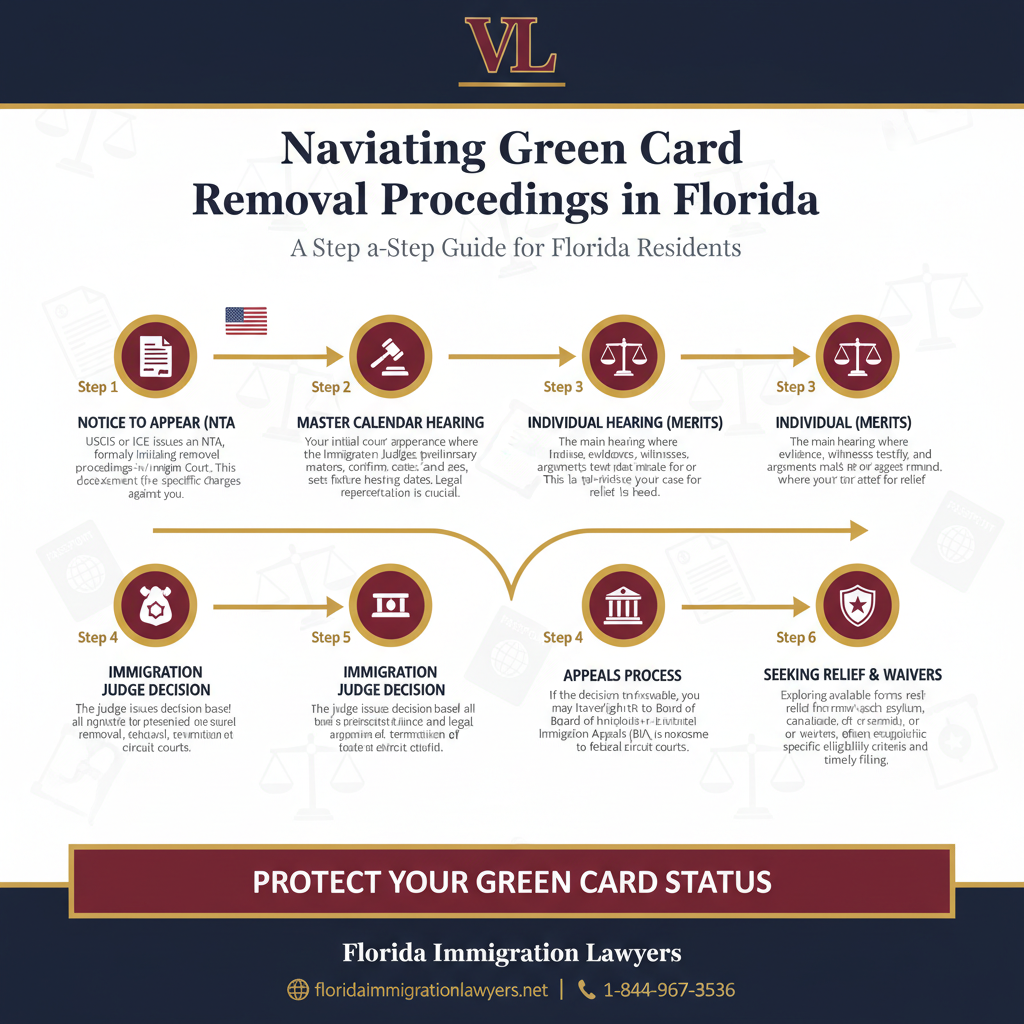
Understanding the stages of USCIS green card removal proceedings is crucial for preparing your defense. The process can be lengthy and complex, often taking place in Florida immigration courts like those in Miami or Orlando.
-
Issuance of a Notice to Appear (NTA)
The process begins when the Department of Homeland Security (DHS) issues a Form I-862, Notice to Appear (NTA). This document alleges why you are deportable and notifies you of the charges against you. It also provides the date, time, and location of your initial hearing before an immigration judge. Receiving an NTA means you are officially in removal proceedings.
-
Master Calendar Hearing (MCH)
Your first appearance in immigration court is typically a Master Calendar Hearing. This is a preliminary hearing where you, or your attorney, will formally acknowledge receipt of the NTA, admit or deny the allegations and charges of deportability, and inform the judge of your intentions (e.g., seek a form of relief from removal, contest deportability). The judge will set deadlines for filing applications for relief and schedule individual hearings.
-
Filing Applications for Relief
If you are eligible for relief from removal, you must file the appropriate application with the immigration court by the judge's deadline. Common forms of relief for green card holders include waivers of inadmissibility/deportability, adjustment of status (if eligible), asylum, or cancellation of removal. The specific relief available depends on the grounds for your removal proceedings and your personal circumstances.
-
Individual Hearing (Merits Hearing)
This is a full evidentiary hearing where you present your case to the immigration judge. You and your attorney will offer testimony, present documents, and call witnesses to support your application for relief. The DHS attorney (trial attorney) will also present their case. The judge will listen to all evidence and arguments before making a decision. This hearing is often the most critical part of the process.
Step-by-Step Process Guide -
Decision by the Immigration Judge
After the individual hearing, the immigration judge will issue a decision. They may grant your application for relief, allowing you to retain your green card, or deny it, ordering you removed from the U.S. This decision is legally binding unless appealed. If your Form I-751 was denied by USCIS, the judge will re-evaluate the petition during this stage, offering a second chance.
-
Appeals Process
If either you or the DHS attorney disagrees with the immigration judge's decision, you have the right to appeal to the Board of Immigration Appeals (BIA). This must be done within 30 days of the judge's decision. Further appeals can be made to a U.S. Circuit Court of Appeals, though these are more complex and less common. An appeal can temporarily halt a removal order.
Essential Documents for Your Defense
Preparing a strong defense against USCIS green card removal proceedings requires meticulous documentation. The specific documents needed will vary depending on the grounds for removal and the type of relief you are seeking. However, some categories are generally critical:
- ✔ Personal Identification: Your green card, passport, birth certificate, and any other valid identification.
- ✔ Immigration Records: All previous immigration applications, petitions, approval notices, and correspondence with USCIS or the immigration court. This includes your original I-485 or I-130 filings.
- ✔ Evidence for I-751 (if applicable): If your removal proceedings stem from a denied I-751, you will need substantial evidence to prove your bona fide marriage. This includes joint bank accounts, joint leases/mortgages, utility bills in both names, birth certificates of children, photos, affidavits from friends/family, and joint tax returns.
- ✔ Financial Records: Tax returns, pay stubs, employment letters, and bank statements to demonstrate financial stability and ties to the U.S.
- ✔ Criminal Records (if applicable): Certified court dispositions for any arrests or convictions, even if expunged. This is crucial for evaluating potential waivers.
- ✔ Family Ties: Birth certificates of U.S. citizen or LPR children, spouses, or parents; marriage certificates; and evidence of their dependency. This can be critical for establishing hardship in waiver applications.
- ✔ Character Evidence: Letters of recommendation from employers, community leaders, or religious figures attesting to your good moral character.
- ✔ Medical Records: If medical conditions are relevant to your case or hardship claims.
Typical Timelines for Removal Proceedings
The timeline for USCIS green card removal proceedings can vary significantly, often extending for several months or even years. The exact duration depends on numerous factors, including the complexity of your case, the caseload of the immigration court (e.g., Miami Immigration Court or Orlando Immigration Court), and whether appeals are filed.
Generally, after an NTA is issued, your first Master Calendar Hearing may be scheduled anywhere from a few weeks to several months later. Subsequent individual hearings and decisions can take additional months. If your case involves a denied I-751 petition, the review by an immigration judge adds another layer of time.
The Board of Immigration Appeals (BIA) also has significant backlogs, meaning an appeal can add a year or more to the overall process. Patience and consistent legal guidance are essential. Your Florida immigration lawyer will keep you informed of estimated timelines for your specific situation.
Understanding the Costs Involved
Navigating USCIS green card removal proceedings involves various costs, which can include government filing fees and legal fees. While specific government fees can change, it's important to be aware of potential expenses.
Government fees might apply if you are filing an application for relief from removal, such as a waiver or an application for adjustment of status. These fees are paid directly to USCIS or the Department of Justice. For example, if you are reapplying for an I-751 in court after a denial, there might be associated fees if you are filing a new application for relief.
Legal fees constitute a significant portion of the total cost. Representing yourself in immigration court is highly risky due to the complexities of immigration law. An experienced deportation defense attorney will charge for their time, expertise, and services in preparing your case, attending hearings, and communicating with government agencies. Florida Immigration Lawyers offers transparent fee structures and free initial consultations to discuss your options.
Do not navigate this process alone. Contact Florida Immigration Lawyers today for dedicated support in your USCIS green card removal proceedings. We are here to help.
Common Mistakes to Avoid in Removal Proceedings
Making mistakes during USCIS green card removal proceedings can have severe and irreversible consequences. Avoid these common pitfalls to protect your status:
-
Ignoring the Notice to Appear (NTA)
Failing to appear for your scheduled immigration court hearings is one of the most serious mistakes. If you miss a hearing, the immigration judge may issue an in absentia removal order against you. This means you are ordered deported without even having your day in court, and it is very difficult to reverse.
-
Representing Yourself Without Legal Counsel
Immigration law is incredibly complex, with constantly changing regulations and judicial precedents. Attempting to represent yourself against a trained DHS attorney significantly reduces your chances of success. An attorney understands the legal arguments, evidence requirements, and court procedures. They are your best advocate in USCIS green card removal proceedings.
-
Not Disclosing All Relevant Information to Your Attorney
It is crucial to be completely honest and transparent with your immigration lawyer. Withholding information, even if it seems minor or embarrassing, can severely harm your case. Your attorney needs a full picture to anticipate challenges and build the strongest possible defense.
-
Missing Deadlines for Filing Documents or Applications
Immigration court operates on strict deadlines. Missing a deadline for filing an application for relief, submitting evidence, or filing an appeal can result in the automatic denial of your request or the dismissal of your case. Always adhere to the judge's orders and deadlines.
-
Providing Inconsistent Information
Any inconsistencies between your past immigration applications, testimony, or documents can be used against you by the DHS attorney. Ensure all statements and submissions are truthful and consistent. This is particularly important in marriage-based cases and I-751 petitions.
-
Traveling Outside the U.S. During Proceedings
Leaving the United States while in removal proceedings can be extremely risky. In many cases, it can be considered a self-deportation or may prevent you from re-entering the country, even if you have a green card. Always consult with your attorney before making any travel plans.
-
Failing to Gather Sufficient Evidence
A strong defense relies on compelling evidence. Whether proving a bona fide marriage for an I-751 or demonstrating hardship for a waiver, insufficient documentation weakens your case. Work closely with your attorney to gather all necessary supporting documents.
When to Call a Lawyer for Your Removal Case
If you are facing USCIS green card removal proceedings, the time to consult an attorney is immediately. Delay can severely jeopardize your case. An experienced immigration lawyer, especially one specializing in deportation defense in Florida, can make a significant difference.
You should call Florida Immigration Lawyers if:
- You have received a Notice to Appear (NTA) from DHS.
- Your Form I-751 (Petition to Remove Conditions on Residence) has been denied by USCIS.
- You have been arrested or convicted of a crime, and you are a green card holder.
- You are a conditional resident approaching your I-751 filing deadline and have concerns.
- You suspect you may be placed in removal proceedings due to any immigration violation.
- You are an LPR and have spent significant time outside the U.S. and are concerned about abandonment of status.
Our firm, serving Pembroke Pines and all of Florida, offers the dedicated advocacy you need. We understand the nuances of immigration court, the complexities of challenging an I-751 denial, and the strategies for seeking relief from removal. Let us review your case and develop a robust defense strategy.
Frequently Asked Questions About Removal Proceedings
Can a green card holder be in removal proceedings?
Yes, absolutely. A green card holder, also known as a Lawful Permanent Resident (LPR), can certainly be placed in USCIS green card removal proceedings. While having a green card grants you many rights, it does not guarantee immunity from deportation. Common reasons include failure to remove conditions on a two-year green card (I-751 issues), certain criminal convictions, committing immigration fraud, or abandoning your U.S. residency. It is a serious situation that requires immediate legal attention to protect your status.
How long does USCIS take to remove conditions on a green card?
The processing time for Form I-751, Petition to Remove Conditions on Residence, can vary significantly. Currently, USCIS processing times can range from 12 to over 36 months, depending on the service center and individual case complexity. During this period, your conditional resident status is extended, and you will receive a receipt notice (Form I-797C) that, along with your expired green card, serves as proof of your continued lawful status. It's crucial to file your I-751 petition within the 90-day window before your conditional green card expires to avoid being placed in USCIS green card removal proceedings.
How long does it take for I-751 to get approved?
As mentioned, I-751 approvals can take a substantial amount of time, often ranging from 1 to 3 years or even longer. Many factors influence this, including the volume of applications at the processing center, the completeness of your initial submission, and whether an interview is required. If USCIS sends a Request for Evidence (RFE), or if your case is referred for an interview, this will add to the overall processing time. If your I-751 is denied, you will typically be issued a Notice to Appear (NTA) and placed in removal proceedings, where an immigration judge will review your I-751 application anew.
What are common I-751 denial reasons?
Common reasons for I-751 denial that can lead to USCIS green card removal proceedings include insufficient evidence to prove a bona fide (real) marriage, USCIS believing the marriage was entered into solely for immigration purposes (marriage fraud), a failure to attend a scheduled interview, or a failure to respond to a Request for Evidence (RFE). If filing a waiver of the joint filing requirement (e.g., due to divorce, abuse, or extreme hardship), insufficient evidence to support the waiver claim can also lead to denial. Consulting an attorney before filing is highly recommended.
Can I get a green card during removal proceedings?
In some cases, yes. It is possible to apply for or adjust status to a green card during removal proceedings if you are eligible for a form of relief from removal, such as adjustment of status, asylum, or cancellation of removal. This process is complex and requires presenting your case to an immigration judge. Eligibility depends on various factors, including your specific circumstances, the grounds for your removal proceedings, and your immigration history. An experienced immigration attorney is essential to explore these options.

What is the difference between removal of conditions and removal proceedings?
Removal of conditions refers to the process of filing Form I-751 to convert a two-year conditional green card into a 10-year permanent green card. It is a positive step to secure your permanent residency. USCIS green card removal proceedings, however, are legal actions initiated by the government to deport an individual from the U.S. If you fail to remove conditions on your green card, it can directly lead to removal proceedings. These are distinct processes, though one can lead to the other.
What happens if my I-751 is still pending when my conditional green card expires?
If your I-751 is still pending when your conditional green card expires, you generally remain in lawful status. USCIS will issue a Form I-797C, Notice of Action, which serves as a receipt and extends your conditional resident status, typically for 24 to 48 months, depending on the date on the notice. You should carry this notice along with your expired green card as proof of your continued status. However, if your I-751 is ultimately denied, you will likely be placed in USCIS green card removal proceedings.
How can a Florida immigration lawyer help with my removal case?
A Florida immigration lawyer can provide invaluable assistance for your USCIS green card removal proceedings. They can assess the grounds for your removal, identify potential forms of relief, prepare and file necessary applications, gather compelling evidence, represent you in immigration court hearings (Master Calendar and Individual Hearings), cross-examine witnesses, and argue on your behalf. They can also advise on appeals to the BIA and help navigate the complex legal system, significantly increasing your chances of a favorable outcome. Our firm serves clients throughout Florida, including Pembroke Pines.
About Florida Immigration Lawyers
Florida Immigration Lawyers is a leading immigration law firm dedicated to serving individuals and families across all of Florida, including Pembroke Pines. We understand the profound impact immigration challenges can have on your life. Our team of experienced attorneys provides compassionate, knowledgeable, and aggressive representation for a wide range of immigration matters, including complex USCIS green card removal proceedings.
We pride ourselves on offering personalized legal strategies tailored to your unique circumstances. Our services include family immigration, business immigration, citizenship applications, asylum claims, and robust deportation defense. We are available 24/7 to answer your urgent questions and offer free consultations to help you understand your options.
When your future in the United States is on the line, choose a firm that fights tirelessly for your rights. Contact Florida Immigration Lawyers today at 1-844-967-3536 or visit our website at https://www.floridaimmigrationlawyers.net to schedule your free consultation with one of our dedicated attorneys. We are here to guide you every step of the way.
This article is for general informational purposes only and does not constitute legal advice. Immigration laws change frequently. For advice specific to your situation, please consult with a qualified immigration attorney.
Do not let the fear of USCIS green card removal proceedings paralyze you. Take action today to protect your right to live and work in the United States. Call Florida Immigration Lawyers at 1-844-967-3536 for a free, confidential consultation. Your future in Florida starts with a strong defense.
Related Articles
- Nicole Micheroni Immigration Lawyer Insights: Navigating Florida USCIS - The case of Nicole Micheroni, an immigration lawyer mistakenly ordered to self-deport, underscores t...
- 2026 Winter Olympics Ice Hockey: Florida Immigration Pathways - Planning to participate in the 2026 Winter Olympics ice hockey events, with training or residence in...
- Trump Gold Card Citizenship in Florida: Your 2026 Guide - The Trump Gold Card Citizenship initiative, launched in 2026, presents a new pathway to U.S. permane...
Florida Immigration Lawyers
Legal Team
Our experienced attorneys at Florida Immigration Lawyers have been serving clients across Florida for over 20 years. We specialize in immigration, personal injury, criminal defense, workers compensation, and family law.