U Visa for Crime Victims in Florida: Your Path to Safety & Status
For crime victims in Florida, the U visa offers a critical pathway to safety and legal status. This comprehensive guide from Florida Immigration Lawyers details eligibility criteria, the complex application process, and what to expect regarding processing times and costs. Learn how cooperation with law enforcement is key and why expert legal assistance is invaluable for navigating this intricate immigration relief. Discover how our compassionate attorneys can help you secure your future in Florida.
The U visa offers immigration relief to crime victims who have suffered substantial mental or physical abuse and are helpful to law enforcement in investigating or prosecuting qualifying criminal activity. It provides temporary legal status, work authorization, and a potential path to a green card for eligible victims and their immediate family members in Florida.
- Designed for victims of specific crimes.
- Requires cooperation with law enforcement.
- Offers temporary status and work authorization.
- Can lead to permanent residency.
- Legal assistance is crucial for success.
Imagine enduring a traumatic crime in Florida, and then facing the added fear of deportation because of your immigration status. Many non-citizen crime victims feel trapped, afraid to report crimes or seek help. You are not alone, and there is a path to protection.
This comprehensive guide explains the U visa, a vital immigration relief option for crime victims Florida, including eligibility, the application process, and how Florida Immigration Lawyers can assist you. Our firm is dedicated to helping victims like you secure safety and legal status.
If you or a loved one are a crime victim seeking protection, call Florida Immigration Lawyers at 1-844-967-3536 for a free consultation today. We are here to help you understand your options.
Understanding the U Visa for Crime Victims in Florida
Congress created the U nonimmigrant status, commonly known as the U visa, to protect non-citizen victims of certain crimes. It aims to strengthen law enforcement's ability to investigate and prosecute criminal activity while offering humanitarian relief to victims. This visa fosters trust between immigrant communities and police, ensuring crimes are reported without fear of immigration consequences.
The U visa was established under the Victims of Trafficking and Violence Protection Act of 2000 (VTVPA), specifically codified in 8 U.S.C. § 1101(a)(15)(U) and INA Section 101(a)(15)(U). It provides temporary legal status for up to four years. After three years in U status, recipients may be eligible to apply for lawful permanent residency.
In Florida, especially in cities like Tampa, local law enforcement agencies play a crucial role in the U visa process by certifying a victim's helpfulness. Our firm works closely with clients across the state to navigate these local requirements and ensure proper documentation for your U visa application.
Eligibility Requirements for a U Visa in Florida
To qualify for a U visa, you must meet several strict criteria. Understanding these U visa requirements is the first step toward securing this crucial immigration relief. Our attorneys at Florida Immigration Lawyers can help assess your specific situation.
1. You are a Victim of a Qualifying Criminal Activity
The law specifies a list of crimes that qualify for U visa status. These include, but are not limited to, abduction, abusive sexual contact, blackmail, domestic violence, extortion, false imprisonment, felonious assault, female genital mutilation, hostage taking, incest, involuntary servitude, kidnapping, murder, manslaughter, obstruction of justice, perjury, prostitution, rape, sexual assault, torture, trafficking, and witness tampering. The crime must have violated U.S. law or occurred in the United States.
2. You Suffered Substantial Physical or Mental Abuse
As a direct result of being a victim of the qualifying criminal activity, you must have suffered significant harm. This can include severe physical injuries, psychological trauma, or emotional distress. Evidence of this abuse is critical for your application.
3. You Possess Information About the Criminal Activity
You must have knowledge regarding the details of the crime. This information is essential for law enforcement's investigative or prosecutorial efforts.
4. You Have Been Helpful, Are Being Helpful, or Are Likely to Be Helpful to Law Enforcement
This is a cornerstone of the U visa. You must cooperate with federal, state, or local law enforcement agencies, prosecutors, or other officials in the investigation or prosecution of the crime. This cooperation is typically certified by a qualifying agency.
5. The Crime Occurred in the U.S. or Violated U.S. Laws
The criminal activity must have taken place within the geographical boundaries of the United States, including its territories, or violated federal U.S. laws.
6. You Are Admissible to the United States
If you have certain inadmissibility grounds, such as prior immigration violations or criminal convictions, you may need to file a waiver (Form I-192, Application for Advance Permission to Enter as a Nonimmigrant). Our experienced attorneys can help determine if a waiver is necessary and guide you through that complex process. For more information on navigating such complex immigration issues, visit our immigration practice area page.
The U Visa Application Process: A Step-by-Step Guide
Applying for a U visa can be intricate and lengthy, often requiring meticulous attention to detail. Here’s a general step-by-step guide to help you understand the journey. Remember, consulting with Florida Immigration Lawyers is highly recommended to ensure proper filing.
- Gather Your Evidence and Documentation: Begin by collecting all relevant documents, including police reports, medical records, personal statements, and any evidence demonstrating the qualifying crime and your suffering.
- Obtain Law Enforcement Certification (Form I-918, Supplement B): This is perhaps the most critical step. You must obtain a signed certification from a qualifying law enforcement agency, prosecutor, judge, or other authorized official. This form attests to your helpfulness in the investigation or prosecution of the crime. Our firm can assist in communicating with agencies in Tampa, Orlando, Miami, and throughout Florida.
- Prepare Form I-918, Petition for U Nonimmigrant Status: Complete this main application form accurately and thoroughly. This form collects your personal information and details about the crime and your eligibility.
- Prepare Form I-192, Application for Advance Permission to Enter as a Nonimmigrant (if applicable): If you have any grounds of inadmissibility, such as a criminal record or prior immigration violations, you will need to file this waiver application. This form requires detailed explanations and supporting evidence.
- Compile All Supporting Documents: Organize all your evidence, including your personal statement detailing your experience, the crime, and your cooperation with law enforcement. Include proof of the crime, your injuries, and any other relevant information.
- Submit Your U Visa Petition to USCIS: Mail your complete application package to the appropriate USCIS lockbox facility. Ensure all forms are signed and all required documents are included. Keep copies of everything for your records.
- Attend Biometrics Appointment: After filing, you will receive a notice to attend a biometrics appointment at a local USCIS Application Support Center (ASC). This involves fingerprinting and photographing.
- Respond to Requests for Evidence (RFEs): USCIS may send an RFE if they need additional information or clarification. Responding promptly and thoroughly is crucial. Our firm can help you prepare a strong response.
- Wait for a Decision and Potential Placement on the Waiting List: Due to statutory limitations on the number of U visas issued each year (10,000), you may be placed on a waiting list even if found eligible. USCIS will issue a bona fide determination (BFD) if your petition is approvable but for the waiting list.
- Receive Your U Nonimmigrant Status: Once a U visa becomes available, USCIS will approve your petition. You will then receive U nonimmigrant status, typically for four years, along with employment authorization.
Essential Documents for Your U Visa Petition
A successful U visa application hinges on submitting a complete and well-organized package of documents. Missing or incorrect documentation can lead to delays or even denial. This is a crucial part of the U visa requirements.
Required Forms:
- Form I-918, Petition for U Nonimmigrant Status
- Form I-918, Supplement B, U Nonimmigrant Status Certification
- Form I-192, Application for Advance Permission to Enter as a Nonimmigrant (if necessary for inadmissibility waivers)
- Form I-765, Application for Employment Authorization (filed concurrently or after U visa approval)
Personal Documentation:
- Copies of your passport, birth certificate, and any previous visas or immigration documents.
- Identity documents, such as a national ID from your home country.
- Marriage certificates and birth certificates for any qualifying family members included in your petition.
- Proof of your current address in Florida.
Evidence of the Qualifying Crime:
- Police reports, arrest records, or other official law enforcement documentation.
- Court documents, such as indictments, plea agreements, or sentencing records.
- Affidavits from witnesses or law enforcement officials.
Evidence of Substantial Harm:
- Medical records, hospital bills, or psychological evaluations detailing physical or mental abuse.
- Therapist's notes or reports from counselors.
- Photographs of injuries sustained from the crime.
- Personal statements describing the trauma and its impact on your life.
Evidence of Helpful Cooperation:
- The signed Form I-918, Supplement B, from a certifying agency.
- Correspondence with law enforcement, such as emails or letters.
- Testimony transcripts or interviews you participated in.
U Visa Processing Times and Expectations for 2026
The U visa process is notoriously lengthy, primarily due to the annual cap of 10,000 U visas issued by Congress. This cap often results in a significant backlog and a long waiting list for eligible petitioners. While specific timelines can fluctuate, here’s what applicants in Florida can generally expect for 2026 regarding U visa processing time.
Initial Review and Bona Fide Determination (BFD): After filing your petition, USCIS will first review your application to determine if you meet the basic eligibility criteria. If your petition is approvable but for the availability of a U visa, USCIS may issue a "bona fide determination" (BFD). This BFD can take several years, often 5-7 years or more, from the filing date. A BFD allows applicants to apply for employment authorization and deferred action, providing temporary relief while awaiting a final decision on their U visa.
Waiting List: Once a BFD is issued, eligible applicants are placed on a waiting list. The time spent on this waiting list can vary significantly, often extending several more years. The date your petition is filed generally determines your place in the queue. The USCIS Policy Manual provides further details on the waiting list process.
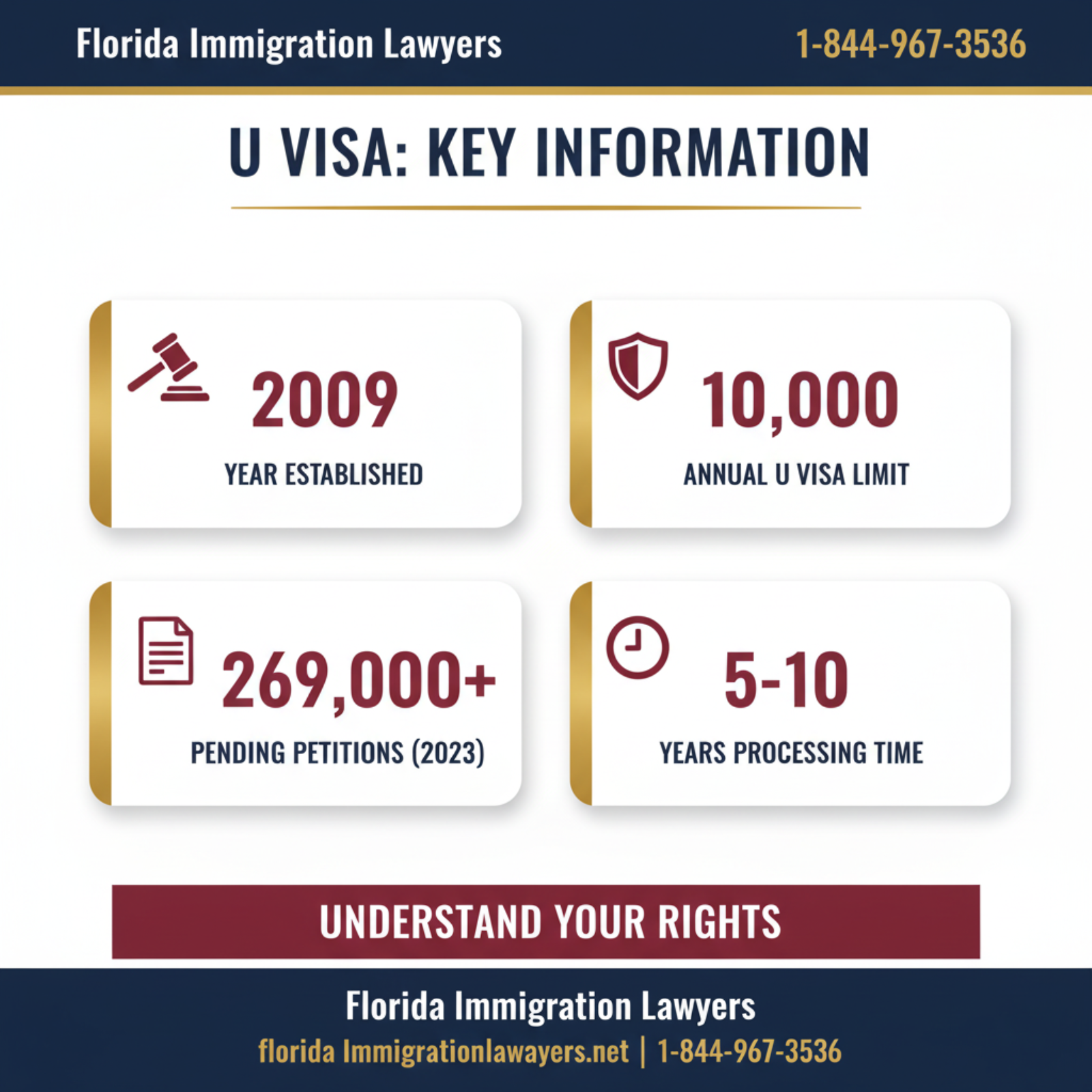
Final Adjudication: When a U visa becomes available, USCIS will proceed with the final adjudication of your petition. This may involve further review of your case and potentially additional requests for evidence. The total processing time from initial filing to final U visa approval can easily span 8-10 years, or even longer, given current backlogs.
Employment Authorization and Deferred Action: A significant benefit of the BFD is the ability to apply for work authorization (Form I-765) and deferred action. This means you can legally work in the U.S. and are protected from deportation while your U visa petition is pending. This provides crucial immigration relief for crime victims and their families in Florida.
Understanding U Visa Costs and Fees
Navigating the financial aspects of a U visa application is an important part of the planning process. While USCIS filing fees can change, and legal fees vary, understanding the different potential costs involved is crucial. Our firm aims for transparency in all financial matters.
USCIS Filing Fees:
- Form I-918, Petition for U Nonimmigrant Status: There is typically no filing fee for Form I-918 itself. This ensures that victims of crime are not deterred from seeking protection due to financial barriers.
- Form I-192, Application for Advance Permission to Enter as a Nonimmigrant (Waiver): If you need to file a waiver of inadmissibility, this form does have a filing fee. This fee is subject to change, so it's essential to check the latest USCIS fee schedule. In some cases, a fee waiver (Form I-912) may be available for those who cannot afford the cost.
- Form I-765, Application for Employment Authorization: This form also typically has a filing fee. However, if you have received a bona fide determination (BFD) on your U visa petition, you may be eligible for a fee exemption for your initial employment authorization application.
Legal Fees:
The cost of hiring an experienced immigration attorney for your U visa case can vary based on the complexity of your situation. Factors that influence legal fees include the number of qualifying family members included in the petition, the need for an inadmissibility waiver, and the extent of communication required with law enforcement agencies for certification.
Our firm provides clear fee structures during your initial consultation. We believe in affordable access to justice for crime victims Florida.
Other Potential Costs:
- Translation Services: If any of your supporting documents are not in English, you will need certified translations, which incur costs.
- Medical Examinations: If a medical exam is required (typically later, for adjustment of status), this will involve a fee from an authorized civil surgeon.
- Travel Costs: You may incur travel expenses for biometrics appointments, attorney meetings, or obtaining documents.
Investing in your future is invaluable. Florida Immigration Lawyers offers free consultations to discuss your case and provide an estimate of legal fees, helping you plan effectively.
Do not navigate this complex and critical process alone. Contact Florida Immigration Lawyers today to ensure your U visa application is handled with the expertise and care you deserve. Call us at 1-844-967-3536.
Common Mistakes to Avoid in Your U Visa Application
The U visa process is complex, and even minor errors can lead to significant delays or denial. Avoiding these common pitfalls is crucial for a successful outcome for crime victims Florida.
- Failing to Obtain Law Enforcement Certification (Form I-918, Supplement B): Without a properly completed and signed Supplement B from a qualifying agency, your U visa petition cannot be approved. This is often the most challenging part of the application.
- Incomplete or Inaccurate Forms: Any missing information, inconsistent data, or unsigned forms will result in a Request for Evidence (RFE) or outright denial. Double-check every field for accuracy.
- Insufficient Evidence of the Crime or Harm: Simply stating you were a victim is not enough. You must provide compelling evidence, such as police reports, medical records, and detailed personal statements, to prove the qualifying crime and the substantial abuse you suffered.
- Lack of Demonstrated Cooperation with Law Enforcement: The U visa requires active and ongoing helpfulness. If you stop cooperating or cannot prove your assistance, your eligibility may be jeopardized.
- Not Addressing Grounds of Inadmissibility: If you have certain criminal convictions, immigration violations, or other issues that make you inadmissible to the U.S., failing to file a Form I-192 waiver can lead to denial.
- Missing Deadlines: Failing to respond to RFEs or other USCIS notices by the specified deadline can lead to the abandonment or denial of your petition.
- Attempting to Navigate the Process Without Legal Counsel: The U visa is one of the most complicated forms of immigration relief. Without the guidance of an experienced immigration attorney, applicants are significantly more prone to errors and lower success rates.
When to Call Florida Immigration Lawyers for U Visa Assistance
While this guide provides general information, the complexities of immigration law mean that individual cases often require tailored legal strategies. Knowing when to seek professional legal help is paramount for your U visa journey. Our team is ready to assist you.
- You've Been a Victim of a Qualifying Crime: If you or a family member have experienced a crime in Florida, especially in areas like Tampa, and believe it might qualify for U visa relief, contact us immediately. We can assess your situation and determine your eligibility.
- Difficulty Obtaining Law Enforcement Certification: Securing the Form I-918, Supplement B, can be challenging. Law enforcement agencies may have varying policies or be unfamiliar with the U visa process. Our attorneys have experience communicating with these agencies across Florida to advocate on your behalf.
- You Have a Criminal Record or Prior Immigration Violations: If you have any history that might render you inadmissible to the U.S., you will likely need a waiver. This is a highly complex area where legal expertise is essential to prepare a strong case for approval. For issues related to inadmissibility or deportation defense, our firm provides robust representation.
- You've Received a Request for Evidence (RFE) or Notice of Intent to Deny (NOID): These notices from USCIS indicate that there are issues with your application. Responding correctly and comprehensively is critical, and a lawyer can ensure your response is robust.
- You're Facing Deportation or Removal Proceedings: If you are in immigration court, a U visa may offer a path to relief from removal. An attorney can help you explore this option and defend you in court. Learn more about asylum and other humanitarian relief options.
- You Need Help Gathering Evidence and Preparing Your Petition: The sheer volume and specificity of required documentation can be overwhelming. Our firm can help you meticulously gather, organize, and present a compelling case to USCIS.
- You Need Empathetic and Experienced Guidance: Dealing with the aftermath of a crime while navigating complex immigration laws is incredibly stressful. Our team provides compassionate support and expert guidance every step of the way, ensuring your rights are protected. Visit our attorneys page to learn more about our dedicated team.
About Florida Immigration Lawyers
Florida Immigration Lawyers is a leading law firm dedicated to providing exceptional immigration legal services across the entire state of Florida. We understand the profound impact immigration matters have on individuals and families. Our commitment is to offer comprehensive and compassionate legal support.
Our experienced attorneys specialize in a wide range of immigration cases, including U visas, asylum, deportation defense, family-based petitions, business immigration, and citizenship applications. We are committed to achieving the best possible outcomes for our clients, guiding them through every step of their legal journey. From family immigration to citizenship, we cover all aspects of immigration law.
We offer personalized attention, strategic legal advice, and unwavering support. Our team is available 24/7 for urgent matters and provides free consultations to discuss your case. We pride ourselves on our deep understanding of Florida's unique immigration landscape and our commitment to our community. You can always contact us for assistance.
Phone: 1-844-967-3536
Website: https://www.floridaimmigrationlawyers.net
Available 24/7, free consultations, serving all Florida.
Sources and References
- U.S. Citizenship and Immigration Services (USCIS) - U Nonimmigrant Status
- USCIS Policy Manual - Chapter 7: Waiting List and Bona Fide Determination
- Executive Office for Immigration Review (EOIR)
- 8 U.S.C. § 1101(a)(15)(U) - Definitions (U nonimmigrant status)
- INA Section 101(a)(15)(U) - Classification of aliens (U nonimmigrant status)
- 8 CFR § 214.14 - U Nonimmigrant Status
This article provides general legal information and is not intended as legal advice. Every case is unique, and outcomes depend on specific facts and circumstances. Contact an attorney for advice about your particular situation.
Your safety and legal status are our top priority. Don't face the U visa process alone. Contact Florida Immigration Lawyers today at 1-844-967-3536 for a free, confidential consultation. Se Habla Español - Estamos aquí para ayudarle a reconstruir su vida con seguridad y esperanza.
Need help with Immigration?
Our Florida immigration attorneys offer free consultations. Call today or schedule online.
Frequently Asked Questions
Florida Immigration Lawyers
Legal Team
Our experienced attorneys at Florida Immigration Lawyers have been serving clients across Florida for over 20 years. We specialize in immigration, personal injury, criminal defense, workers compensation, and family law.