Trump Gold Card Citizenship Florida: Navigating Future Immigration Paths
Curious about the "Trump Gold Card citizenship" in Florida? This detailed guide clarifies that the Gold Card was a political proposal, not an active U.S. immigration program as of 2026. For those in Gainesville and across Florida aspiring to U.S. citizenship, understanding the real, established pathways is crucial. We cover the step-by-step naturalization process, essential documents, typical timelines, and associated costs. Learn how to avoid common mistakes and when to seek legal counsel from Florida Immigration Lawyers to navigate your journey successfully. Your path to citizenship requires accurate information and expert guidance.
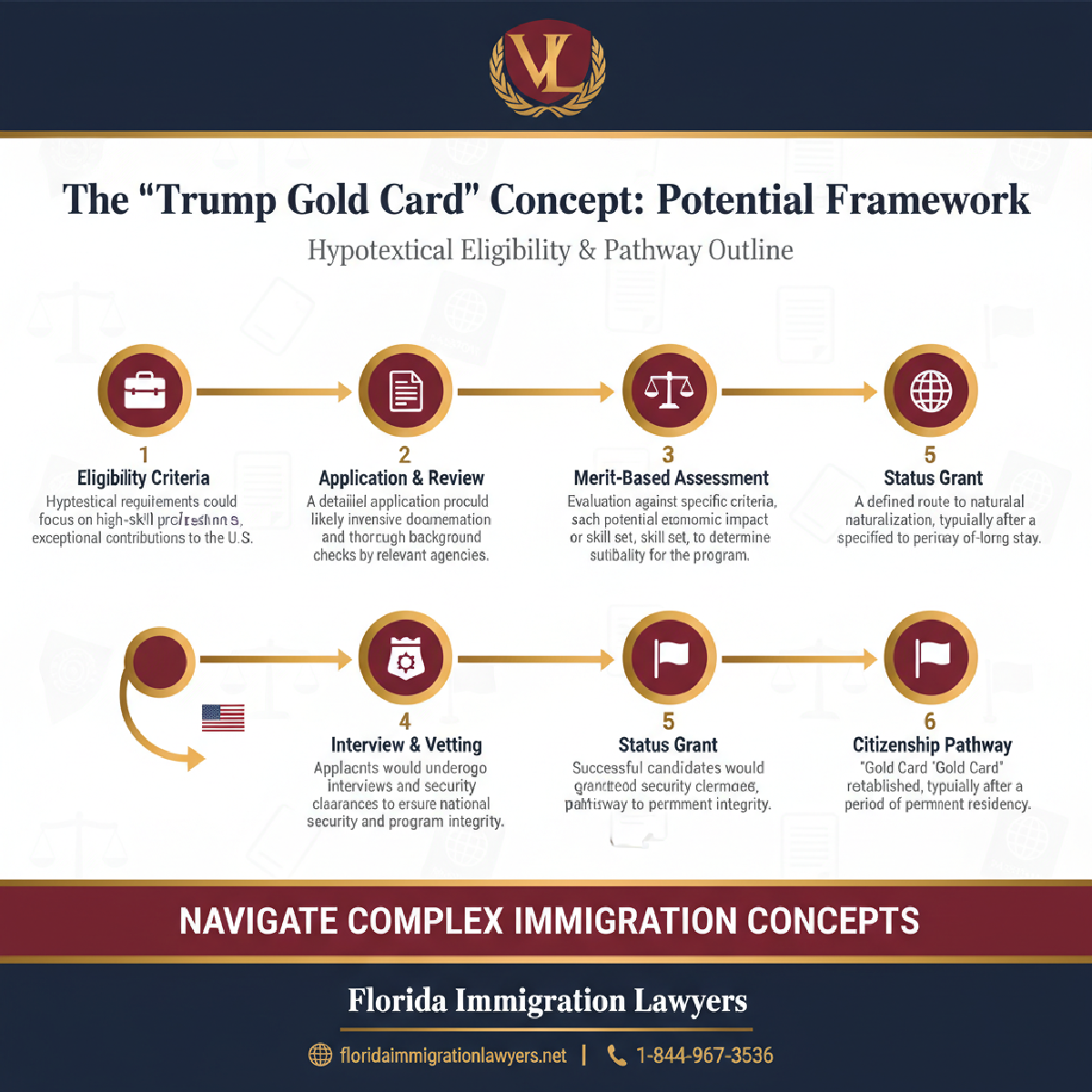
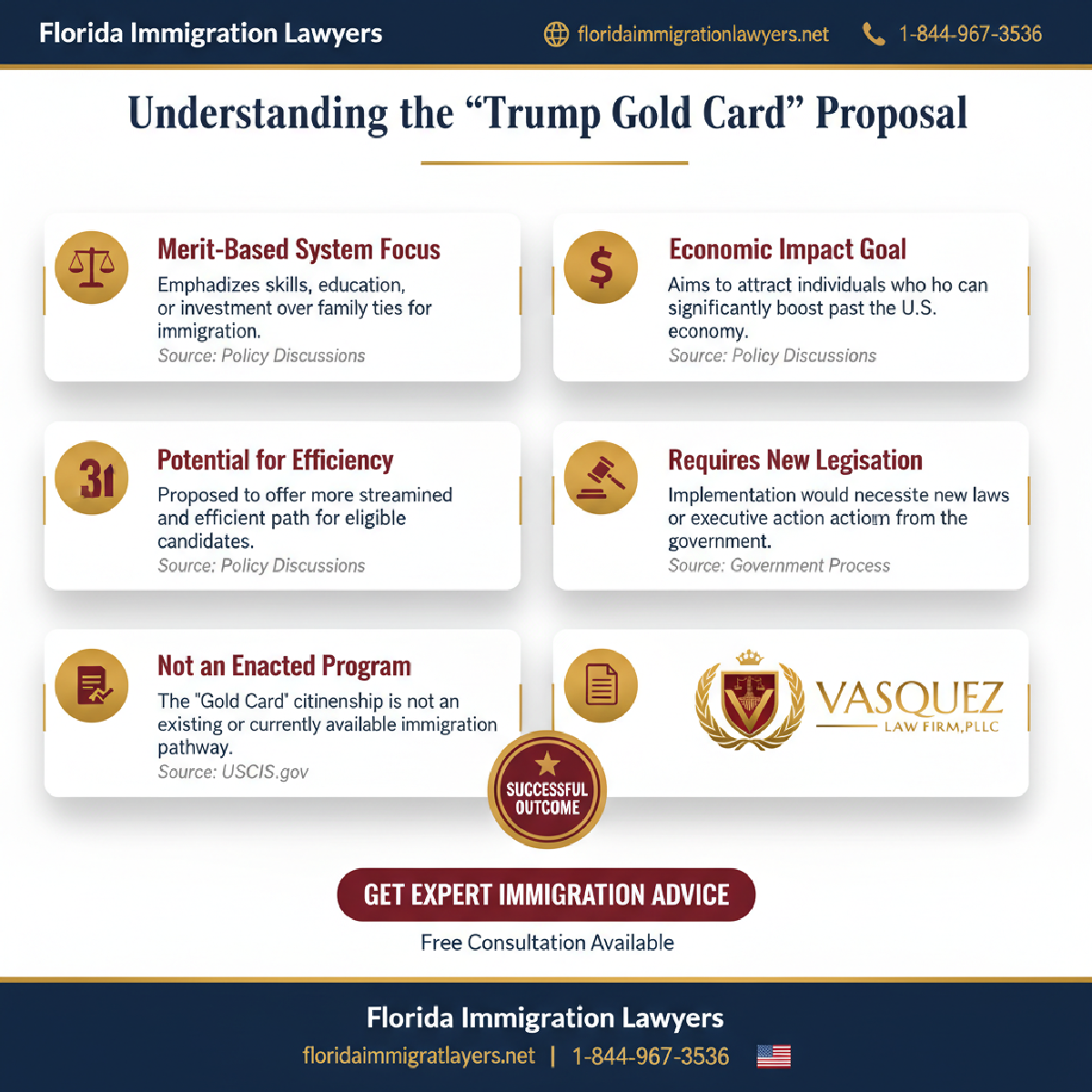
The "Trump Gold Card citizenship" was a conceptual proposal, not an enacted program, aimed at streamlining immigration for certain investors or skilled individuals. It envisioned a faster path to residency, potentially leading to citizenship, with specific criteria and fees. As of 2026, it remains a topic of discussion rather than a current legal pathway for immigration in Florida or nationwide.
- Conceptual proposal, not current law.
- Aimed at specific high-value immigrants.
- Would involve significant investment or skill.
- Not a direct path to citizenship, but residency.
- Consult an attorney for current pathways.
Many immigrants in Gainesville and across Florida dream of U.S. citizenship. You might have heard whispers or news about a "Trump Gold Card citizenship" and wondered if it's a real pathway for you. It's natural to seek clearer, faster routes to achieving your American dream.
This comprehensive guide will clarify what the Trump Gold Card concept entails, differentiate it from existing immigration processes, and explain how Florida Immigration Lawyers can help you navigate your path to U.S. citizenship or residency in Florida. We are here to provide accurate information and expert legal support.
For personalized advice on any immigration matter, call Florida Immigration Lawyers at 1-844-967-3536 for a free consultation today.
Understanding the Trump Gold Card Citizenship Concept in Florida
The idea of a "Trump Gold Card citizenship" has circulated in political discussions and media for some time. It often refers to a proposed, but not implemented, immigration program aimed at attracting foreign investment and highly skilled workers to the United States.
It is crucial to understand that, as of 2026, the Trump Gold Card is a hypothetical concept. It is not an active, codified program or a current legal pathway for obtaining U.S. residency or citizenship through USCIS.
What Was the "Gold Card" Proposal?
The "Gold Card" proposal was a policy idea, not a legislative act passed by Congress. Its proponents envisioned a streamlined process for certain high-value individuals, such as investors, entrepreneurs, or exceptionally talented professionals, to gain U.S. residency.
The goal was to stimulate economic growth and innovation by making it easier for these individuals to contribute to the U.S. economy. This concept sometimes included a significant financial contribution or investment requirement.
While the specifics varied in discussions, the core idea was to offer a faster track compared to traditional immigration routes. However, these discussions never materialized into a formal program or specific legislation.
Distinguishing from Current Immigration Pathways
It is vital to distinguish the conceptual Trump Gold Card from the established U.S. immigration pathways that currently exist. These include family-based visas, employment-based visas, asylum, and the Diversity Visa Lottery, all governed by the Immigration and Nationality Act (INA).
The path to U.S. citizenship is primarily through naturalization. This typically requires first obtaining lawful permanent residency (a Green Card) through one of the existing visa categories. The Trump Gold Card was never added to these recognized legal avenues.
For residents of Florida, a state with a vibrant immigrant population and significant economic activity, proposals like the Gold Card often generate considerable interest. However, your immigration journey must follow current federal laws and regulations, which our firm can help you navigate.
Navigating Current Paths to U.S. Citizenship in Gainesville and Florida
Since the Trump Gold Card is not a current program, we will focus on the actual, established pathways to U.S. citizenship. These are the routes that individuals in Gainesville and throughout Florida successfully pursue every day.
The journey to becoming a U.S. citizen typically begins with obtaining lawful permanent residency. Once you have a Green Card, you can generally apply for naturalization after meeting specific requirements.
- Obtain Lawful Permanent Residency (Green Card): This is the foundational step for most individuals seeking U.S. citizenship. You can obtain a Green Card through various categories, such as family-based petitions (family immigration), employment-based petitions (business immigration), refugee or asylum status, or the Diversity Visa Lottery. Each pathway has specific eligibility criteria and application processes.
- Meet Naturalization Requirements: Once you are a lawful permanent resident, you must meet several criteria to be eligible for naturalization. Generally, you must be at least 18 years old, have been a lawful permanent resident for at least five years (or three years if you are married to a U.S. citizen and meet other conditions), and have maintained continuous residence and physical presence in the U.S. You must also demonstrate good moral character and an attachment to the principles of the U.S. Constitution, as outlined in INA Section 316 (8 U.S.C. § 1427).
- File Form N-400, Application for Naturalization: If you meet the eligibility requirements, the next step is to submit Form N-400 to U.S. Citizenship and Immigration Services (USCIS). This application collects detailed information about your background, residency, and eligibility. It is crucial that this form is completed accurately and thoroughly to avoid delays or issues.
- Attend Biometrics Appointment: After filing Form N-400, USCIS will schedule you for a biometrics appointment. At this appointment, your fingerprints, photograph, and signature will be collected. These biometrics are used for background checks and to verify your identity.
- Attend Naturalization Interview: Following your biometrics, you will be scheduled for an interview with a USCIS officer. During the interview, the officer will review your N-400 application, ask questions about your eligibility, and administer the English and civics tests. You must demonstrate an understanding of basic English (reading, writing, speaking) and U.S. history and government.
- Receive Decision and Attend Oath Ceremony: After your interview, USCIS will issue a decision. If approved, you will be invited to an Oath of Allegiance ceremony, where you will take an oath to the United States and receive your Certificate of Naturalization. This is the final step in becoming a U.S. citizen. You can learn more about the process on the official USCIS Citizenship website.
Essential Documents for Florida Citizenship Applications
Preparing your naturalization application requires careful attention to detail, especially when gathering supporting documents. Having all necessary paperwork in order is critical for a smooth process.
A Florida immigration lawyer can help you compile a comprehensive packet tailored to your specific situation. Here is a general checklist of documents you will typically need for your N-400 application:
- ✔️ Green Card (Form I-551): Your permanent resident card is essential proof of your lawful permanent residency.
- ✔️ State ID/Driver's License: A valid Florida-issued identification card or driver's license.
- ✔️ Social Security Card: Your Social Security card or a document showing your Social Security number.
- ✔️ Tax Returns: Copies of your federal income tax returns for the past five years (or three years if applying based on marriage to a U.S. citizen).
- ✔️ Marriage Certificate: If applicable, your official marriage certificate.
- ✔️ Divorce Decrees: If applicable, certified copies of any divorce decrees or annulment judgments.
- ✔️ Birth Certificates of Children: If applicable, birth certificates for your children, even if they are not applying with you.
- ✔️ Court Records: Certified copies of all court records for any arrests, citations, or convictions, even if they were expunged or occurred outside Florida.
- ✔️ Travel Records: Documentation of all trips outside the U.S. since becoming a permanent resident, including dates of departure and return, and destinations.
- ✔️ Selective Service Registration: If you are a male applicant who resided in the U.S. between ages 18 and 26, proof of Selective Service registration is required.
- ✔️ Form N-400 Application Fee: The required filing fee, payable to the U.S. Department of Homeland Security (do not write specific amounts as they change).
- ✔️ Passport-Style Photos: Two identical passport-style photographs taken within 30 days of filing.
Citizenship Timelines and Processing Expectations for Florida Residents
Understanding the potential timeline for your naturalization application is a common concern for many applicants in Florida. Processing times can vary significantly based on several factors, including the specific USCIS field office and the complexity of your case.
General Processing Times
USCIS processing times for Form N-400 can range from several months to over two years. In Florida, applications are typically handled by field offices such as Orlando, Miami, or Tampa, which serve various regions, including Gainesville. You can check current estimates on the USCIS processing times webpage, but these are always subject to change.
Factors that can influence your timeline include the completeness and accuracy of your application, any requests for additional evidence from USCIS, and the agency's overall workload. A well-prepared application can help minimize potential delays.
Post-Interview Steps
If your interview is successful, USCIS will typically notify you of their decision. If approved, you will usually receive a notice to attend an Oath of Allegiance ceremony. The scheduling of this ceremony can take a few weeks or months after your interview.
Once you take the Oath of Allegiance, you will receive your Certificate of Naturalization. This document is proof of your U.S. citizenship and can be used to apply for a U.S. passport.
Cost Factors and Fees for Naturalization in Florida
Applying for U.S. citizenship involves certain costs that you should factor into your planning. These fees are set by USCIS and are subject to change.
The primary costs include the application fee for Form N-400, Application for Naturalization, and a separate biometrics services fee. It is important to always check the official USCIS website for the most current fee schedule, as we cannot provide specific amounts here.
In some cases, applicants with limited income may be eligible for a fee waiver by filing Form I-912, Request for Fee Waiver. Additionally, you might incur costs for obtaining necessary documents, translations, or travel to USCIS appointments.
Engaging an experienced immigration attorney, like those at Florida Immigration Lawyers, also involves legal fees. While this is an additional cost, the peace of mind and expertise provided can be invaluable in ensuring your application is correctly prepared and filed, potentially saving you from costly mistakes or delays.
Do not navigate complex immigration processes, including naturalization, alone. Understanding the nuances of U.S. immigration law, especially in a state as diverse as Florida, is crucial. Contact Florida Immigration Lawyers today to ensure your application is handled with precision and care.
Common Mistakes to Avoid in Your Citizenship Journey
The path to U.S. citizenship can be complex, and even minor errors can lead to significant delays or even denial. Being aware of common pitfalls can help you avoid them.
- Misunderstanding the "Trump Gold Card": Believing the "Trump Gold Card citizenship" is a current, active pathway to citizenship is a major mistake. Always rely on official USCIS information and legal counsel for current immigration processes.
- Incomplete Applications: Submitting an N-400 form with missing information or required documents is a frequent cause of delays. USCIS will likely send a Request for Evidence (RFE), prolonging your process.
- Providing Inaccurate Information: Any false or misleading information on your application can be considered fraud. This can lead to denial, loss of permanent resident status, and even deportation.
- Failing to Disclose Criminal History: Even minor arrests, citations, or convictions, regardless of how old or seemingly insignificant, must be disclosed. Failure to do so can have severe consequences for your good moral character assessment.
- Not Meeting Continuous Residence Requirements: Taking lengthy or frequent trips outside the U.S. can disrupt your continuous residency. This might make you ineligible for naturalization or require you to wait longer.
- Poor English Language Skills: Failing the English reading, writing, or speaking test during your interview will halt your application. Practice is essential, unless you qualify for an exemption.
- Lack of Civics Knowledge: The civics test covers U.S. history and government. Not adequately preparing for this test can lead to a failed interview and a need to reschedule.
- Missing Deadlines: Failing to respond promptly to USCIS requests for additional evidence or interview notices can result in your application being denied or closed.
- Not Updating USCIS on Address Changes: If you move while your application is pending, you must notify USCIS immediately. Failure to do so can cause you to miss crucial notices or appointments.
- Ignoring Professional Legal Advice: Attempting to navigate the complex naturalization process without consulting an experienced immigration attorney can lead to critical errors that are difficult to rectify.
- Assuming Eligibility: Do not assume you meet all requirements without a thorough review. Specific circumstances, such as past immigration violations or certain absences, can affect eligibility.
- Falling Victim to Scams: Beware of "notarios" or unqualified individuals who offer to help with immigration matters. Only licensed attorneys or accredited representatives can provide legal advice.
When to Call a Lawyer for Your Immigration Journey in Florida
While some immigration processes seem straightforward, the path to U.S. citizenship can involve intricate legal details. Knowing when to seek professional legal help is crucial for a successful outcome.
You should consider contacting Florida Immigration Lawyers if you face any of the following scenarios:
- Complex Eligibility: If you have a criminal history, previous immigration violations, long absences from the U.S., or any other factor that might complicate your "good moral character" assessment.
- Confusion About the Process: If you are unsure about any part of the application, documentation, or interview process, an attorney can provide clarity and guidance.
- Need for Waivers: If you believe you may need to apply for a waiver for certain requirements, a lawyer can assess your eligibility and help prepare the necessary forms.
- Interview Preparation: An attorney can prepare you thoroughly for your naturalization interview, helping you understand potential questions and how to respond effectively.
- Prior Denials: If your N-400 application has been denied in the past, a lawyer can help you understand the reasons for denial and advise on the best course of action.
- Concerns About the "Trump Gold Card": If you encounter information about the "Trump Gold Card citizenship" and are unsure of its validity or how it might relate to your situation, an attorney can provide accurate, up-to-date information.
Florida Immigration Lawyers has extensive experience assisting individuals in Gainesville and throughout Florida with their citizenship applications. Our skilled attorneys are dedicated to protecting your rights and ensuring your application is handled with the utmost care. Contact us for expert guidance.
Frequently Asked Questions About Citizenship and the "Trump Gold Card"
Is the Trump Gold Card a citizenship?
The "Trump Gold Card" was a proposed concept, not a direct path to citizenship. It was discussed as a potential pathway to residency (Green Card) for certain high-net-worth individuals or those with specific skills, with the idea that residency could eventually lead to citizenship through naturalization. As of 2026, it is not an active program. Real citizenship in Florida is obtained through the naturalization process after meeting specific lawful permanent residency requirements and passing tests.
How much does a Gold Card cost for citizenship?
Since the "Trump Gold Card" is not an active program, there is no official cost associated with it for citizenship. For existing pathways to U.S. citizenship, applicants must pay USCIS filing fees for naturalization (Form N-400), which can change over time. There might also be costs for legal assistance, document translation, or travel to appointments. Always consult the official USCIS website for current fee schedules for naturalization applications, as these are subject to change.
Will Trump make it harder for green card holders to get citizenship?
Any changes to immigration policy, including those affecting green card holders' path to citizenship, would require legislative action by Congress or significant regulatory changes by the Department of Homeland Security. While past administrations have proposed stricter enforcement or rule changes, the core requirements for naturalization, such as continuous residence, good moral character, and English/civics tests, are enshrined in the Immigration and Nationality Act (INA). It is always best to stay informed through official government sources and consult an immigration attorney in Florida for the most current legal advice.
What is the Gold Card citizenship initiative?
The "Gold Card citizenship initiative" refers to a concept popularized during political discussions, suggesting a new, expedited immigration pathway. It was envisioned to attract foreign investment and highly skilled workers by offering a faster route to U.S. residency, which could then lead to citizenship. However, this initiative has not been codified into law or implemented as an official program by USCIS. Individuals seeking U.S. citizenship must follow established legal pathways like naturalization, based on existing immigration laws and regulations.
What are the primary requirements for naturalization in Florida?
To naturalize in Florida, you generally must be at least 18 years old, a lawful permanent resident for at least five years (or three years if married to a U.S. citizen and meeting other conditions), have maintained continuous residence and physical presence in the U.S., demonstrate good moral character, and pass English and civics tests. You must also be willing to take the Oath of Allegiance. These requirements are consistent nationwide and are outlined in the Immigration and Nationality Act (8 U.S.C. 1427).
How long does it typically take to become a U.S. citizen in Florida?
The timeline for becoming a U.S. citizen through naturalization in Florida can vary significantly. After filing Form N-400, processing times depend on the specific USCIS field office handling your case (e.g., Orlando, Miami, Tampa) and the agency's current workload. Generally, the process can take anywhere from 6 months to over 2 years from application submission to the oath ceremony. An immigration lawyer can help you monitor your case status and anticipate potential delays, ensuring you are prepared for each step.
Can Florida Immigration Lawyers help with my citizenship application?
Absolutely. Florida Immigration Lawyers are experts in U.S. immigration law and can provide comprehensive assistance for your citizenship application. We can help you determine your eligibility, prepare and file Form N-400, gather all necessary supporting documents, prepare you for your biometrics appointment and interview, and address any complex issues that may arise. Our firm serves clients throughout Florida, including Gainesville, offering dedicated support every step of the way to achieve your citizenship goals.
What is the difference between a Green Card and U.S. citizenship?
A Green Card (lawful permanent residency) grants you the right to live and work permanently in the U.S. Citizenship, however, confers additional rights and responsibilities, such as the right to vote, hold federal office, and travel with a U.S. passport. Citizens cannot be deported (except in rare circumstances involving denaturalization for fraud). Green Card holders must maintain their residency and can be subject to deportation under certain conditions. Citizenship is the highest immigration status in the United States, offering full rights and protections.
Are there any specific Florida resources for new immigrants seeking citizenship?
While the naturalization process is federal, Florida offers various community resources that can support immigrants. Many non-profit organizations and community centers across the state, including in Gainesville, provide English language classes, civics education, and assistance with filling out immigration forms. Florida Immigration Lawyers also serve as a crucial resource, offering expert legal guidance tailored to your specific situation and helping you navigate the complex federal requirements within your local Florida context. We ensure you have the best possible support.
About Florida Immigration Lawyers
Florida Immigration Lawyers is a leading law firm dedicated to serving the diverse immigration needs of individuals and families across the entire state of Florida. Our experienced attorneys specialize in a wide range of immigration matters, including family-based petitions, employment visas, deportation defense, asylum claims, and U.S. citizenship applications.
We understand that navigating immigration law can be overwhelming, which is why we offer empathetic, client-focused representation. Our team is committed to providing personalized attention, strategic legal advice, and vigorous advocacy to achieve the best possible outcomes for our clients.
We pride ourselves on our deep knowledge of immigration law and our unwavering dedication to the immigrant community in Florida. When you choose Florida Immigration Lawyers, you choose a partner who will stand by you every step of the way.
Contact us today for a free consultation to discuss your immigration needs. We are available 24/7. Call us at 1-844-967-3536 or visit our website at https://www.floridaimmigrationlawyers.net.
This article is for general informational purposes only and does not constitute legal advice. Immigration laws change frequently. For advice specific to your situation, please consult with a qualified immigration attorney.
Your journey to U.S. citizenship is a significant milestone. Do not leave it to chance or misinformation. For trustworthy legal guidance and a free consultation, contact Florida Immigration Lawyers at 1-844-967-3536. We are ready to assist you anywhere in Florida and help you confidently pursue your American dream.
Florida Immigration Lawyers
Legal Team
Our experienced attorneys at Florida Immigration Lawyers have been serving clients across Florida for over 20 years. We specialize in immigration, personal injury, criminal defense, workers compensation, and family law.