TPS Honduras Extension 2026: Florida Immigrants' Essential Guide
The Temporary Protected Status (TPS) for Honduras has been extended through a federal court order, currently allowing eligible beneficiaries to maintain their status and work authorization until at least June 30, 2024, with further extensions expected through the Ramos v. Nielsen litigation. This crucial development means Honduran TPS holders in Florida must stay informed about ongoing legal developments and prepare for renewal processes to continue protecting their status. Florida Immigration Lawyers provides essential guidance on the TPS Honduras extension 2026, offering a step-by-step guide to renewal, document checklists, and insights into processing times. We also highlight common mistakes to avoid and when to seek professional legal assistance to safeguard your future in Florida. Contact us for a free consultation.
The Temporary Protected Status (TPS) for Honduras has been extended through a federal court order, currently allowing eligible beneficiaries to maintain their status and work authorization until at least June 30, 2024, with further extensions expected through the Ramos v. Nielsen litigation. This means Honduran TPS holders in Florida must understand the ongoing legal developments and prepare for renewal processes to continue protecting their status. It is crucial to stay updated on USCIS announcements.
- TPS for Honduras is currently protected by litigation.
- Beneficiaries should prepare for future re-registration periods.
- Work authorization documents (EADs) are often automatically extended.
- Consulting an immigration lawyer is vital for accurate guidance.
Living in Florida as a TPS beneficiary from Honduras can bring both hope and uncertainty. You have built a life here, contributed to our communities, and now face questions about the future of your temporary protected status. The news surrounding the TPS Honduras extension 2026 is complex, often driven by ongoing legal challenges rather than new legislative action. Understanding these developments is critical for you and your family.
At Florida Immigration Lawyers, we understand the anxieties you may experience. Our goal is to provide clear, actionable information regarding your TPS status, especially as it pertains to the unique circumstances in Florida. We are here to guide you through every step of the re-registration process and address any concerns you may have.
Do not navigate these complex legal waters alone. For personalized advice and to ensure your status is protected, we encourage you to call Florida Immigration Lawyers at 1-844-967-3536 for a free consultation today. Our experienced team is ready to assist you.
Understanding the TPS Honduras Extension 2026 in Florida
The journey for Honduran TPS beneficiaries in Florida has been marked by significant legal battles. While an official TPS Honduras extension 2026 has not been designated by Congress or a new Department of Homeland Security (DHS) decision, the status remains protected due to federal court orders stemming from the Ramos v. Nielsen (and later Bhattarai v. Nielsen) litigation.
These court orders have temporarily enjoined the termination of TPS for several countries, including Honduras. This means that, despite previous termination announcements, beneficiaries can continue to maintain their status and employment authorization documents (EADs) under specific terms. For many in Florida, this provides a critical lifeline, allowing them to continue working and living without fear of immediate deportation.
A Brief History of TPS for Honduras
Honduras was initially designated for Temporary Protected Status (TPS) on January 5, 1999, following the devastation caused by Hurricane Mitch. This designation allowed eligible Honduran nationals who were in the U.S. at that time to live and work legally, providing a safe haven from the dire conditions in their home country.
Since its initial designation, TPS for Honduras has been extended multiple times due to ongoing environmental, political, and socio-economic challenges. However, in 2017-2018, the Trump administration announced the termination of TPS for several countries, including Honduras, citing improved conditions in the designated countries.
Current Status and the Ramos v. Nielsen Litigation
The termination decision for Honduras, originally set to become effective in September 2019, was challenged in federal court. The Ramos v. Nielsen lawsuit, filed by TPS beneficiaries, argued that the termination decisions were arbitrary and capricious, violating federal law.
A preliminary injunction was issued, preventing the termination of TPS for Honduras and other countries while the case proceeded. This injunction has been upheld through various appeals, leading to a series of automatic extensions of TPS validity and associated EADs for beneficiaries. USCIS provides specific guidance on these litigation-driven extensions, which are crucial for TPS holders in Florida. You can find official updates on the USCIS TPS Honduras page.
As of late 2023 and into 2024, DHS has published Federal Register notices that automatically extend the validity of TPS-related documentation for beneficiaries of Honduras, El Salvador, Nicaragua, and Nepal through June 30, 2024, and potentially beyond, depending on the final resolution of the litigation. These extensions are critical for thousands of families across Florida, particularly in areas like Miami, Orlando, and Tampa, which have significant Honduran populations.
Step-by-Step Guide to Renewing Your TPS in 2026
While the exact re-registration period for TPS Honduras extension 2026 beneficiaries will depend on future USCIS announcements and the outcome of the litigation, preparing for the renewal process is always a wise step. The typical TPS re-registration process involves several key actions.
We advise all eligible individuals in Florida to consult with an immigration attorney to ensure they meet all requirements and file correctly. The process generally includes:
- Stay Informed: Regularly check official USCIS announcements and the Federal Register for specific re-registration periods and validity dates for your EAD. Your attorney at Florida Immigration Lawyers can help you stay current.
- File Form I-821, Application for Temporary Protected Status: This is the primary form for re-registration. Ensure you complete it accurately and provide all requested information.
- File Form I-765, Application for Employment Authorization (Optional but Recommended): If you wish to maintain your work authorization, you must file this form along with your I-821. Your EAD is crucial for employment in Florida.
- File Form I-601, Application for Waiver of Grounds of Inadmissibility (If Applicable): If you have any grounds of inadmissibility, you may need to file this waiver. Discuss this with your lawyer immediately.
- Pay Required Fees or Request a Fee Waiver: USCIS charges fees for Form I-821 and Form I-765, unless you are eligible for a fee waiver. Carefully review the fee schedule on the USCIS website.
- Gather Supporting Documentation: Collect all necessary documents, including proof of identity, nationality, continuous residence, and continuous physical presence in the U.S.
- Submit Your Application Package: Mail your completed forms, fees, and supporting documents to the correct USCIS filing address. Ensure you keep copies of everything you submit.
- Attend Biometrics Appointment: After filing, you will typically receive a notice for a biometrics appointment at a local Application Support Center (ASC), such as those in Miami or Orlando. This appointment is mandatory.
- Receive Decision: USCIS will review your application and send you a decision notice. If approved, you will receive a new EAD and confirmation of your extended TPS status.
Preparing Your Application Forms
Accuracy is paramount when preparing your forms. Any errors or omissions can lead to delays or even a denial of your application. Read all instructions carefully. Use the most current versions of forms from the USCIS website.
For instance, Form I-821, Application for Temporary Protected Status, requires detailed information about your immigration history and ties to Honduras. Form I-765, Application for Employment Authorization, is essential for maintaining your ability to work legally in Florida. Our firm can help you complete these forms correctly.
Essential Documents for Your TPS Honduras Renewal
To ensure a smooth re-registration process for the TPS Honduras extension 2026, you must provide a comprehensive set of documents. Having these ready in advance can significantly expedite your application. Here is a general checklist:
- ✓ Proof of Identity and Nationality:
- Passport from Honduras (copy of biographical page)
- Birth certificate from Honduras (with photo ID)
- National identity document from Honduras (with photo and fingerprint, if available)
- ✓ Proof of Continuous Residence in the U.S. since the last designation date:
- Employment records (pay stubs, W-2s, letters from employers)
- Rental receipts, utility bills, mortgage statements
- School records (transcripts, report cards)
- Medical records (doctor's visits, hospital stays)
- Bank statements
- Affidavits from individuals who can attest to your presence
- ✓ Proof of Continuous Physical Presence in the U.S. since the last designation date:
- Entry stamps in your passport
- I-94 Arrival/Departure Record
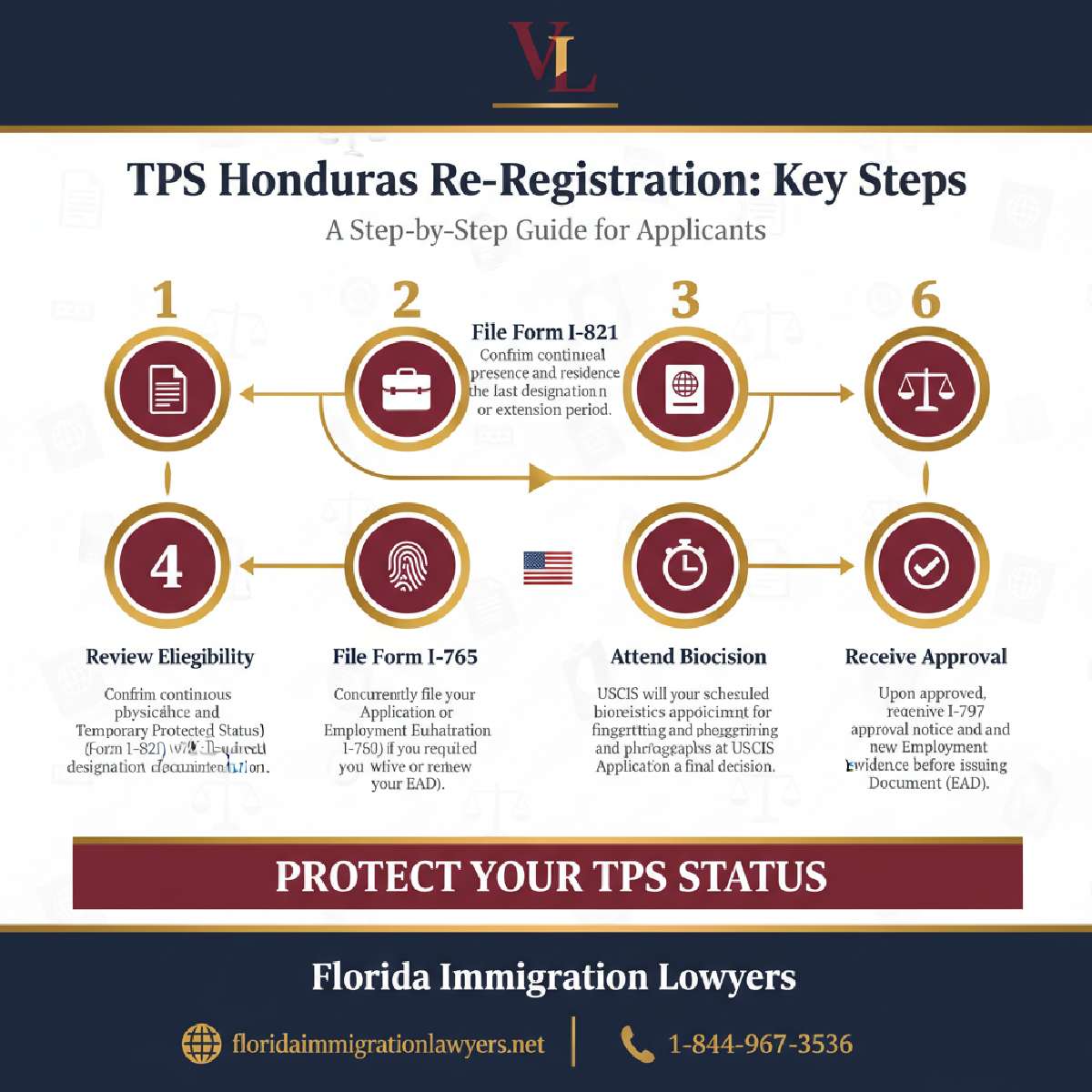
Step-by-Step Process Guide - ✓ Two passport-style photos: Ensure they meet USCIS specifications.
- ✓ Previous TPS approval notice (Form I-797): If you have one.
- ✓ Previous Employment Authorization Document (EAD): If you have one.
- ✓ Marriage certificate and birth certificates of dependents: If applying for family members.
Remember that all foreign language documents must be accompanied by a certified English translation. Failing to provide accurate translations can lead to requests for evidence (RFEs) and delays in your case. Our team at Florida Immigration Lawyers can assist with document preparation and translation requirements.
TPS Processing Times and What Florida Beneficiaries Can Expect
Understanding the timeline for your TPS Honduras extension 2026 application is important, but it's also crucial to manage expectations. USCIS processing times can vary significantly based on the volume of applications, the specific service center handling your case, and the complexity of your individual application.
After submitting your application package, you will typically receive a receipt notice (Form I-797C) within a few weeks. This notice confirms that USCIS has received your application. Following this, you will receive an appointment notice for biometrics collection at an Application Support Center (ASC) in Florida, such as those in Miami, West Palm Beach, or Jacksonville.
Processing times for TPS applications can range from several months to over a year. During this period, your existing EAD may be automatically extended by a Federal Register notice, allowing you to continue working. It's essential to keep copies of these notices with your expired EAD for presentation to employers.
You can check the general processing times for Form I-821 and Form I-765 on the USCIS website by selecting your form type and the service center processing your application. Be aware that litigation-driven extensions often come with their own unique processing advisories, so always refer to the latest Federal Register notices and USCIS guidance.
Do not navigate this process alone. The complexities of immigration law, especially with ongoing litigation affecting TPS, require expert guidance. Contact Florida Immigration Lawyers today to ensure your application is strong and complete. We serve clients across all of Florida, from Miami to Pensacola, providing dedicated legal support.
Cost Factors: Understanding TPS Application Fees
Applying for the TPS Honduras extension 2026 involves certain fees that you must be prepared to pay, unless you qualify for a fee waiver. These fees are set by USCIS and are subject to change, so always check the most current fee schedule on their official website before filing.
The primary fees associated with TPS re-registration typically include:
- Form I-821, Application for Temporary Protected Status: There is generally no fee for filing this form for re-registration, but this can change.
- Form I-765, Application for Employment Authorization: A fee is usually required for this form if you are requesting an EAD.
- Biometrics Services Fee: This fee is mandatory for all applicants unless specifically waived.
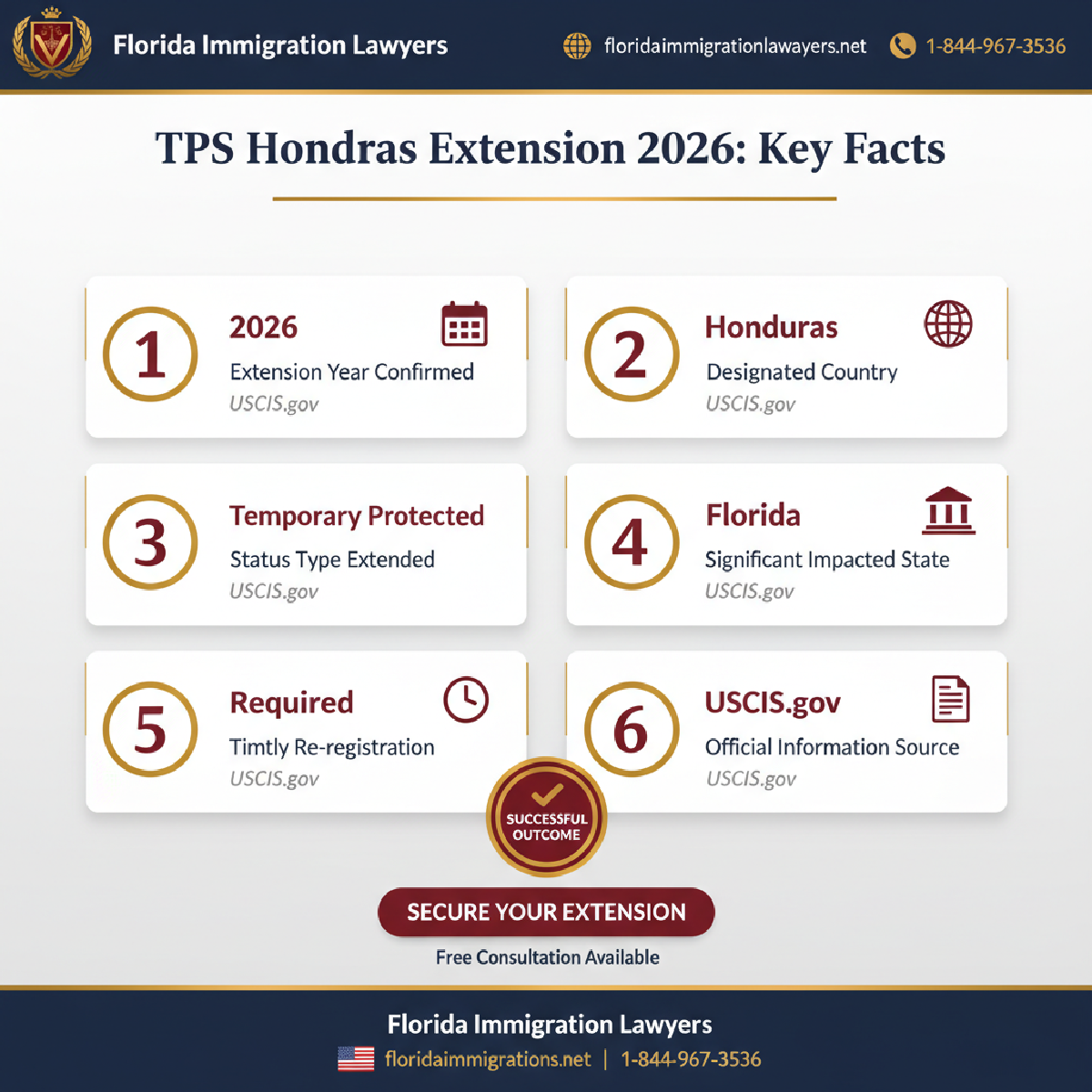
It is crucial to submit the correct fees. If you submit an incorrect amount, USCIS may reject your application, causing significant delays. For individuals facing financial hardship, it may be possible to apply for a fee waiver by filing Form I-912, Request for Fee Waiver. Eligibility for a fee waiver is based on specific income guidelines or receipt of means-tested benefits.
Beyond USCIS filing fees, you should also consider potential legal fees if you choose to hire an immigration attorney. While these are additional costs, the expertise provided by Florida Immigration Lawyers can be invaluable, helping you avoid common mistakes and increasing the likelihood of a successful application. We offer a free consultation to discuss your specific needs and potential costs.
Common Mistakes to Avoid During Your TPS Renewal
Renewing your TPS can be a straightforward process, but common errors can lead to delays or even denial. Avoiding these pitfalls is crucial for maintaining your status, especially with the complexities surrounding the TPS Honduras extension 2026.
- Failing to Re-register on Time: Missing the designated re-registration period is one of the most common and critical mistakes. Unless you have a compelling reason and can prove it, late filing can lead to denial.
- Submitting Outdated Forms: USCIS frequently updates its forms. Using an old version will result in rejection. Always download the latest forms directly from the USCIS website.
- Incomplete or Inaccurate Information: Any missing fields or incorrect data on your forms can cause significant delays. Double-check all information before submission.
- Incorrect Fees: Submitting the wrong fee amount, or forgetting a fee, is a common reason for application rejection. Always verify the current fees on the USCIS website.
- Lack of Sufficient Supporting Documentation: Failing to include all required evidence of identity, nationality, continuous residence, and continuous physical presence can lead to Requests for Evidence (RFEs) or denial.
- No Certified Translations: Any document not in English must be accompanied by a complete and certified English translation. Without it, the document is not valid for USCIS purposes.
- Ignoring Biometrics Appointments: Missing your biometrics appointment without rescheduling can lead to the abandonment or denial of your application. These appointments are mandatory.
- Failure to Update Address with USCIS: If you move, you must inform USCIS within 10 days using Form AR-11. Failing to do so means you might miss important notices regarding your case.
- Not Keeping Copies of Everything: Always make copies of your entire application package, including forms, supporting documents, and fee receipts, before mailing it. This is your record.
- Providing False Information: Any attempt to provide fraudulent information can lead to severe immigration consequences, including denial, criminal charges, and future inadmissibility to the U.S.
- Not Seeking Legal Counsel for Complex Cases: If you have any criminal history, prior immigration violations, or complex travel history, attempting to file without legal advice can be detrimental.
When to Seek Professional Legal Assistance for Your TPS
While some TPS renewals may seem simple, the intricate nature of immigration law, especially concerning litigation-driven extensions like the TPS Honduras extension 2026, often necessitates professional legal help. Florida Immigration Lawyers are here to ensure your peace of mind and the security of your status.
You should strongly consider contacting our firm if any of the following scenarios apply to you:
- Your TPS was previously denied: If you have a history of denial, understanding the reasons and addressing them effectively is crucial for a successful re-registration.
- You have a criminal record: Even minor offenses can impact your eligibility for TPS. An attorney can assess your record and advise on potential waivers or defense strategies.
- You have traveled outside the U.S. without authorization: Unauthorized travel can be a complex issue for TPS holders and may jeopardize your status.
- You have prior immigration violations: Any past overstays, deportations, or other violations require careful legal analysis to ensure they do not prevent your TPS renewal.
- You are unsure about specific required documents: If you lack certain documents or are unsure how to prove continuous residence or physical presence, we can help you gather alternative evidence.
- You have received a Request for Evidence (RFE) or Notice of Intent to Deny (NOID): These notices require a timely and thorough response, which an attorney can expertly prepare.
- You want to explore other immigration options: Beyond TPS, you may be eligible for other forms of relief, such as family-based visas or asylum. We can assess your full immigration profile.
Our attorneys at Florida Immigration Lawyers are deeply familiar with the nuances of TPS law, including the ongoing litigation. We can provide you with a comprehensive assessment, prepare your application with meticulous care, and represent your interests before USCIS. Protecting your future in Florida is our priority.
Frequently Asked Questions About TPS Honduras Extension 2026
Will TPS be extended in 2026?
While a definitive, new statutory extension for TPS in 2026 has not been enacted, the status for beneficiaries from Honduras (and several other countries) is currently protected by federal court orders stemming from the Ramos v. Nielsen litigation. These orders have temporarily prevented the termination of TPS, leading to automatic extensions of status and Employment Authorization Documents (EADs) through Federal Register notices. It is highly probable that these litigation-driven extensions will continue into 2026 as the legal process unfolds. Beneficiaries should monitor USCIS announcements and consult with an immigration attorney for the most current information, as laws and court decisions can evolve.
Is TPS for Honduras going to be extended?
Yes, TPS for Honduras is currently extended due to federal court litigation. The Department of Homeland Security (DHS) has published Federal Register notices that automatically extend the validity of TPS-related documentation for Honduran beneficiaries. This protection is a direct result of the preliminary injunctions issued in the Ramos v. Nielsen case, which halted the planned termination of TPS for Honduras. These extensions typically last for specified periods, and further extensions are anticipated as the litigation continues to be resolved. It is crucial for beneficiaries to check the latest USCIS guidance and Federal Register notices for specific validity dates and re-registration instructions.
Can TPS Honduras still work till November 18th, 2025?
The ability of TPS Honduras beneficiaries to work and their EAD validity dates are directly tied to the Federal Register notices issued by DHS in response to the Ramos v. Nielsen litigation. While previous notices may have extended EADs to certain dates, including November 18, 2025, it is imperative to refer to the most recent official announcements. For example, a Federal Register notice published in late 2023 extended EADs for Honduran TPS beneficiaries through June 30, 2024. Subsequent notices are expected to provide further extensions. Always consult the latest USCIS updates or an immigration attorney to confirm your specific EAD validity and work authorization dates.
When was TPS cancelled for Honduras?
The Trump administration announced the termination of TPS for Honduras in 2018, with an effective date originally set for September 2019. However, this termination never fully took effect due to the federal lawsuit Ramos v. Nielsen. A preliminary injunction was issued by the court, preventing DHS from implementing the termination. As a result, TPS for Honduras has remained continuously valid, with its termination enjoined by court order. Therefore, while there was an attempt to cancel it, TPS for Honduras was not effectively terminated and continues to be extended through litigation-driven notices.
What is the status of the TPS Honduras lawsuit?
The lawsuit, primarily Ramos v. Nielsen (which later saw related cases like Bhattarai v. Nielsen), is ongoing. This litigation challenges the Trump administration's decisions to terminate TPS for several countries, including Honduras. While there have been appeals and legal maneuvers, the preliminary injunction preventing the termination of TPS for these countries remains largely in effect. This means that until a final resolution is reached in the courts, TPS beneficiaries from Honduras continue to have their status and associated benefits, such as work authorization, automatically extended through recurring Federal Register notices issued by DHS. The legal process can be lengthy, so continued monitoring is essential.
How do I re-register for TPS in Florida?
To re-register for TPS in Florida, you must typically file Form I-821, Application for Temporary Protected Status, and Form I-765, Application for Employment Authorization (if you need a new EAD), with USCIS during the designated re-registration period. You will also need to pay the required fees or apply for a fee waiver and provide supporting documentation proving your identity, nationality, and continuous residence and physical presence in the U.S. It is crucial to use the most current forms from the USCIS website and mail your application to the correct filing address. For complex cases or to ensure accuracy, consulting an immigration lawyer at Florida Immigration Lawyers is highly recommended.
Can I travel outside the U.S. with TPS Honduras?
Traveling outside the U.S. with TPS requires careful planning and authorization. You must obtain an Advance Parole Document (Form I-512) from USCIS before you depart. Traveling without advance parole can lead to serious immigration consequences, including the termination of your TPS status and potential inadmissibility upon your return. Even with advance parole, re-entry is not guaranteed, as Customs and Border Protection (CBP) officers at ports of entry have the final say. Always consult with an experienced immigration attorney before making any international travel plans if you hold TPS, especially given the ongoing litigation that affects Honduran TPS.
What happens if the TPS Honduras lawsuit is ultimately lost?
If the Ramos v. Nielsen lawsuit is ultimately lost and the preliminary injunction is lifted, the termination of TPS for Honduras would likely proceed. This would mean that Honduran beneficiaries would lose their TPS status and associated benefits, including work authorization, after a wind-down period. During this period, individuals would need to explore other immigration options, such as family-based visas, asylum, or other forms of relief, to avoid becoming undocumented. This is why it is critical for beneficiaries to consult with an immigration attorney at Florida Immigration Lawyers now to understand all potential pathways and prepare for different outcomes, ensuring their future in Florida.
About Florida Immigration Lawyers
Florida Immigration Lawyers is a leading law firm dedicated to providing comprehensive and compassionate immigration legal services across the entire state of Florida. From Miami to Jacksonville, Orlando to Tampa, and everywhere in between, our experienced attorneys are committed to helping individuals and families navigate the complexities of U.S. immigration law.
We specialize in a wide range of immigration matters, including Temporary Protected Status (TPS), asylum, deportation defense, citizenship, family-based immigration, and business immigration. Our firm is proud to offer bilingual services in English and Spanish, ensuring that you receive clear and effective communication throughout your legal journey.
Why choose Florida Immigration Lawyers? We offer personalized attention, strategic legal counsel, and a deep understanding of federal immigration policies and local court procedures relevant to Florida. Our commitment to our clients is unwavering, and we strive to achieve the best possible outcomes for your case.
We understand that immigration issues can arise at any time, which is why we are available 24/7. Contact us today for a free consultation to discuss your immigration needs. Call us at 1-844-967-3536 or visit our website at https://www.floridaimmigrationlawyers.net to learn more about how we can help you.
This article is for general informational purposes only and does not constitute legal advice. Immigration laws change frequently. For advice specific to your situation, please consult with a qualified immigration attorney.
The future of your immigration status is too important to leave to chance. With the ongoing legal developments surrounding the TPS Honduras extension 2026, having a knowledgeable and dedicated legal team by your side is essential. Florida Immigration Lawyers are here to provide the clarity and support you need.
Do not delay in seeking expert legal guidance. Protect your right to live and work in Florida. Call Florida Immigration Lawyers today at 1-844-967-3536 for your free, confidential consultation. Let us help you secure your future.
Florida Immigration Lawyers
Legal Team
Our experienced attorneys at Florida Immigration Lawyers have been serving clients across Florida for over 20 years. We specialize in immigration, personal injury, criminal defense, workers compensation, and family law.